Live Love Laugh Learn … Create the possibilities

Category: Creativity

  • readilearn: Celebrating Christmas in the classroom

    As December draws nigh, thoughts all over the world turn to celebrations of Christmas, a time for spreading joy through sharing acts of friendship and kindness to others.

    Those of us in the Southern Hemisphere are also thinking about finalising the school year and taking a much-deserved long summer break.

    Before we do, we look for ways of celebrating Christmas in the classroom while maintaining children’s focus and keeping them engaged in meaningful learning until the final moments of the school year.

    While there are a variety of readilearn resources already existing to help you do that, this week I have uploaded four more, all of which support use of the popular interactive digital story Who’s hiding at Christmas?

    Who's hiding at Christmas template

    The Who’s hiding at Christmas -template is a printable resource with both template and instructions for children to make their own Who’s Hiding at Christmas book based upon the original. Children love to share their own Who am I? puzzles, and, as well as providing ongoing practise with both reading and writing skills, the booklets make a lovely gift for sibling or parent.

    Continue reading: Celebrating Christmas in the classroom

  • How important is perfection?

    Are you a perfectionist? If so, in what areas?

    I think it would be difficult to be a perfectionist in everything, indeed, in anything.

    I have never considered myself to be a perfectionist, though others have occasionally labelled my attitude to work that way. I do have certain standards that I like to meet, and I always strive to attain them, to do the best I can. I concede that my expectations of spelling, grammar and punctuation correction may tend towards perfection, but if I can, why would I not? Of course, the occasional imperfection will slip through. It is difficult to catch all when we are editing and proofing our own work. However, if I spot any, I will quickly change them, embarrassed that I let them escape.

    There are many areas in which I am far from a perfectionist – especially housework. I’ll do what needs to be done, but only if I must; and my idea of need may differ vastly from yours. I am often reminded of my mother’s words when I’d completed a household chore; for example, sweep the steps, when I was a child. She’d comment that I’d given it a “lick and a promise”. These days, housework rarely gets more than a promise, a promise I’m not good at keeping.

    As a teacher of young children, it was not perfection I was looking for in their work, but for the best they could do. I expected their work to reflect their development. If they were capable of the calculation, spelling or of using the correct punctuation, I expected them to use it. Opportunities to revise answers and responses were given and improvement was encouraged.

    I’ve hedged around this topic a few times in posts; such as, Is contentment compatible with a growth mindset? The end, Phrasing praise and What is failure.

    But how do we decide when good enough is good enough and that we have put in as much effort as the task requires? I know there are many who agree with me about housework, but what about other things; maybe like, hanging a picture, following a recipe, parking a car, making a payment, checking copyright, or painting a room?

    I recently watched a TED Talk by Jon Bowers entitled We should aim for perfection and stop fearing failure. Bowers provides some different perspectives on the topic of perfectionism, challenging an adjustment to thinking.

    He begins by discussing typos. We’ve all made them, haven’t we? The seemingly innocuous typo can give us a good laugh at times. But it can also do a lot of damage.

    Bowers tells us that “one little typo on Amazon’s supercode produced a massive internet slowdown that cost the company over 160 million dollars in the span of just four hours”, and “an employee at the New England Compound, which is a pharmaceutical manufacturer, didn’t clean a lab properly and now 76 people have died and 700 more have contracted meningitis.”

    Bowers says,

    “When did we come to live in a world where these types of typos, common errors, this do-your-best attitude or just good enough was acceptable? At some point, we’ve stopped valuing perfection, and now, these are the type of results that we get. You see, I think that we should all seek perfection, all the time, and I think we need to get to it quick.”

    traffic

    He talks about the need for perfection when behind the wheel of a vehicle. How many lives are lost daily through inattention, through lack of perfection?

    credit card

    He talks about the need for credit card manufacturers to demand perfection. How would it be if even 1% of our credit cards didn’t work properly?

    book

    He says that “if the Webster’s Dictionary was only 99.9 percent accurate, it would have 470 misspelled words in it.  If our doctors were only 99.9 percent correct, then every year, 4,453,000 prescriptions would be written incorrectly, and probably even scarier, 11 newborns would be given to the wrong parents every day in the United States.”

    He goes on to make many other statements that I’m sure will get you thinking too. At less than 11 minutes in length, the time commitment is far less than the potential learning gain.

    When I watched this video, I was contemplating my response to this week’s flash fiction prompt set by Charli Mills at the Carrot Ranch. Charli shared a “possibly spam” email received as an entry into the Carrot Ranch Rodeo Contest #2: Little and Laugh. You can read the email in Charli’s post, which also includes the challenge to In 99 words (no more, no less) write a fictional story about The Real Nanjo Castille. (The spammer).

    I thought the email to be a little too clever to be real spam, too many clever word choices, phonetic spellings, and our favourite: bitchcoin, that could be purchased for ten dollars, $20 or £20. And the poor writer has an identity crisis, not sure whether to spell his or her name Nanjo or Najno.

    I wondered about how the performance of this child in school might be viewed and what profession might be suggested as a goal.

    This is my response. I hope you enjoy it.

    A job for Nanjo?

    The parents waited.

    Start positive, she reminded herself.

    “Nanjo has a wonderful imagination.”

    They smiled.

    “Very creative too, especially with spelling and punctuation.”

    They exhaled.

    “Has trouble understanding money though, and his knowledge of number facts is non-existent – “ she hesitated, then continued quietly. “I can’t think of any employer who’d have him.”

    “Pardon?”

    “I mean, employment, suited to his – ah – special skills.”

    She cracked.

    “I’m sorry. Your son is unemployable. His spelling and grammar is atrocious. He can’t even spell his own name, for god’s sake! I don’t think he could even get a job as a spammer!”
    Make sure to check the results of Contest #2 at the Carrot Ranch. I’m not the winner. Nor is it Nanjo. Could it be you?
    Thank you for reading. I appreciate your feedback. Please share your thoughts.

  • Never Too Many Cooks:  Literary Recipes in a Flash

    Never Too Many Cooks: Literary Recipes in a Flash

    How is cooking like writing?
    One’s a feast for the body, the other a feast for the mind. For some great flash fiction to get your teeth into (including one of mine!) read on:

  • Winner of Flash Fiction Rodeo Contest #1

    I am delighted to announce the winner of my flash fiction contest “When I grow up”. Judging was a tough job, but we got there in the end.
    Charli has made a lovely badge for contestants to put on their blogs. Check it out when you check out the winners.
    Thanks for a fabulously fun rodeo, Charli.

  • Let’s read, write and spell with Schuyler: readilearn

    I don’t normally post twice a week, but this post is really an addendum to the previous post What’s in a name? Teaching phonics, syllabification and more! so I decided to break with tradition and share it.

    For the inspiration for this post and the resource it describes, I must thank Pamela Wight, who featured in the author interview last month.

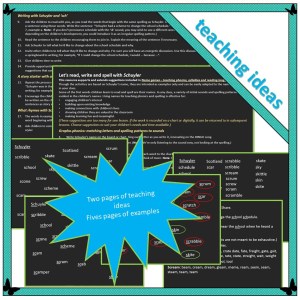
    In commenting on the What’s in a name? post, Pamela mentioned the awkwardness of singing and spelling her grandson’s name – Schuyler, a name with which I was unfamiliar. I joked to Pamela that I’d thought of recording a few names, innovating on the tune of BINGO, to show how “easy” it might be. Pamela suggested I should, even though I explained that my singing voice is anything but, and she told me the pronunciation for Schuyler: Skylar. Well, I couldn’t help myself. My head started racing with ideas of incorporating Schuyler’s name into reading and writing lessons teaching phonics and spelling skills. The result is the resource Let’s read, write and spell with Schuyler,

    and the recording.

    Continue reading: Let’s read, write and spell with Schuyler: readilearn

  • Flash Fiction Rodeo #6

    Another contest in the Carrot Ranch Flash Fiction Rodeo. This time it’s a lot of bull. Are you in?

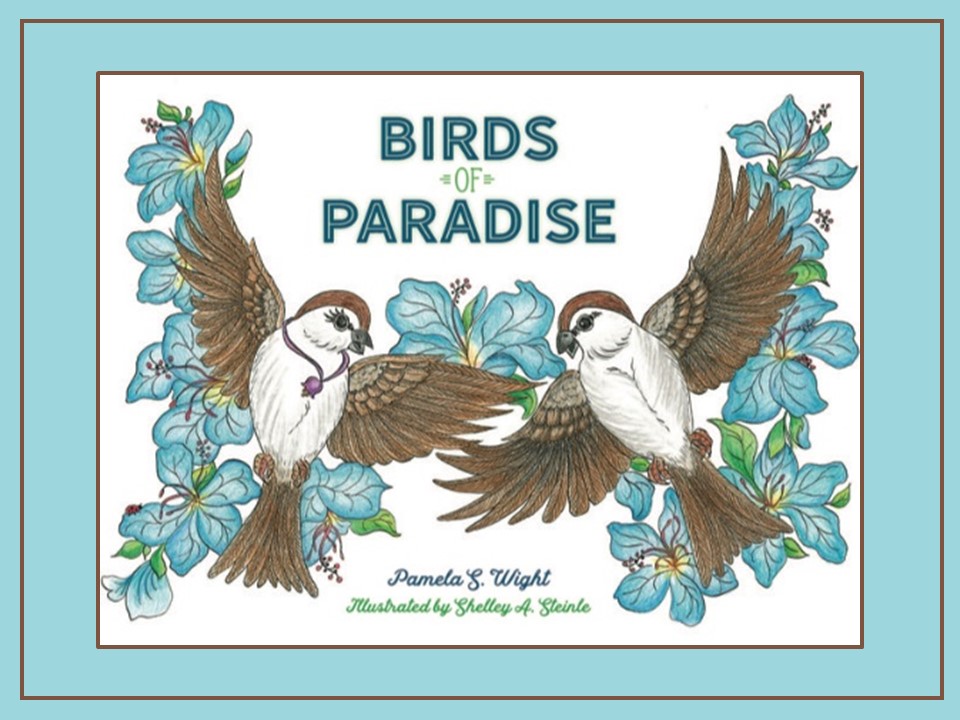
  • readilearn: Introducing Pamela S. Wight, author of Birds of Paradise – Readilearn

    In the author spotlight this month is Pamela S. Wight, a fellow blogger, writer, and teacher of creative writing. I enjoy the stories of life Pamela shares on her blog Rough Wighting, and also enjoyed reading her adult novels. But it was the story of how this picture book Birds of Paradise came to be, a picture book 35 years in the making, that really captivated me. I knew I wanted to share it with you. Before we start talking about the book, though, let me introduce you to Pamela.

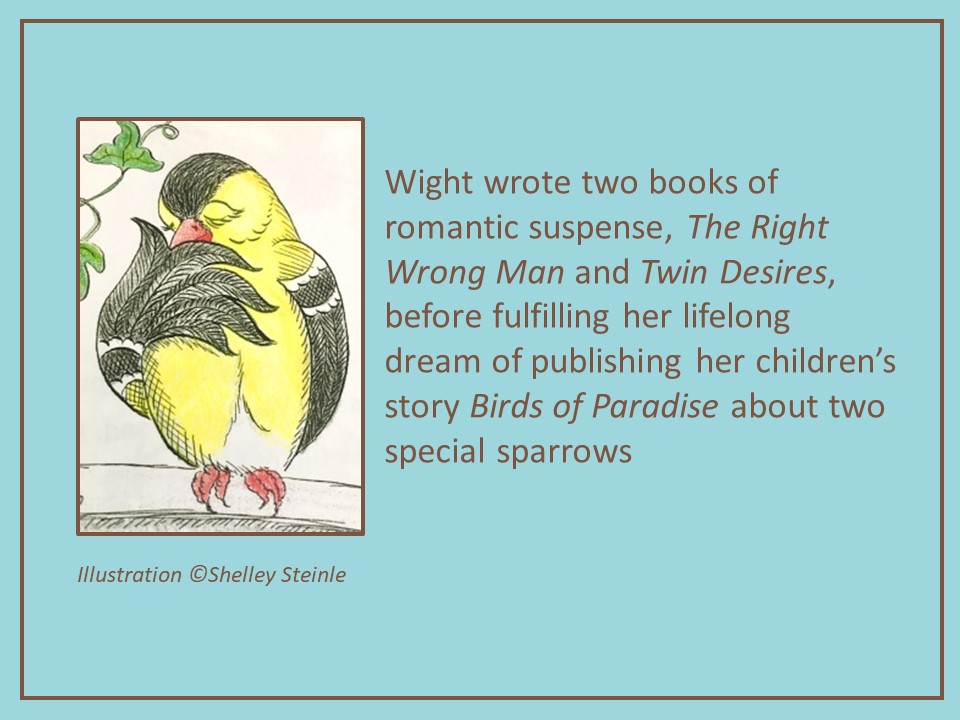
    yellow bird Pamela Wight

    Pamela Wight has joined the ranks of authors who are, as she calls it humorously “bi-genre” or “ambi-writers.” Think of Ian Fleming, who yes, wrote the James Bond books, but also switched genres and wrote the children’s book Chitty Chitty Bang Bang. Before A.A. Milne wrote the Winnie-the-Pooh books, he penned a popular whodunit entitled The Red House Mystery.

    Wight wrote two books of romantic suspense, The Right Wrong Man and Twin Desires, before fulfilling her lifelong dream of publishing her children’s story Birds of Paradise about two special sparrows.

    About the story:

    Birds of Paradise

    Sweet sparrows Bessie and Bert grow up as differently as night and day. Bessie is fearful of the dangers inherent in being a bird. She’s scared to leave her cozy branch. But Bert relishes flying in the sky and

    continue reading: readilearn: Introducing Pamela S. Wight, author of Birds of Paradise – Readilearn

  • Flash Fiction Rodeo Contest #5

    And now for something completely different!
    Got some time to fritter away? Try Twitter Flash Fiction in the Carrot Ranch #FFRODEO

  • STEM in early childhood classrooms – readilearn

    Making space for STEM in early childhood classrooms is easy; or should be.

    Children are naturally curious about the world. They want to know:

    • Why is it so?
    • How does it work?
    • What will happen if?
    • How can I?

    It is important to harness their curiosity, explore their questions, engage their interests and inspire their imaginations.

    Provide them with opportunities to investigate objects and phenomena in the world around them. Don’t always be in a rush to provide answers to their questions. Help them explore ways of finding the answer for themselves, if possible, or conduct the research with them.

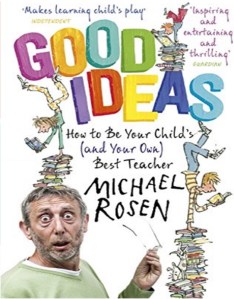
    A story reported by Michael Rosen in his book Good Ideas: How to Be Your Child’s (and Your Own) Best Teacher inspires me. The story explains that, as a child, David Attenborough took an interest in bones. If he was out walking and found some bones, he would take them home and ask his father about them.

    His father, who was a GP and would have known, didn’t just tell him. Wanting his son to be curious and interested in finding things out for himself, he responded, for example: “I wonder if we can work it out . . .” They would then look through books about zoology and anatomy and try to identify the bone’s origin.

    However, the answers don’t always have to be found in a book or on the internet. Some answers can be discovered through explorations and experimentation. Experts can also be consulted.

    In a stimulating early childhood classroom where children have access to a range of resources and opportunities

    Continue reading: STEM in early childhood classrooms – readilearn

  • Flash Fiction Rodeo Contest #2

    My Contest #1 in the Carrot Ranch #FFRODEO is now closed. Thank you to everyone who entered. I’ll be able to start reading tomorrow. Yippee!
    Today the second of the contests kicks off. You are required to make the judges laugh in 300 words! And you have only until Friday (13th) to do it! I hope you enter. Get those laughing pens ready! Good luck!