Live Love Laugh Learn … Create the possibilities

Category: Creativity

  • Let them play!

    GDJ, Playful stick figures https://openclipart.org/detail/230070/playful-stick-figure-kids
    GDJ, Playful stick figures https://openclipart.org/detail/230070/playful-stick-figure-kids

    Play is essential to learning, and creating an environment which allows for play while nurturing children’s learning and development is as important as creating an environment that nourishes and encourages the growth of plants in a garden. The link between the two was first recognised by Froebel in the early 19th century when he coined the term “kindergarten” which translates to “garden for children” (kinder meaning child and garten meaning garden), and created the first educational toys.

    Froebel “devoted his life to educating children and developing methods to maximize human potential”. He was the first to recognise the importance of a child’s early years (birth to three) and considered creativity to be something in all of us.

    Froebel’s kindergartens were the first “formal” education for young children and his work greatly influenced that of other educators such as Maria Montessori and Rudolf Steiner. His beliefs, for example that children have both unique needs and capabilities are still influential today. He believed in the importance of play and some of his toys were favourites of people such as Buckminster Fuller and Albert Einstein.

    I have touched on the topics of playcreativity and children’s uniqueness in previous posts. A respectful, encouraging, nurturing and stimulating environment underpins all that I value in education; as does a belief in the power of play to develop understandings of self, of others and relationships, of the world and how things work, and to inspire thoughts of what could be, to imagine possibilities never before imagined.
    johnny_automatic_playing_dress_up

    While Froebel’s beliefs, and those of his followers, are still valid, sadly they are often disregarded by those who wield the power in education, who dictate otherwise.

    In a previous post I shared an article by Paul Thomas who attributed his readiness to learn at school to the richness of his home environment. He also decried the formal tedium of school lessons which contribute much to curbing a child’s enthusiasm for learning. Paul is not alone in his views. There are many teachers who agree with him, myself included, as I have shared many times before, including here and here.

    I am not the only early childhood teacher to be saddened and appalled by the formal approach that has been enforced upon teachers, replacing play-based approaches in classrooms for children as young as four. With the administration of standardised tests and the publication of graded results, children are labelled successes or failures before they have had a chance to develop. Those children from privileged backgrounds, as described by Thomas in Formal Schooling and the Death of Literacy will be immediately successful. Those from less advantaged backgrounds will be labelled failures. Unfortunately, the labels are often reinforced with little chance of replacement.
    A+   F

    I am always gladdened when I hear another expounding the benefits of play and the importance of child-centred approaches to learning and teaching. I hope that when enough voices unite in this important message, the tide will start to turn, and those with the power to make changes will do so in favour of children.
    the importance of being little

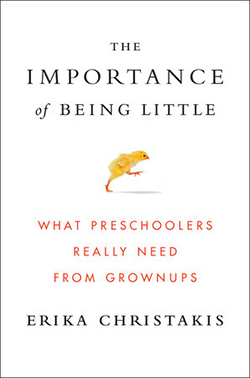
    This week I read another article stressing the importance of play for young children. The article, written by Susan Gonzalez for Yale News, introduces a recently published book by Erika Christakis The Importance of Being Little. I have not yet read the book, but I know that I will agree wholeheartedly with its content. The title itself tells me the value of its message.
    © Norah Colvin
    © Norah Colvin

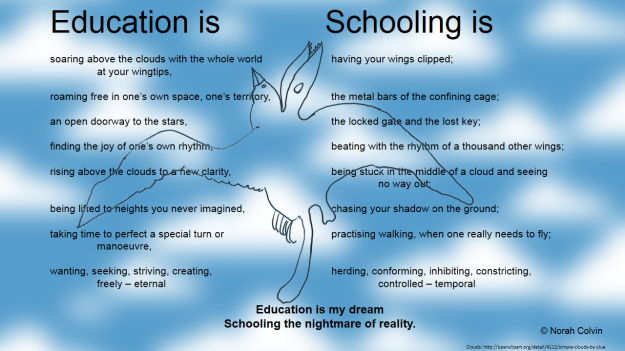
    In words reminiscent of my poem “Education is” Christakis says that “schooling and learning are often two different things.” Here is just a sprinkling of her thoughts reported in the article.

    • children are capable and powerful but our expectations are often mismatched
    • we ask too much of children pragmatically but not enough cognitively
    • there is too much teacher-direction and not enough time for play in many preschool classrooms
    • teachers need to take the time to listen to children’s stories, to laugh with them, to get down on the floor, at their eye level, and figure out what makes them tick … (through) … respectful observation
    • childhood pedagogy should be based on ideas, not on the repetition of simple skills
    • respect for early childhood as a life stage worthy in its own right and not merely as a training ground for an adult future

    These are ideas I have oft repeated here on my blog. Please read the article in full and, if you are as inspired as I am, read the recently published book The Importance of Being Little. I’d love to know what you think.

    Thank you

    Thank you for reading. I appreciate your feedback. Please share your thoughts.

  • Scary monsters

    https://openclipart.org/detail/170917/little-monsters
    https://openclipart.org/detail/170917/little-monsters

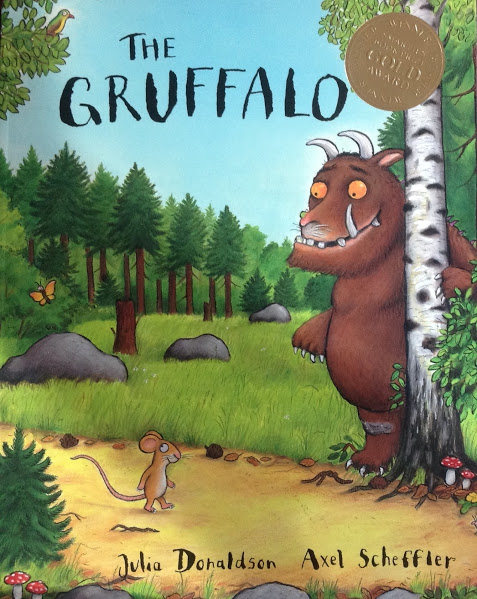
    This week at Carrot Ranch Communications Charli Mills has challenged writers to In 99 words (no more, no less) write a monster story.  Being an early childhood teacher I think immediately of picture books. Two of my favourites are The Gruffalo, written by Julia Donaldson and illustrated by Axel Scheffler, and The Monster at the End of this Book , written by Jon Stone and illustrated by Michael Smollin.

    The Gruffalo

    The Gruffalo is as fearsome as any monster you are likely to meet with its “terrible tusks, and terrible claws, And terrible teeth in his terrible jaws”; “a poisonous wart at the end of his nose” and “purple prickles all over his back”. The quick witted mouse, who imagines the Gruffalo into storybook “reality”, must find a way of ridding himself of the monster’s inherent danger and once again uses his ingenuity to escape.

    I’m not sure if it was Donaldson’s intention, but I think this is a great analogy for the monsters we create for ourselves such as self-doubt, unrealistic expectations, and (you can add your own monster here). Not that I’d be sharing that thought with young children.

    In this video Axel Scheffler explains his concept of the Gruffalo and even hints, a couple of times, that he too may be troubled by that all too common of personal monsters, self-doubt.

    Monster at the end of this book

    Throughout The Monster at the end of this Book Grover, from Sesame Street, pleads with the reader to not turn the page as there is a monster at the end of the book. You could almost say he is immobilised by this fear, or that he tries to immobilise the reader. Of course it is a lot of fun and provides much laughter. When we (reader and Grover) do get to the end of the book, he is rather embarrassed to find that he, “lovable, furry, old Grover” is the Monster. He tries to assure us that we, and not he, were the scared ones.

    Of course Grover wasn’t the monster only at the end of the book. He was always the “lovable, furry” harmless monster. It was his fear that was the real monster. How often are we immobilised by our fear, and how often when we take that jump despite it, do we find our fears to be groundless? Sometimes I think, or is it only me, we are our own worst monsters setting ourselves impossible targets with too-high expectations that lead us only to disappointment if we don’t achieve them.

    But if we view ourselves as works in progress, in the process of working out where we want to be and how to get there, we can find contentment in what we achieve along the way, in where we are and how far we have come, rather than ignoring those milestones and looking only at how much further we must (in our own minds) go.

    It is all too easy to contribute to the development of children’s personal monsters by doing to them what we do to ourselves: setting unrealistic targets, expecting too much, insisting on error-free work, measuring them against external benchmarks … To avoid this, we need to view them also as works in progress and encourage them, through a growth mindset, to reach their own milestones and goals in the time that is right for them.

    Like the mindset of the mouse in The Gruffalo who was able to think on his feet and overcome the obstacles, or that of Grover who realised there was really nothing to be worried about at all.

    We need to be not afraid of the monsters under the bed or in the cupboard, most of which we have created in our imaginations and stuffed there, sometimes with the assistance of others, allowing them to multiply like wire coat hangers until there is no room left for anything good. I have taken the theme of internal monsters for my response to Charli’s challenge.

    Open, close them, open anew

    The picture was clear. Taken with wide open shutters and long exposure, then developed in black and white for extra clarity, the result was undeniable and exactly what would be expected.

    “You’ll never amount to anything.”

    “That’s rubbish.”

    “Pathetic.”

    “You’re always the troublemaker.”

    “Because I said.”

    “Shut up!”

    “Stop asking questions.”

    An existence devoid of value was drilled with reminders hurled unrelentingly from birth. Well-schooled in self-loathing, the lessons were regurgitated without effort or question. The monsters without had created the monster within. How could one escape from what was recognised only as truth?

    And now for something a little lighter:

    The Monster Mash

    Thank you

    Thank you for reading. I appreciate your feedback. Please share your thoughts.

  • Writing poetry with children

    Horses go galloping

    This week at the Carrot Ranch Charli Mills has challenged writers to write about galloping. What keeps replaying in my head is the phrase “The horses go galloping, galloping, galloping” interspersed with the lines from “The Highwayman” by Alfred Noyes, a poem I learned at school.

    The Highwayman came riding, riding, riding,

    The Highwayman came riding, up to the old inn-door.

    tomas_arad_heart

    Learning poems at school was a joy. I love poetry and, in younger years, used to read a lot of it, less currently. Perhaps I should say I loved poetry, but that would unfair, just as it would be unfair to say that I no longer love an old friend that I haven’t seen for years, for at the moment we meet up again the connection is just as strong as ever, the ties never broken.

    Oftentimes when I read Charli’s challenges I know how I will respond immediately. Other times I need to massage the idea until I hit just the right spot. This time the horse has bolted and the paddock is left empty without a horse in sight. All I’m left with are my thoughts of poetry.

    Fortunately, as an early childhood teacher with a love of picture books, recent years haven’t been completely devoid of the poetic form. While not necessarily written in what might be considered “poetic language”, many are written in rhythmic rhyming verse. Others contain verses within the story, such as the refrain in The Gingerbread Man or the song in Love You Forever by Robert Munsch.

    The gingerbread man

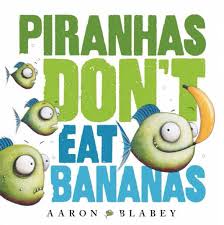
    A title recently added to my list of favourites, through repeated readings and recitations by my grandchildren, is Piranhas Don’t Eat Bananas by Australian author Aaron Blabey. Its rhythm, rhyme and sense of fun is an absolute joy. We laughed together at every reading by G1, and every recitation by G2. It begs to be read and re-read, recited and recited again. Sadly, I got to read it aloud only once, and even then not all the way through! “Hey,” I protested in vain. “I like to read picture books too!

    piranhas don't eat bananas

    Of course there are also many books of poems and rhymes written for children, including Nursery Rhymes, though many of those weren’t written with children in mind. There are also some that fit into a horsey theme such as

    In addition to reading poems and stories to my class I also enjoyed writing poems with them. At this early childhood stage the poems would be more rhythmical verse, sometimes rhyming and sometimes not, with only the hint of an introduction to poetic language.  I have previously written about writing our versions of I Love the Mountains, a traditional camping song.

    I have also written some resources for supporting teachers when Writing Christmas poems with early childhood students. These are available in my Teachers Pay Teachers store and soon to be included in readilearn resources. With easy-to-follow structures, writing these poems give children immediate boosts to their writing confidence.

    I had been thinking for a while that I should write some new versions suited to other times of the year, but hadn’t prioritised it. However, when I read Rowena Dreamer’s post Mr’s Poem: Through My Window on her blog beyondtheflow, another idea sprang to mind. Rowena discussed the writing of a poem “Through my window” that had been set as homework for her son.  I immediately thought of the sound poems that I had taught my students and wondered if the structure could be adapted for sight poems.

    The structure of a sound poem

    This is what I came up with:

    I saw as I looked through my window

    You’ll notice that I haven’t exactly maintained the structure. This is what happens, particularly when young children are writing their versions. It is to be expected and accepted. The purpose of the structure is to support, not restrict.

    I then wondered if it could be used with the other senses and, at the same time, realised that four verses, four senses, would just about reach the target of Charli’s challenge to In 99 words (no more, no less) write a story about galloping. With no other ideas galloping into view, how could I resist giving it a go?

    Disappointingly, I found the structure less accommodating for smell and taste, and had difficulty in conjuring different words to use for each. For example, I wanted to smell and taste the freshness of bread and the sweetness of apples. I had thought touch would be more difficult but have realised that’s not the case. The repetition of the word “felt” for both touch and emotion is perhaps not ideal though.

    I would love to say more here about the necessity for teachers to experiment before setting tasks for children, and of the value of learning from the process rather than the product, but I think I’ve probably said enough in this post.  I will just share what I’ve written which, though responding to Charli’s challenge, doesn’t actually fit the criteria of flash fiction. However, if you’d be kind enough, I’d still love to know what you think.

    Market Day

    I heard

    as I sat curled with a book

    the thundering of hooves

    the snorting of nostrils

    the jangle of stirrups.

    I felt anxious.

    I saw

    as I looked through the window

    the horse at the gate

    the rider on the path

    the bag in his hand.

    I felt excited.

    I smelled

    As I opened the bag

    The freshness of bread

    The sweetness of apples

    The promise of coffee.

    I felt famished.

    I felt

    As I savoured my lunch

    The crunchiness of crusts

    The crispness of apple

    The warming of coffee.

    I felt satisfied.

    Yum! Fresh produce.

    Thank you

    Thank you for reading. I appreciate your feedback. Please share your thoughts.
     

  • Reflections on living a contented life, teaching and school

    In a previous post I introduced you to Pauline King, The Contented Crafter. In comments on my blog, Pauline revealed that she was a teacher so passionate about education that she had attempted to establish an alternative school. I was excited to discover that we have these things in common and I immediately invited her to share some additional thoughts about children, learning, schools and education.

    I am honoured that she has agreed, and delighted to welcome her here. In this post Pauline shares a little of her life journey, and her reflections on teaching and school. In a future post she will share her some of her wisdom about children and parenting.

    Pauline, please tell us a little about yourself. What things are most important to you? What do you hope to achieve through blogging?

    art of contentment

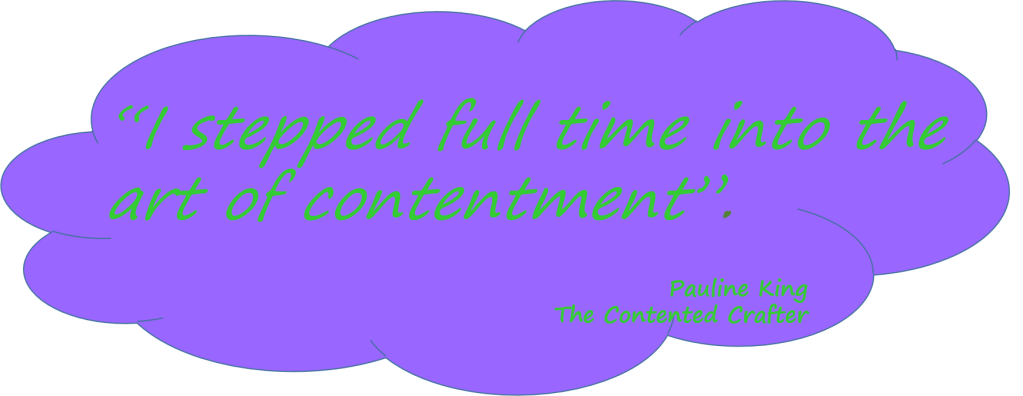
    I was a Steiner School Teacher for some twenty years, here in NZ and in the UK briefly.  It was a demanding vocation that taught me more than I ever imparted to the students in my care.  I left teaching in 2003, spent a year or so recovering my health and eventually took up life coaching – a kind of a natural segue as I had spent a lot of my time in the school system mentoring young parents and teachers. I retired in 2014 and stepped full time into the art of contentment.  It’s what I think I spent my life looking for and in these later years what I taught to the women who came to me for life guidance. 

    joy of blogging

    In my personal life I have always been a creator – hand work, interior design and decorating, gardening and various crafting and artistic outlets that changed over the years.  I took up blogging almost three years ago simply to keep track of my creative work as I was notorious for making stuff, giving it away and not being able to remember what I made or the processes around it.  I soon started using my blog as an on-line diary, documenting the things that amused or dismayed me along with whatever I was playing around with at the time.  I don’t think I really expected anyone to read my blog and was quite surprised when I got comments and returned visitors and followers.  In a surprisingly short time I discovered a new world that was peopled by like-minded souls and fun people and I kept blogging for the joy found in the community that built up around my little blog.

    I live alone in a tiny house with a Maine Coon called Olando and a Shi-Tzu X named Siddhartha [Siddy for short].

    positivity

    I live simply and contentedly, paying close attention to my own personal development and take responsibility for the events in my life.  I am not religious but view life and the planet from a spiritual outlook.  I study quantum physics, enjoy nature and believe in spreading positivity wherever I can.

    I don’t write about education in my blog – even though it is an area I am passionate [and opinionated] about – I simply don’t want it to impinge into the simple creative life I lead nowadays.

    Pauline, you were a teacher? What was it that attracted you to teaching in the first place?

    teacher

    I always wanted to be a teacher, from a very young age.  School was a safe place for me in a family that was damaged and dysfunctional, so I guess that may have been the genesis.  However, I was not allowed to stay in school and was put to work in a factory at the age of 14 [my mother lied about my age].  When I gained my freedom I set about continuing my education and have kept on learning formally and informally ever since.  I was 33, a wife and mother, before I finally achieved the goal I had as a child.

    What things did you love about teaching?

    art of teaching

    I loved being in the classroom – working with the students and the Steiner curriculum [which is a wise and clever thing].  Later when I side-stepped into too much administration and other non-teaching roles I simply dried up and eventually became ill.  That made me really conscious that it was the art of teaching that I really loved.

    You said that you spent many years attempting to establish an alternative school for your eldest daughter. Why was this important to you? What was lacking in schools available to you? How would your school differ?

    bloom and blossom

    My feeble attempts to start a school were short lived, I did not go as far as you did as there was little support or enthusiasm for my initiative.  Within two years I had discovered Steiner Education and serendipitously fallen head first into that with my two daughters.  Both began to bloom and blossom in ways they never had in the state system they were so briefly in and I soon transferred my interest and passion to that form of education.  I began an informal study under the auspices of a venerable old retired teacher and soon went on to study full time.  I think I was incredibly fortunate for throughout this time I was mentored and supported by several practising teachers, and one wonderful head lecturer who went out of his way to keep pouring his wisdom into my listening ears.

    How wonderful to have the support and encouragement of a community so passionate about children and education. Do you have anything else to add?

    it takes a village

    Only that, from this vantage point I find I have become a person who would like schools scrapped and to see education in the true meaning of the word be given back to parents and the community.   My new mantra is ‘It takes a village to raise a child – and educate one too.’

    I totally agree with your new mantra, Pauline! Thank you for your openness in responding to my questions. I could hear the passion in your words as you answered them. I appreciate the time you took out of your contented creative schedule to share your thoughts with us. I think there are many of us who could do with some contentment mentoring. I look forward to welcoming you back next week to share in your wisdom about children and parenting. I’d also love to know more about the Steiner curriculum. Another conversation …

    Addendum: Since this post was published, in an attempt to add clarity to her statement referring to the scrapping of schools, Pauline has expressed some of her reasons for wishing to see changes to schools and the way children are educated. She has done so in a response to an observation made and query posed by Anne Goodwin which you can read here, and a little more clarification here. I apologise, Pauline, if the inclusion of that statement misrepresented your position and caused you concern. It made perfect sense to me! The differences I see between education and schooling feature regularly in my posts.

    Connect with Pauline on Twitter or on her blog The Contented Crafter where you can also check out her delightful Gift Shop

    Thank you

    Thank you for reading. I appreciate your feedback. Please share your thoughts.

  • Which school? I found one!

    school cropped

    Most parents want to provide what is best for their children. However, they don’t always know what that best is, where it is available or how to get it. This is just as true of schooling as it is of anything else. Fortunately, most children are adequately schooled locally, be it at a state or privately run facility.

    I attended a Catholic school and have taught in both the Catholic and State systems. I see little real difference between what is offered in local private and local public schools as far as philosophy, pedagogy and quality of teaching goes. The differences, as I see them, are more due to the inequities in funding for facilities and resources, the restriction to accessibility by the imposition of fees, and the ability of privately run organisations to decline students as opposed to the state’s willingness to cater for all.

    While I think most schools do an excellent job of schooling, there are aspects I don’t like.

    © Norah Colvin
    © Norah Colvin

    Fortunately, most children survive school and graduate adequately prepared for life in the adult world. But the scarring carried by many, whether visible or hidden, emotional or intellectual, is a cost that should not be accepted.

    In this TED talk Sir Ken Robinson asks “Do Schools Kill Creativity? He explains why he thinks they do and the manner in which they do it. He ends the talk saying,

    “our task is to educate their whole being, so they can face this future. … we may not see this future, but they will. And our job is to help them make something of it. “

    By the time Bec was born I had already decided that I wanted more than schooling for her. I had read voraciously about learning and education. I had observed the magic of learning as my son wondered, questioned, explored and reignited my own curiosity, during his before school years. I saw those same traits inhibited by uninspiring teachers. I have written about this before here and in an article published in a teachers’ magazine when Bec was of school starting age. At that time, it was necessary to make decisions about her ongoing education.

    To school or not to school

    www.openclipart.org
    http://www.openclipart.org

    I had already explored local (and not-so local) alternatives. I attended information sessions, read their publications (no Google back then), and visited schools to observe their practices and speak with teachers, children and parents. Disappointingly I found none that met all of my criteria.

    Some “schools” provided little stimulus or input to extend or challenge children’s thinking. Some were very structured and without flexibility in their approach. Some that claimed to be alternative appeared to be not so with uniforms and strict rules and timetables. Some that claimed to be mainstream were more child-focused with an organic curriculum matched to children’s interests, but lacked other things I sought.

    When the pluses and minuses of each were considered, there wasn’t one with a compelling scoresheet. There was nothing for it but to found my own, a possibility I had been contemplating for some time and a “dream” shared by many teachers. The Centre of Learning Opportunities was born. These are some of the original documents drawn up by the team back then.

    Vision

    Symbol

    outside

    COLO brochure inside

    While working to establish this alternative to school, I began an MPhil research project “Educational Diversity: Why school? What school?” which, as well as exploring educational alternatives, was to record the first year of an (my) alternative school. As part of the project I conducted a survey of local alternative schools with the aim of recording the diversity of approaches available in order to demonstrate that there is more than one way to obtain a quality education.

    Although the degree went down the same dead end path as the school, I was able to (self) publish and distribute the results of my research to participating schools in a document titled “Diversity in Schooling: Discovering educational alternatives in South-East Queensland.” (Surprise, surprise, I have just discovered it in a Google search. How weird is that!)

    Diversity

    I was reminded of my research and this document by a recent discussion with Pauline King, The Contented Crafter in response to my post Life — A “choose your own” adventure. When I alluded to the wisdom of young children and “our” efforts to obliterate it, Pauline agreed and suggested that she could do a post-long comment on the topic.  I jumped at the chance and immediately invited her to do so. Pauline again agreed but suggested I refine a set of questions as she could fill a book with her ideas. I”m working on it.

    Responding to The Industrious Child Pauline wrote,

    “Teachers need to be SO flexible in their ability to see their world, their work, their class as a whole and their individual students – it is never a one step process and different expectations and challenges can be laid down for different abilities. Almost every child will shine somewhere within the curriculum and many struggle somewhere else. After all, we all have our different talents and abilities. Schools are structured to meet the needs of a certain academic ability and those who fall above or below that parameter are, in my opinion, so often mis-educated.”

    It is obvious that Pauline, Ken Robinson, and I, along with many others, are part of the same revolution.

    In another comment on my post I found it first Pauline shared that she had spent many years trying to establish a school of her own but had found “an already working alternative system and never regretted it.”

    I think I have questions enough for Pauline to fill a book’s worth of posts and look forward to sharing some of these in the future. If you have questions of your own, please pop them into a comment and we’ll see what we can do.

    Thank you

    Thank you for reading. I appreciate your feedback. Please share your thoughts.

  • I found it first!

    Launching soon - readilearn2

    In my previous post Not lost but found I discussed the notion of adopting the title “Founder” when describing my relationship to readilearn my soon-to-launch website of early childhood teaching resources. The title both bemused and amused me at first but I have now accepted its appropriateness. In fact, I realise that readilearn is not the first thing I have founded.

    © Norah Colvin
    © Norah Colvin

    Create-a-Way was perhaps the first that I founded. It was a home-based business offering educational sessions for children of before school-age and their parents. The impetuses for founding Create-a-Way included:

    • The decision, made before Bec was born, that I would parent and educate her (The alternative to keep teaching the children of others while entrusting her education to another didn’t make sense to me.)
    • A dissatisfaction with playgroups that were simply bitch and coffee mornings for mums and squabble sessions for children left to their own devices
    • A realisation that parents didn’t stimulate or foster their children’s intellectual growth because they didn’t know how, not because they didn’t care

    I saw a niche that would honour:

    • My passion for education and need to be doing something in that area
    • My firm belief in the importance of early years learning
    • My appreciation of children’s innate curiosity and need to learn coupled with the joy of sharing their sense of wonder and creativity
    • My certainty in the power of reading and education to improve the lives of individuals and society
    • A conviction that there are better ways of educating than simply accepting the status quo.

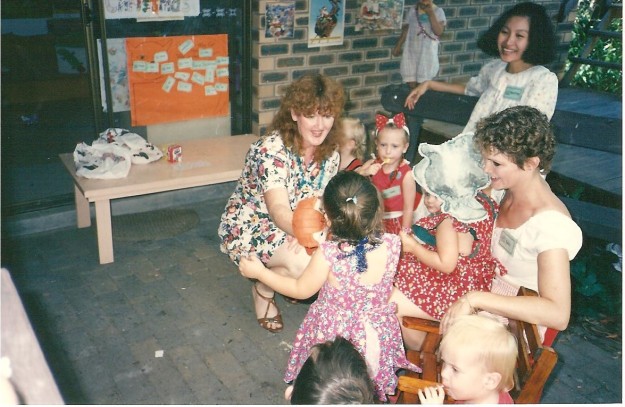
    And best of all, I could do it with Bec! (Although she is not in this photo.)

    Guiding parents in play sessions for parents and children.
    Guiding parents in play sessions for parents and children.

    I express this passion and these basic beliefs repeatedly. They are what make me. They are my driving force; the threads that weave their way through everything I do, holding them and me together. They were the basis for my attempt at founding an alternative school; they guided my classroom pedagogy and now the preparation of resources for readilearn.

    © Norah Colvin
    © Norah Colvin
    © Norah Colvin
    © Norah Colvin

    It’s funny looking back now at the documents I wrote, it seems almost a lifetime ago (well almost all of Bec’s lifetime and more than half of mine), on an Apple IIE computer. I’m still proud of what I offered and truly believe in the value of sessions such as these. However, I can see that, while there has been little change to my passion and beliefs over the years, if I were to do the same thing now I may update some statements to more closely match my current understanding of a growth mindset.

    The thought of doing the same again now is not far from my imaginings. The format of Create-A-Way sessions forms the model of another project I would love to found The Early Learning Caravan. Maybe Steven’s suggestion of crowdfunding would be appropriate for getting it started, but that’s not a project for the immediate future.

    © Norah Colvin
    © Norah Colvin

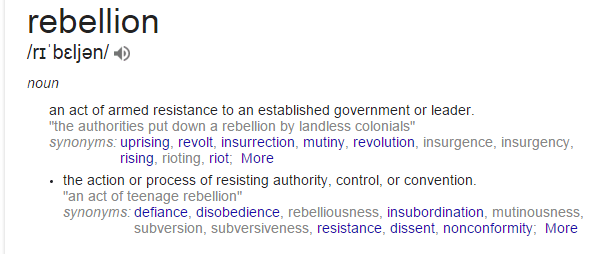
    I wonder if my inability to simply accept what is could be considered rebellion? What is a rebellion? I’m thinking of these terms as this week at the Carrot Ranch Charli Mills has challenged writers to In 99 words (no more, no less) write a rebellion.

    rebellion definition

    The rebellions of which Charli writes are of a larger scale, more in keeping with the first definition.

    In this TED Talk Ken Robinson urges us to Bring on the Learning Revolution making “the case for a radical shift from standardized schools to personalized learning — creating conditions where kids’ natural talents can flourish. I’m proud to be a rebel fighting in the same revolution as Sir Ken.

    In addition to these larger scale rebellions and revolutions there are many that take place on an individual and daily basis in our families and classrooms, and on our streets. Some of the battles, such as  teenage rebellion are fought for justice, independence and identity, a natural and necessary part of growing up. But the need to establish one’s individuality, one’s separateness as a person begins years before that, as anyone who has ever had anything to do with a two-year old can testify.

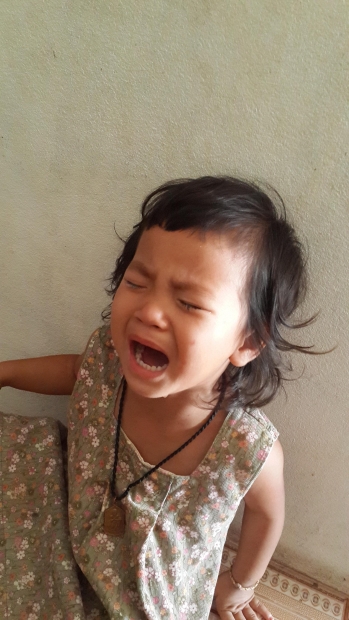
    Sometimes the same battles are played out over and over and parents wonder why the children just don’t accept that they need to clean their teeth, wash their hands, put on their shoes or whatever, rather than battle over it each and every time. It is this early childhood rebellion that has inspired my flash fiction response to Charli’s challenge this week. I hope you enjoy it.

    crying

    You’re not the boss of me!

    Eyes blazed defiance, daring a struggle which could end only in tears and frustration, or a standoff with no real winner. She was ready to flee the moment there was a hint of movement. Our eyes met. I contemplated my options. Did we have to do this now?

    Again the challenge: “You’re not the boss of me!

    I pretended to read.

    Another volley, quieter: “You’re not the boss of me.

    No response.

    Soon she was snuggling beside, pointing to pictures.

    I read aloud.

    We laughed at the antics.

    As I closed the book I said, “Ready? Let’s do this.”

    Thank you

    Thank you for reading. I appreciate your feedback. Please share your thoughts.

  • Not lost but found

    12

    I am struggling with a writing task at the moment. Part of the reason is that is has been at the back, rather than the forefront, of my mind as I worked on other tasks, and part of the reason is that it involves self-promotion in a marketing kind of way. It confuses me a little, because haven’t I been self-promoting all the time I have been writing a blog? Surely putting my ideas out there is at least presentation, if not promotion, of said ideas.

    With the goal of sharing original early childhood teaching resources and stories for children on a website of my own, I began writing a blog and engaging in social media about two and a half years ago. This was in responses to advice received from attending writing seminars and reading books about website development. Preparation of resources for my website took a back seat for a while as I engaged with other writers in the blogosphere.

    Now it is time to turn the focus back onto the website, the launch of which is fast approaching. With an extra effort over the past couple of weeks, I now have sufficient resources to begin. Additional resources will be uploaded at relatively frequent, if irregular, intervals, not unlike adding to my blog.

    80

    I have no issue with ideas for additional resources or blog posts. My stumbling block is the content for my bio and promotional information about the website. It should be easy, I know, but I am struggling to find the answers to these questions:

    • What do people want or need to know about me?
    • How can I promote my resources in an honest way that entices people to sign up to a paid subscription?
    • What is a fair price for subscription?
    • How can I persuade potential subscribers that they will get value for money?
    • How can I ensure that subscribers do not feel let down by the available resources or ripped off by misleading promotion?

    These questions arise even before I begin to tackle the really difficult one:

    • How do I connect with my target audience: early childhood teachers?

    I know I am not alone with these concerns.

    Recently Sarah Brentyn, who blogs at Lemon Shark, questioned the validity of her profile, enflaming my anxiety by stating that “It’s seen by far too many people who judge you by those 10 – 20 words.” The thought to change my blog’s About page, with far more than 10-20 words, hasn’t yet moved beyond that guilt-ridden thought. And while I know it is not suitable as is for my website, perhaps editing or rewriting it is a place to start.

    90

    Throughout the year Anne Goodwin, who blogs at Annecdotal, shared the process of stepping out from under the covers of introversion to promote her debut novel Sugar and Snails.  In her post One huge leap for Anne, one teeny tiny step for womankind, she questioned how to balance celebrating her achievement with the suspicion that many would be unimpressed. In another post on Book pricing: a cautionary tale Anne questioned pricing and value and shared the hope that people wouldn’t feel ripped off. I am fairly confident that Anne’s concern on each of these issues turned out to be unwarranted. Will mine be the same?

    Charli Mills of Carrot Ranch Communications also frequently writes about marketing and the importance of finding one’s niche. In September she declared her position saying,

    “My intention … (is) to write and publish novels. My intention is to be a successful author. Success to me is publishing books I want to write for readers who want to read them. My secondary goal is to market well enough to eat more than hand-picked dandelions from my yard. Many will say it’s a fool’s dream.”

    Charli has expressed it well. Substitute “early childhood teaching resources and stories for children” for novels and it could be me. I hope that neither Charli nor I are dreaming the impossible. Charli at least has a long list of credentials.

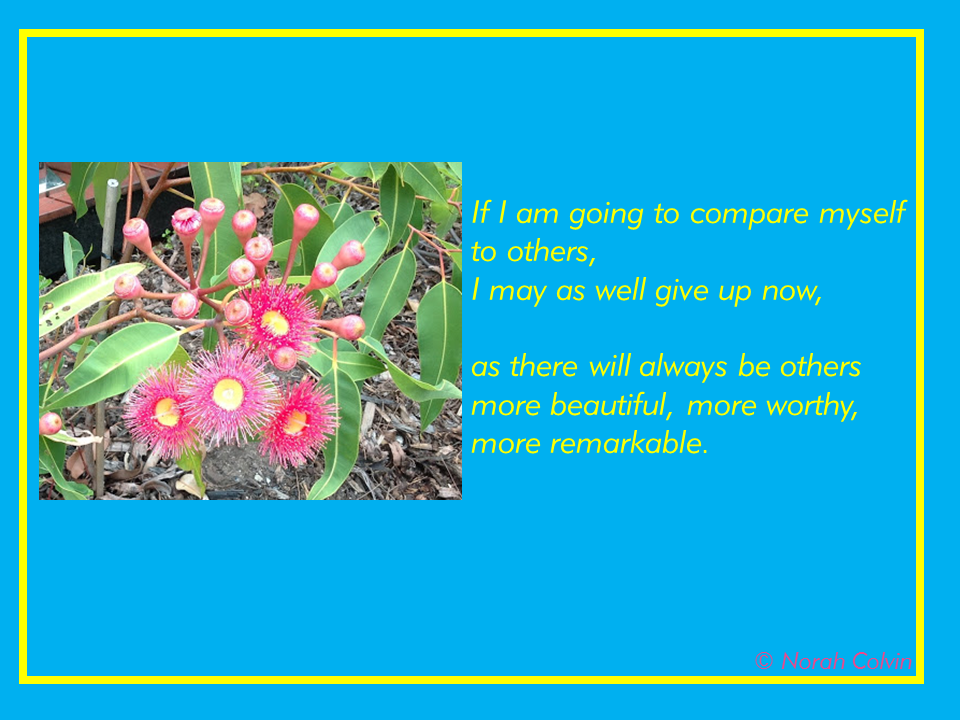
    I have spent some time looking at other websites which may be considered competitors and looking at bios on others. If there’s one thing I have discovered it is this:

    compare - give up

    There is a multitude of websites offering early childhood teaching resources. Some websites offer all resources free. Teachers love freebies. There are also many websites with resources available to subscribers. Why would anyone want mine?

    However, I’m not going to give up now.

    compare - none

    I hope there are many early childhood teachers who will see sufficient value in my website to pay the annual subscription. As far as I explored, I have not found anyone offering interactive resources similar to mine. It is possible that they exist and I just haven’t found them. However, I am hoping that teachers see value enough in these alone, and consider the other resources a bonus. Time will tell. If it returns nothing but the pleasure of achievement, then I will consider it my jetski. If it does more than that I will be well pleased.

    So, if I am not going to give up, maybe I just need to get on with the task of writing my bio and promotion paragraph. The other day I read a bio that described the website owner as its founder. Hmm. I thought. Maybe that’s a title I could use.

    founder of readilearn

    I was amused at the thought that I would found something that hadn’t been lost. It just hadn’t been before. I thought about other things, briefly mentioned in other posts, that I had founded:

    Create-A-Way, educational sessions for children of before-school-age and their parents.

    Centre of Learning Opportunities, envisioning an alternative way of educating.

    Perhaps I can now add another to my list. I just need to get the bio written.

    What advice do you have for me? What should I include? What should I leave out? What is the most important thing of which I need to be mindful?

    Thank you

    Thank you for reading. I appreciate your feedback. Please share your thoughts.


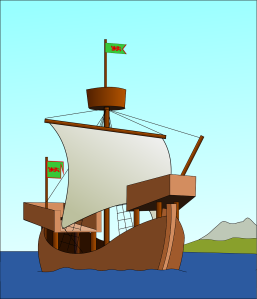
  • Storybook pirates and early childhood learning

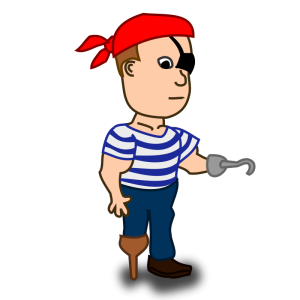
    nicubunu, Comic Characters: Pirate https://openclipart.org/detail/21919/comic-characters-pirate
    nicubunu, Comic Characters: Pirate https://openclipart.org/detail/21919/comic-characters-pirate

    Would you believe that with the hundreds of picture books I have in my possession I do not have one about pirates! That surprises me. There must be oodles of books about pirates on the market.

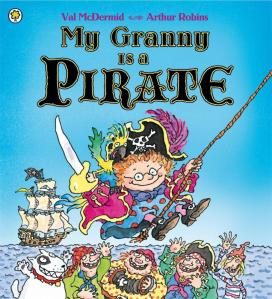
    my granny is a pirate

    When I was in London last year I did buy a delightful book for my grandchildren called My Granny is a Pirate by Val McDermid.  We had enormous fun reading it and laughing at the wonderful illustrations by Arthur Robins.

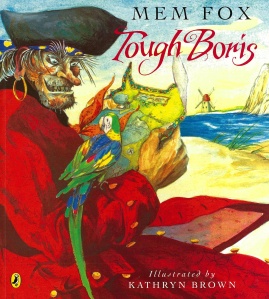
    Although I own many titles by Mem Fox, I don’t own her “all time classic and long-lasting bestselling” pirate book, Tough Boris . In the information about the story on her website, Mem explains how the story came to be and raises issues of sexism, particularly regarding the over-representation of male characters, in picture books. This is a topic that is very familiar to me.

    Tough boris

    In addition to not owning books about pirates, I can remember using a pirate theme for teaching on only one occasion. This surprises me too as pirates seems to be a perennial theme for birthday and fancy dress parties. Children and adults find the idea of pirates fun. You have only to look at the success of the Pirates of the Caribbean series to know that.

    Of course, in this post I am referring only to the pirates of picture books and movies such as these, that were no more real than other fanciful characters such as giants, fairies, elves and dragons.

    The occasion for my using a pirate theme was over twenty years ago when I was running early childhood classes as part of my home-based business Create-A-Way, and the inspiration for it was of a practical rather than literary nature. I was required to wear a patch over an eye after having a pterygium removed. A pirate day seemed like a great way to avoid upsetting the children and to have a bit of fun as well. Perfect!

    https://pixabay.com/
    https://pixabay.com/

    But why am I thinking about pirates you may wonder. Well, it’s in response to the post by Charli Mills at the Carrot Ranch and her challenge to writers to In 99 words (no more, no less) write a pirate story. As always Charli gets me thinking about different things with her prompts. She is talking about the piracy from her internet data service and drinking rum before 10 am, which is apparently something pirates do.

    As usual I take the prompt to the early childhood education setting, and I’m excited by doing so. Ever since reading Charli’s prompt I have had ideas for teaching and learning experiences based on a pirate theme swirling around in my head. I may be late coming to the party, but I’m not coming underdressed.

    https://pixabay.com/
    https://pixabay.com/

    One of the things I have always loved about teaching is the opportunity to be creative: to write and prepare fun educational resources to use with my children. What wonderful things could be done with a pirate theme. I can’t believe I have never done it. And while I am no longer in the classroom and the opportunity is not there for me to use them with my own class, I can make them for my website to share with other teachers. The fun of thinking, writing, and creating is still mine!

    I’m pleased to announce that my website is underway. I have signed with a web designer and developer. It should be ready to go live by the end of January, ready for the start of the new school year in Australia. I can’t wait. Well, I can wait. I still have so much work to do in the meantime. I have resources to finish and new ones to write. There are many “in progress”. While I won’t be rushing into making pirate themed resources, I am putting them on my list. I have lots of ideas.

    Actually now that I think about it, the mix of feelings I have now that the website is imminent may be similar to those experienced by someone walking the plank: there is no way back and the choice for the future is to either sink or swim. If I do manage to hold my head high and above water level, I hope I don’t get eaten by sharks!

    wsnaccad, shark https://openclipart.org/detail/19732/shark
    wsnaccad, shark https://openclipart.org/detail/19732/shark

    On my website subscribers will be invited to suggest or request resources to match their requirements. I love thinking of resources to suit particular topics or to teach particular skills or processes. I would love a request for pirate materials so that I could get started on making them sooner rather than later.

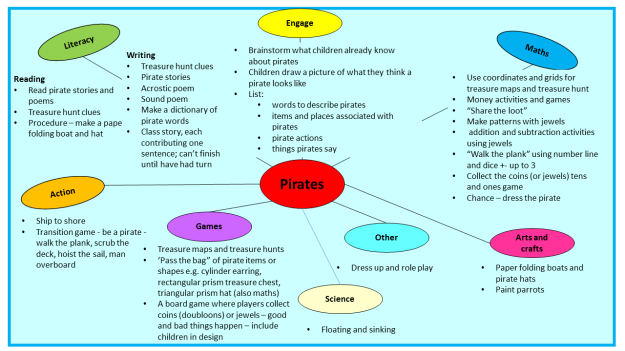
    Here are a few ideas I have to start with. I’m sure I would come up with many more given a little longer.

    © Norah Colvin 2015
    © Norah Colvin 2015

    But now here is what got me thinking about pirates in the first place: my flash fiction response to Charli’s prompt. I’m definitely sticking with my early childhood theme and a bit of fun for this one.

    https://pixabay.com/
    https://pixabay.com/

    If I was …

     If I was a pirate

    I would sail the ocean blue,

    In a boat made out of cardboard

    With my parrot Libby-Lou.


    I would wear a red bandana

    And purple polished boots.

    I would flash my pearls and silver sword

    And plunder pirate loot. 


    I would dig for buried treasure

    In the spot marked with an X,

    And all I’d find I’d stow inside

    My handy wooden chest.


    I would have no one to boss me

    I could do just as I please,

    Until my dad would call me

    “Anna, come, it’s time for tea!”

    Thank you

    Thank you for reading. I appreciate your feedback. Please share your thoughts about any aspect of this post or flash fiction.

  • You’ve got a friend in me


    https://openclipart.org/detail/117199/Friendship
    https://openclipart.org/detail/117199/Friendship

    One of the greatest contributors to a child’s happiness at school, indeed for happiness in life, is friendship. Talking with children about their day at school will more than likely contain some reference to their friends; who they played with, who they didn’t, who was absent, who was mean. If they felt sad during the day it was possibly because someone wouldn’t play, wouldn’t let them play, or was mean.

    Getting along with others seems to come naturally to some children, especially to those who see positive social skills modelled by parents and family friends, who are given lots of opportunities to mix with others of all ages, and who are encouraged to express themselves and their feelings. Other children don’t find it so easy, sometimes due to lack of positive role models, but often for other reasons.

    http://www.morguefile.com/
    http://www.morguefile.com/

    Most children require some explicit teaching from time to time, for example to share, take turns and to use friendly words. Many schools incorporate the development of friendship skills into their programs. Some schools, such as one that employed me to write and teach a friendship skills program in years one to three, develop their own programs. Other schools use published materials such as the excellent You Can Do It! program which teaches the social and emotional skills of getting along, organisation, persistence, confidence and resilience.

    In the early childhood classrooms of my previous school, we used the songs, puppets and stories included in the You Can Do It! Program. We also involved children in role play and discussion, providing them with opportunities to learn the language and practice the skills in supportive and non-threatening situations. Having a common language with which to discuss feelings, concerns and acceptable responses meant issues were more easily dealt with. More importantly children learned strategies for developing positive relationships and friendships with others. They came to understand their own responses as well as those of others.

    SMAG ccbyncnd

    I have talked about friendship in many previous posts, including here, here and here. My online friend Anne Goodwin, who blogs at Annecdotal even wrote about it in a guest post here, and I described friendship trees that I used with my class here.

    Friendship tree

    In this post I want to acknowledge a new friend and a long-time friend. (I can’t say ‘old’. She’s younger than I!)

    My new friend is Pauline, The Contented Crafter. At the beginning of last week Pauline announced a very generous giveaway for Christmas which I shared with you here.  Pauline invited readers to nominate someone as a deserving recipient of her beautiful Christmas light catcher. She posted the nominees and their stories here and invited readers to vote for the two they would most like to receive the light catcher.

    pizap1

    I nominated Robin, a friend of over thirty years. That must be deserving of an award in itself! In case you missed her story on Pauline’s blog, I include it here so that you can understand why I value her friendship so highly.

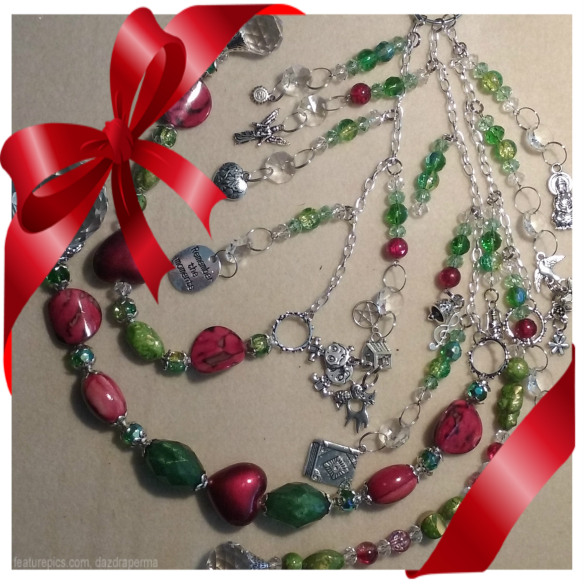
    I have a wonderful friend for whom this beautiful light catcher would be a perfect gift. Each of its strands holds a special significance, as if Pauline had her in mind.

    She gifted her friendship to me more than thirty years ago and, thanks to a miracle and the protection of angels, it is a gift that continues.

    Over twenty years ago, on my birthday, she was involved in a serious car accident. My birthday became her life day, a constant reminder that life and each passing year is a precious gift. 

    Her many injuries, requiring numerous surgeries over the years, did not injure her bright, cheerful nature and positive outlook on life. Although she lives with constant pain you wouldn’t know unless you asked, and then only if she chose to tell you.

    She has an enormous generous and loving heart, and her home is warm and welcoming. Family, especially her two grown daughters and her dear Mum who passed this year, is important to her. She loves to bake and craft individual gifts for her family and friends. She is always busily thinking of others.

    She is a gifted musician and amazing music teacher. She plays the flute and sings like a Robin. She incorporates music and fun into classes for children and lessons for adults learning English. All come to her classes eager to learn and leave singing with joy and acceptance.

    At Christmas the family gather round to decorate the tree and “remember the moments” marked by ornaments made by smaller hands, collected on travels, or signifying achievements and occasions like graduations and engagements.

    I know my friend would treasure this beautiful light catcher as another reminder of life’s precious gifts and moments that make it magic. Thank you Pauline for the opportunity to express openly how much I value her friendship.

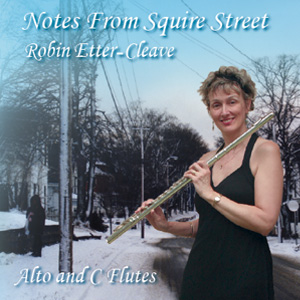
    You can find out more about Robin on her website and even purchase her wonderful CD “Notes from Squire Street”.

    Robin - Notes from Squire Street

    I am very excited to say that Robin is included in Pauline’s list of winners. In fact Pauline’s generosity is being extended to many of the nominees, and even to one for commenting on the post. Very soon Pauline’s light catchers will be dispersing rainbow light of friendship and joy around the world. I think that is a beautiful and generous gesture.

    Thank you

    Thank you for reading. I appreciate your feedback. Please share your thoughts.


  • Power tools


    www.openclipart.org
    http://www.openclipart.org

    This week at the Carrot Ranch Charli Mills has challenged writers to In 99 words (no more, no less) include a tool in a story. I open this post with a quote by Jackie French I used to close my previous post.

    Jackie French - books - tools

    Books are a great tool. So is the ability to think creatively.

    Being literate is a key that opens many doors. Being able to think opens many more. You could say they are the power tools of education and success.

    In his book The Outliers (recommended to me by Rowena who blogs at Beyond the Flow), Malcolm Gladwell talks about the role of intelligence in success. He says that “intelligence only matters up to a point”, and that “past that point, other things — things that have nothing to do with intelligence — must start to matter more”. He raises the question of what those things are.

    He makes a suggestion to

    “Write down as many different uses that you can think of for the following objects:

    1. a brick
    2. a blanket”

    and calls it a “divergence test”. Rather than asking you to come up with a one right answer, a divergence test “requires you to use your imagination and take your mind in as many different directions as possible.”

    Gladwell describes the test as a measure of creativity, of the ability to come up with imaginative and unique responses rather than a list of commonplace uses. He considers this imaginative thinking combined with intelligence, not intelligence alone, to be what is required to make new discoveries such as those that may be awarded Nobel Prizes.

    www.openclipart.com
    http://www.openclipart.com

    Can this sort of creative thinking be taught?

    Edward de Bono certainly thinks so. As long ago, dare I say, as the late 60s I read (and did) The Five Day Course in Thinking, a series of puzzles to help readers (thinkers) understand their thinking strategies. The puzzles in the book are divided into three sections: Insight Thinking, Sequential Thinking, and Strategic Thinking.

    Over the years I read a number of de Bono’s books including but not limited to Lateral Thinking, Six Thinking Hats, How to Have a Beautiful Mind, Teach Your Child How to Think, Textbook of Wisdom and Why I Want to Be King of Australia. I had a thirst for learning how to think, as thinking had not been encouraged and memorising content had not come easily in my younger years. Discovering that I was able to think, and think outside the box, was empowering.

    www.openclipart.org
    http://www.openclipart.org

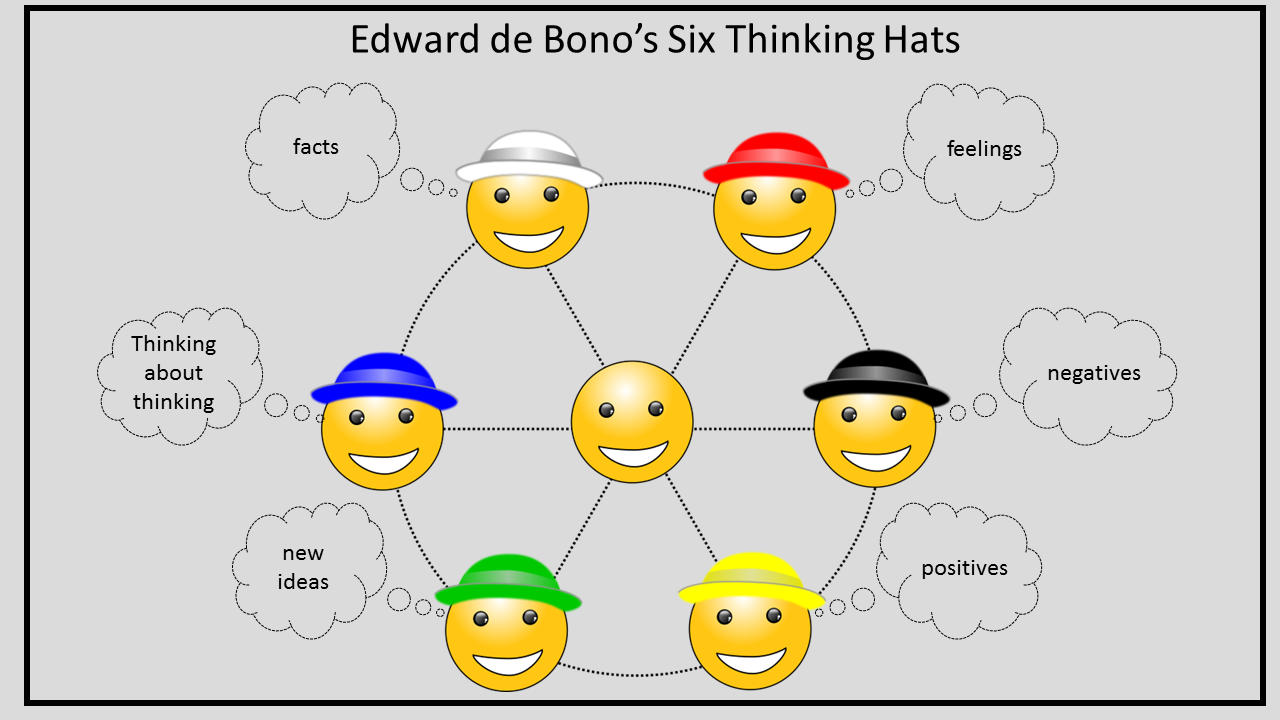
    I enjoyed using de Bono’s strategies and teaching them to my own children as well as to children in my classrooms over the years. His Six Thinking Hats are used in classrooms worldwide as are many others of his thinking strategies.

    six hats

    In this video de Bono talks about creativity, creative thinking, and thinking “outside the box”:

    Tony Ryan is another educator who believes it can. He has published a number of books that aim to get students thinking in creative ways. His Thinkers Keys “a powerful program for teaching children to become extraordinary thinkers” is designed to do just that.

    Tony Ryan says that we now need to think beyond the square and think “outside the dodecahedron”.

    In a comment on a previous post about Lifetime Changes, Steven linked to an amusing video showing the reactions of 21st century children to our earliest computers, tools of technology. This is it in case you missed it:

    I combined the notions of books, creative thinking and technology as tools for learning, productivity and success with a little bit of backward (historical) thinking to inspire my futuristic flash this week. I hope you enjoy it.

    tools for learning

    Relic

    The family shuffled amongst the haphazard collection of primitive artefacts without attempting to disguise disinterest or disdain. The waiting seemed interminable in this “so-last-century” outpost.

    Haven’s seen one of these before,” they’d been told. “I’ll need to order a specialized tool as well as the part. Shouldn’t take long though. Look around while you wait.”

    Confidence in the simpleton’s tools “upstairs”, even if the correct parts arrived, was as low as their interest.

    Hey look!” one called. “Is this …?”

    Can’t be.”

    All destroyed centuries ago.”

    Would be worth a fortune though.’’

    They opened it.

    A book!” they gasped.

    Thank you

    Thank you for reading. I appreciate your feedback. Please share your thoughts about any aspect of this post or flash fiction.