Live Love Laugh Learn … Create the possibilities

Category: Celebrations

  • Who cares anyway?

    sad

    There are a lot of things to care about in this world, and not least of these is each other.

    What do you care about?

    Your family?

    The environment?

    World peace?

    Justice?

    Equity?

    Disadvantaged children?

    The dolphins?

    Climate change?

    The Great Barrier Reef?

    Plastic in the oceans

    Sustainable seafood

    Ethical shopping

    This week I am joining in with the #1000Speak for Compassion project which calls on “Bloggers from all over the world (to come) together to talk about compassion, in one epic event on February 20, 2015.”

    Charli Mills of the Carrot Ranch is also promoting the project through her flash fiction prompt which challenges writers to: In 99 words (no more, no less) write a story that demonstrates compassion. In her post Charli refers to two words which have been raised and discussed by our blogging community recently.

    These two words are:

    Weltschmerz which was discussed on Anne Goodwin’s blog in a post entitled 20th-century lives: The End of Days by Jenny Erpenbeck

    and

    Meliorism which was discussed in my post entitled How much of a meliorist are you?

    Thanks Charli for explaining that Weltschmerz refers to “world pain” or the grief we feel at how the world keeps falling short of our expectations and meliorism to a belief that the world can be improved by the actions of humans.

    Some of the items listed above are definitely cause for both weltschmerz and meliorism, but most send us a call to action. What action we take depends very much upon our beliefs and our circumstances. In an article in The Guardian earlier this year, Oliver Burkeman states that “World pain is bad – but numbness to world pain would be worse.

    However compassion is more than weltschmertz (seeing the pain) and more than meliorism (believing that something can be done about it).

    In this TED talk, Joan Halifax explains that

    “compassion is comprised of that capacity to see clearly into the nature of suffering. It is the ability to really stand strong and to recognize that I’m not separate from this suffering … (and that) we actually aspire to transform suffering. And if we’re so blessed, we engage in activities that transform suffering. But … we cannot be attached to the outcome.”

    In the talk Halifax explains that compassion is good for us, it enlivens us and makes us resilient, it also develops our immunity.

    She asks

    “if compassion is so good for us, I have a question. Why don’t we train our children in compassion?”

    In my next post, to coincide with #1000Speak for Compassion on Friday 20th I will be looking at some ways that have been suggested to answer that question. If you wish to add your voice to the call follow this link for suggestions of how you can be involved.

    For now I will leave you with my response to Charli’s challenge. I have not tried to address compassion on a global scale but have thought smaller.

    In her talk Halifax said that “compassion is actually an inherent human quality. It is there within every human being. But the conditions for compassion to be activated, to be aroused, are particular conditions.”

    I wondered how feelings of compassion might be activated in the life of a young woman from an impoverished and abusive background.

    Understanding

    In the ‘smart’ outfit carefully selected by the charity shop attendant, Marnie was surprised how well the confident exterior masked the whirlpool of fear, anxiety and insecurity.

    Without looking up, the receptionist handed Marnie a number and waved her to the waiting area.

    “9”. Her heart sank. “That many?”

    Avoiding contact and ‘contamination’, she squeezed into the only available space: between a boy slouching awkwardly and a girl picking her fingernails.

    The girl started crying. Marnie stiffened, but glanced sideways. The girl cried into her sleeve.

    Marnie breathed, proffered her unopened purse packet of ‘just-in-case’ tissues, and smiled, “Here.”

    Thank you


    Thank you for reading. I appreciate your feedback. Please share your thoughts about any aspect of this post or flash fiction.

  • “If you want intelligent children, give them a book …”

    If-you-want-intelligent children

    These words piqued* my interest as they wafted to my ears from the TV set in the other room.

    Who is that?” I called out.

    Jackie French,” he replied.

    I jumped up, eager to see and hear more.

    Jackie French is a well-known Australian author and advocate for literacy and the environment. She is currently the Australian Children’s Laureate with the task of promoting “the importance and transformational power of reading, creativity and story in the lives of young Australians”.

    I was delighted to find that Jackie’s speech was in acceptance of an Australian of the Year Award.

    The media announcement released by the Minister for Social Services explains that Jackie was recognised for her “long and distinguished career as a beloved children’s writer, earning more than 60 literary prizes for her books.”

     “Jackie embodies this commitment (to changing lives in our community) and I’d like thank her for the work she continues to do sharing the power of reading and story-telling for young Australians, and her work in conservation.” 

    Here is Jackie, Senior Australian of the Year 2015, accepting her award.

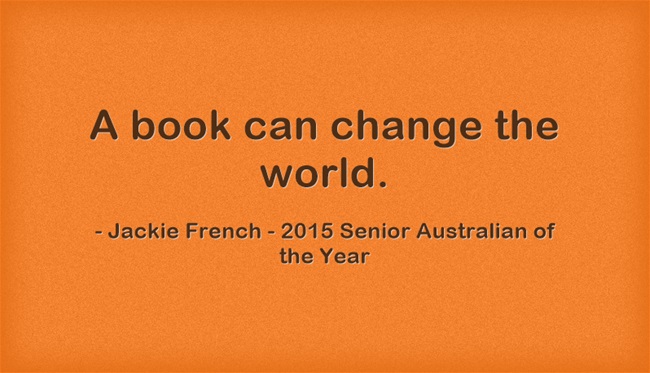
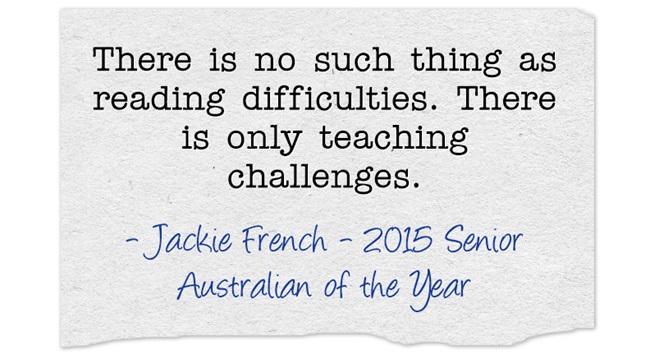
    Failure-is-not-an-optionA-book-can-change-theThere-is-no-such-thing


    In this next video Jackie talks about her book “Hitler’s Daughter”. You don’t have to have read the book to glean much of interest from the interview. In the discussion Jackie shares her thoughts about reading and writing. She questions how the ‘world’ in which one is, influences thoughts about good and evil and decisions that are made. She discusses how the need for evil to be resolved in a work of fiction differs between children and adults. She talks about whether it is necessary for a child to apologise for the sins of the previous generation, and how still controversial issues can be dealt with in an historical situation. It is worth listening to if you simply want something to ponder over.

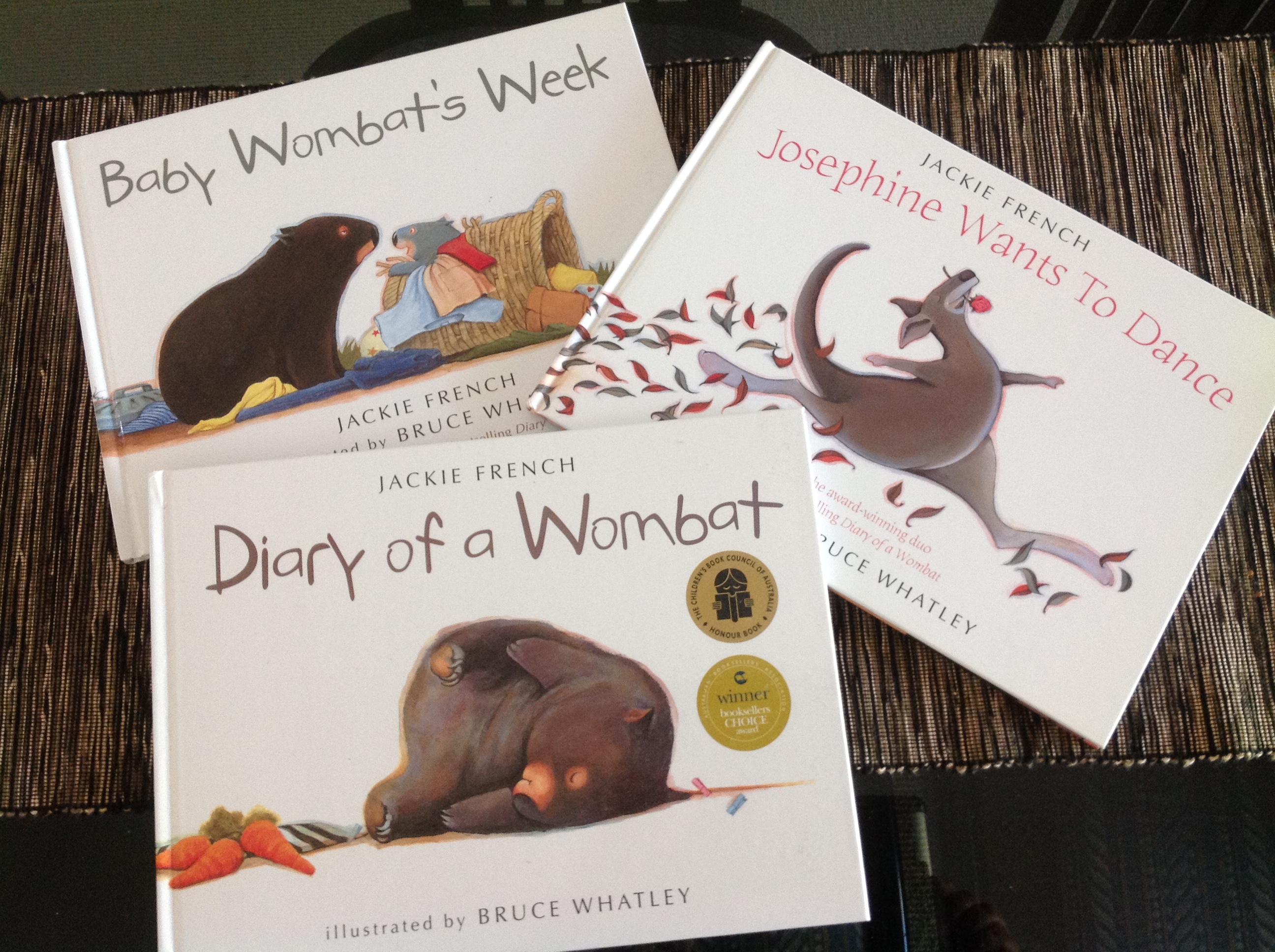
    Being an early childhood teacher I am more familiar with Jackie’s picture books such as

    Diary of a Wombat, Baby Wombat’s Week, and Josephine Wants to Dance, which are delightful.

    IMG_4302

    Here is a video of Jackie reading Diary of a Wombat.

    I have just discovered that Hitler’s Daughter is available as an audiobook, so it is going onto my list!

    https://openclipart.org/image/800px/svg_to_png/148843/1310261210.png
    https://openclipart.org/image/800px/svg_to_png/148843/1310261210.png


    I congratulate Jackie on her award and thank her for the contribution she is making to the lives of so many and the future of our planet.


    *piqued

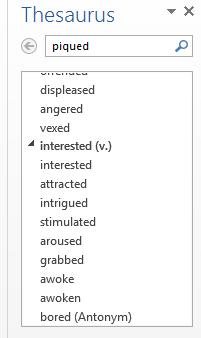
    In this sentence, I am using the word “piqued” to mean “stimulated or aroused my interest”.

    How can one word be used to express opposite meanings? I don’t know how anyone is expected to learn or understand the nuances of this language we call English!

    When I checked with my thesaurus to ensure I had chosen the correct word, this is what I found:

    piqued 1         piqued 2

    How many other words do you know that could almost be listed as its antonym?

    Thank you

    Thank you for reading. I appreciate your feedback. Please share your thoughts about any aspect of this post.

  • Talking the way out

    https://openclipart.org/image/800px/svg_to_png/100009/Coffee-by-netalloy
    https://openclipart.org/image/800px/svg_to_png/100009/Coffee-by-netalloy

    Recently I met up with some teacher friends and, as always happens with teachers, the discussion turned to school, teaching and children. There was talk about the crowdedness and inappropriateness of many aspects of the curriculum, of resources that were ambiguous and poorly written, of time spent practising and preparing for tests, of (other) teachers who were ill-equipped to teach and not interested in professional learning.

    It made me sad. It has always made me sad. Sad and frustrated with the inappropriateness of so much that happens in schools and the effect it has on diminishing our most precious resource: the ability to think, learn, innovate and create.

    The fact that I am unable to do anything about this situation at times overwhelms me and I just want to curl up in a ball in the corner and cry. That I have spent almost my entire adult life swimming against the tide trying, through a variety of means, to make a positive difference through education with an effect as insignificant as a grain of salt in the ocean, makes my efforts seem futile and worthless. A waste of time and energy. I should just give up.

    But, foolishly maybe, I haven’t and don’t. Here I am writing a blog about education. One more way to try; with a website on the way as well. What effect will they have? Probably very little, but at least I am doing something that is important to me; something that gives my life meaning; even if it has no real value beyond that.

    I have been out of the classroom now for three years. I escaped before the introduction of new programs which I would have found philosophically and pedagogically impossible to implement. It had always been a balancing act, doing what my employer expected of me and what I believed to be best for the children and their learning. (Of course there is no saying that what I thought was better. The value of my thinking may well have been just in my head!)

    Five times before I had left the classroom, only twice for reasons unrelated to dissatisfaction (the birth of children). But I could never shake off my belief that education delivery could be improved. I read widely, seeking alternative ways of making a positive difference but, although I had vowed at each departure to never return, something always drew me back.

    Man-resigning
    https://openclipart.org/detail/211086/man-resigning.-by-doodleguy-211086

    Rather than allowing the situation to overwhelm me by accepting that there was nothing I could do; rather than throwing my hands in the air, walking away and admitting that it’s all too hard, I didn’t let go. Perhaps it was foolhardy. Maybe I should. Maybe one day I will. But not yet.

    Instead I choose to focus on the good things I see happening; the parents, teachers, nannies and child care workers who strive to make a positive difference. We know we can’t change the whole world. We can’t rid it of all the injustices, inequalities, violence and other wrongdoings against humanity and the Earth. But we can make a difference in our own little corner; and my own little corner has always been my focus. If I can make a difference with something as simple as a smile or sharing a positive thought then I will do it. If I can do more than that then I will, but I will focus on what I can rather than what I can’t.

    So for my little bit of positivity today, I am sharing some of what I think are great things that are happening, making a positive contribution to education and children’s lives; some things that make my heart sing and confirm my belief that if we want to, we can make a difference.

    marshmallow 5

    I have previously shared some thoughts that stimulated great discussion about the famous Marshmallow Test conducted by Professor Walter Mischel.

    On All Our Words I recently read a report of an address made by Mischel to the team at All Our Kin.

    In that address, Mischel is quoted as saying,

    “When a child grows up in a high-poverty, extremely unpredictable environment – in which anything can happen, in which danger is constantly present, in which chaos is always possible – it affects him at a biological level. Those experiences turn into chronic stress, or toxic stress, and they actually change his brain. They limit the potential of the cool system to make long-term plans and be patient and work for a distant goal.”

    The author of the article, Christina Nelson writes

    “Fighting against the biology of disadvantage requires a sustained effort that begins at birth, or even earlier, which is why creating high quality early care and education is so important for vulnerable children.”

    Mischel’s address further supports that view and congratulates the team at All our Kin for their work, saying

    “By providing a sense of trust, a sense that the rewards are attainable, that promises will be kept, that life doesn’t have to be chaotic and unpredictable, you folks are providing exactly the basis for the development of the cool system, and for the regulation of the hot system. The kids who have that when they are two years old are the same kids who are successful at the marshmallow test at five.”

    The praise from Mischel would not have been given lightly. I’m impressed with what I have read about All Our Kin, including this from their mission statement:

    “. . . children, regardless of where they live, their racial or ethnic background, or how much money their parents earn, will begin their lives with all the advantages, tools, and experiences that we, as a society, are capable of giving them.”

    family1

    The Talking is Teaching program, which was launched by Hillary Clinton as part of the Too Small to Fail initiative, in Oakland aims to reduce educational (and life) disadvantages by teaching parents the importance of talking to their children from birth.

    Thanks to my friend Anne Goodwin and daughter Bec I was also alerted to an article in the New Yorker The Talking Cure which described a program in Providence that also encourages low-income parents to talk more with their children.

    The author of the article, Margaret Talbot says that “The way you converse with your child is one of the most intimate aspects of parenting, shaped both by your personality and by cultural habits so deep that they can feel automatic. Changing how low-income parents interact with their children is a delicate matter”. The aim of the program is to support parents in non-threatening ways to support their children.

    I have previously mentioned a recent publication by Michael Rosen entitled Good Ideas: How to Be Your Child’s (and Your Own) Best Teacher. This book provides wonderful support for parents of children of any age. In very readable, accessible language, Rosen’s book is packed full of simple, inexpensive, fun and powerful ways for parents to support their children’s learning, effectively but unobtrusively, in their everyday lives. I think this book should be supplied to all parents on the birth of their children.

    Closer to home here in Australia are Community Hubs  and other programs such as Learning for Life run by the Smith Family and Acting Early, Changing Lives by the Benevolent Society.

    These are but a few of the good things that are happening. I have focussed on community programs rather than individuals (except for Michael Rosen’s book) in this post. I know there are many more great programs, and individual teachers doing amazing work. I’d love to hear about some that you admire.

    Thank you

    Thank you for reading. I value your feedback. Please share your thoughts about any aspect of this post.


  • The Power of Not Yet by @TeacherToolkit

    The Power of Not Yet by @TeacherToolkit

    Some of my most popular posts of 2014 were those that discussed praise, growth mindset, assessment and failure.
    My final post for the year included thoughts about failure and the need to reflect and refine to move forward.
    It is fitting to begin 2015 with a post that revisits and extends those themes. I’m sharing a post about The Power of Not Yet I read on @TeacherToolkit’s blog. The post includes a video of Carol Dweck explaining that

    “if (students) didn’t pass a course, they got the grade “Not Yet.” And I thought that was fantastic, because if you get a failing grade, you think, I’m nothing, I’m nowhere. But if you get the grade “Not Yet” you understand that you’re on a learning curve. It gives you a path into the future.”

    I would much rather consider that I have not yet achieved my writing goals, than think I failed to achieve them in 2014. Not yet means I am making progress, and will continue to do so in 2015 and beyond.
    In the video Dweck shares research showing a difference that having a growth ‘not yet’ mindset can make to student effort and achievement.
    For me, her most powerful statement is that at the end of the talk:

    “Once we know that abilities are capable of such growth it becomes a basic human right for children, all children, to live in places that create that growth, to live in places filled with yet.”

    It’s a bit like learning to ride a bike. There is no failure, just stages of growth in ability.

    I hope you enjoy the article, and especially, Carol Dweck’s video.

    Thank you

    Thank you for reading. I value your feedback. Please share your thoughts about any aspect of this post.

  • Reflect and refine

    The end of a year is often used as a time for reflection, reassessment, and redefining goals. This week at the Carrot Ranch Charli Mills is talking just that: reflecting on the year that was, assessing her achievements and failures and redefining her goals for the next part of her journey. Charli admits that she didn’t achieve all she had hoped but acknowledges that those shortcomings were more opportunities for learning than failure as such. While she learned more about herself and her abilities she was able to recalculate her goals and redefine her vision.

    In education, failure is recognised as integral to learning.

    Willingness to

    • have a go
    • try something new
    • seek alternate solutions and ways of finding solutions
    • persist and not give up
    • recognise that success does not always come with a first attempt;

    these are effective characteristics of learners, innovators and creative people.

    Thomas Edison, after many unsuccessful attempts said,

    “I have not failed. I’ve just found 10,000 ways that won’t work.”
    There is no failure in a failed attempt; there is only failure in giving up.

    Again, to quote from Edison,

    “Many of life’s failures are people who did not realize how close they were to success when they gave up.”

    C.S. Lewis is also quoted as saying,

    “Failures, repeated failures, are finger posts on the road to achievement.”

    He says,

    “One fails forward toward success.”

    The-greatest-glory-in Ralph Waldo Emerson

    What helps that ability to rise again is a sense of where we are going, of what we are aiming for and what we want to achieve. This is often referred to as a vision, and it is a vision that Charli Mills has challenged writers to include in a flash fiction piece this week: In 99 words (no more, no less) write a story that includes a vision.

    Having a vision of the future and working towards that future is essential to effective teaching.

    As explained by Vicki Davis in her post Thank You Teacher for Your Presence on the Cool Cat Teacher blog, teachers are constantly preparing students for more independent and resourceful futures.

    Through learning from a mentor teacher Jackie Catcher was able to refine her vision for effective teaching, which she shared on Three Teachers Talk :

    “I learned that to lead students into our subject, we must make them feel valued within our community. We must work to acknowledge their strengths and show them that we are all equals when it comes to developing as readers and writers. We must praise their hard work and determination far more than their failures, and we must make ourselves available both in and outside of class to have meaningful conversations and connections. In the end, we are never too old to change our outlook and education. After all, one teacher can make the difference.”

    I constantly share my own, and others’, views about and vision for education on this blog.

    I-had-this-dream-Chris Lehmann

    Some of those posts are:

    Visioning a better school, a better way of educating

    Talking interviews

    Whose failure?

    Imagine that!

    Child’s play – the science of asking questions


    I have also referred to an alternative to traditional schooling that I “failed” to establish in the 1990s. The vision for that alternative was:

    “A dynamic centre of learning opportunities

    for children, families and communities

    which focuses upon the development

    of self-esteem and positive attitudes

    in a nurturing environment

    in which individuals are appreciated

    for their uniqueness and diversity

    while fostering the commonality of their human essence.”

    The-best-questions-are

    Which brings me to my flash fiction piece for this week. In it I attempt to draw together many threads from views expressed over the year and finish with an optimism for the future.


    The power of “No”

    It was grey.

    For as long as anyone could remember.

    They moved about, comfortable in the familiar, avoiding the unknown.

    Shadowy shapes beyond incited fear: a threat to all they knew?

    Lives lacked definition, blending to sameness, conforming to rules.

    “But why?” The tiny voice shattered the stillness.

    All eyes turned. Bodies stiffened.

    Whose was this unruly child?

    “Shhh!” the hapless parents failed to hide their offensive produce.

    “Why?”

    Again! No one moved.

    “Because!” was the parents’ definitive reply.

    They breathed. “Because!” they confirmed in unison.

    Defiantly the child pressed the dust-covered switch and flooded the world with light.


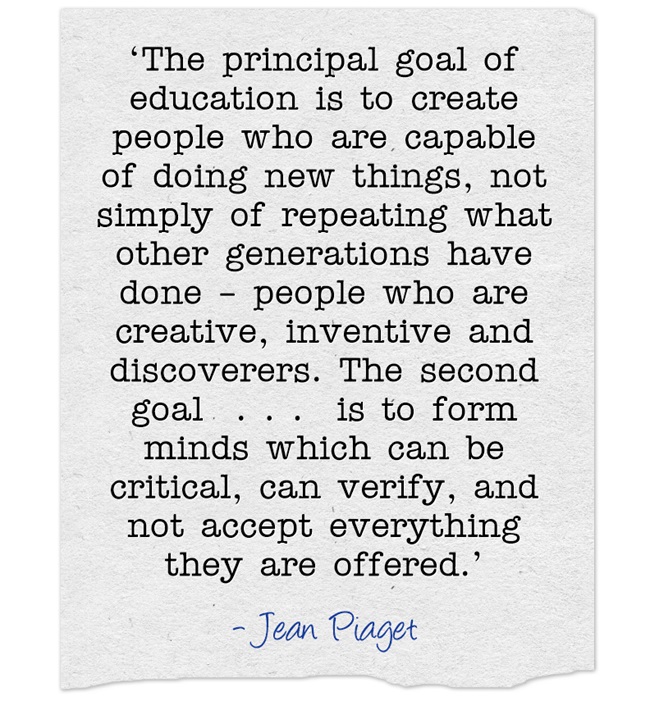
    The-principal-goal-of education - Piaget

    Thank you

    Thank you for reading. I appreciate your feedback. Please share your thoughts about any aspect of this post or flash fiction.

    I wish you success as your vision takes shape in 2015.

    HappyNewYear_by_Rones

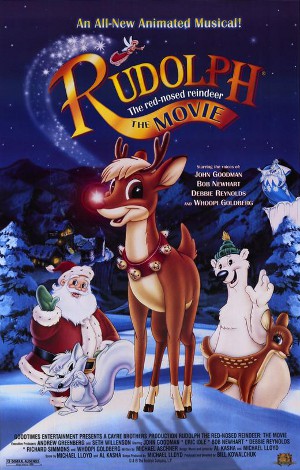
  • The True Story of Rudolph (The Red Nosed Reindeer)

    The True Story of Rudolph (The Red Nosed Reindeer)

    What a heartwarming and inspiring story, just right for this time of year. I found it via Book Chat by Michelle James.
    I hope you enjoy it as much as I do.

    Chris The Story Reading Ape's avatarChris The Story Reading Ape's Blog

    This was emailed to me by a friend:

    A man named Bob May, depressed and brokenhearted, stared out his drafty apartment window into the chilling December night. His 4-year-old daughter Barbara sat on his lap quietly sobbing. Bob’s wife, Evelyn, was dying of cancer.

    Little Barbara couldn’t understand why her mommy could never come home. Barbara looked up into her dad’s eyes and asked, “Why isn’t Mommy just like everybody else’s Mommy?”

    Bob’s jaw tightened and his eyes welled with tears. Her question brought waves of grief, but also of anger. It had been the story of Bob’s life. Life always had to be different for Bob. Small when he was a kid, Bob was often bullied by other boys. He was too little at the time to compete in sports. He was often called names he’d rather not remember.

    From childhood, Bob was different and never seemed to fit…

    View original post 473 more words

  • ‘Tis the Season

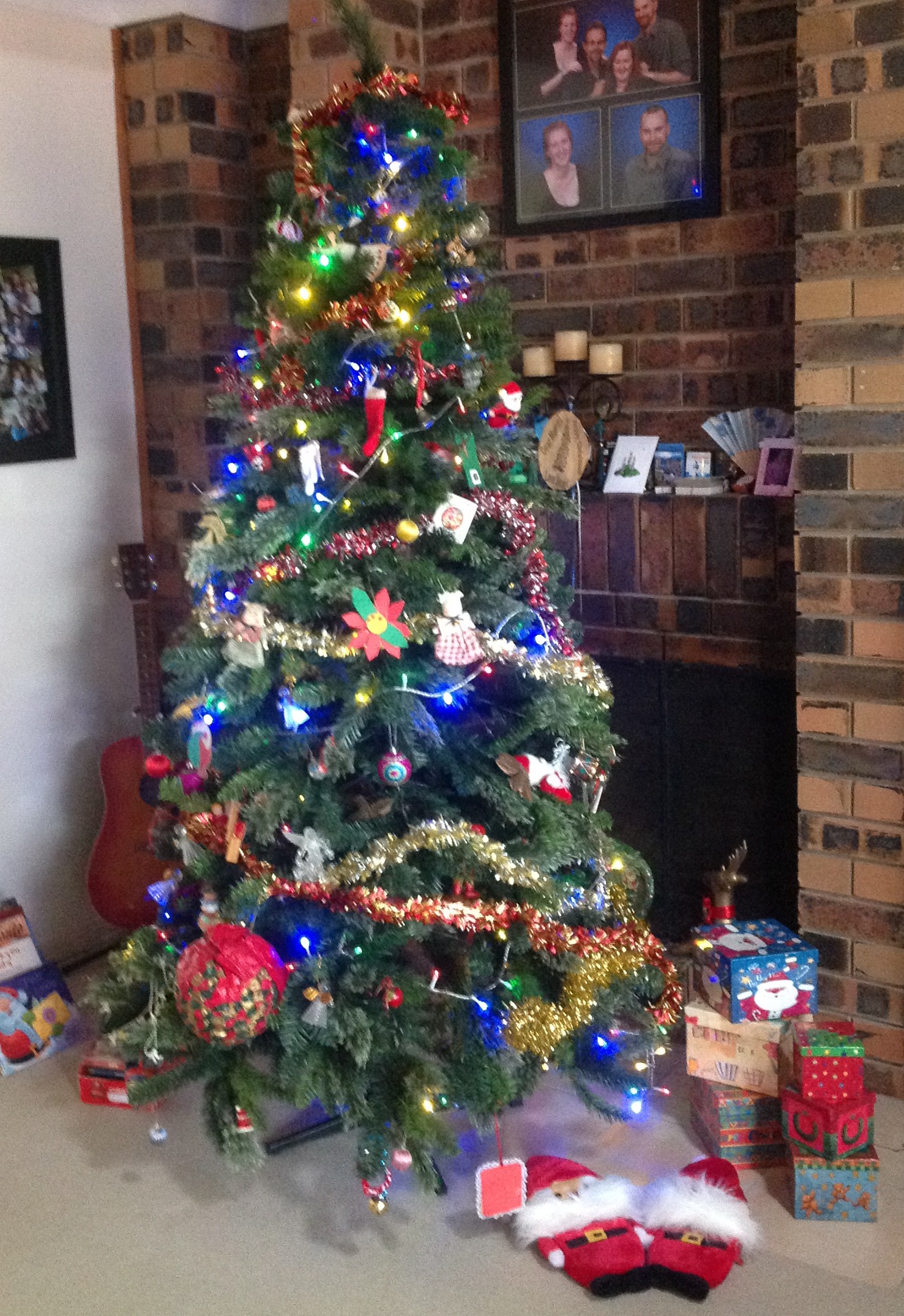
    Christmas 2014
    Christmas 2014

    At about this time of year people all around the world are finding something to celebrate. According to reindeerland.org about one third to one half of the world’s population celebrate Christmas, whether they are Christians or not. I am not sure about the authenticity of their “facts” but other sites also suggest that arriving at the number of people who celebrate Christmas is problematic.

    As explained by Education World December: A Month of Multicultural Holidays Celebrations and National Geographic Kids Winter Celebrations , for example, many other celebrations occur at this time of year.

    Christmas is the holiday that I celebrate with my family and friends. I was surprised to find, by reading a guest post, written by Gordon Le Pard on Geoff Le Pard’s blog TanGental, that many of the traditions celebrated at Christmas time are more recent in origin than I would have thought. It is not surprising, though, that the way Christmas is celebrated differs from country to country, and even from household to household, around the world. Sherri Matthews wrote a beautiful post about a Christmas tree festival hosted by a church in Dorset, England. I haven’t seen anything quite like this.

    In a previous post I’m (not) dreaming of a white Christmas I talked about some of my family’s Australian ways of celebrating. Sadly most “Australian” resources are simply innovations on, or adjustments to, the European traditions. There are not enough that recognise the summer celebration and “traditions” unique to Australia. I guess our small population keeps us in the minority so it is not economically worthwhile to create alternative resources.

    So from my hot sunny days in Australia I wish you and your loved ones happy and safe times, whatever your celebration.


    Thank you for reading. I appreciate your feedback. Please share your thoughts about any aspect of this post.

    Best wishes,

    Norah

  • Bring a plate

    This time of year always seems busy with lots of functions and get-togethers to attend. To avoid leaving all the food preparation to one person, often times in Australia we are asked to “bring a plate” to such gatherings. Most Aussies have no difficulty understanding the intention of the request to bring an item of food to add to the meal.

    However the request can be a little confusing for newcomers to Australia as testified by my Canadian friend Robin who found the request to bring an empty plate to eat from a little strange. I’ve also had a discussion recently with my online friend Charli Mills of the Carrot Ranch  about the American tradition of “pot luck” which seems to imply a similar request.

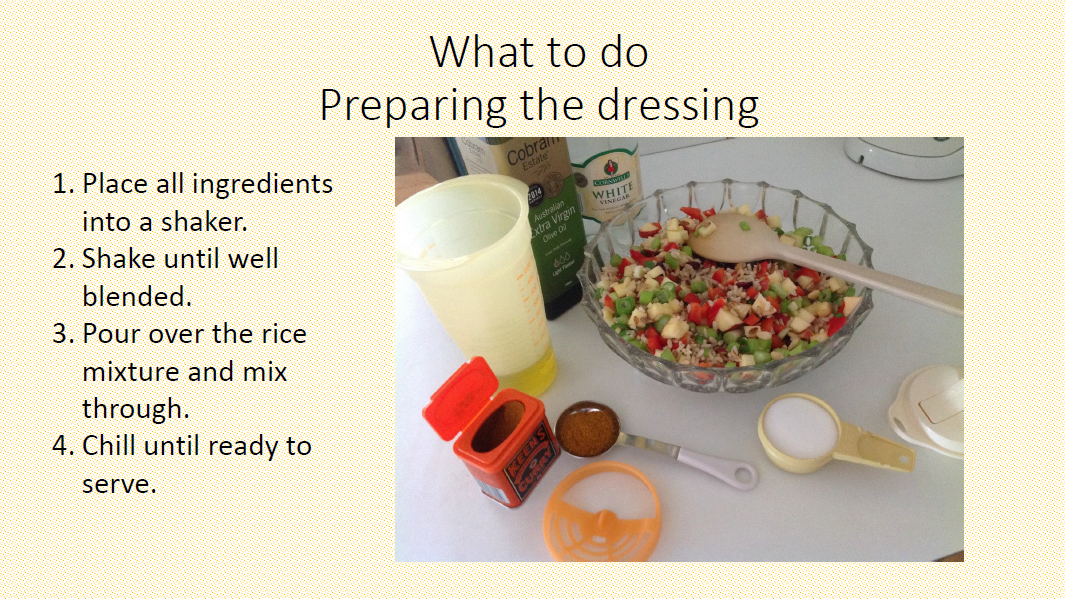
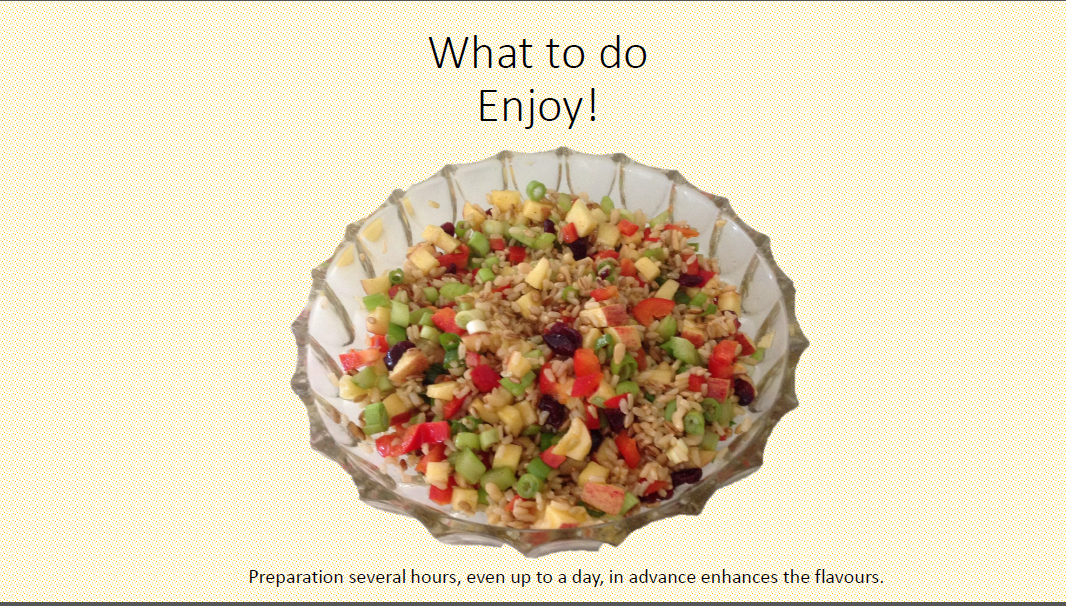
    Along with an invitation to a “bring a plate” get-together, I am usually requested to contribute a rice salad to the main meal, or a pavlova for dessert, or sometimes both! I am always happy to oblige as both of these dishes are not only very popular, they are also very easy to make. In this post I am sharing my favourite rice salad recipe.

    In a previous post I made some suggestions for involving children in Learning in the kitchen. While for safety reasons children may not be able to actively participate in the preparation of the rice salad due to boiling water and the use of sharp knives, there is still much for them to learn through collecting and measuring the ingredients, and observing and discussing what the adult is doing in each step of the preparation.

    If you are looking for a quick, nutritious and delicious salad to accompany a main meal at home or away, this rice salad recipe might be just the thing.

    Rice salad 1


    Rice salad 2


    Rice salad 3


    Rice salad 4


    Rice salad 5


    rice salad 6

    I hope you enjoy it as much my family, friends and I do!

    Thank you

    Thank you for reading.

    I value your feedback. Please share your thoughts about any aspect of this post.

  • December reflections

    https://openclipart.org/image/800px/svg_to_png/194578/07-Juli-goin-on-a-summer-holiday.png
    https://openclipart.org/image/800px/svg_to_png/194578/07-Juli-goin-on-a-summer-holiday.png

    The end of the school year in Australia has approached swiftly and silently this year, for me at least. You see, now that I am not in the classroom I am not absorbed by all the things that the end of the school year brings.

    In Australia the school year coincides with the calendar year so November and early December are frantic for teachers completing the final assessment and reporting for the year, preparing their students (and themselves) for separation after spending so much of the year together, and making preparations to welcome a new class in the new year.

    The classroom remains busy with learning and curriculum matters until the last day. Both teachers and students begin to tire and the warming (hot, in most parts of Australia) days in classrooms without air-conditioning add to the fraying edges of all as they anticipate the long summer holidays.

    teacher beginning and end

    One thing I always enjoyed about the end of the year, that made all the extra work and the increasing heat tolerable, was the learning about family traditions and celebrations, including Christmas.

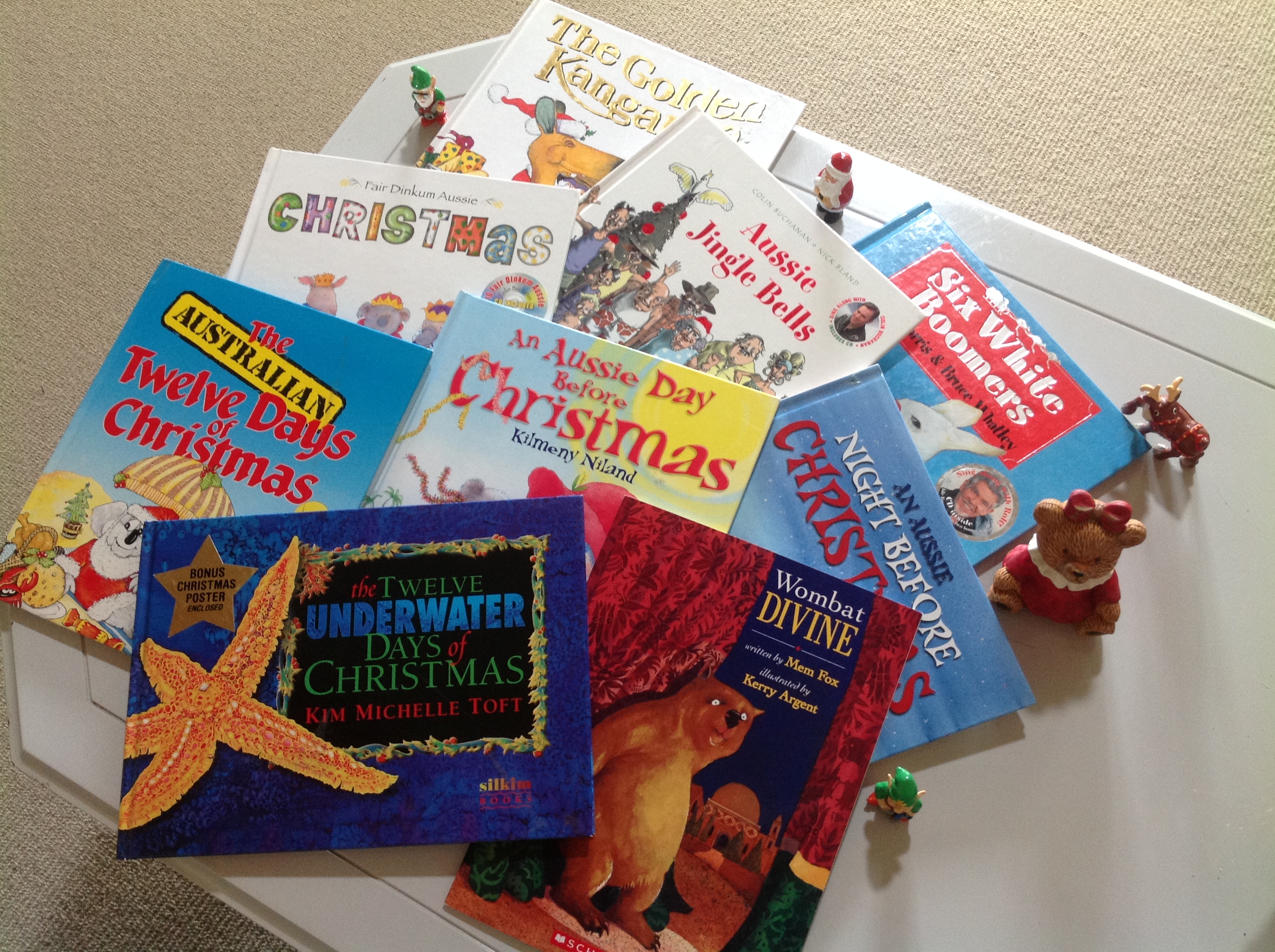
    Some Australian Christmas picture books
    Some Australian Christmas picture books

    Last year I wrote about some of the Christmas activities I did with my class, such as making friendship trees

    Friendship treeand a co-operative 3D display.

    3D Christmas tree display
    3D Christmas tree display

    I shared some suggestions for parents to support their children’s  reading, writing and maths development in fun ways during the holidays. (These and other items are available in my TeachersPayTeachers store.)

    I also provoked a lively discussion about whether Christmas should be included in a school program by suggesting tens reasons for its inclusion. Many readers joined in explaining their position either in support or against.

    I always enjoyed this special time of year. I loved hunting through discount stores for items with which children could make cards and gifts for their families and decorations for their home. Often we talked about “free” gifts they could give and made vouchers for things like a free car wash, breakfast in bed or unlimited smiles and hugs.

    https://openclipart.org/image/800px/svg_to_png/59389/happy_sun_gm.png
    https://openclipart.org/image/800px/svg_to_png/59389/happy_sun_gm.png

    As well as the gifts they made for each other in class, such as the friendship trees and Christmas crackers, I always gave each child a small gift, usually a book to read, a pencil and notebook for writing in; something to do over the holidays.

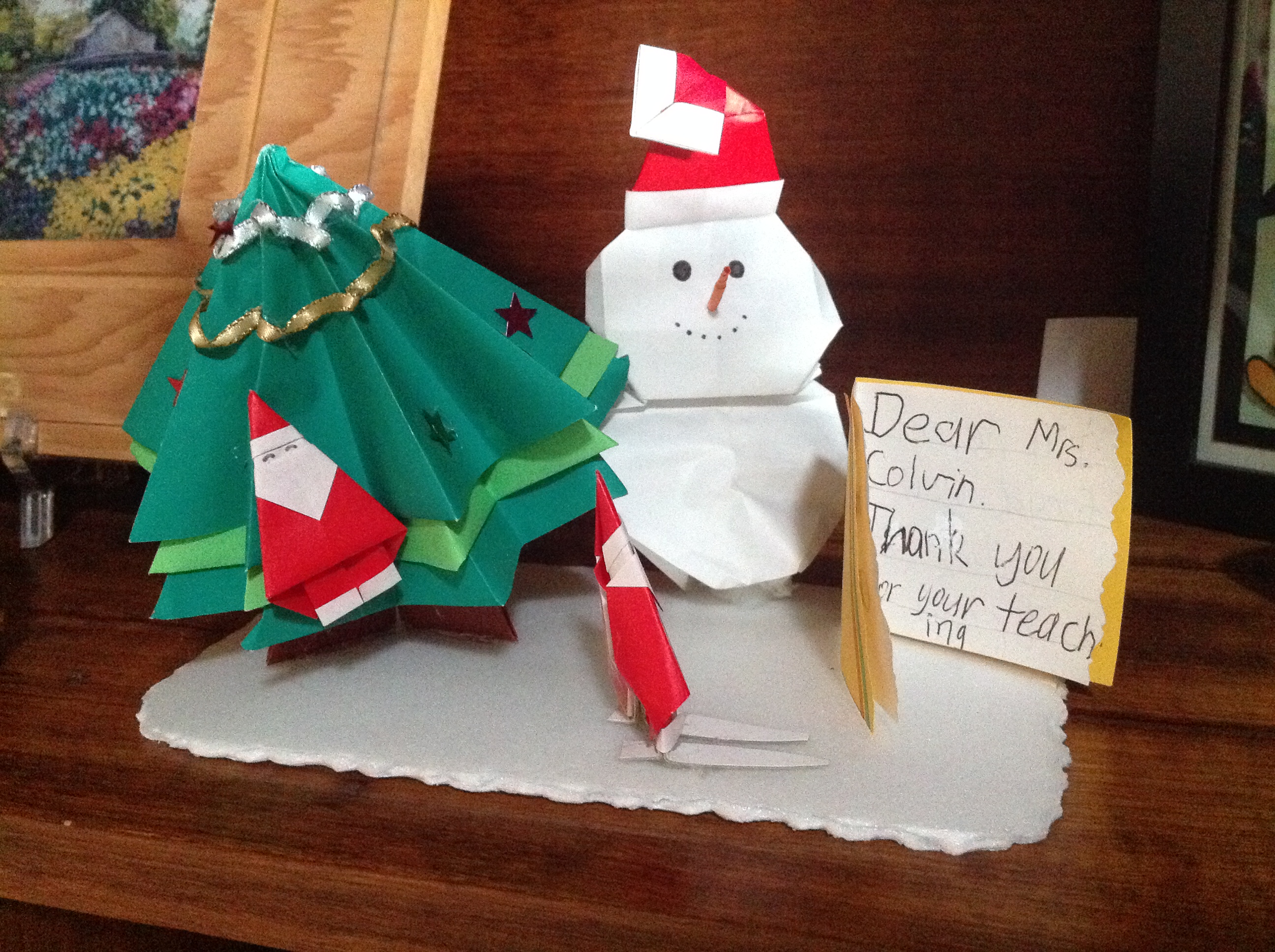
    While it was never expected, but always very much appreciated, many of the parents and children presented me with lovely ‘thank you’ cards, letters and gifts, some purchased, many home-made; all treasured. While the consumables were long ago enjoyed, many other items still adorn my shelves!

    A selection of gifts from over the yeats
    A selection of gifts from over the years

    Brian

    Sometimes it was difficult to know what to give as a gift to recognise a special teacher. This year Bec has come up with, what I think, is the perfect gift, though she didn’t design it for that purpose. It’s the apple cozy: a special little bag for carrying an apple safely, protecting it from bumps and bruises. They are available in her Made It and Etsy stores. An apple for the teacher in its own special bag: how cute!

    Apple Cozy // Joyce
    Apple Cozy // Joyce

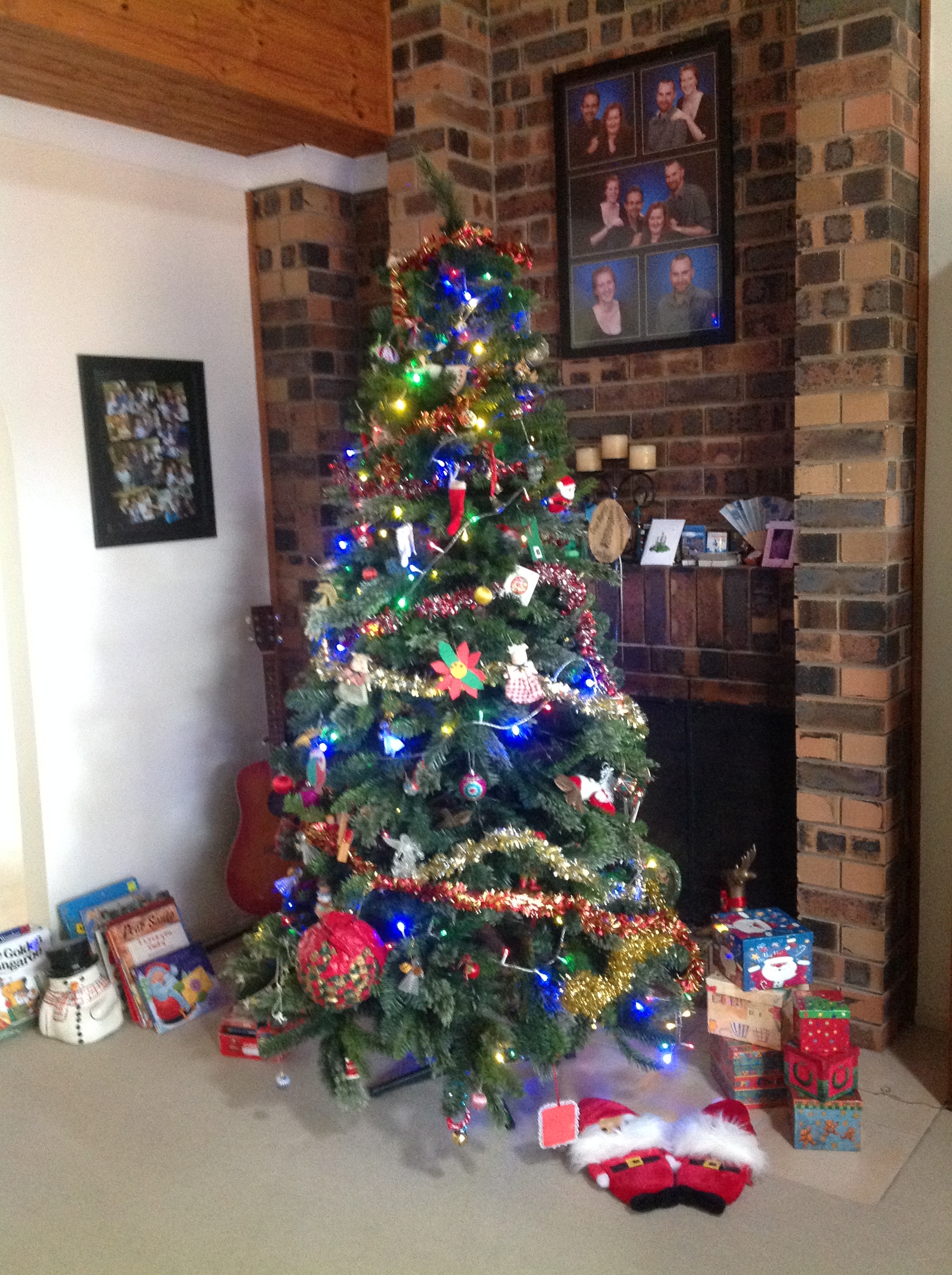
    Although there are no preparations for Christmas at work this year (except for Secret Santa) there is still much to do at home. The traditional time for putting up the tree and decorations is December 1, and I usually have mine up by the end of the first week in December. Now that both my children are grown and living in homes of their own, I thought I would have the lonely experience of decorating on my own this year (Hub says he helps by not helping, but actually he gets tree and decorations down from the roof space for me!)

    What a delightful surprise it was to have both my children and grandchildren (all two of each) visit on the day I was putting up the tree and help me out. The joy that the excitement of a 3- and a 5-year old bring to such activities cannot be matched. I think we did a pretty good job! When I look at it I relive the fun we had together.

    Christmas 2014
    Christmas 2014

    Although to most it would appear simply a Christmas tree, and some may consider many decorations to be ready for the discard pile, most decorations have a story to tell. For me it is a memory tree. It holds decorations made by my own children over the years, and now some by my grandchildren.  There are gifts from family and friends, and children I have taught. Each item, as it is placed on the tree, provides a time for reflecting upon the wonderful people whose lives have touched mine over the years. Each has its own story to tell of the joy that others’ kindnesses can bring. But it is more even that just a memory tree. It is a giving tree; a time for remembering and being grateful.

    What are you family traditions? What and how do you celebrate?

    Thank you


    Thank you for reading. I appreciate your feedback. Please share your thoughts about any aspect of this post.


  • Celebrating 100!

    Celebrating 100!

    Welcome to my 100th post!

    I’m excited!

    When I started this blog just under a year ago (I published my first post on August 15 2013) I set myself the goal of writing two posts a week. I am pleased that I have maintained that output, with only an occasional variance.

    Thank_you_pinned_noteI thank you all, my readers, whether you have been with me from the beginning, joined in along the way, or pop in occasionally to see what I am up to. I really appreciate your support and encouragement. If it wasn’t for your interest I may not have achieved my goal.

    One of the most rewarding things about blogging is belonging to a very special online community of readers and bloggers from whom I have learned a lot, and from whose encouragement I have developed the confidence to share my ideas.

    Celebrating 100 anything is a milestone.

    In Australia if you live to celebrate your 100th birthday you can receive a letter from the Prime Minister, the Governor-General and the Queen.

    In my year one classroom we would celebrate 100 days of school. In the ‘old’ days, when pre-school was part-time and not compulsory, before prep became the first year of formal schooling, year one was the first year of ‘real’ school, and the celebration really was of the first 100 days of school. After the advent of prep it simply became a celebration of the first 100 days of year one.

    Many valuable learning opportunities accompany the celebration.

    Preparation for the celebration would begin on the first day of school. We would count off each day on the number board, counting up the days we had been at school and how many more days there would be until we reached 100.

    Closer to the day we would explore what 100 items ‘looked like’ and count 100 children lined up for class, a tower built of 100 blocks, or 100 paperclips arranged around the edge of a piece of paper. We would count and collage 100 different items, and play games that involved counting to 100.

    celebratory cake

    One of the things that I enjoyed most was discussing with the children what they thought they would be like at 100 years of age. We would read A. A. Milne’s poem Now I am Six and talk about them being six or seven – what they looked like, things they could do, and their favourite things and activities. They would draw a self-portrait and write a description of themselves to accompany it.

    Then we would read books about growing older and discuss what it might be like to be 100 years old. They would do a self-portrait to show what they thought they would look like and write about what they would be able to do and activities they would enjoy.

    https://openclipart.org/image/800px/svg_to_png/154735/faltige_frau.png
    https://openclipart.org/image/800px/svg_to_png/154735/faltige_frau.png
    https://openclipart.org/image/800px/svg_to_png/103549/old_man01.png
    https://openclipart.org/image/800px/svg_to_png/103549/old_man01.png


    I wish I had some of their portraits and descriptions to share with you. They wrote about having grey hair, wrinkly skin and wearing glasses. They wrote about using walking sticks, living in nursing homes and having a lot of grandchildren. Overwhelmingly, they were happy.

    The last group of year one children I taught were born this century. They turned seven in year one in 2011. They will not celebrate their 100th birthdays until 2105! Chances are, with improvements to health and the increasing length of life expectancy, many of these children will get to celebrate that milestone.

    While the children had no difficulty imagining themselves as 100 years of age, I can’t imagine what life will be like for them in the next century; or even fifty years ahead. One hundred posts ago, I couldn’t even be sure if I would still be here writing this blog; but I am, and I thank you very much for reading and participating.

    To mark my 100th post, I have placed a new item in my Teachers Pay Teachers store with suggestions for celebrating 100 days of school. This also coincides with a storewide sale on Teachers Pay Teachers; so, for any teachers out there, it may be worth taking a look.

    sale_160_200

    Thank you for reading. I appreciate your feedback. Please share your thoughts about any aspect of this post or my blog in general.