Live Love Laugh Learn … Create the possibilities

Category: Celebrations

  • Sharing holiday traditions – readilearn

    A great way of sharing information about holiday traditions is through the use of class surveys. It’s fun, engaging, and provides opportunities for learning across the curriculum.

    Here are some of the benefits:

    • Children feel valued when they have opportunities to share information about themselves and their families.
    • Children’s social skills develop when they interact to find out interesting information about each other.
    • Children become more aware of their similarities and differences. This helps to develop feelings of acceptance and appreciation for the diversity represented in the class.
    • Children’s language skills develop as they talk to each other, asking questions and clarifying information.
    • Children learn to be organised and methodical in the collection, recording, interpretation, and reporting of data.
    • Children are fully engaged in the learning when they are asking questions they have raised and to which they are interested in finding the answers.
    • Because learning occurs in meaningful contexts and is integrated across subject areas, children can transfer learning to other situations.
    • Children enjoy learning about their classmates and the classroom community is strengthened.


    This week I have uploaded three new resources to support early childhood teachers’ use of Yes or No class surveys, and a quick and easy recipe for entertaining at home or to contribute to a “bring a plate” function.

    Click here to read the original: Sharing holiday traditions – Readilearn

  • Thinking ahead to the new school year – Readilearn

    As the school year in Australia comes to a close, teachers are busy preparing ways to say “Thank you” to their classroom aides and volunteers, organising gifts for their students (remember to add a 9 square Christmas puzzle), and gifts their students can make for their parents (a poem makes a great gift).

    With all that going on, one would think it impossible for teachers to think ahead to the new school year, but they do; and are already making preparations to ensure the beginning of the year goes smoothly.

    If students and teachers are fortunate enough to know to which class they will be allocated in the following year, things can be much easier.

    One school made the transition from one year to the next more efficient than most with which I’d been involved.

    The process of allocating children to new classes can be daunting

    Click here to read the original: Thinking ahead to the new school year – Readilearn

    Thank your for reading. I appreciate your feedback. Please share your thoughts.

  • Books make the #1 best gifts!

    The love of reading is gift

    I am notorious for gifting books. I’ve written about this before in Guess what you’re getting for Christmas and other posts. It would not surprise me if you are also a notorious gifter of books. Perhaps that could be our super power: The Book Gifters!

    Reading is empowering. A book is a gift that continues to give, long after the occasion has past. It’s effects cannot always be measured.

    books-life-memories

    In this post, I suggest some books you may like to purchase for special people in your life. And why not treat yourself with one or two as well?

    Most, but not all, are fairly recent releases. A few are long-time favourites.

    Most, but not all, are written by people I know personally or through blogging. You might recognise their names from comments on other of my blog posts. A few are long-time favourites written by people who inspire me.

    I have read most. The only two not read (the books of short stories) are very, very recent. However I am happy to recommend them as I am already familiar with some of the stories, and the writers’ work  from their blogs.

    Disclaimer: These are books that appeal to me. They may not appeal to you. The important thing in choosing books for others is in finding something that they will like.

    The list is not exhaustive. It is just a beginning to provide a few ideas that you may not have considered. There are many other wonderful books that could just as easily have been included.

    I have arranged my list in this way:

    For children:

    Picture books (including fiction, non-fiction, and poetry)

    Early chapter books (for readers of about 7 to 12 years)

    For adults:

    Books of short stories

    Novels

    Memoirs

    Books for teachers and parents

    If you follow the links you will be able to discover more about the writers and their other work.

    For children:

    Picture books – Fiction

    picture-books

    Lauri Fortino The Peddler’s Bed This heart-warming story demonstrates that a kindness given can encourage kindness in others. You can read a lovely interview with Lauri on the readilearn blog here.

    Tara Lazar Little Red Gliding Hood In this fun fractured fairy tale, Little Red Riding Hood needs a new pair of skates. The only way she can acquire them is by winning a skating competition. But which fairy tale character will be her partner?

    Galvin Scott Davis Daisy Chain This is a beautifully illustrated, animated and interactive, anti-bullying book app, narrated by Kate Winslet.

    Non-fiction

    non-fiction-picture

    Rebecca Johnson The Insect Series This series of ten little books, each about a different insect, combines both fact and fiction with stunning close-up photographs. You can read a lovely interview with Rebecca on the readilearn blog here.

    Sue Fliess The Bug Book This book about bugs is beautifully illustrated with stunning photographs. Written in rhyme, it introduces children to many tiny creatures.

    Poetry
    book-cover

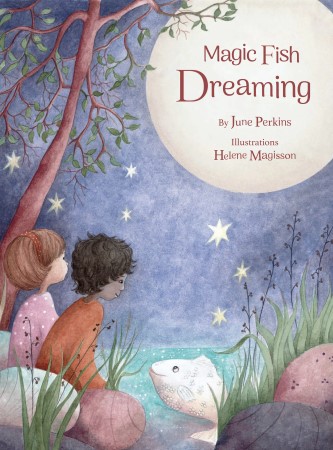
    June Perkins Magic Fish Dreaming This gorgeous book of poems with its focus on nature will uplift and inspire you and your children. You can read a lovely interview with June on the readilearn blog here.

    Early chapter books (about 7 to 12 years)
    early-chapter-books

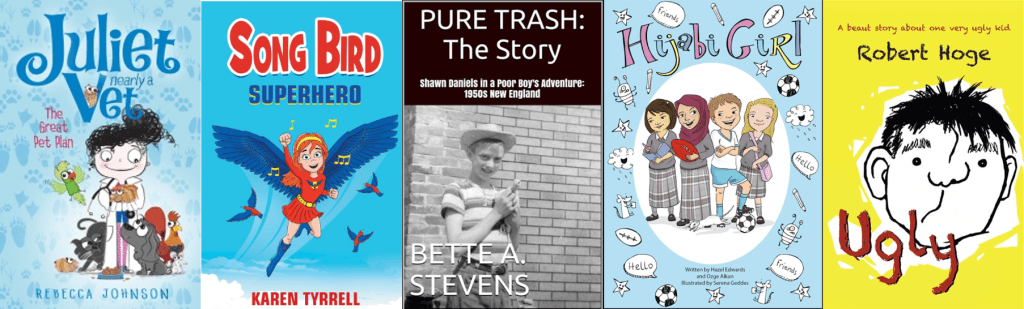
    Rebecca Johnson Juliet nearly a Vet This lovely series of books tells of the adventures of ten-year-old Juliet who aspires to be a vet, just like her mother.

    Karen Tyrrell Song Bird Superhero This story tells of Rosella Bird and her quest to fly. While she battles the bully at school and at home, she is empowered and discovers the joy of flight when she finds her voice.

    Bette A. Stevens Pure Trash: The Story Set in New England in the 1950s, this story tells of a Saturday afternoon adventure of two young boys. The Kindle version is free on Amazon until 29 November (today – be quick!). 

    Hazel Edwards & Ozge Alkan Hijabi Girl In this story, when eight-year-old Melek is deciding what to wear to the book parade, she is unable to find a super-hero who wears a hijab, so she creates her own.

    Robert Hoge Ugly (a memoir) Robert’s story is one of resilience, of survival against the odds, and of making hard decisions. While coping with difference and bullying, Robert shows that strength of character is a trait of survivors. I have introduced you to Robert previously here and here.

    Books of short stories

    short-stories

    Sarah Brentyn Hinting at Shadows This book is a collection of very short stories, each 100 words or less. While each may be a quick read, they will give insight, inspiration, and a greater understanding of what it means to be human.

    Hugh Roberts Glimpses Launching on 2 December, available for pre-order “28 short stories that will take your mind on a rollercoaster of a ride into worlds that conceal unexpected twists and turns.”

    Novels
    novels

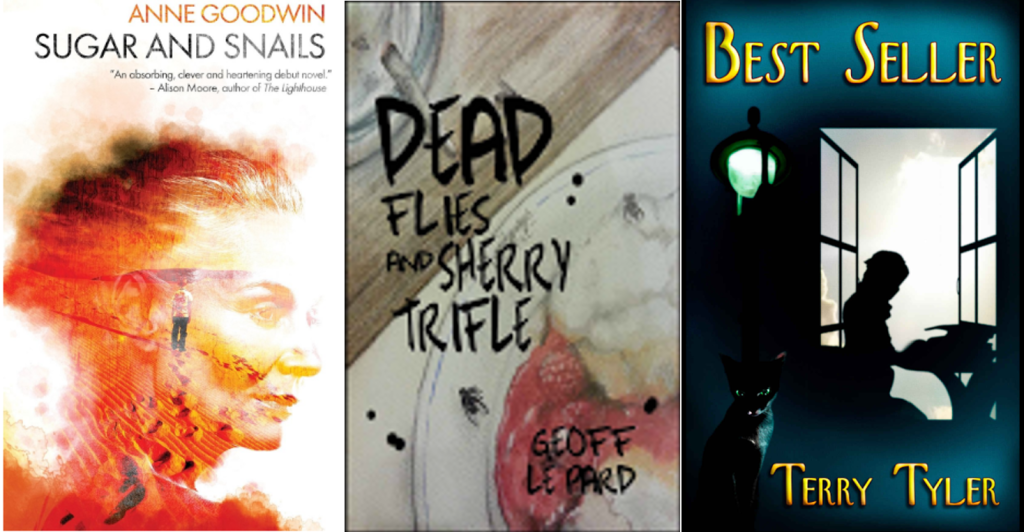
    Anne Goodwin Sugar and Snails In this mid-life coming-of-age story, Diana Dodsworth has some tough decisions to make as she comes to terms with who she really is. Anne has previously talked about her book on my blog here and here.

    Geoff Le Pard Dead Flies and Sherry Trifle This story about nineteen-year-old Harry Spittle, who is home from university for the hottest of hot holidays, will have you laughing out loud at his misadventures.

    Terry Tyler Best Seller This intriguing novella is about three writers, all of whom wish to write a best seller. One does; but which one?

    Memoirs

    memoir

    Robert Hoge Ugly (a biography) Robert’s inspirational story is one of resilience, of survival against the odds, and of making hard decisions. While coping with difference and bullying, Robert shows that strength of character is a trait of survivors. I have introduced you to Robert previously here and here.

    Lesley and Tammy Williams Not Just Black and White Told as a conversation between mother and daughter, this inspirational story tells of the importance of family, of difficulties experienced by many Indigenous Australians in relatively current times, with a drive to ensure that history is neither forgotten nor repeated.

    Malala Yousafzai Malala The Girl Who Stood up for Education and Changed the World The story of Malala, winner of the Nobel Peace Prize, is one of courage and of the difference that one person can make in the world. I have previously written about Malala here.

    Magda Szubanski Reckoning: A Memoir With a Polish father, a Scottish mother and an Australian childhood, Magda’s story is complex, courageous, compassionate, and inspirational.

    Books for teachers and parents

    for-teachers-and-parents

    Mem Fox Reading Magic This book provides lots of practical advice and support for parents in developing a love of reading in their children. I have introduced you to Mem many times previously, including here and here.

    Michael Rosen Good Ideas: How to be Your Child’s (and Your Own) Best Teacher This very readable book is packed full of suggestions for encouraging curiosity and learning in children (and you!) I have previously introduced you to Michael here and here.

    Vivian Kirkfield Show Me How Vivian passion’s for picture books and her understanding of the importance of literacy are obvious in this book that provides great ideas for reading and extending the learning experience associated with many picture books.

    Or, for a special early childhood educator, gift a subscription to readilearn, a collection of teaching resources that can be used throughout the year.

    special-gift-for-special-teacher-ad

    It’s easy. Simply send an email to hello@readilearn.com.au, arrange payment for the currently discounted subscription, and you will be emailed a voucher with a coupon code, unique to your special teacher. Print the voucher and personalise it with your own message before presenting your gift.

    Note: The subscription is for 12 months from date of activation, not purchase: a gift that will go on giving all year long.

    2

    I hope there is something in this list that you can add to your gift list.
    Thank you

    Thank you for reading. I appreciate your feedback. Please share your thoughts.


  • Preparing for holidays – Readilearn

    At this time of the year, people around the world are preparing to celebrate a variety of holidays. Christmas, celebrated by almost half of the world’s population, is perhaps the biggest holiday of the year. While traditionally a Christian celebration, its focus for many is now more secular than religious and is celebrated by both Christians and non-Christians. Even within the Christian community, there are many ways in which the festival is observed.

    In addition to Christmas, children in Australia are preparing for the end of the school year and their long summer holidays from approximately mid-December to late January. While not as long as that of some of our northern cousins, the six-week break challenges parents in thinking of ways to keep the children occupied, while ensuring that the achievements of the year are not lost before the new school year begins.

    In this post, I share some suggestions and readilearn resources to assist in preparation for both.

    Click here to read the original: Preparing for holidays – Readilearn

  • Around the campfire

    camping-1289930_1920

    You could count the number of times I have been camping on one hand with a few fingers chopped off. And those times, in the main, could not even be considered real camping. They involved cabins, water on tap, and flushing loos. Only once was I required to sleep in a tent, and the experience wasn’t one I wished to repeat: as much to do with other campers as with facilities.

    I am not into roughing it. I like the convenience of warm showers, flushable toilets, and power at the touch of a button. I acknowledge my privilege in being able to take these things for granted and, when I holiday, to choose accommodation at which they are available. I recognise that for much of the world’s population, that privilege is as unattainable as a dream.

    toilet-1033443_1280

    So, for this week, in which the flash fiction prompt by Charli Mills coincides with World Toilet Day, it is fitting to combine the two.

    World Toilet Day is a day to raise awareness and inspire action to tackle the global sanitation crisis – a topic often neglected and shrouded in taboos. Today, 2.4 billion people are struggling to stay well, keep their children alive and work their way to a better future – all for the want of a toilet.

    Anne Goodwin who blogs at Annecdotal has also combined Charli’s flash fiction prompt in her post about Fictional Toilets for World Toilet Day. Anne has included snippets of toileting issues from novelists whose characters, unlike most “fictional characters, (who) like royalty, don’t have to suffer the indignity of urinating or opening their bowels”, deal with the inconveniences of life. Her own novel Sugar and Snails is among those quoted. You can read the post here.

    who-gives-a-crap

    For a while now I have been supporting Who Gives a Crap, a company that takes toileting seriously. In its production of toilet paper, tissues, and paper towels it uses only 100% recycled paper, bamboo, or sugarcane. It also donates 50% of its profits to providing toilets for those in need. I am in favour of both those practices.

    I am also in favour of helping children recognise their privilege and to understand that not everyone in the world can take for granted what they can. With Christmas celebrations just around the corner, a picture book that encourages children to think of others, rather than just what they can get, is useful in starting the discussion.

    dear-santa-please-dont-come-this-year

    Dear Santa: Please Don’t Come This Year written by Michael Twinn and illustrated by Patricia D. Ludlow explains that Santa has tired of children’s requests, of their always wanting more, and of their lack of gratitude. He considers making this Christmas delivery his last; until he receives one final letter that turns his thinking around.

    The letter is from a group of children who write:

    “Dear Santa,

    Please don’t come this year … we have almost everything we want.

    So, we don’t want presents for ourselves this year  …

    We want to help other children, instead.

    And old people and animals in need …”

    Santa feels heartened by the children’s selflessness, and he spends the year travelling the world, sharing the gifts suggested by the children:

    “The gift of food

    The gift of health

    The gift of sight

    The gift of water

    The gift of technology

    The gift of hard work

    The gift of peace

    The gift of learning

    The gift of survival”

    At the end of the year, Santa realises that “The greatest gift is yourself.”

    (Note: I’m not sure if it is still so, but at the time of its publication, sales of the book helped raise funds for UNICEF.)

    Now, I seem to have strayed a little, but I’m thinking that’s probably what happens when a group is sitting around the campfire discussing life. I’m sure no subject is taboo, Blazing Saddles proved that, and that the conversation would flow from one topic to another with just a few meagre threads to hold it together.

    Song, too, would be a big part of the campfire tradition. I learned a campfire song from Bill Martin Jr. at a reading conference years ago. (I’ve written about that previously here.)

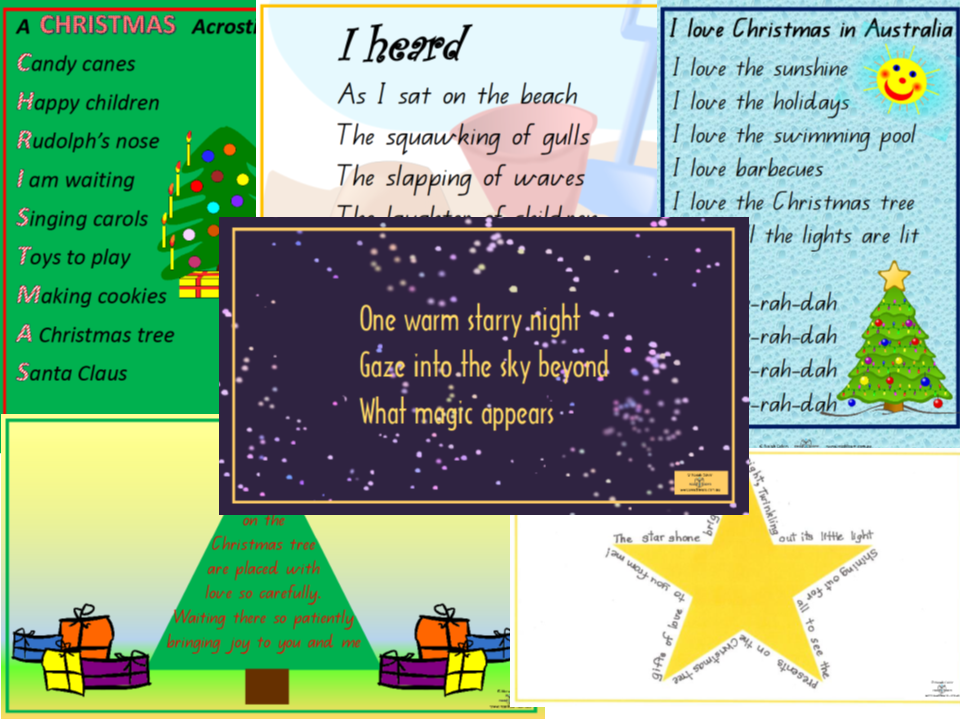
    The song “I love the mountains” is perfect for teaching to children and as a structure that children can use to write poems of their own. Sample innovations; for example, “Christmas in Australia” have been included just for that purpose in readilearn resources.

    poetry-examples-and-templates

    Writing “I love” poems is also a good way for children to express gratitude in their everyday lives, which fits perfectly with Thanksgiving celebrations in the United States, also this week.

    Happy Thanksgiving to my American readers!

    This week at the Carrot Ranch Charli Mills has challenged writers to In 99 words (no more, no less) write a story that is told around a campfire. It can be a bonfire, burning trash can, a fire pit, something flaming outdoors. It can be a prop, and you can tell the story of anything — ghosts, ancients, jokes. Who is gathered and listening?

    Even if you don’t intend joining in the challenge, and there is an extra week with this prompt if you are tempted, please pop over to the Carrot Ranch to read Charli’s fascinating report of her explorations of The Zion Valley area and of the historical artefacts and remnants she found there. You’re sure to find a gem or two, as she did.

    Here is my response to her challenge.

    Around the campfire

    “Smile,” they said. “It could be worse.”

    Than what: a compulsory “adventure”? navigating scrub lugging a loaded rucksack? avoiding plant and animal nasties? digging a toilet? erecting a recalcitrant tent? enduring inane chatter and laughter roaring as insanely as the campfire flames?

    “You’ll learn something,” they’d said.

    Fat chance.

    Darkness hung low like her spirits.

    Along with the dying flames, the mood quietened and, one by one, each told a story of horrors beyond her imaginings: of fleeing famine, war, abuse, hate …

    Along with the sky, her heart softened with the light of a new day, and gratitude.

    Thank you

    Thank you for reading. I appreciate your feedback. Please share your thoughts.


  • Early childhood resources for celebrating friendship – Readilearn

    Republished from readilearn

    In this post I suggest ways of helping children develop friendship skills, and describe some readilearn resources for celebrating friendship.

    Developing a welcoming, happy, supportive classroom environment, a place where children want to be, is essential for learners of all ages, but especially so in early childhood. These classrooms are the first that children experience and influence lifelong attitudes to school and learning. It is important to establish strong foundations with positive attitudes, respect, and friendship.

    Making friends doesn’t come easily to everyone. Simply being put with a whole bunch of other children of similar ages doesn’t ensure friendships will be established, or that children will be accepting of, and respectful to, others.

    Strategies for helping children develop effective social skills need to be interwoven throughout the curriculum. Respect, kindness, and empathy need to be modelled and taught. It is especially important for children who have had limited experience mixing with others, or for those who respond to others in inappropriate or unkind ways.

    Some useful strategies include:

    • Develop a vocabulary of words used to describe feelings. Words

    Source: Early childhood resources for celebrating friendship – Readilearn

  • 5 forms of poetry to write with children – Readilearn

    I love to write poems. Children do too.

    Giving young children a simple structure or a repetitive pattern to start from gets them thinking about words, how they sound, what they mean, the number of syllables and letters. All the while they are having fun, playing with words and sounds, and learning about language.

    Five easy poems to write with children are:

    • Acrostic poems
    • Sound poems
    • Haiku
    • “I love” poems, and
    • Shape poems

    Acrostic poems are one of the easiest. They don’t need to rhyme or follow a set rhythmic pattern.

    Click to continue reading: 5 forms of poetry to write with children – Readilearn


    Thank you for reading. I appreciate your feedback. Please share your thoughts.

  • Trick or Treat – it’s Halloween! – Readilearn

    The latest post from readilearn explains resources for a new board game to play at Halloween.

    The game is great for literacy and maths groups, to play with buddies or in family groups. It links literacy, maths and physical activity. Players collect treats and perform actions as they move

    Source: Trick or Treat – it’s Halloween! – Readilearn

  • A view from space

    Next week sees two celebrations:

    wsw-logo-color-wsw-text_dates_white_background1

    World Space Week from 4 – 10 October, and

    World Teachers’ Day on 5 October.

    On the readilearn blog this week there are 20 quick suggestions for teaching and learning about space in an early childhood classroom, as well as a bookmark that can be printed and given as a gift to a special teacher.

    Readilearn bookmark

    This post is republished from the readilearn blog.

    Since its inauguration in 1999, World Space Week has been celebrated each year from 4 to 10 October. Its purpose is to celebrate the “contributions of space science and technology to the betterment of the human condition”. The dates were chosen to commemorate the launch of Sputnik 1 on 4 October 1957 and the Outer Space Treaty signed on 10 October 1967.

    wsw2016-poster-final-global-with-text-small

    This year’s theme is “Remote Sensing: Enabling Our Future” which focuses on the contribution of observations from space to our knowledge of the world, including our ability to

    • monitor changes in the environment, and
    • understand and predict weather patterns,
    • which in turn assists planning for agriculture and helps to prepare for weather events.

    World Space Week has a free downloadable Teacher Activity Guide for classes from K – 12. While many of the activities are more suited to older students, there are some that can be adapted for the early grades.

    There are no particular requirements for participation. You choose how to involve yourself and your students. Or, better still, introduce the topic to the children and see where their questions and suggestions lead. Contemplating the skies and what lies beyond has excited imaginations since the beginning of human time. Why not give your children the opportunity to wonder, imagine, and create?

    If you have neither the flexibility nor the time to explore “space’ in depth, here are a few suggestions for incorporating learning about space in your busy program:

    space-week-display

    • Cover a large display board or wall with dark blue paper. (Each child could paint a piece of A3 paper to contribute to the background.) Add the children’s wonderings, questions, ideas, suggestions, pictures, and writing to the display.
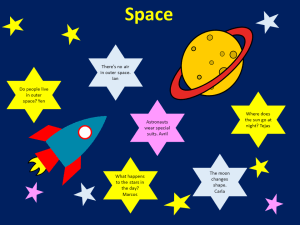
    • Ask children what they wonder about space, and record their wonderings. Many of their wonderings will match those of philosophers and scientists throughout history; for example, “Yen wonders if people live in outer space. Jan wonders what Earth looks like from space. Margot wonders how long it would take to get to the sun.” This is not a time for answers. It is a time for questions. If children are writers, you could supply them with (star-shaped) sticky notes on which to write their wonderings, one per note. Display the wonderings.
    • Record what children want to know about space. This is also a time for questions, and not for answers. There will be time for answers later. It is important for children to know that their questions are both valid and valued; for example, “Marcos wants to know what happens to the stars during the day. Tejas wants to know where the sun goes at night.”
    • Record what children already know, or think they know, about space, space exploration,

    Click to continue reading the original post.

    Thank you

    Thank you for reading. I appreciate your feedback. Please share your thoughts.
  • #Sugar and Snails BirthdayBlog Tour – The legacy of a Catholic childhood

    www.openclipart.org
    http://www.openclipart.org

    I have been friends with Anne Goodwin who blogs at Annecdotal for almost as long as I have been blogging. While there are many differences in our experiences, there is the right balance of agreement and divergence for friendly and robust discussion to occur. Anne regularly contributes to the conversations on my blog through her thoughtful comments.

    Anne has also visited as a guest blogger twice before. The first was a discussion of The Examined Life by Stephen Grosz. In the second she wrote about the treatment of friendship in her debut novel Sugar and Snails. This post celebrates that novel’s first birthday! Congratulations, Anne. I wish you much success with this and future writing.

    sugar-and-snails cover

    In this post, Anne discusses the legacy of a Catholic childhood. I hope you will join me in welcoming Anne to my blog.

    The legacy of a Catholic childhood

    It was our last evening in Rome, and we’d grown weary of churches, even when they hosted a Caravaggio painting or a Bellini sculpture. But it seemed a shame to leave without a peek inside the church we’d passed almost every day that week on the way to some museum or other attraction. So while my husband walked back to our rented apartment for a pre-dinner cocktail, I pushed through the heavy door.

    Just inside, I hesitated. I hadn’t expected there’d be a service in progress. I was mesmerised: the golden light; the scent of incense, the mournful melody of human voices accompanied by an organ. I registered this, not so much with my eyes and nose and ears, but in my gut. In another country, in a less magnificent church, this had been my childhood.

    Ignoring the disapproving gaze of the usher, I passed through the rope barrier holding back the tourists, to take my place among the congregation. I no longer shared their faith, but I felt entitled to share the ritual.

    My childhood, at Catholic schools, was passed within a bubble. It was something of a culture-shock to discover, at university, that the majority of people I encountered belonged to other religions, or none. Later still, more at ease in the secular world, it was always interesting when friends and colleagues outed themselves as former Catholics. Then there’d be that nod of recognition, a shared heritage marking our psyche more indelibly than the ashen cross the priest would thumb on our foreheads at the beginning of Lent.

    I believe that we are strongly shaped by the past, so what is the legacy of a Catholic childhood? Some have found solace in the beauty of the liturgy and the sense of community while others have had their personalities destroyed through unimpeded clerical abuse. Many, like me, would place themselves somewhere in the middle, regarding Catholicism not as something to celebrate but to recover from.

    The threat of eternal damnation incites fear, or disbelief, and neither is conducive to developing a person’s moral compass. Telling a child what she must believe, rather than letting her discover it, doesn’t facilitate an enquiring mind. While it might seem comforting to be able to believe there’s a God who will always take care of you, you’ve a more secure base if you’ve been brought up by parents who are responsive to your earthly needs. There seems to be a very fine line between putting your faith in magical solutions and the “delusions” of the psychotic mind. And the veneration of suffering and a tortuous death through crucifixion is decidedly odd. As for sex, the risky business of discovering a new kind of intimacy in adolescence is further distorted by the taint of shame.

    sugar-and-snails cover

    When it came to writing my debut novel, Sugar and Snails, it made sense to give my main character a Catholic childhood. Uncomfortable in her skin from childhood, Diana finds no salvation in the church. She recalls morbid childhood games and, aged about eleven, being taken on pilgrimage to Lourdes for a miracle cure for a problem no-one will name. As an adolescent in the 1970s, her knowledge of menstruation comes from the bizarre instruction manual, My Dear Daughter, an exercise in obfuscation of North-Korean proportions, which her mother surreptitiously places on her bed along with a packet of bulky sanitary towels. Although it would be unfair to blame it entirely on Catholicism, she doesn’t have sex until the age of twenty-five and then it’s so dreadful she is celibate for the next twenty years.

    Yet I didn’t want to stuff my novel with my own issues. Firstly, because I don’t think that makes for a good read; secondly, I didn’t want to alienate potential readers, especially not the old school friends to whom my novel is partly dedicated, most of whom have stayed loyal to their childhood beliefs. Fortunately, my novel’s first year of feedback suggests I’ve managed on both counts.

    In preparing this post, I realised that less than half the Catholic scenes from earlier drafts survived to the final version. While there are solid structural reasons for these deletions, it also strikes me that, in the almost seven years I’ve been writing this novel, I’ve become less angry about the past. Perhaps it’s because I’ve worked through it or maybe simply because, as in that church in Rome, I’ve been able to reclaim the good bits. No, I don’t go to church, but I do sing with a marvellous mixed-voice choir. While we have an eclectic repertoire, it’s the sacred works – Verdi’s Requiem, Handel’s Messiah and the like – that really make me tingle inside. For more on the music that shaped my novel, see my forthcoming post on the undercover soundtrack.

    birthday blog tour final

    Please check out some other stops and posts on the Birthday Blog Tour.

    Anne Goodwin’s debut novel, Sugar and Snails, about a woman who has kept her past identity a secret for thirty years, was published in July 2015 by Inspired Quill and longlisted for the 2016 Polari First Book Prize. Her second novel, Underneath, about a man who keeps a woman captive in his cellar, is scheduled for publication in May 2017. Anne is also a book blogger and author of over 60 published short stories. Catch up with Anne on her website: annethology or on Twitter @Annecdotist.

    In honour of its first birthday, Sugar and Snails is available in Kindle format at only £0.99 / $0.99 until 31 July 2016.

    Amazon UK 

    Amazon.com

    Thank you

    Thank you for reading. I appreciate your feedback. Please share your thoughts.