In just a couple of months it will be two years since I started blogging. Writing a blog had never been a goal of mine. In fact it would be fair to say that until I started blogging I didn’t have much of an idea of what it was; or of any social media platforms for that matter. I was a latecomer to the party considering, according to Wikipedia, blogging began in the 1990s!
My goal at the time of beginning blogging was, and still is, to set up a website of educational resources for use in early childhood classrooms or homes. The main message I received when attending a writers’ seminar about digital publishing was the importance of having an “online presence”. I took the advice and started tweeting and blogging. Here I am now, a semi-experienced tweeter and blogger, still a bit unsure about the online presence.
I started blogging with a goal of posting twice a week, which I have pretty much maintained since then. Initially I had just few readers, all of whom were “real” people, family and friends, I already knew. As much as I was, and am, very grateful for their continued support and encouragement, it was very exciting to receive my first “outside” comment two months later.
It was over four months before any new readers visited and commented regularly. Some of those first readers are still with me (Anne and Caroline), others have moved on, and others have since joined. Now I have a wonderful group of online friends. As with offline friendships we interact when we can, exchanging comments and ideas with each other, mostly on our blogs and Twitter.
I have been as fortunate with my online friendships as I have with my offline friendships. (I was tempted to use the word “real” instead of “offline”, but I consider my online friendships no less real.) We don’t have to see each other every day, every week, or even every month, for the friendships to flourish. Wherever the friendships form, they require certain ingredients to keep them strong, including:
respect, acceptance, attention, appreciation, gratitude, and open communication that goes both ways.
I really appreciate people who challenge and extend my thinking as much as those who are happy to jump on my bandwagon with me, or just come along for the ride.
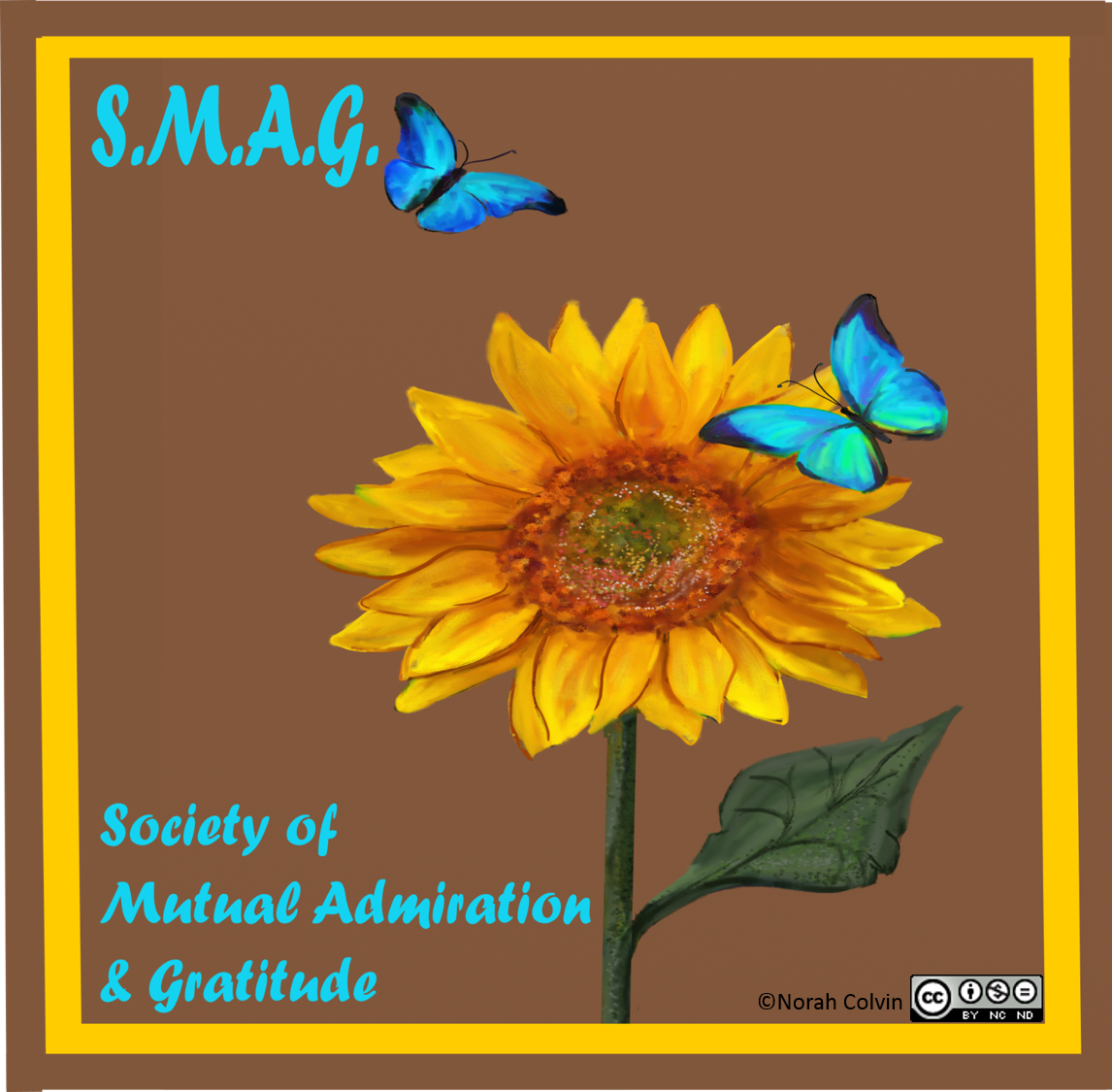
During the past few months when some of my blogging friends and I have been sharing appreciation for each other and our comments, I have suggested that we belong to S.M.A.G.: The Society of Mutual Appreciation and Gratitude.
It started off in a light-hearted way (yes, I coined it) but others seemed to appreciate the thought and welcomed the idea of belonging to a group that required of them no extra effort. I decided that a S.M.A.G. badge to be displayed by anyone who wished was in order.
In a previous post, I discussed the need for Making choices in how I allocate my use of time while working towards achieving my goals (including posting twice weekly). I shared thoughts about using a contest on 99designs to obtain illustrations for some of my work. While I was very happy with the illustrations, I was a bit uncomfortable with the contest process. However I decided that engaging each of the three runner-up finalists to do other illustrations in a guaranteed one-on-one project would (in my mind) help, in a little way, to make up for all the work they had done without reward. I have since done this and feel much happier about the process and am pleased with the results.
One of the designers, Kari Jones (ArtbyJonz), is now illustrating a second book for me and I approached her for the S.M.A.G. badge. This is what she produced. I love it. I hope you do to.
If you would like to display it on your blog, and share it with your blogging friends, I would be honoured for you to do so, but please attribute it to me and link back to this page.
I have found Kari wonderful to work with. She has been very helpful and accommodating and I am delighted with the artwork she has produced for me. If you are looking for illustrations I am happy to recommend Kari. You can check out some of her other work on her ArtPal page and contact her on Facebook if you have any queries.
So thank you, all my friends, for your continued support and readership. Whether or not you choose to post the badge, you are still part of S.M.A.G. and it is a pleasure knowing you.
Thank you for reading. I appreciate your feedback. Please share your thoughts about any aspect of this post.
Today I am sharing a lovely post published by Marilyn Warner on her blog Things I Want To Tell My Mother. Her post Ooops! is just a short one but it includes some mighty fine reminders:
• that mistakes can become successes if one doesn’t give up
• that mistakes are only failures if one chooses them to be
The ability to accept mistakes as inevitable, and to embrace the messages in them as stepping stones to success are important attitudes for learning at any stage. (And as Marilyn says, we are not talking here about life-changing, heart-breaking mistakes with tragic consequences, just the little ones that can be redefined if we don’t give up.)
Enjoy!
Thank you for reading. I appreciate your feedback. Please share your thoughts about this post.
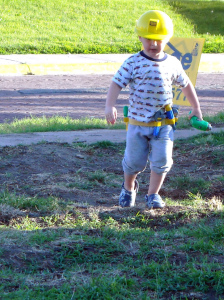
It would be a mistake to hire a 4-year-old to be your carpenter. Cute, maybe, but still a mistake. (Pictures by Marylin Warner)
Using the wrong fork is embarrassing, but it’s a minor mistake.
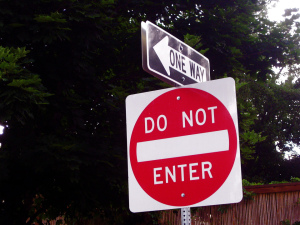
Texting or speeding and driving the wrong way can be a very serious mistake.
Years ago, before my dad’s Alzheimer’s and my mother’s dementia, they were included in a tour of one of the 3M facilities. When I asked how they’d liked it, my dad told me details from a businessman’s perspective. My mom’s perspective was different.
She remembered ACM—the initials of Acrylate Copolymer Microspheres—from the tour. She nicknamed them “A Creative Mistake,” and they became an inspiration.
In 1968 3M intended to create a super strong adhesive for the aerospace industry. But there was a mistake in the plan, and the end result was an incredibly weak product. Years later, the reworked mistake became Press’n…
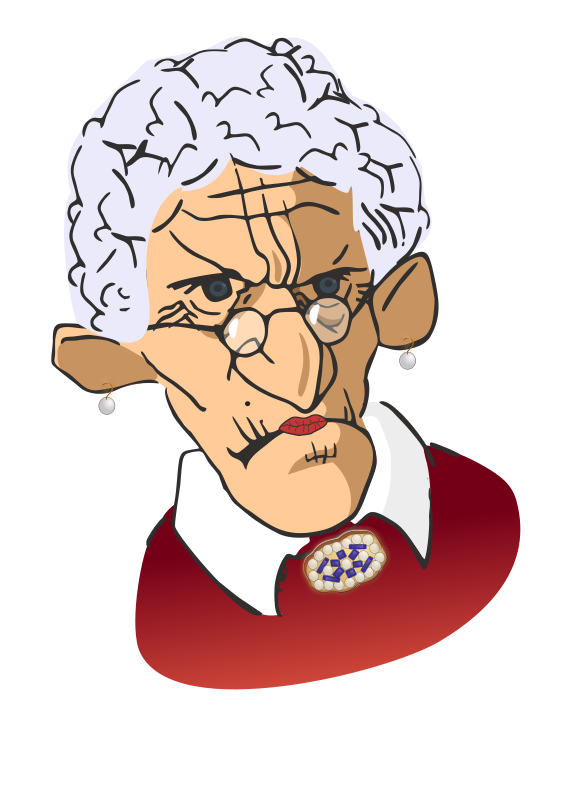
For the past few years people have often asked me when I will retire. Some people think I already have. Some think I am too young to be thinking about it (they are either very kind or very blind), and others think I should have done it long ago.
I have preferred to ignore the word ‘retire’ for the negative connotations I thought it embodied and the implication that I would have to admit to things like:
I’m getting old
I have nothing left to contribute
I am passed my use-by date and can’t keep up with modern trends and developments
I am ready for ‘God’s waiting room’. (I ‘m not even sure I’d be able to find the right room, and he’d probably keep me waiting for ever anyway!)
Even this morning I heard an ad on the radio that put together the concepts of retirement, having more time on one’s hands, retirement village and nursing home. If that’s what retirement means, it’s not for me.
When I was fifty-ish and working part-time, I awoke one morning to the realisation that, if I was going to retire at sixty, I had only ten years of working life left. With that in mind I returned to full-time work in order to earn as much as I could so that I could save enough to support myself in retirement. (I think I should have had the epiphany many years earlier!)
When the ten years of teaching full-time as a year one teacher were done, I was still not ready to consider the ‘R’ word. However just at that time an opportunity to be involved in writing curriculum support materials was offered. A short break from the classroom to refresh and re-energise was a welcome idea and I accepted the position.
After eighteen months in the role I reverted to working part-time in order to devote more time to my own writing while establishing a website for peddling said writing. I didn’t consider it retirement, transition to retirement, or anything to do with retirement. For me, the working week was simply a combination of paid work and working for myself. It was not time off.
Now another eighteen months has past and I am indeed counting down the ‘paid’ working days until ‘retirement’. In my head and heart I still don’t consider it retirement, perhaps a re-alignment of priorities, but others do. I am breaking ties with my long-term on-and-off employer for the fourth and last time. This time there will be no going back. Even though I may have said that on each of the three previous occasions I resigned and still went back; this time I am very doubtful of that occurring. This time it is ‘officially’ retirement, and I accept that if I have more time on my hands to do my own work, then that is a good thing!
It is the enthusiasm that others have for me and hearing them excitedly question, “What are you going to do?” that has helped my change of heart and I am beginning to accept theiruse of the ‘R’ word. Denial would be another unwinnable battle. So what if I intend to spend the days of my retirement at the computer? Getting a website up and running might be just an expensive hobby, but not as expensive as others I could think of, like boating or flying! And definitely more fun for me.
The changing view of self as transitioning through working full-time, part-time, being semi-retired, or retired is not unique to me. While some embrace the change, eager to accept every opportunity that freedom from employer demands and schedules has to offer; others like me sidestep in, with a similar appreciation of the freedom from outside expectations but an ever-increasing expectation of self.
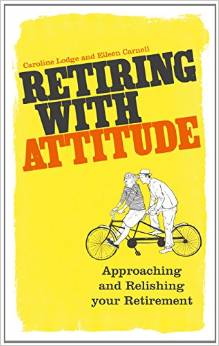
Last year “Retiring with Attitude”, written by one of my favourite bloggers Caroline Lodge and her colleague Eileen Carnell, was published. I found the title quite intriguing and thought it may apply to me, though I wasn’t sure to which attitude they were referring. However the subtitle “Approaching and Relishing your Retirement” gave a few clues and I knew I had to read it. Were they serious?
In the introduction the authors explain that retirement should be viewed as “a time of further exciting possibilities”. They set out their goals which include convincing readers that the “old” view of retirement (they say “previous”) is no longer applicable; that possibilities abound; that outdated views of ageism and sexism should be challenged; and that “Learning is the most powerful means to handle changes and transitions” that occur in the retirement phase of life.
“Retiring with Attitude” is an easy and enjoyable read which I recommend to anyone approaching (from near or far) or already in retirement. The authors have drawn upon their own experiences and many years of research from which to explain options and make suggestions for every aspect of life. While “Chapter 11: This is Your Rainy Day: Relationships with Money” does discuss finances, the book raises many other issues including seeking and accepting support as well as ways to ensure you are not over-committed to fulfilling others needs and requests.
The authors emphasize that there is no one way for everyone to do retirement but that learning and good communication are the key. They say that retirement can be the time of one’s life and that
“As an older person you can develop a new identity and redefine your life.”
I think that’s the ‘R’ word for me: Redefine. I’ll get to do those things I always wanted to do but didn’t have time for when my focus was elsewhere.
Thank you for reading. I appreciate your feedback. Please share your thoughts.
Regular readers of my blog are aware of my attitude to didactic top-down, content and assessment driven methods of schooling students to become machines regurgitating meaningless facts on command. A bit of push and shove it in and belch it out. For those of you who weren’t aware – now you are!
I probably should apologise for my indecorous description as I’m usually a little more temperate in the way I express my views, but I won’t as that is how I am feeling about it at the moment. The authorities who have the power to make the changes necessary are so caught up in their own murky visions that they fail to see either effects or solutions. Every time I read another report of test scores or hear of another child damaged by a faulty system my frustration grows. It becomes one of those hysteria blossoming days.
As the title suggests, Vietnamese fifteen year old students did better than their US, UK and most other EU counterparts in the 2012 PISA tests, ranking 12th out of 76. What I found interesting about the article was not the results but the attitude of Vietnam’s Deputy Minister of Education and Training. His view that the tests don’t reflect students’ overall competence, reminded me of a letter, shared in my previous post, written by teachers to students sitting the national tests last week in Australia. (PISA are international tests).
In the article referred to by Ravitch, Dr Giap Van Duong was reported as making reference to UNESCO’s four pillars of learning: Learning to know, Learning to do, Learning to be and Learning to live together. His opined that PISA addresses only the first pillar, and in only a limited way. He said that while Vietnamese students did well on the tests, “many … students fail to land a job after graduation. (and that when) they study overseas, many have difficulties in meeting the requirements of advanced education systems like team-work, problem solving and creativity”. Perhaps they are not “out of basement ready” as described by Yong Zhao.
Duong said that the reason Vietnamese students do well on the tests is because the “The whole system operates to serve only one purpose: exams.”
Duong’s admission that Vietnamese students lack the ability to work in teams, to problem solve and to think creatively reiterates the fears of many teachers who are ruled by expectations of high test results and provided little opportunity to inspire learning, which surely remains the real (if neglected) purpose of education. Counterbalancing one’s philosophy with an employer’s expectations sometimes seems like being caught between a rock and a hard place.
It is connections that are most important in my two main roles in life: parent and teacher. Neither is easy and neither will result in much good without making connections. I often worry about things I have said and the affect they may have had on others. To be truthful, occasionally it even keeps me awake at night. While I would rather think of my words and actions creating a positive ripple, there is no guarantee that, even when delivered with my best intentions, they won’t do harm.
“teachers have (the power) to develop their students and shape their future lives. The power to turn them on or off academically, stimulate or dampen their minds and heighten or destroy their engagement and intellectual curiosity.”
Scary stuff!
At about the same time I read an article that said that the influence of teachers is not as great as one might think; that socio-economic status, amongst other things, is more important. While I am happy with the thought of having a positive effect, I definitely do not wish to ruin anyone’s life so am happy to know that my influence is not be the most important to the lives of my students.
For this challenge of Charli’s I am back thinking about Marnie’s art teacher and the hard place she found herself in when she saw the brown muddy mess that Marnie seemed to have made of her paints. That she must respond is a given; but how? Whatever she says will probably have a lasting impact so she must ensure that her response is appropriate. While her initial instinct is to express disappointment, she maintains her professional composure and delays commenting until she has thought it through.
Here is my response:
Brown.
She glanced at the child, usually so eager to please, and knew this was no ordinary day.
Downcast and avoiding eye contact, the child trembled. Her instinct was to reach out with comfort to soothe the hurt; but stopped. Any touch could end her career. What to say? Brown earth/brown rocks? would ignore and trivialise the pain. Any talk now would be insensitive with other ears listening. Any word could unravel the relationship built up over time. Nothing would harm more than doing nothing. Her steps moved her body away but her heart and mind stayed; feeling, thinking.
Thank you for reading. I appreciate your feedback. Please share your thoughts about any aspect of this post or flash fiction
When thinking about schooling and education there is always a lot of discussion about readiness and the things that must be done to have a child ready for school, ready for the next class, ready go to college or university . . .
While I agree that a learner must be ready to take the next step, to broaden understanding of a concept or to grasp the complexity of deeper issues; just what that readiness requires is often up for conjecture.
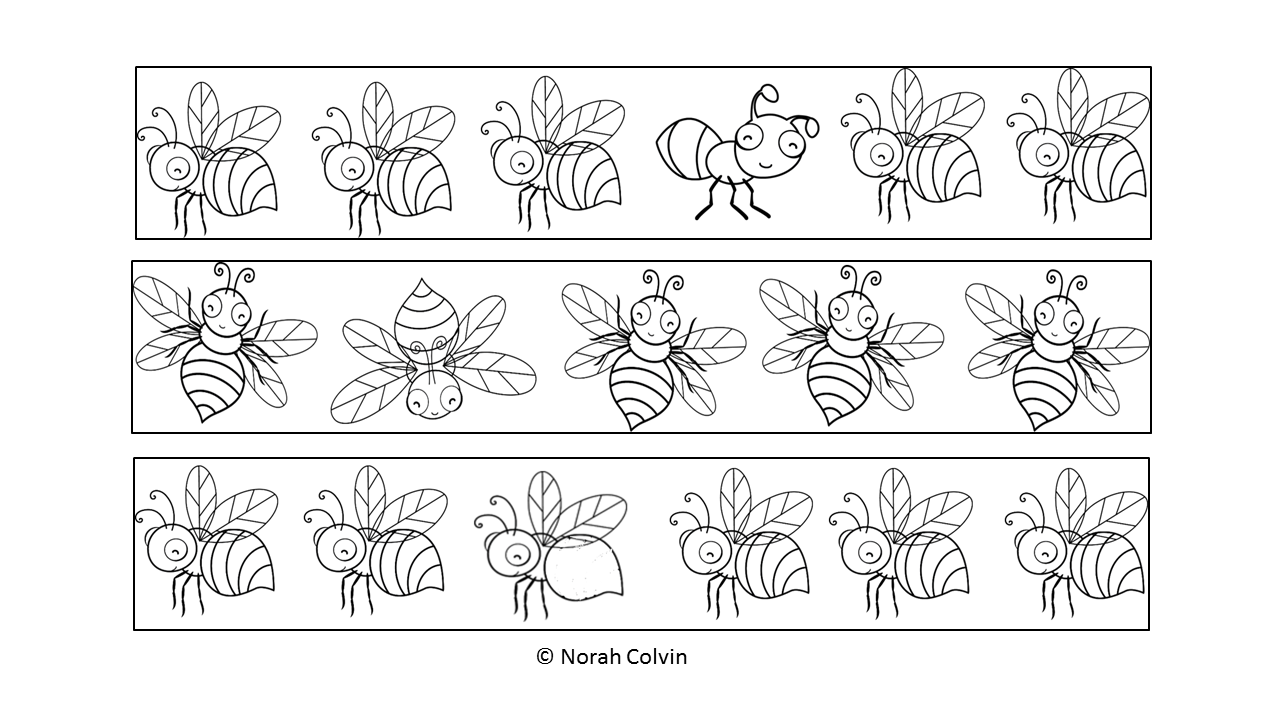
Back in the early days of my teaching experience workbooks of ‘reading readiness’ exercises were frequently used with students in their first year of school. These activities generally required children to identify the one that was different in a group of objects. The exercises, such as those shown below, progressed through various levels of difficulty with the aim of preparing children for reading.
Fortunately our understanding of how reading is learned has progressed since then and it is now recognised that exercises such as those did little to prepare children for learning to read. We now know that the best preparation for reading is to be immersed in language through conversations, with adults especially; to be read to frequently; and to develop a love of books and interest in print by sharing with others. The role of parents in preparing children for reading cannot be underestimated.
This week I watched a video of a presentation by Yong Zhao about a type of readiness he referred to as “Out of basement readiness”. I admit I hadn’t heard the term before but the concept is definitely familiar.
I do recommend you listen to Zhao’s talk. It is interesting, thought-provoking and humorous. I think I enjoyed listening to this talk as much as to Ken Robinson’s on How schools kill creativity which I have mentioned in previous posts here and here, amongst others. However at 55 minutes some of you may not be willing to commit the time. For me, it is 55 minutes of my life I’m very happy to not get back!
I will not attempt to share all the content of the talk; there is too much of value, but here are just a few snippets that resonated with me:
Zhao explains out of basement readiness this way:
Zhao says that students are being mis-educated, that they are being educated for something that doesn’t exist, and suggests that we should remove several phrases from the language we use to talk about education, especially
Under-performance
Evidence based
Data driven
His description of the traditional education paradigm will be familiar to any frequent readers of my blog. He says that it is “about forcing people to do what some other people prescribe them to do” and that we reduce it to just a few subjects that can be tested.
He talks about the “homogenisation” of schooling, and explained that homogenisation was the best way of getting rid of creative people and innovative thinkers.
He mentioned kindergarten readiness tests, and suggests that the only test should be whether the kindergarten was ready for the children and parents.
He recognises the uniqueness of every student, with different backgrounds, motivations and talents; and stresses the importance of effort. He says, “You cannot be born to be great. If you do not put effort into it you can never be good at it.” He explains it this way:
“If you put ten thousand hours into something you are good at, something you are interested in you get great talent. But if I force you to spend time on something you have no interest in, you hate and something you are not good at, you at best become mediocre.”
He says that countries that produce high test scores, score low on confidence and interest.
He says,
“Everyone is born to be creative, that’s a human being, that’s our gift: to be able to adapt, to learn and relearn and do new things. But school has typically tried to suppress it (with) . . . short term learning. . . Direct instruction may give the short-term gain but cause long term damages Studies show that if you teach children how to play with the toy, they lose creativity, lose curiosity and if you allow children to explore more they may not test very well but they maintain creativity and curiosity.”
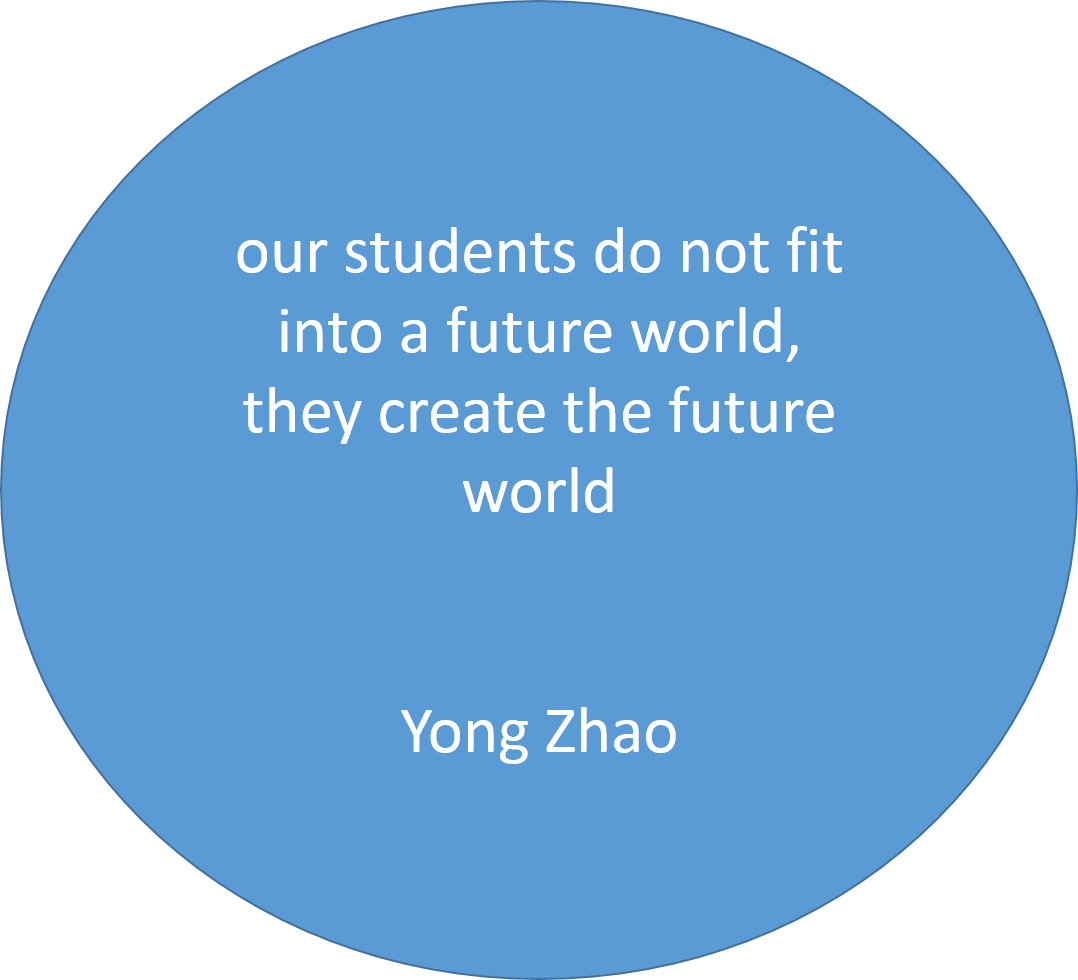
Zhao says that “our students do not fit into a future world, they create the future world. This is why we need a different type of education.” He says that “education is to create opportunities for every individual student, they are not an average, they are not a probability, they need to be improved as individual human beings.”
I couldn’t agree more. What do you think?
I was led to Zhao’s talk via Diane Ravitch’s blog which is about the education system and situation in the US. Much of what she writes has applications further afield and I recommend it to anyone wishing to stay informed of current issues in education.
Thank you for reading. I appreciate your feedback. Please share your thoughts on any aspect of this post.
Charli describes racism as a “social earthquake that divides our common ground”. She says that “Our first step is to recognise our one race: human (with a) colourful kaleidoscope of culture.”
Charli suggests that writers “Think about common ground, about the things that rip us apart as humans. How we can recover our identities in a way that honors the identities of all individuals? What breaks the barrier of other-ness? Imagine a better tomorrow that doesn’t need expression in riots or taking sides on social media. As writers, think about genres, characters, tension and twists. We can rebuild.”
In my comment on Charli’s post I admitted that I am not qualified to write on this issue. I am fortunate to have never experienced the negativity of racism, the cloak that can at the same time judge one to be invisible and without value or singled out in the spotlight of blame. The responses of those who have, from the moment of their birth, needed to prove the value of their existence are often judged without understanding or sympathy by those who have experienced no such discrimination and whose attitudes are so ingrained as to go unnoticed.
Consider this exchange between work correspondents who decided to meet up at a conference. “How will we know each other?” she asked. He responded, “I’m black.” In recounting this episode to friends, she said, “I’ve never thought of myself as white.” Perhaps until all feel their skin colour is not an issue, any more than eye or hair colour, it will remain so.
I am not participating in the flash challenge this week, feeling unable to write something that would give sufficient recognition to the gravity of the divide that is racism. However I do not want my silence to be seen as lack of concern, or negation of the importance of the issue. Instead I will use my post to amplify the voices of others.
Dr Enyimba Maduka from the Department of Philosophy, University of Calabar in a paper entitled “Racism and Philosophy: An examination of Human and Kantian Racial Thoughts” considers the history of racism and the effects it has had on the mindsets of African peoples and cultures as well as Western philosophies. Maduk specifically targets and explores writings by Hume and Kant.
He says that racism can be understood “as a functional rationalization and symbol for oppression; (that it is) an attitude always directed at the vanquished not the powerful; it is the colonized who are the victims of racism and not the colonizers.”
He also says that “when human persons refuse to recognize the authentic humanity of their neighbours and fellow human beings, they cease or fail to be human persons themselves”. Strong words, definitely requiring reflection.
Listen to Clint Smith explain everyday limitations imposed by, and reminders of, skin colour; and ponder their humanity:
Or read the letter to his future son, expressing his hopes and dreams and fears. His message reiterates Charli’s call to rebuild.
He says,
“do not for one moment think you cannot change what exists. This world is a social construction; it can be reconstructed. This world was built; it can be rebuilt. Use everything that you accrue to reimagine the world.”
Or listen to James A. White Sr. describe the difficulties he had in renting a house, and consider how patient and resilient you may be in similar circumstances. Some of these situations I find difficult to imagine. White Sr. “aims to share his experiences of racism in order to stress the message that all races, genders and backgrounds must come together to challenge the status quo.”
Or perhaps Nina Jablonksi, an anthropologist, who says that skin colour is an illusion.
The ability to learn language always amazes me. Given a supportive environment most young children will learn the language of the home effortlessly; forming their own hypotheses about its use and very quickly understanding the complexities of language structures and nuances of meaning.
I am also impressed by the fluency and comprehension of many for whom English is not their first language. I briefly touched on some of the difficulties experienced even by users of English as a first language in a previous post about spelling. Sometimes I wonder that communication is possible at all, especially when considering local idioms and sayings that make little sense out of context, but largely go unnoticed. What must a new speaker of English think when encountering “Bite the bullet, break the ice, butter someone up, or even bring a plate”.
How difficult it must be too, when words, like vice for example, have multiple meanings.
This week at the Carrot RanchCharli Mills has been talking about vice. Her article is about the not-so-pleasant type of vices. As usual, I like to be the contrarian and consider alternative viewpoints. That might be considered one of my vices. Sometimes I laugh when a thought takes me to a context far away from a speaker’s intended message. Other times I fail to see the intended humour, reading beneath the surface intent to hidden messages.
To illustrate this I will use two recent examples:
The cyclist and the flight attendant
He: a cyclist, just entering the last third of his life (about 60, give or take 5 years)
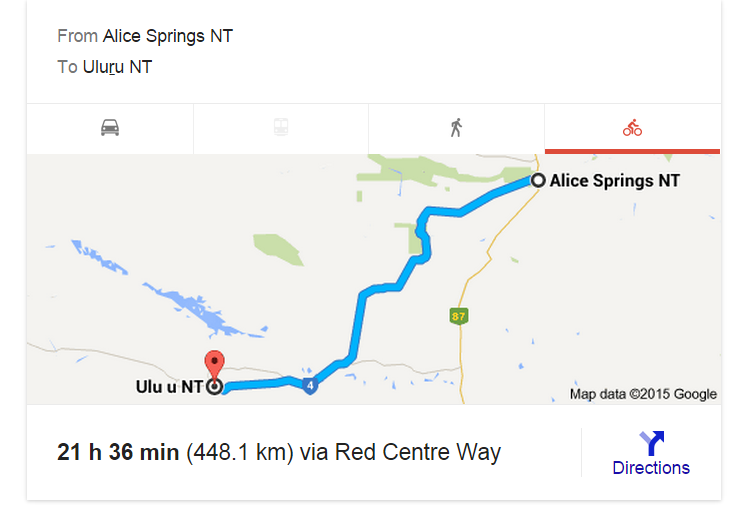
As his bike was being loaded onto the plane he explained that he had ridden from Alice Springs to Uluru, the long way. (I’m not sure of the distance of the long way, but the direct way would be more than long enough for me!)
She: a flight attendant still in the first third of her life (about 25, give or take 5 years)
“That’s so awesome! I hope I continue to exercise all my life.”
I didn’t hear his response; I was laughing too hard: the innocence and blindness of youth. How well I remember thinking anyone over about thirty was at death’s door. What amuses me now is the number of people my age who think we are much younger than those of the previous generation at the same age. I think the blindness and selective sight continues throughout life.
Of course I interpreted her words to mean: “You’re so old. I can’t believe you could do that. I hope I can still exercise when I am as old as you!”
The joy of fatherhood?
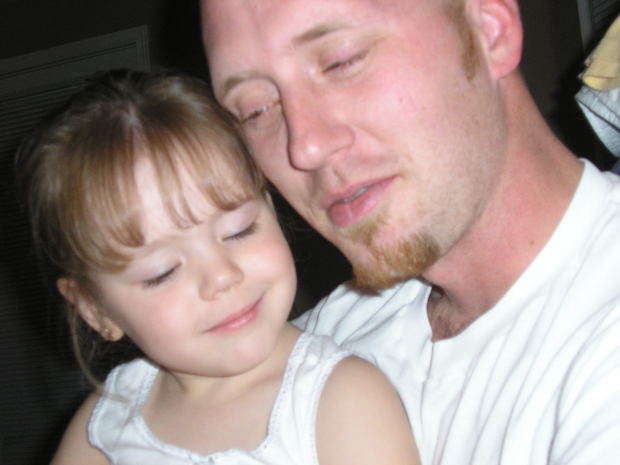
Waiting for the same flight was a father and his daughter, approximately two and a half years of age. The daughter was doing what any child of that age would do: looking around, exploring a short distance away from dad before returning to his side. From what I could see she was doing no harm and was perfectly safe. It was a small airport, she could not wander far.
Each time she moved away he barked a short command at her. Although his words were not familiar to me, I had no difficulty interpreting them. As with most children, sometimes she heeded them, sometimes she didn’t. Sometimes he repeated the command, or retrieved the child. Sometimes he didn’t.
Then I saw his t-shirt and read the word emblazoned on the front. I am a reader. Sometimes I wish I were not. The words read, “Guns don’t kill people, Dads of daughters do”.
I have never “got” the need for messages on apparel, and definitely not a message as negative as this. I assume it was meant to be amusing, but I could see no humour in it. Maybe he didn’t understand the message underlying the words (he was speaking in a language other than English). Maybe I read too much into it. Apparently though, according to this Google search, there is a sizable market for shirts and products extolling these sentiments, some even with the inclusion of the word “pretty”.
My interpretation of the subliminal message is one of acceptance of a number of vices, and my belief is that until we can obliterate the insidiousness of messages such as these from the common psyche, our society won’t much improve. To me the message commends: disrespect for others, sexism, murder, violence, antagonistic relationships between parent and child/father and daughter, an absence of nurturing, an acceptance that children are difficult and a burden . . .
Perhaps I should stop there. I think this father and daughter team would be prime candidates for the early learning caravan project I wrote about recently. I would love to help this father see, not only the power in his words, but the treasure his daughter is and the importance of their relationship.
As I’ve explained, I sometimes see humour in words where it’s not intended, and fail to see it where it is. I’ve attempted to include humour in my flash response to Charli’s challenge to In 99 words (no more, no less) write a story that includes a vice, by using three different meanings of the word. I’ll be interested to know if my “humour” matches yours, but won’t be surprised if it doesn’t!
Over the past few months in response to flash fiction challenges set by Charli Mills at the Carrot Ranch, I have been writing snippets from the life a character, Marnie, whose story is beginning to emerge as I respond to the prompts.
A couple of recent prompts had me writing about a particular situation which involved mixing paints in an art class. While all flash fiction stories relevant to Marnie’s story can be found on her own page, the two specific to this post can be read here and here (scroll to the bottom of each post for the flash fiction).
I was appreciative of the comments on both posts, with those specific to Marnie’s story encouraging me to reflect and think more deeply about the art class situation in relation to both Marnie and the teacher. While I am still mulling over the appropriate response the teacher may make, I thought I would write a longer piece to explore one possibility from Marnie’s point of view. This episode also relates to other flash fiction pieces, but hopefully the longer episode will be strong enough to stand on its own.
Art class
Marnie looked at the paints. The bright colours reminded her of a rainbow, and her unicorn. Her gaze dropped. She needed her unicorn now, but it was up in the office, drying out on Mrs Tomkin’s desk.
“It will be here waiting for you at home time,” Mrs Tomkin had said, smiling. “Okay?”
Marnie nodded, reluctantly, knowing there was no other choice. At least there was only the afternoon session left, and that was art with lovely Miss R.
Miss R. always wore beautiful dresses with colourful patterns. She had long wavy red hair, the colour of Marnie’s and her nails were always painted brightly, sometimes decorated with stars, sometimes with hearts, and sometimes with other patterns. She smelled of paint, and chalk and crayon and other scents Marnie found delightful. She noticed everything about Miss R.; because Miss R. noticed her. Miss R. always had a kind word to say:
“I like the way you used this shade of blue for the sky. I can see a storm is brewing.”
“Tell me about this picture. What’s it all about?”
“I can see you worked hard to get that looking just right.”
Marnie liked it best when she said, as she often did, “I like your choice of colour, Marnie. Your pictures are always bright. They make me happy when I look at them.”
But not today.
Miss R. stopped and looked at Marnie’s work. Her paper was covered in paint the colour of brown mud. Marnie felt Miss R.’s eyes on her work, then on her. She didn’t look up. She didn’t want Miss R. to see the tears that were threatening to fall, that would fall whatever was said. Her lip quivered.
Miss R. moved on.
“I am not crying. I am not, not, not . . .” but it took all her strength when her insides felt as muddy as the paint on her paper. She felt like mud. Maybe she should look like mud too. She smeared her paint-covered hands on her shirt, and wiped the strand of hair away from her eyes. She wanted to tell Miss R. She wanted to tell her about Bruce and what he had done. But she dare not. Bruce had threatened her and she knew he meant it.
Bruce had tripped her at lunch time and she’d fallen into the puddle. The mud had covered her from head to toe. She’d tried to hold her unicorn high; tried to keep it out of the mud. But it had fallen as she hit the ground. It was all muddy too. Everyone had laughed. Everyone except Jasmine, that is. Jasmine had taken her to Mrs. Tomkin, who had helped her clean herself up and gave her some clean clothes to wear. Mrs Tomkin had said she’d call her Mum, so that was another problem looming. At least things would be okay in art with Miss R.
But not today.
Bruce had pulled faces at her and made threatening arm movements as they lined up. He made fun of the oversized shirt Mrs Tomkins had found for her. Everyone was sniggering at it; at her.
Marnie looked straight ahead, trying to ignore the stares. “I am not crying!”
Then Miss R. was there and she suddenly felt protected, like everything was going to be alright; for a little while at least.
But not today. Today was a bad day, a very bad day. It had been bad in the beginning, and it was going to be bad at the end too. Nothing she could do.
Miss R. handed out the papers and paints. Everyone had their own brush but a small pot of water was shared by four.
Marnie couldn’t wait to get started. She knew what she was going to paint: a rainbow and a unicorn! Maybe a tree and some green grass, with some flowers. She couldn’t have her own unicorn but she could paint it. Miss R. would like her bright happy colours, and her pleasure would make her feel better, for a little while at least.
But not today.
While Marnie was contemplating which colours to mix for her unicorn’s mane, Brucie reached over and snatched Marnie’s brush. With one flourish he had dragged the brush through the middle of each of her colours leaving a dirty brown trail. Marnie had opened her mouth to speak, but Bruce silenced her with a threatening motion of a finger across his neck, as it to slit it open. He stashed her brush on the shelf out of reach, and turned back to his paper, innocent-like. Marnie’s eyes searched for Miss R.’s hoping she had seen and would come to her rescue. But Miss R. was talking to Jasmine and some others at the front, and didn’t see.
Marnie looked at her palette. “I am not crying,” she thought as she tried to still her quivering lip and stop the tears that would give Brucie so much pleasure.
She looked at him and poked her tongue. He held up a fist.
Marnie rubbed first one hand, and then the other into the coolness of the paint, blending all the colours. It felt soothing somehow, the way her hands slid easily through the paints. She watched each colour disappear into the muddy brown she was creating, wishing she too could slide away and disappear where no one would notice her anymore; where no one would taunt or bully or harm. If they couldn’t see her, if she was invisible, maybe she’d be safe.
She looked at her palms – covered in brown, just like the mud that had covered them earlier. She smeared the paint on her paper, covering it from edge to edge so nothing of it remained. She wiped what was left on her shirt. What did it matter? She couldn’t be in more trouble than she already was. They were already going to kill her. Sometimes she wished they would. Sometimes she wished she’d never been born. Sometimes . . .
Miss R. stood beside her desk. Marnie could hear her breathing; could still smell her marvellous scents above that of the muddy brown paint that was now her camouflage. She longed for Miss R. to paint her life away, to ask her about her work and what it meant. But she willed her not; and it must have worked because she walked away. How could she tell her? Her life was as muddy as the paint and she could see no way out.
Thank you for reading. I appreciate your feedback. I’d love to know what you think of this as a possibility of Marnie’s thinking.
Most teachers try to incorporate a variety of experiences into their programs in order to maximise learning opportunities in the hope that, if students don’t “get” it one way, they will “get” it in another. The imposition of national standardised assessment makes doing this a challenge for teachers. The increased requirement for the implementation of particular approaches to teaching makes it even more so.
To say that I hold fairly strong views about learning, and the differences I consider there to be between education and schooling is perhaps an understatement, but it wasn’t always so.
My memory tells me that, while I probably didn’t “love” school, I probably didn’t “hate” it either. It was simply something that I had to do. I didn’t question it. I did my best to be a “good” girl, do what was expected of me, and conform. All of which I think I did pretty well.
The questioning came later and had more impact upon my teaching and parenting than it did on my own schooling. I came to view schooling as something that is “done” to us, and education as something that we do for ourselves. That is not to say that no worthwhile learning takes place in school, for it does, but education is a whole-of-life experience and schooling is but one small part of that.
However, if the importance of schooling, and here I mean learning of particular content by particular ages, is inflated and rated more highly than children’s natural curiosity, interests and abilities, then the consequences to individuals and the community in general can be more negative than positive. One consequence may be that children don’t enjoy school; another may be the view that only school knowledge is important; and yet another may be that children are turned off learning all together.
My first conscious discomfort with what, for convenience, I’ll call a factory model of schooling (children go in one end, have things “done” to them, and come out the other end all the same) was as a young teacher when all five year two teachers were expected to be doing the same thing at the same time. That imposition, along with other inadequacies that were beginning to become apparent, set me on a quest to learn more about learning and education. My quest has never ceased and I am still searching for answers.
Recently I read a book by Daniel T. Willingham entitled “Why Don’t Students Like School?” The title had instant appeal, of course, and I thought I’d recognise a few of the reasons at least. My initial expectation was of reading views similar to those of authors like John Holt, Ivan Illich, A.S. Neill and John Dewey whose books I had read in the 70s and 80s; but a closer look at the subtitle told me I was in for more: “A Cognitive Scientist Answers Questions About How The Mind Works and What It Means For The Classroom”.
The book is a wonderful read and I’m certain to share many of Willingham’s ideas with you in future posts. I enjoyed it because, in almost equal measure it reinforced, challenged and extended my thinking about many aspects of learning and how best to provide for and stimulate it in a classroom setting.
Sometimes Willingham would make a statement with which I agreed, and then go on to explain the faulty thinking behind it. Sometimes his statement would seem to completely contradict what I think but his explanation would show that we simply had different ways (mine perhaps inadequate) in explaining it.
What I really appreciate about the book is that Willingham carefully translates what has been learned from research into practices that can be implemented in the classroom to enhance student learning. Often research seems only to tell teachers what they already know from experience and observations, or provides information in such an abstract way that nothing of practical use can be gleaned.
The section of Willingham’s book that I refer to today is “Chapter 7 – How Should I Adjust My Teaching for Different Types of Learners?” Willingham opens the chapter with the words “All children are different.” He says that some learn visually, some auditorily; that some are linear thinkers and some holistic, for example, and that
“It seems that tailoring instruction to each student’s cognitive style is potentially of enormous significance”.
The important word in that sentence is “seems”. He talks about the differences in the way that hypothetical Sam and Donna might learn and says that “An enormous amount of research exploring this idea has been conducted in the last fifty years, and finding the differences between Sam and Donna that would fit this pattern has been the holy grail of educational research, but no one has found consistent evidence supporting a theory describing such a difference.”
He states that the “cognitive principle guiding this chapter is:
“Children are more alike than different in terms of how they think and learn.”
That statement really made me sit up and take notice: “Children are more alike than different”. But it turns out, those words are not the most important ones in the sentence. The most important ones are: “in terms of how they think and learn.”
He goes on to say that, “the claim is not that all children are alike, nor that teachers should treat children as interchangeable. Naturally some kids like math whereas other are better at English. Some children are shy and some are outgoing. Teachers interact with each student differently, just as they interact with friends differently; but teachers should be aware that, as far as scientists have been able to determine, there are not categorically different types of learners.”
He also talks about it in this video:
Willingham acknowledges that students differ in their cognitive abilities and styles. What he does in the chapter is “try to reconcile the differences among students with the conclusion that these differences don’t mean much for teachers.” In reading these words one might expect that Willingham is proposing that differentiation is not an important part of classroom practice. But such is not the case, as stated in this video:
In the book he writes, “I am not saying that teachers should not differentiate instruction. I hope and expect that they will. But when they do so, they should know that scientists cannot offer any help.” According to Willingham, scientists have not identified any types of learners or styles of learning. He says, “I would advise teachers to treat students differently on the basis of the teacher’s experience with each student and to remain alert for what works. When differentiating among students, craft knowledge trumps science.”
What Willingham says is of most importance for a learner to learn is background knowledge. If a student does not have sufficient background knowledge to understand the content or concepts which are presented, learning will not take place. This supports the advice that I repeatedly give to parents: read to your children, talk with them, and provide them with a wide range of experiences and activities.The same is true for teachers: ensure the students have sufficient knowledge on which to build the new work you are expecting them to grasp.
This week at the Carrot RanchCharli Mills has thrown a prompt with which I have struggled: In 99 words (no more, no less) write about the day the earth turned brown. I always like to tie my responses to the educational focus of my blog and this one had me stumped for a while. A mind journey following various twists and turns, retracing well-worn paths, and hitting many dead ends, finally led me to an oasis in the parched brown earth: the uniqueness of each of us; the amazing potential of each new child to create possibilities beyond our imagining; and the contrasting effect of a narrow test-driven school system that attempts to reduce each to the sameness of minimum standards and age (in-)appropriate benchmarks. A paint palette seemed a suitable medium for the story.
For those of you who have been following Marnie’s story, I apologise. She makes no appearance this time, though I have not ruled out the possibility with student M. I’d be pleased to know what you think.
Palette potential
She walked between the desks admiring their work. From the same small palette of primary colours, and a little black and white for shades and tones, what they produced was as individual as they: J’s fierce green dinosaur and exploding volcanoes; T’s bright blue sea with sailing boat and smiling yellow sun; B’s football match . . . At least in this they had some small opportunity for self-expression. She paused at M’s. M had mixed all the colours into one muddy brown and was using hands to smear palette, paper, desk and self . . .
Thank you for reading. I appreciate your feedback. Please share your thoughts about any aspect of this post or flash fiction.
In my most recent post I discussed my goals and the steps I was taking towards, and away from achieving them. Writing that post, and receiving your wonderful comments, advice and suggestions, provided me the opportunity of really assessing how I spend my time and of deciding where to from here; at least until I meet the next juncture anyway.
I love the writing community that welcomed me so warmly and of which I feel very much a part:
The friendship and sharing
The open communication and exchange of ideas
The feedback and encouragement
The writing practice
The opportunity to be doing something with my time – it does a good job of keeping me off the streets!
The impact that being a part of this community may have on my ability to reach other goals may never be known. But for now it meets other needs in many wonderful ways that I am not prepared to forgo just yet. I may need to reassess the content of my posts in view of my writerly, as opposed to teacherly, audience; but since you have all accepted and responded so well to them thus far, maybe not. I can’t think what else I know about anyway!
However, I must prioritise my other work as well.
To do this I have refined my record of comments:
to include the twenty bloggers I engage with most frequently (reduced from the approximately thirty I showed on the infographics in that previous post, and seventy plus I had in the table when I began the record!)
by arranging the bloggers alphabetically to make them easier to locate and record
to match the Monday to Sunday week used in WordPress stats (I was using Sunday to Saturday previously)
While I have not unfollowed any bloggers, I have requested to not be notified of new posts of bloggers who have not engaged with me. This will reduce the number of emails I receive and therefore the time taken in dealing with the burgeoning inbox. I won’t be distracted by their content; and, if I have any spare time, I can always check out their posts in my reader.
Reducing the number of emails I receive each day is one of the things I am looking most forward to! It has always been a bugbear.
I have also decided that I will not actively seek new blogs to follow at this stage but will continue to maintain existing relationships. However if someone new engages with me, I will be more than happy to respond.
These changes should help me devote more time to other projects.
I have already written a lot of teaching resources. Unfortunately I am no more of an artist than I am a singer and, since my resources are mainly for use in early childhood settings, most of them need to be illustrated. My niece has illustrated some for me but she has her own life and busy work schedule as well so I need to look further afield.
Last week I decided to take action.
I signed up to 99 designs and ran a contest to see if it was possible to get some illustrations for one of my stories. It has been a steep learning curve and very interesting; even a bit harrowing at times. Many artists submitted work in the contest and I have narrowed it down to four finalists. I am running a poll to get some advice on the illustrations. I’d appreciate your thoughts if you have time to check it out.
I feel a bit uncomfortable with all the work the artists have done, in the hope of winning the contest (these are 99designs’ terms), but it seems to be the way it is done so I guess they are aware of and expect it. I am already looking towards future contests and getting more work illustrated. I may also look at other options, so if you have other suggestions I’d be pleased to hear them.
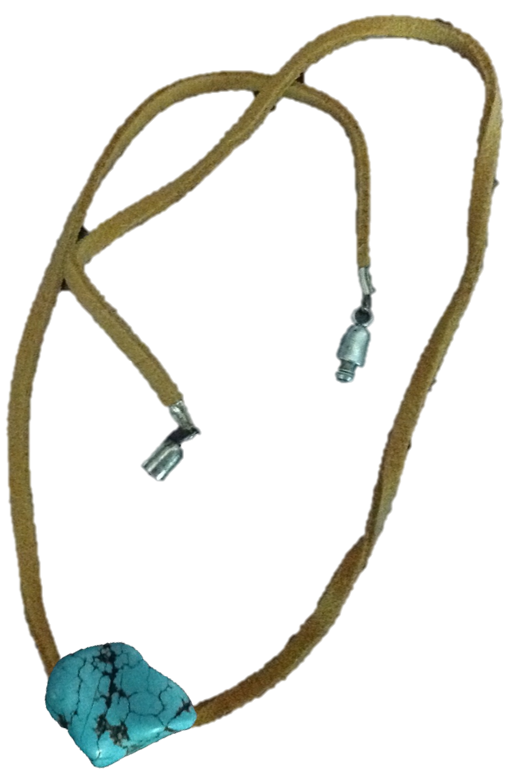
I’ve been trying to think of a segue from there into my flash fiction response to the challenge set by Charli Mills at the Carrot Ranch this week. Charli’s prompt is to In 99 words (no more, no less) include a juxtaposition between the ordinary and natural worlds. Now that I look at it again, I’m not so sure my response quite fits, so perhaps that is fitting in itself. It seemed like a good idea at the time: matching the turquoise stone to the colour of Marnie’s eyes, which I didn’t even include!
Here it is anyway, the next little revelation of Marnie’s story that continues on from this one:
Juxtaposition
She paused her dusting, as often she did, scanning the fading faces. Her gaze lingered, as always, on one. She gave it an extra rub as if to wipe away a tear, erase the pain.
She lifted the postcard wedged into the frame to read the words she knew so well but wished had more to tell: “Thank you, Miss. Remember me.”
“Where are you? How are you doing?” she’d never stopped wondering, hoping.
She fingered the smoothness of the turquoise stone, its partner given long ago . . .
A quiet knock on the door interrupted her thoughts.
Thank you for reading. I appreciate your feedback. Please share your thoughts about any aspect of this post or flash fiction.




























 Norah Colvin