Live Love Laugh Learn … Create the possibilities

Category: Alternative / non-traditional education

  • This too will pass

    www.openclipart.org
    http://www.openclipart.org

    When the idea of an Australian National Curriculum was mooted, many teachers and parents looked forward to the uniformity that would enable students to move from school to school or state to state without the impediments to learning posed by different curriculums. Each state had its own curriculum, its own school-starting age, its own handwriting style, textbooks, exercise books, and so on. Each state trained their own teachers in different philosophies and pedagogies, and few states gave automatic recognition to qualifications earned in another. In addition to state differences, each school had its own uniform, variation on rules, routines, and culture.

    When children arrived at a school from interstate, making the decision about which class to assign them to was always problematic. Should they be placed with age peers, or with those who had been at school the same number of years, or with those at the same level of achievement? Rarely was there a neat match between even two of these, and there were just as many reasons for and against each placement.

    With a change of school, particularly with numerous changes occurring frequently, children may have missed key areas of learning. Sometimes they would be challenged by work that was too difficult as they had no foundation on which to build. Other times the work would be too easy, often requiring repetition of familiar material. Such was the inconsistency from state to state.

    https://openclipart.org/detail/191190/brother-and-sister-traveling
    https://openclipart.org/detail/191190/brother-and-sister-traveling

    There are many reasons for children and their families to transfer interstate, and not all doing so are itinerant. Some make a once-only move.

    Some families move:

    • when a parent is transferred for work, including military transfers
    • because they are part of a travelling circus or show
    • to obtain seasonal farm work
    • to flee difficult circumstances
    • for a change of lifestyle or location
    • to be closer to, or further away from, family or friends
    • when they lose their home and/or employment.

    There are probably as many reasons as there are families. In addition to differences in curriculum and school culture, each family has its own set of issues to deal with when moving interstate. Not least among these are the emotional and social issues for children who leave behind established routines and possible friendships, and face learning new routines and making new friends.

    How well children cope with the change depends upon many factors, especially the reason for the change and the parental response to it. The number and frequency of changes will also be influential and it would not be unexpected for each to require a period of adjustment.

    school cropped

    Students who arrive one at a time for a lengthy stay, are easier to accommodate than an influx of transient students staying for just a few months; for example, for harvest season. The attitudes of the community in general, including that of teachers, parents and children, are not always positive towards itinerants. Many hold pre-conceptions of families and their children as having deficits in learning, potential, and lifestyle. These views create barriers which can be difficult to overcome, and compound rather than alleviate any problems.

    Of course, while it was hoped that an Australian National Curriculum might overcome the difficulties caused by curriculum disparity, it wouldn’t necessarily be able to address some of those associated difficulties faced by individual children, their families, the schools, and their communities.

    Although the national curriculum has been rolled out, it wasn’t the panacea hoped for, even in with regard to curriculum uniformity. Indeed, the imposition of uniformity of content and pedagogy has been riddled with controversy and it has not been fully embraced, with only partial implementation, in differing degrees, by each state. It has recently undergone a review from which came a number of recommendations for improvements.

    It seems that curriculum disparity cannot yet be removed from the list of problems faced by children when changing schools.

    What got me thinking about these issues this week is the flash fiction challenge set by Charli Mills at Carrot Ranch Communications. Charli, who has recently had homelessness thrust upon her, wrote about some of the issues she is now facing being transient, and how she is learning to cope with them. She challenged writers to In 99 words (no more, no less) write a story about something or someone that is transient. It can be a fleeting moment, a rogue vagabond, or ephemeral like trending hashtags. What is passing by and how can you capture the passing in a flash?

    For my flash, I have decided to write about an itinerant child, one who has been on the move, and faces yet another first day at yet another new school.

    Déjà vu

    “I don’t wanna go.”

    “You have to.”

    “Why?”

    “I have to work.”

    “I could look after m’self.”

    “No. You have to go to school.”

    Tears cascaded as the parent thrust the child onto the back seat littered with clothing, books, and assorted paraphernalia.

    “How long are we gonna be here?”

    “How long?”

    A small hand thumped the door. Feet pushed hard into the back of the front seat.

    Hands trembled on the steering wheel. Ash tumbled.

    “I don’t know.”

    “Where are we?”

    “Nowhere.”

    Finally, with only a cursory glance at the sign, they approached the school office.


    nlyl, reading man with glasses https://openclipart.org/detail/3133/reading-man-with-glasses
    nlyl, reading man with glasses https://openclipart.org/detail/3133/reading-man-with-glasses

    If you wish to do further reading on the topics of itinerant students and the review of the Australian National Curriculum, here are some links:

    STUDENT MOBILITY: ISSUES AND PEDAGOGICAL IMPLICATIONS FOR LITERACY EDUCATORS Dr Robyn Henderson Queensland University of Technology

    Review of the Australian Curriculum Final Report

    Thank you

    Thank you for reading. I appreciate your feedback. Please share your thoughts.

  • Home is where the start is

    © Norah Colvin
    © Norah Colvin

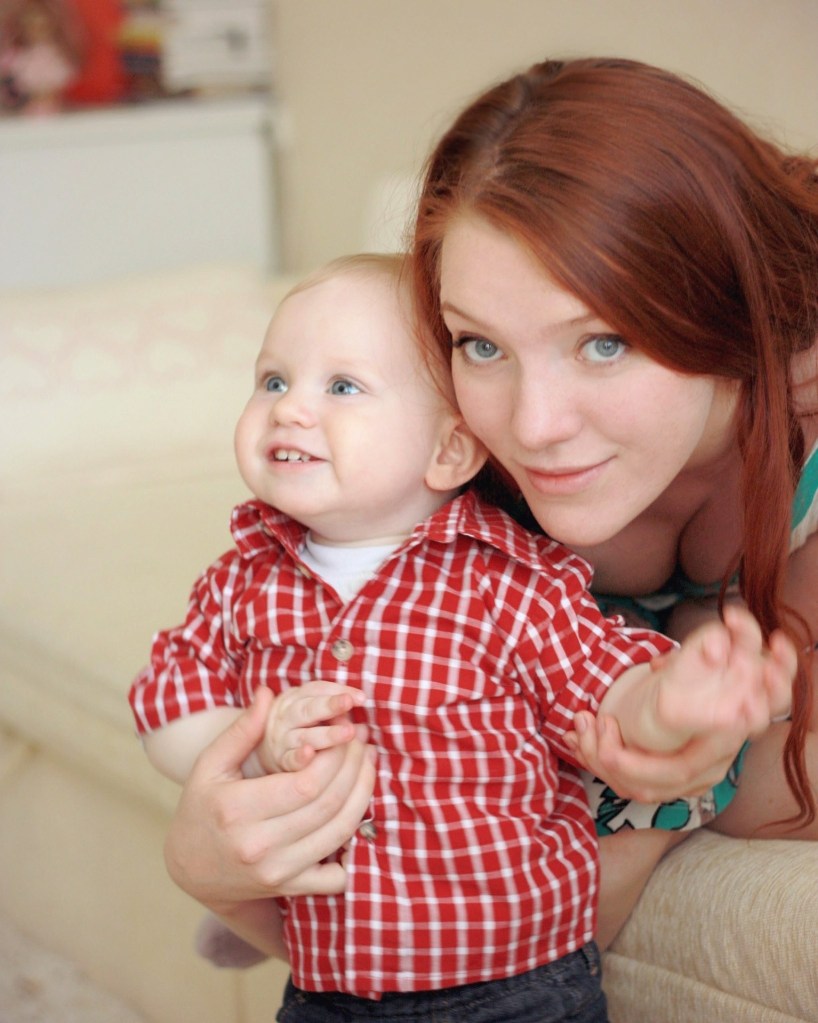
    Early childhood years, from 0-8, are the formative years. It is during these years that most is learned. Children learn about the world through their explorations. They learn about themselves through the responses they receive from others, and learn about others through these responses also. Attitudes to most things begin in the home.

    Children require warm, nurturing, positive relationships that demonstrate the way life should be lived, in actions, not just words. As Anne Goodwin, former psychologist says, the interactions with significant adults will greatly influence the adult that the child becomes.

    If home is where it starts, then we can’t wait until the children are of school age. By then it’s too late. It is relatively undisputed that it is difficult for children to catch up what may have been missed in those early years. Sadly, much of the intense formal work in school does more to alienate these children further, rather than improve their opportunities for learning.

    Therefore, we must begin in the home, and I don’t mean with formal structured programs. I mean with fun activities that validate parents and children and provide them with opportunities and suggestions for participation and learning.

    Guiding parents in play sessions for parents and children.
    Guiding parents in play sessions for parents and children. © Norah Colvin

    It is these beliefs that informed my home-based business Create-a-way,

    © Norah Colvin
    © Norah Colvin

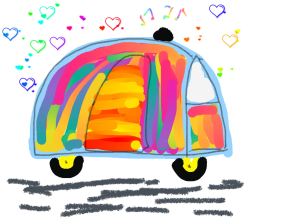
    and my idea for an early learning caravan that, staffed with an early childhood educator, would

    •  go to the parents and children in their neighbourhoods, meeting in a local park or community greenspace, on regular weekly occasions;
    • invite parents to talk with, read to and play with their children using provided books, games and toys;
    • model positive parenting behaviour, explaining to parents the benefits to their children of engaging with them in activities and discussions;
    • provide suggestions for inexpensive and easy activities to do at home;
    • encourage borrowing from a book and toy library.

    Of course, for many parents, such as those reading this post, nurturing a child’s development is almost second nature. They have the education and resources, and a belief in the benefits, to empower them to nurture their children’s development. They require little additional support.

    Requiring most support are those without the benefits of education, resources or a belief that life could be improved. If all they have experienced through school systems is failure and rejection, they will have difficulty in perceiving any purpose in trying. It is these parents and their children that we need to reach. If they feel valued, they in turn may find value in others. If we improve the lives of those marginalised by poverty or lack of education, it must contribute to improving our society, and our world, in general. This will help us to feel safe in our homes, in our localities and in the wider world.

    This week at the Carrot Ranch, Charli Mills is talking about homes and the importance of having a roof over our heads. The way we treat each other, especially those hurting, indicates there is a greater need for compassion and for those in need to receive a helping a hand.

    In my response to Charli’s flash fiction challenge to In 99 words (no more, no less) write a story about home, I attempt to show that the situation in which one is raised is not always a self-fulfilling prophecy. Out of the cruellest situations, hope can be born. We, as a society, need to do what we can to give hope to many more, to help break the cycle of despair.

    81

    The birth of Hope

    Startled by the blueness of eyes and the intensity of unfamiliar feelings, she suddenly relaxed, as if finally, home.

    She’d not known home before: not locked in a room with hunger the only companion; not shivering through winters, barefoot and coatless; not showered with harsh words and punishments.

    She’d sought it elsewhere, mistaking attention for something more. When pregnancy ensued; he absconded. They kicked her out.

    Somehow she’d found a place to endure the inconvenience. Once it was out, she’d be gone.

    But now, feeling unexpectedly connected and purposeful, she glimpsed something different —a new start, lives entwined: home.

    Thank you

    Thank you for reading. I appreciate your feedback. Please share your thoughts.
  • Don’t fence me in

    This week at the Carrot Ranch Charli Mills is talking about anxiety, panic attacks and agoraphobia.

    The following statements taken from the Mayo Clinic website explain agoraphobia as:

    “a type of anxiety disorder in which you fear and often avoid places or situations that might cause you to panic and make you feel trapped, helpless or embarrassed.”

    “The anxiety is caused by fear that there’s no easy way to escape or seek help if intense anxiety develops.”

    “Most people who have agoraphobia develop it after having one or more panic attacks, causing them to fear another attack and avoid the place where it occurred.”

    “Agoraphobia treatment can be challenging because it usually means confronting your fears.

    Sometimes, as Charli says, we can face our fears head on and defeat them with the choices we make. Other times we may need support to help us overcome them. Sometimes therapy and medication may be needed to help those suffering the debilitating effects of anxiety. I will not be discussing those paths in this post. Nor am I going to talk about the anxieties of children with Asperger’s or Autism. There are others who do a much better job of it and are much more knowledgeable than I, such as Sherri Matthews and Shawna Ainslie.

    school cropped

    However, it is not uncommon for a child to occasionally feel anxious and stressed by situations that occur at school. The incidence increases when children are placed in situations that are inappropriate to their development and don’t respect their needs. Sometimes the anxiety and stress is manageable and alleviated by more appropriate circumstances outside of the school environment. But sometimes the distress to the child and family can increase to a level at which more help and support is required.

    A school environment more suited to children’s needs would reduce the number of anxious and stressed students, parents, and teachers. Creating a nurturing and supportive school environment requires a firm understanding of child development and a belief in their ability to learn. It also requires that children are respected and appreciated for who they are, and that they receive timely and appropriate feedback, encouragement, and support.

    last child in the woods


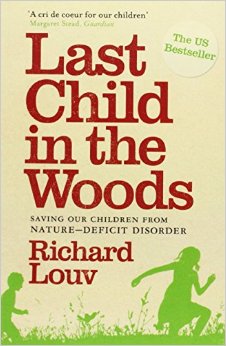
    In recent posts I have mentioned the importance of play, and of time spent in, and learning outdoors, in nature. In his book Last Child in the Woods, Richard Louv espouses the importance of nature to the development of healthy children, as well as to the physical health and well-being of adults. Perhaps more time in nature would provide the calm that is needed to combat the hustle and bustle of modern life and pressures of formal, test-driven classrooms.

    In fact, it is not just “perhaps”. In his article The School of Nature Louv provides evidence of benefits to learning that nature-based and place-based education can bring. He says, “greening schools may be one of the most cost-effective ways to raise student test scores.

    earth in mind

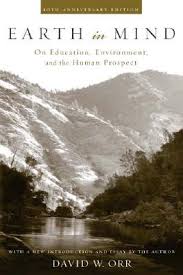
    David Orr agrees. In his book Earth in Mind: On Education, Environment and the Human Prospect, he also stresses the importance of learning about, from, and in nature.  He says, that, “all education is environmental education. By what is included or excluded we teach students that they are part of or apart from the natural world.”

    It is easy to talk about the failings of the school system and suggest ways it could be improved. It is more difficult to make the desired changes happen. While the majority of teachers work hard to create warm, supportive, nurturing environments for children, there are many situations over which they have no control. It is important then to have strategies for dealing with anxiety and stress if they occur.

    stress can really get on your nerves

    I recently came across a book that may be useful if your child tends towards anxiety.  Stress Can Really Get on Your Nerves aims to provide children with strategies for coping with stress. Written by Trevor Romain and Elizabeth Verdick, it is published by free spirit Publishing as one of a series aimed at helping 8 – 13 year-olds “get through life rough spots”. With Trevor’s fun, cartoon-like illustrations on every page, the book promises to turn stressed out kids into “panic mechanics” with a toolkit of suggestions for reducing their own stress levels. I’d have to say, they’re not bad strategies for anyone’s toolkit.

    https://openclipart.org/detail/2921/toolkit
    https://openclipart.org/detail/2921/toolkit

    I first heard about the book on the free spirit publishing blog in a post by Trevor in which he explains how drawing helped him cope with his learning difference. Trevor may be an outlier, but his story certainly provides inspiration for those who struggle in the traditional classroom.

    cropped forest

    I think time outdoors, breathing the fresh air, and enjoying the natural world is a great antidote to stress. I may no longer gambol in the grass, but I can sit in stillness and quiet, appreciating the beauty around me as I unplug from technology and reconnect by grounding myself in nature. I’m not sure how that works for agoraphobics with a fear of open places though. Perhaps having more time in nature as a child and learning techniques for coping with anxiety and stress could work as a preventative. But it’s only a thought. I am no expert.

    This brings me back to Charli Mills and her flash fiction prompt to In 99 words (no more, no less) write a response to an agoraphobic moment.  I have used the Mayo Clinic’s broader interpretation rather than the “narrow” definition of “fear of open spaces”. (I’d rather not be fenced in!) I hope my story portrays a recognisable response that could occur in a variety of circumstances. Please let me know what situation you think of as you read, and whether you consider my attempt successful.

    Confrontation

    She could hardly manage to chew, let alone swallow, the morsel of cereal occupying her mouth.

    Her vacant stare and stifled moans alerted him.

    “Are you okay?”

    “I’m trying,” she mumbled, and squeezed her hands between her quivering knees.

    “You’ll be fine. You haven’t had an attack for months. And, you’re prepared.”

    “I know.” She pressed her arms against her gurgling belly. “But …”

    He waited.

    Finally, she looked at him. “But …”

    He sponged her clammy forehead.

    She looked away. “What if they don’t like me?”

    “They won’t like you. They’ll love you. Come on. I’ll take you.”

    What did you think of as you read? I wrote the piece about young teacher about to meet her first class. Did you pick it?

    While anxiety about school is more commonly thought of as presenting in children, it is not uncommon for teachers to suffer from school anxiety as well. We accept that teaching is a stressful role, but for some it can also cause anxiety.

    I think there are few who are immune from anxiety. We need to be more open in talking about mental health in general. Recognition, acknowledgment and supportive discussion are important factors in helping to overcome the effects of anxiety.

    Thank you

    Thank you for reading. I appreciate your feedback. Please share your thoughts.

  • Let them play!

    GDJ, Playful stick figures https://openclipart.org/detail/230070/playful-stick-figure-kids
    GDJ, Playful stick figures https://openclipart.org/detail/230070/playful-stick-figure-kids

    Play is essential to learning, and creating an environment which allows for play while nurturing children’s learning and development is as important as creating an environment that nourishes and encourages the growth of plants in a garden. The link between the two was first recognised by Froebel in the early 19th century when he coined the term “kindergarten” which translates to “garden for children” (kinder meaning child and garten meaning garden), and created the first educational toys.

    Froebel “devoted his life to educating children and developing methods to maximize human potential”. He was the first to recognise the importance of a child’s early years (birth to three) and considered creativity to be something in all of us.

    Froebel’s kindergartens were the first “formal” education for young children and his work greatly influenced that of other educators such as Maria Montessori and Rudolf Steiner. His beliefs, for example that children have both unique needs and capabilities are still influential today. He believed in the importance of play and some of his toys were favourites of people such as Buckminster Fuller and Albert Einstein.

    I have touched on the topics of playcreativity and children’s uniqueness in previous posts. A respectful, encouraging, nurturing and stimulating environment underpins all that I value in education; as does a belief in the power of play to develop understandings of self, of others and relationships, of the world and how things work, and to inspire thoughts of what could be, to imagine possibilities never before imagined.

    johnny_automatic_playing_dress_up

    While Froebel’s beliefs, and those of his followers, are still valid, sadly they are often disregarded by those who wield the power in education, who dictate otherwise.

    In a previous post I shared an article by Paul Thomas who attributed his readiness to learn at school to the richness of his home environment. He also decried the formal tedium of school lessons which contribute much to curbing a child’s enthusiasm for learning. Paul is not alone in his views. There are many teachers who agree with him, myself included, as I have shared many times before, including here and here.

    I am not the only early childhood teacher to be saddened and appalled by the formal approach that has been enforced upon teachers, replacing play-based approaches in classrooms for children as young as four. With the administration of standardised tests and the publication of graded results, children are labelled successes or failures before they have had a chance to develop. Those children from privileged backgrounds, as described by Thomas in Formal Schooling and the Death of Literacy will be immediately successful. Those from less advantaged backgrounds will be labelled failures. Unfortunately, the labels are often reinforced with little chance of replacement.

    A+   F

    I am always gladdened when I hear another expounding the benefits of play and the importance of child-centred approaches to learning and teaching. I hope that when enough voices unite in this important message, the tide will start to turn, and those with the power to make changes will do so in favour of children.

    the importance of being little

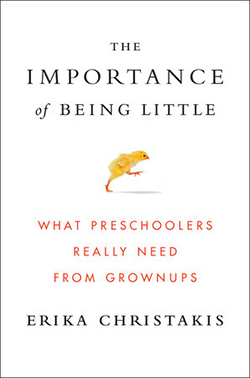
    This week I read another article stressing the importance of play for young children. The article, written by Susan Gonzalez for Yale News, introduces a recently published book by Erika Christakis The Importance of Being Little. I have not yet read the book, but I know that I will agree wholeheartedly with its content. The title itself tells me the value of its message.

    © Norah Colvin
    © Norah Colvin

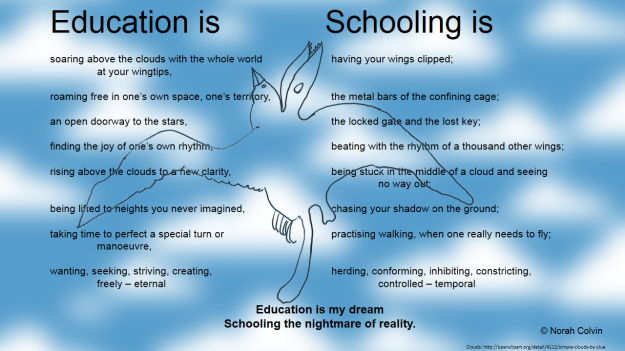
    In words reminiscent of my poem “Education is” Christakis says that “schooling and learning are often two different things.” Here is just a sprinkling of her thoughts reported in the article.

    • children are capable and powerful but our expectations are often mismatched
    • we ask too much of children pragmatically but not enough cognitively
    • there is too much teacher-direction and not enough time for play in many preschool classrooms
    • teachers need to take the time to listen to children’s stories, to laugh with them, to get down on the floor, at their eye level, and figure out what makes them tick … (through) … respectful observation
    • childhood pedagogy should be based on ideas, not on the repetition of simple skills
    • respect for early childhood as a life stage worthy in its own right and not merely as a training ground for an adult future

    These are ideas I have oft repeated here on my blog. Please read the article in full and, if you are as inspired as I am, read the recently published book The Importance of Being Little. I’d love to know what you think.

    Thank you

    Thank you for reading. I appreciate your feedback. Please share your thoughts.
  • Learning environment


    gardeningIn last week’s post I shared information about research projects students could become involved in to be scientists in real life. Some of the projects such as Project BudBurst and BudBurst Buddies encourage junior scientists to observe and record changes in plants throughout the changing seasons. Many commenting on the post agreed that projects such as these would make the learning of science come alive. Pauline King the Contented Crafter even commented that she may have to reconsider her opinion of schools if children were involved in projects such as these.

    © Norah Colvin
    © Norah Colvin

    Shortly after posting I read an article on Co.Exist describing a preschool that doubles as urban farm where Kids learn among the plants and animals in this design for a radically different education environment.”  A bit like my concept of an early learning caravan, the school does not actually exist. The design was entered into and won an architecture competition. It is an interesting concept and I especially like the suggestion that children spend more time learning about nature through experiencing it in wild spaces in the outdoors rather than only through classroom activities and books, both of which do have their role.

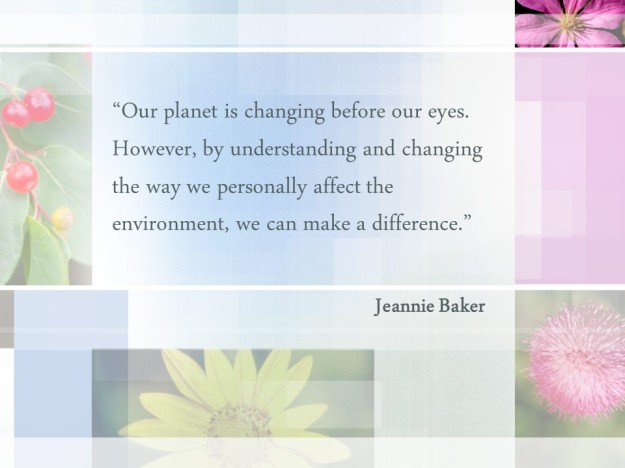
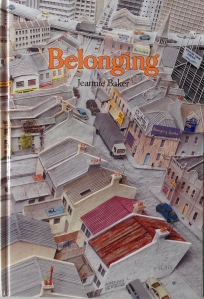
    Jeannie Baker - planet changing

    I have previously shared the wonderful books of Jeannie Baker which have strong environmental themes encouraging children to care for nature and appreciate the natural wonders and beauty of the world around them.

    2015-09-19 11.09.45 2015-09-19 11.11.04

    This morning, thanks to a recommendation from Sarah Brentyn who blogs at Lemon Shark, I received another lovely book in the post that will sit among my favourites. The Curious Garden by Peter Brown tells the story of how a curious boy helps transform a city from a drab grey concrete jungle to a one filled with gardens and gardeners. The story affirms the belief that the actions of one person can make a difference.

    Never-doubt-that-a-small - Margaret Mead

    I am currently listening to Earth in Mind: On Education, Environment and the Human Prospect, an interesting and thought-provoking book by environmentalist David W. Orr who challenges the focus of schools and advocates for learning outdoors in the natural environment. He may approve of the preschool farm, but he’d probably be more in favour of a forest preschool.

    This, however, is only a small part of his position and I do not wish to misrepresent it. In an article, which reads like a chapter from the book, Orr describes “Six myths about the foundations of modern education, and six new principles to replace them”. The part of me that strives towards meliorism is seriously challenged by the picture Orr paints. The picture books, stories, and research projects are fine; but there’s much more to be done if we want to do more than simply wish for a greener future.

    I agree with Orr wholeheartedly that education for, with and through the environment is essential; and that many of our problems are caused by miseducation. However, I had not thought about education in the way that Orr explains. I think I’ll be sharing more of his work in future posts.

    Thank you

    Thank you for reading. I appreciate your feedback. Please share your thoughts.


  • Be a scientist in real life!


    Scout, Science Girl https://openclipart.org/detail/192588/science-girl
    Scout, Science Girl https://openclipart.org/detail/192588/science-girl

    I have often talked about the scientific explorations of young children and referred to children as born scientists. Their curiosity, ability to engage in their own explorations and investigations, and make their own discoveries can be encouraged by adults who welcome their questions and become co-investigators.

    I recently read a post on The School Bell, An Official Blog of Harris County Department of Education that excited me about ways of maintaining that engagement. The post, contributed by Lisa Felske, is entitled Kids Count: Let them Be Citizen Scientists. Lisa says that there of hundreds of projects children can get involved with, some for the long-term as a classroom project, and others that can be conducted independently. They are all real projects that help researchers collect and analyse data.

    Lisa says,

    “For students, participation can make them feel connected to a community or a place far from home and can give them the satisfaction of knowing they have made a small but important contribution to real science.”

    How exciting to be part of a real project, collecting data that will make a difference to our world.

    www.morguefile.com
    http://www.morguefile.com

    Lisa says that one of her favourites is “Penguin Watch, which allows students to monitor penguins in remote regions by looking at still images and counting the number of adults, chicks and eggs seen in the photos.”

    I imagine many children would be interested in that too. But when you follow the link to Penguin Watch you find it is only a small part of the Zooniverse, “a collection of web-based citizen science projects that use the efforts of volunteers to help researchers deal with the flood of data that confronts them”. With projects ranging from astronomy to zoology, you could say there is something for everyone.

    gardening

    Lisa also mentions other favourites including Project BudBurst and BudBurst Buddies (for younger students) in which junior scientists observe and record changes in plants throughout the changing seasons. While these are US based projects, the websites are rich with suggestions for adaptation in other places.

    Finding out about, appreciating and caring for everything, plant, animal or mineral, large or small, near or far is a major part of the real purpose of education. I think involvement in programs such as those described in Lisa’s article will do much to maintain a learner’s curiosity and sense of wonder. What an amazing use of the Internet. I was definitely born too soon.

    Thank you

    Thank you for reading. I appreciate your feedback. Please share your thoughts.


  • Are we finished?

    work-in-progress
    Anonymous, Work in progress https://openclipart.org/detail/12941/work-in-progress

    I am a work in progress. I reflect on the past, predict the future, and live in the present moment. Nearly everything I do is a work in progress. Some things just make more progress than others!

    Over the past few years I have been preparing resources for my readilearn website. It’s slow going, slower than I expected, but I’m getting … somewhere. Even when the website launches it will be a work in progress as I update old and add new resources.

    Launching soon - readilearn2

    In a flurry of activity, with the intention of completing additional resources as development of the website nears completion, I experimented with making a product promotional video. My intention is to make a number of these, possibly explaining the use of each interactive resource. Doing so is far more time consuming that I had expected.

    Below is my first attempt. But please don’t let that word “first” mislead you into mistakenly thinking it was my only attempt. I lost count of the number of takes and couldn’t believe how difficult it was to utter just a few short sentences. While I am sharing it, please consider it a work in progress. Making promotional videos for my products is something I need much more practice with.

    My purpose in sharing the video is to illustrate the importance of being a lifelong learner, which involves a combination of persistence, resilience and confidence, including:

    • a willingness to make mistakes and repeated attempts
    • a growth mindset without an expectation of immediate success
    • confidence to say “I haven’t got it yet, but I’m working on it”
    • belief in the ability to succeed, either independently or with support
    • an ability to adjust future attempts according to feedback provided from the past.

    I learned a lot in making this video, perhaps more about what doesn’t work than what does. But eliminating what doesn’t work is crucial in finding out what does. For example, I learned after repeated attempts on both, that selfie videos recorded with phone or iPad just weren’t going to be good enough. I learned that neither of the software programs for making videos I owned would allow me to achieve what I wanted on its own. I needed to combine recordings from each. After many trials I finally made something that at least has the semblance of an attempt.

    Included in my passion for learning is a passion for learning about learning: how we learn, why we learn and the conditions that contribute to our learning. I am fascinated by learning that occurs at all ages, but particularly during early childhood.

    Morguefile http://mrg.bz/omEd2M
    Morguefile http://mrg.bz/omEd2M

    In the process of repeated attempts described above, I responded constantly to feedback provided, and adjusted each new attempt accordingly. Feedback is necessary for learning. But perhaps more important than the feedback is the response to it.

    Hopeful of getting some other feedback, I shared the video with my family on the weekend. They made some helpful suggestions. But perhaps the most interesting feedback, about feedback, was that given by my four-year-old granddaughter, G2.

    G2 watched the video with her mother and immediately wanted to play the game. I was delighted, of course, and opened the resource on the iPad for her to use. She had no trouble manipulating the objects to make the ice creams and quickly made a few combinations. When I asked if a mango with strawberry on the top was the same as, or different from, a strawberry with mango on the top, she confidently explained that they were different because “this one’s got the strawberry on the top and this one’s got the mango on the top”. She went on making combinations.

    icecreams
    © Norah Colvin

    After she’d made about ten combinations she asked, “Are we finished yet?” I said, “We can finish whenever you like.” I wasn’t using it as a “teaching episode”, simply as something fun for her to do. She asked again, “But are we finished? You know –“ and she indicated for something to happen on the screen showing that we had finished.

    Suddenly I realised that she was wanting feedback from the program to tell her that she was finished, that she was successful; perhaps some bells, whistles or fireworks. Because I designed the resource as an open-ended teaching episode, for use by a teacher with a class rather than by individual children, the resource does not have any inbuilt feedback. The feedback occurs in the discussion between teacher and students.

    What I intended as a teaching episode became, for me, a learning episode; thinking and learning about feedback.

    • G2 expected to receive feedback about completion, and
    • she wished to continue until she received that feedback.

    However,

    • she doesn’t’ require feedback about completion from all apps, for example, drawing programs: she decides when she is finished, and
    • during play she decides which activity she will take up and when she will finish.

    G2 has a good balance of activities with home and Kindy; indoor and outdoor with a variety self-selected and self-directed imaginative play mixed with cooperative activities including reading, board games and screen time with a variety of apps.

    GDJ, Playful stick figures https://openclipart.org/detail/230070/playful-stick-figure-kids
    GDJ, Playful stick figures https://openclipart.org/detail/230070/playful-stick-figure-kids

    With such variety she receives feedback from many sources including self and others, as well as from manipulation with real and electronic objects. I think her question “Are we finished yet?” was related to use of the specific device and type of activity (game to her), not indicative of a generalised need for feedback from outside.

    But what of children who are more engaged with electronic games, have less time for self-directed activity, and fewer opportunities to engage with others? Will the need for feedback from an outside source overtake the ability to provide feedback for self? I hope not. I believe the abilities to self-monitor, self-regulate and self-determine to be extremely important to life-long learning. What do you think?

    Thank you

    Thank you for reading. I appreciate your feedback. It is important to me! Please share your thoughts about any aspect of this post.


  • You’ve got the power


    Super s

    If I had the ability to bestow upon each of you a super power of your choosing, what would you choose?

    I’m sure you’d be eager to accept with a suggestion immediately. I am not an exception. I would love to be able to control time, to make it go faster or slower when I want, and basically to just have more of it.

    But the reality is that each of us reading this post, myself included, already has one of the most amazing super powers available: the ability to read. Living in a print saturated world as we do, the ability to read is essential for full participation. Not surprisingly, but perhaps also a little sadly, those of us who can, tend to take it for granted.

    The love of reading is gift

    I am a compulsive reader. I read everything everywhere. I wish I could stop myself reading the signs on the back of the toilet doors for the umpteenth time, but it’s virtually impossible. This is not my genre of choice. Many of us bemoan the fact that we do not have enough time to read all the wonderful material available to us.

    studentbooks

    Time is not my only reading frustration. As I age my eyesight is changing and even with the assistance of reading glasses I struggle (and often fail) to read the fine print on labels or in instructions. Not only that, my eyes tire more quickly now than ever before and the physical act of reading is not as pleasurable as it once was.

    However, even with these frustrations, I am one of the lucky ones.  Not everyone in the world is as fortunate as I with my lack of time and failing sight. While the literacy rates around the world are improving, there are still too many suffering the disadvantages that result from inadequate opportunities to acquire an education in general, and specifically, the ability to read. Even in our midst there are those who, for various reasons, have failed to become literate.

    The empowering effect of the ability to read and of acquiring a quality education is never far from my mind or my blog. If you were to type the word “power” into the search button at the top right of my blog you would find at least ten posts with the word “power” or “empowerment” in the title, including

    The power of reading

    The power of imagination

    The power of words, and

    Empowerment – the importance of having a voice.

    This week at the Carrot Ranch Communications Charli Mills is talking about power and has challenged writer to in 99 words (no more, no less) write a story that explores the question, “What good is power?”  What choice did I have but to discuss the empowering effect of reading, an ability that is a right of everyone.

    reading

    Super Power

    Bored with responses as repetitious as their store-bought costumes, he scanned the room of superheros, wondering how many more interviews to fulfil his quota. Spying a child sans costume, he winked at the camera crew and moved in, the opportunity to highlight another’s inadequacies all too alluring.

    “And what superhero are you?” he smirked.

    The child held out a book, drawing artefacts from within its pages. “I am a reader. I can soar on dragon wings, explore the Earth, and the farthest galaxy. I can fill my head with imaginings, or discoveries new and old. Reading: my Super Power.”

    Thank you

    Thank you for using your Super Power. I appreciate your feedback. Please share your thoughts.
  • Thankful and inspired: schools and education

    In recent posts there was some discussion about the importance of education, the value of schools and the role of teachers. I thought it timely to re-share this post, first published in July 2015.

    Earlier this week I read a post by Kimmie of Stuck In Scared about Ten Things of Thankful. I have also read many other posts about things to be thankful for. These posts prompted me to share something for which I am thankful: schools and education.

    I know that I often write about what I consider the shortcomings of traditional schooling and make suggestions of how schools could be improved. However I live in a country that values education and in which every child has a right to a free education. For that I am thankful. Those of us who have access to schools and education are the lucky ones.

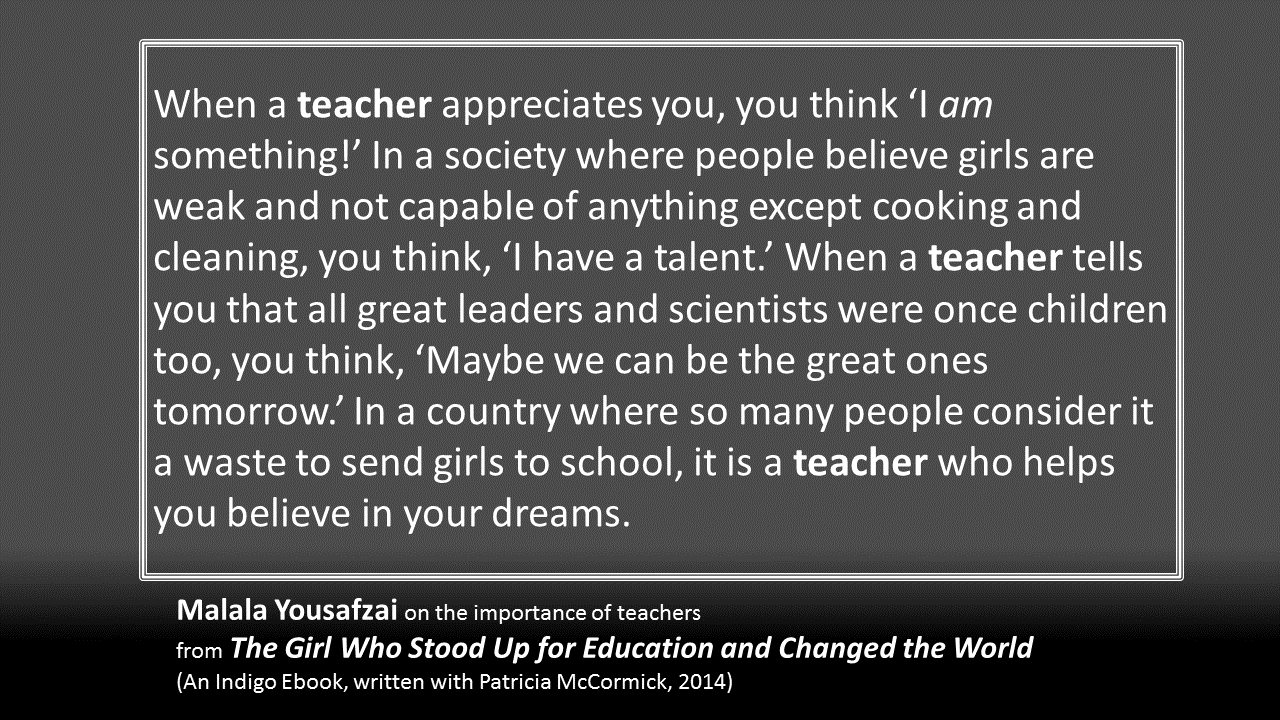
    This week I have been listening to Malala The Girl Who Stood Up for Education and Changed the World by Malala Yousafzia with Patricia McCormick (Indigo).

    Malala-The-Girl-Who-Stood-Up

    Malala’s is an inspirational story of courage, and how one person can change the world. In this trailer for the movie of her story to be released later this year, she says,

    “One child, one teacher, one book and one pen can change the world.”

    (Note: I haven’t seen the movie yet. I’d love to know if any readers have.)

    In her speech accepting the Nobel Peace Prize in 2014, Malala says,

    “I am just a committed and even stubborn person who wants to see every child getting quality education, who wants to see women having equal rights and who wants peace in every corner of the world.”

    The Malala Fund, of which she and her father are co-founders and to which she donated her prize, “empowers girls through quality secondary education to achieve their potential and inspire positive change in their communities.”

    She calls world leaders and people everywhere to take action and make education their top priority, for all the children of the world, not just their own children.

    This is one of my favourite quotes from the book:

    Malala - teachers

    I think one of her most influential teachers must be her father.

    Thank you

    Thank you for reading. I’m sure you have found Malala’s story just as inspirational as I have.

    I appreciate your feedback. Please share your thoughts.
  • On children and parents – more from the Contented Crafter

    In a previous guest post Pauline King, The Contented Crafter shared her Reflections on living a contented life, teaching and school. The richness of the discussion that ensued, including additional clarifying comments from Pauline, made for interesting reading. One thing I have found consistent throughout life is that everyone has an opinion about education and schools. However, there is great diversity in the opinions held. I love to hear them all for the opportunity they provide for clarifying my own thinking.

    In this second guest post Pauline shares some of her wisdom about children and parenting. Pauline and I share much of the same philosophy and background knowledge and are aware that some statements may require clarification out of that shared context. We therefore welcome your responses and look forward to the discussion that these thoughts may instigate.

    What do you think is the most important thing for parents to understand about their children? What advice would you love to give every new parent?

    I seriously think every parent should read and study Khalil Gibran’s chapter about Children in his poem ‘The Prophet’.  Children are not just short adults; they are not there to fulfil a parents dreams [though they may]. 

    Kahlil Gibran Children(Note: This is just a short extract of Gibran’s words about children. You can read them in full here)
    Children need to be allowed to enjoy their childhood, let them play, let them dream, let them imagine.  Very little ones learn through imitation and play so be careful what you model for them. 

    1 (8)

    Send them into formal learning when they reach their seventh year.  But let that learning proceed through imagination, through practical practise and first-hand experience.  Let the education content grow and deepen as the child matures.  Don’t just stuff stuff into their heads because you think it’s a good idea or something awful has happened in the world. 

    1 (2)

    Don’t discuss adult issues with young children.  Keep them safe and secure while their bodies and brains mature.  Give them time to grow up. 

    Parents study your child and all other children.  Raising children is not a competition.  It is not a case of keeping your child safe and clean and out of your way while you are busy.  Think more of ‘The Waltons’ and let each child have a task to perform to help the family.  Teach them all how to help prepare meals, set tables, make beds and other chores that need to be done. 

    105

    Start to think less about how clever [or not] your child is, but what talents and attributes your child is exhibiting.  Don’t stream, let them all do everything and let everyone have something they are good at and see there is something that someone else is better at – because that is the way of the world and we all have contribution to make and our lessons to learn.  Understand that just as your child is special, all children are special. Understanding this is the first step in making a wholesome community.

    Don’t be fearful of your child hurting themselves.  As a wise man recently said ‘the purpose of our lives is not to arrive safely at our death!’ 

    147

    My personal opinion is that the increase in a society that reveres ‘health and safety’ has been responsible for the rise of lost teenagers, those aimless, disinterested kids who suffer from low self-esteem, drinking and drug taking and mindless vandalism.  Take your older kids camping, hiking, abseiling.  Do it with them and have lots of fun.  Give them physical challenges and the ability and skills to succeed in them.  It really is true that the family who plays together, stays together.

    3

    But mostly love and respect your child.  Keep them safe when they are small and slowly teach and release them as they grow older.  Feed them good food, positivity and encouragement and watch them blossom into the people they were born to be.

    Give them time and lots of your time.  They don’t need stuff and they don’t need to keep up with the Joneses.  They just need you.

    In responding to a previous post you said that you could write a post-length comment about the wisdom of children. Could you share a few ideas about that here. We might come back to that longer post in the future, if you are willing.

    Observe your children, listen to them, know they are their own little being and as such bring their own personality and gifts into the world.  Watch how they approach life and activities and you will see they have come with a wisdom about themselves and their purpose that we, the adults, may not be privy to.  This is the wisdom of childhood and we, as parents and teachers, are really beholden to respect this and not try to ‘change’ the child to suit us, society or anything else. 

    Most teachers know that most children reach similar developmental points at around the same time.  There is a great wisdom in this and when we become aware of it, it can help us understand what they are ready for in terms of learning, activities and life in general. 

    1 (3)

    All of this Norah, is part and parcel of the training of a Steiner Teacher – understanding child development is the open secret that drives the curriculum. 

    Wow! Thank you, Pauline, for sharing your wisdom. Kahlil Gibran’s The Prophet is one of my favourite books and his passage about children is never far from my mind. Your words in this post reflect very much the words and intent of his. You have given us much to think upon, and I appreciate it, as I’m sure the readers do too.

    Connect with Pauline on Twitter or on her blog The Contented Crafter where you can also check out her delightful Gift Shop

     Thank you

    Thank you for reading. I appreciate your feedback. Please share your thoughts.