Live Love Laugh Learn … Create the possibilities

Author: Norah

  • Cranes – That’s stretching it!

    Cranes – That’s stretching it!

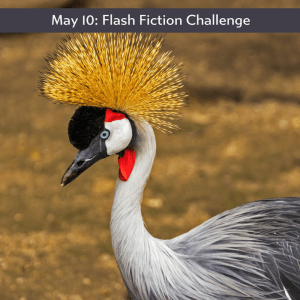
    This week at the Carrot Ranch, Charli Mills wrote about the different species of crane that inhabit North America and included an image of the stunning crowned grey crane.

    crowned crane as part of the Carrot Ranch flash fiction challenge

    I was fascinated by the story of an ornithologist and a crane and, when she challenged writers to In 99 words (no more, no less) write a story defining “the charisma of cranes”, I wondered why my mind drew a blank. I struggled to recall ever seeing a crane.

    Charli’s additional information that “For centuries, cranes have inspired art and philosophy” and her suggestion that, “You can write a crane story or create something new out of the phrase. Go where the prompt leads”, didn’t make it any easier.

    I consulted my favourite book of Birds of Australia. It listed only two cranes. One I knew of as the Brolga. The other, the Sarus Crane, I hadn’t heard of.

    An online check confirmed the two species. The Brolga is famous for its dance and features in many Aboriginal legends and dances. At over 1 m tall and with a wingspan of 2.4 m, it is one of Australia’s largest flying birds. The Sarus Crane is rare and lesser known.

    To my embarrassment, I also discovered that the Brolga is the bird emblem of my home state Queensland and appears on its Coat of Arms. Information about the Coat of Arms tells me that the Brolga is one of Queensland’s most distinctive birds and “symbolises the native population”.

    Follow this link for information about the importance of the Brolga to Indigenous Australians and a video of an Aboriginal story.

    More familiar to me are the cranes that dot the ever-changing city skyline as new buildings creep skywards.

    For my response to Charli’s prompt, I’ve avoided the birds and employed two other meanings of crane. It might be stretching it a bit, but I hope you like it.

    Living the nightmare

    The shaft of light reflecting from the mirror jolted her awake.

    “What time is it?” She fumbled for her phone. “Hell!” All night she’d craved sleep, then slept through. She pulled on yesterday’s clothes, ruffled her hair and charged out.

    People packed the square so tight she couldn’t squeeze through. She craned her neck but, even on tiptoes, couldn’t see. She pushed into the tiniest gap on a ledge, only to be elbowed off. But she’d spotted a cherry picker. She climbed in, pushed a button and up she went; just as the crowd dispersed. She’d missed out again.

    Thank you blog post

    Thank you for reading. I appreciate your feedback. Please share your thoughts.

  • Rough Writer Tour: Happy Trails

    Rough Writer Tour: Happy Trails

    And so, the Rough Writers Tour Around the World is over. We’re back at the ranch with the lead Buckaroo Charli Mills, wrapping up the first adventure. This tour might be over, but the journey has just begun. Charli says, “Through writing together on projects of creative expression, we are on the trail to happiness. We ride the trail of peace.”
    I respond, “The pen is mightier than the sword. Together our voices are stronger than one, but we don’t speak as one, we speak as a collective of individuals, supporting, and receiving the support of, an amazing leader. Doubters may have considered your vision a puff of cloud easily erased. But it is a rainbow of inspiration under which unicorns dance, writers write and readers read. How delighted I am to have shared in the journey.
    If you haven’t yet, come and join us at the Carrot Ranch. There’s always room for more in the posse on the trail to happiness and peace.

  • readilearn: Teaching phonics and letter-sound relationships in early childhood classrooms – Readilearn

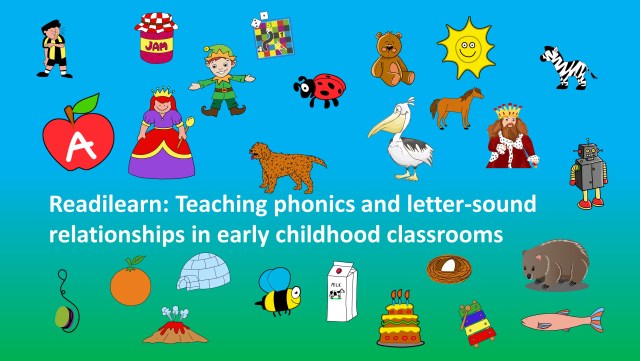
    readilearn: Teaching phonics and letter-sound relationships in early childhood classrooms – Readilearn

    Teaching phonics and letter-sound relationships is an important part of literacy education in early childhood classrooms. To be fluent readers and writers we need to understand the relationship that exists between the letters and sounds of our language. This knowledge is what enables us to extract meaning from texts we read and ensure that others can interpret the intended meaning in words we write.

    The process of expressing thoughts in writing can be laboured for young children as they stretch out words to identify individual sounds and the letters we use to represent them. From the initial stages of making arbitrary marks upon the page, children develop into proficient writers through recognisable stages of approximation. Readable writing is dependent upon the effective use of letters to represent sound.

    Reading is not so dependent as there are other cues and strategies that readers can employ to interpret a writer’s message. Young children garner information about texts they read from supporting illustrations, prior knowledge of the subject matter and text type (for example, narrative or non-fiction) and understanding of how language works. This information supports their reading which is guided by words they recognise by sight as well as their knowledge of letter-sound relationships.

    When teaching children to read, it is important to ensure children learn to use effective strategies that access all available cues. Over-dependence on any one cuing system leads to a break-down in the process. While the teaching of phonics has an important place in early childhood classrooms, I have resisted making resources for teaching phonics in isolation for two main reasons.

    Two reasons against making resources to teach phonics in isolation
    #1

    I believe reading is best learned and taught by reading. Knowledge of letters and sounds can be learned while reading meaningful and enjoyable texts. Teaching and learning can occur in literacy lessons, lessons in any subject, or whenever an opportunity to interact with print exists, which is frequent in our print-rich environment.

    I have previously written about some strategies I consider beneficial for teaching reading and will no doubt write more in the future. You can read some of those posts here:

    What’s in a name? Teaching phonics, syllabification, and more!

    Engage Learners with pizza-themed cross-curricular teaching and learning resources

    Continue reading: readilearn: Teaching phonics and letter-sound relationships in early childhood classrooms

  • More than just lines on a page

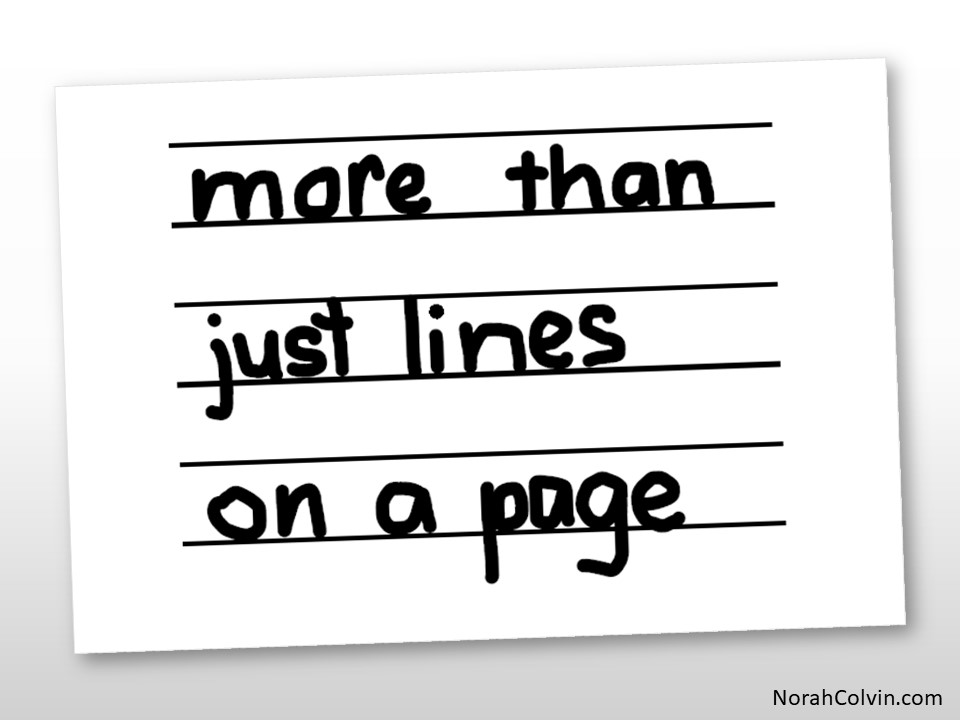
    More than just lines on a page

    This week at the Carrot Ranch, Charli Mills has challenged writers to In 99 words (no more, no less) use a line in your story. You can think of the variation of the word meaning, or you can think of visual references. Go where the prompt leads.

    As an educator of young children, with a special interest in literacy development, I shouldn’t have needed to think for long. Although, there being so many possible ways of interpreting the prompt, I did. I finally decided on the lines that we as writers and artists make on the page, the meaning we assign to them, and the meaning others extract from them.

    Children begin their journey into literacy by assigning meaning to marks they make upon the page and by realising that marks made by others also carry meaning. As their ability to both express and decipher develops, they come to realise that a text or image is more than the sum of the individual lines of which it consists. Communication deepens by interpreting and understanding the meaning conveyed below and between the marks.

    The ability to both imply and infer meaning extends to the interpretation of facial expressions, body language and changes in the environment. We can accept what we see at face value or make a judgement about what may be implied or intended. While the messages are often considered obvious, misinterpretation is possible.

    In response to Charli’s prompt, I’ve played with interpreting other lines. I hope you like it.

    Reading between the lines - signs in the sand www.NorahColvin.com

    Reading between the lines

    Four lines of footprints stretched along the shore. A line, mostly unbroken, edged one side; the other, a sequence of dots. The smaller prints danced lightly. The larger dragged heavily with one foot sideways. Criss-crosses of triple-pronged seagulls’ prints failed to obscure, unlike the smudge of ocean’s wet kisses. Tiny crabs scuttled their own story tracks through weeds, shells and stones coughed up by the sea. Beyond a collapsed castle, the footprints continued. In the distance—rocks. So far?  He accelerated. Didn’t they know the tide had turned?  Caught in the moment, they’d missed the signs. Lucky he didn’t.

    Thank you blog post

    Thank you for reading. I appreciate your feedback. Please share your thoughts.

  • readilearn: How to make STEM learning a part of every day

    readilearn: How to make STEM learning a part of every day

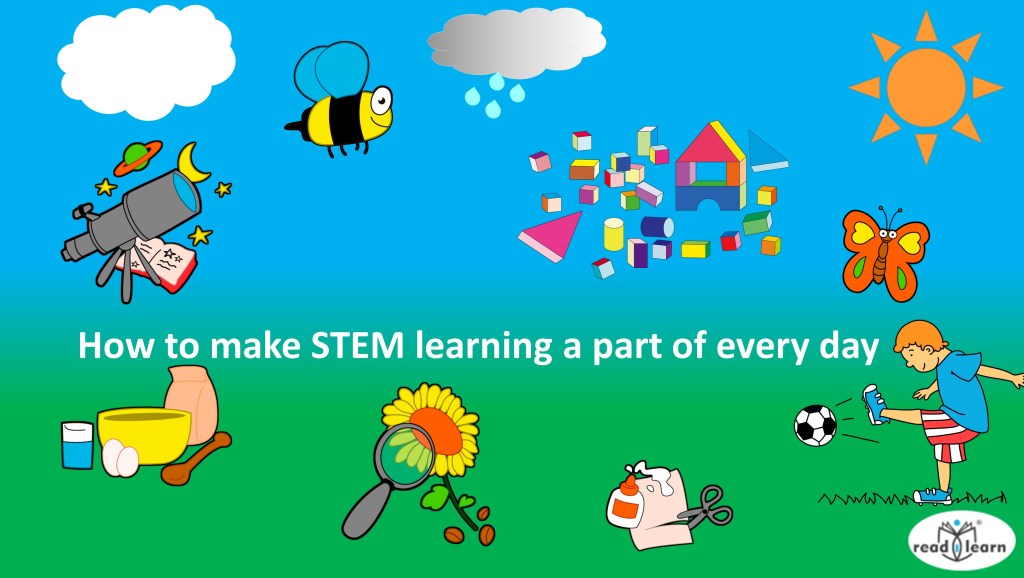
    Making STEM learning a part of every day is easy if one is mindful of the opportunities that arise. In a previous guest post, Narinda Sandry explained STEMtastic: making it easy — in every classroom, for every child and teacher.

    Last month I shared with you an excellent article from The Conversation by Kym Simoncini of the University of Canberra about Five things parents can do every day to help develop STEM skills from a young age.

    There is a thirst for information about STEM in the wider community, and articles such as these generate a lot of interest. In response, I have compiled some suggestions to help parents Incorporate STEM learning into everyday activities – suggestions for parents. The handout, located in Classroom ManagementFor parents, is available for teachers to distribute free to parents

    Incorporate STEM learning into everyday activities

    Continue reading: readilearn: How to make STEM learning a part of every day

  • Rough Writer Tour: Ruchira Khanna

    Rough Writer Tour: Ruchira Khanna

    The final stop on the Rough Writers Tour Around the World before we head back to the Ranch next week is with Ruchira Khanna from California. Ruchira writes about her experiences of life in India and America in books that are best sellers.
    Read on to find out more about Ruchira.

  • Reeling in the fishermen

    Reeling in the fishermen

    This week at the Carrot Ranch, Charli Mills challenged writers to In 99 words (no more, no less) write a fish tale. It can be about fishing from any angle, about those who fish, or what might be caught. Go where the prompt leads.

    I cast my net hoping to catch an idea.

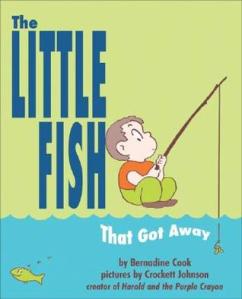
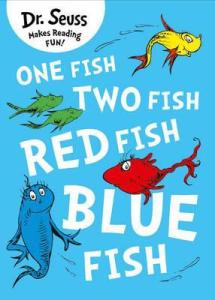
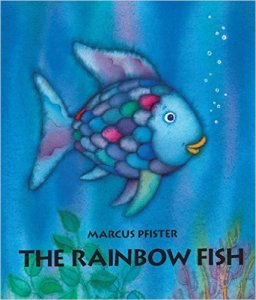
    Would I share some fish-themed picture books? For example:

    The Little Fish that Got Away by Bernadine Cook and Corbett Johnson

    The Little Fish that Got Away, written by Bernadine Cook and illustrated by Crockett Johnson

    one fish two fish by Dr Seuss

    One Fish Two Fish Red Fish Blue Fish, by Dr. Seuss

    The rainbow fish by Marcus Pfister

    The Rainbow Fish, by Marcus Pfister

    Would I consider rhyming words?

    dish

    fish

    squish

    swish

    wish

    fish on a dish rhyming words

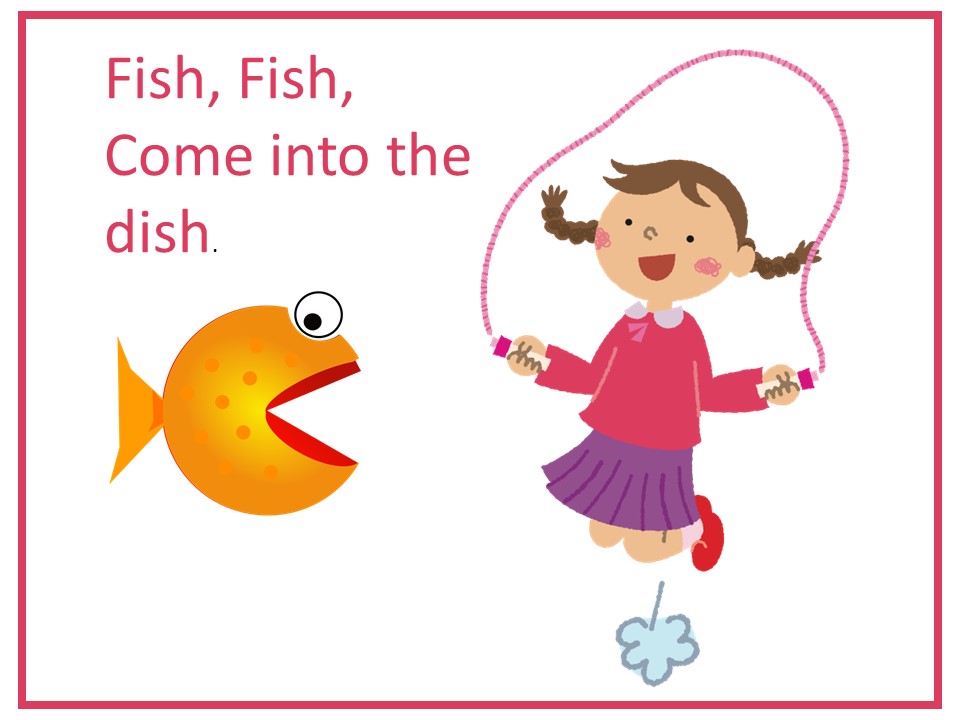
    Perhaps a childhood skipping game?

    Fish, Fish,

    Come into the dish.

    Fish, Fish,

    Turn around in the dish.

    Fish, Fish,

    Touch the bottom of the dish.

    Fish Fish, run out of the dish.

    Fish fish come into the dish skipping game

    Fishy sayings?

    something fishy going on around here

    Sounds or smells fishy

    A fish out of water

    A dead fish handshake

    Fell for it, hook, line and sinker

    Plenty of fish in the ocean

    Or maybe a childhood story?

    When I was a child, my father fished a lot in his spare time. As well as being a cheap way of feeding his large family, he probably enjoyed getting out on the water in his rowboat for some peace. When the fishing was good, it could be on the menu twice a day, seven days a week. Exaggerations, maybe, but sometimes it seemed that way.

    I did accompany him once. Neither of us caught anything edible. I caught a knotty eel, a tiny trumpeter and a desire to never go fishing again. I never have. Catching words is much more to my taste.

    For my response to Charli’s prompt, I have gone with a story from my childhood. It incorporates some of the ideas that got caught in the net. I hope you like it.

    Reeling in the fishermen

    She sat by the window watching as the invisible painter coloured the morning sky. These moments lost in waking dreams, with the youngest of her brood suckling quietly, were precious. Slamming car doors and laughter interrupted the silence but not her thoughts. An occasional word invaded her consciousness…haul, fishing, catch. Wait—her man, a fisherman, was home. The night was not conducive to fishing. She leaned forward. Two dark figures unloaded a ute. They had neither lines nor nets, and it sure wasn’t fish in those boxes. “Fisherman, eh?” she thought as she dialled the local police. “You’re hooked.”

    Thank you blog post

    Thank you for reading. I appreciate your feedback. Please share your thoughts.

  • #WATWB Malala returns to Pakistan for the first time in five years

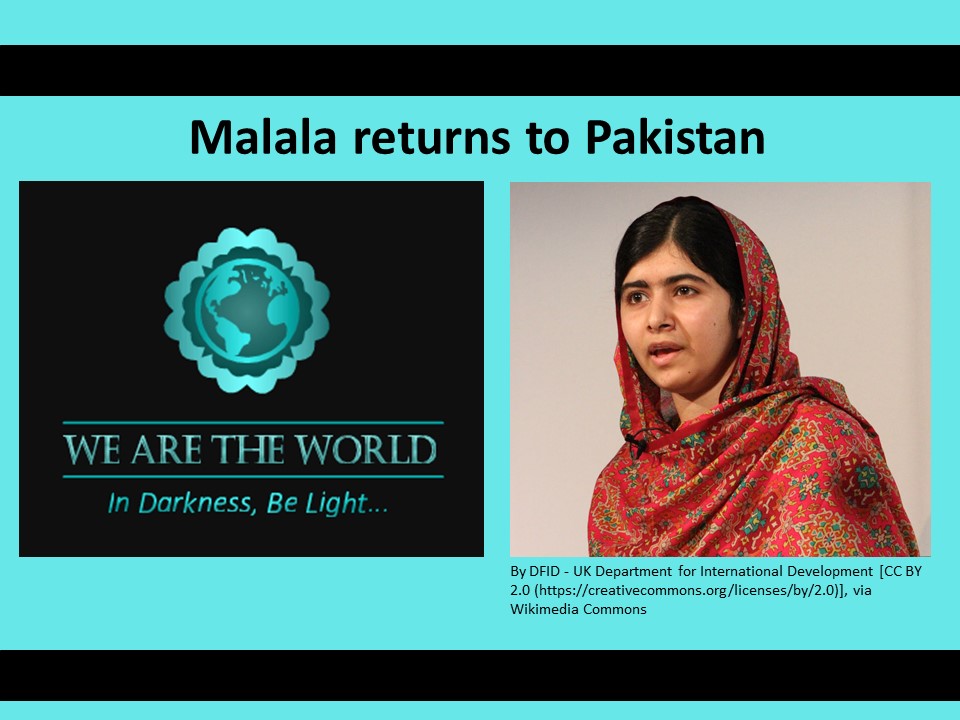
    #WATWB Malala returns to Pakistan for the first time in five years

    On the last Friday of each month, We Are the World Blogfest invites bloggers to join together in promoting positive news. If you would like to join in, please check out the rules and links below.

    “There are many an oasis of love and light out there, stories that show compassion and the resilience of the human spirit. Sharing these stories increases our awareness of hope in our increasingly dark world.”

    This month I am pleased to share the next chapter of Malala Yousafzai’s inspiring story.

    Malala fled Pakistan in 2012 after being shot in the face by Taliban militants for promoting education for girls. In 2014 she was awarded the Nobel Peace Prize. At the end of last month, five years after the attack, she returned to visit her home in Pakistan.

    Click to read the report published by the BBC.

    I read about it first on the Facebook page of A Mighty Girl,

    and watched it here:

    I admire Malala for her strength and the determination of her voice in campaigning for education for all. I particularly applaud these two quotes by Malala:

    “One child, one teacher, one book, one pen can change the world.”

    “When the whole world is silent, even one voice becomes powerful.”

    Here are the guidelines for #WATWB:

    1. Keep your post to Below 500 words, as much as possible.

    2. Link to a human news story on your blog, one that shows love, humanity, and brotherhood. Paste in an excerpt and tell us why it touched you. The Link is important, because it actually makes us look through news to find the positive ones to post.

    3. No story is too big or small, as long as it Goes Beyond religion and politics, into the core of humanity.

    4. Place the WE ARE THE WORLD badge or banner on your Post and your Sidebar. Some of you have already done so, this is just a gentle reminder for the others.

    1. Help us spread the word on social media. Feel free to tweet, share using the #WATWB hashtag to help us trend!

    Tweets, Facebook shares, Pins, Instagram, G+ shares using the #WATWB hashtag through the month most welcome. We’ll try and follow and share all those who post on the #WATWB hashtag, and we encourage you to do the same.

    The co-hosts for this month are:  :  Shilpa Garg, Dan Antion, Simon Falk, Michelle Wallace , Mary Giese.

    Please pop over to their blogs to read their stories, comment and share.

    Click here to join in and enter the link to your post. The bigger the #WATWB group each month, the greater the joy!

    Thank you for reading. I appreciate your comments. Please share your thoughts.


  • Learning fun with Mother’s Day activities in early childhood classrooms – Readilearn

    Learning fun with Mother’s Day activities in early childhood classrooms – Readilearn

    Mother’s Day is celebrated on the second Sunday in May in many countries, including Australia, the United States, and Canada. As the day approaches, teachers often look for easy-to-make gifts for children to give to mothers or other carers.  In this post, I share inexpensive suggestions that are easily incorporated into your class literacy and art programs.

    Before beginning to work on gifts for mothers, it is important to have some knowledge of children’s backgrounds so you can treat with sensitivity the diversity of family situations that may be represented in your classroom and adjust the program accordingly. For example, when you are already part-way through an activity, it is no good finding out from an upset child that his mother has passed.

    It is best to find out this information at least a few weeks before commencing the activities to allow time for consultation with families if necessary. An easy way of doing this is to ask the children to draw a picture of the people who live at their house. Children can then show and discuss their pictures and their families, including those who have two homes and two families.

    Your school librarian will be able to suggest picture books to read about diverse families, or you can find some on this list.

    You could introduce the activity by saying something like, “Mother’s Day is a day on which

    Continue reading: readilearn: Learning fun with Mother’s Day activities in early childhood classrooms – Readilearn

  • Into the forest

    Into the forest

    Since its beginning in 1970, every 22 April is celebrated as Earth Day, a day for appreciating the beauty of our Earth and mobilising ourselves to protect it. Earth Day is credited with starting the environmental movement and is the largest worldwide environment event.

    This year focuses on single-use plastic with the aim to End Plastic Pollution. The goals of the Earth Day Network “include ending single-use plastics, promoting alternatives to fossil fuel-based materials, promoting 100 percent recycling of plastics, corporate and government accountability and changing human behavior concerning plastics.”

    While governments introduce regulations about the use of plastics, it is up to each of us to monitor and reduce our own usage.

    Unless quote from The Lorax by Dr. Seuss

    Other Earth Day campaigns include combating climate change, greening schools and cities, and protecting forests, anything to help create a greener, more sustainable future.

    Five of my favourite picture books that include these themes are:

    The Lorax by Dr Seuss

    The Lorax by Dr. Seuss demonstrates the effects of pollution and destruction of the environment and highlights the important role of each person in protecting the environment.

    Window by Jeannie Baker deals with the effect of progress on wilderness areas as towns and cities are built. (All book by Jeannie Baker carry strong environmental messages.)

    Leaf Litter by Rachel Tonkin helps children appreciate the smaller parts of our world and the way they are all interconnected.

    The Curious Garden by Peter Brown is about a boy who greens a dead part of the city.

    One Less Fish Kim Michelle Toft

    One Less Fish by Kim Michelle Toft deals with dangers to marine life and suggests what can be done to improve the marine environment.

    These are just a few of the many wonderful books available. Please let me know your favourite in the comments.

    By the way, did you notice that each of these books is written and illustrated by an author-illustrator?

    At the Carrot Ranch, Charli Mills celebrated Earth Day this year with a little forest bathing or Shinrin Yoku. Developed in Japan in the 1980s, Shinrin Yoku is about “fostering deeper relationships and positive experiences with forested areas”. Charli challenged writers to In 99 words (no more, no less) write a story about forest bathing. You can use the Japanese term, Shinrin Yoku, or you can make up your own ideas about the phrase. Go where the prompt leads.

    A few weeks ago, in response to another prompt, I wrote this story about Crow and Mouse.

    a fable about crow and mouse in which mouse helps crow and crow helps mouse

    I presented the story to my local critique group and received some useful suggestions. One was to have Mouse explore the forest on his own in an attempt to fend for himself, rather than rely on Crow for food. I thought this fitted in nicely with the aim of Shinrin Yoku, and it is to that suggestion I have responded. I’ve changed the setting, for this prompt, from woods to forest. I haven’t quite managed to tell all I wanted in 99 words, which is usual for me, but I hope you like it.

    We pick up the story from “In the darkness, Mouse trembled.”

    Forest Feast

    Unfamiliar sights, sounds and smells assailed his senses. He dived into a pile of leaves.

    “Would you mind!” squealed Skink.

    “Sorry,” said Mouse, backing into Frog.

    “Hey! This is my cockroach,” said Frog.

    “Ewww!” said mouse. “Who eats cockroaches?”

    Mouse’s belly rumbled.

    Skink was eating a slug. Frog had a cockroach. Nothing for Mouse anywhere.

    “Try mushroom,” suggested Frog.

    Mouse hesitated, then began nibbling.

    Flapping overhead sent Skink and Frog for cover. Mouse, oblivious, had been spotted.

    Crow alighted and placed a gift of bread at Mouse’s feet.

    “Thank you,” said Mouse. “I like bread, but I love mushroom!”

    Thank you blog post

    Thank you for reading. I appreciate your feedback. Please share your thoughts.