Welcome to the School Days, Reminiscences series in which my champion bloggers and authors share reminiscences of their school days. It’s my small way of thanking them for their support and of letting you know about their services and publications.
This week, I am pleased to introduce Robbie Cheadle, author, poet and blogger. I’m not sure when or where I first met Robbie, but I know was captivated by her delightfully unique Sir Chocolate series of picture books which she illustrates with amazing fondant figurines. I was also intrigued to know that these books were jointly written with her and her son Michael, starting from when he was ten years old. There are now six books in the Sir Chocolate series and, since then, Robbie has published a memoir of her mother’s war-time childhood, co-written a book of poems, and had others of her poems and short stories featured in anthologies.
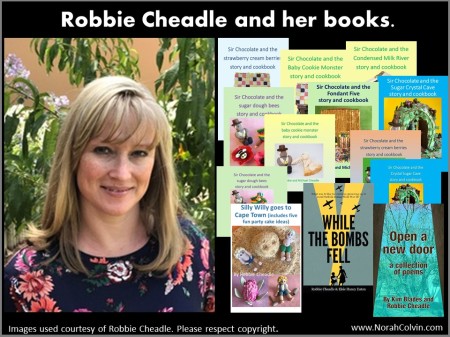
Before we begin the interview, I asked Robbie to tell you a little of herself:
Robbie, short for Roberta, is an author with six published children’s picture books in the Sir Chocolate books series for children aged 2 to 9 years old (co-authored with her son, Michael Cheadle), one published middle grade book in the Silly Willy series and one published preteen/young adult fictionalised biography about her mother’s life as a young girl growing up in an English town in Suffolk during World War II called While the Bombs Fell (co-authored with her mother, Elsie Hancy Eaton). All of Robbie’s children’s book are written under Robbie Cheadle and are published by TSL Publications.
Robbie has recently branched into adult horror and supernatural writing and, in order to clearly differential her children’s books from her adult writing, these will be published under Roberta Eaton Cheadle. Robbie has two short stories in the horror/supernatural genre included in Dark Visions, a collection of 34 short stories by 27 different authors and edited by award winning author, Dan Alatorre. These short stories are published under Robbie Cheadle.
Robbie has also recently published a poetry collection, Open a new door, together with fellow South African poet, Kim Blades.
Welcome, Robbie.
Let’s talk school. First, could you tell us where you attended school?
I went to fourteen different schools as we moved around a lot. My first school was Craighall Convent in Johannesburg. The school I learned the most at was a bilingual school in George in the Western Cape. I was only there for six weeks but I learned the basics of Afrikaans (second language in South Africa) which I had missed out on before.
Did you attend a government, private or independent school?
I attended a mixture of schools. I attended a couple of private schools when I was in primary school including two convents. I went to public schools when we lived in George for the first time and when we lived in Cape Town. I attended a public high school in Johannesburg.
What is the highest level of education you achieved?
I have a degree and an honours degree in Accounting as well as my board examinations to become a chartered accountant. I was keen to do an economics degree a few years ago when I wrote my publications on direct foreign investment into Africa but I couldn’t find anything suitable. I reverted to self-study and analysis instead and this research is in my publications.
What work or profession did you choose after school and was there anything in school that influenced this choice?
Immediately after school I went to a secretarial college for a year where I learned typing, shorthand and the other skills of a professional secretary. I then worked for a few years and saved money which I used to pay for some of my university education. I attended a correspondence university and worked shifts in a video shop to earn money while I did my first degree. I applied for, and was accepted, for an internship at KPMG in Johannesburg when I finished my degree. KPMG paid for my studies for my honours degree and I studied part time in the evenings and during public holidays and weekends. It was hard but I managed to do it and I passed all my examinations first time around, even my honours degree where I had to pass all nine examinations in one sitting.
What is your earliest memory of school?

I remember having my photograph taken for the national newspaper on the first day of school. My friend’s father was a photographer for the newspaper and he used me as his “First day of school” photograph that year.
I also remember being left out when the girls (aged 7 years old) when to mass and practiced for their first Holy Communion. I recall being sad that I didn’t have a long white dress and candle. I only took my Holy Communion when I was 12 years old and we were living in George.
What memories do you have of learning to read?
I remember being fascinated with books and reading. I can recall sounding out the words by myself and the triumph of reading Little Bear all by myself. Once I got the hang of reading, I just went from strength to strength. I got books for every birthday and Christmas and belonged to the library. When I was 9 years old and we lived in Cape Town, I used to cycle to the library twice a week and take out 7 books at a time to read (4 library cards were mine and 3 were my sister, Cath’s, but she let me use them.)
What memories do you have of learning to write?
I remember writing my name in my books and I always inverted by b’s, d’s and p’s. I had a bit of remedial help and this was corrected when I was 8 years old. My old books still have the inscription Roderta Eaton.
What do you remember about math classes?
I have very little memory of maths class other than I was able to do reasonably well without much effort which left me lots of time to read. I remember my high school maths teacher writing a remark on my report that said: “Generally speaking, Robbie is generally speaking.” I have always remembered that comment. I had one teacher that told my mom that I had layers like an onion which you needed to peel back to find the real me. My mother was also told by a teacher that I practiced “silent insubordination.”

What was your favourite subject?
I enjoyed English firstly and then History. Accounting and Maths were both relatively easy for me and I hated Afrikaans with a passion. My second ever Afrikaans teacher embarrassed me in front of the whole class and I would never bother with learning this language after that.
What did you like best about school?
I have two lovely memories of school, one, was creating a play with my friends to perform for the class when I was 8 years old. I loved organizing the cast and teaching them their roles. I have always enjoyed project management and organizing. The other memory I cherish was being chosen to be Mary in the Nativity Play when I was 12-years old. I was simply thrilled.
What did you like least about school?
I can’t think of anything I really didn’t like about school; it just was something I did every day for 12 years. I have always been a loner and would always chose books over people. We moved a lot, so I learned not to get too close to other children, it was easier to uproot myself that way. I am still quite good at accepting change and I don’t retain long-term physical friendships. I prefer my virtual friends who are constant and always there.
How do you think schools have changed since your school days?
Unfortunately, the quality of the public education in South Africa for underprivileged children has not improved much since 1994. Lots of children start learning English late in their school career (at the age of 10 or 11 years old) and it is difficult for them to cope with being taught in English.
There is still a huge shortage of school basics in many rural schools and children are still being taught under trees and in classes with few desks and chairs and even fewer learning materials. There are often no proper toilets for the children to use.
I belong to charities which donate books and stationery to underprivileged schools. A lot is done to help by the private business sector and individuals.
My sons both attend private schools and the college my older son attends is exemplary in its out-reach programme. It supports a disadvantaged college in a rural area and has a programme to train teachers from disadvantaged backgrounds. It also has a programme to help disadvantaged children with potential to achieve at school. This is run in the afternoons and the teaching staff freely give of the own time and skills. It is a sad that the public education is poor because our world is evolving into one where higher-level skills are becoming vital to get and retain jobs. English and maths skills are essential.
What do you think schools (in general) do well?
I can only answer this question from the point of view of my own sons. Both of their schools have outcomes-based education programmes and this works so well. Their curriculums are marvelous and I often find myself thinking how much I would have enjoyed their schooling when I was a girl. My older son’s school has programmes to give accelerated learning opportunities to boys who find learning easier and support programmes for boys that find some areas of learning more difficult. They just do such wonderful things, read fantastic books and have marvelous learning opportunities. Of course, as with all things in life, you have to grasp opportunities or else they pass you by.
How do you think schools could be improved?
The most important thing in our government schools is to get good teachers. Teachers that aren’t masters in their subject will struggle to teach others, particularly, children that can’t learn in one specific way but need the information presented in another way. The children also need a safe learning environment, which often isn’t the case, and basic learning materials.
Thank you for sharing your reminiscences of school and thoughts about education in general, Robbie. It was interesting to hear the comparisons between your own schooling and that of your son’s current schooling. I was interested to hear your response to learning Afrikaans and was surprised at how late English was taught. The photographs of you from the newspaper are very cute and to be treasured.
Find out more about Robbie Cheadle on her blogs
Bake and Write
Robbie’s inspiration
And her Goodreads author page:
Connect with her on social media
Facebook @SirChocolateBooks
Roberta Writes
Twitter @bakeandwrite
@robertaeaton17
Robbie’s books can be purchased from
Amazon
Or
TSL Publications
If you missed previous reminiscences, check them out here:
Charli Mills
Sally Cronin
Anne Goodwin
Geoff Le Pard
Hugh Roberts
Debby Gies
Pauline King
JulesPaige
D. Avery
Christy Birmingham
Miriam Hurdle
Look for future interviews in this series to be posted on Sunday evenings AEST.
Coming soon:
Marsha Ingrao
Ritu Bhathal
Joy Lennick
Susan Scott
Mabel Kwong
Sherri Matthews
Chelsea Owens
Pete Springer
with more to follow.
Thank you for reading. I appreciate your comments. Please share your thoughts.




 Norah Colvin