
Are you saddled up ready to write in the Carrot Ranch Flash Fiction Rodeo 2018? The contests get underway this week and continue throughout October with plenty of opportunities to join in and the chance of winning a prize.
Who will be among the TUFF 5 writers? Did you enter? Could one be you.? Or maybe me? Charli reveals all on 1 October. Not long to wait!
Month: September 2018
-

All You Need to Know to Rodeo
-
#WATWB Children’s Book Authors Take A Stand
On the last Friday of each month, We Are the World Blogfest invites bloggers to join together in promoting positive news. If you would like to join in, please check out the rules and links below.
“There are many an oasis of love and light out there, stories that show compassion and the resilience of the human spirit. Sharing these stories increases our awareness of hope in our increasingly dark world.”
As someone who is passionate about education and children’s books, how could I not be attracted to an article titled Children’s Book Authors Are Selling More Than Books. They’re Taking A Stand?
Some of the issues authors are taking a stand about are the separation of migrant families in detention and gun violence. They are raising money, protesting in marches and writing books.
Click to read the whole article: https://www.nytimes.com/2018/09/05/books/childrens-books-authors-activists-politics.html
If you would like to join in with spreading the good news with #WATWB, here are the guidelines:
1. Keep your post to Below 500 words, as much as possible.
2. Link to a human news story on your blog, one that shows love, humanity, and brotherhood. Paste in an excerpt and tell us why it touched you. The Link is important, because it actually makes us look through news to find the positive ones to post.
3. No story is too big or small, as long as it Goes Beyond religion and politics, into the core of humanity.
4. Place the WE ARE THE WORLD badge or banner on your Post and your Sidebar. Some of you have already done so, this is just a gentle reminder for the others.
- Help us spread the word on social media. Feel free to tweet, share using the #WATWB hashtag to help us trend!
Tweets, Facebook shares, Pins, Instagram, G+ shares using the #WATWB hashtag through the month most welcome. We’ll try and follow and share all those who post on the #WATWB hashtag, and we encourage you to do the same.
The co-hosts for this month are: Eric Lahti, Inderpreet Uppal, Shilpa Garg, Sylvia Stein,and Peter Nena Please pop over to their blogs to read their stories, comment and share.
Click here to join in and enter the link to your post. The bigger the #WATWB group each month, the greater the joy!

Thank you for reading. I appreciate your comments. Please share your thoughts.
Share this:
-
readilearn: freemium lower primary teaching resources with lessons ready to teach
In this post, I explain what readilearn is and how it works. There is more to readilearn than just this blog. In fact, this blog is just one small part of it.
readilearn is a collection of digital teaching resources designed for use with children from about five to seven years of age in their first three years of school. They are equally suited to the homeschool situation and for use with ESL students.
A freemium website, readilearn provides free support and resources for teachers in a variety of ways. However, some resources are exclusive to subscribers. The small annual subscription of just AU$25 reduces teachers’ workloads with lessons ready to teach and recognises and adds little to the expenditure many already occur in purchasing resources for their classrooms.
Resources are available across curriculum areas. Many provide contexts for integrating learning in fun and meaningful ways.
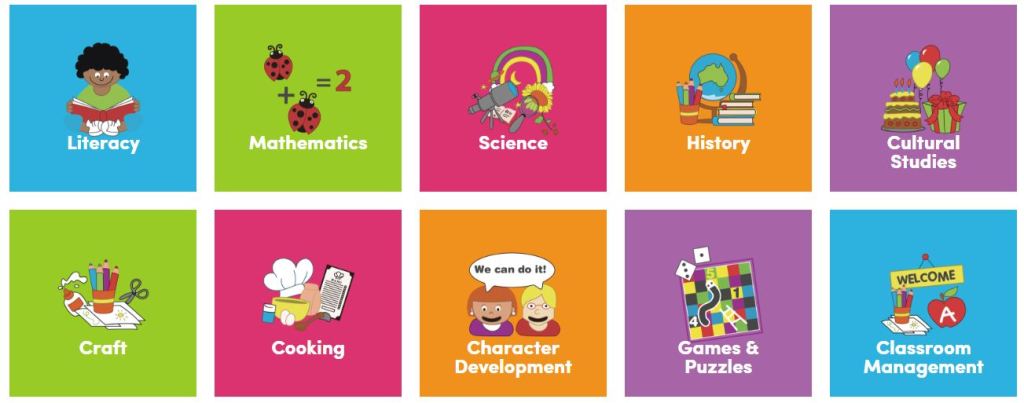
readilearn resources support teachers teaching and children learning by providing opportunities for discussions that promote thinking, collaboration and learning across the curriculum. Open-ended discussions encourage children to learn from each other as well as the teacher and to participate at their own level.
Resources include
- original digital stories (estories)
- interactive teaching episodes
- open-ended problem-solving activities
- readilessons (lessons ready to teach)
- printable activities
- teaching suggestions
- notes for parents
- and more.
Free from readilearn
Continue reading: readilearn: freemium lower primary teaching resources with lessons ready to teach
Share this:
-
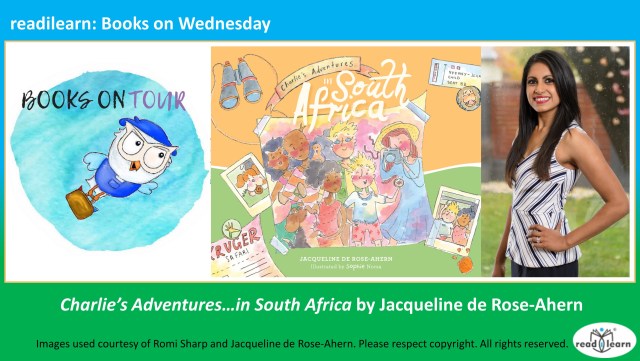
readilearn: Books on Wednesday — Charlie’s Adventures…in South Africa by Jacqueline de Rose-Ahern
This week I have great pleasure in introducing Jacqueline de Rose-Ahern author of Charlie’s Adventures…in South Africa. This post is but one of several celebrating Jacqueline’s beautiful picture book in Romi Sharp’s Books on Tour. Please read to the end of the post for details of other posts celebrating Jacqueline’s work.
About Jacqueline de Rose-Ahern
Jacqueline de Rose-Ahern is a Canberra based author and the recipient of the ACT Writers Centre 2017 Anne Edgeworth Fellowship. Her debut picture book, Charlie’s Adventures…in Hawaii, was shortlisted for the 2017 Speech Pathology Australia Book of the Year Awards and chosen as a finalist in the 2017 American Best Book Awards. Her second book in the Charlie’s Adventure series, Charlie’s Adventures…in South Africa, was recently released. At the heart of Jacqueline’s books are an appreciation of travel and the uniqueness of culture. She endeavours to encourage her readers to learn more about the world, supporting an empathetic and inclusive community.
About Charlie’s Adventures…in South Africa
Charlie is off on the second of his adventures with his family … to South Africa! With his friends, Charlie is set on a discovery of different clues to uncover South Africa’s Rainbow Nation. Join Charlie and his family on their adventures across the world.
The interview
Welcome to readilearn, Jacqueline.
Thanks for inviting me.
Jacqueline, what gave you the idea for this book?
Continue reading: readilearn: Books on Wednesday — Charlie’s Adventures…in South Africa by Jacqueline de Rose-Ahern
Share this:
-
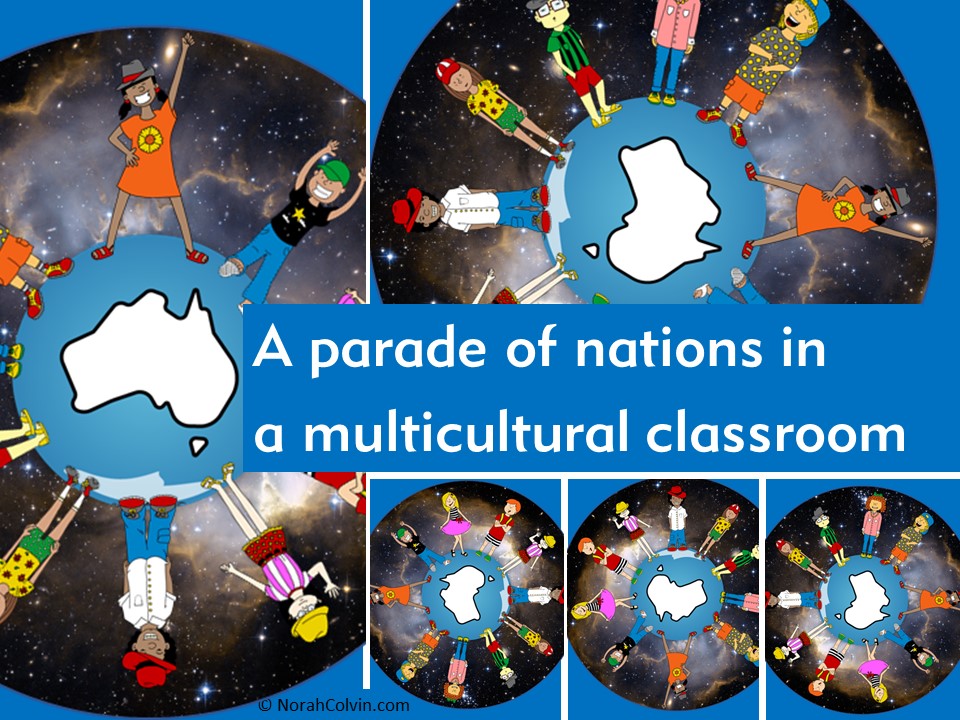
A parade of nations in a multicultural classroom
This week at the Carrot Ranch, Charli Mills has challenged writers to In 99 words (no more, no less) write a story about a parade of nations. It can be literal, or it can be a phrase that you use to describe a situation. Explore what it could be. Go where the prompt leads.
One need look no further than a classroom of children to find a parade of nations. Below is my response to Charli’s prompt, but please read on for information about Multicultural Children’s Book Day, International Day of Peace, and suggestions of books to read.
A parade of nations
The children listened intently, eager to learn. Each family’s wish was for a better life. The group was a parade of nations; with Dragos from Serbia, Duy from Vietnam, Melino from Tonga, Ervine from Scotland, Rongo from New Zealand, Jung from Korea, Sanhitha from Sri Lanka, and Jawara from Senegal; and these were only the new arrivals. Others were first and second generation with but a few who could count back further than three, except for Kinta whose ancestors were the first to arrive. The wall map, dotted with pins to show each one’s heritage, was their proudest display.
While I have taught classes with children from each of these countries, and many more, for the purpose of my story I used the Baby Name Finder at Mom Junction to locate names with friendly, peaceful meanings. It is a very helpful resource.

It was my experience in such multi-cultural classrooms that prompted me to make a resource to facilitate learning about our own and each other’s cultural traditions and celebrations. The resource is now available on readilearn.

Used courtesy of Multicultural Children’s Book Day Thinking about the diversity that exists in our classrooms, our cities, our countries and our world is a perfect time to bring to your awareness Multicultural Children’s Book Day, the focus of which is on “bringing attention to all of the amazing children’s books available that celebrate diversity.”
The co-creators of the event Valarie Budayr and Mia Wenjen define multicultural books as those that
- include characters of colour or that represent a minority point of view
- share ideas, stories, and information about cultures, race, religion, language, and traditions
- embrace our world and offer children new ways to connect to a diverse and richer world.
On the Multicultural Children’s Book Day website, teachers can find a collection of helpful resources; including a classroom kindness kit and a classroom empathy kit. Authors and publishers of multicultural books are also invited to sponsor Multicultural Children’s Book Day through a range of sponsorship options already open for 2019. Interest in the day has increased in the six years since its inception and that growth can only continue. While it is wonderful to see the greater number of books with multicultural and diverse themes now available, more are still needed.

One of my long-time favourites is Whoever You Are written by Mem Fox and illustrated by Leslie Staub. I have read it to many groups of children, every one of whom has loved its powerful message: that underneath it all, we are just the same.
You can read about, listen to Mem read, or purchase the book here.

A newer favourite is another by Mem Fox —I’m Australian Too. This one is illustrated by Ronojoy Ghosh.
This book is a celebration of all cultures and heritages that are represented in the Australian population and together make our country what it is.
You can read about, listen to Mem read, or purchase the book here.

An even newer favourite is All are Welcome written by Alexandra Penfold and illustrated by Suzanne Kaufman.
I first heard about this book from the wonderful Patricia Tilton who blogs at Children’s Books Heal. Patricia’s aim with her blog is to “share books on a wide range of topics that have a healing impact on children who are facing challenges in their lives.” I have purchased many lovely books recommended by Patricia and never been disappointed.
Just as I was completing a draft of this post, I received notification of a new post by Patricia. You won’t believe it, but Patricia wrote about the book again for the International Day of Peace on 21 September. How perfect. Please pop over to Patricia’s post for more details about this beautiful book.
Once, long ago, there used to be a recording of Bill Martin Jr. singing I am Freedom’s Child on his website. I loved singing along to it with my class. The words were especially meaningful in our multicultural classes. We sang, “As I learn to like the differences in me, I learn to like the differences in you.” What a wonderful thought that, with acceptance of ourselves, comes acceptance of others. If we could just do that, we would indeed, all be freedom’s children.
Thank you for reading. I appreciate your feedback. Please share your thoughts.
Share this:
-

readilearn: Introducing Robbie Cheadle author and illustrator of the Sir Chocolate Book series
This week I have great pleasure in introducing you to Robbie Cheadle author and illustrator of the Sir Chocolate Book series.
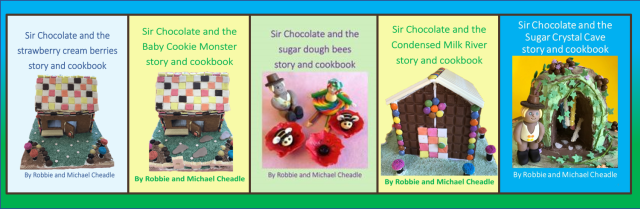
What most appeals to me about the Sir Chocolate Books is Robbie’s amazing fondant illustrations. I am also impressed that her twelve-year-old son Michael co-authors the books with her, and has been since he was ten. Perhaps your children will also find this aspect interesting.
About the books
Sir Chocolate and Lady Sweet live in Chocolate Land where everything can be eaten. In each story, told in rhyme, Sir Chocolate and Lady Sweet have a new adventure or problem to solve. Robbie also includes recipes from the story in each book.
To date, there are five books in the Sir Chocolate Book series.
About Robbie
Robbie Cheadle was born in London. Her father died when she was three months old, and she and her mother emigrated to South Africa where they lived in Johannesburg, George and Cape Town. While growing up, Robbie attended fourteen different schools. This gave her many opportunities to develop social skills and meet new people as she was often “the new girl”.
Robbie is a qualified Chartered Accountant and writes in that field about equities and investments in South Africa.
While Michael co-authors the books with her, Robbie’s other son Gregory (aged 14) assists Robbie and Michael with filming and editing their YouTube videos and editing their books. The books are very much a family affair.
For other books written by Robbie, see the end of the blog post.
The interview
Welcome to readilearn, Robbie.
Thank you for inviting me.
Robbie, the number of books in the Sir Chocolate book series is continually growing with five books now available. What gave you the idea for this series?
Continue reading: readilearn: Introducing Robbie Cheadle author and illustrator of the Sir Chocolate Book series
Share this:
-
Once Upon a Rodeo Time
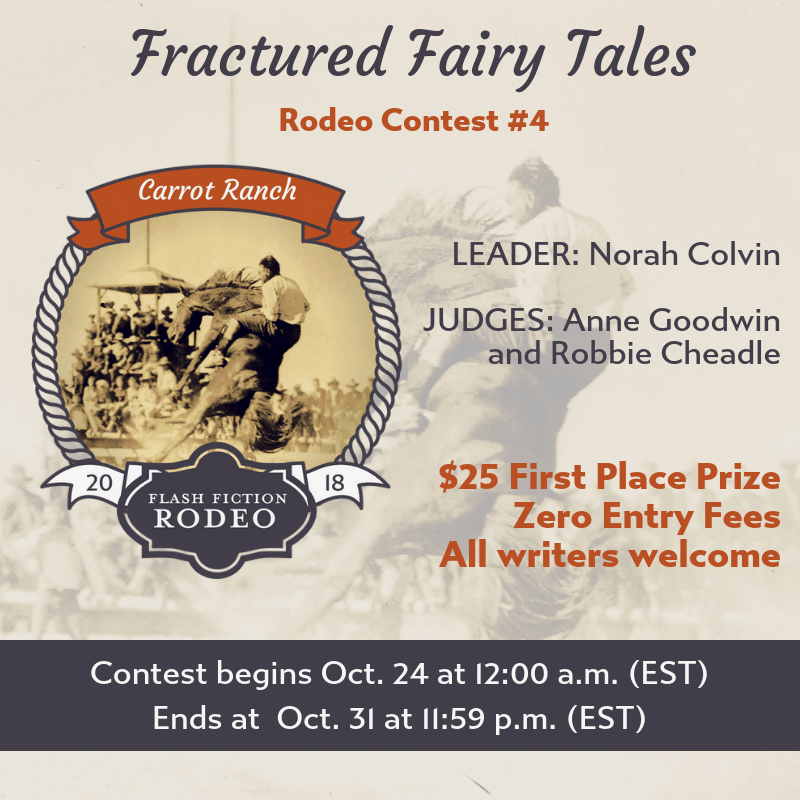
As promised, here’s some information to start your thinking in preparation for the fractured fairy tale flash fiction contest in the Carrot Ranch Rodeo next month. (Try saying that five times real fast!)
Please note: The correct date is Oct 24, not Oct 17 as shown below.
Share this:
-
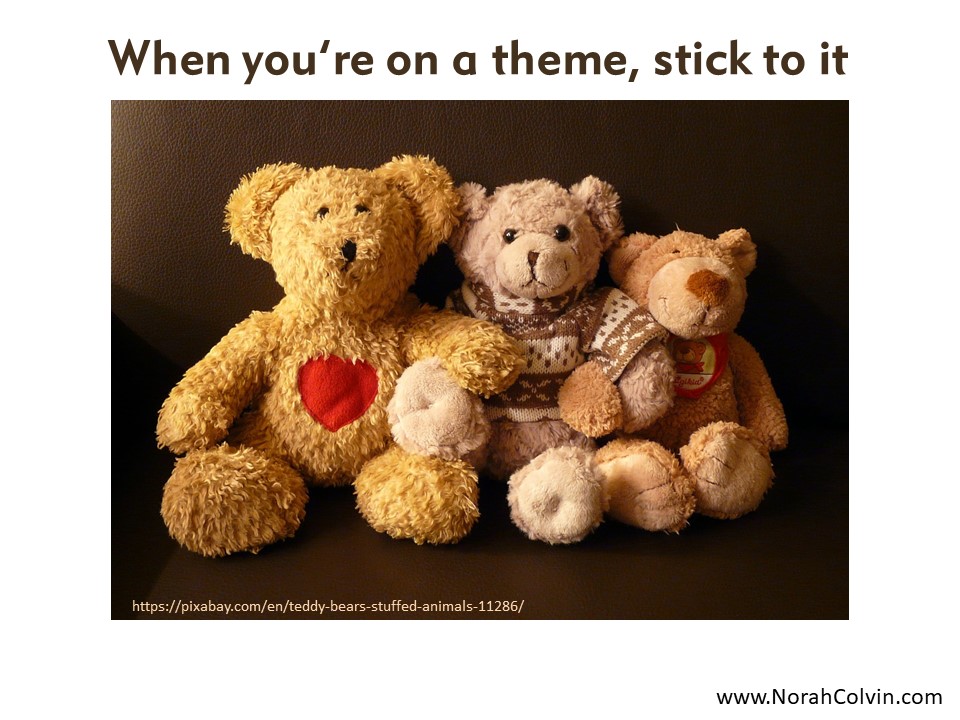
When you’re on a theme, stick to it
Education is my theme. It’s my passion. Sometimes I think I should get another interest, but I’m stuck with this one. Sometimes I get stuck with a theme within a theme too. That’s happening at the moment.
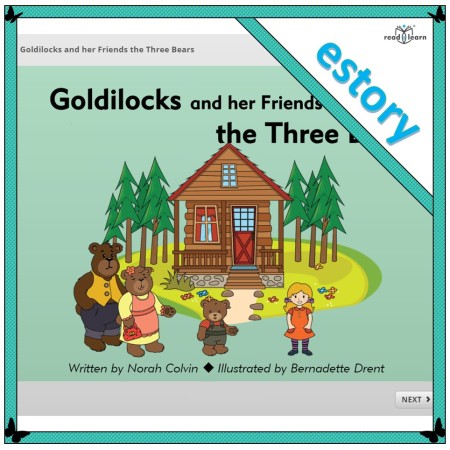
A couple of weeks ago, I uploaded an innovation on the traditional story of Goldilocks to readilearn, a collection of teaching resources for the first three years of school. I also added some suggestions for using the resource to teach reading and writing, including sight words in context. I have other supporting resources in progress to be added to the collection soon.
While my story Goldilocks and her Friends the Three Bears is not really a fractured fairy tale, it’s simply a retelling with an alternative ending; I’ve also been thinking of fractured fairy tales for my Carrot Ranch Rodeo Contest coming up next month. (Look for further details to be published at the Ranch this week.)
So stuck on this theme am I, that I wrote a 297 (3 x 99) word story as a response to Charli’s Tuff prompt “Papa’s Bar”. While this Free-Write contest is now closed (writers have only twenty-four hours to respond to the prompt), there will be four more chances to enter the TUFFest Ride event with the next one scheduled for September 19. Be sure to look out for it if you want to be in it.
Note: I’m not sure where or what the Papa’s bar is that Charli alluded to, but I am sure that it’s not what I wrote my story about. In Australia, when we play tiggy, that you might know as tag or tig, or some other name, we might allocate a certain spot as ‘bar’. This means that you are safe and cannot be tagged when on or touching that spot. Sometimes, players will attempt to allocate a spot as bar just as they arrive at it in order to avoid being tagged.
While I have no thoughts that I may win any of the TUFF contests, it is fun having a go. This is what I wrote in response to the Papa’s Bar prompt. I hope you enjoy it.

Papa’s Bar
Out in the woods lived a family of bears; Papa Bear, Mama Bear and baby bears five. All summer long, Papa Bear toiled, ensuring his family were contentedly fuelled, ready to sleep through the winter’s long dark. They filled up their bellies with berries hung low, with fish in abundance in streams flowing clear, and hives’ full bounty of gold. Mama and babies had no need to complain, every meal Papa made, a sumptuous feast. When autumn arrived, and food became scarce, Papa Bear said, ‘Now’s time for bed. Close your eyes little ones, dream sweet dreams until spring.’
The babies were restless, not ready for sleep.
‘We need a story,’ a little one said. ‘Tell us about life when you were a cub. What did you eat? Where did you play?’
‘Just one story — then sleep.’
‘We need a drink first,’ said the cubs.
‘Okay, but lickety-split.’
They had just settled back when another voice said, ‘I’m hungry.’
‘Me too,’ chimed the others.
‘Can’t be,’ said Papa Bear. ‘No food until spring.’
‘Awh,’ they chorused.
‘I could make some porridge,’ yawned Mama Bear.
‘Yay! Porridge!’ said the baby bears.
‘But then you must sleep,’ said Papa Bear.
But they didn’t. Before his story was through, Papa Bear was snoring with Mama Bear nestled beside him.
‘Let’s play tag,’ smirked one.
‘I’m It,’ said another.
They took turns to run and catch, and through it all, the parent bears slept.
At last, the littlest bear yawned. No more running and catching, he was ready for sleep. He scrambled over Papa Bear, escaping the tagger’s clutches with a warning, ‘Can’t get me. Papa’s bar.’
His eyes closed and then, one by one, they snuggled into a big bear hug, murmuring ‘Papa’s bar’ as they drifted off to sleep.
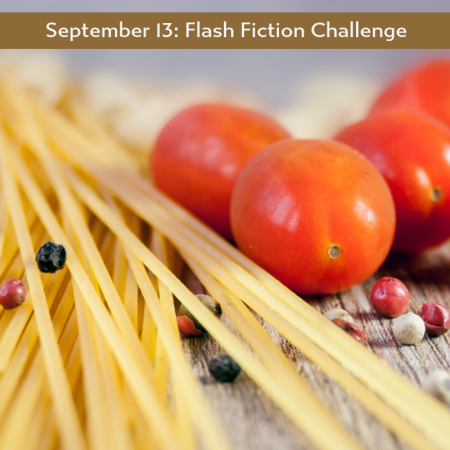
When Charli Mills of the Carrot Ranch posted this week’s flash fiction prompt, challenging writers to In 99 words (no more, no less) write a story that includes pasta. It can be spaghetti, macaroni and cheese, or any variety. It can be a meal or a work of art. Go where the prompt leads, how could I not get the bears in on the act again.
This is my response. I hope you enjoy it too.
Pasta for Breakfast
Papa Bear pushed back his chair. “Not this muck again.”
Mama Bear stopped mid-ladle. “It’s Baby Bear’s favourite. I— I thought it was yours too.”
Baby Bear’s lip quivered.
“Pfft! Sometimes a bear needs real food.” He grabbed his hat. “I’m going for a walk.”
“Papa!” Baby Bear went after him.
Mama Bear dumped the porridge, pot and all, into the bin, grabbed her hat and followed.
“Where are we going?” asked Baby Bear.
“Somewhere nice for breakfast. It is spring after all.”
Papa Bear paused outside BreakFasta Pasta, then went in.
Mama Bear smiled; pasta was her favourite.
Thank you for reading. I appreciate your feedback. Please share your thoughts.
Share this:
-

readilearn: Introducing Sonia Bestulic author of Reece Give Me Some Peace
This week I have great pleasure in introducing you to Sonia Bestulic author of Reece, Give Me Some Peace. While interviews with authors and illustrators have featured regularly on the readilearn blog, this interview marks a new collaboration with Romi Sharp and the team from Books on Tour. This post is but one of several celebrating the launch of Sonia’s beautiful picture book. Please read to the end of the post for details of other posts celebrating Sonia’s work.
About Sonia Bestulic
Sonia grew up in Sydney Australia enjoying a childhood filled with wonderful books, a passion for writing and music entwined. She played the violin until her late teens, including performances at the Sydney Opera House. Sonia is Founder of Talking Heads Speech Pathology established in Sydney in 2006. A long-term advocate for children’s learning and literacy, Sonia continues to write and speak about all things children.
About Reece Give Me Some Peace
Reece Give Me Some Peace is a fun-loving book about the wonderful world of music and noisy play. Reece is a very cheeky and curious boy who loves making noise. His mother’s requests for him to be quieter only seem to make him louder. As his exuberance grows, so does his mother’s exasperation. Will she ever get any peace?
The simple rhythmic text combined with delightful illustrations by Nancy Bevington reminds us of the power of learning through play and exploration. Children will love to join in making the sounds and adults will identify with the challenge of being able to enjoy some quiet.
Now, let’s meet Sonia.
The interview
Hello, Sonia. Welcome to readilearn.
Thank you for inviting me.
Sonia, today we will discuss your beautiful new picture book Reece, Give Me Some Peace, but first, can you tell us what inspired you to be a writer?
Continue reading: readilearn: Introducing Sonia Bestulic author of Reece Give Me Some Peace
Share this:
-

How important is classroom decoration?
For a relative newcomer, in my terms anyway, Pinterest has made quite an impact on the world, particularly on the world of the classroom.
If you’re in doubt, just Google ‘Pinterest classroom’. Your search will bring up hundreds, indeed thousands, of ‘best’ classroom décor ideas.
Decorating classrooms seems to be the thing of the moment. It would be easy to believe that an elaborately decorated classroom is of greatest importance to teachers today. While we always did it (decorated our classrooms), we didn’t share and compare on social media. How could we? Social media didn’t exist. Oh, horrors! Really? Really. Pinterest is not only new to this century. It’s new to this decade, and the sharing phenomenon isn’t exclusive to Pinterest.
Concerns about harmful effects of social media messages on young, and not-so-young, people’s body image are often expressed. I wonder if there may be similar harmful effects of these classroom images. If teachers compare their classroom décor with that of others, perhaps in very different situations, will they constantly come up short? If they spend copious amounts of time, and money, on decorating their room, how much will they have left for professional reading and planning? As with body image, are these images sending the wrong message?
While I agree with the importance of setting up a bright, welcoming classroom, I also believe that space must be left for the display of children’s work. While I don’t believe in the bare wall theory as proposed by some, if there is too much on the walls, and particularly if they didn’t contribute to it, children may either ignore it or simply find it distracting.
What do you think? Do you remember the walls of your childhood classroom? Mine were mostly bare. I don’t remember anything other than a Crucifix (I went to a Catholic school), a photo of the Queen, and a flip book of large cloth charts.
What about your children’s classrooms, or your own (if you are a teacher)? How are they decorated? I’d love to know your thoughts.

While I had been contemplating a post about Pinterest classrooms for a while, this week seemed the perfect time, even if this isn’t the post I had been planning. You see, Charli Mills at the Carrot Ranch challenged writers to In 99 words (no more, no less) write about an epic workplace. It can be real or imagined. Go where the prompt leads.
Most of my working life (and all of my school days, which together equate to most of my life 😊) has taken place in a classroom. I had brief tilts at other minor roles, but overall, the classroom has been my workplace. With a career spanning five decades (but not fifty years – yet), I think it could be categorised as epic.
However, rather than tackle my career, I realised that Pinterest-Inspired Classrooms fitted neatly into the EPIC acronym. as long as I could find that exceptional ‘e’ word. This is my response. I’d love to know what you think.
It’s EPIC
Roll up! Roll up! Come one, come all. This new attraction will have you enthralled. Bring parents, bring partners, siblings and friends. No one’s excluded. It’s Earth’s latest trend. Your eyes won’t believe. Your ears won’t deceive. It’s a sensory explosion, for all to explore. It’s entertaining, electrifying, edifying too. It’s a universe first, and it happened on Earth. It’s empowering, engrossing. There’s so much to see. With no space left empty, it’s elaborate, exciting, extols energy. With exquisite exhibits and enlightening exposures, it’s the most, enticing, enriching, educational environment, established on Earth. It’s EPIC, the Exceptional Pinterest-Inspired Classroom.
Thank you for reading. I appreciate your feedback. Please share your thoughts.
Share this:


 Norah Colvin