Every day is a great day for reading aloud to children, but with the celebration of International Read to Me Day on March 19, now is a great time to give some thought to the importance of reading aloud in preparation for the Day’s celebrations. by arming yourself with a basket of books to read.
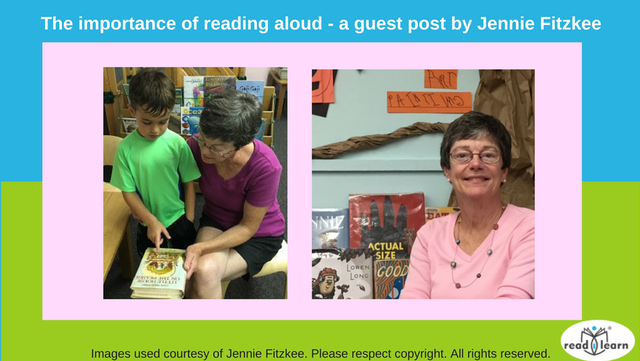
To help put us in the mood and assist our preparations, Jennie Fitzkee is here to tell us why reading aloud to children is important.
Jennie, a passionate and inspirational teacher, has been teaching preschool in Massachusetts for over thirty years. She is considered by many to be the “book guru” and the “reader-aloud”. She is also a writer and her work is often posted by The Eric Carle Museum of Picture Book Art. This is what Jennie says of teaching:
“I believe that children have a voice, and that is the catalyst to enhance or even change the learning experience. Emergent curriculum opens young minds. It’s the little things that happen in the classroom that are most important and exciting. That’s what I write about.”
Jennie is highlighted in the new edition of Jim Trelease’s bestselling book, The Read-Aloud Handbook because of her reading to children. Her class has designed quilts that hang as permanent displays at both the National Liberty Museum in Philadelphia, and the Fisher House at the Boston VA Hospital. Their latest quilt is currently hanging at the Massachusetts State House in Boston. In 2016, Jennie was one of seven teachers in Massachusetts to receive the Teacher of the Year Award.
I’m sure you’ll agree that there is much we can learn from Jennie.
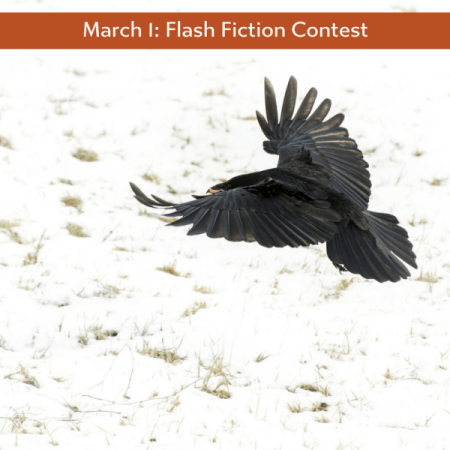
While ravens and crows may have their differences, as an Australian, I can be forgiven for having difficulty in telling them apart. As this article about the Australian Raven in Birds in Backyards says,
“There are six members of the family Corvidae found in Australia: five native breeding species and one infrequent self-introduction. Three are called crows and three ravens, although there is really little difference. Most Australian species are similar in size and colouration, and can be difficult to tell apart.”
In fact, when I attempted to find photographs of crows and ravens, I found the same photograph labelled ‘crow’ in one location and ‘raven’ in another!
I provide this information only so you’ll understand why I refer to crow rather than the raven of Charli’s prompt.
You see, Charli’s prompt reminded me of this video in which a crow shares its bread with a mouse.
I wondered why the crow would make such an effort to share with a mouse. Don’t crows usually eat mice?
I was reminded, then, of the Aesop’s fable The Lion and the Mouse in which a lion, surprised at the idea that a mouse might one day be able to help him, forgoes a meal and releases the mouse. The mouse returns the favour one day by freeing the lion when it was ensnared by hunters.
However, in the fable, it was the potential prey who helped the predator in an act of kindness.
In the video, it is the predator showing kindness to potential prey. Finding a motive required some divergent thinking. This is what I came up with as a start.
Crow and Mouse
“Caw, caw,” called Crow in the morning from atop the tree.
“Caw, caw,” called Crow at midday from the neat vegie patch.
“Caw, caw,” called Crow, perched high on a wire, at the end of the day.
“Shoo, shoo,” shouted Man in the morning, shaking knobbled fists.
“Shoo, shoo,” shouted Man at midday, stamping his feet.
“Shoo, shoo,” shouted Man, clattering his pans at the end of the day.
Sneak, sneak went Mouse from his hole in the wall, to the kitchen and back, unnoticed by Man who was noticing Crow.
And so it repeated, day after day.
Until, one day, Man grew tired of shooing Crow and loaded his slingshot with a rock. Mouse, ready to sneak, saw Man take aim. Mouse ran–across the floor and up Man’s leg. Man stumbled. In so doing, he dropped the rock upon his toe. He hollered. Crow heard the commotion and flew away, cawing his thanks to Mouse.
Man saw where Mouse hid. He fetched his hammer, nails and a board.
Just in time, Mouse escaped–down the stairs, through the garden and into the woods. In the darkness, Mouse trembled. All his life, he had filled his belly with three good meals a day from Man’s kitchen. Could he fend for himself? He looked about this unfamiliar world. When the quiet was interrupted by a flap-flap-flap, he ducked for cover.
Too late–he’d been spotted.
“There you are,” cawed Crow, placing a piece of bread on the ground in front of Mouse. “Thank you for your kindness. One good turn always deserves another.”
What do you think?
Stories, stories, everywhere
I had fun writing the story and it reaffirmed for me that potential stories are everywhere, not only for adult writers, but for children too. I think children would love to discuss the video of the crow and the mouse and would ask many more questions and come up with more inventive stories than I did. What a fun writing prompt it would be. Children could also compose dialogue for the animals and act it as a play.
In this article from ABC News, I discovered that clever crows are learning from magpies to swoop in order to protect their nests. It also seems that they never forget a face. Perhaps they are no happier to see bullying than we are.
This is my response to Charli’s challenge. I hope you like it.
Nothing to crow about
Brucie had to get there first to stake his place at the very top. He didn’t slow on the still-wet grass, and only momentarily to laugh at Jasmine who slipped as he brushed past. From his perch, he smirked at the disappointed faces below.
“Caw!” said a crow, alighting alongside.
“Shoo!”
It didn’t shoo–more came.
Brucie shouted, waving his arms.
The crows shuffled closer.
Brucie thrashed wildly.
Bang! Bang! Bang! Jasmine banged a cricket bat against the frame.
The crows flew away.
“Are you okay?” asked Jasmine.
Brucie nodded, then let the others play.
The crows never returned.
Thank you for reading. I appreciate your feedback. Please share your thoughts.
Providing children with fun and purposeful activities for writing is one of the best ways to encourage a love of writing, to replace the drear with enthusiasm.
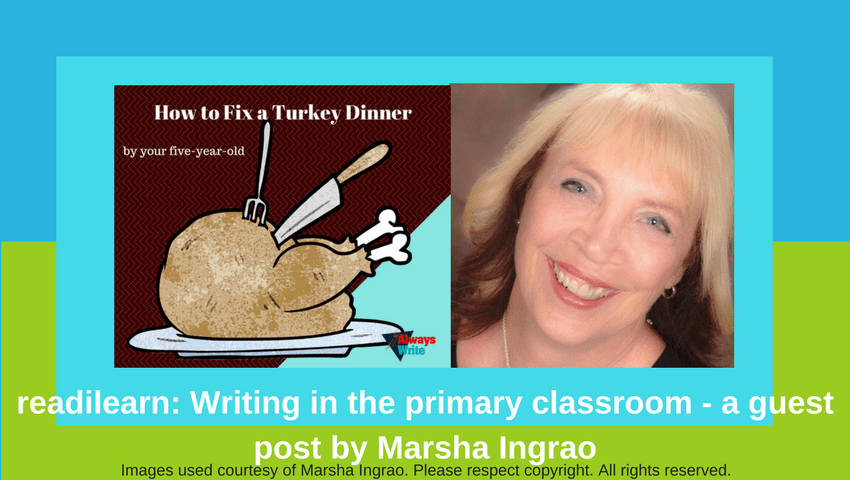
In this post, I introduce guest author Marsha Ingrao who shares suggestions for bringing joy to your writing lessons through the Language Experience Approach.
“The Language Experience Approach (LEA) is a literacy development method that has long been used for early reading development with first language learners…It combines all four language skills: listening, speaking, reading, and writing.”
Although Marsha retired from public education in 2012, her passion for education remains and she continues to educate through blogging, speaking engagements and volunteering for Kiwanis and the Chamber of Commerce. Her classroom experience ranged from teaching kindergarten to fourth grade. She left the classroom to work as a consultant for the county office of education first in math, working with migrant education, then in history and language arts. She is author of Images of America Woodlake, a history of her local Woodlake area, published by Arcadia Press.
Welcome to readilearn, Marsha. Over to you.
Because LEA employs all four branches of language arts, listening, speaking, reading and writing, it is perfect for teaching writing to pre-school and primary students as well. With the thrust in the United States for non-fiction reading, the language experience approach becomes the perfect avenue for teaching writing to young children.
To make the language experience approach applicable to all young students, adult assistance is required.
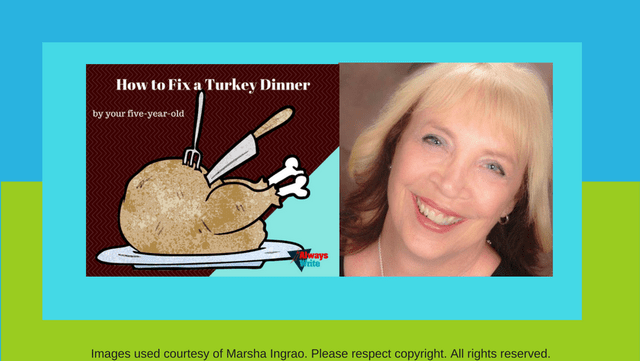
The “How To” Essay
Beginning in pre-school, we tackled one of the hardest types of writing, the “how to” essay. Holiday traditions are the perfect avenue for this








 Norah Colvin