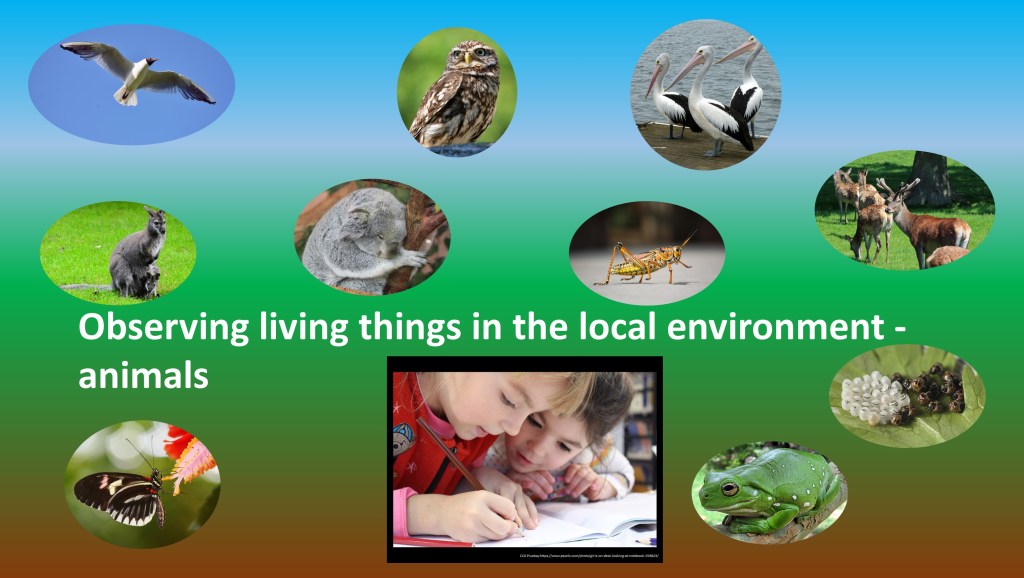
Observing living things in the local environment helps children develop an appreciation for all living things, not just the exotic animals that feature most commonly in picture books and wildlife shows. It also helps them appreciate the diversity of living things in their local area and may stimulate an interest to know more.
Conducted over a week, including a weekend, observations can reveal a surprising number of creatures. If the observations are repeated throughout the year; for example, during different seasons, a greater diversity may be observed.
Be part of a larger project
While observations can be conducted independently as part of the class curriculum, sometimes you can be involved in larger citizen science projects such as these two Australian projects: the Aussie Backyard Bird Count and The Atlas of Living Australia. Data on The Atlas of Living Australia enables you to find out what living things others have observed in your local (Australian) area.
For those living outside Australia, you may find resources specific to your location by searching National Geographic, Scientific American or simply by conducting an internet search.
Books and other resources
While many species observed may be identified through an internet search, particularly using the resource section of your local museums, it is also useful to source books about the wildlife of your area, or to seek out local groups and experts to assist identification and to develop understanding of local habitats and living things.
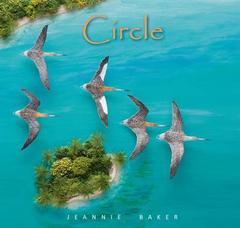
Include picture books if possible too. For example, earlier this week I had the pleasure of attending the launch of an exhibition of collages created by Australian author and illustrator Jeannie Baker to continue reading
My mind skipped immediately to a song from my childhood, remembering Sunday evenings when we huddled around the television set to watch The Wonderful World of Disney:
“When you wish upon a star
Makes no difference who you are”
What a wonderful thought – all success stories have to start somewhere – why not with us?
But there is another saying too, Be careful what you wish for.
This is my response. I hope you enjoy it.
The wish
The words replayed continuously as he sat on the step searching the sky for a wishing star: “When you wish upon a star …”
Inside, the adults’ voices grew louder and harsher. He covered his ears and sang through his tears.
A crash followed a thump, then all went quiet. He held his breath.
He crept to the door and peeked in. Mum, slumped on the floor, cradled Dad’s head in her lap. Blood was everywhere.
“Call triple zero.”
Huddled together they watched paramedics try to revive him.
“I didn’t mean …” each whispered to themselves, but weren’t convinced.
Thank you for reading. I appreciate your feedback. Please share your thoughts.
Have you ever had that moment of inspiration when two ideas mesh and you know you’ve found the answer? I’m certain you have. It’s creativity. It’s energising. It’s like bubbles in a can, popping all over the place, bursting with exuberance, needing to express; and there’s no keeping it in.
Writing is like that for me. Writing or teaching. Writing and teaching!
Except for when it’s not.
I can think and think and think and struggle to find an idea. But as soon as the two (or more) right ideas come together, there’s an explosion, and I just can’t wait to get it down, or try it out.
It’s what I love about creating teaching resources. I think: how can I best explain this concept, what will children enjoy most, how will they best learn? Fizz! And I’ve just got to do it. I love the creative outlet. Without it, life’s just, well – dull.
I like to think that what I write is different; that my teaching resources differ from the millions of repetitive worksheets that are written to keep children busily unengaged in the learning process. I imagine myself using them, and having fun with my class. I like to think of other teachers using them to encourage children to think creatively, critically, logically, imaginatively, and learning through discussion with their teachers and peers. But do they? I like to think.
Do you hear that self-doubt? Like so many creatives, I find self-promotion difficult. I struggle to put my work out there for fear it might not be good enough. Each new step requires blinkered determination, focus, and practice, practice, practice to strengthen self- belief that wavers at the first hint of a breeze.
But did you see that? I called myself a creative. Should I? Do I have the right? I always say that one thing I loved about teaching was the opportunity it gave me to be creative. Though I may think I was creative, does my thinking allow me the label?
A few years ago, I gave myself some good talking-tos, took some deep breaths, and attended a writer’s group. Sure, they were the creative types – picture book writers and junior fiction writers. And me. Well, I was aspirational, but had a number of educational publications behind me and was working on my own collection of teaching resources.
In turn, around the circle, we were required to introduce ourselves to the group, sharing what writing we were working on. I could have said I was working on picture books and junior fiction. I have several stuck away in drawers for future development, many with rejection slips to prove I was aspiring. I’d been collecting rejection slips since long before many of these writers were born. I must admit that none of them were recent though, as I’d been more involved in other things, including educational writing.
When it was my turn, I took a deep breath, and stated that I was involved in educational writing at the moment. “Oh,” said the leader. “Educational writing. That’s so formulaic.” And she quickly turned to the next person. Well, if that didn’t burst my bubble. The confidence I’d struggled to muster to even attend the meeting was felled in one swoop.
Not only was she wrong, (well, I believe she was wrong), her attitude was wrong, and her response to an aspiring writer was wrong. She asked no questions, gave no opportunity to discuss why my work may be considered creative, or what other more creative writing I might engage in. She obviously considered I had no business being there among the “real” creatives.
Similar difficulties can be experienced by children in school. People are quick to judge, assess and dismiss on perceptions of background, ability and potential. It can be difficult to stay strong and persistent when the brush of other’s biases paints you inadequate. Without a strong framework and inner fortitude, the will may crack and crumble at the first sign of tension.
Surely, one purpose of education must be to build those strong foundations in order to avoid wreckage in the future. Just as for buildings, we start from the bottom, building on a strong base, adding more to each layer. There’s no starting at the top, or even the middle. Each new layer must mesh with the one before.
I immediately thought of the mesh that is embedded in concrete to give it inner strength, to hold it together when under pressure, to prevent it cracking and crumbling. What a great analogy for both personal core strength and a foundation of a great education. How could I resist?
Here’s my story. I hope you enjoy it.
Strong foundations
Jamie heard the vehicles; the doors slam; then men’s voices. He looked to his mum. She smiled and nodded. Dad was already there, giving instructions.
“Watch, but don’t get in the way,” he’d said.
Clara arrived, breathless. “What’s happenin’?”
“Carport. Pourin’ the slab,” he answered. “That’s the frame. Keeps it in shape.”
Beep. Beep. Beep. The concrete truck backed into position.
The men quickly spread the mix, then lifted the mesh into place.
“Makes it strong,” said Jamie.
Another load of mix was spread.
“All done,” said Jamie.
Later, in the sandpit, the children experimented with strengthening their structures.
Thank you for reading. I appreciate your feedback. Please share your thoughts.
P.S. If you are a teacher of children of about 5 to 7 years of age in their first three years of school, I’d love your feedback on readilearn, my collection of early childhood teaching resources. Please complete the survey here and share this post with other early childhood educators you know. I am keen to receive honest feedback about the site’s visual appeal and usability, as well as suitability of resources. Thank you. 🙂
How is cooking like writing?
One’s a feast for the body, the other a feast for the mind. For some great flash fiction to get your teeth into (including one of mine!) read on:
For the inspiration for this post and the resource it describes, I must thank Pamela Wight, who featured in the author interview last month.
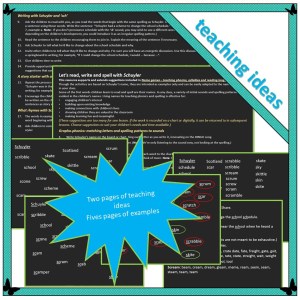
In commenting on the What’s in a name? post, Pamela mentioned the awkwardness of singing and spelling her grandson’s name – Schuyler, a name with which I was unfamiliar. I joked to Pamela that I’d thought of recording a few names, innovating on the tune of BINGO, to show how “easy” it might be. Pamela suggested I should, even though I explained that my singing voice is anything but, and she told me the pronunciation for Schuyler: Skylar. Well, I couldn’t help myself. My head started racing with ideas of incorporating Schuyler’s name into reading and writing lessons teaching phonics and spelling skills. The result is the resource Let’s read, write and spell with Schuyler,
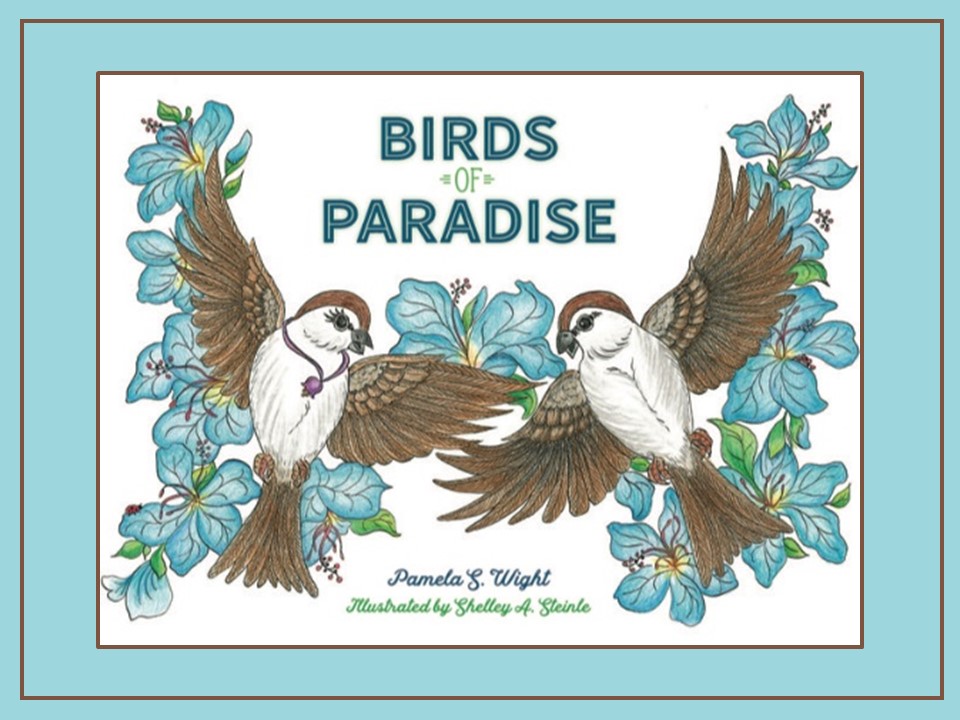
In the author spotlight this month is Pamela S. Wight, a fellow blogger, writer, and teacher of creative writing. I enjoy the stories of life Pamela shares on her blog Rough Wighting, and also enjoyed reading her adult novels. But it was the story of how this picture book Birds of Paradise came to be, a picture book 35 years in the making, that really captivated me. I knew I wanted to share it with you. Before we start talking about the book, though, let me introduce you to Pamela.
Pamela Wight has joined the ranks of authors who are, as she calls it humorously “bi-genre” or “ambi-writers.” Think of Ian Fleming, who yes, wrote the James Bond books, but also switched genres and wrote the children’s book Chitty Chitty Bang Bang. Before A.A. Milne wrote the Winnie-the-Pooh books, he penned a popular whodunit entitled The Red House Mystery.
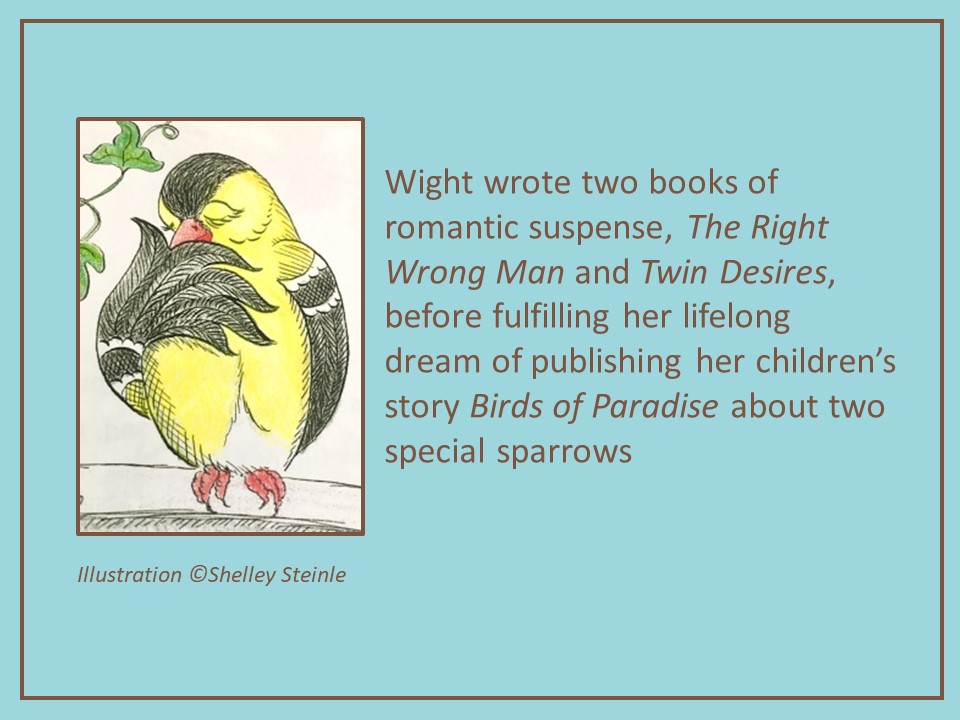
Wight wrote two books of romantic suspense, The Right Wrong Man and Twin Desires, before fulfilling her lifelong dream of publishing her children’s story Birds of Paradise about two special sparrows.
About the story:
Sweet sparrows Bessie and Bert grow up as differently as night and day. Bessie is fearful of the dangers inherent in being a bird. She’s scared to leave her cozy branch. But Bert relishes flying in the sky and
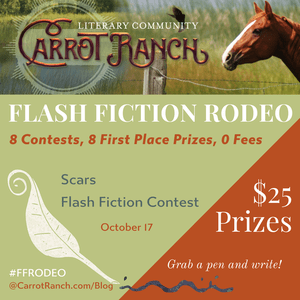
Have you got any scars you wish to share? Maybe others you’d rather hide?
Irene Waters has thrown down the challenge for the fourth of the contests in the Carrot Ranch Flash Fiction Rodeo. #FFRODEO
We’re halfway through the challenges. Can you believe that!
I’m having a difficult time judging all the wonderful entries for my contest. Thank you to all who entered.
Have you entered any of the contests yet? There’s a $25 prize for the winner of each one!
And the third of the contests has begun!
How’s your poetry? Ever written a septolet? I haven’t. Know what one is? I didn’t.
But I’m about to change both those answers. Are you?
Contests are free to enter and the winner receives a $25 prize!








 Norah Colvin