Live Love Laugh Learn … Create the possibilities

Tag: thinking

  • Searching for truth in a picture book – Part C

    Cocoon or chrysalis – what’s in a name?

    In my previous post Searching for purpose in a picture book – Part B  I conducted this poll:

    If you didn’t participate in the poll, but would like to, have a go now.

    What did you answer?

    If you are familiar with this book

    The Very Hungry Caterpillar

    you may have chosen both statements as correct along with one third of respondents in the poll.

    In his book Eric Carle writes that

    “He (the caterpillar) built a small house, called a cocoon, around himself. He stayed inside for more than two weeks. Then he nibbled a hole in the cocoon, pushed his way out and . . . he was a beautiful butterfly!”

    If you either read or wrote one of the hundreds of thousands of articles about “The Very Hungry Caterpillar”, or about butterflies and caterpillars in general, published on the internet, you probably also identified those two statements as correct.
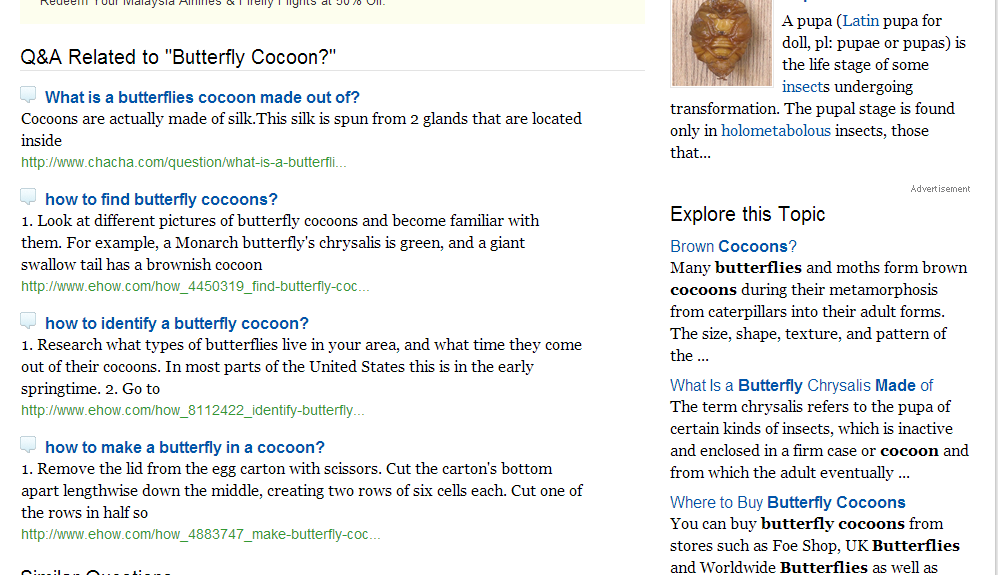
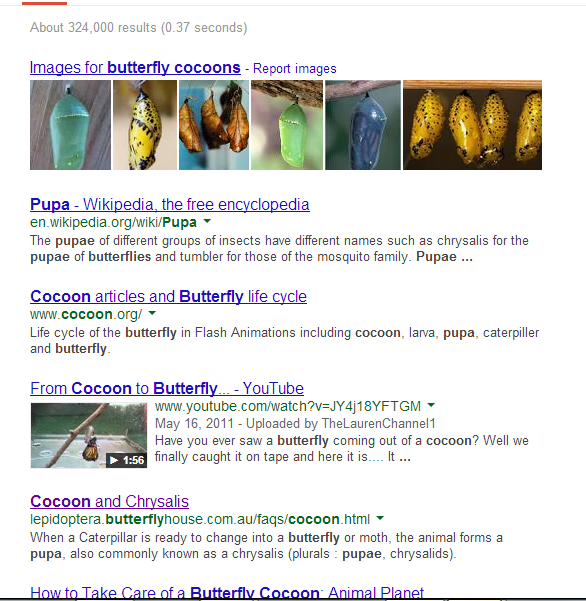
    butterfly cocoons Cocoon to butterfly

    But if you did, just like Eric Carle, you’d be wrong!

    A caterpillar that undergoes metamorphosis to become a butterfly does not spin a cocoon and does not nibble its way out. The fully grown caterpillar moults into a chrysalis and, when ready, it splits the chrysalis to emerge as a butterfly.

    Monarch butterfly

    For a series of beautiful photos showing the last moult of a caterpillar as it becomes a chrysalis, and another series showing a butterfly emerging from its chrysalis, click here.

    Or watch this video by Strang Entertainment showing the caterpillar becoming a chrysalis

    or this one by Neil Bromhall showing a butterfly emerging

    A moth’s caterpillar does spin a cocoon and does nibble its way out (think of a silkworm cocoon and moth).

    silkworms24a

    This video shows silkworm caterpillars nibbling hungrily away at the mulberry leaves. Then when a caterpillar is fully grown (about 2 mins in) it spins it cocoon.

    Compare the process with that of a monarch caterpillar forming a chrysalis. It is a very different thing.

    It is impossible to rely on the information provided by many of the websites to guide one’s use of “The Very Hungry Caterpillar” when working with children.

    For example, on the website Math & Reading Help, these suggestions are made:

    “Many Teaching Moments

    Though it’s a very brief picture book with sparse and simple language, The Very Hungry Caterpillar conveys an impressive array of wisdom and lessons for children. Most prominent among these is the life cycle of a caterpillar. The caterpillar in the story begins his life as an egg, then progresses through the larva stage. The time in his cocoon is his chrysalis stage, followed by his adult appearance as a butterfly.

    This is a factually accurate portrayal of how lepidopterans (sic), an order of insects including butterflies and moths, grow and change. It teaches your child to understand this biological process. When you encounter a caterpillar, you can refer to The Very Hungry Caterpillar and ask your child about what it’s doing, since it’s likely to be looking for food. Likewise, you can reference the book when you see a butterfly, noting how it’s a caterpillar that has emerged from its cocoon after its transformation.”

    You have already picked out the inaccuracies in that statement, haven’t you?

    Another website, Primary upd8 also suggests using the book for teaching children about the butterfly’s life cycle, and look how it promotes itself!

    Uks most exciting science resource

    This misinformation is so common and insidious that Jacqui, writing on the Monarch Butterfly New Zealand Trust website, said

    “When speaking to teachers I often find raised eyebrows when I explain that butterflies’ larvae do not make cocoons. The teachers refer to Eric Carle’s book, The Very Hungry Caterpillar, where he refers to a ‘cocoon’.

    Why does this misinformation persist, and why did Eric Carle use misleading statements in his book?

    Does it matter if children (and adults) think that butterflies hatch out of cocoons?

    Eric Carle didn’t seem to think it did.

    Unfortunately I was unable to locate for confirmation an article I’d read years ago. This article, if I recall correctly, reported a response of Carle’s to children enquiring why he had used “cocoon” rather than “chrysalis”. His response was one of disdain. What did it matter?

    If you search Eric Carle’s current website for cocoon, this is the response you will receive:

    Why a cocoon

    While Carle concedes that most butterflies come from a chrysalis, he triumphantly states that one rare genus pupates in a cocoon! I confirmed this with the Encyclopaedia Britannica .

    Does that one rare instance let Carle off the hook?

    I think not.

    In her article on the Monarch Butterfly New Zealand Trust website in response to Carle’s statement, Jacqui says

    “Actually, the Parnassians pupate inside cocoon-like webs usually constructed among leaves or in rubbish piles.” (my underlining)

    So not quite true and not quite off the hook Eric Carle.

    In addition, although I couldn’t find the article I was searching for, I found this from Scholastic which shows that Eric was aware of the error and declined to change it.

    “By the way, Eric already knows that a caterpillar emerges from a chrysalis, not a cocoon! So don’t bother writing to tell him. Eric explains how the famous “mistake” crept into the book:

    “My editor contacted a scientist, who said that it was permissible to use the word cocoon. Poetry over science. It simply would not have worked to say, ‘Come out of your chrysalis!’ If we can accept giants tied down by dwarfs, genies in bottles, and knights who attack windmills, why can’t a caterpillar come out of a cocoon?”

    There are many points for discussion in that statement:

    • His editor contacted a scientist – What sort of scientist? I would say one with questionable credentials or entomological knowledge.
    • Permissible to use the word “cocoon” – Why? For what purpose?
    • Poetry over science!!!!!!! Chrysalis is a beautiful word, specific to the butterfly. What could be more poetic than that? Poetic and scientific! What a great combination!
    • Why wouldn’t it have worked to say “Come out of your chrysalis”?
    • A caterpillar doesn’t come out of a cocoon. A caterpillar spins a cocoon; then a moth comes out of it; not a butterfly! (Except for the rare Parnassian butterfly.)

    Is this issue, as Carle suggests, the same as giants and dwarfs, genies in bottles and knights who attack windmills?

    What do you think?

    Do picture book authors have a responsibility in imparting factual information to children?

    Is it okay to choose “poetry over science”?

    In his talk Reading and obligation (reviewed in an earlier post) Neil Gaiman said that

    “We writers – and especially writers for children, but all writers – have an obligation to our readers: it’s the obligation to write true things, especially important when we are creating tales of people who do not exist in places that never were – to understand that truth is not in what happens but what it tells us about who we are. Fiction is the lie that tells the truth”

    Not quite the same thing I know, but an obligation nonetheless?

    Though not there now, when I first looked at the Reading Rockets interview with Eric Carle this quote was prominently displayed beside it:

     “The more that you read, the more things you will know. The more you learn, the more places you’ll go.”

    — Dr. Seuss

    A bit ironic, don’t you think?

    How much of the responsibility should remain with the reader to verify the correctness/accuracy of what is read? How does one go about that?

    I have always been a believer in the “question everything” approach. “Don’t believe everything you read,” I say. But sometimes knowing what to accept and what to question can be a difficult thing.

    I’d love to know what you think. Please leave a comment in the comment box.

    Here are links to some of the articles I referred to in this post:

    Monarch Butterfly Website

    Reading Rockets

    Eric Carle

    Encyclopaedia Britannica

    Scholastic

    Ask.com

    Google.com

    Neil Gaiman lecture in full: Reading and obligation

    This post is the third in a series

    Searching for meaning in a picture book – Part A

    Searching for purpose in a picture book – Part B


  • A book worth reading: Stephen Grosz “The Examined Life”

    CoD_fsfe_Books_icon

    What appeals to a reader about a book, or what a reader takes away from a book is as individual and personal as the reader. What is of most significant to one, may be of lesser importance, or even insignificant to another. The fact that many different readers can read the same book and take away a very different impression, understanding and emotional connection is testament to the power of the written word, the value of reading and the ability of an author to reach readers on many different levels.

    Recently I read Anne Goodwin’s review of the book “The Examined Life: How We Lose and Find Ourselves” by Stephen Grosz. Anne described the book as a “must read for any thoughtful individual.”

    I was already familiar with the quote attributed to Socrates:

    “An unexamined life is not worth living.”

    and recently read an article by Simon Longstaff in the NewPhilosopher magazine examining the quote.

    Simon suggested that

    “one can make sense of Socrates’ claim if it is understood to mean something like – those who do not examine their lives (make conscious ethical decisions) fail to live a life that allows them to experience being fully human.”

    He goes on to say that

    “In a world of abiding uncertainty and complexity one can recognise a certain attraction in not examining too much, for too long in life. Thus the allure of those who offer to provide clear answers, simple directions, precise instructions (whatever) so that you may set aside examination and merely comply, or unthinkingly follow custom and practice – perhaps living a conventionally moral life rather than an examined ethical life. One can easily imagine how pleasant an unexamined life might be.” 

    I like to think of myself as a thinker often engaging in a bit of self- or other-reflection, living a somewhat examined life, not blindly complying or following customs and practice and always open to a challenge of my beliefs and ideas.

    Anne’s review intrigued me.  By fortunate coincidence I was finishing one audiobook and ready for another, and was delighted to find that “The Examined Life” was available in audio format.

    Anne’s review gives 7 reasons why readers and writers of fiction should read “The Examined Life”. You can read them here.

    As Anne suggested, I found it compelling “reading” throughout and agree with her description of the stories as

    “especially exquisite. Beautiful prose, tightly structured, these are moral stories without being moralistic, gentle fables . . . that leave us pondering the big questions of how to live.”

    Alex Clark on Vintage Books was also complimentary, saying that

    “what The Examined Life shows above all else is that we should not fear looking deeply into ourselves, because it is more likely that the effort of holding our feelings at bay will render them far more damaging.”

    In search of a succinct synopsis, I found this on the Book Depository:

    “We are all storytellers we create stories to make sense of our lives. But it is not enough to tell tales. There must be someone to listen. In his work as a practicing psychoanalyst, Stephen Grosz has spent the last twenty-five years uncovering the hidden feelings behind our most baffling behavior. The Examined Life distils more than 50,000 hours of conversation into pure psychological insight without the jargon. This extraordinary book is about one ordinary process: talking, listening, and understanding. Its aphoristic and elegant stories teach us a new kind of attentiveness. They also unveil a delicate self-portrait of the analyst at work and show how lessons learned in the consulting room can reveal as much to the analyst as to the patient. These are stories about our everyday lives: they are about the people we love and the lies we tell, the changes we bear and the grief. Ultimately, they show us not only how we lose ourselves but also how we might find ourselves.”

    Each of these reviews focused upon the importance of examining life, of delving into our own stories and emotions.

    At the commencement of this article I suggested that what we each take away from a book is as individual as we are; because what each of us brings to a book is very different, and what we need to take away is also different.

    The part of this book that had the greatest impact upon my thinking will the subject of my next post. I hope you will join me for it.

    If you have read or read “The Examined Life” by Stephen Grosz I would love to know what you think of it and which of it resonates mostly with you.

    Please share your thoughts.

    Quick links to articles mentioned in this post:

    Anne Goodwin (Annethology)

    New Philosopher

    Vintage Books

    Book Depository

  • Must read: Neil Gaiman – “Reading and obligation”

    When I first stepped, rather tentatively, into the world of blogging and tweeting I had no idea of the pleasures I would find. I found a whole community of others who share my passion for education, learning, literacy and writing. I found a comfortable niche, discussion group, and a place for sharing ideas like I hadn’t for a long time. I’ve “come home” on the internet.

    In these few short months I have come across some bloggers with very powerful messages that I wish everyone could read and act upon in the ways described. What a wonderful world we would have!

    Over the coming months I will let you know about some  articles I consider  ‘must reads’.

    Please let me know of others you think I should also be reading!

    Thanks for sharing and supporting me on my learning journey thus far.

    The story has just begun!

    This first in the series is a lecture given by Neil Gaiman entitled “Reading and obligation”

    Neil Gaiman lecture in full: Reading and obligation

    Neil captivates me with his opening statement:

    “It’s important for people to tell you what side they are on and why, and whether they might be biased.”

    If you have read any other articles on my blog, you will know that I am biased; biased towards a child-centered, hands-on, creative and innovative approach to education. I believe that children are capable of far more than a structured didactic approach to schooling gives them credit for; and that big changes in the way education is delivered are necessary if we are to make best use of our most valuable resource – human potential.

    As a reader, writer and literacy educator I am biased towards approaches which foster a love of reading and writing. The pleasures to be gained from a literate existence are immeasurable. But more than that, being literate is not only personally empowering, it is a basic human right.

    Obviously the articles on my must read list will be those that share my biases.

    Please follow the link to watch the video or read the complete transcript of Neil’s lecture.

    I offer a few teasers below to incite your interest.

    “everything changes when we read”

    Wow! How powerful is that statement!

    “The simplest way to make sure that we raise literate children is to teach them to read, and to show them that reading is a pleasurable activity. And that means, at its simplest, finding books that they enjoy giving them access to those books and letting them read them.”

    “Fiction has two uses. Firstly, it’s a gateway drug to reading. . .

    And the second thing fiction does is to build empathy.”

    “Fiction can show you a different world. It can take you somewhere you’ve never been. Once you’ve visited other worlds, like those who ate fairy fruit, you can never be entirely content with the world that you grew up in. Discontent is a good thing: people can modify and improve their worlds, leave them better, leave them different.”

    Don’t you love that last statement? I do. If we are always “happy” with the way things are, why would we ever try to improve or change them? A little discontent can be a good thing!

    “We need to read and write, we need global citizens who can read comfortably, comprehend what they are reading, understand nuance, and make themselves understood.”

    Neil goes on to talk about our obligations as readers, writers and citizens of the world.

    He lists the following (read or listen for his explanation)

    • Read for pleasure
    • Support libraries
    • Read aloud to our children
    • To use the language
    • We writers – and especially writers for children, but all writers – have an obligation to our readers: it’s the obligation to write true things, especially important when we are creating tales of people who do not exist in places that never were – to understand that truth is not in what happens but what it tells us about who we are. Fiction is the lie that tells the truth (underlining is mine)
    • not to bore our readers
    • not to preach, not to lecture, not to force 
    • never, ever, under any circumstances, to write anything for children to read that we would not want to read ourselves.
    • to understand and to acknowledge that as writers for children we are doing important work,
    • to daydream We have an obligation to imagine. . . . individuals change their world over and over, individuals make the future, and they do it by imagining that things can be different.
    • to make things beautiful.
    • to tell our politicians what we want

    Neil reminds us that

    Albert Einstein was asked once how we could make our children intelligent. His reply was both simple and wise.

    If you want your children to be intelligent,” he said, “read them fairy tales. If you want them to be more intelligent, read them more fairy tales.

    I couldn’t agree more.

    What about you? What do you think of Neil’s list of obligations? Are there any you would omit, or any you would add?

  • Whose idea is it anyway?

    Whose idea is it anyway?

    First of all, let me say, there is nothing scientific in this article.

    The notions, unless otherwise attributed, are just my thoughts and ideas.

    Or are they?

    Have you ever had an idea just ‘pop’ into your head?

    What about an entire poem or song? Maybe even a story?

    Have you ever had an idea; only to find out that another has had almost the exact idea at roughly the same time as you with no chance of collaboration or leak?

    Where have these ideas come from?

    Do you really think you have thought them up when they have come fully-formed and unbidden?

    Sometimes I am not so sure.

    ryanlerch_thinkingboy_outline
    http://www.openclipart.org

    Sometimes an idea pops into my head; an idea with no connection to any current thought. It may take me by surprise and make me think: Why didn’t I think of that before? Or rather, why did I think of that at all?

    I can’t explain the force that at times propels my hand across the page, fervently trying to keep pace with and capture the words as they spill forth, lest they escape to a region from which they would never be retrieved.

    Sometimes I’ve written stories, which I may, or may not, have submitted to a publisher, only to find another very similar in print not long after. How can this be? There was definitely no collusion. My story had been written before the other was in print; and the other would have been underway by another publisher before mine had been submitted.

    Have you ever noticed that often two movies on a similar topic or theme are released almost simultaneously? Is this coincidence or planned?

    I know that sometimes songs are very similar, and in fact, there have been court cases over certain bars and riffs. I am surprised this doesn’t happen more often. How can new combinations of notes still be arranged? How difficult it can be to get a melody out of one’s head. How much more difficult it must be to be certain whether that melody is one of your own creation or one that your ears have captured.

    image courtesy of openclipart.org
    image courtesy of openclipart.org

    I remember hearing someone suggest, many years ago, that there are many ideas out there (floating around somewhere in the universe?) ready to be picked. Sometimes they are picked simultaneously by different people in different places around the world.

    I wasn’t too sure about that, but it did provide an explanation, of sorts, for the duplication of ideas.

    A few months ago, I listened to a fascinating TED talk by Elizabeth Gilbert: Your elusive creative genius.

    The focus of Elizabeth’s talk is a little different from my own, but she did offer some thoughts on this topic also.

    I was particularly interested to hear that in ancient Greece and Rome

    people did not happen to believe that creativity came from human beings . . . People believed that creativity was this divine attendant spirit that came to human beings from some distant and unknowable source, for distant and unknowable reasons.

    The Romans called this entity a “genius”. A genius was not a clever individual. It was the spirit that would help shape the artist’s work. The artist did not need to take full credit or responsibility for the work, as the work was that of the “genius’ working through the artist.

    Now that seems to support the notion of ideas arriving fully-formed, as does this next one:

    Elizabeth went on to talk about the American poet, Ruth Stone, who described how “she would feel and hear a poem coming at her from over the landscape” and she would have to run back to house in order to “collect it and grab it on the page” before it thundered on to another poet. I won’t quote the whole story here. Please follow the link to read the rest. It may surprise you as much as it surprised me!

    Looking for a little more content for this article, I came across this blog post by Amanda CraigSynchronicity, or when writers have the same idea

    Amanda writes,

    “Synchronicity is when two or more people have the idea at the same time. Science is littered with examples of this. Darwin only published his Origin of the Species because a fellow biologist had also deduced the concept of natural selection, and sent him his own book in manuscript; several people can claim to have invented the computer, and so on. So, too, in literature. I still remember a Spectator Diary Susan Hill wrote when she found out that Beryl Bainbridge was working on a novel about Scott’s doomed expedition to the Antarctic. She had to abandon it. Rival biographies of the same person are commissioned simultaneously, and sometimes even films (like the two versions of Les Liasons Dangereuses).”

    Now, is that just what I’ve been talking about?

    Follow the link to her entire article to find out what she thinks about synchronicity.

    Still eager for more, this article about Multiple discovery explains that scientists, also, are similarly burdened and, according to Robert K. Merton

    Sometimes the discoveries are simultaneous or almost so; sometimes a scientist will make a new discovery which, unknown to him, somebody else has made years before.

    So where is all this leading me?

    It is simply to introduce the poem,  “A leaf floated down” which came to me as I was preparing for my day. The thoughts were not connected to any others of the moment; the first verses simply wrote themselves, and the parts that I am least happy with, are the parts I laboured to bring forth. I hope it is my own!

    I’d love to know what you think about this synchronicity that we, as creatives, often experience. Please share your thoughts!

  • Thinking about Philosophy

    18457-Bubbles-Comic-webThe third Thursday in November has been identified by UNESCO as World Philosophy Day, and the theme for this year is Inclusive Societies, Sustainable Planet”.

    A round table discussion will include topics such as “the growing inequalities between rich and poor within many countries and between countries and sustainable development” including “concepts of social justice, solidarity, exclusion and inclusion in different societies, as well as issues related to the vulnerability of various groups – including women, children, young people, people with disabilities, minorities, indigenous peoples, migrants, refugees, people living in poverty – and the interfaces between these issues and sustainable development.”

    18457-Bubbles-Comic-webThe development of global citizens who are able to reason, think critically and contribute positively to the world by the ability to identify, discuss and suggest ways of resolving such moral and ethical issues can begin with the study of philosophy in schools.

    Peter Worley, co-founder of the charity The Philosophy Foundation, is just one of many philosophers who believe that children are able to engage in philosophical discussions, and are convinced of the importance of placing the study of philosophy at the heart of education.

    In his article “Class Act”, published by The Philosophers Magazine (April 2, 2013) Peter Worley explains why he considers philosophy should be taught in schools. The following is an excerpt from that article. Please follow the link to read his article in full.

    “The “basic” argument: Thinking and reasoning are even more basic than the three Rs (reading, writing and arithmetic) given that reasoning (the fourth “R”?) and the concepts involved in reasoning underpin all three. Philosophy is the subject that specialises in conceptual thinking and reasoning, therefore we may appeal to a very basic educational need for doing philosophy, i.e. conceptual thinking and reasoning.

    The “truth” argument: By honing the concepts that we use in all other truth-seeking subjects (e.g. the sciences), philosophy, which is singularly concerned with concepts and reasoning, is the subject best placed to improve the thinking on which the other truth-seeking subjects are based, thereby improving our efforts to reach truth. (This is to paraphrase an argument owed to Catherine McCall.)

    The incoherence argument: When incoherence occurs between disciplines (or simply in the way the world seems to “hang together” or not) one needs the tools to deal with such incoherence, to be able to attempt to make sense of it. Philosophy is the subject that specialises in making sense of incoherence. Therefore philosophy should be taught. (This is a paraphrase of an argument put forward to me by Stephen Boulter.)

    It is worth noting that incoherence is just as much a feature of school children’s lives as anyone else’s. Just think of the way the children learn objectivity in the sciences but then are taught something like universal relativism in other aspects of their schooling, perhaps in religious education or the classroom mantra “opinions are never wrong” and such like.

    The inescapability argument: Philosophical problems are inescapable. Every time you read something in a newspaper or on the internet you are faced with a philosophical problem: how do you know when something is true? When the teacher teaches you about atoms and shows you the atomic model: how do they know that atoms look like that if they’ve never seen one? If it’s true that philosophical problems are inescapable then surely there is an argument for preparing people/students for how to respond to these problems intelligently and philosophically. (This is a paraphrase of an argument put to me by Michael Hand.)

    Perhaps the last word on teaching philosophy to children should go to Montaigne, who wrote, back in the sixteenth century: “Since philosophy is the art which teaches us how to live, and since children need to learn it as much as we do at other ages, why do we not instruct them in it?”

    I am grateful to Peter for permitting me to reproduce this excerpt as my contribution towards the celebration of World Philosophy Day. For more information about Peter’s publications, please visit

    The Philosophy Foundation.

    Watch this video to listen to Peter and Emma Worley, co-founders of The Philosophy Foundation, explain why it is important for philosophy to be taught in schools:

    Teaching philosophy in schools

    You may also enjoy this entertaining and enlightening video, written by Emma Worley, “What has philosophy ever done for us?” (adapted from Monty Python’s Life of Brian):

    What has philosophy ever done for us?

    What do you think? How important is philosophy to you?

  • Why do I have to?

    19178-School-Building-Graphic

    School attendance during some years of their childhood is compulsory for most children around the world. In Australia schooling is compulsory for children between the ages of about five and fifteen. Most children accept this attendance without question and, in fact, many really enjoy it! A society in which schooling was not compulsory and children didn’t want to attend would be very different from that which we currently enjoy.  So while I have some misgivings about the type of schooling on offer, I guess I feel grateful that it is compulsory and that most children are happy to attend.

    Given that schooling is compulsory, I believe that a school must be a place where children wish to be; where they feel safe and comfortable, respected and valued; where their needs are met and imaginations excited; where they have some sense of purpose and control; and where they are challenged to be more than they ever thought they could.

    For some children, schooling does provide all these things and, as adults, they may look back on their school days with fondness. Others become disengaged, unable to see the purpose in endless tasks and expectations that appear to bear little connection to their lives either now or in the future, as they imagine it. Reigniting enthusiasm for learning once the first flush has faded is more difficult than maintaining it in the first place, which is often challenging enough.

    The study of philosophy in schools may help students understand the purposes of what they are learning, maintain their engagement with the curriculum and contribute to their excitement for learning and the desire to stay in school.

    I have always had a personal interest in philosophy and philosophical discourse, though I do not claim to have any great knowledge of particular philosophers and their thinking. The “Philosophy for Children” program developed by Dr Matthew Lipman, which has been implemented in many schools throughout the world, including Australia, favours a community of enquiry and democratic approach in which students are encouraged to think; critically, creatively and reflectively. They are also encouraged to think and talk about thinking. When I was first introduced to the approach in the mid-1990s, I was not surprised to find that development of the approach had been influenced by John Dewey’s ideals of progressive education. The program not only fitted with my philosophy of education perfectly, but expanded my thinking and gave more credence to what I believed. I was pleased to receive, through use of the program, guidance for implementing these important thinking skills in my early childhood classroom.

    Recently, on the recommendation of my friend and fellow philosophy-enthusiast, Glenn, I listened to a podcast “Philosophy in Education” available on the Philosophy Now website. In this podcast, three philosophers, Peter Worley, Dr Michael Hand and Dr Stephen Boulter, discussed the question “Should schools teach philosophy?” All three were unanimous, of course, and presented some very interesting and convincing arguments for the inclusion of philosophy in the curriculum.

    The discussion dealt with questions about values and basic morality, what one ought to do or should do, and the reasons why. It also raised the importance of “why” questions in maths and science e.g. “Why do we know that 2 + 2 = 4?”, or “How do we know that what we perceive in the natural sciences is reliable?”

    17925-Microscope-Graphic

    All three agreed that the importance of the basics in education can’t be denied, but Stephen contended that if we want to improve the basics of reading, writing and arithmetic, then we need to start with philosophy. He said that secondary school students are already asking philosophical questions about the material they are being taught in subjects like chemistry and history; questions like “Why do I have to learn this?” or “Why is this important?”  (I suggest that children are asking these same questions from a far younger age.)

    questions

    Stephen asserted that these questions about the curriculum are philosophical questions that must be answered if students’ engagement with the curriculum is to be maintained.

    This argument was the most compelling for me as it confirmed the importance of providing students with an understanding of the purposes for the learning they are required to undertake. Michael explained that while the basics are important in education, education is more than just that; it is for the “whole of life”. Stephen agreed, insisting that children need to know the reasons why adults force them to go through so many years of formal education. He said that although there were answers to these questions, they were infrequently given to students.

    Peter agreed that children need more than just the practical reasons, for example learning to count so that you can add up when you go to the shops. Stephen maintained that students would find it easier to engage and put effort in if they saw the point of the learning, including an understanding of what it is to be an educated person. Not only that, children need to know why they should believe all the information they are being presented with in school, not just because the teacher tells them so.

    19180-Text-Book-Graphic

    The arguments for including philosophical discussions in school, and I would suggest in all curriculum areas, are very convincing. Peter explains that philosophy is inescapable as it deals with concepts and the ability to reason and suggests that these underpin the basics. He questions whether, if the basics haven’t improved for a long time, it may be because no one is questioning what needs to be learned before these skills can be developed. Maybe philosophy and the development of reasoning and concepts is the answer.

    What do you think?

    How important is it for you to understand the reasons for what is expected of you?

    If a seemingly meaningless task is expected of you in your role, do you more willingly accept the requirement if the reason for it is explained?

    All clip art used in this post is copyright but used with permission of the eLearning brothers.