Usually I include my responses to Charli’s prompts in longer posts sharing some thoughts about education.
This week I’m going to leave it as a stand-alone, without the padding I usually provide. I am hopeful that the educational issues I have alluded to will be as obvious to you as they are to me. I’d love to know what you think.
Thanks for reading. I appreciate your feedback. Please share your thoughts about this flash and what you consider its message to be.
Lisa Reiter is writing her memoir and sharing her stories on her blog. She also invites others to join in and share their memories through her Bite Size Memoir prompt. Her prompt of the moment is “Interviews”.
In my role of teacher over the years, I have conducted many parent-teacher interviews, each with varying degrees of pleasure and stress. And that’s just for me! I have also sat on the other side of the desk attending interviews to find out about the progress of my own two children.
I mostly worked with children in their first year of school.
When conducting interviews with parents, particularly at the beginning of the year but at any time, I always invited them to talk first; to tell me their impression of how their child was going, to raise any concerns they had and to ask any questions they wanted answered.
There are a variety of purposes for beginning an interview in this way:
It gives the parents a voice and acknowledges their importance in the child’s life and education.
It ensures that any concerns parents have are raised and discussed first, and not left until the end or even missed out in the short time allocated to each interview scheduled on a parent-teacher night.
It provides an insight into the child’s life and how the attitudes of the parents may affect, or be reflected in, the child’s attitude to school and learning.
Often times I have found that parents share my concerns, and discussing them is easier when raised by the parent. One of the most difficult things is raising and discussing an issue of which the parent is unaware.
Over the years I have found that what parents most want to know is:
Is my child happy?
Is my child well-behaved?
Does my child have friends?
How does my child’s progress compare to that of others?
Prior to the interviews I would make a checklist of things I wished to discuss with each parent, including responses to the queries listed above and any other issues I wished to raise or anecdotes I wished to share, ensuring the positives always outweighed the concerns. I would gather samples of the child’s work to show and have at hand suggestions for ways the parents could continue to help with their children’s learning at home, which generally meant reading to them, talking with them, playing games together and possibly involving them in daily activities such as setting the table, writing shopping lists etc.
But I digress. My purpose in writing this post wasn’t really to talk about parent-teacher interviews, it was to list 10 memories about interviews in response to Lisa’s prompt. Like the parent-teacher interviews, many of them have a link to education.
I remember brushing up on my conversational French for an interview as part of my final exam. I remember the interviewer laughing at something “funny” I said. I’m not really sure if he was laughing at what I meant to say, or at what I did say!
Employment
I remember not having an interview for my first teaching position. I was awarded a three-year teaching scholarship which, in return for my training and a small living allowance, “bonded” me to the Education Department for three years.
I remember agonising for hours over written responses to selection criteria but being unsuccessful in the interviews; and going without preparation to other interviews and scoring the job!
Would you employ this woman? Bad taste fundraising function at school.
Police
I remember being interviewed by a policeman after hitting a pedestrian on my way to work one morning. I was horrified to see the teenage girl bounce off the bonnet of my car. Fortunately she wasn’t hurt as I had only just pulled away from traffic lights, but we were both rather shaken up. She was only a few metres from a pedestrian crossing (also with lights) and the policeman said if anyone was to be charged it would be her. I wish she hadn’t been so impatient. I still worry about the unpredictability of pedestrians on the side of the road.
I remember being interviewed by police after our car was stolen. I was so upset I couldn’t remember the registration number. After it was stolen a second time, we got rid of it!
Our beautiful car – stripped!
I remember being interviewed by the police after our house was burgled and giving them a list of items that had been stolen. The most surprising one was a big screen TV. Big in 1999 is not the same as big in 2014. It went as far out the back as it did across and weighed a ton. How they got it out of the house and down the steep driveway without being seen I’ll never know; or even why they did, as newer technology was on its way and it wouldn’t have been worth much to resell.
The media (Note: You are neither expected nor required to watch any of the videos included in this section. They are simply for my amusement and learning.)
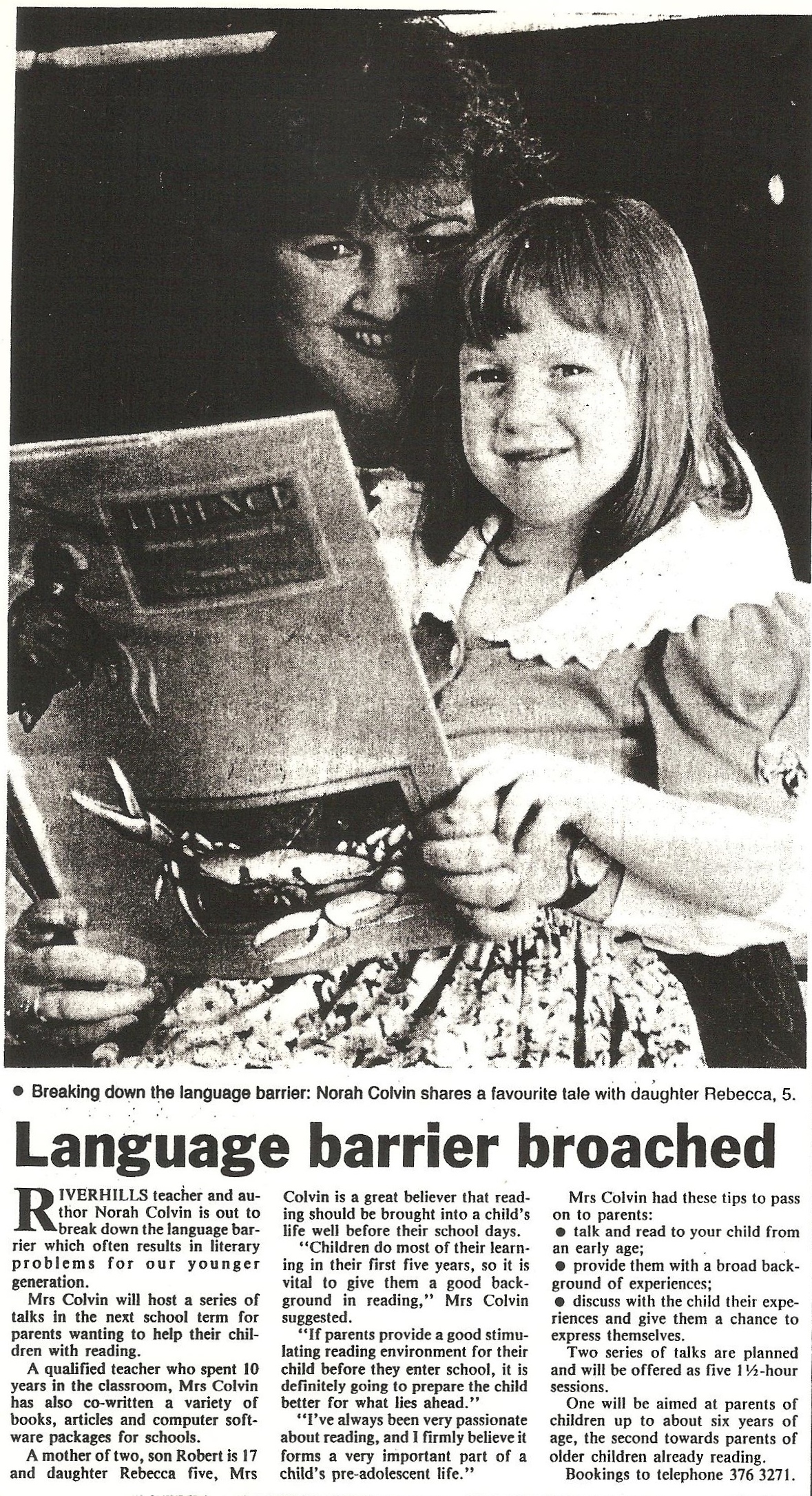
I remember being interviewed by the local paper when offering sessions to assist parents help their children read.
I remember being interviewed on Radio on the morning of the Family Day Picnic for the year of the family in 1994.
I remember being interviewed on a local community television station. I was invited to talk about the alternative school I was setting up. (I haven’t found the footage yet, but below is a response given to a question about self-esteem at a publicity meeting. Apologies for the amateur quality.)
I remember being interviewed at school about keeping butterflies in the classroom, twice: each time for different programs and different television studios.
Just as an aside, at about the same time that I was being interviewed about butterflies for the program “Totally Wild”, Bec was also being interviewed at school for the same program. She is proud to say that the times she appeared on that program numbered three to my one! Not long afterwards she appeared on the news a couple of in anti-war rallies!
Bec and friend Elise talking about heating on “Totally Wild”
Of course, not all interviews occur face-to-face. Interviews can take place online too. During the 15 months that I have been blogging I have passed on a number of awards asking people to answer questions. This post is a compilation of the answers given to my interview questions by my first nominees.
Thanks, Lisa, for this opportunity to take a walk down memory lane.
Thank you readers. I appreciate your feedback. Please share your thoughts about any aspect of this post.
Do you have a quiet place at home where you like to think?
Some people I know like to think in the toilet. (I’m not one of them. I prefer to not be in there long enough for that!) They see it as a quiet place where they can sit and think, undisturbed, for as long as they like. If they are “in the can”, “in the dunny”, “at the loo” or “out the back”, or whatever other euphemism you can come up with, their position is unassailable and their sanctuary respected. Mostly, anyway. Parents of young children may vehemently disagree with that!
A couple of weeks* ago Anne Goodwin reminded us of World Toilet Day and how lucky we are to have access to toilets and sanitation. Most of us take what used to be the smallest room in (or out) of the house for granted, not giving its use a second thought as we flush away our waste.
But not everyone is so lucky. It seems that more of the world’s population have access to a mobile phone, and or to the internet, than to a toilet. Visit Anne’s blog for many links that explain why a day for toilets is important.
“The day was created to raise global awareness of the struggle faced by the 2.5 billion people living without access to sanitation. It is also used to explore some of the healthy, emotional and psychological consequences people endure as a result of not having a proper, clean toilet.”
An article written by Nicole Arceand published in the Tech Times cites the U.S. Centers for Disease Control and Prevention for the information that 2,200 children around the world die every day due to diarrhoea. Proper sanitation would prevent most of those deaths.
Arce writes that the Indian Prime Minister Narendra Modi has set 2019 as its target for “total sanitation”. However, as also suggested in Anne Goodwin’s flash fiction piece “Culture Shock”, the problem can be attributed to cultural as well as monetary issues.
Charli Mills at the Carrot Ranch followed Anne Goodwin down the toilet path and extended the discussion to include the effect that poor sanitation has on education, particularly of young girls. The link is not as tenuous as it may first appear as explained here and here.
Charli decided to use her flash fiction challenge to “spread awareness that toilets matter.” She invited readers to “Help spread the call for human dignity and basic sanitary health” by linking to UNICEF when responding to her prompt: In 99 words write a story that includes the toilet.
I have decided to do just that, as have many others. Check out Charli’s post at the Carrot Ranch to read all responses.
Toilet sanctuary
“Miss. Marnie’s locked herself in the toilet and won’t come out.”
“What now?” I thought, scanning the troubled face pleading for assistance as much as to be absolved of blame.
“Okay,” I reassured Jasmine. “Let’s go see what’s up.”
As we hurried to the toilet block Jasmine reiterated her innocence, she hadn’t done anything, she didn’t know what was wrong (it wasn’t her fault).
“I know,” I smiled. The toilet cubicles had frequently been Marnie’s sanctuary. But not for weeks. Jasmine’s kind-hearted friendship had seen to that.
“She’s got her unicorn again,” Jasmine whispered.
“Oh,” I said.
*I apologise that this post may appear out of sync with World Toilet Day which was now ten days ago. Unfortunately I have been without internet access for 12 days and unable to publish although I had the post written. Fortunately I still had access to a flushing toilet, and if I had to choose between that and the internet, I’d go for the toilet every time! Though World Toilet Day has passed for this year, the message remains important every day!
I appreciate your feedback. Please share your thoughts about any aspect of this post or flash fiction.
Tomorrow, 20 November 2014, is UNESCO’s World Philosophy Day. Celebration of the day “underlines the enduring value of philosophy for the development of human thought, for each culture and for each individual.”
In recognition of the day I am reblogging a recent post from The Philosophy Foundation which discusses the differences between open and closed questions and explains the greater value of The Question X.
The importance of encouraging children to ask questions has been a recurring theme on my blog (here, here, here and here) , as has the need to encourage them to think for themselves rather than to become experts at regurgitating force-fed information (here and here).
The discussion of The Question X gave me a lot to think about. Maybe it will do the same for you.
Happy thoughts and thinking on World Philosophy Day 2014!
We read this blog ‘Closed Question Quizzing, Unfashionable Yet Effective‘ by Andy Tharby the other day. The virtues of closed questioning are well known to The Philosophy Foundation as they are central to our philosophical questioning approach, so we wanted to share this extract taken from a chapter entitled ‘If it, Anchor it, Open it up: A closed, guided questioning technique‘ that Peter Worley has written for the forthcoming book The Socratic Handbook ed. Michael Noah Weiss, LIT Verlag, 2015. Some of these ideas were first written about in The Question X published in Creative Teaching and Learningand available here: The Question X. In this blog Peter has developed some of the ideas written about in The Question X.
Plato’s Socrates asks many closed questions – questions that elicit a one-word or short answer such as ‘yes’, ‘no’ or ‘Paris’. Dip in to any of the dialogues…
My previous post How much of a meliorist are you? attracted many comments and much lively discussion, including comparisons of seemingly pessimistic or optimistic views of the future and the validity of each.
This discussion surprised me as my intention in writing the post was not to delve into the damage that we humans have wreaked upon the world, but simply to express my belief that we humans, should we desire to do so, have the power to improve the world. We may not be able to change everything we would like to see changed, but we can make a start within our own circle of influence.
Or, in the words of Michael Jackson, one can “Look in the mirror and make a change!”
My chosen avenue for making a difference is education; through maintaining my own interest in learning, through attempts to keep alive a love of learning and a curiosity about our world and others, and through improving learning opportunities for others throughout their lives beginning at birth (or earlier!).
The contribution each of us makes is unique and reflects our own values and life choices. I am grateful to others who help me grow in my understanding of what motivates and drives us, what excites our imaginations and stimulates our curiosity, and what propels us towards choices for improving our individual and combined futures.
Among those who encourage my learning and stretch my thinking are you, my wonderful readers, who selflessly contribute thoughts and ideas to extend my understanding. To you all, my teachers, I express my great gratitude.
While I may often fall short of the mark and need to make frequent reminders to myself, these are just a few ways I try to make my little spot in the world a better place:
Smiling
Being friendly towards those I engage with throughout the day
Being polite
Being kind, sometimes randomly and anonymously without requiring thanks
Listening attentively, to understand and without interrupting or interjecting
Accepting graciously and without whingeing and whining
Finding humour in situations which enable me to laugh, especially at myself
Changing behaviours to reduce my impact on the environment
Seeking ways to ease the burdens of others
Accepting and encouraging others to be themselves
Recognising and accepting my ‘mistakes’ and shortcomings, and those of others
What about you? What do you do to make your little spot in the world a better place? Please share your ideas so we can all learn from your example.
At times in my life I have been told that I take life too seriously. At other times I have been told that I don’t take it seriously enough. I think life should be about enjoyment and fun, so I’m going to turn the seriousness of this post on its head and leave you with another quote, this time by A.H. Weiler:
“Nothing is impossible for the man who doesn’t have to do it himself.”
I welcome your feedback. Please share your thoughts and ideas about any aspect of this post, whether you agree with me or not!
Recently I was sent a link to an article titled Cheer up, it’s not all doom and gloom published by the Australian Broadcasting Commission’s The Drum.
This article mentioned a book by Steven Pinker called Better Angels of Our Nature which had been recommended to me by Geoff Le Pard in a comment on my post about childhood illness. The premise of this book is that humanity, over the ages, has become less violent. After to listening to Pinker’s history of violence, I’m pleased that I live these relatively peaceful times.
The article also introduced me to a new term ‘meliorism’ which means having a belief that the world can be improved by the actions of humans. While the term may have been unfamiliar to me, the attitude is not and I attest that I am a meliorist.
I have a very strong belief in the power of education to improve the world. Education empowers individuals, and educated individuals empower societies to build improved futures. It becomes very difficult to sustain negative practices in the face of overwhelming evidence and information.
What better place is there for education to begin than in the home?
In a recent post I referred to a new book by Michael Rosen called Good Ideas: How to Be Your Child’s (And Your Own) Best Teacher. At the time I had not read the book but now I can say, with great delight, that I have listened to most of it. With messages such as those contained in Michael’s book, it is easy to be a meliorist.
I think Rosen’s book should be available to, perhaps compulsory reading for, every parent; I consider its message to be that important. In fact, I am off to the shops today to purchase copies to give to parents of young children I know. It will become part of my gift to new parents that also includes Reading Magic by Mem Fox and a selection of picture books. I have previously blogged about that here and here.
The “Good Ideas” contained in Rosen’s book, if implemented, will keep alive the natural curiosity of one’s children and oneself. They will encourage the development of thought, creativity and responsiveness.
In the next few weeks I will post a more detailed review of the book and some of Michael’s ideas for stimulating curiosity, whoever and wherever you are.
What about you? Are you a meliorist?
I welcome your feedback. Please share your thoughts about any aspect of this post.
Two recurring themes, amongst others on my blog, are ways of encouraging a love of literacy and of questioning in young children.
If you read my post Going on a treasure hunt! you will know that I greatly admire the work of Michael Rosen and its contribution to literacy development. You may have followed the links and checked out the riches in store on his website.
My post Child’s play – the science of asking questions introduces my thoughts about ensuring that children’s inborn curiosity is maintained through the encouragement of their questions.
You can imagine my delight, then, when I read a review of new book by Michael Rosen. (Thank you, Anne Goodwin, for alerting me to it.) The review, posted by Sabine Durrant in The Guardian on 6 September 2014, discusses Rosen’s new book How to be Your Child’s (and Your Own) Best Teacher. I confess that I have not read the book but I am very excited to see that it is now available as an audiobook, so it is next on my listening list. So much about the book appeals to me.
Rather than review the review I will simply leave with you the links to the review:
Thinking is as much a part of life as is eating. Something to think about is often referred to as ‘food for thought’; and food for thought is just as important to wellbeing as is food for the body. When I’m not thinking about where I’ll partake of my next meal, or what I might eat, I’m often thinking about education.
I will be upfront and admit that I have not read the book and am commenting on the review alone which states that the book brings together “several years of research and experience into a methodology for applying their groundbreaking thought and technique.” It goes on to say that “The basic argument … is pretty basic: for our students to achieve excellence and equity, we need to teach them the skill of question formulation.” (my emphasis)
What I wonder about is: If it is so important for students to learn to ask questions, why do we spend so much time in school teaching them to stop asking questions and to learn just what is presented to them, whether they like it or not?
Aren’t children born asking questions? Aren’t they pretty good at asking questions (verbal or otherwise) to figure out what they need to know about the world? Why then do we sit them in desks all day and force-feed them content for future on-demand regurgitation?
His eyes widened, flitting across the table, scanning the feast, a smorgasbord of sensory delights. His mouth moistened and tummy growled.
Where to start? A bit of this. A little of that. A whole lot of that! Mmmm!
He rubbed his belly and licked his lips.
Suddenly he was marched away and slammed onto a hard wooden bench. A bowl of colourless pap was flung at him. “Eat this!”
He recoiled.
“Eat it!”
The overfilled spoon was shoved between tightened teeth.
He gagged.
“It’s good for you!”
He spluttered.
Over time he learned. “Not so bad,” he thought.
Okay. Maybe I’m exaggerating. Maybe I’m painting the picture darker than reality. Maybe. But sometimes that is necessary for even partial recognition of the situation to occur. You know about the swinging pendulum.
The picture painted by Scott McLeodof dangerously ! irrelevant is no brighter. In his post The declining economic value of routine cognitive work he says that while most employees (in the U.S.) are engaged in non-routine cognitive and interpersonal work; routine cognitive work is what students are mostly engaged and assessed in, and what traditionalist parents and politicians advocate. So while work tasks may require “problem-solving, intuition, persuasion, and creativity”, school tasks involve things such as automation and repetition.
My wish is that all parents, school administrators, education policy makers and teachers do as Rothstein and Santana suggest – let them ask questions!
Of course I couldn’t write a post about food and questions and not mention the blog of one of my very favourite questioners, Bec, who writes about “wholefoods, vegetarianism, slow living and their existential friends” at There’s no food. There’s much food for thought there!
And now for something a little bit different: The edible cookbook. It’s a cookbook you can read, cook and eat! I wonder what questions its designer was asking to come up with such an innovative and interesting design.
Thank you for reading. I appreciate your feedback. Please join in the discussion or share your thoughts about any aspect of this post, including my flash fiction.
Multiple invitations or engagements often occur on the same date. Deciding between desired activities is not always easy. Cloning would make choosing unnecessary. Additionally, sending a clone to an unpleasant but unavoidable engagement could also be desirable.
Sometimes the number of must-do tasks can be overwhelming. The ability to engage the assistance of clones, especially to complete less desirable tasks would be great.
Time travel, wormholes and parallel universes are the stuff of science fiction; and while I am not a fan of the science fiction genre, I wouldn’t mind having access to some of its features. However, whether any, or which, of those features ever move from science fiction to science fact remains to be seen.
The power of imagination to drive creativity and innovation cannot be overstated. Much of what we now accept as commonplace was once a part of science fiction. Imagination, the stuff of science fiction and scientific exploration and investigation, has brought them to reality.
You are probably familiar with following quote, initially attributed to George Bernard Shaw but also made famous by Robert F. Kennedy:
“Some men see things as they are and say why. I dream things that never were and say why not.”
These words highlight the importance of questioning to stimulate imagination, and when paired with creative thinking, innovation can occur.
Einstein said that,
“Imagination is more important than knowledge. For knowledge is limited to all we now know and understand, while imagination embraces the entire world, and all there ever will be to know and understand.”
He also said that,
“Education is what remains after one has forgotten everything he learned in school.”
Although I cannot be certain, from those quotes, what Einstein’s attitude to the current trends in schooling would be (he did attend school and was very advanced in maths and sciences but did not perform so well in the humanities) I think he would not favour a content-driven curriculum which excluded opportunities for imagination and creativity.
On the other hand, Thomas Edison, the world’s most prolific inventor, was mostly educated at home by his mother who was able to encourage his experimentation and love of learning. He said,
“To invent, you need a good imagination and a pile of junk.”
If these significant thinkers of the 20th century, each of whom followed different educational pathways, recognise the importance of imagination, why would anyone argue against it?
Now the term ‘multiverse’ takes me back to the science fiction genre: wormholes, parallel universes and time travel, for example. I’m not sure how well I’ll do with this unfamiliar genre, but I will call upon my imagination and give it a try. See what you think – does my piece fit the criteria?
Clone Magic
All night Leone had huddled in line, sleepless with excitement, waiting for the release.
Now she had them! Clone pills!
‘Take one with water. Cloning occurs in 30 minutes and lasts 24 hours.’
Leone swallowed one tablet, then another, and another; ignoring the small print: ‘Do not take multiple tablets. Effects are unpredictable.’
When three clones appeared she instructed:
“1. Clean the house. 2. Exercise. 3. Weed the garden.”
She flopped on the couch. “Now to read.”
But — their hands grabbed for her book, pulling her hair and clawing her eyes.
“Me read! Me read! Me read!”
Thanks for reading. I appreciate your feedback. Please share your thoughts about any aspect of this article or my multiverse flash.
















 Norah Colvin