Live Love Laugh Learn … Create the possibilities

Tag: TED talks

  • 3 Inspiring educators

    3 Inspiring educators

    Like every other teacher, I want to make a difference in the world.

    The thought that I could make a positive difference to the life of another is both empowering and inspiring.

    To do so, I seek out others making a positive difference and pay it forward, hoping that the ripple effect will carry it far and wide.
    flag on twitter

    Three inspiring educators who have positively influenced me are:

    Brian Cambourne

    Brian is an amazing literacy educator from whom I had the extreme good fortune of learning many years ago. I have written about him before here and here.

    Brian’s work focused on the conditions necessary for literacy development. His influence has spread beyond the classroom with the application of the conditions to learning in the workforce demonstrated.

    Tony Ryan

    Tony is an amazing educator who does his best to be the change he wants to see in the world. He talks about future-proofing and using innovative thinking to solve problems of both local and global importance.

    Anyone who believes ‘that education is the most important profession on the planet’ and does everything in his power to support teachers to be outstanding, as does Tony; must be pretty good in my books.

    One of Tony’s books The Ripple Effect is particularly apt for mention in this post. Tony says,

    “you must believe in your personal power to create ripples that spread out and change the world. In fact, if it is not you who is going to do it, then who else do you think is likely to make the effort? Remember that every change on this planet begins with a human being somewhere, somehow. It may as well be you.”

    This year Tony has started a new project called The Earth Movers Foundation which ‘helps young teenagers to create solutions to local and global issues. And they get to choose their own project. No adults will be telling them what project to do. They decide for themselves.’ Sounds pretty good to me.

    Ken Robinson

    Ken is another amazing educator. I fell in love with his ideas when I listened to his TED talk Do schools kill creativity? which I have also shared before here.

    The statement on his website declares that

    “Imagination is the source of all human achievement”.

    I could not argue with that.

    Ken introduces this short video The writing spirit which presents quotes from artists, thinkers, writers, innovators and snippets of interviews with writers. Just incidentally, and exciting for me, Richard Bach is included. Richard is the author of Jonathan Livingston Seagull, one of my favourite books for its inspirational message.

    It is more than likely that these educators have no idea how they have influenced my life (and others as a result).

    How wonderful might it be to know of the positive influence you have had on someone, and to have the opportunity of letting others know that they have positively impacted your life?

    This is the purpose of The Butterfly Light Award which was bestowed upon me my Lisa Reiter, a lovely lady who is herself inspirational for her courage and her positive attitude which she shares with others through her blog Sharing the story. Thank you, Lisa. I am honoured and accept with pleasure.

    As with any award, it comes with conditions:

    1. You should write an acceptance post, making sure you link back to the blogger who awarded you and thank them. You MAY NOT lump this award in with a batch of other awards.

    Thank you Lisa Reiter!

    1. You must individually name and re-award to a minimum of 1 and a maximum of 9999999 bloggers. You must let them know either personally with a comment on their blog OR a pingback.

    As I have been writing about educators, I am going to stick with that theme. A quick visit to these blogs will explain why I have selected them.

    Ruth Mancini

    The Nerdy Book Club

    Two Writing Teachers

    Raising a literate human

    3.  You should link back to Belinda’s blog either to http://idiotwriting.wordpress.com/about/ or http://idiotwriting.wordpress.com/2014/03/13/i-love-charismatic-geeks/

    Done!

    1. You must write a short paragraph entitled either “How I’m Spreading Light” OR “How I’m A Positive Influence” (what Lisa calls ‘the squirmy bit’).

    Done! See beginning of article.

    5. Display Belinda’s lovely “Butterfly Light Award” badge on your blog.

    Thank you, Belinda. It’s a pleasure! We can never have too many butterflies!

    butterfly-light-award

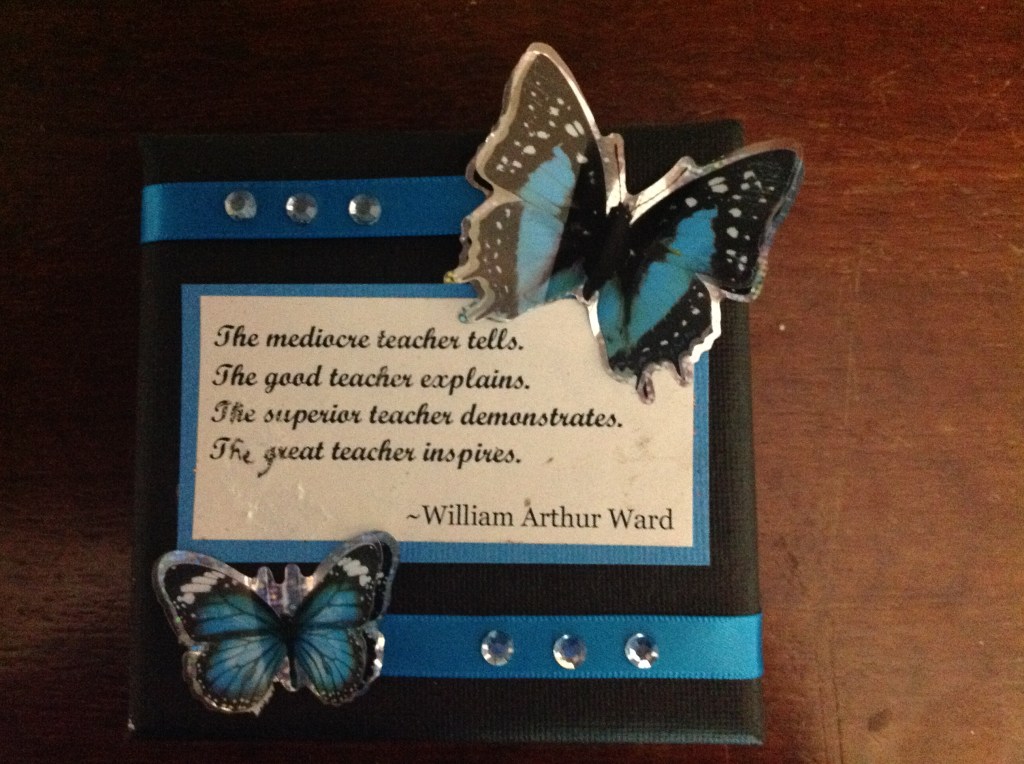
    Note: The beautiful framed quote, pictured at the top of this post, was made for me by a wonderful lady, the mother of two of my students. They all share my love of butterflies! I thank them for sharing their appreciation of my positive influence.

    I welcome your feedback. Please share your thoughts about any aspect of the article.

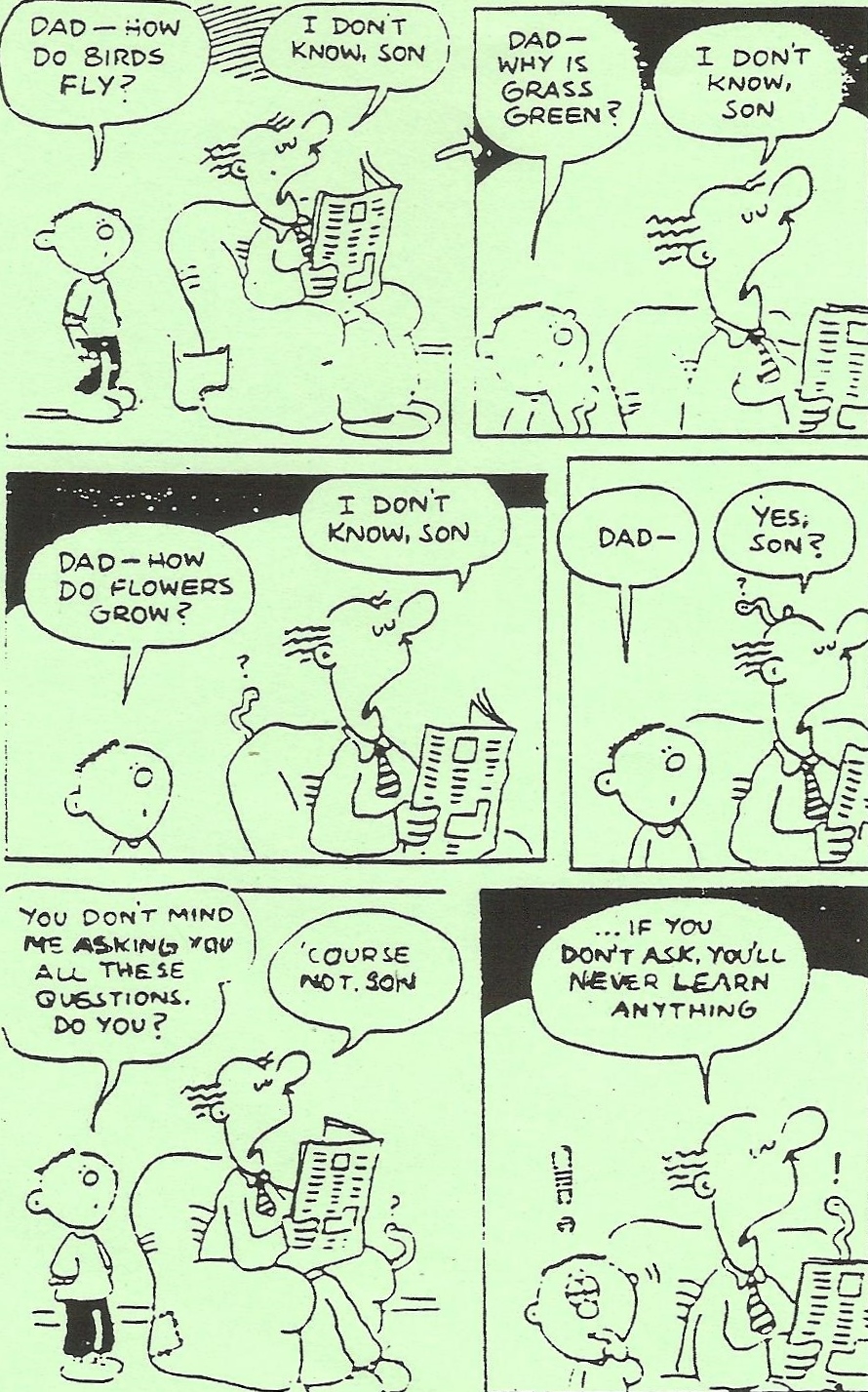
  • Child’s play – the science of asking questions

    Unknown source. Apologies. Happy to attribute if informed.
    Unknown source. Apologies. Happy to attribute if informed.

    I often say that children are born scientists. From the moment they are born they are actively finding ways of figuring out how the world works, and how they can get it to work for them.1

    Some people say children are sponges. But I say they are more than that. They are creators. They don’t just copy what they see. They don’t just repeat what they hear. They find new ways of working things out, new ways of expressing ideas, and new ways of thinking about things. Parents often remark, when children exhibit new behaviours or cute new phrases or ways of expressing themselves, “Where did they get that from? Where did they learn that?” Often the source cannot be identified, for the source is within the child.

    An important way to keep children creating their own understandings and ideas is to not only allow them to ask questions, but to actively encourage them to do so, and to help them seek answers to their questions. Adults can be quick to quiet children’s questions for a number of reasons including not knowing the answer, being too busy at the time to investigate an answer, or even considering the question unimportant or “dumb”.

    Unknown source. Apologies. Happy to attribute if informed.
    Unknown source. Apologies. Happy to attribute if informed.

    Remember, many things that adults may take for granted or that they may no longer question but simply accept (possibly as a result of not receiving appropriate answers or responses to their childhood questions) are new and unfamiliar to the child.

    Sometimes it is easier to accept than to question for questioning means that something is unknown; and not knowing can lead to feelings of insecurity, doubt and instability. But it is these self-same feelings which drive innovation and progress. If everything was known, there would be no room for improvement, no need for anything new, no need for greater understanding.

    This inspiring TED talk by Beau Lotto and Amy O’Toole, Science is for everyone, kids included emphasizes the need for children to be given the opportunity of asking, and exploring answers to, questions.

    Beau explains that what we see is based upon our experience, upon our expectations. But he asks,

    “if perception is grounded in our history, . . . (and) we’re only ever responding according to what we’ve done before . . . how can we ever see differently?”

    He goes on to explain that seeing things differently begins with a question and that questions lead to uncertainty. He says that

    The-best-questions-are

    and explains that the answer to uncertainty is play. He says that play “is a way of being” and is important for five reasons:

    • Uncertainty is celebrated in play and makes play fun
    • Play is adaptable to change
    • Play is open to possibility
    • Play is cooperative
    • Play is intrinsically motivated

    “Play is its own reward.”

    Beau says that science, also, is a way of being; and that science experiments are like play.

    He describes working with a group of 8-10 year old children, encouraging them to ask questions and involving them in an investigation of a question they posed.

    Amy O’Toole, one of the children involved, joins Beau and describes the experiment which investigated the ability of bees to “adapt themselves to new situations using previously learned rules and conditions.”

    The really exciting thing about the project, Amy says, was that they “had no idea whether it would work. It was completely new, and no one had done it before, including adults.”

    The process of taking the findings of the project to publication, as Beau explains, was rather complex with a variety of complications, taking two years to achieve. The experiment itself took only four months! Publication of the paper made Amy and her friends the youngest ever published scientists.

    The response to the paper, The Blackawton Bees is amazing:

    30 000 downloads on the first day

    Editor’s Choice in Science (a top science magazine)

    the only paper forever freely accessible on Biology Letters and

    the second-most downloaded paper from Biology Letters in 2011

    Amy wraps up the talk by stating that

    “This project was really exciting for me, because it brought the process of discovery to life, and it showed me that anyone, and I mean anyone, has the potential to discover something new, and that a small question can lead into a big discovery.”

    She finishes by saying that

    “science isn’t just a boring subject … anyone can discover something new.”

    We might not all make those big scientific discoveries, but it is the questions we ask each day which lead to our own discoveries, no matter how small; it is our curiosity which keeps us learning.

    What have you learnt today?

     Changing-the-way-a

    1 This is just my opinion formed from observations, discussions and reading. I am not supporting it with research references.

  • What is education, anyway? Pt.2

    This week I am sharing a post published on Teachling earlier this year. Teachling introduces her post with a TED talk by Sir Ken Robinson, an international advisor on Education. Like Teachling, I very much admire his work and would love to see education systems implement his recommendations. I hope you will set aside the 19 minutes it will take to listen to what Ken has to say. You will be amused, entertained and educated. I intended providing a summary of important points from his talk, but found I was recording the talk in full! Teachling has provided a few notes but I would love you to listen to the entire talk and let me know what you think. How can we join the revolution that Ken says we need?

    Teachling's avatarTeachling

    Let’s face it, children are basically all the same and should be taught in the same, tried and tested, chalk and talk, fashion. Teachers in schools should focus purely on the 3R’s – Reading, wRiting and aRithmetic – and leave that creative ‘fluff’ for kids to pursue in their own time. Children should be viewed as empty vessels and a teacher’s role is to fill them with enough knowledge to pass the test. Some kids are just lazy, hyperactive or incapable of learning, so teachers should let them be whilst focussing on the other kids that can and want to learn. Wait… What? Was there actually a time when people thought this way about education? I do hope that the opinions above are not felt by any person on this earth. My opinions are much more aligned with those articulated in Ken Robinson’s Ted Talk, “How to escape education’s death…

    View original post 447 more words

  • “You say it long enough, it starts to be a part of you.” (Rita Pierson)

    Affirmation, encouragement, praise . . .  

    “You say it long enough, it starts to be a part of you.”

    Recently I came across this great TED talk by Rita Pierson “Every kid needs a champion”.

    Rita’s entire life centred around education. Her parents and her mother’s parents were teachers, and she was a teacher.

    She observed numerous teachers at work – some of the best and some of the worst – and believed that relationships are the key to learning.

    She said that

     “kids don’t learn from people they don’t like.”

    Rita spoke about having classes of students whose academic level was so low she wondered how she could “raise the self-esteem of a child and his academic achievement at the same time”.

    One year she told her students

    “You were chosen to be in my class because I am the best teacher and you are the best students, they put us together so we could show everybody else how to do it.”

    Affirmation, encouragement, praise . . .

    She talked about giving a student a +2 with a smiley face for getting 2 out 20 questions correct. She encouraged the student by saying

    “you’re on a roll . . . and when we review this, won’t you do better?”

    The student agreed “I can do better”.

    Affirmation, encouragement, praise . . .

    Rita told of her mother’s past students expressing their gratitude for the difference she made in their lives, saying

    “You made me feel like I was somebody, when I knew, at the bottom, I wasn’t. And I want you to just see what I’ve become.”

    Affirmation, encouragement, praise . . .

    She tells us that teachers won’t always like all the children they teach, but it’s important that the children never know it. Acting is part of the role description!

    She says that

    “Teaching and learning should bring joy. How powerful would our world be if we had kids who were not afraid to take risks, who were not afraid to think, and who had a champion? Every child deserves a champion, an adult who will never give up on them, who understands the power of connection, and insists that they become the best that they can possibly be.”

    Affirmation, encouragement, praise . . .  

    Go ahead and listen to this inspirational talk. It will take less than 8 minutes listening time but its effect will be more lasting. It has already had more than 2 600 000 views. Why not add one more to the total. I’m certain you won’t regret it.

    I can find nothing to dispute in Rita’s talk. I’d like to underline every word and make it compulsory viewing for all aspiring and practising educators in any field.

    Affirmation, encouragement, praise . . .  helpful or harmful?

    What do you think?  Please share your thoughts below.

    Refer to these previous posts for discussions on self-esteem, affirmations and praise:

    Happy being me

    Affirmations: How good are they?

    Seeking praise – Stephen Grosz revisited

    Examining praise: Stephen Grosz – the third instalment (guest post by Anne Goodwin)

    I came across this talk on a great educational website edutopia. It was included in a Five-Minute Film Festival: Videos on Kindness, Empathy, and Connection. Check the others out. You may find something else to inspire you.

    Sadly Rita Pierson passed away in June 2013. I’m grateful that we may continue to share the strength of her wisdom through her appearance with TED.

    Click here to find out more about Rita and to read a tribute posted by Tedstaff.

    “You say it long enough, it starts to be a part of you.” (Rita Pierson)

    Let’s make sure it’s the good stuff that learners everywhere are hearing!

  • What is education, anyway? Pt.1

    One of my favourite talks about education is a TED talk given by Ken Robinson in 2006 “How schools kill creativity”.

    His contention is that

    “creativity . . . is as important in education as literacy, and we should treat it with the same status.”

    Although the video has had more than 21 million views (while quite a few of them mine, nowhere near that number!) and drawn over 3 000 comments during the last 8 years, his views need to reach a wider audience still; an audience with the power to enact change.
    One thing I had always loved about teaching was the opportunity to express myself creatively, and to encourage my students to do the same. Unfortunately the current emphasis on a content-driven, top-down approach where test results reign supreme has left little room for anyone’s creativity. I am not saying there was ever much opportunity for creativity in formal schooling, but creative teachers could always squeeze a bit it. Now the opportunities for creative “massage” are few.
    My optimism for positive change in education is always raised when I read or hear of others who share similar views. I think if enough voices are heard chanting the same message that a change may come.
    This post (and article in Saturday’s QWeekend magazine) by Mary-Rose Maccoll “Why Banff means the World” also proclaims the vision of Ken Robinson. Mary-Rose is another fan.
    She says that

    “Being at the Banff Centre (in Canada) has made me reflect on what we lose when we don’t foster art, when we don’t foster creativity. And what we lose is the world.”

    She says that

    “even as school education becomes increasingly narrow in its focus, we’re also seeing a decline in performance on the very outcomes that standardisation seeks to improve.”

    She concludes by saying,

    “As I sit in my room and watch the mountains, listening to the trail of a contraband sax down the hall (you’re supposed to play in the soundproofed studios in the forest), reading a piece by a Scottish writer, I am grateful for artists. In our 21st century world, we surely need them.”

    I agree wholeheartedly as, I’m sure would Ken Robinson, along with Teachling whose post What is Education, anyway?Pt 1 I reblog for you here.

    I agree with Teachling’s belief that

    “many teachers would feel that – as well as their students’ innate talents and creativity being snuffed – their own talents and creativity don’t get much of a look-in. I believe most teachers are very restricted in terms of what they teach as well as how they teach it.”

    I also agree with her when she states that

    “that there’s very little teachers can do about it.

    It’s the administrators and politicians that should take Robinson’s advice. It’s also the perceptions of a majority of parents that would need to vastly change if any rethinking of fundamental principles were to occur.”

    Have a listen to Ken and read these other posts, then let me know what you think.

    How can we make our voices be heard to ensure that creativity and innovation is not lost for the future?

    Teachling's avatarTeachling

    Ken Robinson’s take on schools, and how they kill creativity…

    You’re likely one of the 20,738,467 viewers of Ken Robinson’s “Schools Kill Creativity” 2006 TED Talk. Robinson’s assertion, and general gist of the talk, is that “all kids have tremendous talents, and we squander them; pretty ruthlessly”. The “we”, we can infer from the rest of his talk, are schools.

    Let me pick out some key points:
    • “My contention is that creativity, now, is as important in education as literacy, and we should treat it with the same status.”
    • “We are educating people out of their creative capacities.”
    • “Every education system on Earth has the same hierarchy of subjects… At the top are Mathematics and Languages, then the Humanities and at the bottom are the Arts… And in pretty much every education system there’s a hierarchy within the Arts. Art and Music are normally given a higher…

    View original post 423 more words

  • Whose idea is it anyway?

    Whose idea is it anyway?

    First of all, let me say, there is nothing scientific in this article.

    The notions, unless otherwise attributed, are just my thoughts and ideas.

    Or are they?

    Have you ever had an idea just ‘pop’ into your head?

    What about an entire poem or song? Maybe even a story?

    Have you ever had an idea; only to find out that another has had almost the exact idea at roughly the same time as you with no chance of collaboration or leak?

    Where have these ideas come from?

    Do you really think you have thought them up when they have come fully-formed and unbidden?

    Sometimes I am not so sure.

    ryanlerch_thinkingboy_outline
    http://www.openclipart.org

    Sometimes an idea pops into my head; an idea with no connection to any current thought. It may take me by surprise and make me think: Why didn’t I think of that before? Or rather, why did I think of that at all?

    I can’t explain the force that at times propels my hand across the page, fervently trying to keep pace with and capture the words as they spill forth, lest they escape to a region from which they would never be retrieved.

    Sometimes I’ve written stories, which I may, or may not, have submitted to a publisher, only to find another very similar in print not long after. How can this be? There was definitely no collusion. My story had been written before the other was in print; and the other would have been underway by another publisher before mine had been submitted.

    Have you ever noticed that often two movies on a similar topic or theme are released almost simultaneously? Is this coincidence or planned?

    I know that sometimes songs are very similar, and in fact, there have been court cases over certain bars and riffs. I am surprised this doesn’t happen more often. How can new combinations of notes still be arranged? How difficult it can be to get a melody out of one’s head. How much more difficult it must be to be certain whether that melody is one of your own creation or one that your ears have captured.

    image courtesy of openclipart.org
    image courtesy of openclipart.org

    I remember hearing someone suggest, many years ago, that there are many ideas out there (floating around somewhere in the universe?) ready to be picked. Sometimes they are picked simultaneously by different people in different places around the world.

    I wasn’t too sure about that, but it did provide an explanation, of sorts, for the duplication of ideas.

    A few months ago, I listened to a fascinating TED talk by Elizabeth Gilbert: Your elusive creative genius.

    The focus of Elizabeth’s talk is a little different from my own, but she did offer some thoughts on this topic also.

    I was particularly interested to hear that in ancient Greece and Rome

    people did not happen to believe that creativity came from human beings . . . People believed that creativity was this divine attendant spirit that came to human beings from some distant and unknowable source, for distant and unknowable reasons.

    The Romans called this entity a “genius”. A genius was not a clever individual. It was the spirit that would help shape the artist’s work. The artist did not need to take full credit or responsibility for the work, as the work was that of the “genius’ working through the artist.

    Now that seems to support the notion of ideas arriving fully-formed, as does this next one:

    Elizabeth went on to talk about the American poet, Ruth Stone, who described how “she would feel and hear a poem coming at her from over the landscape” and she would have to run back to house in order to “collect it and grab it on the page” before it thundered on to another poet. I won’t quote the whole story here. Please follow the link to read the rest. It may surprise you as much as it surprised me!

    Looking for a little more content for this article, I came across this blog post by Amanda CraigSynchronicity, or when writers have the same idea

    Amanda writes,

    “Synchronicity is when two or more people have the idea at the same time. Science is littered with examples of this. Darwin only published his Origin of the Species because a fellow biologist had also deduced the concept of natural selection, and sent him his own book in manuscript; several people can claim to have invented the computer, and so on. So, too, in literature. I still remember a Spectator Diary Susan Hill wrote when she found out that Beryl Bainbridge was working on a novel about Scott’s doomed expedition to the Antarctic. She had to abandon it. Rival biographies of the same person are commissioned simultaneously, and sometimes even films (like the two versions of Les Liasons Dangereuses).”

    Now, is that just what I’ve been talking about?

    Follow the link to her entire article to find out what she thinks about synchronicity.

    Still eager for more, this article about Multiple discovery explains that scientists, also, are similarly burdened and, according to Robert K. Merton

    Sometimes the discoveries are simultaneous or almost so; sometimes a scientist will make a new discovery which, unknown to him, somebody else has made years before.

    So where is all this leading me?

    It is simply to introduce the poem,  “A leaf floated down” which came to me as I was preparing for my day. The thoughts were not connected to any others of the moment; the first verses simply wrote themselves, and the parts that I am least happy with, are the parts I laboured to bring forth. I hope it is my own!

    I’d love to know what you think about this synchronicity that we, as creatives, often experience. Please share your thoughts!

  • What did you do that for? Rewards and motivation

    ausines headphonesRecently, on the recommendation of my friend Rosie, I listened to a TED Talk by Michael Sandel “Why we shouldn’t trust markets with our civic life”.

    Rosie and I often suggest Talks to each other and then share thoughts and comments about them.

    This Talk, like most of those on TED, raises some very interesting, thought provoking and challenging ideas and issues. The issue of most importance to me in each of these Talks may not be the issue of most importance to Rosie, nor to any other listener. The understandings, beliefs and personal positions, (ideological, philosophical and ethical), that each person has will not only influence what they hear but how they interpret, organise and prioritise what they hear and what they take away from the Talk, whether intended by the speaker or not.

    In this Talk, Michael raises themoney bag issue of motivating students to learn, a challenge experienced in many schools.  He invited the audience to consider whether cash rewards should be used as incentives for students to perform well on tests or to read books.

    The reaction from the audience was mixed with fewer in favour of offering the rewards than against. When asked why cash incentives should not be used to encourage students to work harder or read more books, a participant stated that the students should be reading for intrinsic motivation, for an intrinsic desire to learn, and that a cash reward would take the intrinsic incentive away.

    studentbooksHowever: If a child is a reluctant reader or reads only when required, does that child have any intrinsic motivation for reading? If not with cash rewards, how can we inculcate an intrinsic motivation to read? What is or has happened in this child’s experience that an intrinsic motivation to read has already been killed? (I will offer some thoughts on these issues in a future post.)

    The argument for and against the use of rewards in schools, as well as homes, to encourage children to perform or behave in a particular way has waged for as long as I can remember and, I’m sure, even longer than that.

    stars

    Should children receive a sticker, a star or an award for that? Shouldn’t they just do what we want of them for the sheer joy of it / because it will do them good / because it’s the right thing to do? Shouldn’t they be intrinsically motivated and have no need of extrinsic rewards?

    It all sounds very good, doesn’t it? And maybe it works when a child is intrinsically motivated through a genuine interest, or maybe when children are happy to comply and perform expected tasks either through a need to please others or their own developing sense of how things should be.

    But what of the child who does not have this intrinsic motivation, no need to please or any ability to see a personal purpose in expected tasks or behaviours?

    One of the Talk participants suggested that results of offering a cash reward for reading books could be measured by a count of the books read while the reward was being offered, followed by a count of the books read after the payment ceased. Results of the experiment found that students, when offered cash rewards, read more books, but they also read shorter books.

    And why should we expect any more of children than we do of adults?

    tomas_arad_heart

    How many adults perform their work tasks for the sheer joy of it, powered by intrinsic motivation? Only the lucky few, I would guess, who are able to combine passion with employment, or who have sufficient resources to maintain the lifestyle they desire. Isn’t the extrinsic reward a major motivator for much of what we do? I dare say the performance of most adult workers would not measure highly after payment ceased!

    mystica_Coins_(Money)

    Okay. I know it’s not quite the same. The children are not in need of the cash rewards as they are supported by adults who receive cash rewards. Nevertheless, without that extrinsic reward, in most cases, that work would cease, regardless of whether the cash is actually required for survival or not.

    However I am always drawn back to an attempt at reconciling intrinsic motivation with compulsory schooling.

    tomas_arad_heartIntrinsic motivation is usually related to something of one’s own choice through interest, challenge or purpose. The motivation comes from within, not from the promise of any external reward.

    So how does this work for children in school?

    Not only is school attendance compulsory throughout most of their childhood years, children have few choices in school. They generally attend a school chosen by someone else, are taught by a teacher allocated by someone else, and expected to make friends with a group (class) allocated by someone else.

    teacherbellThey line up, eat, talk, play and toilet on the ring of a bell and are expected to perform academic feats on command. When they progress from one year to the next, they often suffer the disruption of new class group arrangements, decided by somebody else for questionable reasons. What would be so harmful about a child going through all the years of schooling with the same group of friends?

    Why then do we think that students should be intrinsically motivated to do something about which and in which they have very little choice and are most often powerless?

    Learning for the love of it, for the sheer fun and joy of it is a marvellous goal. And I believe children are innately intrinsically motivated to learn.

    How different would schools be if we began with the intrinsic motivation of each child and wrapped the leaning around that? How much more powerful would the learning be? What would that school look like?

    Is that what we call a child-centred approach? An approach that values the interests and needs of each learner. An approach that starts where the child is and supports them to find the paths that take them where they want to be. An approach that values their individual styles and timeframes while providing just the right amount of challenge to stretch them beyond where they thought they were able to go. That piques their interest in a vast array of topics and supports their learning of skills to achieve their desires.

    But often the lip service given to a child-centred approach in a traditional school, with all its constraints, still smacks of ‘You’ll do what I say but you’ll think that you have a choice’.

    What slap in the face it is to tell someone that they must do this, when to do it and how to do it; and then tell them they must do it because they want to do it!

    However there are teachers who passionately believe in a child-centred approach and in harnessing the power of intrinsic motivation. They work tirelessly and creatively, powered by their own intrinsic motivation, to employ a vast array of strategies designed to make a child’s opportunities for learning within the confines of an imposed curriculum of a traditional school motivating for each learner while targeting their individual needs.

    SnarkHunter_Arrow_in_the_gold

    Here are some strategies that teachers use in a child-centred approach:

    • Make connections with the children’s lives

    –          discussing their experiences

    –          valuing their contributions

    –          involving parents

    –          informing parents of classroom learning and experiences

    • Incorporate children’s interests

    –          using negotiated topics and tasks

    –          employing a variety of activities

    • Offer children some autonomy

    –          using negotiated topics and tasks

    –          employing a variety of activities

    –          providing opportunities for independent and self-directed learning

    • Make learning fun, meaningful and explicit

    –          using games, songs and hands-on participatory activity

    –          explaining how classroom learning connects to purposes in life

    –          providing clear and easy-to-follow procedures

    –          providing opportunities for finding solutions to real problems

    –          allowing explorations in creativity and innovation

    • Provide opportunities for cooperation and collaboration

    –          working with a partner or in groups

    –          allowing opportunities for discussion

    • Support and extend learning

    –          harnessing  spontaneous opportunities for optimising learning

    –          providing opportunities for practice and clarification

    –          challenging learners to stretch their imaginations and abilities

    • Add joy and laughter through happiness and humour every day

    These strategies may not tap into the intrinsic motivation of each student all of the time. However a supportive environment in which children are provided some choice of activities, opportunities to learn at a pace suited to their needs, and an understanding of the point of it all, will provide learners with the desire and skills to harness their intrinsic motivation for learning of their own choosing beyond the classroom.

    What do you think?