A recurring theme on this blog has been the inappropriateness of, and the difficulty faced by children sitting, large-scale external exams which require an immediate response to a stimulus that may have little relevance or interest to them. I have written about it here and here.
Making a judgment about student progress or achievement from one piece of writing, particularly one completed under conditions not necessarily conducive to encouraging one’s best work, is problematic.
It would be unrealistic of me to expect that everyone would agree with me, (though who wouldn’t want everyone to agree with them?) but it is always affirming to find that others share similar views. Maybe if enough people voice their concerns, change may occur.
Recently I read an article in our local newspaper that had me nodding in agreement. The article NAPLAN writers have trouble writing a writing testby Mary-Rose MacColl explained that a good part of the reason students didn’t do well on the NAPLAN writing task this year, is that the task itself wasn’t well written!
MacColl said that the task was wordy and the standards themselves (the criteria against which the writing is marked) poorly written. She pointed out how ludicrous it was for the ACARA CEO to write a letter explaining to parents that students should not view the test as ‘pass or fail’ when many children were experiencing extreme anxiety in the lead up to the test and parents were withdrawing their children from the tests in increasing numbers.
In addition to writing newspaper columns, MacColl is also a writer of fiction. She is pleased that the focus of NAPLAN is on persuasive rather than narrative writing, and goes on to describe some wonderful writing that is going on her son’s class.
Many teachers are doing wonderful things helping students develop a love of writing. Unfortunately, those setting external assessment tasks aren’t listening to the professionals.
I have given only a brief indication of what Mary-Rose MacColl had to say. Please read her article to fully understand her views.
Thank you for reading. I value your feedback. Please share your thoughts about any aspect of this post.
Recently Julie Stock nominated me for a Very Inspiring Blogger Award. Thank you Julie, I am totally delighted to accept. Julie blogs at ‘My Writing Life’ Julie writes about her journey towards being a published author and offering help to others who are in the same position.
It is only a short while ago that I posted an acceptance for the same award from Geoff Le Pard. In that post I promised I would do some exploring to seek out other inspiring bloggers to add to our growing community. Since then I have also created a page listing awards for which I have been nominated and those whom I have nominated. I’m sure a quick look at that page will suggest many worthwhile bloggers to follow.
Here are the rules of the award:
Thank and link to the person who nominated you.
List the rules and display the award.
Share seven facts about yourself.
Nominate 15 other amazing blogs and comment on their posts to let them know they have been nominated.
Optional: follow the blogger who nominated you, if you don’t already do so.
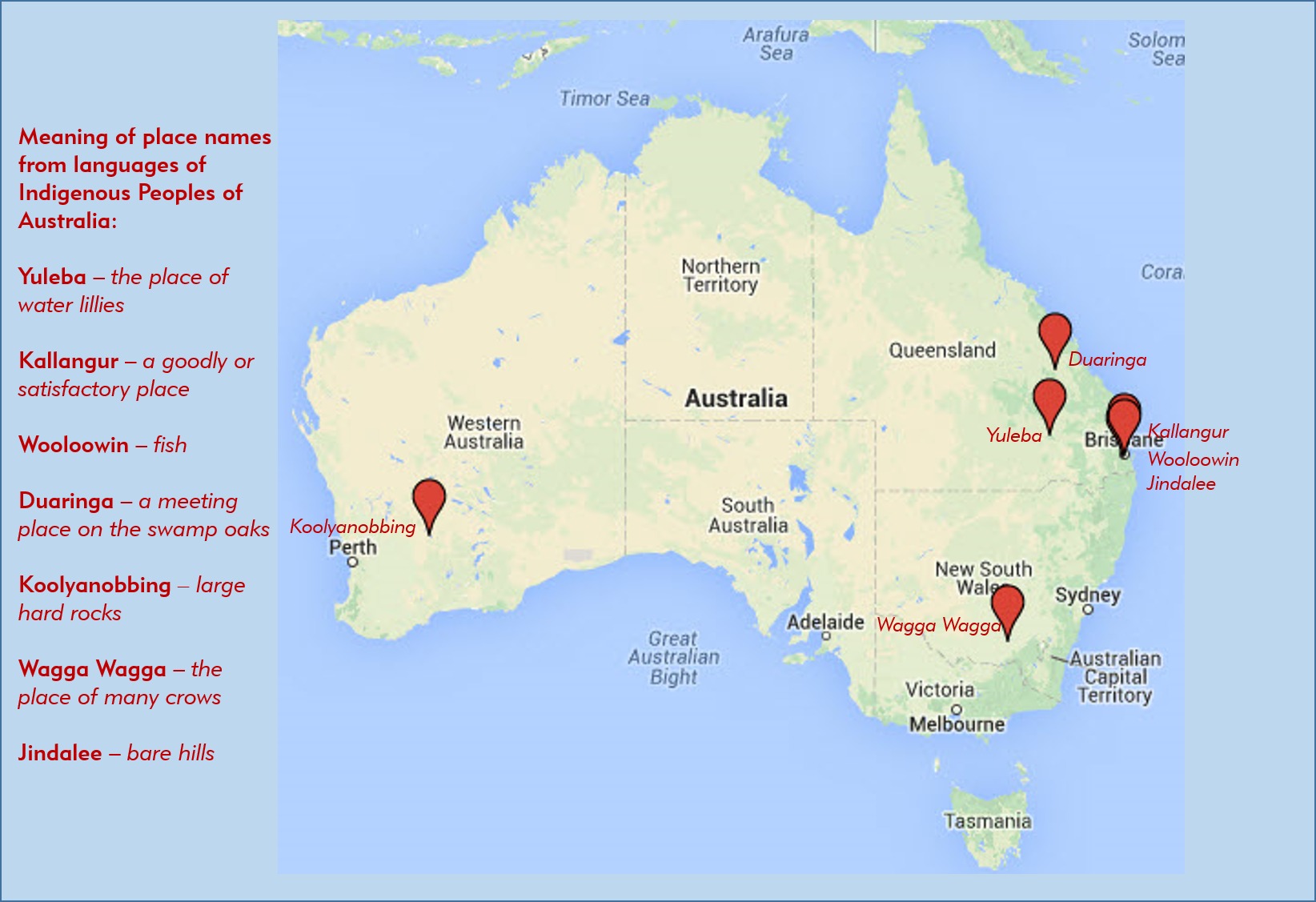
The seven facts I am sharing with you in this post are seven locations in which I have lived that are named using a word from the languages of Aboriginal peoples of Australia. Although I have lived in more than 20 homes for varying lengths of time, only seven locations have Aboriginal names.
Yuleba: “the place of water lilies”, about 420km west of Brisbane: birth until about 10 months.
Kallangur: “a goodly or satisfactory place”, about 20km north of Brisbane: 10 months until 61/2 years. I started school at Kallangur walking the approximately 2 miles (3.3km) to and from school with my older brother and sister.
Wooloowin: “fish”, a suburb of Brisbane: 1970 – 72 (teacher training).
Duaringa: “a meeting place on the swamp oaks”, about 116km west of Rockhampton: second year of teaching.
Koolyanobbing: “large hard rocks”, approximately halfway between Perth and Kalgoorlie (i.e. in ‘the middle of nowhere’): about 18 months during 1977/78.
Wagga Wagga: “the place of many crows”, approximately 450km south-west of Sydney: 1979 (university).
Jindalee: “bare hills”, a suburb of Brisbane: 1997-2004 (though have lived in adjoining suburbs since 1981).
In this post I am nominating fifteen blogs that I have not before nominated for an award. If I have nominated you previously, you are still on my list of wonderful blogs to follow (see page).
It is up to each nominee whether they wish to participate by accepting the award and/or paying the compliment forward. The purpose of my nomination is simply to share with others how valuable I consider the blog to be.
Do I respond to the flash fiction prompt in isolation?
Neither of these alternatives appealed as I have been enjoying the camaraderie and support of the flash fiction tribe as well as the opportunity to experiment in a genre that, while not an immediate writing priority, I may move towards in the future. On the other hand, as my intent with this blog is to share ideas and thoughts primarily about education, I don’t want to become distracted from my focus.
As do many, the idea for this prompt attached itself to me when I wasn’t thinking about it. Ideas tend to pop into my head when I first awaken in the morning, when I am showering, or during any other moment when my thoughts are free to flit and fly without the constraints of achieving a particular outcome.
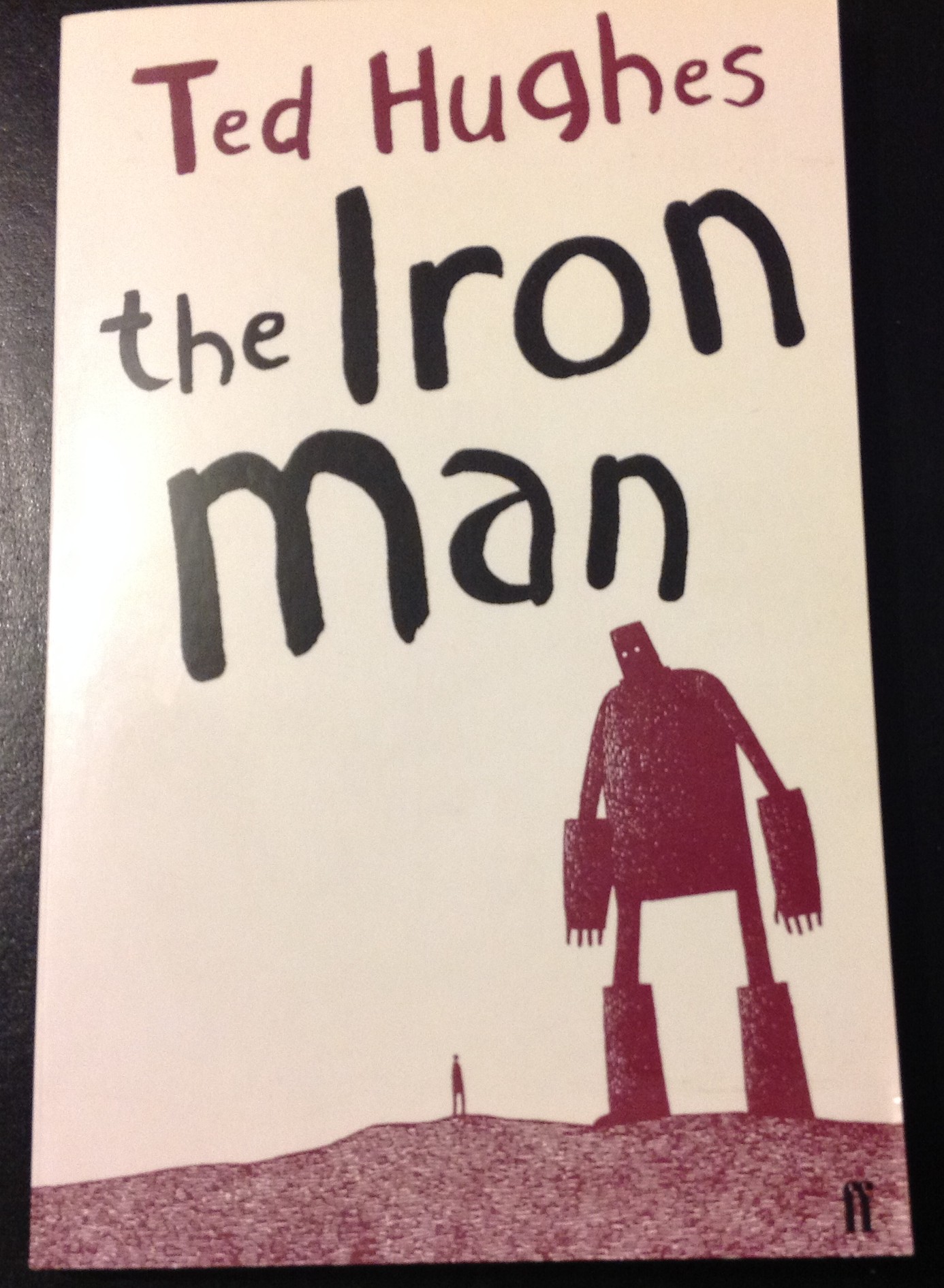
This one descended when I was out for a drive appreciating the beauty of the pure white clouds, like puffballs, on the bright blue sky of a glorious winter day. It plopped down, ‘Barrrump!’ just as the space-bat-angel-dragon from The Iron Man by Ted Hughes had plopped down on Australia.
As mentioned in a previous post, The Iron Man is one of my favourite books. It is a great story told in beautiful language. On the back of my copy a quote from the Observer declares that it is ‘Reckoned one of the greatest modern fairy tales.’ The rhythm and poetry of the language begs for it to be read aloud. Because it has just five short chapters, ‘a story in five nights’, it is perfect as a first chapter book to share with younger children, and can be read to a class in a week, a chapter a day.
The chapter I wish to share with you in this post is #4 ‘The Space-Being and the Iron Man’.
The previous chapter has seen The Iron Man happily ensconced in a huge scrap-metal yard. It could have finished there with a happily ever after ending. But no. It was only chapter 3. There were two more chapters to come! What excitement was in store?
The chapter begins
‘One day there came strange news. Everybody was talking about it. Round eyes, busy mouths, frightened voices – everybody was talking about it.
One of the stars of the night had begun to change.’
We are immediately reeled back into the story – What is going to happen? What will the Iron Man do? – and propelled along by the giant star that grew ‘not just bigger. But bigger and Bigger and BIGger’ as it came
‘rushing towards the world.
Faster than a bullet.
Faster than any rocket.
Faster even than a meteorite.’
Thankfully it stopped before it hit Earth. But wait – it’s not over yet, for ‘a dreadful silhouette, (came) flying out of the centre of that giant star, straight towards the earth.’
After several days it (‘a terrific dragon’) landed, with its body ‘covering the whole of Australia’ and it ‘wanted to be fed. And what it wanted to eat was – living things.’
‘The people of the world decided they would not feed this space-bat-angel-dragon … they would fight it.” But all the forces of the world were no match for the dragon.
As you may have guessed, this is where the heroic Iron Man devises his plan ‘to go out, as the champion of the earth, against this monster from space’. The dragon was very surprised to be challenged to a test of strength.
The Iron Man, you may remember, is taller than a house, but the space-bat-angel-dragon is bigger than Australia. The dragon thought that, when the Iron Man had finished, he’d ‘just lick him up.’ He didn’t figure on the ingenuity of the Iron Man. The Iron Man’s challenge was for the dragon to ‘go and lie on the sun till (he was) red-hot’. (The Iron Man was small enough to be made red-hot on Earth.)
After the second journey to the sun the dragon again ‘landed on Australia. This time the bump was so heavy, it knocked down certain sky-scrapers, sent tidal waves sweeping into harbours, and threw herds of cows on their backs. All over the world, anybody who happened to be riding a bicycle at that moment instantly fell off. The space-bat-angel-dragon landed so ponderously because he was exhausted.’
Have you ever felt that exhausted you just wanted to flop down and never move again? An article in my local newspaper1 recently declared that ‘We belong to the Spent Generation – the most overcommitted, overscheduled, overconnected, and therefore overtired, in modern times.’ The journalist Frances Whiting listed a number of professions including ‘doctors, scientists, social commentators (who) the statistics tell us (are) working longer, sleeping less, not resting enough and taking on too much.’
Teachers weren’t on this list, but they could have been at the top. Anyone who lives with, or has a friend who is, a teacher knows the long hours they work. Because it is a caring profession it is impossible to leave work at the gate and pick it up the following day. Content-driven curricula and unrealistic expectations imposed upon both teachers and learners place extra stress upon all stakeholders. Long before a school terms end teachers are tired, stressed and in need of time to recuperate and recharge in preparation for the next one.
At the moment most teachers in Australia are conducting assessments, evaluating their own work and student learning, preparing report cards and conducting teacher-parent interviews. This is in addition to their ongoing tasks of preparing and teaching lessons and is mostly expected to be completed in out-of-scheduled work hours.
When I was teaching I worked between 50 and 70 hours most weeks. I used to say that even with our ‘enviable’ holidays we were still owed time. In my current out-of-the-classroom role as writer of curriculum materials, I now feel the difference as I don’t have to think about it away from my desk.
I still get tired, but not the same heavy exhaustion that comes from giving all; physically, mentally and emotionally, to a class of 25 active learners while trying to stay afloat amidst ever increasing expectations.
So my flash this week recognises the teachers who, buried under a pile of paperwork and lost in a maze of data collecting spreadsheets, still struggle to be everything to everyone, endeavouring to make every child feel special and valued, while often feeling that their own work fails to achieve any real recognition. Enjoy the break, teachers. You deserve it!
A Unicorn at School
‘Miss. Marnie has a toy in her bag.’
‘Uh-uh,’ I responded.
‘You’re not allowed to have toys at school,’ he insisted.
‘Uh-uh.’
Trust him! Always dobbing.
‘Miss,’ he persisted, tugging my sleeve.
‘What is it?’ I sighed, dragging myself out of the confusion of marks and percentages that now seemed more important to telling a child’s story than their own words and actions.
I looked at the little fellow pleading for my attention. They were all so needy; so demanding; but time . . .
‘It’s a unicorn, Miss.’
‘Unicorn! Let’s see!’ I was back. A child in need!
I welcome your feedback. Please share your thoughts about any aspect of the article or my flash fiction piece.
However the chapter that captured my attention and challenged my thinking more than any other was the one about praise. I also blogged about this: Seeking praise: Stephen Grosz revisited.
My post about praise got Anne Goodwin thinking further about this issue and she was able to delve into it more deeply with her background in psychology. She has very generously written this guest post to share her thoughts.
Thanks Anne – over to you:
Although I was enchanted by The Examined Life from the first page, I glossed over the chapter on praise. Reading primarily for the parallels between these therapeutic case studies and reading and writing fiction, I didn’t stop to analyse my reaction, to acknowledge I was challenged by the suggestion that praise could be detrimental. Perhaps I dismissed this chapter as a reaction to the rarefied atmosphere of that cosy part of North London that is the hub of British psychoanalysis. In my neck of the woods, as reflected in myflash fiction piece, Peace-and-Quiet Pancake, I’m more concerned about a shortage of praise and encouragement than an excess.
I was initially disappointed when Norah mentioned on Twitter that, with over thirty chapters to choose from, she’d decided to blog about the chapter on praise. Yet her wonderful post showed me what I’d missed in my initial (defensive) reading and inspired me to go back to the book and ponder the depths of wisdom within those four and a half pages for myself.
“Stephen Grosz calls into question where our ideas of good practice originate.”
In suggesting we rethink what’s best for our children, Stephen Grosz calls into question where our ideas of good practice originate. We tend to respond to the mistakes of our forebears by striving to do the opposite, so those of us who suffered from a dearth of praise ourselves might be inclined to lavish praise on the next generation. Yet we can become so fixated on turning our backs on theapproaches we know from experience to be unhelpful, we’re blinded to the potential pitfalls of the alternative path. Cutting back on praise feels treacherous, like siding with the harsh disciplinarians of days gone by. Stephen Grosz points us towards a third way.
“Behavioural strategies are invaluable for introducing the necessary structures and routines in which children can prosper and learn.”
Behavioural psychology shows that targeted rewards, either tangible, or intangible like praise, increase the frequency of desired behaviours. Rewards are actually most effective when they’re doled out intermittently, which might be one argument (although not the author’s) for soft-pedalling on the praise. Behavioural strategies are invaluable for introducing the necessary structures and routines in which children can prosper and learn. However, they can also result in the over-controlled and compliant child, one who is well versed inpleasing adults but struggles to think for him or herself.
“Stephen Grosz suggests that parents and educators can become as addicted to praise as these children.”
Stephen Grosz suggests that parents and educators can become as addicted to praise as these children. The mother who continually tells her child she is good might be vicariously praising herself. Underlying this might be a lack of confidence in her own parenting skills and a difficulty accepting her child as a separate person, with potentially different values and preferences. This is unlikely to enhance the child’s confidence and self-esteem.
“He also cautions us to be wary of praising children for what they are rather than for what they do.”
He also cautions us to be wary of praising children for what they are rather than for what they do. He cites a study in which, consistent with attribution theory, children praised for their effort rather than their intelligence, developed a more positive approach to problem solving. We can always put in more effort, but if we believe success is down to stable and unchangeable factors we might be less resilient in the face of the failure we will all, however talented, meet at some point in our lives.
“a third position where the adult is benignly attentive to the child and curious about what he/she is doing.”
What the author recommends is not a return to a pedagogy of threat and punishment, but a third position where the adult is benignly attentive to the child and curious about what he/she is doing. The child who believes that an adult is genuinely interested in their ideas, thoughts and feelings, is likely to develop a strong sense of agency and self-worth. While this might seem a radical approach, it’s not dissimilar to the behaviour of a tuned-in mother who watches over and mirrors her baby’s moves. It’s also the stance taken by the psychoanalytically orientated psychotherapist.
This is familiar ground for me, but I didn’t recognise it on an initial reading. Having already decided I loved the book from hearing snippets on the radio, I was reading it for what I could praise. I hope it wasn’t empty praise, but I was unwilling to engage with parts that were hard to swallow. On the second reading, my stance flipped to critical, almost punitive, focusing more on what was missing from the chapter than what was actually there. Now this process of putting my thoughts into words has brought me towards the position of curiosity and attentiveness I wish I’d had first time round. Whilst other readers might be less defensive, it does make me wonder, if it’s a struggle to reach this position in relation to a text, how difficult might it be to apply this learning in the real world and on a larger scale?
“While parents, politicians and educationalists might all claim to value individual expression and personal growth, this has to be weighed against an equally strong pressure for the achievement of standardised performance goals.”
On a sociopolitical level, we might resist this understanding because of conflicting views as to what education is for. While parents, politicians and educationalists might all claim to value individual expression and personal growth, this has to be weighed against an equally strong pressure for the achievement of standardised performance goals.
On the individual level, as Stephen Grosz says in his final paragraph, being present with others is hard work. Therapists have their own therapy in addition to training and supervision; parents striving to do a similar job with only their experience of their own parenting to draw on could struggle to find the position of attentiveness beyond both praise and chastisement.
“Children who have never been praised, even for attributes outside their control, might have no concept of their own ability to impact on their environment.”
Furthermore, for the child entering school knowing only neglect and criticism, a teacher’s benign curiosity could be experienced as threatening, just as the neutrality of therapist can provoke anxiety in his or her client. Children who have never been praised, even for attributes outside their control, might have no concept of their own ability to impact on their environment. Does the busy classroom teacher have the resources to be truly present with them in the way they require?
Thanks, Norah, for challenging me to revisit this chapter and for the invitation to rework my comment into a guest post. For those who’ve had the patience to stay present this far, I look forward to your reactions.
Thank you Anne for the insight and challenge you have offered with much for us to think about.
I reiterate Anne’s invitation for you, the reader, to share your thoughts on this topic, and suggest you head on over to Anne Goodwin’s writing blog (Annethology) for a great assortment of interesting fare.
One of my favourite talks about education is a TED talk given by Ken Robinson in 2006 “How schools kill creativity”.
His contention is that
“creativity . . . is as important in education as literacy, and we should treat it with the same status.”
Although the video has had more than 21 million views (while quite a few of them mine, nowhere near that number!) and drawn over 3 000 comments during the last 8 years, his views need to reach a wider audience still; an audience with the power to enact change.
One thing I had always loved about teaching was the opportunity to express myself creatively, and to encourage my students to do the same. Unfortunately the current emphasis on a content-driven, top-down approach where test results reign supreme has left little room for anyone’s creativity. I am not saying there was ever much opportunity for creativity in formal schooling, but creative teachers could always squeeze a bit it. Now the opportunities for creative “massage” are few.
My optimism for positive change in education is always raised when I read or hear of others who share similar views. I think if enough voices are heard chanting the same message that a change may come.
This post (and article in Saturday’s QWeekend magazine) by Mary-Rose Maccoll “Why Banff means the World” also proclaims the vision of Ken Robinson. Mary-Rose is another fan.
She says that
“Being at the Banff Centre (in Canada) has made me reflect on what we lose when we don’t foster art, when we don’t foster creativity. And what we lose is the world.”
She says that
“even as school education becomes increasingly narrow in its focus, we’re also seeing a decline in performance on the very outcomes that standardisation seeks to improve.”
She concludes by saying,
“As I sit in my room and watch the mountains, listening to the trail of a contraband sax down the hall (you’re supposed to play in the soundproofed studios in the forest), reading a piece by a Scottish writer, I am grateful for artists. In our 21st century world, we surely need them.”
I agree wholeheartedly as, I’m sure would Ken Robinson, along with Teachling whose post What is Education, anyway?Pt 1 I reblog for you here.
I agree with Teachling’s belief that
“many teachers would feel that – as well as their students’ innate talents and creativity being snuffed – their own talents and creativity don’t get much of a look-in. I believe most teachers are very restricted in terms of what they teach as well as how they teach it.”
I also agree with her when she states that
“that there’s very little teachers can do about it.
It’s the administrators and politicians that should take Robinson’s advice. It’s also the perceptions of a majority of parents that would need to vastly change if any rethinking of fundamental principles were to occur.”
Have a listen to Ken and read these other posts, then let me know what you think.
How can we make our voices be heard to ensure that creativity and innovation is not lost for the future?
Ken Robinson’s take on schools, and how they kill creativity…
You’re likely one of the 20,738,467 viewers of Ken Robinson’s “Schools Kill Creativity” 2006 TED Talk. Robinson’s assertion, and general gist of the talk, is that “all kids have tremendous talents, and we squander them; pretty ruthlessly”. The “we”, we can infer from the rest of his talk, are schools.
Let me pick out some key points:
• “My contention is that creativity, now, is as important in education as literacy, and we should treat it with the same status.”
• “We are educating people out of their creative capacities.” • “Every education system on Earth has the same hierarchy of subjects… At the top are Mathematics and Languages, then the Humanities and at the bottom are the Arts… And in pretty much every education system there’s a hierarchy within the Arts. Art and Music are normally given a higher…







 Norah Colvin