Two recurring themes, amongst others on my blog, are ways of encouraging a love of literacy and of questioning in young children.
If you read my post Going on a treasure hunt! you will know that I greatly admire the work of Michael Rosen and its contribution to literacy development. You may have followed the links and checked out the riches in store on his website.
My post Child’s play – the science of asking questions introduces my thoughts about ensuring that children’s inborn curiosity is maintained through the encouragement of their questions.
You can imagine my delight, then, when I read a review of new book by Michael Rosen. (Thank you, Anne Goodwin, for alerting me to it.) The review, posted by Sabine Durrant in The Guardian on 6 September 2014, discusses Rosen’s new book How to be Your Child’s (and Your Own) Best Teacher. I confess that I have not read the book but I am very excited to see that it is now available as an audiobook, so it is next on my listening list. So much about the book appeals to me.
Rather than review the review I will simply leave with you the links to the review:
Recently I listened to a compelling TEDx talk by Dan Habib. You can listen to it here:
Dan opens his talk by asking the audience some questions about their school days:
Did kids with and without disabilities study together and learn together?
Did they have a best friend who had a disability?
Did they have a boyfriend or girlfriend that had a significant disability?
Very few of the approximate one hundred in the audience answered in the affirmative.
Then Habib asked the audience to consider and answer the following question:
Did you feel some fear or nervousness when you were a kid about talking to a kid with a disability?
The majority of the audience affirmed they did.
Had I been in the audience, my responses would have been similar.
When I was a kid, there were no children with disabilities in my classes. Children with disabilities were hidden away as an embarrassment and were segregated into what where called ‘opportunity schools’.
Thinking back, my impression is that people with disabilities were not visible in the community and their needs were not catered for. They were not expected to have any participation in society. Often they were targets of taunts and laughter, but mostly ignored and avoided.
However, when I was a kid discrimination wasn’t restricted to people with disabilities. It was a time in which racial discrimination and segregation was more prevalent; before the emergence of women’s rights and children’s rights.
Sometimes when we see how far humanity still has to go towards equality, tolerance and compassion it is hard to see how far we have come. But looking back on the changes that have occurred in just my life time, the progress is obvious, if still insufficient.
Even into my college years I had little contact with people with disabilities and my teacher training made no mention (that I can remember) of catering for students with disabilities, who were still segregated into what became called ‘special’ schools. I don’t recall catering for individual differences being high on the agenda back then.
I worked as a remedial teacher for a few years, supporting students who were achieving below the expected level, of reading mainly. These children were generally of average intelligence but experiencing a learning difficulty. Children falling below average on an intelligence test would still be shunted away to special schools.
I cannot recall the inclusion of any students with intellectual or physical disabilities at any school at which I taught prior to the 1990s when integration and mainstreaming was introduced. Dan Habib says in his talk that, as he was growing up, ‘disability was just a blip on the radar screen’ as well. Maybe this experience was similar to yours?
When Dan came to accept that his son Samuel had a disability and that he would have that disability for life, he realized that they had to create a vision for Samuel, and let ‘Samuel create a vision for himself“.
Part of this was the need for a sense of belonging: to the neighbourhood, the community and the local school. It was this that got Dan thinking about inclusion. Dan goes on to describe the ways in which Samuel was included in the school and the community, and the benefits, for both Samuel and others.
He urges everyone to advocate for inclusive education as the benefits include better communication skills, higher academic achievements, wider social networks and fewer behaviour problems. He decries the fact that, despite the benefits, most kids with disabilities still spend their day segregated.
He explains that the benefits are just as valuable for typical kids who achieve higher academically while learning to be patient, caring, compassionate, and loving. In my more recent years of teaching, I got to see these benefits of inclusion first hand. Not only did the children learn, so did I.
I didn’t just chance upon this TEDx talk. It was included in a great guest post by Gary Dietz on The Cool Cat Teacher’s blog. The post introduced a book, written by Gary, about dads of kids with disabilities and proposed 5 practical lessons for elementary classroom inclusion. The book Dads with Disabilities is described as inspiring and ‘a must read for any teacher working with special needs kids’.
The five suggestions(which I think are based on respect and are applicable for all students) are:
‘Meet the student “where the student lives” (where they need to be, at their level of development)
Presume competence
Be creative in your use of ‘adaptive’ technology (e.g. use of video and Skype or Facetime)
Listen to parents and help them listen to the child
Give “overlooked” children the same chance to shine as the superstars
Vicki Davis is the Cool Cat Teacher. Her blog is consistently among the top 50 education blogs worldwide. Her byline is “A real teacher helping teachers be really excellent”. I agree that she is and recommend her blog to you.
Update from Gary Dietz (12/08/2014):
“The book ‘Dads of Disability’ is now a FREE loan if you subscribe to Amazon Prime or Kindle Unlimited. And if not, it is on sales as an ebook for $4.99. Look it up on Amazon. (Of course the paperback is still available!)”
How do you view inclusion? What is your experience?
I appreciate your feedback. Please share your thoughts about any aspect of this post.
This post almost didn’t get published. It almost fell through a crack into the never-never. But just in time the safety net sprang into action and saved it from obscurity.
That may matter more to me than it does to you, but as an educator I hear too often about children who ‘fall through the cracks’, who fail to thrive in the school system, who miss out on the inspiration and timely support that would empower them on their journey to life-long learning.
Like those children, this post was an also-ran. It didn’t quite get it, didn’t quite reach the expectations. But then I read something that confirmed for me the importance of sharing my message.
You see, the love of reading is contagious. It can be caught from anyone, anytime.
However, it can just as easily be extinguished; and the danger of that happening seems to be lurking in school systems packed too tight with lists of must do, must learn and must achieve expectations.
I consider it imperative that teachers prioritize time for children to develop a love of literature and reading that will expand their horizons and create a worthwhile companion on the journey of their lifetime.
Here are 10 easy tips for keeping the love of books alive in an early childhood classroom:
Read aloud to children every day, ensuring that a variety of books and genres are being read and shared.
Have a great supply and variety of children’s books available: picture books, fiction and non-fiction, collections of poetry, beginning chapter books, funny books, sad books, books about animals, space, people . . .
Display books with covers facing out and give them pride of place. Make a display of ‘favourite reads’.
“Sell” books to children (you won’t have time to read them all) by showing the cover and some illustrations; by telling what they are about, what happens, and what the children will enjoy about them.
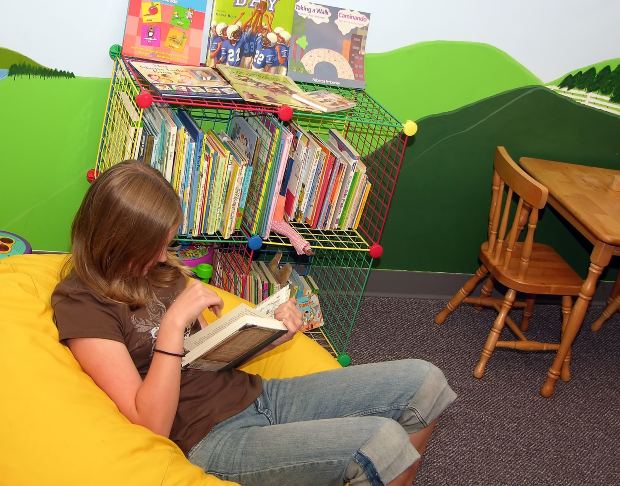
Make a reading corner with carpet, pillows and bean bags that invites children to get comfy while they read.
Provide time for children to choose and read independently.
This can occur during quiet times set aside on a daily basis in which everyone, including the teacher, reads for 10 – 15 minutes. e.g. D.E.A.R. (drop everything and read) or U.S.S.R. (uninterrupted silent sustained reading).
It can also be integrated into reading group or literacy centre activities.
Share the enthusiasm for books by providing time for children to excite each other about the books they are reading in a sharing circle.
Display books written by the children and allow access to them for independent choice. Include them in the sharing and ‘selling’ sessions also.
Make a time to visit the school library for reading and borrowing.
Invite other adults to the class to read to the children e.g. teacher-librarian, administrators, support personnel, parents and grandparents.
Let me know in the comment box a favourite tip of yours.
This week I have read some fabulous posts by teachers who are making sure there is time for joy and independent choice in their literacy classrooms. I will share these with you below.
The article that convinced me to share my thoughts was one that was not so joyful.
Written by Alexander Nazaryan, a first-year teacher, the article appeared in the Opinion Pages of the New York Times on July 6, 2014. He talked about not being able to meet the needs of his students and explained that it was not the fault of the students though, the fault was that they were mostly of poor and immigrant families.
He felt that asking these students to write about their own experiences did not have ‘the pedagogical value of a deep dive into sentence structure or a plain old vocab quiz.’
I was immediately struck by the similarity of a statement made to me by my son’s teacher thirty years ago. At the time I was leading an in-service workshop about teaching writing. I would have been talking about ways of engaging students in the writing process by giving them opportunities to write at length about things of interest to them; by encouraging the writing of a first draft to get the ideas down; by providing opportunities for redrafting, rewriting and editing; and opportunities for feedback by sharing their writing with peers; and by making the most of teachable moments through individual conferences with each student.
This teacher exclaimed that there was no way the children would be able to write anything of length as not one knew what a paragraph was, or indeed what a sentence was. The students were ten years of age and in their fifth year of school. I believe the statement to be more an indictment of the teacher’s inability to appreciate what the children could do, rather than an accurate estimation of their abilities. I knew for a fact that at least one student was more than capable of writing at length with a variety of sentence structures and correct paragraphing. I was certain he wasn’t the only one.
I am inclined to agree with Nazaryan that ‘Expecting children to independently discover the rules of written language is like expecting them to independently discover the rules of differential calculus.’
However trying to teach the skills of literacy through a barrage of meaningless drill and practice exercises in a joyless classroom is doomed to failure, and the children, sadly, will fall through the cracks.
What the children need, in my opinion and unlike that of Nazaryan, is a balanced approach. The skills of literacy need to be taught in a meaningful context.
She willed the earth to open up and swallow her whole. But it didn’t. She just stood there trembling, attempting to hold back the deluge that threatened to engulf her.
She strained to remember, knocking her head with her fist. Quick. Try. Try. What’s the rule: i? e?
She stammered an answer. Wrong again! Too many rules! Stupid rules! Broken – just like her.
She fled, eyes stinging, mouth twitching; and as she passed, with one hand grasped the confiscated unicorn sitting askew the teacher’s desk.
Away they flew, the assault of mocking laughter fading far below.
Thanks for reading. I appreciate your feedback. Please share your thoughts about any aspect of this post, including my flash piece.
Do I respond to the flash fiction prompt in isolation?
Neither of these alternatives appealed as I have been enjoying the camaraderie and support of the flash fiction tribe as well as the opportunity to experiment in a genre that, while not an immediate writing priority, I may move towards in the future. On the other hand, as my intent with this blog is to share ideas and thoughts primarily about education, I don’t want to become distracted from my focus.
As do many, the idea for this prompt attached itself to me when I wasn’t thinking about it. Ideas tend to pop into my head when I first awaken in the morning, when I am showering, or during any other moment when my thoughts are free to flit and fly without the constraints of achieving a particular outcome.
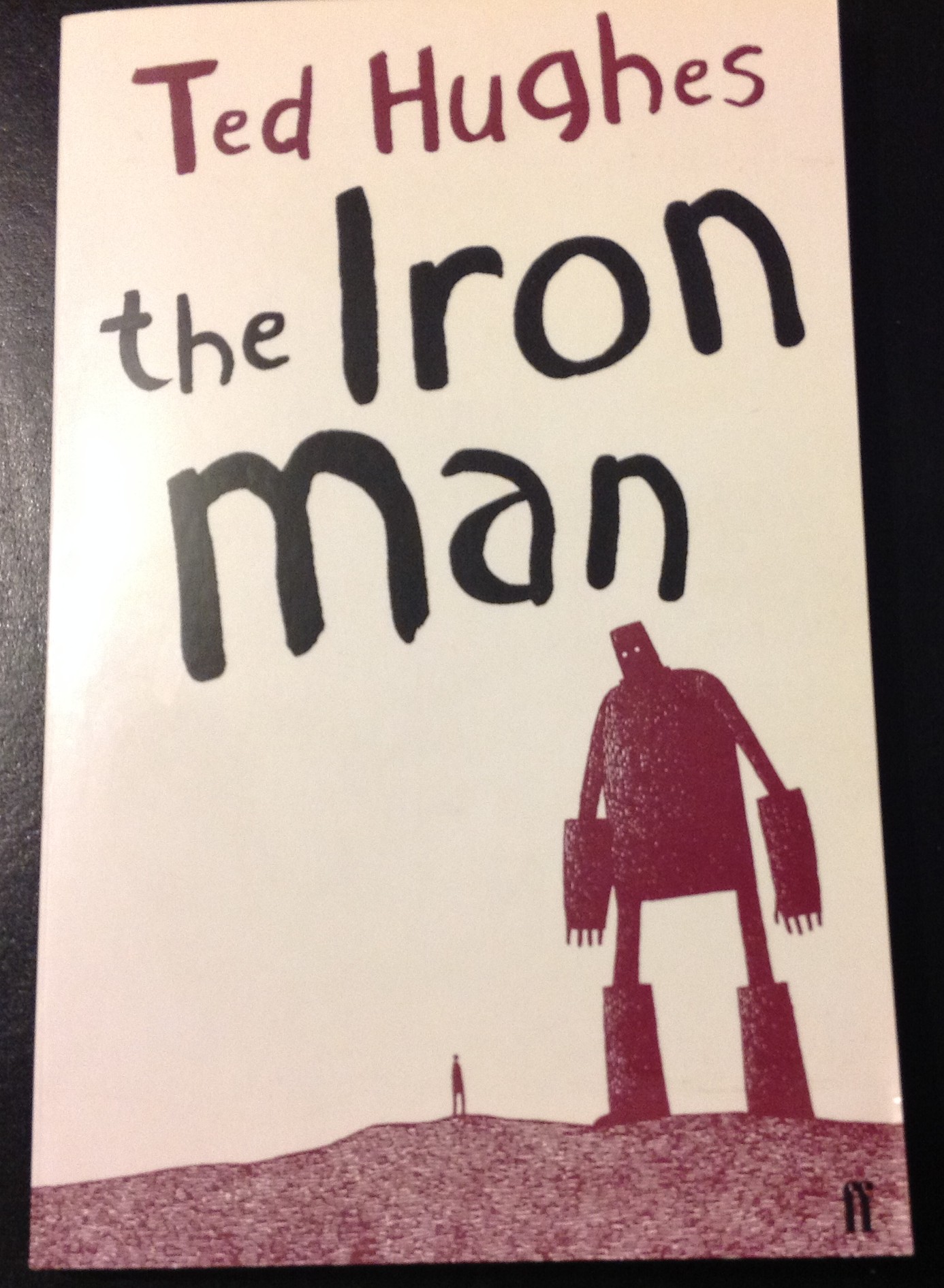
This one descended when I was out for a drive appreciating the beauty of the pure white clouds, like puffballs, on the bright blue sky of a glorious winter day. It plopped down, ‘Barrrump!’ just as the space-bat-angel-dragon from The Iron Man by Ted Hughes had plopped down on Australia.
As mentioned in a previous post, The Iron Man is one of my favourite books. It is a great story told in beautiful language. On the back of my copy a quote from the Observer declares that it is ‘Reckoned one of the greatest modern fairy tales.’ The rhythm and poetry of the language begs for it to be read aloud. Because it has just five short chapters, ‘a story in five nights’, it is perfect as a first chapter book to share with younger children, and can be read to a class in a week, a chapter a day.
The chapter I wish to share with you in this post is #4 ‘The Space-Being and the Iron Man’.
The previous chapter has seen The Iron Man happily ensconced in a huge scrap-metal yard. It could have finished there with a happily ever after ending. But no. It was only chapter 3. There were two more chapters to come! What excitement was in store?
The chapter begins
‘One day there came strange news. Everybody was talking about it. Round eyes, busy mouths, frightened voices – everybody was talking about it.
One of the stars of the night had begun to change.’
We are immediately reeled back into the story – What is going to happen? What will the Iron Man do? – and propelled along by the giant star that grew ‘not just bigger. But bigger and Bigger and BIGger’ as it came
‘rushing towards the world.
Faster than a bullet.
Faster than any rocket.
Faster even than a meteorite.’
Thankfully it stopped before it hit Earth. But wait – it’s not over yet, for ‘a dreadful silhouette, (came) flying out of the centre of that giant star, straight towards the earth.’
After several days it (‘a terrific dragon’) landed, with its body ‘covering the whole of Australia’ and it ‘wanted to be fed. And what it wanted to eat was – living things.’
‘The people of the world decided they would not feed this space-bat-angel-dragon … they would fight it.” But all the forces of the world were no match for the dragon.
As you may have guessed, this is where the heroic Iron Man devises his plan ‘to go out, as the champion of the earth, against this monster from space’. The dragon was very surprised to be challenged to a test of strength.
The Iron Man, you may remember, is taller than a house, but the space-bat-angel-dragon is bigger than Australia. The dragon thought that, when the Iron Man had finished, he’d ‘just lick him up.’ He didn’t figure on the ingenuity of the Iron Man. The Iron Man’s challenge was for the dragon to ‘go and lie on the sun till (he was) red-hot’. (The Iron Man was small enough to be made red-hot on Earth.)
After the second journey to the sun the dragon again ‘landed on Australia. This time the bump was so heavy, it knocked down certain sky-scrapers, sent tidal waves sweeping into harbours, and threw herds of cows on their backs. All over the world, anybody who happened to be riding a bicycle at that moment instantly fell off. The space-bat-angel-dragon landed so ponderously because he was exhausted.’
Have you ever felt that exhausted you just wanted to flop down and never move again? An article in my local newspaper1 recently declared that ‘We belong to the Spent Generation – the most overcommitted, overscheduled, overconnected, and therefore overtired, in modern times.’ The journalist Frances Whiting listed a number of professions including ‘doctors, scientists, social commentators (who) the statistics tell us (are) working longer, sleeping less, not resting enough and taking on too much.’
Teachers weren’t on this list, but they could have been at the top. Anyone who lives with, or has a friend who is, a teacher knows the long hours they work. Because it is a caring profession it is impossible to leave work at the gate and pick it up the following day. Content-driven curricula and unrealistic expectations imposed upon both teachers and learners place extra stress upon all stakeholders. Long before a school terms end teachers are tired, stressed and in need of time to recuperate and recharge in preparation for the next one.
At the moment most teachers in Australia are conducting assessments, evaluating their own work and student learning, preparing report cards and conducting teacher-parent interviews. This is in addition to their ongoing tasks of preparing and teaching lessons and is mostly expected to be completed in out-of-scheduled work hours.
When I was teaching I worked between 50 and 70 hours most weeks. I used to say that even with our ‘enviable’ holidays we were still owed time. In my current out-of-the-classroom role as writer of curriculum materials, I now feel the difference as I don’t have to think about it away from my desk.
I still get tired, but not the same heavy exhaustion that comes from giving all; physically, mentally and emotionally, to a class of 25 active learners while trying to stay afloat amidst ever increasing expectations.
So my flash this week recognises the teachers who, buried under a pile of paperwork and lost in a maze of data collecting spreadsheets, still struggle to be everything to everyone, endeavouring to make every child feel special and valued, while often feeling that their own work fails to achieve any real recognition. Enjoy the break, teachers. You deserve it!
A Unicorn at School
‘Miss. Marnie has a toy in her bag.’
‘Uh-uh,’ I responded.
‘You’re not allowed to have toys at school,’ he insisted.
‘Uh-uh.’
Trust him! Always dobbing.
‘Miss,’ he persisted, tugging my sleeve.
‘What is it?’ I sighed, dragging myself out of the confusion of marks and percentages that now seemed more important to telling a child’s story than their own words and actions.
I looked at the little fellow pleading for my attention. They were all so needy; so demanding; but time . . .
‘It’s a unicorn, Miss.’
‘Unicorn! Let’s see!’ I was back. A child in need!
I welcome your feedback. Please share your thoughts about any aspect of the article or my flash fiction piece.
While I did eventually produce a piece in response to the prompt and received some very generous comments (thank you readers), the difficulty I was experiencing made me think of all the school children who have ever been set a topic and told to write about it, sometimes without an opportunity for discussion, reflection or planning, and often without any consideration of interests or experiences. I was feeling particularly sympathetic that week as children in Australia were, at that time, sitting the NAPLAN (National Assessment Program – Literacy and Numeracy) writing test.
While I have not yet read the entire paper, the abstract itself is quite interesting.
Behizadeh begins by saying
“The dangers of a single story in current U.S. large-scale writing assessment are that assessment practice does not align with theory and this practice has negative effects on instruction and students.”
As shown in my previous article, large-scale writing assessment also occurs in Australian schools and, I believe, in the Education systems of many other countries as well.
It is interesting to see that the practice, while widely implemented, is not, according to Behizadeh, supported by theory. One would have to wonder why. Oftentimes teachers lament that those making decisions about educational practices are bureaucrats with little or no training or experience in education. (Pardon me, we all went to school didn’t we?)
In our data driven world where information can be collected on spreadsheets, compared in a wide variety of graphs and tables, and stored indefinitely, emphasis moves from qualitative to quantitative assessment. I believe that this trend towards valuing only that which can be scored numerically is having a negative effect upon children’s learning and their enjoyment of learning. It discourages creativity and imagination and forces everyone to squeeze into the same sized and shaped hole. Some manage to fit more easily and more comfortably than others, but I question the cost to all.
Behizadeh goes on to propose
“A new vision of large-scale sociocultural writing portfolios in K–12 education . . . that builds on the practices of past large-scale portfolio assessment … (and) also encourages students to write in multiple languages/dialects and modes for multiple purposes.”
I love the idea of portfolios for assessment, rather than a one-off test. I would think most professional writers have a portfolio consisting of work at various stages: some as ideas jotted on slips of paper, some in planning stages, others in draft form, others completed and waiting for the next step, and others in publication.
A portfolio allows a writer to work on different pieces at different times and at different rates. Rarely is it imperative for a piece to be completed in an hour or two. (Unless you’re a journalist I suppose.) You can dip in, leave to rest, go back, redraft, edit, start again, and not be required to churn something out for a reader, let alone assessment, more or less on the spot.
As a teacher, too, I loved my children having portfolios of work. They would write a draft of many different pieces and store them in a folder. They would edit and “publish” those only they wished (which was usually most!).
I would conference with them about their pieces, firstly about the content be it story, poem, letter or information discussing what they wanted to say, who they were writing it for and how they wanted the reader to think and feel. When they were happy with their message we might talk about choices of words and language structures. Finally, when they were ready to publish, we would look at the surface features of spelling and punctuation. No teacher’s red pen was ever used to mark their work. The children were engaged with the entire process of writing (we called it “process writing” back then) and had ownership of their work.
We published by sharing our work with classmates, other classes, teachers and parents. We displayed writing on classroom walls, in the hallways and in the school foyer. Each term I would print booklets of the children’s writing for them to take home and share with their families. Many took pride of place on the family bookshelves.
This type of portfolio clearly demonstrates a student’s ability to write in a variety of genres, to develop an idea, to express oneself grammatically, to use editing skills and to proofread for spelling and punctuation correctness. What better than that could be used to assess a child’s writing development?
The two main points I am making in this article are:
a one-off writing assessment task does not give students an opportunity to show their best work and puts pressure on them to perform
a portfolio of work collected over time provides a clear picture of student ability, development, and next steps for learning
While I began this article by expressing how I was feeling about responding to the flash fiction prompt, I am in no way suggesting that the flash fiction challenge has any similarity to the national writing assessment tasks that are set for children, for it does not.
With flash fiction:
I choose whether to participate or not
I choose the genre in which I will respond
I hone my writing skills, paring away unimportant words to get to the heart of the story
I share my writing with willing readers
I receive lots of encouraging and supportive feedback on my writing
I have a sense of belonging to a community of other writers.
I have spent a lot of time thinking about this one, making various starts and writing some drafts but the twist in this one is, I haven’t been able to come up with something I am happy with sharing. But that’s okay because, unlike the children sitting the one-off national assessment, I can choose not to contribute this time, a low-ranking score won’t be collected and placed against my name for all time, and I can get to participate next time, if I choose.
Although I am not contributing a piece this time, I have still learned a lot by the process of trying different things, even if I haven’t found a way to make them work, yet
… and it provided me an opportunity of sharing some of my thoughts about writing with children. There will be more to come!
I’d love to know what you think!
PS Make sure you pop over to the Carrot Ranch to see how others have responded to the prompt.
I have spent almost my entire life thinking about how to educate, and the rest of it being educated.
That is to say, just like everyone else, I began to learn about the world from the moment I was born, if not before; probably before.
From age ten I knew that I wanted to be a teacher and worked hard through school to achieve that goal.
When I completed school I was fortunate to receive a teacher’s scholarship which meant that my three years of training was provided by the state education system and, in return, I was required to teach within the system for three years. Without the scholarship that path would have been unattainable.
I remember sitting in my classroom on, what I will say was, my first day of teaching. I gathered a group of children around me, each of us with a reader in our hands, ready for a reading lesson. Suddenly I realised I didn’t have a clue what to do.
Realisation 1: Teaching reading isn’t as simple as putting book in the hands of children and telling them to read.
This was a third grade class, so I’m hoping that most of them were already able to read and we figured it out together. Round robin reading seemed to be the method of the moment.
During that first, and the following year, I put a lot of energy into sorting books into levels and children into groups to read the books at the different levels. I’m not sure what the children learned but I know I was earning my pay. I was ‘teaching’.
Realisation 2: Children learn to read at different rates.
At the beginning of my third year of teaching I was listening to children read individually, in order to group them according to reading ability, when one of the children, considered a good reader by his previous teacher, informed me proudly that he could read the book without looking; and proceeded to do so. He had memorised it! He didn’t recognise any of the words and could not read any other book.
Realisation 3: Reading is more than reciting the words on the page.
Major realisation: There was something wrong with the way reading was being taught, and I still didn’t feel confident about teaching it.
Fortunately most children learn to read despite how it is taught, and although I sometimes think I’d like to apologise to all those students I “taught” when I didn’t have much of a clue, I’d like to say “I hope they’re not reading this”, but I really hope they can!
Not long after this I had a break from teaching for a few years. During that time I read a lot of books about education, especially alternative views of schooling. I continued to feel strongly about reading instruction and even wrote a series of readers (unpublished) based on instruction in phonics. (Such was my ignorance!)
I worked with groups of upper primary remedial readers who made great progress ostensibly using a phonics program. However they also received lots of individual attention, encouragement and opportunities for reading real books.
At the same time I watched my three year old son become a reader without any formal instruction. I read to him, talked with him, wrote stories for him and transcribed his stories which we read together. We played games with language making up rhymes, playing “I spy”, singing songs and talking about print in our environment. Before I knew it he was jumping into bed in the mornings, prising my eyes open and begging to read to me!
I struggled to make sense of what I was observing.
Then the serendipitous moment arrived: I saw an advertisement for a graduate diploma in reading and language. It sounded tailored to my needs exactly. And it was.
We packed up the family and moved across the country to enable me to undertake the study.
It was one of the best things I have ever done. Suddenly everything made sense. The course about developing literacy skills also supported my developing beliefs and understandings about learning in general. I was at last in a place I felt comfortable. This was where I belonged. The course reignited my passion and provided the knowledge and skills that would underpin everything I have since done in education. Time has moved on but the essential understandings are timeless.
The coordinator of the course, the person who deserves my sincerest gratitude, is just as passionate about literacy education today as he was then, influencing new generations of teachers and students. His name is Brian Cambourne, Principal Fellow on the Faculty of Education at the University of Wollongong. He is affiliated with the International Reading Association and the Australian Literacy Educators Association.
Recently a friend sent me a link to an article about reading on The Conversation. It is titled “The seven messages of highly effective reading teachers” and begins with a caption under a photo:
Teaching kids to read isn’t just about learning the alphabet or “sounding out”, it’s about making sense of what’s on the page.
I read the article and quickly responded to my friend saying that I agreed wholeheartedly and that I was, in fact, writing a book about those very same ideas, right at that moment!
Then I checked the author. Imagine my surprise when I discovered it was Brian Cambourne! I am delighted to be able to share his wisdom with you.
In the article Brian explains the seven messages that highly effective reading teachers share with their students:
A reader’s major focus should always be meaning
Effective readers draw on all sources of information in the text
When the topic “Maths” is mentioned in conversation among adults, including teachers, many of them moan, “I hate maths. It’s too abstract. I could never understand it. I can’t see the point in it.”
I think it is a sad situation that many such adults were turned off maths in school by teachers who didn’t introduce them to the beauty of maths, who didn’t teach maths in the context of real-life purposes and whose pedagogical kit bag was entirely filled with worksheets of meaningless and endless algorithms to complete.
I am one of those adults too. In my final years of high school I had a “teacher” who could do the math but couldn’t teach the math; couldn’t explain the why or the how, or any of the steps required to achieve understanding. Maths became an impenetrable forest of meaningless algorithms, formulae and theorems.
As both a parent and teacher of young children, I was determined to not be an instrument of math torture. Granted this may be easier with young children than it is with older students, but I’m sure there are still ways of making maths fun and meaningful in high school classrooms.
The suggestions in this article provide parents of young children with ways of finding maths in everyday contexts and incorporating mathematical learning effortlessly into holiday activities. Of course, the activities are of benefit at any time, not just during the holidays!
If you don’t have young children to inspire, or inspire you, please move on to the end of the article for some suggestions to excite your own interest in maths!
Although the word “counting” appears in the title, it is important to remember that maths is not just counting.
My list includes just a few suggestions for each of those strands to get you started. Need I say there is an infinite number of possibilities?
25 ways to keep children thinking mathematically during the holidays:
Number and place value
Count items e.g. birds in the sky, shells collected from the beach, people for lunch, steps in a staircase, windows on a house, seats in a bus . . .
Count out the cutlery required for each person at dinner
Include your child in shopping activities by helping them to:
Recognise the coins and notes
Count the value of coins and notes
Predict whether they have enough money to purchase an item, and whether there will be change
Tender the money in payment for an item
When your child is sharing e.g. the biscuits, balloons or slices of fruit, ask them to:
Predict if there will be enough for everyone to have one, or more than one each
Share out the items, allocating the same number to each
Determine if there are any left over and what to do with them
Use terms like half and quarter correctly, e.g. when cutting apples, oranges, sandwiches, pizza, to indicate pieces of equal size
Play games that involve counting, e.g. counting the number of skips, balls in hoops, pins knocked down or dice games like snakes and ladders that require adding as well as number recognition and counting
Make up number stories e.g. “We had five apples in the bowl. I ate one, and you ate one, how many are left?” “
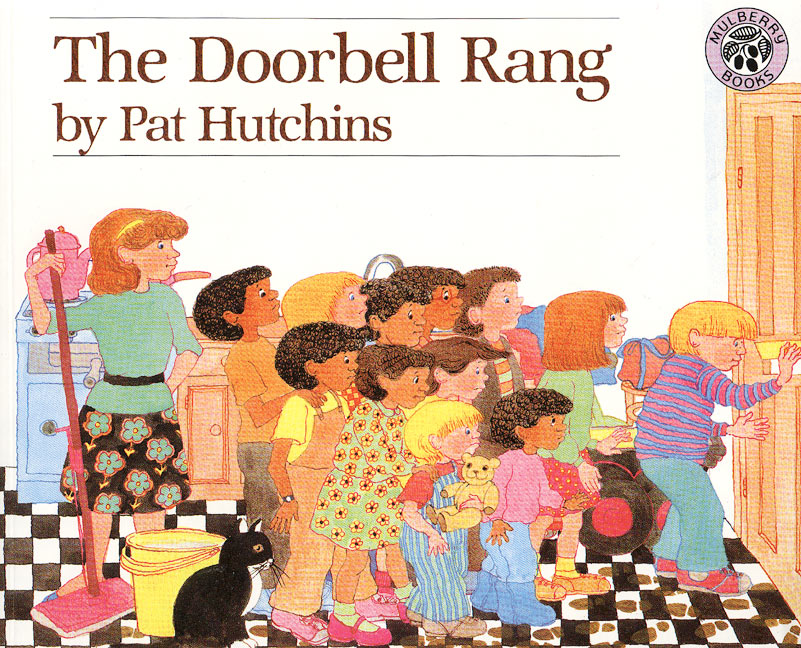
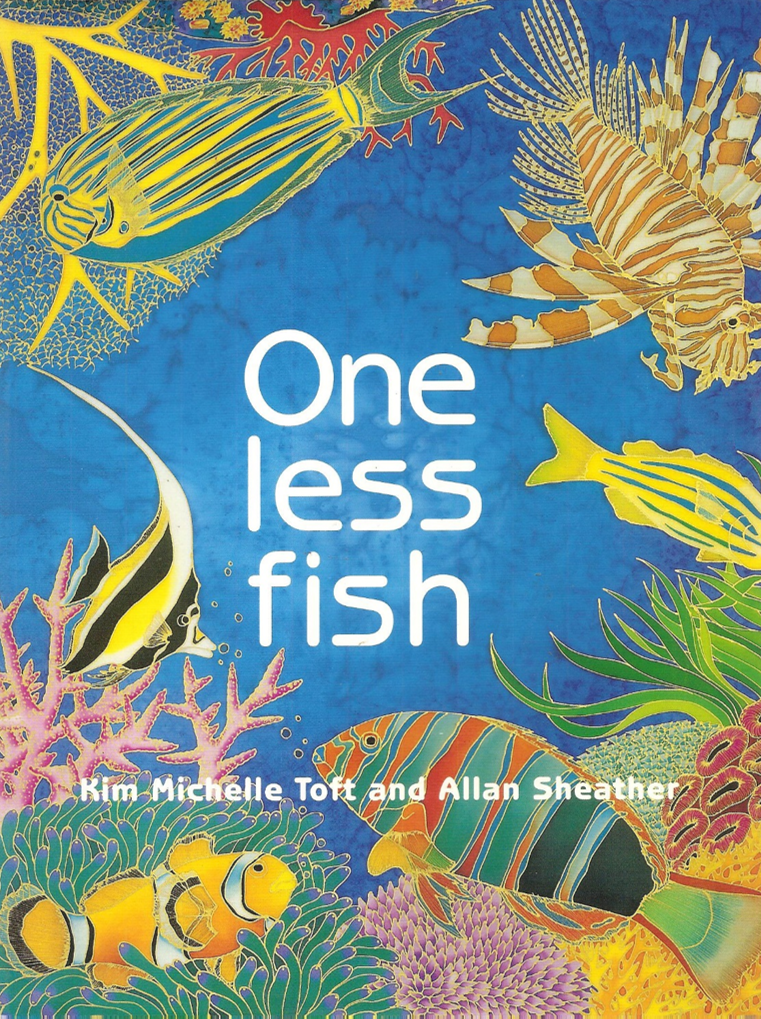
Read books with number concepts e.g. Pat Hutchins The Doorbell Rang, Eric Carle Rooster’s off to see the world or Kim Michelle Toft One Less Fish
Patterns and algebra
Use items to make patterns e.g. sort and create a pattern from shells collected at the beach, building blocks or toy cars
Look for patterns in the environment e.g. fences, tiles, walls and window, zebra crossings
Decorate cards and drawings with a patterned frame
Make gift wrapping paper by decorating with potato prints or stamp patterns
Measurement and geometry
Include your child in cooking activities and allow or support them to:
measure the ingredients
set the temperature on the oven
work out the cooking finish time
2. A child’s understanding of volume and capacity can be developed when they:
pour glasses of water from the jug and discuss terms such as enough, full, empty, half or part full, more, less
pour from one container into another of a different shape to compare which holds more and which holds less
3. Scales can be used to compare the mass of different items or quantities e.g. compare an apple and an orange, measure the mass of butter required for a recipe
4. Measuring length can be included by:
measuring and comparing height
cutting a length of string to tie a package
measuring who is closest to the jack in a backyard game of lawn bowls
5. Use the calendar to
Learn the names and sequence of days in the week or months in the year
count the passing days or the number of days until an event
6. Identify shapes in the home and environment e.g.
2D shapes: tiles on floor and walls, shapes of windows, sections of footpath
3D shapes: cereal boxes (rectangular prism), balls (sphere), bottles or cans (cylinder), dice (cube)
7. Play games that involve shapes e.g. jigsaw puzzles, tangrams
8. Talk about directions e.g. left, right, forwards, backwards and follow directions on a grid
9. Play games that involve directions and movement in space e.g. battleship, Hokey Pokey, Simon Says, snakes and ladders, ludo
10. Read and discuss books that include measurement concepts e.g. Pamela Allen: Who Sank the Boat? (volume); Eric Carle: The Very Hungry Caterpillar (days of the week) and The Bad Tempered Ladybird (time); Penny Matthews and Andrew McLean A Year on our Farm (months and seasons); and for looking at places on a map Mem Fox Sail Away The ballad of Skip and Nell or Annette Langen & Constanza Droop Letters from Felix
Probability and statistics
When discussing the weather or desired activities include the language of probability e.g. possible, certain, likely, unlikely, impossible
Encourage children to collect data about family or friends by asking yes/no questions e.g. do you like swimming, or making a graph of the family’s favourite colour or meal.
Play games with spinners and dice and talk about the likelihood of spinning or throwing a particular number
This list is really just a beginning. I’m sure you will add many more suggestions of your own.
For your convenience, the list is available to download FREE in my TEACHERSpayTEACHERS store.
As promised I will leave you with a few suggestions to spark your own interest in and love of maths. Be sure to check them out:
These are must listen TED talks by Arthur Benjamin:
Back in the early days of my teaching career, back before many of our younger teachers were born, let alone teaching, we used to have a visit from a school inspector every year or two. The role of the inspector was to monitor and evaluate the implementation of school programs as well as to provide advice and support to teachers.
However many teachers tended to think of them in less positive ways and these visits often engendered a sense of fear in some teachers as the inspector could appear at the classroom door at any time and ask to see current curriculum programs and mark books, test the spelling and computational ability of the class as a whole, and hear individual children read.
Because of this, when one of these visits was imminent there was often a flurry of activity getting curriculum documents and assessment up to date, and displaying children’s work in the classrooms and foyer.
But I wasn’t one of those teachers frantic in preparation and fear of being found out. I firmly believed that if what I was doing each day for the children in my class wasn’t good enough, then so be it. They were the ones that mattered after all and their education was my priority. I could not see what else I could do to prepare for these visits.
My programs were well researched, up to date and innovative. They were responsive to individual needs which were well documented with anecdotal records and diagnostic assessments as well as required testing, and supported by samples of student work. My classroom had an ever-changing display of children’s current work allowing visitors to see what we had been working on as well as giving the students a sense of pride in their achievements.
I guess also, for me back then, the school inspector was only one of the many visitors to my classroom as I was used to people coming to see what we were doing. Parents were always welcome and there were many who helped out on a regular basis and others who made the effort to come for special events and celebrations.
The principal was very involved and supportive and often popped in to see what we were up to and to provide additional support for children’s learning. In addition, teachers from other schools would visit in order to observe and take ideas back to their own classrooms; and pre-service teachers (student teachers they were called then) were often involved.
So, for me, the inspector’s visit was just another day, business as usual.
I am having difficulty in summoning words to describe how I felt when I saw the teacher next door (our classrooms were open, separated only by cupboards and shelves) busily testing children and writing marks in mark books, filling in “current” curriculum programs for the preceding term’s work and covering the previously bare classroom walls with displays of children’s work completed that day.
I guess you could say I was aghast at what I considered to be blatant dishonesty. I felt it was so wrong that I almost wanted to remove what I had on display for fear of the inspector thinking it was simply there for his benefit.
I didn’t.
Instead I turned to poetry, as I often do, to express my feelings; and I would like to share it with you, its first readers.
I had forgotten all about it until I came across it unexpectedly while looking for something else. It reminded me of the attempt at deception I saw enacted. I say “attempt” because, of course, the principal would have been aware of the situation and I have no doubt that these trained inspectors would be able to see through the veneer.
I think if I was writing the poem now, rather than 30 years ago, I would not be so generous with my analogy, nor so disrespectful to the butterfly.
This list itemises some of the differences between traditional and alternative schools. The list is meant to contrast the stereotypes rather than reflect the culture of any particular school.
It is unlikely that a school would have all the characteristics of one approach and none of the other. Most schools will have some characteristics of both approaches to a greater or lesser degree.
As you read the list, consider each characteristic with regard to the schools you attended, or those attended by your children.
Traditional schools are authoritarian organisations in which children are expected to conform. Alternative schools are run more democratically with children involved in planning and decision making.
Teachers in traditional schools direct activities from a pre-established curriculum; while activities in alternative school are more spontaneous and child-centred, with children involved in planning and choosing their educational experiences.
In traditional schools, students are passive recipients of information; while in alternative schools, students are actively involved in learning, both mentally and physically.
Information taught in a traditional school has an academic orientation and is often disconnected; while students in alternative schools learn about a wide range of topics by making connections with prior knowledge, and through interaction with the environment.
In traditional schools, information is transmitted by someone or something else; while in alternative schools, students discover their own answers, solutions, concepts and create their own interpretations.
Most communication in traditional schools is one way: the teacher talks and students listen. Communication between students and teachers, and among children in alternative schools is reciprocal.
Most questions asked by traditional teachers are closed and deal with facts; while students in alternative schools are involved in reflective thinking, problem solving, and learning how to learn.
Students in traditional schools do a lot of written work while emphasis is given to hands-on-activity in alternative schools.
Traditional teachers provide little corrective feedback or guidance to students; while teachers in alternative schools usually provide guidance, evaluation and direction to students.
In traditional schools, instruction is usually given to the class as a whole. A greater emphasis is placed upon individual instruction in alternative schools.
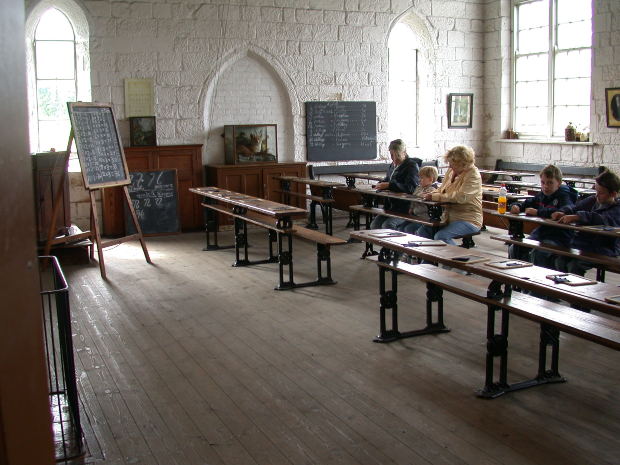
Desks are usually arranged to face the chalkboard or whiteboard in traditional schools; while space is used more flexibly in alternative schools.
The main focus in a traditional school is on imparting the existing values and roles of the society and culture. In an alternative school emphasis is placed upon the importance of the child in society and on educating the child for a responsible, thinking role.
In traditional schools students are generally grouped for work by ages, but in alternative schools children work at their own pace.
The traditional school day is divided into sessions according to subject matter, while the organisation in an alternative school is flexible and loosely structured.
In traditional schools students remain dependent; while students in alternative schools are encouraged to develop independence.
How closely do the characteristics describe the schools attended by yourself or your children?
What do you see as the main similarities and differences?
Where would they sit along the continuum?
The school that I attended as a child was firmly embedded in traditional practices without any characteristics of an alternative approach.
However some changes in pedagogical theories have occurred over the years, and the schools attended by my own children, and those in which I have recently taught, while still traditional, have moved a little along the continuum towards a less rigid and more flexible approach in some areas.
In an earlier post “To school or not to school” I shared some thoughts I considered when making choices for the education of my children.
I invite you to leave a comment and share your views.
Which of the characteristics are most important to you when choosing a school for your child?
Which characteristics would encourage you to choose against a particular school?
“John Dewey dreamed of the teacher as a guide helping children formulate questions and devise solutions. Dewey saw the pupil’s own experience, not information imparted by the teacher, as the critical path to understanding. Dewey also contended that democracy must be the main value in each school just as it is in any free society. The education system in Finland is . . . shaped by these ideas of Dewey and flavored with the Finnish principles of practicality, creativity, and common sense. What the world can learn from educational change in Finland is that accomplishing the dream of a good and equitable education system for all children is possible. But it takes the right mix of ingenuity, time, patience and determination.
The Finnish Way of educational change should be encouraging to those who have found the path of competition, choice, test-based accountability, and performance-based pay to be a dead end. . . . the Finnish way reveals that creative curricula, autonomous teachers, courageous leadership and high performance go together.” (Sahlberg, Pasi 2011 Finnish Lessons, What can the world learn from educational change in Finland?)
John Dewey (1859 – 1952) was an American philosopher and educator. Dissatisfied with traditional practices for what he saw as their inability to keep pace with changing needs of learners and society, opened his Laboratory School in Chicago, proposing a more child-centred approach focusing upon individual needs of the children who would be engaged in a variety of activities of interest and meaning to them. The term “progressive education” refers to the movement against formal traditional practices which, following Dewey’s lead, began in America in the late 19th Century.
Pasi Sahlberg’s book “Finnish Lessons” is “about Finland and how the Finns transformed their educational system from mediocre in the 1980s to one of the models of excellence today. International indicators show that Finland has one of the most educated citizenries in the world”.
In the introduction Ann Lieberman writes, “In the Finnish context, teaching is a high-status profession, akin to being a doctor. Those who enter not only stay in teaching, but many continue their studies, not to leave, but to learn more and contribute more to their profession. This heightened sense of professionalism makes teaching a sought-after position and one obtained only by those who are fortunate enough to be chosen for candidacy.”
The debate about the value of a traditional versus a child-centred approach to education has waged for centuries. It seems that Finland has incorporated many of Dewey’s progressive ideals into their educational philosophy and pedagogical practice. I can’t help but get excited when I read of what happens in schools in Finland.
Which other countries will follow Finland’s lead to transform their educational system into one of excellence? For me, it can’t happen soon enough!



























 Norah Colvin