Live Love Laugh Learn … Create the possibilities

Tag: science

  • Five things parents can do every day to help develop STEM skills from a young age – Readilearn

    Five things parents can do every day to help develop STEM skills from a young age – Readilearn

    The development of STEM (Science, Technology, Engineering and Mathematics) skills can be encouraged in children, even before they start school, by parents who are attuned to opportunities for learning.

    I’ve previously introduced you to Rebecca Johnson, Narinda Sandry, Brenda Miles and Susan Sweet with their books and suggestions for including STEM in early childhood classroom learning, and soon I will be interviewing Andrew King about his beautiful Engibear series of picture books that focus on the engineering component in STEM. These supplement my own posts about incorporating STEM in the classroom here and here.

    In this post, I share with you Five things parents can do every day to help develop stem skills from a young age by Kym Simoncini Assistant Professor in Early Childhood and Primary Education, University of Canberra. This article was first published in The Conversation. Throughout Kym’s article, you will notice links to other articles. Be sure to follow the links for even more great ideas and resources.

    Now over to Kym Simoncini, University of Canberra

    Five things parents can do every day to help develop STEM

    skills from a young age

    Educators and researchers agree early literacy experiences are important for children’s cognitive and language development. For the past 30 years there has been a strong movement to foster children’s literacy skills. This has resulted in an abundance of information on how parents can do this by reading books, singing songs and nursery rhymes, playing word games and noticing print.

    This is a good thing and should continue, given the importance of early literacy skills in learning to read, and how this leads to later success in school and life.

    Continue reading: Five things parents can do every day to help develop STEM skills from a young age – Readilearn

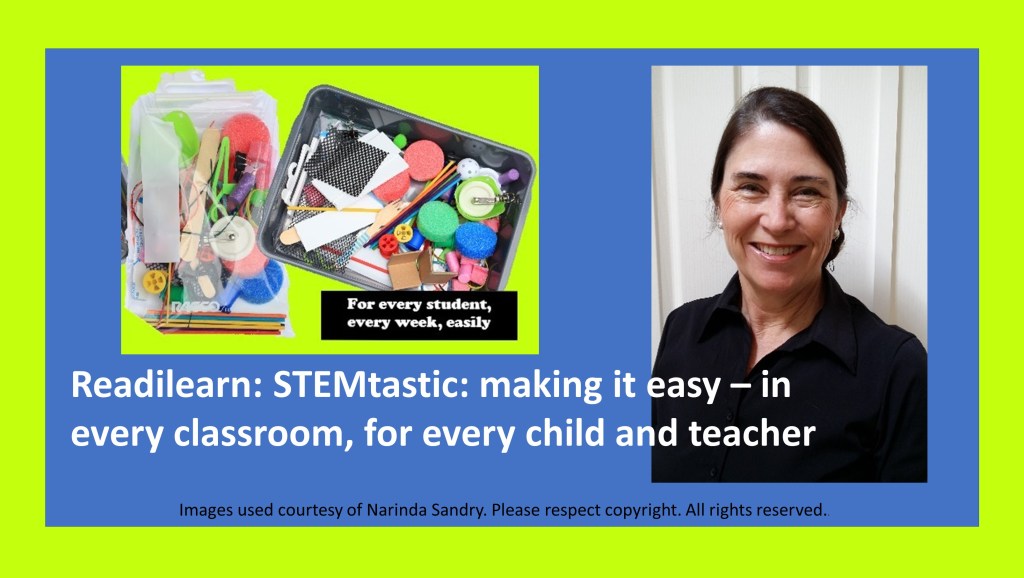
  • Readilearn: STEMtastic: making it easy – in every classroom, for every child and teacher

    STEMtastic Narinda Sandry

    STEM (Science Technology Engineering Mathematics) subjects are being rejuvenated in schools. Many of us remember them as uninteresting, unfathomable and seemingly unrelated to anything we needed to know in the real world of our daily lives. Fortunately for us, some “nerdy” types found them interesting enough to imagine, explore and create new possibilities that improve our lives in countless ways.

    I’ve previously written about the importance of making space for STEM in early childhood classrooms. In this post I talk with early childhood educator Narinda Sandry who is spreading the word and showing even STEM-averse educators how they can “deliver STEM experiences to every student, every week, in class and easily in an overcrowded curriculum.”

    Narinda is a teacher, curriculum writer and advisor. She spent many years teaching in early childhood classrooms, wrote educational materials for the Queensland Museum, and curriculum documents to support implementation of the Australian Curriculum. She now shares her combined love of learning, passion for early childhood education, and interest in STEM subjects, with teachers through her new STEMtastic project promoting “STEM education for every student, every week, easily.”

    Hello, Narinda, and welcome to readilearn.

    Absolute pleasure to talk with you and your readers Norah.

    Narinda, tell us a little about why you feel STEM education is so important in early childhood and all classrooms.

    The world we live in is changing, faster now than it ever has before. It is predicted that many of the jobs we know now will be either non-existent or at least disrupted in the near future. Think about the

    Continue reading at Readilearn: STEMtastic: making it easy – in every classroom, for every child and teacher

  • STEM in early childhood classrooms – readilearn

    Making space for STEM in early childhood classrooms is easy; or should be.

    Children are naturally curious about the world. They want to know:

    • Why is it so?
    • How does it work?
    • What will happen if?
    • How can I?

    It is important to harness their curiosity, explore their questions, engage their interests and inspire their imaginations.

    Provide them with opportunities to investigate objects and phenomena in the world around them. Don’t always be in a rush to provide answers to their questions. Help them explore ways of finding the answer for themselves, if possible, or conduct the research with them.

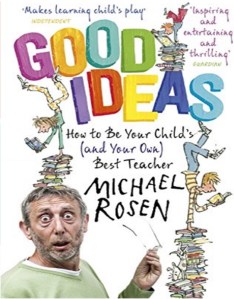
    A story reported by Michael Rosen in his book Good Ideas: How to Be Your Child’s (and Your Own) Best Teacher inspires me. The story explains that, as a child, David Attenborough took an interest in bones. If he was out walking and found some bones, he would take them home and ask his father about them.

    His father, who was a GP and would have known, didn’t just tell him. Wanting his son to be curious and interested in finding things out for himself, he responded, for example: “I wonder if we can work it out . . .” They would then look through books about zoology and anatomy and try to identify the bone’s origin.

    However, the answers don’t always have to be found in a book or on the internet. Some answers can be discovered through explorations and experimentation. Experts can also be consulted.

    In a stimulating early childhood classroom where children have access to a range of resources and opportunities

    Continue reading: STEM in early childhood classrooms – readilearn

  • I spy butterflies – Readilearn

    I spy butterflies

    Learning about butterflies in the classroom, especially when observations of the life stages with a live learning kit are possible, is almost magic for children. The growth of the caterpillars is obvious and children can watch as they moult and pass through each instar. The voracious appetite of the caterpillars means that plants are quickly stripped of their leaves and, if children listen carefully, the munching of the mandibles can be heard.

    Many resources to support an early childhood science biology unit about butterflies in particular, or minibeasts in general, already exist in the readilearn collection; including:

    Butterfly diary

    Minibeast project

    My minibeast ABC

    Code for Caring

    I included suggestions for teaching about minibeasts, including butterflies, in a previous post Classroom minibeasts. While there are many minibeasts suitable to study in the classroom, butterflies are my favourite. This week the readilearn collection has grown with some new resources to support learning about butterflies; including:

    butterfly word cards

    Butterfly word cards

    Butterfly word cards is a collection of forty butterfly-relevant words which may be printed and displayed on a word wall or used to label a butterfly display. The words are presented in three different formats for printing choice.

    The words include some fascinating scientific terms; such as:

    • instar
    • frass
    • chrysalis
    • prolegs

    Continue reading: I spy butterflies – Readilearn

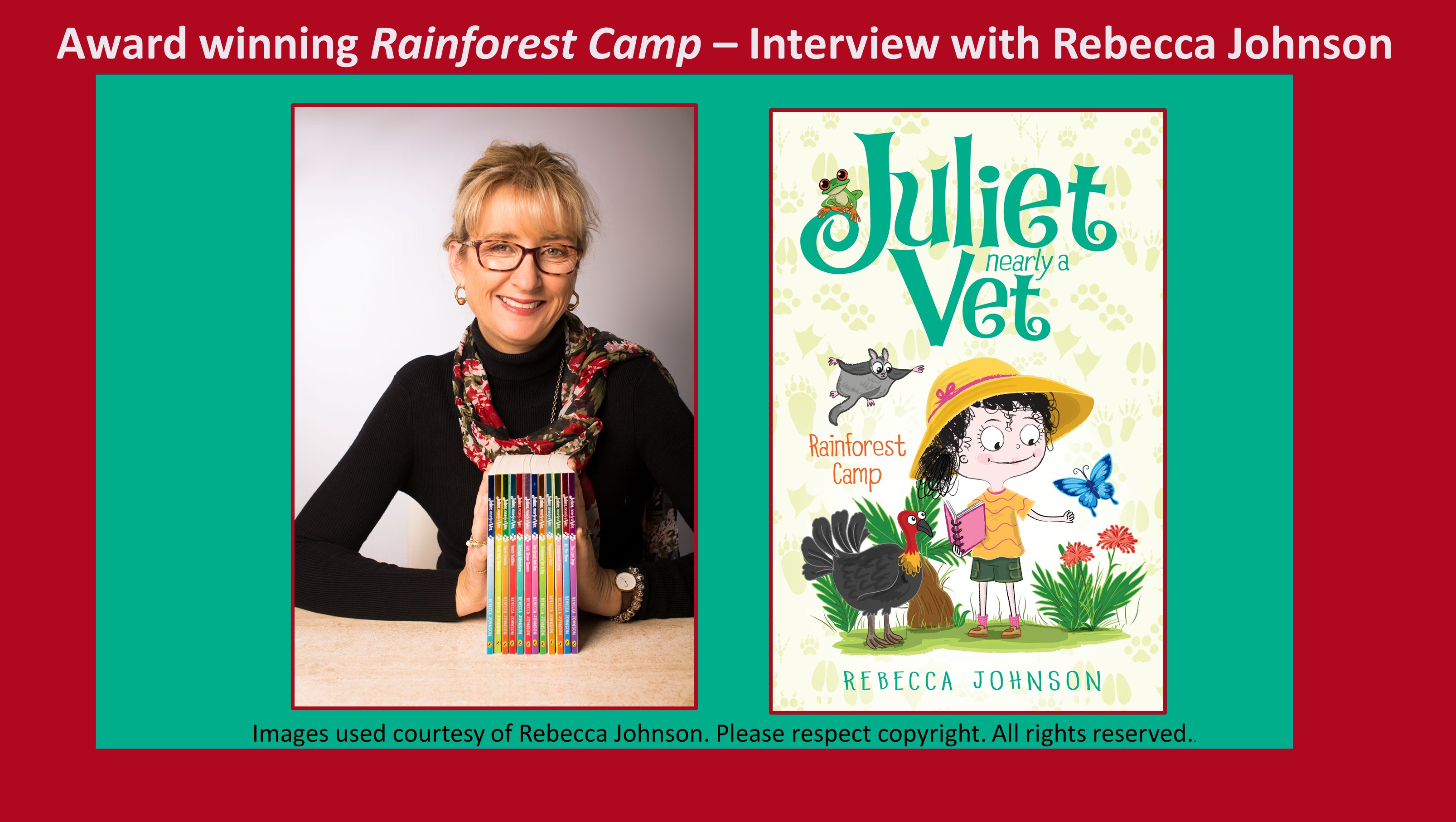
  • Award winning Rainforest Camp – interview with Rebecca Johnson – Readilearn

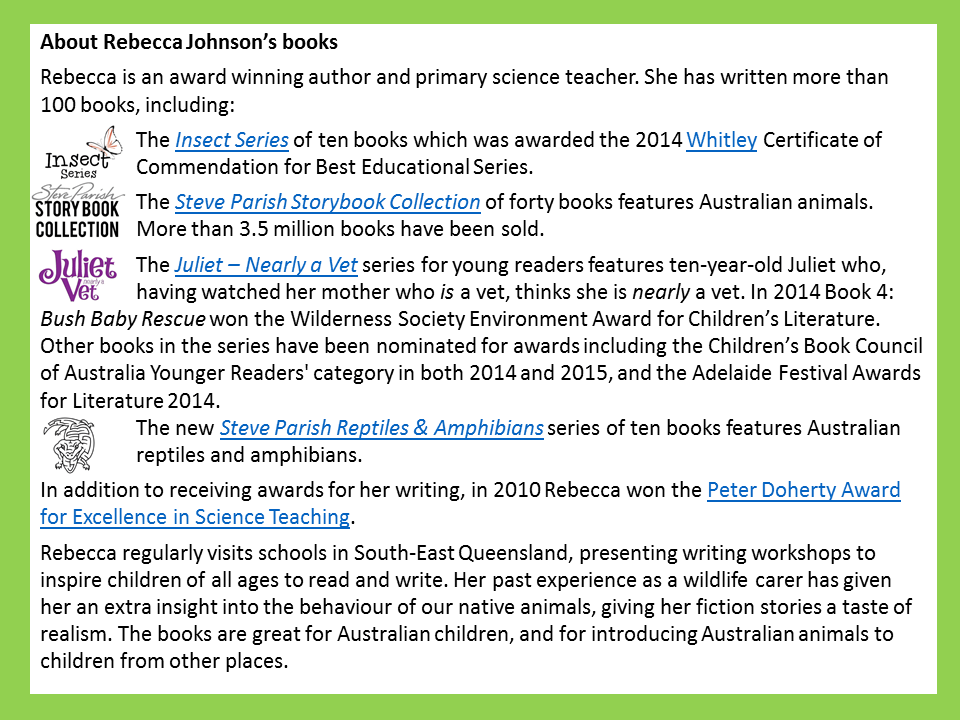
    Just over a year ago, in my very first author interview, when I introduced you to Rebecca Johnson and her award winning Insect Series, I shared the following information about her publications and awards:

    Since then, Rebecca’s list of publications has continued to grow, including two new series of books:

    Vet Cadets “an exciting new four book series for smart, animal and science-loving girls who aren’t afraid to get their hands dirty!”

    First Facts “designed to give children a clear understanding of the six main groups of animals.”

    Rebecca’s popular junior fiction series Juliet nearly a Vet, for readers from about 7 years of age, continues to attract attention. The series features ten-year-old Juliet who believes she is nearly a vet after watching her mother, who is a vet, at work.

    Rebecca’s purpose in telling these stories is to blend science with fiction in a way that engages children’s interest in wildlife and nature. She does it successfully. In 2014, the fourth in the series Bush Baby Rescue won the Wilderness Society Environment Award for Children’s Literature. This year, the most recent title Rainforest Camp received the same award.

    Continue reading at: Award winning Rainforest Camp – interview with Rebecca Johnson – Readilearn

  • Logical thinking and problem solving – Readilearn

    logical thinking and problem solving

    Logical thinking and problem solving are important skills for children of all ages to develop, including those in early childhood classrooms. We employ thinking skills each day, in many situations, from deciding the order in which to dress ourselves, complete simple tasks, collect items for dinner or set the table; through to more complex problems such as assembling furniture, writing work programs, juggling timetables, and organising class groupings for activities.

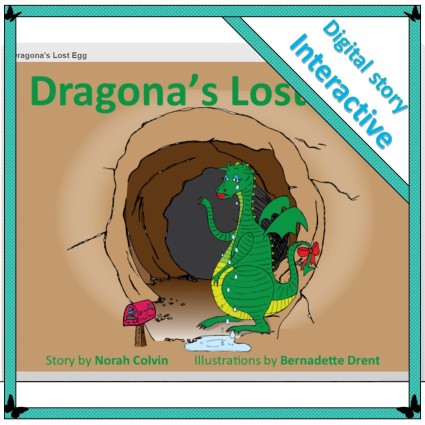
    This week I am excited to upload a new interactive digital story that encourages children to use logical thinking to solve a problem.

    Dragona's Lost Egg

    Dragona has lost her egg and turns to her friend Artie, owner of a Lost and Found store, for help. Artie is confident of helping her as he has many eggs on his shelves. He asks Dragona to describe features of her egg, including size, shape, pattern and colour. He uses a process of elimination to identify which egg might be Dragona’s. Children join in the process by choosing eggs with the characteristic described.

    What is Dragona’s egg really like, and will Artie be able to help her find it?

    You’ll have to read the story to find out.

    The process of writing this story also required a problem to be solved; and I love nothing better than a good problem to solve.

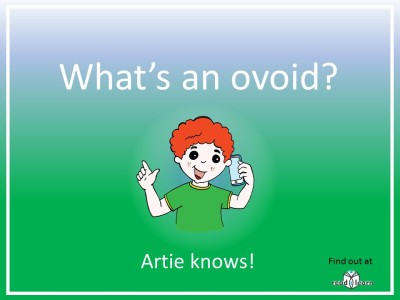
    What’s an ovoid? Do you know?

    what's an ovoid


    To find out, continue reading at: Logical thinking and problem solving – Readilearn

  • Introducing co-authors Brenda Miles and Susan Sweet – Readilearn

    Brenda Miles and Susan Sweet

    This month I have great pleasure in introducing you to two fine authors, Brenda S. Miles and Susan D. Sweet, who co-wrote the wonderful picture book Cinderstella: A Tale of Planets Not Princes.

    With both World Space Week and International Day of the Girl Child just a few weeks away, I couldn’t think of a better book and authors to spotlight this month. This year’s theme for World Space Week is “Exploring new worlds and space”, and the theme for International Day of the Girl Child is “Girls’ Progress = Goals’ Progress: What Counts for Girls.”

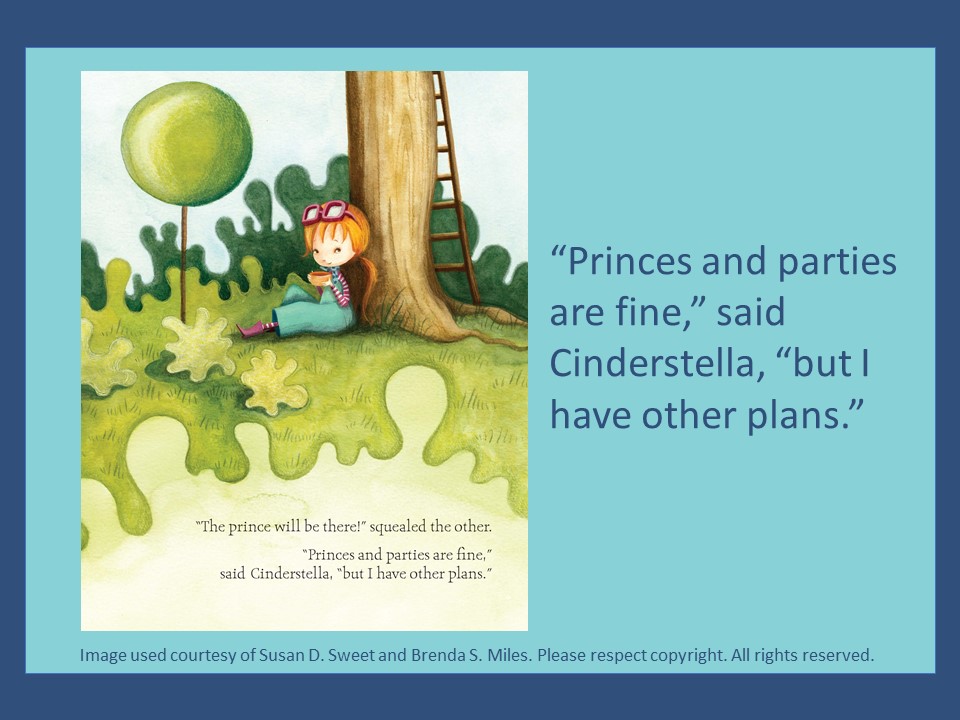
    princes and parties

    Cinderstella sees no prince in her happily ever after. She’d rather be an astronaut exploring space. Challenging the role of girls as portrayed in traditional fairy tales, Cinderstella determines to take control of her own destiny and be what she wants to be in a universe of unlimited possibilities. The story encourages girls, and boys, to take an interest in science, technology, engineering and mathematics (STEM) and break the limits imposed by gender stereotypes and biases.

    Continue reading: Introducing co-authors Brenda Miles and Susan Sweet – Readilearn

  • Crystalline wonders

    This week, Charli Mills at Carrot Ranch Communications challenged writers to: In 99 words (no more, no less) write a story using the word crystalline.
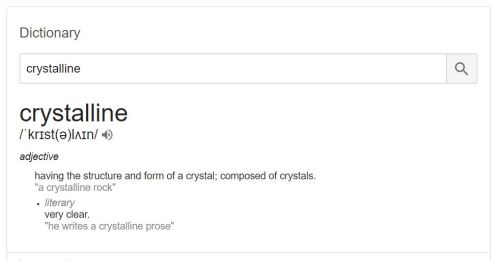
    In her post, Charli wrote about hunting for agates. She also mentioned many other types of rock, including quartz, chert, silica, gneiss, granite, mica… She used terms like metamorphic and fossilised, and I was transported back to my high school science classes. Sadly, I wasn’t inspired to be a rock-hound like Charli, and needed to check my understanding of these words and terms.

    My research uncovered both science facts and assorted beliefs about the seemingly magical properties of agate, some of which I’ll share with you.
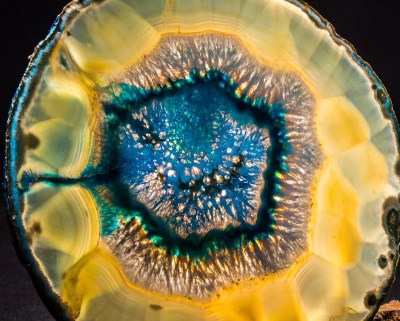
    #12 Science facts about agate (without getting too technical):

    • A type of quartz
    • Most commonly found in volcanic rock, sometimes metamorphic
    • Fine grains and bright colours, often in bands
    • Many are hollow geodes
    • Weather resistant
    • Often found in soil or on the shoreline of waterways
    • Many different types of agate
    • Found in many different countries
    • Many uses including art and jewellery
    • Polishing, often by tumbling, helps to expose their inner beauty of colours and patterns
    • Each agate is unique
    • Can vary in size and value

    Sources: Wikipedia, Minerals.net, International Gem Society
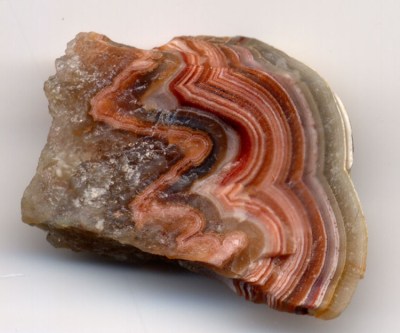
    Due to the bands of colour, agate is also known as Earth’s rainbow.

    A collection of beliefs about the metaphysical properties and healing powers of agate

    Can be used to create balance in emotional, physical and intellectual energy of an individual and of the universe.

    Worn as an amulet, it provides protection.

    Different colours and types of agate are considered to have different metaphysical properties, for example; some are thought to be calming, some uplifting, others bring abundance, some have healing powers, and others bestow strength. In fact, it seems agate can help with almost everything from marketing your writing and managing your overwhelming multitude of tasks to preventing traffic accidents.

    Agate is a zodiac stone for my birth sign Gemini. While I may not dare agree with it (pass me the agate. I’m sure it will help me), I rather like the description. It tells me that Gemini is the sign of the inventor and that,

    Those born under this sign can see both sides of an issue. They’re flexible and can go with the flow, and can be lively and talkative, or restless and nervous depending on their setting. Those born when the Sun is in Gemini are quick thinkers, quick-witted, and quick on their feet.

    Disappointingly for me, I was not born in summer. I’m a Southern Hemisphere winter Gemini baby. Does that make me the opposite?

    Sources: Crystal Vaults, Crystal Healing, Crystals and Jewellery

    It seems that with a small collection of differently coloured agates one could conquer almost everything, be self-aware and self-confident, courageous and strong, peaceful and healthy.  Perhaps a collection in every home, on every corner, and in every classroom, could be the answer to humanity’s problems.

    #12 Agates for a classroom collection?

    • Blue – creativity, problem solving, courage
    • Banded – creates a healthy environment, removes negativity, cuts ties to negative relationships, helps seek solutions and to try new things, offers protection, encourages creativity
    • Blue lace – healing and calming, nurturing and supportive, reduces anger, reduces fear of being judged, assists with verbal expression
    • Botswana – creativity, problem solving, quit smoking, energises the brain
    • Bull’s eye – focus
    • Colorin – helps accept changes associated with aging
    • Crackled fire – energy and protection, prevents burn-out
    • Crazy lace – focus, reduces negativity
    • Dendritic – abundance, peace
    • Green – enhances thinking, improves decision making, resolving disputes
    • Laguna – builds community, improves learning, especially in mathematics
    • Moss – self-esteem, friendship skills, try again

    What do you think? Is it worth a try? I know of at least one teacher who thought so. I was employed to replace her when other teachers and parents became concerned that the children weren’t learning anything useful. She may have found a sense of calm and balance, but the children were disrupted, distracted, and disengaged. Like many things, the power is in the actions we take, and not manifested by the object itself.

    Charli likens rock hunting to writing. She says,

    the more you show up to the beach and the page, the better your chances of finding a crystalline wonder.

    I think polishing the agates to reveal their inner beauty must be a little like writing, and teaching too.

    That’s one reason why I keep showing up. I don’t know that I’ll ever find a crystalline wonder, but I’m prepared to put in some effort to find out.

    This is my response to Charli’s challenge. It didn’t go quite where I intended and maybe not where you’d expect, but I hope you enjoy it anyway.

    Darling Crystalline

    Her mother wanted Chrystal; father, Clementine. Calm registrar decided: Baby Crystalline.

    Parental spats continued as Crystalline grew up. Never in agreement, it made her so messed-up.

    Crystalline retreated, spent days all on her own, searching by the water, for brightly coloured stones.

    She gathered a collection that healed her aching heart, ignited self-compassion and made a brand-new start.

    Believing stones worked magic, curing each and every woe, she took the heart stones with her, wherever she would go.

    She shared their healing powers, with any she could find, she told them “Pay it forward. She became their darling Crystalline.
    Thank you for reading. I appreciate your feedback. Please share your thoughts.

  • Classroom minibeasts – Readilearn

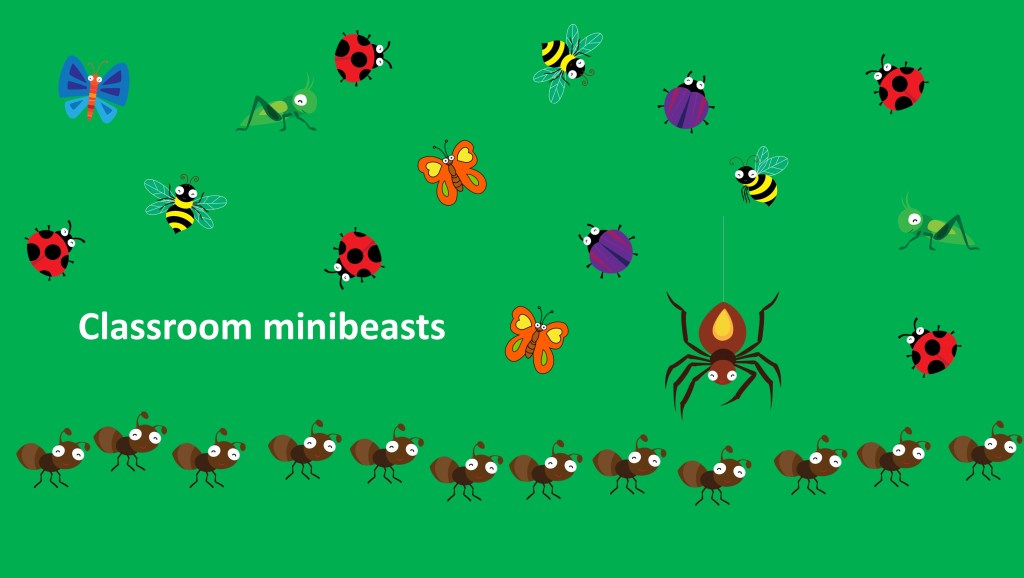
    Learning about minibeasts in the classroom is a great way of engaging children with science knowledge, appreciation of nature, the interrelationships between people and the environment, sustainability, and caring for our planet. It fits beautifully into the science curriculum in an early childhood classroom when children are learning about living things, their needs, their external features, and their life stages.

    With live minibeasts in the classroom, it is possible for children to observe all these aspects of a tiny creature. They can use their observations to consider how the life stages of minibeasts compare to those of others, including themselves.

    My personal favourite minibeasts for the classroom are butterflies, but there are many others equally suitable; such as:

    • Silkworms
    • Meal worms
    • Stick insects
    • Cockroaches
    • Spiders

    The timing and choice may depend upon your location.

    For Australians, Minibeast Wildlife is a great resource.

    This week I have uploaded some new resources to support a unit of work about minibeasts in an early childhood classroom. These are resources I used for many years in my own classroom. I hope you find them useful too.

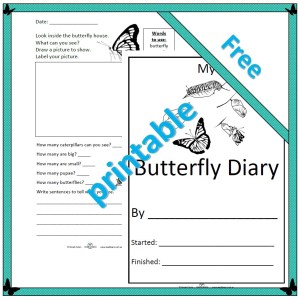
    Butterfly diary is a free printable resource for recording observations of butterflies in the classroom. Observing the stages in these brief lives helps develop an appreciation for all life. Recording observations integrates science learning with other subject areas

    Continue reading: Classroom minibeasts – Readilearn