Some of my most popular posts of 2014 were those that discussed praise, growth mindset, assessment and failure.
My final post for the year included thoughts about failure and the need to reflect and refine to move forward.
It is fitting to begin 2015 with a post that revisits and extends those themes. I’m sharing a post about The Power of Not Yet I read on @TeacherToolkit’s blog. The post includes a video of Carol Dweck explaining that
“if (students) didn’t pass a course, they got the grade “Not Yet.” And I thought that was fantastic, because if you get a failing grade, you think, I’m nothing, I’m nowhere. But if you get the grade “Not Yet” you understand that you’re on a learning curve. It gives you a path into the future.”
I would much rather consider that I have not yet achieved my writing goals, than think I failed to achieve them in 2014. Not yet means I am making progress, and will continue to do so in 2015 and beyond.
In the video Dweck shares research showing a difference that having a growth ‘not yet’ mindset can make to student effort and achievement.
For me, her most powerful statement is that at the end of the talk:
“Once we know that abilities are capable of such growth it becomes a basichuman right for children, all children, to live in places that create that growth, to live in places filled with yet.”
It’s a bit like learning to ride a bike. There is no failure, just stages of growth in ability.
I hope you enjoy the article, and especially, Carol Dweck’s video.
Thank you for reading. I value your feedback. Please share your thoughts about any aspect of this post.
The end of a year is often used as a time for reflection, reassessment, and redefining goals. This week at the Carrot RanchCharli Mills is talking just that: reflecting on the year that was, assessing her achievements and failures and redefining her goals for the next part of her journey. Charli admits that she didn’t achieve all she had hoped but acknowledges that those shortcomings were more opportunities for learning than failure as such. While she learned more about herself and her abilities she was able to recalculate her goals and redefine her vision.
In education, failure is recognised as integral to learning.
Willingness to
have a go
try something new
seek alternate solutions and ways of finding solutions
persist and not give up
recognise that success does not always come with a first attempt;
these are effective characteristics of learners, innovators and creative people.
Thomas Edison, after many unsuccessful attempts said,
“I have not failed. I’ve just found 10,000 ways that won’t work.”
There is no failure in a failed attempt; there is only failure in giving up.
Again, to quote from Edison,
“Many of life’s failures are people who did not realize how close they were to success when they gave up.”
C.S. Lewis is also quoted as saying,
“Failures, repeated failures, are finger posts on the road to achievement.”
He says,
“One fails forward toward success.”
What helps that ability to rise again is a sense of where we are going, of what we are aiming for and what we want to achieve. This is often referred to as a vision, and it is a vision that Charli Mills has challenged writers to include in a flash fiction piece this week: In 99 words (no more, no less) write a story that includes a vision.
Having a vision of the future and working towards that future is essential to effective teaching.
Through learning from a mentor teacher Jackie Catcher was able to refine her vision for effective teaching, which she shared on Three Teachers Talk :
“I learned that to lead students into our subject, we must make them feel valued within our community. We must work to acknowledge their strengths and show them that we are all equals when it comes to developing as readers and writers. We must praise their hard work and determination far more than their failures, and we must make ourselves available both in and outside of class to have meaningful conversations and connections. In the end, we are never too old to change our outlook and education. After all, one teacher can make the difference.”
I constantly share my own, and others’, views about and vision for education on this blog.
I have also referred to an alternative to traditional schooling that I “failed” to establish in the 1990s. The vision for that alternative was:
“A dynamic centre of learning opportunities
for children, families and communities
which focuses upon the development
of self-esteem and positive attitudes
in a nurturing environment
in which individuals are appreciated
for their uniqueness and diversity
while fostering the commonality of their human essence.”
Which brings me to my flash fiction piece for this week. In it I attempt to draw together many threads from views expressed over the year and finish with an optimism for the future.
The power of “No”
It was grey.
For as long as anyone could remember.
They moved about, comfortable in the familiar, avoiding the unknown.
Shadowy shapes beyond incited fear: a threat to all they knew?
Lives lacked definition, blending to sameness, conforming to rules.
“But why?” The tiny voice shattered the stillness.
All eyes turned. Bodies stiffened.
Whose was this unruly child?
“Shhh!” the hapless parents failed to hide their offensive produce.
“Why?”
Again! No one moved.
“Because!” was the parents’ definitive reply.
They breathed. “Because!” they confirmed in unison.
Defiantly the child pressed the dust-covered switch and flooded the world with light.
Thank you for reading. I appreciate your feedback. Please share your thoughts about any aspect of this post or flash fiction.
I wish you success as your vision takes shape in 2015.
Most of my current writing is non-fiction with a strong focus on education. The two blog posts I publish each week generally address educational issues or share my thoughts about learning.
In my ongoing work-for-self I develop educational materials and resources for parents, teachers and children. Some of these are available in my Teachers Pay Teachers store, and are listed on the Teaching and learning resources page of this blog. My goal is to set up my own website on which all the resources I produce will be available.
During my work-for-pay hours I am also involved in writing resources for teachers. Most of my published material, listed on the Writing – interest and publications page, is also educational.
That is not to say that I am not interested in writing fiction. Over the years I have enjoyed writing in a variety of other genres including stories for children, short stories and poetry; and still do. They are just not my main focus at the moment. That may change in the future. Or it may not.
One opportunity for writing fiction that I am very much enjoying at the moment is the weekly 99 word flash fiction challenge set by Charli Mills at the Carrot Ranch.
Initially my responses to Charli’s prompts were unsystematic. However it was not long before I was incorporating them into longer posts which maintained the educational focus of my blog. A recurrent theme is the importance for schooling to target the particular needs of individual children.
Soon a character emerged: Marnie — a young girl, from a dysfunctional family, for whom school would be a threatening and meaningless experience without the support of a passionate and caring teacher. Sometimes, as with this week’s, the prompt inspires immediately and I write a story in which I hope that the message is strong enough for it to stand alone, without the support of a lengthier post explaining my thinking background.
She examined the new arrival, assessing the possible effects of integration into the existing collective. Would the group be enhanced or would this newcomer disrupt the established harmony?
From every angle the edges were rough and uneven. The years of obvious neglect obscured the potential from any but a trained eye.
Fortunately her eyes were keen. A bit of encouragement here, a little adjustment there, an opportunity to sparkle and display unique and positive attributes.
She smiled. Experience had shown what could be achieved with a little polish and care.
“Welcome to our class, Marnie,” she said.
Thank you for reading. I value your feedback. Please share your thoughts about this post and flash fiction story.
Usually I include my responses to Charli’s prompts in longer posts sharing some thoughts about education.
This week I’m going to leave it as a stand-alone, without the padding I usually provide. I am hopeful that the educational issues I have alluded to will be as obvious to you as they are to me. I’d love to know what you think.
Thanks for reading. I appreciate your feedback. Please share your thoughts about this flash and what you consider its message to be.
Do you have a quiet place at home where you like to think?
Some people I know like to think in the toilet. (I’m not one of them. I prefer to not be in there long enough for that!) They see it as a quiet place where they can sit and think, undisturbed, for as long as they like. If they are “in the can”, “in the dunny”, “at the loo” or “out the back”, or whatever other euphemism you can come up with, their position is unassailable and their sanctuary respected. Mostly, anyway. Parents of young children may vehemently disagree with that!
A couple of weeks* ago Anne Goodwin reminded us of World Toilet Day and how lucky we are to have access to toilets and sanitation. Most of us take what used to be the smallest room in (or out) of the house for granted, not giving its use a second thought as we flush away our waste.
But not everyone is so lucky. It seems that more of the world’s population have access to a mobile phone, and or to the internet, than to a toilet. Visit Anne’s blog for many links that explain why a day for toilets is important.
“The day was created to raise global awareness of the struggle faced by the 2.5 billion people living without access to sanitation. It is also used to explore some of the healthy, emotional and psychological consequences people endure as a result of not having a proper, clean toilet.”
An article written by Nicole Arceand published in the Tech Times cites the U.S. Centers for Disease Control and Prevention for the information that 2,200 children around the world die every day due to diarrhoea. Proper sanitation would prevent most of those deaths.
Arce writes that the Indian Prime Minister Narendra Modi has set 2019 as its target for “total sanitation”. However, as also suggested in Anne Goodwin’s flash fiction piece “Culture Shock”, the problem can be attributed to cultural as well as monetary issues.
Charli Mills at the Carrot Ranch followed Anne Goodwin down the toilet path and extended the discussion to include the effect that poor sanitation has on education, particularly of young girls. The link is not as tenuous as it may first appear as explained here and here.
Charli decided to use her flash fiction challenge to “spread awareness that toilets matter.” She invited readers to “Help spread the call for human dignity and basic sanitary health” by linking to UNICEF when responding to her prompt: In 99 words write a story that includes the toilet.
I have decided to do just that, as have many others. Check out Charli’s post at the Carrot Ranch to read all responses.
Toilet sanctuary
“Miss. Marnie’s locked herself in the toilet and won’t come out.”
“What now?” I thought, scanning the troubled face pleading for assistance as much as to be absolved of blame.
“Okay,” I reassured Jasmine. “Let’s go see what’s up.”
As we hurried to the toilet block Jasmine reiterated her innocence, she hadn’t done anything, she didn’t know what was wrong (it wasn’t her fault).
“I know,” I smiled. The toilet cubicles had frequently been Marnie’s sanctuary. But not for weeks. Jasmine’s kind-hearted friendship had seen to that.
“She’s got her unicorn again,” Jasmine whispered.
“Oh,” I said.
*I apologise that this post may appear out of sync with World Toilet Day which was now ten days ago. Unfortunately I have been without internet access for 12 days and unable to publish although I had the post written. Fortunately I still had access to a flushing toilet, and if I had to choose between that and the internet, I’d go for the toilet every time! Though World Toilet Day has passed for this year, the message remains important every day!
I appreciate your feedback. Please share your thoughts about any aspect of this post or flash fiction.
I think about education. A lot. You could say it consumes me. It has been my lifelong passion, and although I am not currently in the classroom I don’t stop thinking and reading about how we learn and how learning can best be encouraged. My discontent with how schooling often is and my optimism for what it could be has been a recurring theme on my blog and a driving force in my life. You would not have to open too many posts to find at least one expressing that view.
My poem “Education Is” sums up the differences I see between education and schooling. Some schools do education really well. Some professing to be educational institutions school, very badly. What I consider to be one of the major differences is that education encourages a love of learning that lasts a lifetime; while schooling attempts to force-feed content in such a way that learning is neither enjoyed nor viewed as anything other than what one is forced to do in school.
In traditional schools assessment often takes the form a test which requires students to regurgitate information that has been thrust upon them, whether they like it, or are interested in it, or not. This occurs across all subject areas. I have written about it before in relation to writing tasks in these three posts: Writing to order – done in a flash!Writing woes – flash fiction and Who tests the testers?
I contrasted my choice of responding to Charli Mills’ flash fiction prompts to the lack of choice students have in state- or nation-wide writing tasks. In Writing woes – flash fiction I suggested that it would be difficult for me, on a given day, with a restricted amount of time, under the watchful eyes of supervisors, to produce my best work in response to a prompt about which I may have little experience, knowledge or interest.
In my flash fiction responses I introduced a unicorn as a symbol of escape from the confines of the classroom or other oppressive situation, into the space where one is free to truly be oneself. It wasn’t a deliberate or premeditated choice, simply a response to Charli’s prompt. However I am happy to adopt it in my flash fiction as a symbol of playfulness and imagination unleashed; the basis for all great inquiry and innovation. Thank you, Charli, for the prompt!
I have returned to both these themes again in response to Charli’s most recent prompt to In 99 words (no more, no less) write a story inspired by your muse. I’m not certain who my muse is, but I am certain that it would be very difficult to call upon a muse to assist when writing in a test situation such as that expected of students in school.
My piece is titled ‘Failure’, but this is the question I have for you: Who really deserves the “F”? Whose failure is it really?
Failure
She spluttered out the splinters of pencil: no longer tasty, never helpful. The assessor’s steely eyes pounced. She wiped the last vestiges from her mouth; staring blankly, as blank as the paper in front of her.
Outside the sunlight danced like fairies on the leaves, beckoning. Below, in the shade, the unicorn pranced and called her name.
“Why do I have to do this stuff? Who cares anyway!”
She grasped the broken pencil and scored a large “F” on the page.
Then she closed her eyes and was away, riding to freedom and joy on the unicorn’s back.
What do you think?
I appreciate your feedback. Please share your thoughts about any aspect of this post or my flash fiction writing.
If you are interested in reading other of my flash fictions pieces, I have collected them all together on one page which you can access here or click on the Flash Fiction tab above.
I spent a good part of the 1990s working towards creating an alternative to traditional schooling for my own daughter and the children of similarly-minded parents. For an assortment of reasons, none of which had anything to do with education, we didn’t get the school operational. There is a big part of me that still longs for that alternative and I am always interested to hear of situations which espouse similar beliefs and attitudes to mine. When I do, my heart starts to race and I want to holler and jump for joy, shouting from the rooftops, “See it can be done! This is how it should be! This is what children need!” I want to be in there with them, a part of it all, learning from and with them, and perhaps even adding a little to their learning, should I be that impudent to suggest it possible.
Yesterday was one such occasion. I popped over to Tara Smith’s A Teaching Life blog and read her post “Preparing for a student teacher”. I always enjoy reading Tara’s blog and could identify with much of what she was feeling while preparing to welcome a student teacher into her classroom. But what got me most excited was a video of a talk given by Chris Lehmann at the 2013 MassCue (Massachusetts Computer Using Educators) conference.
Chris Lehmann is the founding principal of the inquiry-driven Science Leadership Academy (SLA) in Philadelphia. The achievements of both Chris and the SLA are rather impressive. You can read about them here, here and here. Chris is one excited, enthusiastic and inspiring educator.
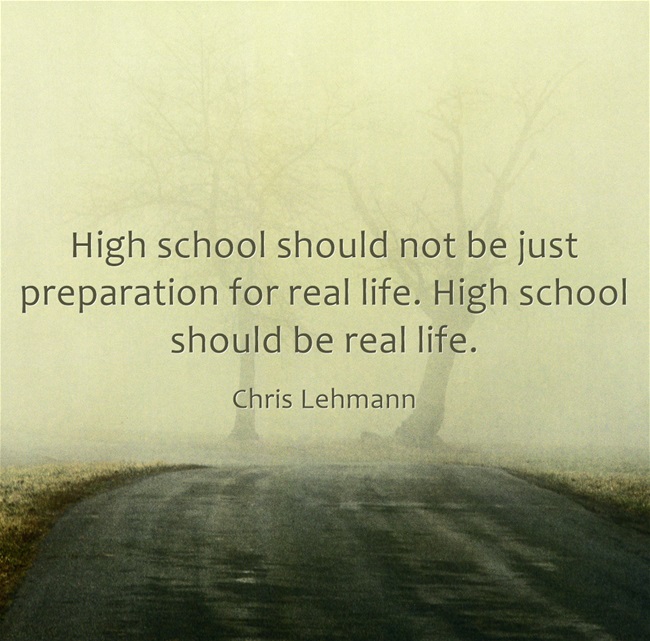
The video of Chris’s keynote address to the conference is rather long at almost 1 hour and 8 minutes (in comparison the mostly 15-minute TED talks that I often watch). I admit that when I saw how long it was I baulked, wondering if I had that amount of time to “spare”. Fortunately something in Tara’s words induced me to do so. After all I didn’t have to watch it all, did I? But watch it all I did. How could I not? His dream was my dream:
And then Chris added:
‘all these people showed up and breathed life into that dream’
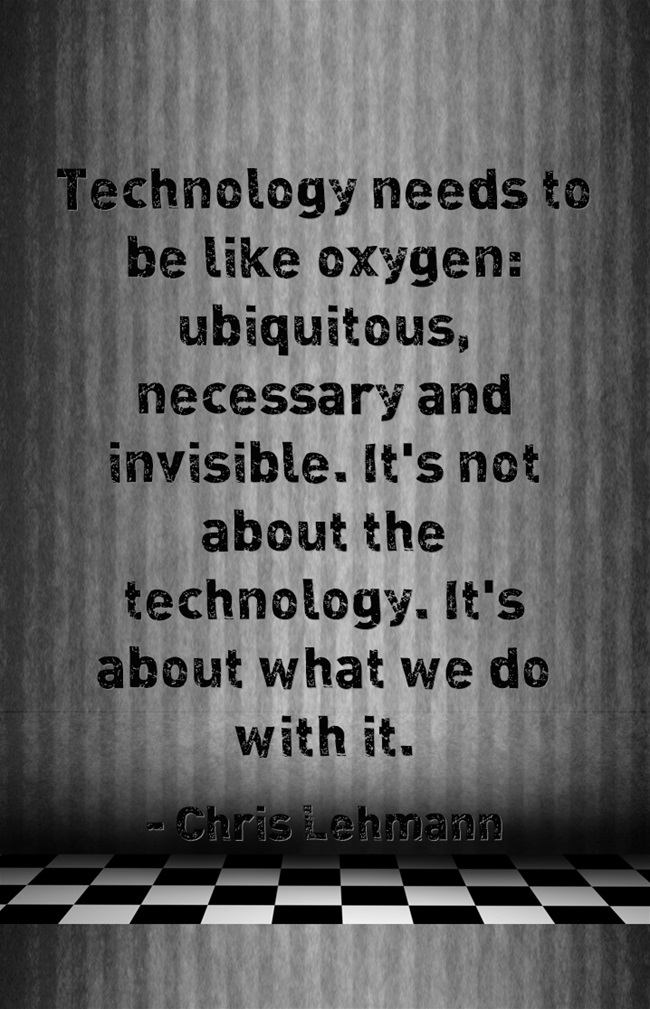
Here is his talk. If you don’t have time to listen to it all, I give you a few of my favourite quotes. (You may have already encountered some of these ideas before on my blog!) But who knows, he may have other thoughts that resonate with you.
Chris says that many people often ask why schools can have so many problems when there are so many passionate, dedicated teachers. He answer is simple: ‘We have a systemically screwed up system and if you put a good person in a bad system the system wins way too often.’ He says that ‘the factory model of education . . . no longer works for our children if it ever did.’
Chris says that one of the biggest problems with many schools is that students are being repeatedly told to do stuff that they may never need or even care about. He says, ‘If we were to write a students’ bill of rights the first statement on it should be this question:
He then goes on to say that ‘They shouldn’t even need to ask it because the reason should be so apparent through the work that they are doing that is meaningful and relevant to their life right now.’
He says that kids can do amazing things but that the sad thing is that unless it can answer a question on a state-wide test, no one will care! He says that using data from standardised tests is dangerous and that the best data comes from the work students are doing in class every day.
He says that better questions to ask of schools would be:
‘What is your college persistence rate?
How many of your graduates five years out are either in school or in a job where they are over the poverty level?
What does a student survey of your school tell you about whether or not the students feel valued and feel that their education is valuable?’
These are just some of the things that Chris Lehmannsays schools should be:
Inquiry driven
Student centred
Teacher mentored
Community based
Places of collaboration and incredible passion with
Integrated learning
Project based
In traditional classrooms the assessment tool is a test. Chris talks not about tests but about projects. He says,
“If you really want to see what a kid has learned it’s about the project, it’s about what they can do, what they can create, what they can transfer, what they can make, what they can do with their own head, heart and hands. A true project is when kids get to own it.’
His goal is to educate people to be ‘thoughtful, wise, passionate and kind’ and says that
‘ what were really trying to do is nothing less than trying to change the world.’
This brings me back to my two previous posts How much of a meliorist are you? and Can you make a difference? which drew quite a debate (unintended) about whether we believe we can, or should, try to change (i.e. improve) the ‘world’. I think Caroline Lodge who blogs at book word sums it up quite nicely for educators, saying
‘ I am a meliorist. How can someone in education stay there if they are not? The kids improve their skills and understanding, the world turns, and sometimes (like this summer) seems on the way to hell in the proverbial handcart. But there are SO MANY people working to improve the world. Educators as special people in this.’
For Chris,
‘The link between an inquiry-driven education and a care-driven education are three simple questions:
What do you think?
How do you feel?
What do you need?’
He says, ‘Everything you do should empower children.’ Thanks Chris. My words exactly!
He says,
‘Kids can do real work. We have to dare them to do that, we’ve got to help them, we’ve got to facilitate the work and we’ve got to get out of the way.’
The Science Leadership Academy is not the only ‘school’ of note. In response to previous posts, including Food for thought and Are you ready to embrace the futureCharli Mills of the Carrot Ranch left comments and links to information about a school attended by her children, the Minneapolis’s School of Environmental Studies(SES). Charli linked to this article about the school and another on Edutopia that includes a 10-minute video that she says aptly describes what makes SES a learner-based school. She also provided a link to a very impressive student project developed by two of her daughter’s classmates, and a link to a video produced by students explaining the school. Overall, if I represent her views correctly, Charli was very happy with the education her children received at SES and the impact that project-based learning had on their lives.
These are just two of the many wonderful schools out there empowering learners. If you know of others, I’d love to hear about them.
I value your feedback. Please share your thoughts about any aspect of this post. I’m happy to follow the discussion wherever you lead.
Recently I was sent a link to an article titled Cheer up, it’s not all doom and gloom published by the Australian Broadcasting Commission’s The Drum.
This article mentioned a book by Steven Pinker called Better Angels of Our Nature which had been recommended to me by Geoff Le Pard in a comment on my post about childhood illness. The premise of this book is that humanity, over the ages, has become less violent. After to listening to Pinker’s history of violence, I’m pleased that I live these relatively peaceful times.
The article also introduced me to a new term ‘meliorism’ which means having a belief that the world can be improved by the actions of humans. While the term may have been unfamiliar to me, the attitude is not and I attest that I am a meliorist.
I have a very strong belief in the power of education to improve the world. Education empowers individuals, and educated individuals empower societies to build improved futures. It becomes very difficult to sustain negative practices in the face of overwhelming evidence and information.
What better place is there for education to begin than in the home?
In a recent post I referred to a new book by Michael Rosen called Good Ideas: How to Be Your Child’s (And Your Own) Best Teacher. At the time I had not read the book but now I can say, with great delight, that I have listened to most of it. With messages such as those contained in Michael’s book, it is easy to be a meliorist.
I think Rosen’s book should be available to, perhaps compulsory reading for, every parent; I consider its message to be that important. In fact, I am off to the shops today to purchase copies to give to parents of young children I know. It will become part of my gift to new parents that also includes Reading Magic by Mem Fox and a selection of picture books. I have previously blogged about that here and here.
The “Good Ideas” contained in Rosen’s book, if implemented, will keep alive the natural curiosity of one’s children and oneself. They will encourage the development of thought, creativity and responsiveness.
In the next few weeks I will post a more detailed review of the book and some of Michael’s ideas for stimulating curiosity, whoever and wherever you are.
What about you? Are you a meliorist?
I welcome your feedback. Please share your thoughts about any aspect of this post.
Two recurring themes, amongst others on my blog, are ways of encouraging a love of literacy and of questioning in young children.
If you read my post Going on a treasure hunt! you will know that I greatly admire the work of Michael Rosen and its contribution to literacy development. You may have followed the links and checked out the riches in store on his website.
My post Child’s play – the science of asking questions introduces my thoughts about ensuring that children’s inborn curiosity is maintained through the encouragement of their questions.
You can imagine my delight, then, when I read a review of new book by Michael Rosen. (Thank you, Anne Goodwin, for alerting me to it.) The review, posted by Sabine Durrant in The Guardian on 6 September 2014, discusses Rosen’s new book How to be Your Child’s (and Your Own) Best Teacher. I confess that I have not read the book but I am very excited to see that it is now available as an audiobook, so it is next on my listening list. So much about the book appeals to me.
Rather than review the review I will simply leave with you the links to the review:
A recurring theme on this blog has been the inappropriateness of, and the difficulty faced by children sitting, large-scale external exams which require an immediate response to a stimulus that may have little relevance or interest to them. I have written about it here and here.
Making a judgment about student progress or achievement from one piece of writing, particularly one completed under conditions not necessarily conducive to encouraging one’s best work, is problematic.
It would be unrealistic of me to expect that everyone would agree with me, (though who wouldn’t want everyone to agree with them?) but it is always affirming to find that others share similar views. Maybe if enough people voice their concerns, change may occur.
Recently I read an article in our local newspaper that had me nodding in agreement. The article NAPLAN writers have trouble writing a writing testby Mary-Rose MacColl explained that a good part of the reason students didn’t do well on the NAPLAN writing task this year, is that the task itself wasn’t well written!
MacColl said that the task was wordy and the standards themselves (the criteria against which the writing is marked) poorly written. She pointed out how ludicrous it was for the ACARA CEO to write a letter explaining to parents that students should not view the test as ‘pass or fail’ when many children were experiencing extreme anxiety in the lead up to the test and parents were withdrawing their children from the tests in increasing numbers.
In addition to writing newspaper columns, MacColl is also a writer of fiction. She is pleased that the focus of NAPLAN is on persuasive rather than narrative writing, and goes on to describe some wonderful writing that is going on her son’s class.
Many teachers are doing wonderful things helping students develop a love of writing. Unfortunately, those setting external assessment tasks aren’t listening to the professionals.
I have given only a brief indication of what Mary-Rose MacColl had to say. Please read her article to fully understand her views.
Thank you for reading. I value your feedback. Please share your thoughts about any aspect of this post.



















 Norah Colvin