

Welcome to the School Days, Reminiscences series in which my champion bloggers and authors share reminiscences of their school days. It’s my small way of thanking them for their support and of letting you know about their services and publications.
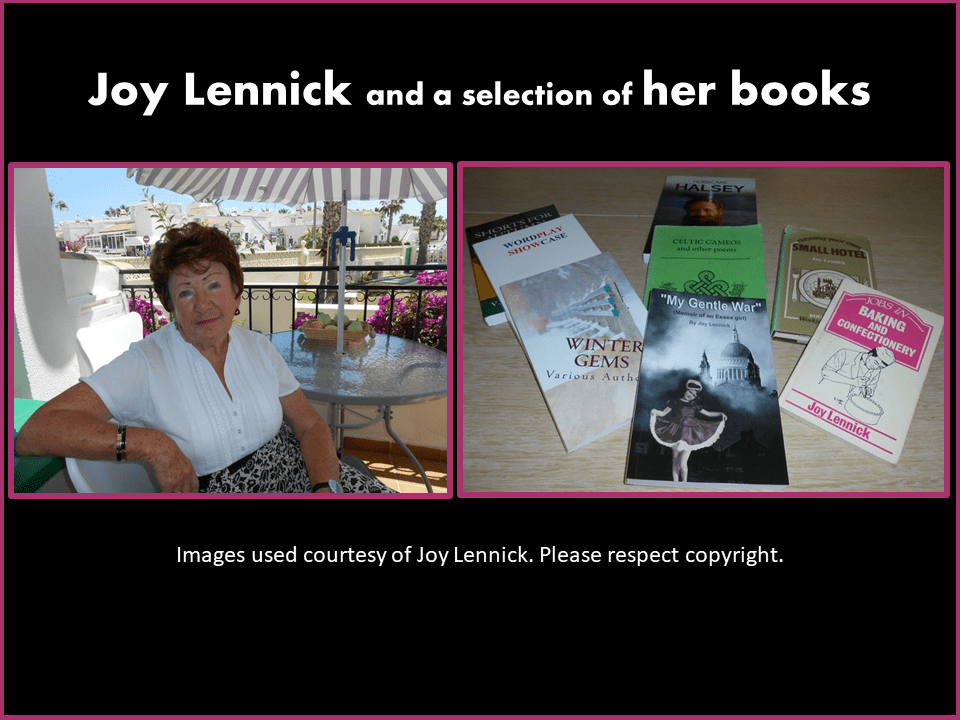
This week, I am pleased to introduce Joy Lennick, author and poet. Joy joined in the conversations from the outset, sharing snippets from her war-time schooldays. Intrigued to learn more, I invited Joy to join in with a post dedicated to her own reminiscences and she accepted. I’m certain you’ll find them as interesting as I do.
Before we begin the interview, I’ve invited Joy to tell you a little of herself:
From a young age, I was never happier than when reading or writing (and perhaps dancing!). I was evacuated with my two brothers to live on a mountain (Hare) in Wales, being half Welsh on my mother’s side, and grew to love Wales. My education was completed in Pitman’s College, London, from the last year of the war. At fifteen, I became a shorthand-typist, and worked for an agency in the East and West ends of London, which I really enjoyed.
After marriage just before the age of 21, and living in London for a few years, the Suez Crisis debacle flared up and petrol was so short and the atmosphere so “war-like,” we set sail for Canada, where we lived and worked for eighteen, unforgettable, months.
Returning to the UK due to home-sickness…in 1960 I had my first son, followed by No.2 in 1962 and No.3 in 1968. I contracted but beat cancer, so was very lucky. We then ran a green-grocery/grocery store for several years. After its sale, and the children went to school, I returned to work in the city as secretary to the two editors of Kaye & Ward, an old established publishing company in the city. (My dream job!)
The next chapter saw us buying a small hotel in Bournemouth as we both enjoyed cooking and people. We turned a dark, mean place into a thriving business, I lost a stone (yippee) and gained a few muscles, and we thoroughly enjoyed the whole business, even though it was hard work. Tastes were changing and the hotel was old. We needed more cash than we had to make it more comfortable, so – with regret, sold it and returned to Essex to live. And that is when I learned about “Serendipity,” and became a writer, quite by chance.
A letter from Kogan Page Ltd of London “commissioned” me (?!) to write a book for them, subject to approval of the first two chapters. I couldn’t wait! “Running Your Own Small Hotel” was approved. I had been recommended by one of the editors I’d worked for who had read some of my poetry and an article I’d had published. The book did well and went to reprint. There was even an exciting “Authors’ party,” and I updated two of their books and wrote a second called “Jobs in Baking and Confectionery,” which also sold well.
In between working for my local junior school, part-time, I then ran a modest, while successful poetry club, and wrote a few poems and articles, which were published. I also received a few rejection letters…par for the course!
Fast forward too many years, and we retired to Spain, I joined The Torrevieja Writing group and won the first Torrevieja International Short Story competition with a Time Traveller tale called “Worth its Salt,” then was a writing judge for two years.
Next came a memoir: “My Gentle War” which went to No.1 in Kindle’s Social History and Memoir category. A true sea adventure story: “Hurricane Halsey” followed, then my only novel “The Catalyst,” covering one of the terrorist bombings of a train in London in 2005, but with fictitious characters. I also wrote several stories which were included in WordPlay’s anthologies – later called Writers’ Ink (our off-shoot Ezine is called INK SPOT). Then came “Where Angels and Devils Tread,” a collection of short stories written with author friend Jean Wilson; and a modest collection of jokes and humorous poems written with my husband, Eric: “The Moon is Wearing a Tutu.” I also edited husband’s book “A Life Worth Living,” and updated “From the Prairies to Paschendeale,” for a friend. I am at present working on a book about the “Dombrowski family.”
I took a Creative Writing class for the U3A for several years and am in the “Chair” for Writers’ Ink here in Spain.
Welcome, Joy.
Let’s talk school. First, could you tell us where you attended school?
Where did you go to school?
1937: Dagenham Infants school
1939: Twynrodyn Junior School
1941: Hunters Hall school
1943: Eastbrook senior school, Long Eaton senior school, Derbyshire
1944: Neath senior school
1944: Pitman’s College, London.
Did you attend a government, private or independent school?
All Government schools, except Pitman’s College, London, which was private.
What is the highest level of education you achieved?
Highest level: Pitman’s where I received various certificates for hand-writing/typing/shorthand and commerce.
What work or profession did you choose after school and was there anything in school that influenced this choice?
I started as a shorthand-typist, became assistant secretary and then secretary. Also assisted husband in running a greengrocery/grocery shop and became a hotelier. I was then a Dinner Lady/School assistant and did voluntary work with the elderly before writing professionally.
What is your earliest memory of school?
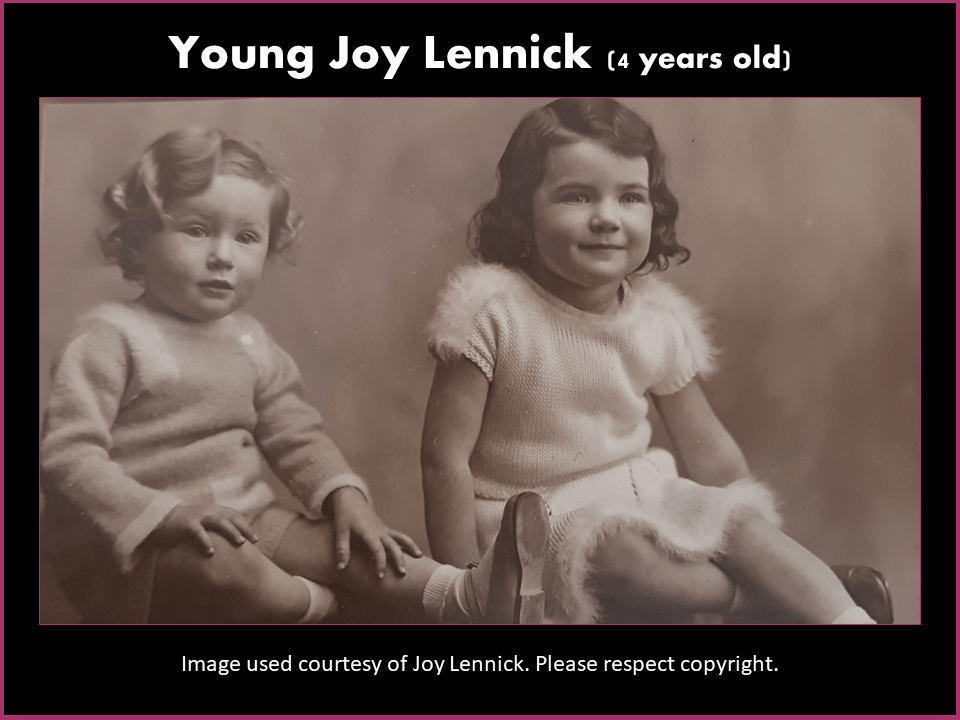
My earliest memory at Infants school was writing my name in sand on a shallow tray and playing the triangle and the tambourine in the school band.
What memories do you have of learning to read?
I was immediately fascinated by the letters and words on a page and took to reading straight away. I read anything and everything: ingredients on cereal boxes, comics, etc., and was always lucky enough to be given books for my birthdays. I joined the library in MerthyrTydfil and devoured books from age seven — Hans Christian Anderson and the frightening Bros. Grimm, et al.
What memories do you have of learning to write?
As for writing, my father was a keen letter-writer (positive views on many subjects to the local newspaper) and wrote beautiful Calligraphy which I greatly admired and wanted to emulate. He kept stamps and made a few admirable displays with delicate work around each stamp. I was proud to be told I had a “good hand!” and of my hand-writing certificate. Shorthand later made it a bit scruffier…
What do you remember about math classes?
I had a problem with maths. Adding, subtracting, decimals and fractions was coped with OK but if I was thrown a maths ‘puzzler’ I’d freeze…I coped fine when we had our shop, and did the accounts when we ran the hotel as it was comparatively straight-forward, but I much preferred English.
What was your favourite subject?
Most definitely English, and because of the very nature of war — between the years 1939,when it began and 1945 when it ended, there were, periodically, huge disruptions in my schooling, especially when the siren sounded. At such times, we were read to and had to ‘Read quietly!’ by ourselves, which I found a joy. I also loved composing stories and enjoyed spelling. I even wrote a silly play which was acted on the stage. Poetry also pleased my young ears. I was particularly fond of Hiawatha because of the delightful rhythm. I couldn’t take to Shakespeare when young but loved it later when, at the ripe age of 66 I finally took and passed the English Literature exam – much to the amusement of my younger peers…
What did you like best about school?
I made friends quite easily, despite being shy and was a chatter-box, in spite of the annoying habit of blushing if a boy spoke to me. In fact, I blushed a lot as I was often unsure of myself, but always enjoyed having friends at school. There was so much to learn, and I have always been a curious person. I was lucky in that I was never bullied and got on with most children, and was also fortunate with the teachers, except for my maths teacher at Pitman’s who had no patience with my many questions…Miss Jones, my English and Games teacher at Pitman’s was my favourite.
What did you like least about school?
To be fair, the mores of the times were dictated by the state of the whole world, as very little was as ‘normal’ as in peace time. Some children were killed or injured and lost loved ones and air raids disrupted many classes, especially in London, Coventry, Norwich and many other towns. We children went back-wards and forwards to home and Wales several times in between the bombing for long weekends and holidays. And when I attended Eastbrook senior school in Dagenham, the bombing increased and the whole school was evacuated to Long Eaton in Derbyshire. It must have been a nightmare for the teachers to keep to a curriculum!
How do you think schools have changed since your school days?
There is no comparison between my schooldays and those of my three sons. Only one was bullied because he was more studious and wouldn’t join an unruly gang. Fortunately, the headmaster sorted it out. All three received a fair and satisfactory education. I have no grand- children to comment on present conditions but do have friends who were teachers. They both complained about the increased paper-work, which – apparently – is an ongoing problem for teachers today.
What do you think schools (in general) do well?
From my ten years working as a Dinner Lady and reading/poetry assistant in a junior school, I’d say that, over-all, today’s children are in pretty safe hands, education-wise. The technological strides forward are amazing, and I’m personally pleased to see more musical appreciation and tuition being introduced in some schools
How do you think schools could be improved?
It’s no secret there are a lot of problems in the world, generally – of course there always have been – but because of technology and the immediacy of news reaching eyes and ears, it is often exaggerated in our minds. Too much paper-work still seems to overload some teachers, and I wish there was more emphasis put on caring for each other. Not all parents are equipped for the job they undertook…(as my husband says: ‘You have to pass a test to drive a car, but any idiot can have a child…’ Religion should be discussed broadly, but taught and practiced in specific schools, not mainstream, although children should be helped to accept and live and let live, when taught about caring.
Thank you for sharing your reminiscences of school and thoughts about education in general, Joy. How disruptive your schooling was as a result of the war. You seem to have overcome any obstacles that it may have created. It’s been a pleasure to have you here and get to know you and learn about your school days and your achievements.
Find out more about Joy Lennick
Website: https://joylennick.wordpress.com/
Contact her at joylennick@gmail.com
Or connect with her on social media
Twitter, Facebook, Linked In, Writers’ Ink
also a member of Authors/Bloggers Rainbow Support Club on Facebook
If you missed previous reminiscences, check them out here:
Look for future interviews in this series to be posted on Sunday evenings AEST.
Coming soon:
Darlene Foster
Pete Springer
with more to follow.
Thank you for reading. I appreciate your comments. Please share your thoughts.








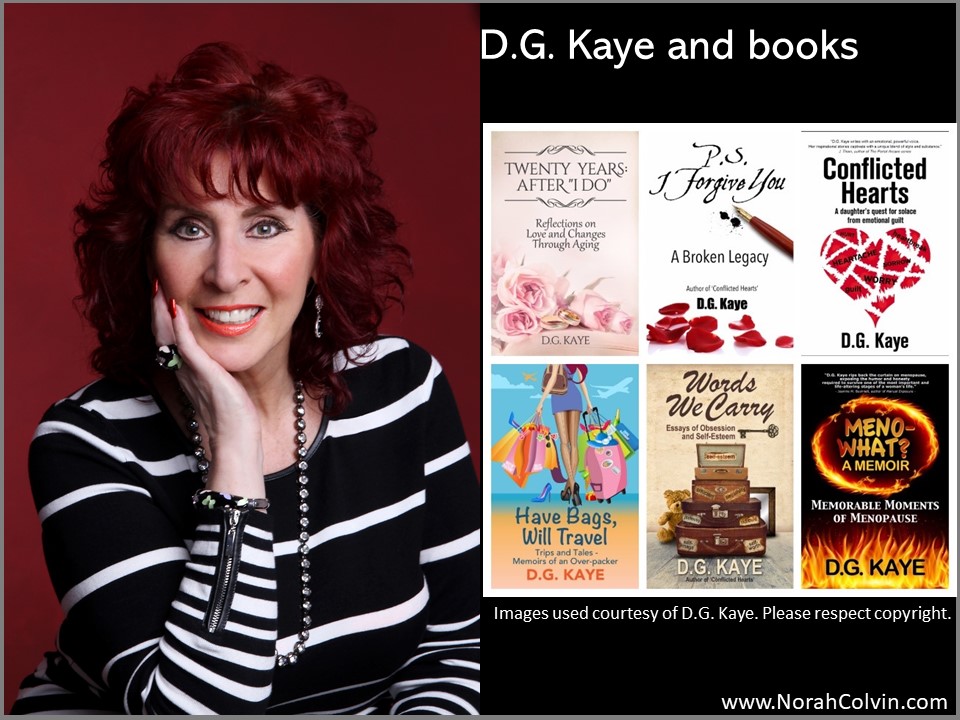
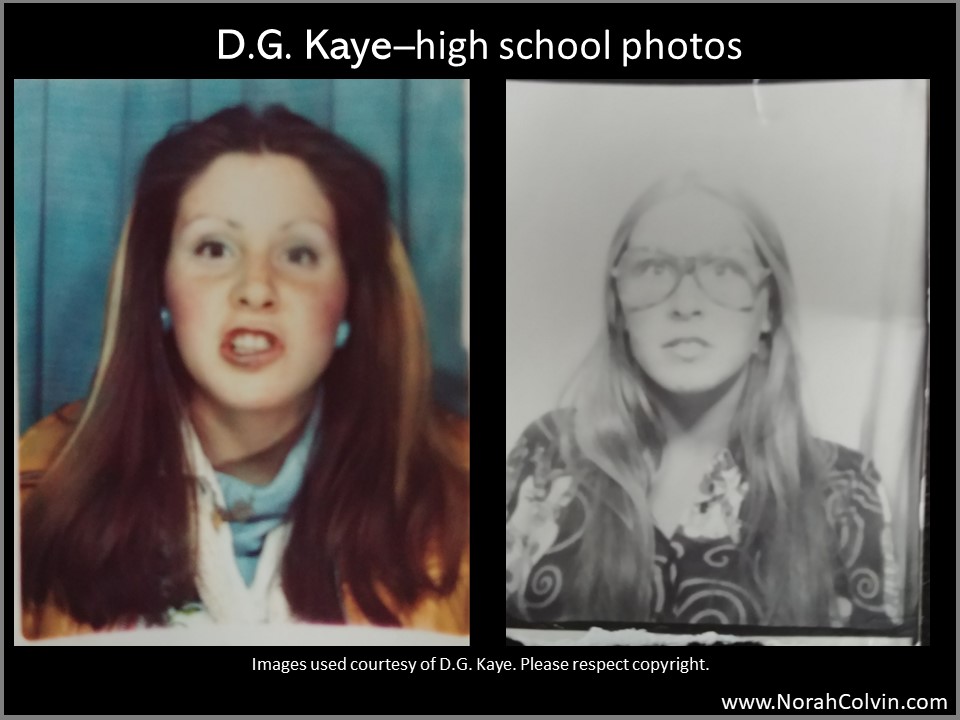



![School Days, Reminiscences of Charli Mills Welcome to the School Days, Reminiscences series in which my champion bloggers and authors share reminiscences of their school days. It’s my small way of thanking them for their support and of letting you know about their services and publications. This week, I am pleased to introduce Debby Gies (D.G. Kaye), author and blogger extraordinaire. I can’t remember when or how I met Debby, but I do know that very early on I read and thoroughly enjoyed her travel memoir Have Bags, Will Travel. While Debby has done far more travel than I, there was much in her book with which I could identify. I remember laughing out loud in places, surprised to find there was someone else who shared similar obsessive behaviour. Debby is a prolific writer, mainly of memoir. I have read others of her books and never been disappointed. Her style is open, from the heart, and conversational. You could be having a chat with a best friend over coffee, sharing love, life and laughter. In fact, those are things we both have in our blog taglines. How could we not be friends? Since our first encounter, Debby has been a constant supporter of both my blogs, always dropping by to share some words of wisdom or encouragement — a true champion. But perhaps I should allow Debby to tell you a little of herself: Debby Gies is a Canadian non-fiction/memoir author who writes under the pen name of D.G. Kaye. D.G. is born, raised, and resides in Toronto, Canada. Kaye writes about her life experiences, matters of the heart, and women’s issues hoping to empower others. Why I write: I love to tell stories that have lessons in them and hope to empower others by sharing my own experiences. I write raw and honest, hoping that others can relate and find that we always have a choice to move from a negative space to a positive. We need only the courage to take the leap. Describe yourself in three words: Optimistic, funny, worry-wart. (Is that four words?) Best advice: If you can’t say something nice, don’t say anything at all. Never do something to someone you wouldn’t want done unto yourself. Welcome Debby. Now let’s talk school. First of all, could you tell us where you attended school? I’m born and raised in Toronto, Canada. I originally began grade 1 going to a parochial school. Before the school year ended, I was stamping my feet demanding I wanted to go to ‘real school’, lol, meaning public school. I got my wish and grade 2 was Kenton Drive Public School where I was thrilled to have Miss Jacobs for my teacher as she was very compassionate toward me. In middle of grade 4, we moved (again) and changed schools to Rockford Road Public School till grade 7 where I spent my 3 years at Fisherville Junior High. In grade 10 I went to high school at William Lyon Mackenzie Collegiate – far out of my living district, but considered higher academically than the one near my home. It was a half mile walk to the bus and 3 busses there and back a day throughout high school. After high school I moved away from home and began working and taking night school classes for business and accounting where I received diplomas, which proved useful for many of the secretarial and admin jobs I had through the years. I also became a certified travel agent and then proceeded back to University of Toronto to study voice and theory in music. Did you attend a government, private or independent school? They were all government schools. What is the highest level of education you achieved? High school diploma and the school of hard knocks. What work or profession did you choose after school and was there anything in school that influenced this choice? While in school I couldn’t make up my mind what I wanted to do. My initial goals were to become a journalist or a lawyer. I had the grades to do so but not the inspiration nor the encouragement to follow through. I worked in the clothing industry for a few years in my early twenties, started as a salesgirl, working my way up to managerial positions and buyer. The fashion bug hit me early. I then became an executive secretary for a general manager of the Carlton Inn Hotel – best job ever! And then I moved on to run an office for a construction company for a friend and later did the same work for an architectural firm. After ‘those days’ I went to ‘dealer’ school where I became a licensed blackjack and poker dealer and worked in the casino business until I met my husband. I also spent the better part of my twenties trying to catch a break in the music industry as a singer. Fun times in bands doing gigs. I recorded a demo tape, but eventually I gave up the dream. What is you earliest memory of school? My earliest memory of school was a kind teacher I had in kindergarten – Mrs. Wagner. She knew my emotional struggles and paid me extra attention. I came from a severely, ongoing, broken home situation and a few of these teachers I pointed out were like angels with radar. What memories do you have of learning to read? Honestly, I don’t have any memories of learning to read other than I loved reading. Nobody ever read to me at home and we didn’t have any books. I must have had some great teachers! What memories do you have of learning to write? I couldn’t wait how to learn to write. I do remember I began writing as soon as I learned how to write as a tool to release my thoughts and feelings. I wrote poems and love notes on scraps of paper and made cards. Some I gave to intended recipients – some I never showed a soul. What do you remember about math classes? I enjoyed math until high school and always had good grades, but I lost interest when we began learning physics and calculus. I much preferred English and French classes. Languages have always fascinated me. What was your favourite subject? It’s a toss up between history and geography. I loved to learn about other countries and cultures, even as a child. But I’ll have to go with geography, which I think stimulated my interest to travel. What did you like best about school? My teachers. I had developed several rapports with teachers in many grades. When I look back on those days, I know it had to do with the compassion and extra attention they gave me that I didn’t receive at home. What did you like least about school? I hated gym class. I was not an active child, more of a thinker than a doer. I didn’t like the ugly uniforms we wore that weren’t the least flattering, especially for girls carrying extra weight, and I didn’t enjoy sports. I was the proverbial girl chosen last when picking teams. Here’s the girl who always kept a high 80s average throughout high school until the year I actually failed gym, which cut into my good grade average. Seriously, who fails gym? How do you think schools have changed since your school days? Oh my, that’s a loaded question. Even though I never had children, I’m quite aware how much the system has changed. There have been many cutbacks in after school programs, classrooms have too many students in them, and I hear complaints from parents that their kids are inundated with homework nowadays. Not to mention, the whole computer era that wasn’t our world then. The saddest thing I think that’s happening is the decision to no longer teach cursive writing. How on earth can they not teach that anymore? It’s sad the art of letter writing is on its way out with time. It also makes me wonder if children will even learn how to sign their name where print doesn’t cut it. What do you think schools (in general) do well? I’m not too familiar with what’s happening nowadays in classrooms, but I do know from having a 7-year-old great niece and having picked her up from school a few times, the system for safety seems to be excellent before picking up children from school. I must sign in, and my niece (her mother) must call the school to alert them someone else will be picking up her child. How do you think schools could be improved? They could definitely use more government funding, more teachers, more after school programs, and more benefits for the children whose families can’t afford supplies and books for their kids, and for field trips. [thank you] Thank you for sharing your reminiscences of school and thoughts about education in general, Debby. It’s pleasing to know that you enjoyed school and that you had compassionate teachers who helped you blossom. It’s been wonderful to have you here. I learned so much I didn’t already know about you. Find out more about Debby Gies (D.G. Kaye) and connect with her on social media or any of her author and blog pages www.dgkayewriter.com www.goodreads.com/dgkaye www.amazon.com/author/dgkaye7 www.twitter.com/@pokercubster (Of course there’s a story to this name!) www.facebook.com/dgkaye www.linkedin.com/in/DGKaye7 www.mewe.com/i/debbygies www.instagram.com/dgkaye www.pinterest.com/dgkaye7 Debby invites you to come join our Literary Diva’s Library Facebook group for writers and authors And our #ABRSC -Authors/bloggers rainbow support club. We are also on Mewe - https://mewe.com/join/theliterarydivashangout BOOKLINKS: [image] Conflicted Hearts [image] MenoWhat? A Memoir [image] Words We Carry [image] Have Bags, Will Travel [image] P.S. I Forgive You [image] Twenty Years: After “I Do” Visit me at my Amazon Author Page [books] If you missed previous reminiscences, check them out here: Charli Mills Sally Cronin Anne Goodwin Geoff Le Pard Hugh W. Roberts Look for future interviews in this series to be posted on Sunday evenings AEST. Coming soon: Pauline King Jules Paige D. Avery With more to follow. Note that, as next Sunday is Easter Sunday, I won’t be posting an interview. Pauline’s interview will be posted on 28 April. See you then. [thank you] Thank you for reading. I appreciate your comments. Please share your thoughts.](https://norahcolvin.com/wp-content/uploads/2019/04/books-by-d.g.-kaye.jpg?w=1024&h=1024)











 Norah Colvin