Live Love Laugh Learn … Create the possibilities

Tag: Questions

  • I can do this – one step at a time!

    Confidence, the willingness to have a go and to get up and try again after an unsuccessful attempt, is crucial to learning.

    Attached to real confidence, as opposed to false bravado, are certain types of knowledge:

    • of the desired outcome
    • of possible steps to achieving the outcome
    • of what is needed to achieve the outcome
    • of where and how to find the knowledge or support necessary to achieve the outcome

    and an openness to possibilities.

    Knowing what one doesn’t know is just as important as knowing what one does!

    www.openclipart.com
    http://www.openclipart.com

    Caroline Lodge expressed a similar view on her blog just this week, confessing that she didn’t know how to go about revising her novel, but that she did know what to do about not knowing: she enrolled in an online editing course. She attributed the view of intelligence as “knowing what to do when you don’t know what to do to the educationalist Guy Claxton.

    I wasn’t aware of Claxton but he sounded like my sort of educationalist so I decided to investigate further.

    https://openclipart.org http://goo.gl/ZvsCFc
    https://openclipart.org
    http://goo.gl/ZvsCFc


    A Google search brought up this result:

    Claxton - Google

    Hmm – seems like, according to Claxton, that definition of intelligence is first attributed to Jean Piaget. I’d better read his article: Learning to learn: a key goal in a 21st century curriculum.

    I didn’t have to read far into the article before I knew that Caroline had sent me in the direction of another great educator (thanks Caroline).

    In the introduction Claxton says,

    “The well-rehearsed economic argument says that knowledge is changing so fast that we cannot give young people what they will need to know, because we do not know what it will be. Instead we should be helping them to develop supple and nimble minds, so that they will be able to learn whatever they need to. If we can achieve that, we will have a world-class workforce comprising people who are innovative and resourceful. The personal argument reaches the same conclusion.”

    I have expressed similar views previously on this blog, including here, here and here.

    A little further into the article Claxton introduces a new (to me) term: illearnerate. He described students not thinking of themselves as effective real-life learners. He says,

    “They think that school has not only failed to give them what they need, it has actually compounded the problem.”

    The term is new, but the thinking is not!

    He goes on to say that,

    “More fundamental even than the concern with literacy and numeracy is the need to protect and develop young people’s learnacy.”

    What great terms, illearnerate and learnacy, I have added to my vocabulary today!

    The steps I am taking are definitely enhancing my learning. I think I am learnerate.

    However, I digress. I was looking for the attribution to Piaget and, a little further into the article, there it was:

    Claxton - Piaget

    I looked further online for confirmation of the quote and found this on goodreads:

    Good Reads - Piaget

    I think there is a subtle difference in the interpretation given by Claxton and would say that intelligence is not so much defined by, but incorporatesknowing what to do when you don’t know what to do”.

    A few weeks ago I used images in my post Bring a plate that prompted Geoff Le Pard to ask,

    “How do you do the images? Adding the captions?”

    I said that I used PowerPoint and would post some instructions if he thought it could be useful. He said that it would be, and Anne Goodwin agreed.

    For some time I had been wanting to create an instructional video using a capture of what I was doing onscreen. However it hadn’t reached the top of my to-do list. This seemed the perfect opportunity to put it there and do the learning required.

    In response to Geoff’s request I made this video demonstrating how to insert pictures and text in PowerPoint, then group and save them as one image.

    For my first attempt I was fairly pleased with the result, though I fear the video may be a bit long at 10 minutes. Maybe I should have started with a simpler image – one picture and one text box may have been enough for the demonstration to be effective. I’d be pleased to know what you think.

    After I had finished the video it occurred to me that I may not have addressed Geoff’s question at all, that the combination of image and caption that Geoff was referring to may have been the image of the whole PowerPoint slide, like this one:

    Rice salad 2

    If so, then my first video would be of no use to Geoff.

    There is a saying attributed to George Bernard Shaw:

    “Those who can do, and those who can’t teach.”

    I both agree and disagree with the statement for different reasons. Teaching is an incredibly important profession and not everyone can do it. Looking beyond the profession to simply teaching someone a skill is also something that not everyone can do. Sometimes I think that the one most capable of teaching a skill is the one who struggled to learn it; not the one who was able to do it effortlessly and almost by intuition.

    The ability to teach requires knowledge of each step or each component and how they work together. This knowledge helps the teacher understand where a learner is confused or what the learner needs to know.

    So just as teachers in classrooms provide resources and strategies to cater for a range of needs and abilities, I have produced a second video demonstrating how to make an image of a PowerPoint slide. This shorter (five minute) video explains how to create images using three different methods: Snagit, Snipping Tool, and printscreen function. I hope I have explained the steps for each clearly.

    Important update: Do not do this at home. Do not follow the procedures in this video.

    Since viewing this post and videos my daughter Bec has told me of a much easier way to create an image of a PowerPoint slide, or of every slide in a presentation. Maybe you know of it too.

    Here’s how to do it:

    1. Click on the slide you wish to make an image of, or any slide if you wish to make images of all slides in the presentation
    2. Go to file, save as
    3. Choose Save as type: PNG
    4. Click Save – you will be asked which slides you wish to export: all or just this one
    5. Selecting all saves every slide as a separate image to a new folder with the file name you choose; selecting just this one saves only the slide selected.

    How easy is that? Thanks Bec. 🙂 And I don’t mind that I found out after making the video. I wanted to learn how to do that anyway, and now I have learned something else as well. Great steps in learning. I’m learnerate!

    The discussion of steps to learning tied in very nicely with the flash fiction prompt set by Charli Mills at the Carrot Ranch this week. Charli challenged writers to In 99 words (no more, no less) write a story about steps, stairs or a staircase.

    This is my response:

    If only

    She collapsed, exhausted. Stairs led up and stairs led down; some steep, some wide, some narrow, most dark. Her head spun and vision blurred. Which way now? Which way had she come? Had she been going up and down these stairs forever?  Going around in circles?  They all now looked the same. She didn’t even know if she’d been in this place before.

    “I’m trapped,” she thought. “Stuck here forever.”

    She closed her eyes, surrendering to despair.

    Outside birds heralded the rising sun. She was lost, oblivious of its promise.

    If only she had recognised the door.


    Thank you


    Thank you for reading. I appreciate your feedback. Please share your thoughts about any aspect of this post, including the videos and flash fiction.

  • Reflect and refine

    The end of a year is often used as a time for reflection, reassessment, and redefining goals. This week at the Carrot Ranch Charli Mills is talking just that: reflecting on the year that was, assessing her achievements and failures and redefining her goals for the next part of her journey. Charli admits that she didn’t achieve all she had hoped but acknowledges that those shortcomings were more opportunities for learning than failure as such. While she learned more about herself and her abilities she was able to recalculate her goals and redefine her vision.

    In education, failure is recognised as integral to learning.

    Willingness to

    • have a go
    • try something new
    • seek alternate solutions and ways of finding solutions
    • persist and not give up
    • recognise that success does not always come with a first attempt;

    these are effective characteristics of learners, innovators and creative people.

    Thomas Edison, after many unsuccessful attempts said,

    “I have not failed. I’ve just found 10,000 ways that won’t work.”

    There is no failure in a failed attempt; there is only failure in giving up.

    Again, to quote from Edison,

    “Many of life’s failures are people who did not realize how close they were to success when they gave up.”

    C.S. Lewis is also quoted as saying,

    “Failures, repeated failures, are finger posts on the road to achievement.”

    He says,

    “One fails forward toward success.”

    The-greatest-glory-in Ralph Waldo Emerson

    What helps that ability to rise again is a sense of where we are going, of what we are aiming for and what we want to achieve. This is often referred to as a vision, and it is a vision that Charli Mills has challenged writers to include in a flash fiction piece this week: In 99 words (no more, no less) write a story that includes a vision.

    Having a vision of the future and working towards that future is essential to effective teaching.

    As explained by Vicki Davis in her post Thank You Teacher for Your Presence on the Cool Cat Teacher blog, teachers are constantly preparing students for more independent and resourceful futures.

    Through learning from a mentor teacher Jackie Catcher was able to refine her vision for effective teaching, which she shared on Three Teachers Talk :

    “I learned that to lead students into our subject, we must make them feel valued within our community. We must work to acknowledge their strengths and show them that we are all equals when it comes to developing as readers and writers. We must praise their hard work and determination far more than their failures, and we must make ourselves available both in and outside of class to have meaningful conversations and connections. In the end, we are never too old to change our outlook and education. After all, one teacher can make the difference.”

    I constantly share my own, and others’, views about and vision for education on this blog.

    I-had-this-dream-Chris Lehmann

    Some of those posts are:

    Visioning a better school, a better way of educating

    Talking interviews

    Whose failure?

    Imagine that!

    Child’s play – the science of asking questions


    I have also referred to an alternative to traditional schooling that I “failed” to establish in the 1990s. The vision for that alternative was:

    “A dynamic centre of learning opportunities

    for children, families and communities

    which focuses upon the development

    of self-esteem and positive attitudes

    in a nurturing environment

    in which individuals are appreciated

    for their uniqueness and diversity

    while fostering the commonality of their human essence.”

    The-best-questions-are

    Which brings me to my flash fiction piece for this week. In it I attempt to draw together many threads from views expressed over the year and finish with an optimism for the future.


    The power of “No”

    It was grey.

    For as long as anyone could remember.

    They moved about, comfortable in the familiar, avoiding the unknown.

    Shadowy shapes beyond incited fear: a threat to all they knew?

    Lives lacked definition, blending to sameness, conforming to rules.

    “But why?” The tiny voice shattered the stillness.

    All eyes turned. Bodies stiffened.

    Whose was this unruly child?

    “Shhh!” the hapless parents failed to hide their offensive produce.

    “Why?”

    Again! No one moved.

    “Because!” was the parents’ definitive reply.

    They breathed. “Because!” they confirmed in unison.

    Defiantly the child pressed the dust-covered switch and flooded the world with light.


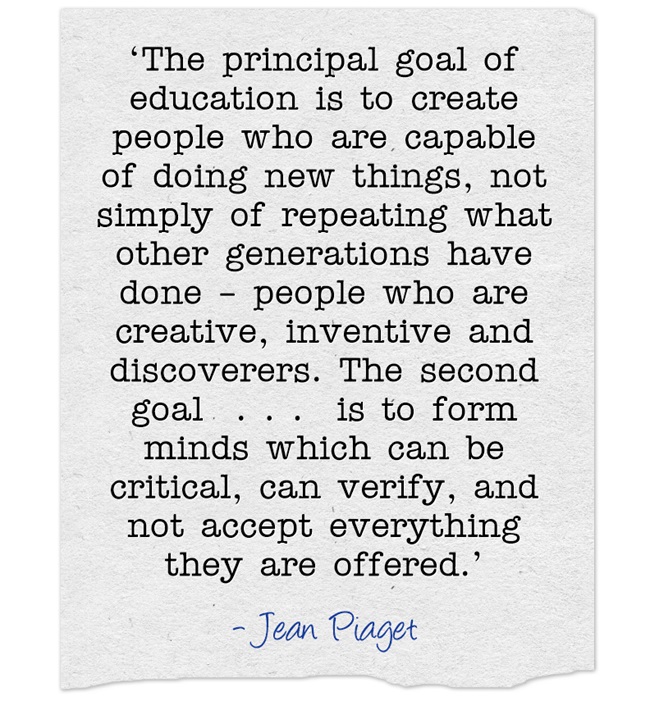
    The-principal-goal-of education - Piaget

    Thank you

    Thank you for reading. I appreciate your feedback. Please share your thoughts about any aspect of this post or flash fiction.

    I wish you success as your vision takes shape in 2015.

    HappyNewYear_by_Rones

  • Learning in the kitchen

    Learning in the kitchen

    The kitchen is a great place for learning.

    kitchen

    When children participate in the preparation and cleaning up of meals and other food items the learning is richer than just cooking and cleaning, they are learning skills which will be invaluable for their future independent lives such as:

    • cooperation, sharing, taking turns and patience (how long before they’ll be ready?)
    • the etiquette of dining.
    • hygienic food handling.
    • the language of food and cooking and the preciseness of vocabulary such as the difference between dice and chop, shred and slice, boil and steam, bake and roast.
    • counting and one to one matching when setting the table with one of each item for each person.
    • the mathematics of measuring mass (250 g), volume (1 cup or 250 ml) and time (bake for 15 minutes).
    • the mathematics of linear measurement; measuring the length, width and depth of baking tins and trays.
    • reading and following procedures, and understanding that unless the steps of a recipe are followed in order the outcome may not be what was expected.
    • writing of menus and shopping lists.
    • organisational and preparation skills: making sure all ingredients and utensils are available and assembled.
    • the science of mixing and combining, heating and cooling, and the different effects these may have upon different ingredients and utensils.
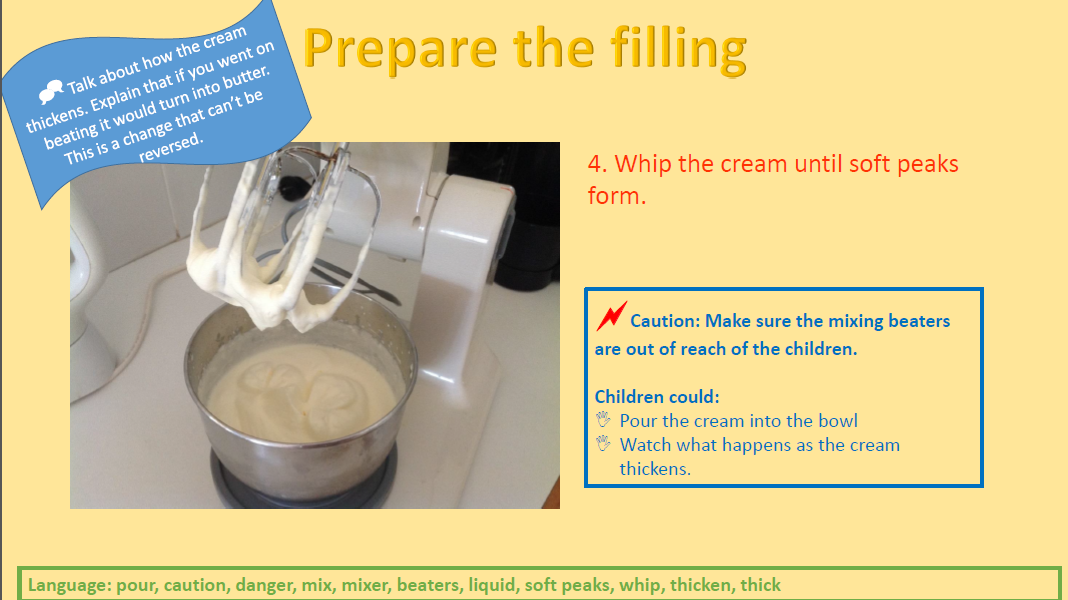
    • understanding that some of the changes that occur are reversible e.g. water to ice and back again; but that some are irreversible e.g. cream to butter, but not back again.

    While it is not suitable for children to use knives or handle hot utensils or heating appliances when young, and only under careful adult supervision when older, children can be included in many kitchen tasks from a young age.

    Watching, discussing and asking questions provide great opportunities for learning. Children can be introduced to tasks such as mixing, pouring, measuring, menu planning and cleaning up, amongst others, as they grow.

    One of the fantastic things about food preparation is the opportunity it provides for asking questions: it can be an ongoing edible science experiment, for example:

    Why do the cakes rise?

    What makes the water bubble?

    Why is a cloud coming out of the jug?

    Where does the water go when it boils?

    Why isn’t the egg white white before it’s cooked?

    What would happen if I didn’t put the egg in the cake mixture?

    Why is some sugar brown?

    What the difference between sugar, caster sugar and brown sugar?

    What happens to cream when it is beaten?

    At the moment I am grappling with a kitchen science dilemma, and if you can provide an answer to my question, I’d be very appreciative.

    My question is:

    What is a suitable vegetarian substitute for gelatine?

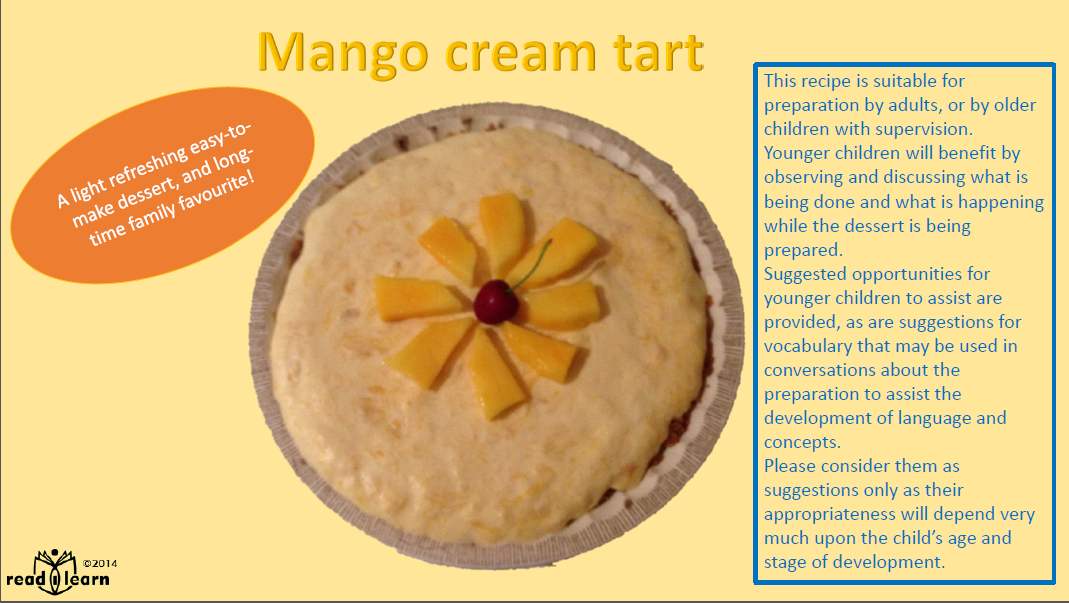
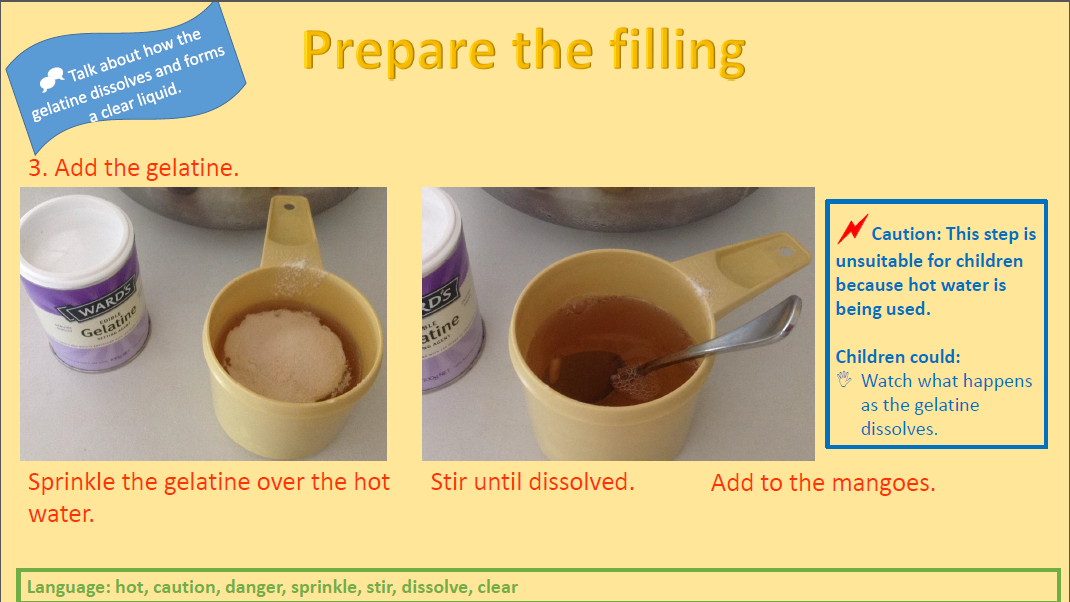
    One of my family’s favourite desserts is Mango Cream Tart. Gelatine is used as a setting agent in the dessert.

    Some of my family members are vegetarians who, upon discovering the answer to the seemingly innocuous question

    What is gelatine made from?

    realised that eating anything containing gelatine no longer suited their food choices.

    So rather than remove the dessert from family menus, or make something that was unacceptable to these family members, I decided the only thing to do was find a substitute for the offending ingredient.

    I have purchased two different vegetarian substitutes but both require being boiled in the liquid which they are to set and are therefore unsuited to the Mango Cream Tart and other cream cheese cheesecakes I may wish to make. An additional factor confirming their lack of suitability is the warning that they may not set some fruit juices.

    I did an online search and found 3 Vegetarian Substitutes for gelatine. If you have used with success any these products, or another product, that may be suitable to use in my Mango Cream Tart recipe I would love to know please.

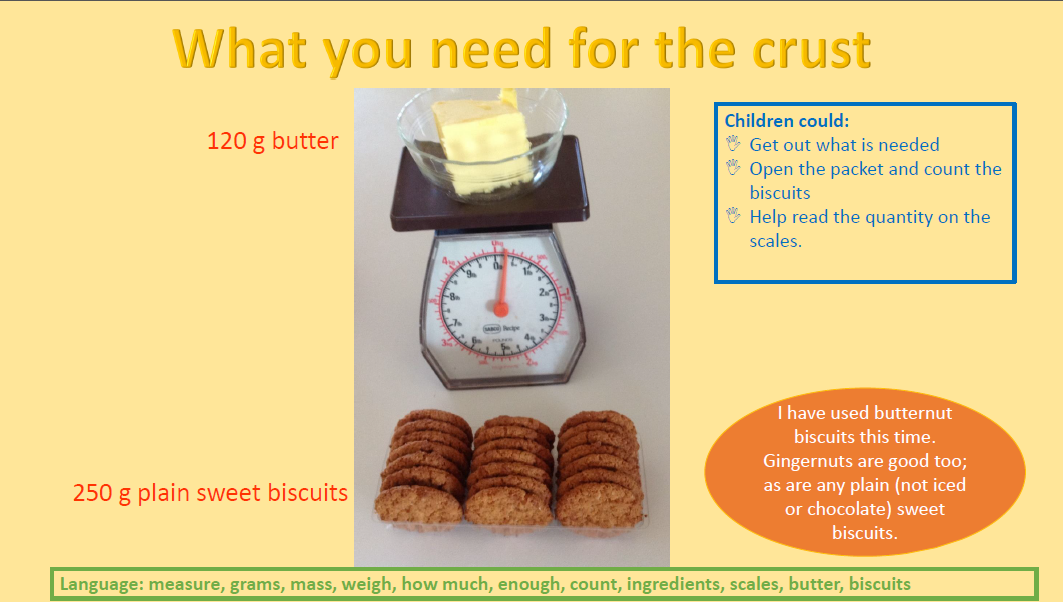
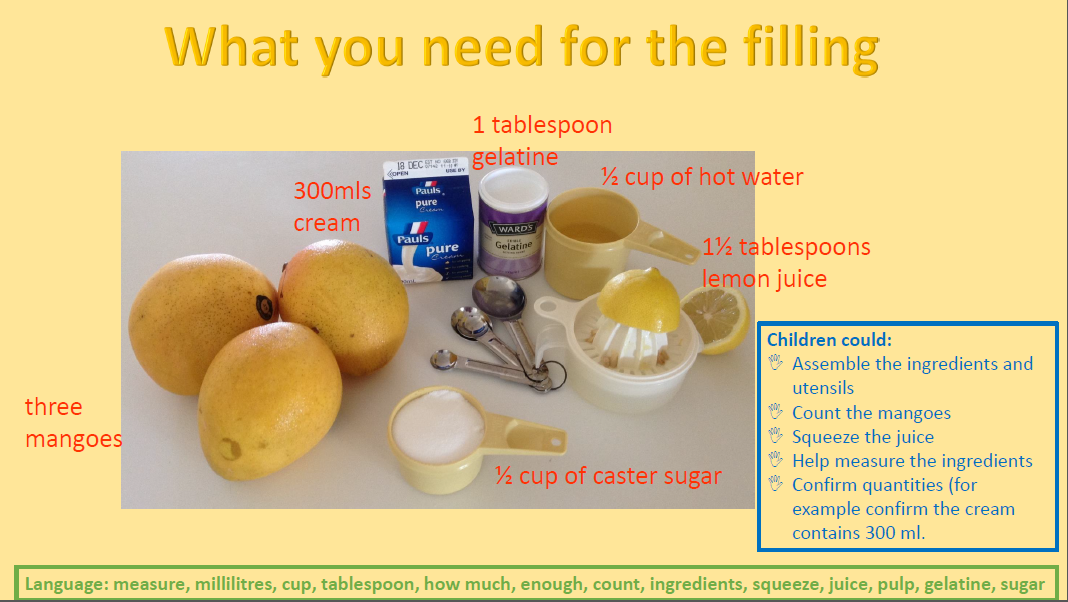
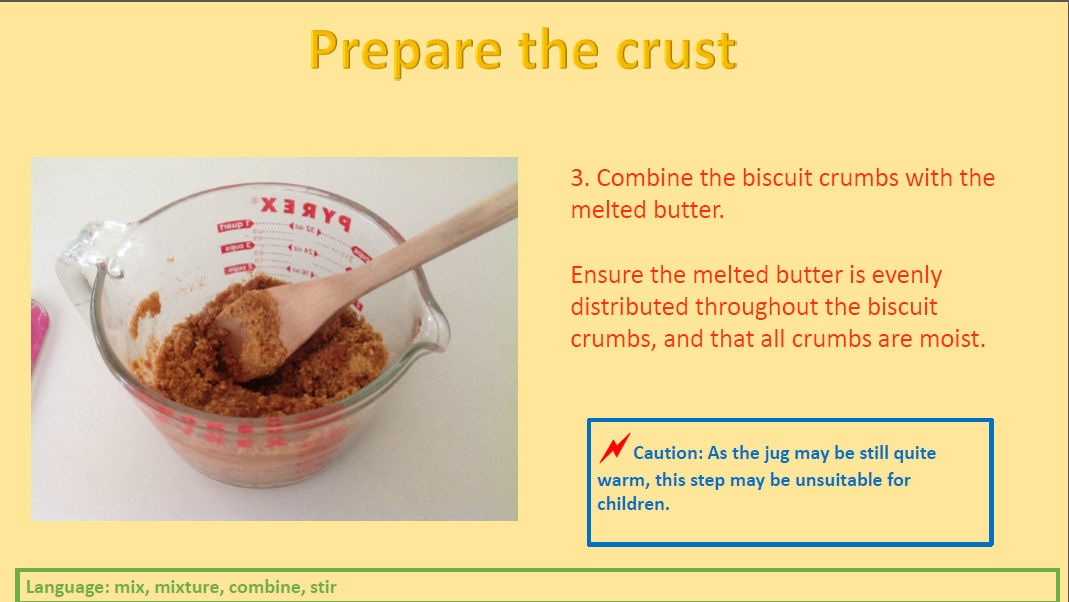
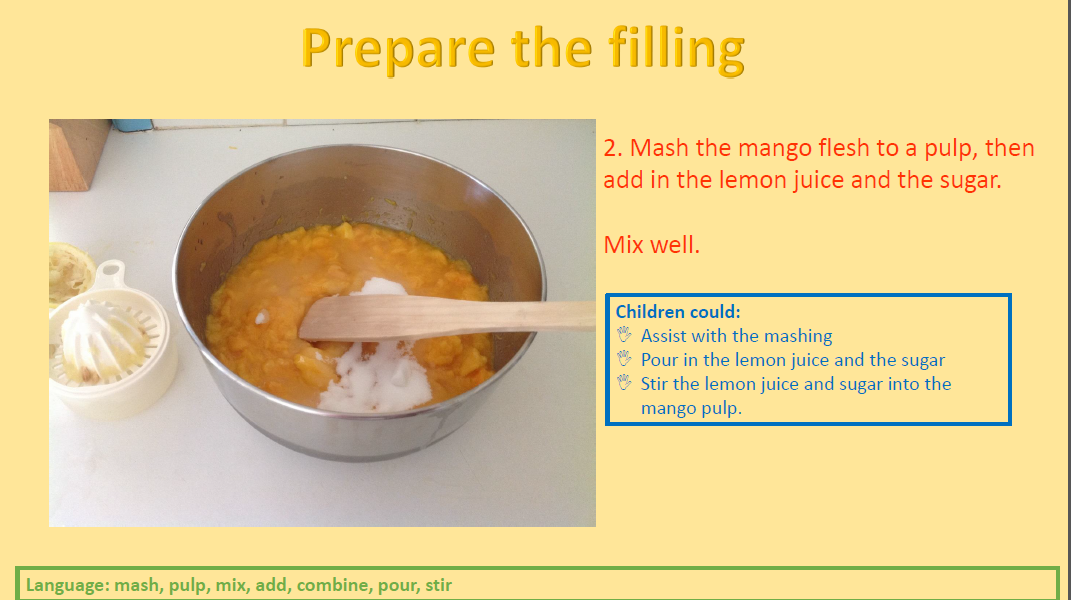
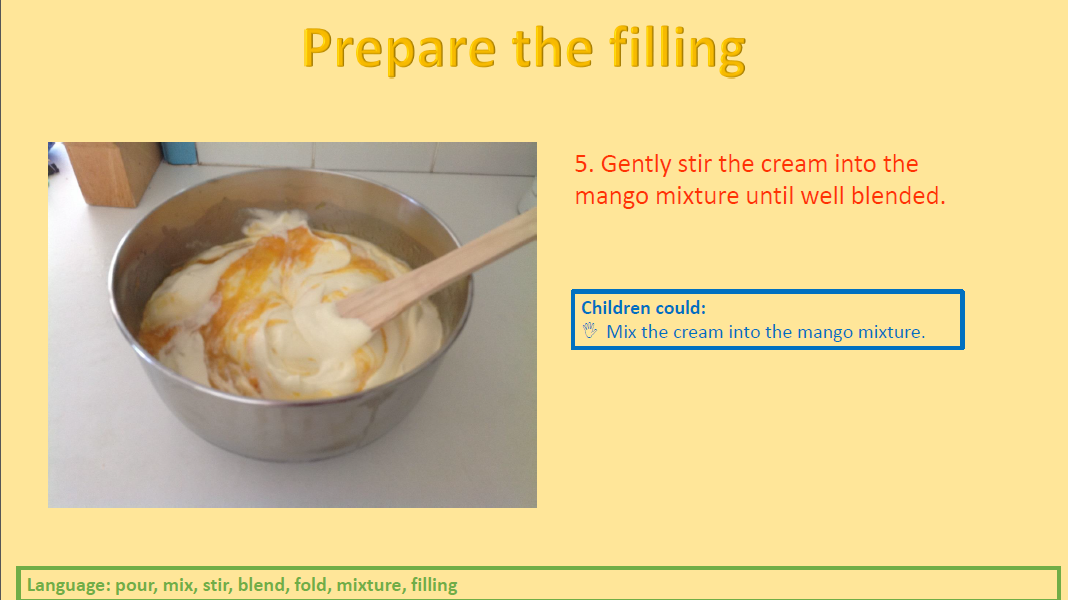
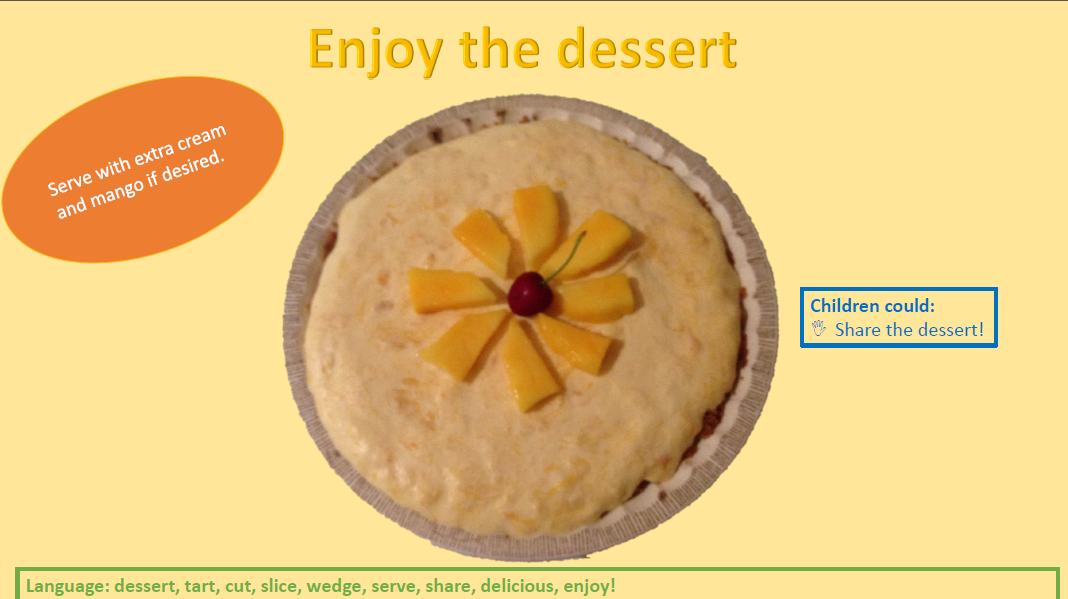
    Here is the recipe which includes suggestions for parents on how they can incorporate learning opportunities for their children while making it. If you can’t help solve my gelatine dilemma, I’d love to know what you think of the way I have presented the recipe. Would this format be useful to parents of young children?

    Mango 1

    mango 2

    Mango 3

    mango 4

    Mango 5

    Mango 6

    Mango 7

    Mango 8

    Mango 9

    Mango 10

    mango 11

    mango 12

    Mango 13

    Mango 14

    You can click on this link: Mango cream tart – recipe for a full-screen slideshow of the recipe.

    The quote by Michael Rosen at the top of this post is from his new book: Good Ideas How to Be Your Child’s (and Your Own) Best Teacher. In the book he includes a chapter “The Kitchen” explaining why he thinks the kitchen is the best classroom invented.

    Thank you

    Thank you for reading. I appreciate your feedback. Please share your thoughts about any aspect of this post. I’d especially appreciate feedback on my presentation of the recipe and suggestions for a vegetarian substitute for gelatine.


    Kitchen photo credit: https://www.flickr.com/photos/john-schilling/364481975/  http://creativecommons.org/licenses/by-nd/2.0/


  • Talking interviews

    BITE SIZE MEMOIR

    Lisa Reiter is writing her memoir and sharing her stories on her blog. She also invites others to join in and share their memories through her Bite Size Memoir prompt. Her prompt of the moment is “Interviews”.

    In my role of teacher over the years, I have conducted many parent-teacher interviews, each with varying degrees of pleasure and stress. And that’s just for me! I have also sat on the other side of the desk attending interviews to find out about the progress of my own two children.

    I mostly worked with children in their first year of school.

    When conducting interviews with parents, particularly at the beginning of the year but at any time, I always invited them to talk first; to tell me their impression of how their child was going, to raise any concerns they had and to ask any questions they wanted answered.

    There are a variety of purposes for beginning an interview in this way:

    • It gives the parents a voice and acknowledges their importance in the child’s life and education.
    • It ensures that any concerns parents have are raised and discussed first, and not left until the end or even missed out in the short time allocated to each interview scheduled on a parent-teacher night.
    • It provides an insight into the child’s life and how the attitudes of the parents may affect, or be reflected in, the child’s attitude to school and learning.

    Often times I have found that parents share my concerns, and discussing them is easier when raised by the parent. One of the most difficult things is raising and discussing an issue of which the parent is unaware.

    Over the years I have found that what parents most want to know is:

    Is my child happy?

    Is my child well-behaved?

    Does my child have friends?

    How does my child’s progress compare to that of others?

    Prior to the interviews I would make a checklist of things I wished to discuss with each parent, including responses to the queries listed above and any other issues I wished to raise or anecdotes I wished to share, ensuring the positives always outweighed the concerns. I would gather samples of the child’s work to show and have at hand suggestions for ways the parents could continue to help with their children’s learning at home, which generally meant reading to them, talking with them, playing games together and possibly involving them in daily activities such as setting the table, writing shopping lists etc.

    But I digress. My purpose in writing this post wasn’t really to talk about parent-teacher interviews, it was to list 10 memories about interviews in response to Lisa’s prompt. Like the parent-teacher interviews, many of them have a link to education.

    www.openclipart.com http://goo.gl/EY7z5L
    http://www.openclipart.com http://goo.gl/EY7z5L

    I remember interviews

    15073-Briana-web

    School days

    • I remember brushing up on my conversational French for an interview as part of my final exam. I remember the interviewer laughing at something “funny” I said. I’m not really sure if he was laughing at what I meant to say, or at what I did say!

    Employment

    • I remember not having an interview for my first teaching position. I was awarded a three-year teaching scholarship which, in return for my training and a small living allowance, “bonded” me to the Education Department for three years.
    • I remember agonising for hours over written responses to selection criteria but being unsuccessful in the interviews; and going without preparation to other interviews and scoring the job!

      bad taste party
      Would you employ this woman? Bad taste fundraising function at school.

    Police

    • I remember being interviewed by a policeman after hitting a pedestrian on my way to work one morning. I was horrified to see the teenage girl bounce off the bonnet of my car. Fortunately she wasn’t hurt as I had only just pulled away from traffic lights, but we were both rather shaken up. She was only a few metres from a pedestrian crossing (also with lights) and the policeman said if anyone was to be charged it would be her. I wish she hadn’t been so impatient. I still worry about the unpredictability of pedestrians on the side of the road.
    • I remember being interviewed by police after our car was stolen. I was so upset I couldn’t remember the registration number. After it was stolen a second time, we got rid of it!

      stolen car
      Our beautiful car – stripped!
    • I remember being interviewed by the police after our house was burgled and giving them a list of items that had been stolen. The most surprising one was a big screen TV. Big in 1999 is not the same as big in 2014. It went as far out the back as it did across and weighed a ton. How they got it out of the house and down the steep driveway without being seen I’ll never know; or even why they did, as newer technology  was on its way and it wouldn’t have been worth much to resell.

    The media (Note: You are neither expected nor required to watch any of the videos included in this section. They are simply for my amusement and learning.)

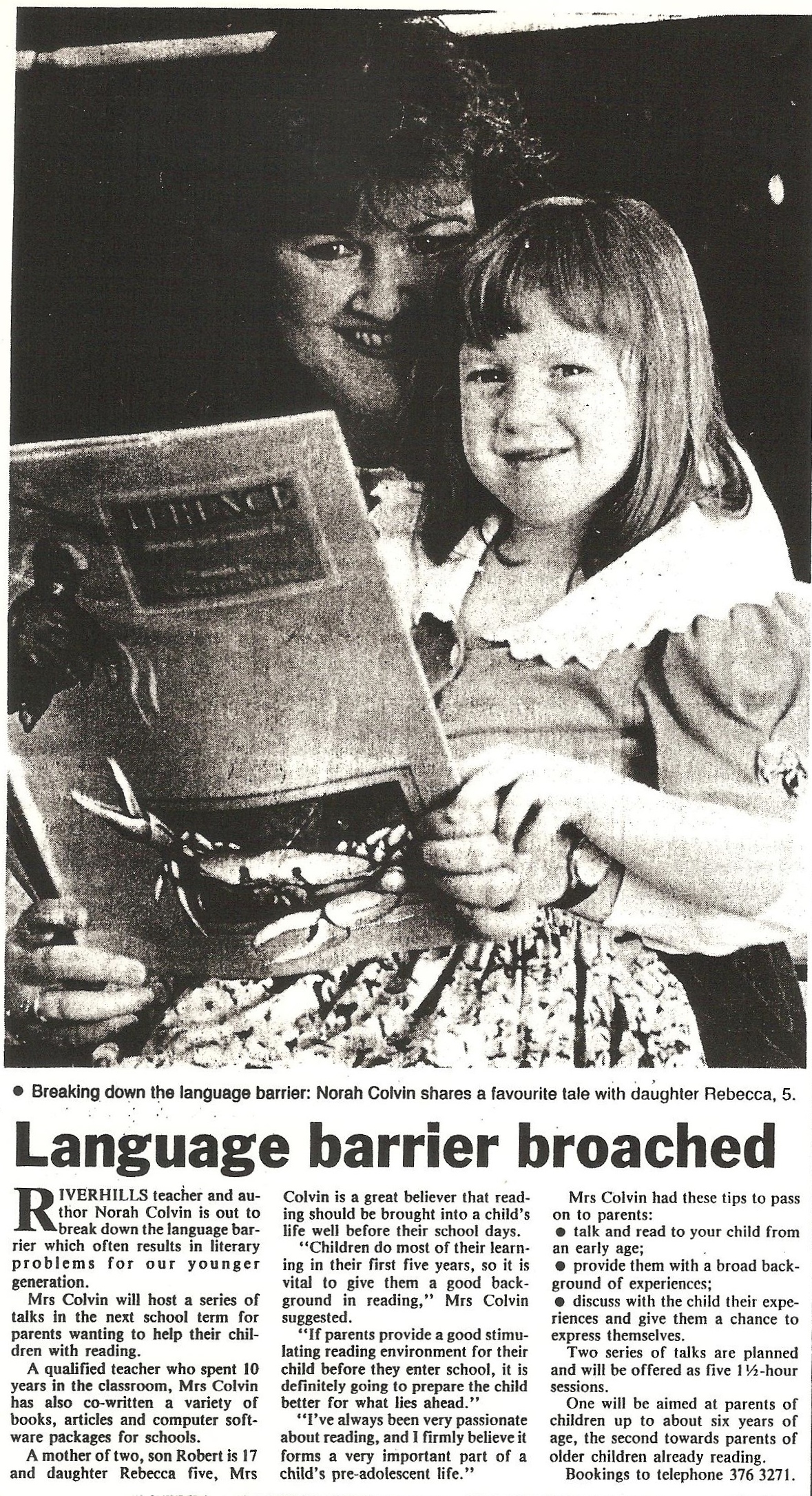
    • I remember being interviewed by the local paper when offering sessions to assist parents help their children read.

    Satelitte 17.06.92 (2)

    • I remember being interviewed on Radio on the morning of the Family Day Picnic for the year of the family in 1994.
    • I remember being interviewed on a local community television station. I was invited to talk about the alternative school I was setting up. (I haven’t found the footage yet, but below is a response given to a question about self-esteem at a publicity meeting. Apologies for the amateur quality.)
    • I remember being interviewed at school about keeping butterflies in the classroom, twice: each time for different programs and different television studios.


    Just as an aside, at about the same time that I was being interviewed about butterflies for the program “Totally Wild”, Bec was also being interviewed at school for the same program. She is proud to say that the times she appeared on that program numbered three to my one! Not long afterwards she appeared on the news a couple of in anti-war rallies!

    Bec on "Totally Wild"
    Bec and friend Elise talking about heating on “Totally Wild”

    Of course, not all interviews occur face-to-face. Interviews can take place online too. During the 15 months that I have been blogging I have passed on a number of awards asking people to answer questions. This post is a compilation of the answers given to my interview questions by my first nominees.

    Thanks, Lisa, for this opportunity to take a walk down memory lane.

    Thank you

    Thank you readers. I appreciate your feedback. Please share your thoughts about any aspect of this post.

  • The Question X Revisited

    Tomorrow, 20 November 2014, is UNESCO’s World Philosophy Day. Celebration of the day “underlines the enduring value of philosophy for the development of human thought, for each culture and for each individual.”
    In recognition of the day I am reblogging a recent post from The Philosophy Foundation which discusses the differences between open and closed questions and explains the greater value of The Question X.
    The importance of encouraging children to ask questions has been a recurring theme on my blog (here, here, here and here) , as has the need to encourage them to think for themselves rather than to become experts at regurgitating force-fed information (here and here).
    The discussion of The Question X gave me a lot to think about. Maybe it will do the same for you.
    Happy thoughts and thinking on World Philosophy Day 2014!

    philosophyfoundation's avatarphilosophyfoundation

    We read this blog ‘Closed Question Quizzing, Unfashionable Yet Effective‘ by Andy Tharby the other day. The virtues of closed questioning are well known to The Philosophy Foundation as they are central to our philosophical questioning approach, so we wanted to share this extract taken from a chapter entitled ‘If it, Anchor it, Open it up: A closed, guided questioning technique‘ that Peter Worley has written for the forthcoming book The Socratic Handbook ed. Michael Noah Weiss, LIT Verlag, 2015. Some of these ideas were first written about in The Question X published in Creative Teaching and Learningand available here: The Question X. In this blog Peter has developed some of the ideas written about in The Question X.

    Plato’s Socrates asks many closed questions – questions that elicit a one-word or short answer such as ‘yes’, ‘no’ or ‘Paris’. Dip in to any of the dialogues…

    View original post 2,461 more words

  • How much of a meliorist are you?

    https://openclipart.org/image/800px/svg_to_png/103549/old_man01.png
    https://openclipart.org/image/800px/svg_to_png/103549/old_man01.png

    Recently I was sent a link to an article titled Cheer up, it’s not all doom and gloom published by the Australian Broadcasting Commission’s The Drum.

    This article mentioned a book by Steven Pinker called Better Angels of Our Nature which had been recommended to me by Geoff Le Pard in a comment on my post about childhood illness. The premise of this book is that humanity, over the ages, has become less violent. After to listening to Pinker’s history of violence, I’m pleased that I live these relatively peaceful times.


    The article also introduced me to a new term ‘meliorism’ which means having a belief that the world can be improved by the actions of humans. While the term may have been unfamiliar to me, the attitude is not and I attest that I am a meliorist.

    I have a very strong belief in the power of education to improve the world. Education empowers individuals, and educated individuals empower societies to build improved futures. It becomes very difficult to sustain negative practices in the face of overwhelming evidence and information.

    What better place is there for education to begin than in the home?

    In a recent post I referred to a new book by Michael Rosen called Good Ideas: How to Be Your Child’s (And Your Own) Best Teacher. At the time I had not read the book but now I can say, with great delight, that I have listened to most of it. With messages such as those contained in Michael’s book, it is easy to be a meliorist.

    I think Rosen’s book should be available to, perhaps compulsory reading for, every parent; I consider its message to be that important. In fact, I am off to the shops today to purchase copies to give to parents of young children I know.  It will become part of my gift to new parents that also includes Reading Magic by Mem Fox and a selection of picture books. I have previously blogged about that here and here.

    The “Good Ideas” contained in Rosen’s book, if implemented, will keep alive the natural curiosity of one’s children and oneself. They will encourage the development of thought, creativity and responsiveness.

    In the next few weeks I will post a more detailed review of the book and some of Michael’s ideas for stimulating curiosity, whoever and wherever you are.

    What about you? Are you a meliorist?

    I welcome your feedback. Please share your thoughts about any aspect of this post.

    Thank you

  • Who’s the best teacher?

    Two recurring themes, amongst others on my blog, are ways of encouraging a love of literacy and of questioning in young children.

    If you read my post Going on a treasure hunt! you will know that I greatly admire the work of Michael Rosen and its contribution to literacy development. You may have followed the links and checked out the riches in store on his website.

    My post Child’s play – the science of asking questions introduces my thoughts about ensuring that children’s inborn curiosity is maintained through the encouragement of their questions.

    You can imagine my delight, then, when I read a review of new book by Michael Rosen. (Thank you, Anne Goodwin, for alerting me to it.) The review, posted by Sabine Durrant in The Guardian on 6 September 2014, discusses Rosen’s new book How to be Your Child’s (and Your Own) Best Teacher. I confess that I have not read the book but I am very excited to see that it is now available as an audiobook, so it is next on my listening list. So much about the book appeals to me.

    Rather than review the review I will simply leave with you the links to the review:

    Michael Rosen: Why curiosity is the key to life

    and Michael’s website.

    I’m sure you will find much to enjoy.

    Thanks for reading.

    Thank you

  • Food for thought

    Food for thought

    Thinking is as much a part of life as is eating. Something to think about is often referred to as ‘food for thought’; and food for thought is just as important to wellbeing as is food for the body. When I’m not thinking about where I’ll partake of my next meal, or what I might eat, I’m often thinking about education.

    www.openclipart.com
    http://www.openclipart.com

    I recently read an article on Selected Reads called Teacher’s Guide to Teaching Students to Ask Their Own Questions which included a review of a book by Rothstein and Santana entitled “Make Just One Change: Teach Students to Ask Their Own Questions“.

    I will be upfront and admit that I have not read the book and am commenting on the review alone which states that the book brings together “several years of research and experience into a methodology for applying their groundbreaking thought and technique.” It goes on to say that “The basic argument … is pretty basic: for our students to achieve excellence and equity, we need to teach them the skill of question formulation.” (my emphasis)


    I really have no argument with the premise of the book. In fact, it sounds like a pretty good read to me. I have even previously blogged about the importance of asking questions in these posts: Child’s play – the science of asking questions  and What you don’t know …


    What I wonder about is: If it is so important for students to learn to ask questions, why do we spend so much time in school teaching them to stop asking questions and to learn just what is presented to them, whether they like it or not?


    Aren’t children born asking questions? Aren’t they pretty good at asking questions (verbal or otherwise) to figure out what they need to know about the world? Why then do we sit them in desks all day and force-feed them content for future on-demand regurgitation?


    I consider it to be a bit like inviting someone to a feast but feeding them pap, which is the essence of my flash fiction piece written in response to the prompt suggested by Charli Mills this week at the Carrot Ranch: In 99 words (no more, no less) include food in your story.


    Food?

    His eyes widened, flitting across the table, scanning the feast, a smorgasbord of sensory delights. His mouth moistened and tummy growled.

    Where to start? A bit of this. A little of that. A whole lot of that! Mmmm!

    He rubbed his belly and licked his lips.

    Suddenly he was marched away and slammed onto a hard wooden bench. A bowl of colourless pap was flung at him.  “Eat this!”

    He recoiled.

    “Eat it!”

    The overfilled spoon was shoved between tightened teeth.

    He gagged.

    “It’s good for you!”

    He spluttered.

    Over time he learned. “Not so bad,” he thought.


    Okay. Maybe I’m exaggerating. Maybe I’m painting the picture darker than reality. Maybe. But sometimes that is necessary for even partial recognition of the situation to occur. You know about the swinging pendulum.


    The picture painted by Scott McLeod of dangerously ! irrelevant is no brighter. In his post The declining economic value of routine cognitive work  he says that while most employees (in the U.S.) are engaged in non-routine cognitive and interpersonal work; routine cognitive work is what students are mostly engaged and assessed in, and what traditionalist parents and politicians advocate. So while work tasks may require “problem-solving, intuition, persuasion, and creativity”, school tasks involve things such as automation and repetition.


    My wish is that all parents, school administrators, education policy makers and teachers do as Rothstein and Santana suggest – let them ask questions!


    Of course I couldn’t write a post about food and questions and not mention the blog of one of my very favourite questioners, Bec, who writes about “wholefoods, vegetarianism, slow living and their existential friends” at There’s no food. There’s much food for thought there!

    And now for something a little bit different: The edible cookbook. It’s a cookbook you can read, cook and eat! I wonder what questions its designer was asking to come up with such an innovative and interesting design.

    Thank you

    Thank you for reading. I appreciate your feedback. Please join in the discussion or share your thoughts about any aspect of this post, including my flash fiction.


  • Just imagine . . . the power of imagination

    Have you ever wished you could:

    • be in two places at once?
    • clone yourself to ensure you get everything done?
    • slow time down so that you could achieve all you wanted?
    • make time stand still so you could stay in the present moment forever?
    • pop back in time to undo that embarrassing moment, or peek forward to see the result of a decision that is pending?
    • choose both options and follow each through consecutively, as in parallel universes?

    I have.

    https://openclipart.org/image/800px/svg_to_png/194578/07-Juli-goin-on-a-summer-holiday.png
    https://openclipart.org/image/800px/svg_to_png/194578/07-Juli-goin-on-a-summer-holiday.png

    Multiple invitations or engagements often occur on the same date. Deciding between desired activities is not always easy. Cloning would make choosing unnecessary. Additionally, sending a clone to an unpleasant but unavoidable engagement could also be desirable.

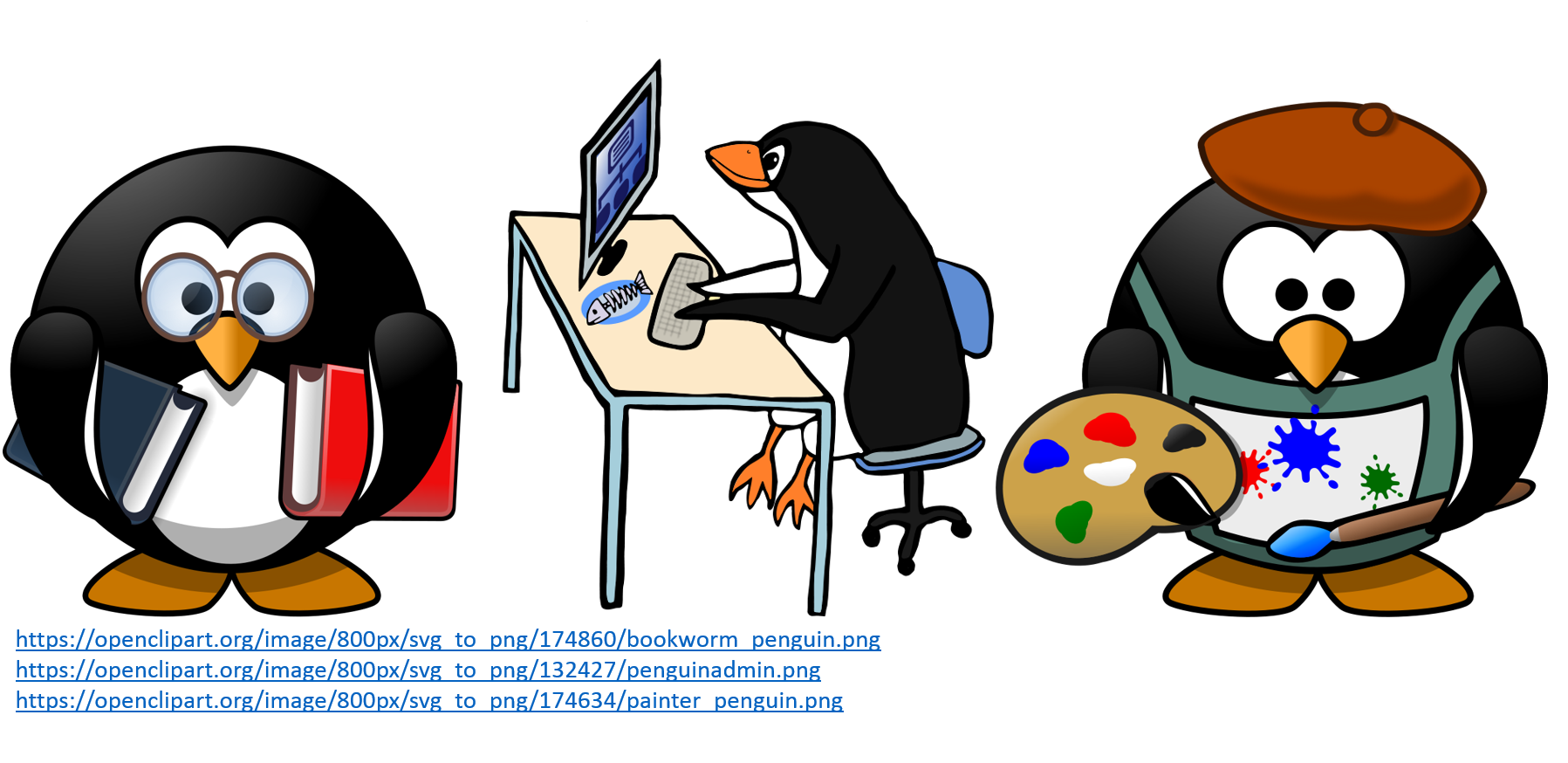
    penguins

    Sometimes the number of must-do tasks can be overwhelming. The ability to engage the assistance of clones, especially to complete less desirable tasks would be great.

    Time travel, wormholes and parallel universes are the stuff of science fiction; and while I am not a fan of the science fiction genre, I wouldn’t mind having access to some of its features. However, whether any, or which, of those features ever move from science fiction to science fact remains to be seen.

    The power of imagination to drive creativity and innovation cannot be overstated. Much of what we now accept as commonplace was once a part of science fiction. Imagination, the stuff of science fiction and scientific exploration and investigation, has brought them to reality.

    You are probably familiar with following quote, initially attributed to George Bernard Shaw but also made famous by Robert F. Kennedy:

     “Some men see things as they are and say why. I dream things that never were and say why not.”

    These words highlight the importance of questioning to stimulate imagination, and when paired with creative thinking, innovation can occur.

    Einstein said that,

     “Imagination is more important than knowledge. For knowledge is limited to all we now know and understand, while imagination embraces the entire world, and all there ever will be to know and understand.”

    He also said that,

     “Education is what remains after one has forgotten everything he learned in school.”

    Although I cannot be certain, from those quotes, what Einstein’s attitude to the current trends in schooling would be (he did attend school and was very advanced in maths and sciences but did not perform so well in the humanities) I think he would not favour a content-driven curriculum which excluded opportunities for imagination and creativity.

    On the other hand, Thomas Edison, the world’s most prolific inventor, was mostly educated at home by his mother who was able to encourage his experimentation and love of learning. He said,

     “To invent, you need a good imagination and a pile of junk.”

    If these significant thinkers of the 20th century, each of whom followed different educational pathways, recognise the importance of imagination, why would anyone argue against it?

    Charli Mills at Carrot Ranch Communications certainly doesn’t. As a fiction writer she embraces imagination. It is the tool of her trade, creating stories where before there were none. This week her challenge is to In 99 words (no more, no less) craft a multiverse situation, setting or character(s)
    Now the term ‘multiverse’ takes me back to the science fiction genre: wormholes, parallel universes and time travel, for example. I’m not sure how well I’ll do with this unfamiliar genre, but I will call upon my imagination and give it a try. See what you think – does my piece fit the criteria?


    Clone Magic

    Clone magic

    All night Leone had huddled in line, sleepless with excitement, waiting for the release.

    Now she had them! Clone pills!

    ‘Take one with water. Cloning occurs in 30 minutes and lasts 24 hours.’

    Leone swallowed one tablet, then another, and another; ignoring the small print: ‘Do not take multiple tablets. Effects are unpredictable.’ 

    When three clones appeared she instructed:

    “1. Clean the house. 2. Exercise. 3. Weed the garden.”

    She flopped on the couch. “Now to read.”

    But — their hands grabbed for her book, pulling her hair and clawing her eyes.

    “Me read! Me read! Me read!”


    Thanks for reading. I appreciate your feedback. Please share your thoughts about any aspect of this article or my multiverse flash.


  • Are you a lemon or a grapefruit? – Ten articles about creativity

    Are you a lemon or a grapefruit? – Ten articles about creativity

    I am a great fan of creativity.

    Imagination and creative thinking are what inspire and drive improvement, innovation and progress.

    I affirm my belief in the power of creativity in my header: ‘Create the possibilities . . .’

    In this post I share articles and blog posts that discuss creativity. It is not an exhaustive list, just a few to get you started. You will notice that many, but not all, are from Edutopia, a website that is ‘dedicated to improving the K-12 learning process through innovative, replicable, and evidence-based strategies that prepare students to thrive in their studies, careers, and adult lives’; and TED, an organisation of people who ‘believe passionately in the power of ideas to change attitudes, lives and, ultimately, the world.’

    1. In this article on Creativity and education Judy O’Connell says that

    ‘Every student is creative in some way, and the job of educators is to release and support that creative talent in an appropriate manner.’

    She adds that

    ‘Teaching creatively and for creativity entails taking students on a creative journey where their responses are not predetermined.’

    In her article Judy lists some features of teaching for creativity and includes a video of a new school in New Zealand that she suggests fits the criteria. It is quite exciting and worth a look.

    1. In this article shared on Edutopia Do Standards Kill Creativity Claus von Zastrow suggests creative ways of teaching creativity while teaching standards.

    Linking of subject areas, as we used to do through ‘themes’ in the old days, or more recently ‘integrated units’, before subjects were divided and each given their own slot in the timetable, was one suggestion.  A number of varied and interesting comments accompany the article.

    1. I have previously shared this TED talk by Sir Ken Robinson on How schools kill creativity here and here. If you have not yet listened to it, please do. As well as sharing a very important message, Ken is a very entertaining speaker. I’m sure you will enjoy it.

    4. Following on from that talk is this article by Bruce Price shared on examiner.com Ken Robinson and the Factory Method of Education. The article shares an animated talk by Ken Changing Education Paradigms.

    Bruce does not agree with Ken’s views and warns readers to be sceptical of information imparted by Ken. He says that Ken’s opposition to traditional schooling is unhelpful and argues that, unlike most others referenced here, that creativity cannot be taught.

    5. In this article by Deepak Kulkarni Recreational and Educational Value of Math Puzzles shared on Edutopia the suggestion is made that creative problem solving can be taught using maths puzzles.

    6. A variety of Techniques for creative teaching are shared on the Iowa State University Center for Excellence in Learning and Teaching website which states that

    in order to teach creativity, one must teach creatively’.

    7. In yet another article shared on Edutopia, Andrew Miller states enthusiastically Yes, You Can Teach and Assess Creativity! Andrew provides suggestions for recognising creativity as well as teaching and assessing it.

    8. Also on Edutopia, Diane Darrow talks about Creativity on the Run: 18 Apps that Support the Creative Process.

    9. In this rather long TED talk on his life, authenticity vs karaoke culture Malcolm McLaren postulates that ‘we’re living in a karaoke culture, with false promises of instant success, and that messiness and failure are the key to true learning.’ He talks about his own schooling and attitude to creativity.

    10. Michael Michalki shared an article on Edutopia regarding what he considers the 7 Tenets of Creative Thinking, including:

    Believe you are creative

    ‘While creative people believe they are creative, those who don’t hold that belief are not.’

    Work at it and ‘produce an incredible number of ideas — most of which (may be) bad. He says that

    ‘more bad poems were written by major poets than by minor poets’.

    Go through the motions – ‘Every hour spent activating your mind by generating ideas increases creativity’; visualise what you want and go for it.

    On his own website Creative Thinking, Michael Michalko suggests many more ideas for getting you to think creatively.

    The header of Michael’s website states that “A grapefruit is a lemon that took a chance.”

    lemons and grapefruit

    So which are you: a lemon or a grapefruit?

    I appreciate your feedback. Please share your thoughts about any aspect of this post and let me know whether you agree or disagree with the value of creativity and if it can be taught.

    Thanks for reading.