
Live Love Laugh Learn … Create the possibilities

Tag: motivation

  • Paying it forward – a Liebster Award!

    Paying it forward – a Liebster Award!

    Last week I was intrigued, surprised and delighted to find that I had been nominated for a Liebster Award.

    I was intrigued because I had never heard of a Liebster Award; had no idea of what it was for or why I should have been nominated for it;

    I was surprised because I’d had no inkling that such an honour was about to befall me;

    and I was delighted to receive the nomination from fellow blogger, Harriet the Bloom whose blog is “A place for educators to reflect, recharge, and revive.” Thank you, Harriet, I am indeed honoured.

    In reality, before feeling delighted and honoured, I felt a little confused. Confusion, if acted upon, leads to learning. So I headed over to Google and Harriet’s blog to see what I could find out.

    It appears that the purpose of the Liebster Award is to:

    • provide encouragement for new bloggers with a following of fewer than 200
    • promote communication between bloggers,
    • recommend blogs to others.

    Nominating others for the award is like paying a compliment forward.

    According to Harriet, the
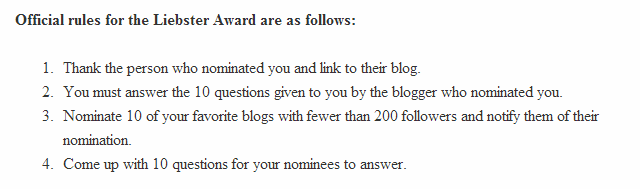
    Liebster rules

    Answers to the 10 questions posed by Harriet:

    1. Congratulations! You just won the Liebster Award! What are you going to do next?

    The immediate answer is contained in this post. The longer term answer is: keep on blogging!

    2. Describe yourself in three words.

    Happy. Thoughtful. Loyal.

    3. Describe your thoughts on your very first job.

    In my early teens I swept out a carpenter’s workshop on a Sunday morning. It was hard, dirty, tiring work. The head of the heavy wooden broom was about 60 cm long and difficult to manoeuvre. It would take about 2 hours to sweep up all the sawdust and I would go home and sleep for about the same length of time to recover. For hours I would be blowing black dust out of my nose, but the crisp $1 note I received in payment was sufficient encouragement for me to return and do it all again the following week.

    4.If you could go anywhere in the world, where would you go and why?

    I would love to visit Monet’s garden. I would love to sit on a seat near the bridge overlooking the waterlilies and ponder the big questions of life. I would like to share my contemplations with the artist, his contemporaries and philosophers from all eras. I love the works of Impressionist painters, especially Monet’s Waterlilies and Van Gogh’s Starry Night. The mood evoked by these beautiful paintings is especially conducive to philosophical musings.

    5. I like food. What is your favorite recipe?

    Whenever we have a family get-together it is expected that I will make a pavlova. It is enjoyed by all generations, and although I make a double (using 8 egg yolks) there is rarely any left over.

    However, for birthdays and Christmas with my immediate family (husband and children) I usually make a strawberry torte. It is a special treat that I have been making on these occasions for almost 40 years. While the in-laws find it a little rich for their taste buds, the grandchildren are taking to it in true Colvin fashion.

    OLYMPUS DIGITAL CAMERA

    strawberry torte

    6. Give a short summary of the book you are currently reading.

    As usual I have a few books “on the go” at the moment, but the one of which I have read most at this stage is “Why ‘a’ Students Work for ‘c’ Students and Why ‘b’ Students Work for the Government: Rich Dad’s Guide to Financial Education for Parents” by Robert Kiyosaki. Of course it appealed to me because of its relevance to education and because I had read others of his books years ago: “If You Want to be Rich & Happy: Don’t Go to School” and “Rich Dad Poor Dad”. In this book Kiyosaki contends that schools don’t educate students for financial success and urges parents to teach children about finances at home. He suggests that playing “Monopoly” is a great way to start. He is greatly concerned about the “entitlement mentality” which he considers to be so pervasive in our society. Some of his ideas are challenging and confronting; others make perfect sense. I recommend the book to anyone wanting to achieve financial independence. I would love the opportunity of discussing his ideas with others.

    7. What inspired you to start blogging?

    Blogging wasn’t a goal, or even an idea, initially. My intention is to create my own website to market teaching resources that I produce. I have a lot of learning to do before I am ready, and part of that learning involves attending seminars. Some of these seminars recommended having an online presence and building a “brand”. Blogging was suggested as one avenue for achieving this. I decided to give it a go, and have found it rewarding in itself – an unexpected pleasure, delightful detour and amazing adventure.

    8. How did you come up with the name for your blog?

    My blog is simply my name; that wasn’t difficult.

    9. What do you do when you experience writer’s block?

    Eat. Procrastinate. Go on with something else. Push through it. Write around it.

    10. Which post are you most proud of and why? Provide a link.

    This is tricky. I don’t think I’ve written it yet! However I very much enjoyed the comments and discussion that ensued from my series of posts about “The Examined Life” by Stephen Grosz.  The series includes:

    A book worth reading: Stephen Grosz “The Examined Life”

    Seeking praise – Stephen Grosz revisited

    and a guest post by Anne Goodwin in response:

    Examining praise: Stephen Grosz – the third instalment!

    The discussion stretched my thinking and learning and I am grateful to all participants in the conversation. Learning is what life is all about!

    Nominate 10 bloggers for the Award:

    As the rules appear to be blurred rather than definite e.g. Harriet’s rules differ slightly from those on Wording Well , which differ again from those on Sea Play Photography, I decided to nominate 13 bloggers.

    Belinda Pollard of Small Blue Dog Publishing (Australia)

    I’m starting with Belinda Pollard of Small Blue Dog Publishing because it was Belinda’s recommendation that prompted me to enter the world of blogging and tweeting. At a seminar hosted by Queensland Writers Centre last year Belinda urged all writers to have an online presence. She said that Twitter was like the water cooler for writers. I’m beginning to see that she was right. Belinda’s posts about all aspects of writing and self-publishing, including blogging, have been a great source of information for me and I appreciate what I have learned from her.

    Belinda, I know you have thousands of followers on Twitter but Word Press tells me that you have fewer than 200 followers on your blog so I hope you are happy to accept this award.

    NANNY SHECANDO (Australia)

    Next I’d like to introduce you to Hope who blogs at NANNY SHECANDO. Hope blogs about her experiences as a nanny, cooking and craft. She says, “We’re staying young, Peter Pan style, by embracing the creativity and sunshine in life.”

    Anne Goodwin (UK)

    Anne Goodwin’s website is rich with things to read: short stories, interviews with authors, book reviews, blog posts and more. Anne is one of the writers I met at ‘the water cooler’ and we have had many interesting and thought provoking conversations since then. I love the way Anne has called her website Annethology and her blog Annecdotal. She tweets @Annecdotist. Very clever!

    Caroline Lodge (UK)

    Caroline Lodge blogs at book word . . . about books, words and writing. She joined with Anne and me and we stood around the water cooler sharing ideas and exchanging thoughts. I’m certain you will find much of interest on her blog including suggestions for blogging, great books to read and writing tips.

    PS Cottier (Australia)

    For a little bit of poetry I recommend PS Cottier who posts a poem every Tuesday, and occasionally writes prose.

    Teachling (Australia)

    Teachling is a blog dedicated to improving education with ideas about teaching, learning and parenting. Teachling believes that “Improving a child’s life-chances is everyone’s responsibility” Along with me and millions of others, Teachling is a big fan of Ken Robinson.

    I have always enjoyed reading philosophy and engaging in philosophical discussions. I support the teaching of philosophy as an active thinking subject in schools and am excited about the benefits of a thinking population to the future of our world. I have two great blogs to recommend in this category:

    Peter Worley’s philosophy foundation (UK)

    Michelle Sowey at The Philosophy Club (Australia)

    Note: Last year I reblogged one of Michelle’s posts:

    Can you kill a goat by staring at it? A critical look at minimally invasive education

    There’s No Food ( Australia)

    A bit closer to home (actually much closer to home, it’s my daughter’s blog) I’d like to recommend There’s No Food. Bec blogs about “wholefoods, vegetarianism, slow living and their existential friends.” She has interesting thoughts about the impact of our food choices on the environment and practical suggestions for changes we can make to our everyday routines.

    Obscure Pieces (Australia)

    Glenn at Obscure Pieces expresses himself through black and white photography. His special interest is urban and landscape photography. He frequently offers support and comments on my posts and has generously allowed my use of some of his photographs. Thanks Glenn.

    Cultivating Questioners (USA)

    On her Cultivating Questioners blog, Nicole posts about her experiences as a teacher, especially encouraging her young students to use higher-order thinking skills . I love to see a young teacher so passionate about education.

    Nillu Nasser Stelter (UK)

    Nillu Nasser Stelter is a fiction and freelance writer and her blog features short stories, flash fiction and tips for writing. I love the ways she uses words effectively in her writing to create a picture or emotion.

    Carrot Ranch Communications (USA)

    Charli Mills at Carrot Ranch Communications also blogs about writing. As of Wednesday 5 March she launched a flash fiction challenge. Each week writers have the opportunity to accept the challenge to write a 99 word “story”. This is something I haven’t done before so I’m hoping to join in the fun. What about you? I’m sure it’s not as easy as it sounds!

    Now my nominees, it is your turn.

    These are the things I would like to know about you:

    Note: Although I have listed 13 questions, you need answer only 10. You may substitute one of your own if you wish.

    1. What do you value most in life?
    2. What activities do you enjoy and why?
    3. What is something you wish you had more time for?
    4. What is one change you would like to make in the world?
    5. What is something you would like to change about yourself?
    6. What surprises you most about your life – something good in your life that you hadn’t expected, dreamed of or thought possible?
    7. What ‘big” question do you often ponder?
    8. What sorts of things amuse you?
    9. What do you like to collect?
    10. If you could talk with anyone and ask them to explain their ideas and/or actions, who would it be, and why?
    11. What is something you can’t do without?
    12. What is something important you learned about life, and how did you learn it?
    13. What is your earliest memory?

    I look forward to reading your responses and continuing our discussions at my place or yours!

    Happy blogging!

    Footnote:
    How to find out the number of followers on a blog:
    For Word Press blogs:
    View the blogs in the Reader
    Click on the blog name at the top of the blog
    Lo and behold, you will be provided with the number of followers. Easy for Word Press.
    For other blogs
    I wasn’t sure how to find out for others not using Word Press so I sent them a message on Twitter asking their numbers. Simple.
  • “You say it long enough, it starts to be a part of you.” (Rita Pierson)

    Affirmation, encouragement, praise . . .  

    “You say it long enough, it starts to be a part of you.”

    Recently I came across this great TED talk by Rita Pierson “Every kid needs a champion”.

    Rita’s entire life centred around education. Her parents and her mother’s parents were teachers, and she was a teacher.

    She observed numerous teachers at work – some of the best and some of the worst – and believed that relationships are the key to learning.

    She said that

     “kids don’t learn from people they don’t like.”

    Rita spoke about having classes of students whose academic level was so low she wondered how she could “raise the self-esteem of a child and his academic achievement at the same time”.

    One year she told her students

    “You were chosen to be in my class because I am the best teacher and you are the best students, they put us together so we could show everybody else how to do it.”

    Affirmation, encouragement, praise . . .

    She talked about giving a student a +2 with a smiley face for getting 2 out 20 questions correct. She encouraged the student by saying

    “you’re on a roll . . . and when we review this, won’t you do better?”

    The student agreed “I can do better”.

    Affirmation, encouragement, praise . . .

    Rita told of her mother’s past students expressing their gratitude for the difference she made in their lives, saying

    “You made me feel like I was somebody, when I knew, at the bottom, I wasn’t. And I want you to just see what I’ve become.”

    Affirmation, encouragement, praise . . .

    She tells us that teachers won’t always like all the children they teach, but it’s important that the children never know it. Acting is part of the role description!

    She says that

    “Teaching and learning should bring joy. How powerful would our world be if we had kids who were not afraid to take risks, who were not afraid to think, and who had a champion? Every child deserves a champion, an adult who will never give up on them, who understands the power of connection, and insists that they become the best that they can possibly be.”

    Affirmation, encouragement, praise . . .  

    Go ahead and listen to this inspirational talk. It will take less than 8 minutes listening time but its effect will be more lasting. It has already had more than 2 600 000 views. Why not add one more to the total. I’m certain you won’t regret it.

    I can find nothing to dispute in Rita’s talk. I’d like to underline every word and make it compulsory viewing for all aspiring and practising educators in any field.

    Affirmation, encouragement, praise . . .  helpful or harmful?

    What do you think?  Please share your thoughts below.

    Refer to these previous posts for discussions on self-esteem, affirmations and praise:

    Happy being me

    Affirmations: How good are they?

    Seeking praise – Stephen Grosz revisited

    Examining praise: Stephen Grosz – the third instalment (guest post by Anne Goodwin)

    I came across this talk on a great educational website edutopia. It was included in a Five-Minute Film Festival: Videos on Kindness, Empathy, and Connection. Check the others out. You may find something else to inspire you.

    Sadly Rita Pierson passed away in June 2013. I’m grateful that we may continue to share the strength of her wisdom through her appearance with TED.

    Click here to find out more about Rita and to read a tribute posted by Tedstaff.

    “You say it long enough, it starts to be a part of you.” (Rita Pierson)

    Let’s make sure it’s the good stuff that learners everywhere are hearing!

  • Seeking praise – Stephen Grosz revisited

    Praise may be defined as an expression of approval or admiration.

    Who wouldn’t want that?

    If you write a blog, don’t you love it when others “like” a post, leave a positive comment, re-blog your article or link to it via theirs? I do. Aren’t these all expressions of approval or admiration?

    What about on Twitter when someone Re-tweets, favourites or replies positively to your comment, engaging you in conversation?

    Aren’t these also expressions of approval or admiration?

    I love to receive all these signs of encouragement and support that let me know that my efforts are appreciated and confirm that I am on the right track. If I did not receive any of this feedback I would feel quite isolated and consider my efforts to be fruitless and a waste of time. I would probably just give up.

    As a teacher I have always considered it of primary importance to create a happy and welcoming classroom environment in which children feel valued, affirmed and supported. Expressions of approval and admiration for behaviour, effort and achievement were generously given with the aim of encouraging the desired response, a happy child being foremost. I have written about this in previous posts, including:

    Happy being me

    Affirmations: How good are they?

    As a parent too I considered it important to affirm my children and display my approval and admiration for them. I still do, even now they are adults. The need for approval never ends. I know sometimes you just have to go out there and say what you know is right, even though others will disagree or ridicule you. I am not talking about those instances here.

    My strong belief in the power of affirmations and approval stems partly from the dearth of them in my childhood and school days. I have also mentioned this in a previous post: 

    Mouthing the words – the golem effect

    Recently I listened to a fabulous (audio)book, “The Examined Life: How We Lose and Find Ourselves” by Stephen Grosz. I wrote about it in my previous post A book worth reading: Stephen Grosz “The Examined Life” saying that

    “What appeals to a reader about a book, or what a reader takes away from a book is as individual and personal as the reader. What is of most significant to one, may be of lesser importance, or even insignificant to another. “

    For me the chapter of most significance is chapter 3 “How praise can cause a loss of competence”.

    To say I was startled by the title would be an understatement. I was puzzled, intrigued and challenged. How could praise cause a loss of competence? Surely negative feedback or a lack of encouragement altogether would be major contributors to diminishing competence. Was everything I had believed and practiced wrong? (Oh no –there’s my need for approval and affirmation!)

    Grosz says that during the past decade studies into self-esteem have found that praising a child as “clever” may not only inhibit school achievement, it may cause under performance. He suggests children may react to praise by quitting. Why would you try to improve or do something new if you have already done something really well or are the “best”?

    Studies showed that children who were praised for effort, rather than for being clever, were more willing to try new approaches and were more resilient. Children who were praised for being clever, tended to worry more about failure and chose unchallenging tasks, tasks they knew they could achieve or had already achieved. Being told they were clever led to a loss in self-esteem and motivation and to increased anxiety. Some children who had been praised for being clever (rather than working hard), when confronted with a more difficult task and asked to comment on it, were so unhappy with the results they lied about them, exaggerating their achievements to others.

    Grosz questions whether we may lavish praise on our children nowadays in order to demonstrate that we are different from our parents who possibly used criticism, rather than praise, on us. I hinted at something similar earlier in this article.

    While admiring our children with words like “Good boy” or “Good girl” may temporarily lift our self-esteem by showing others what wonderful parents we are or how wonderful our children are, Grosz says, it isn’t doing much for a child’s sense of self. He says that in trying to be different from our parents we end up doing the same thing: doling out empty praise where an earlier generation doled out thoughtless criticism.

    Grosz says that if we offer this empty praise without thinking about the child’s individuality and needs we are effectively showing the child indifference.

    So what do we do?

    I think the emphasis here is on the empty praise. I think support, encouragement and positive feedback are all essential. Sure, knowing in yourself that you have done well is fine but a little recognition certainly helps too. I think the difference is in recognizing what has been achieved, the learning or progress made, and the effort it took, the message communicated in a story or painting and the techniques used; not a hollow “Well done”, “Good work” or “Good boy” but “Tell be about . . .”, “Why do you think that?” “How did you work it out?” “I like the way you . . .”

    As Grosz says, this is being attentive to the child, to what the child has done and how it has been done.

    To read more on this topic:

    Sian Griffiths interviewed Stephen Grosz and reported on the interview in the article “Praise her . . . and see her fail” which adds even more clarity to my precis above.

    Maria Popova delves into the messages of this same chapter in her article “Presence, Not Praise: How to Cultivate a Healthy Relationship with Achievement

    Being attentive, being present, being really with someone, noticing what they have done and how they have done it – is it more precious than praise?

    In these days of constant distractions and must-dos to put all aside to be in the present with the child, friend or partner to talk, listen share and laugh, what better affirmation is there than that?

    What do you think?

    How has praise encouraged or discouraged you?   When has criticism hindered you?

    I’d love to hear your thoughts.

  • What did you do that for? Rewards and motivation

    ausines headphonesRecently, on the recommendation of my friend Rosie, I listened to a TED Talk by Michael Sandel “Why we shouldn’t trust markets with our civic life”.

    Rosie and I often suggest Talks to each other and then share thoughts and comments about them.

    This Talk, like most of those on TED, raises some very interesting, thought provoking and challenging ideas and issues. The issue of most importance to me in each of these Talks may not be the issue of most importance to Rosie, nor to any other listener. The understandings, beliefs and personal positions, (ideological, philosophical and ethical), that each person has will not only influence what they hear but how they interpret, organise and prioritise what they hear and what they take away from the Talk, whether intended by the speaker or not.

    In this Talk, Michael raises themoney bag issue of motivating students to learn, a challenge experienced in many schools.  He invited the audience to consider whether cash rewards should be used as incentives for students to perform well on tests or to read books.

    The reaction from the audience was mixed with fewer in favour of offering the rewards than against. When asked why cash incentives should not be used to encourage students to work harder or read more books, a participant stated that the students should be reading for intrinsic motivation, for an intrinsic desire to learn, and that a cash reward would take the intrinsic incentive away.

    studentbooksHowever: If a child is a reluctant reader or reads only when required, does that child have any intrinsic motivation for reading? If not with cash rewards, how can we inculcate an intrinsic motivation to read? What is or has happened in this child’s experience that an intrinsic motivation to read has already been killed? (I will offer some thoughts on these issues in a future post.)

    The argument for and against the use of rewards in schools, as well as homes, to encourage children to perform or behave in a particular way has waged for as long as I can remember and, I’m sure, even longer than that.

    stars

    Should children receive a sticker, a star or an award for that? Shouldn’t they just do what we want of them for the sheer joy of it / because it will do them good / because it’s the right thing to do? Shouldn’t they be intrinsically motivated and have no need of extrinsic rewards?

    It all sounds very good, doesn’t it? And maybe it works when a child is intrinsically motivated through a genuine interest, or maybe when children are happy to comply and perform expected tasks either through a need to please others or their own developing sense of how things should be.

    But what of the child who does not have this intrinsic motivation, no need to please or any ability to see a personal purpose in expected tasks or behaviours?

    One of the Talk participants suggested that results of offering a cash reward for reading books could be measured by a count of the books read while the reward was being offered, followed by a count of the books read after the payment ceased. Results of the experiment found that students, when offered cash rewards, read more books, but they also read shorter books.

    And why should we expect any more of children than we do of adults?

    tomas_arad_heart

    How many adults perform their work tasks for the sheer joy of it, powered by intrinsic motivation? Only the lucky few, I would guess, who are able to combine passion with employment, or who have sufficient resources to maintain the lifestyle they desire. Isn’t the extrinsic reward a major motivator for much of what we do? I dare say the performance of most adult workers would not measure highly after payment ceased!

    mystica_Coins_(Money)

    Okay. I know it’s not quite the same. The children are not in need of the cash rewards as they are supported by adults who receive cash rewards. Nevertheless, without that extrinsic reward, in most cases, that work would cease, regardless of whether the cash is actually required for survival or not.

    However I am always drawn back to an attempt at reconciling intrinsic motivation with compulsory schooling.

    tomas_arad_heartIntrinsic motivation is usually related to something of one’s own choice through interest, challenge or purpose. The motivation comes from within, not from the promise of any external reward.

    So how does this work for children in school?

    Not only is school attendance compulsory throughout most of their childhood years, children have few choices in school. They generally attend a school chosen by someone else, are taught by a teacher allocated by someone else, and expected to make friends with a group (class) allocated by someone else.

    teacherbellThey line up, eat, talk, play and toilet on the ring of a bell and are expected to perform academic feats on command. When they progress from one year to the next, they often suffer the disruption of new class group arrangements, decided by somebody else for questionable reasons. What would be so harmful about a child going through all the years of schooling with the same group of friends?

    Why then do we think that students should be intrinsically motivated to do something about which and in which they have very little choice and are most often powerless?

    Learning for the love of it, for the sheer fun and joy of it is a marvellous goal. And I believe children are innately intrinsically motivated to learn.

    How different would schools be if we began with the intrinsic motivation of each child and wrapped the leaning around that? How much more powerful would the learning be? What would that school look like?

    Is that what we call a child-centred approach? An approach that values the interests and needs of each learner. An approach that starts where the child is and supports them to find the paths that take them where they want to be. An approach that values their individual styles and timeframes while providing just the right amount of challenge to stretch them beyond where they thought they were able to go. That piques their interest in a vast array of topics and supports their learning of skills to achieve their desires.

    But often the lip service given to a child-centred approach in a traditional school, with all its constraints, still smacks of ‘You’ll do what I say but you’ll think that you have a choice’.

    What slap in the face it is to tell someone that they must do this, when to do it and how to do it; and then tell them they must do it because they want to do it!

    However there are teachers who passionately believe in a child-centred approach and in harnessing the power of intrinsic motivation. They work tirelessly and creatively, powered by their own intrinsic motivation, to employ a vast array of strategies designed to make a child’s opportunities for learning within the confines of an imposed curriculum of a traditional school motivating for each learner while targeting their individual needs.

    SnarkHunter_Arrow_in_the_gold

    Here are some strategies that teachers use in a child-centred approach:

    • Make connections with the children’s lives

    –          discussing their experiences

    –          valuing their contributions

    –          involving parents

    –          informing parents of classroom learning and experiences

    • Incorporate children’s interests

    –          using negotiated topics and tasks

    –          employing a variety of activities

    • Offer children some autonomy

    –          using negotiated topics and tasks

    –          employing a variety of activities

    –          providing opportunities for independent and self-directed learning

    • Make learning fun, meaningful and explicit

    –          using games, songs and hands-on participatory activity

    –          explaining how classroom learning connects to purposes in life

    –          providing clear and easy-to-follow procedures

    –          providing opportunities for finding solutions to real problems

    –          allowing explorations in creativity and innovation

    • Provide opportunities for cooperation and collaboration

    –          working with a partner or in groups

    –          allowing opportunities for discussion

    • Support and extend learning

    –          harnessing  spontaneous opportunities for optimising learning

    –          providing opportunities for practice and clarification

    –          challenging learners to stretch their imaginations and abilities

    • Add joy and laughter through happiness and humour every day

    These strategies may not tap into the intrinsic motivation of each student all of the time. However a supportive environment in which children are provided some choice of activities, opportunities to learn at a pace suited to their needs, and an understanding of the point of it all, will provide learners with the desire and skills to harness their intrinsic motivation for learning of their own choosing beyond the classroom.

    What do you think?

  • Being childwise, cultivating habits of the heart

    As a regular commenter on my blog Rosie has contributed additional value and insight, demonstrating her unlimited passion for the education of young learners as well as those who engage with them in a professional capacity.  A recurring topic in her comments is the importance of self-actualisation.

    I feel that Rosie’s message is important to share and, in response to my invitation, she has contributed a post, not just a comment, in order to more fully explain her views.

    Please enjoy Rosie’s contribution and feel welcome to add your own insights and comments in response.

    Growth toward self-actualisation (Maslow) requires integration of habits of heart and habits of mind.

    tomas_arad_heart             ryanlerch_thinkingboy_outline

    The development of these habits is essential to the balanced self. Schools have long attended to the habits of mind providing for a range of capabilities from the academic to the intellectual to the cognitive. The habits of the heart have received far less attention. Critically, however, attention to the first, habits of the mind, does little if it is not complemented by attention to habits of the heart.

    school cropped

    Curriculum frameworks have varied in the last forty years to the amount of attention focussed on habits of the heart. The trend to teach only that which is assessable and hence, that which can be measured, has resulted in many habits of the heart being neglected. To some teachers, habits of the heart, known also as the affective domain, are not within their role statement.

    CoD_fsfe_Checklist_icon

    Early years teachers have long recognised the importance of scaffolding the development of all aspects of the child. The belief that teaching the whole child has as its focus, the integration of emotional, social, physical, and cognitive. All interact as conditions for learning. When one area of development is not receiving attention, growth of the other areas may be restricted as well.

    58294main_The_Brain_in_Space-page-21-asian-girl-jumping

    From this perspective, words such as motivation, attitude, well-being, responsibility, independence, self-control, self-concept and identity become the “bread and butter” of a teacher’s daily activity. When learning is not occurring, the answer is not another worksheet or more of the same. These other conditions that form the habits of the heart are examined to formulate the next step to ensure growth.

    image courtesy of www.openclipart.org

    Views toward conditions for learning are slowly changing. For example, the Australian curriculum has at its focus, General capabilities embedded across all Learning areas. One of these capabilities refers to personal and social capability, bringing the affective domain into the realm of respectability as a teaching focus, at last. Despite this, the term ‘behaviour management’ continues to attract funding in some education systems.

    A proposal is to redirect attention away from behaviour management and engage with the direction of the Australian Curriculum. To do this, there is a need to view what needs to be taught and how to teach it if the habits of the heart are to develop.

    image courtesy of www.openclipart.org

    In looking at how to work with habits of the heart, some preservice teachers (now teachers), lecturers and a psychologist adapted “On becoming childwise” (Ezzo & Ezzo) to the needs of teachers and the classroom context. Documentation related to this program is available at www.teachersbeingchildwise.com.au. Videos are also available.

    teachersBeingChildwise

    All images, except Childwise, courtesy of www.openclipart.org