Welcome to the School Days, Reminiscences series in which my champion bloggers and authors share reminiscences of their school days. It’s my small way of thanking them for their support and of letting you know about their services and publications.
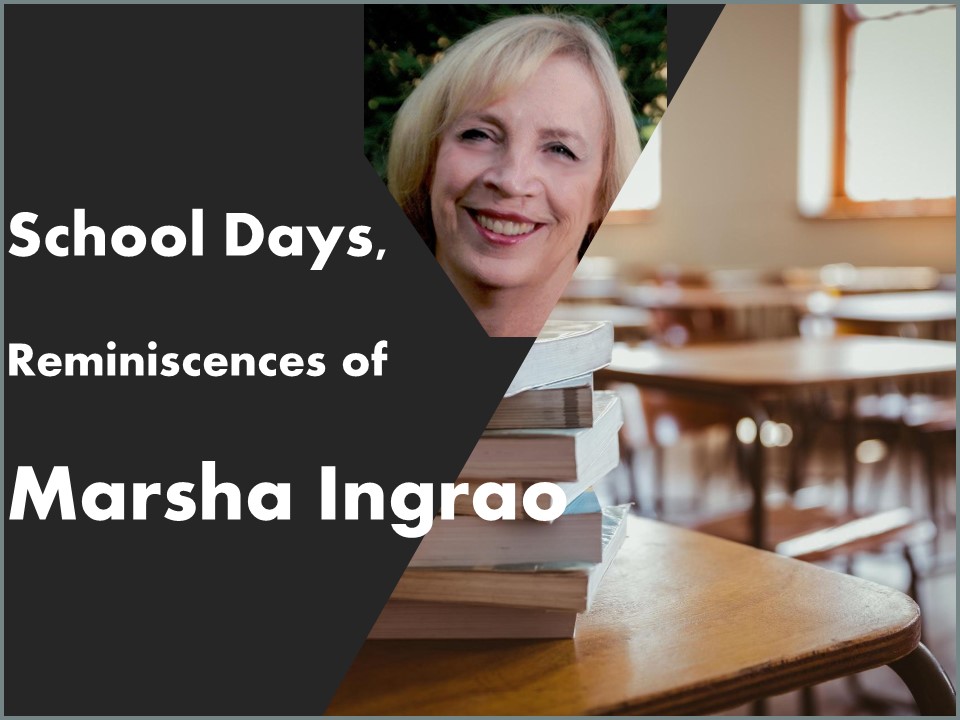
This week, I am pleased to introduce Marsha Ingrao, author, blogger, teacher. Marsha and I hit it off as soon as we met, somewhere in the blogosphere. I think our shared backgrounds in and beliefs about education helped cement our friendship. I was delighted when Marsha contributed a guest post on readilearn about Writing in the lower primary classroom, a topic we are both passionate about, last year. I was also honoured when she entrusted me with reading a draft of her WIP Girls on Fire, which I’m looking forward to seeing in print one day.
Before we begin the interview, I’ve invited Marsha to tell you a little of herself:

My career in education spanned twenty-five years, first as a classroom teacher, then as a math consultant for Migrant Education, and finally the County Office of Education in the area of history-social science.
Publications include various poems in anthologies, curriculum written as part of my consultant duties, and two published books, Images of America: Woodlake by Arcadia Publishing and So You Think You Can Blog? by Lulu Press.
Fiction is still on my bucket list. Two manuscripts I have completed, but not published are:
- Girls on Fire, a fiction novel about three women in their 50s and 60s who are looking for new love and a change in life.
- Winning Jenny’s Smile, a middle school fiction about Jenny’s first months in a new school.
For the past seven years, I have sporadically kept three blogs, TC History Gal Productions about local history, Traveling and Blogging Near and Far, and Always Write about hobby blogging, writing and photography. I manage social media for several non-profits and am an active volunteer in Kiwanis.
Welcome, Marsha.
Now let’s talk school. First, could you tell us where you attended school?
I attended five schools in Indianapolis, Indiana through my junior year of high school, then moved with my mother and brother to Portland, Oregon to finish high school at Madison High. I attended one year of college at Portland State University and finally finished my education with a master’s degree and administrative credential over twenty years and two states later from Fresno Pacific University.
Did you attend a government, private or independent school?
Except for the short stint to finish my master’s degree my schooling was all public.
What is the highest level of education you achieved?
Master’s Degree
What work or profession did you choose after school and was there anything in school that influenced this choice?
My career choices, except for education, were as scattered as my education primarily based on how long it took me to finish my degree and my financial constraints in finishing. My mother taught school, and that was my eventual goal as well.
What is your earliest memory of school?
Kindergarten was my first experience at school. My grandmother and mother had already taught me most of the things they teach now in kindergarten, but we played in school and having such wonderful play setups and being with so many children was new to me.
What memories do you have of learning to read?
I remember Dr. Seuss and Dick and Jane. We did not learn phonetically at first that I remember, but somewhere along the line, someone introduced phonetics. By that time, I read voraciously.
What memories do you have of learning to write?

Learning to write pained me. I couldn’t see well and probably was dyslexic with a graphic disability, so I didn’t learn to write in cursive, which was wildly important in those days, until I reached the fourth grade. I remember my third-grade teacher took my new fountain pen away because I couldn’t write. Grrr
My fifth-grade teacher praised my poetry and my father called me Hemist Earningway. I entered writing contests in magazines. Sadly, they responded that I was too young to show any promising talent. That squelched my professional writing career.
What do you remember about math classes?
I skipped half of second grade, so my mother prepared me over the summer by teaching me multiplication. When I started third grade, we had timed tests in subtraction. I was number one in music memory tests, but a failure at subtraction timed tests. My father was a design engineer and tried to teach me to use a slide rule when I started algebra in ninth grade. I did not do well in either algebra or learning from my father. Geometry was a bust, but I enjoyed and did well in math after the first two years of high school. I also got contact lenses.
What was your favourite subject?

I liked to research, not that I was thorough compared to the kinds of research students can do today. In fifth and sixth grades we did reports on states and countries. Those were my favorite assignments in grade school. I loved the mathematics of grammar and for some strange reason loved diagramming sentences in junior high school. English was my favorite subject. That’s when I joined the journalism club.
What did you like best about school?

I loved music and art classes and was thrilled to learn techniques to draw because seeing something and trying to recreate it on paper baffled my brain as much as using a slide rule. I adored reading but hated giving oral book reports.
What did you like least about school?
The bus ride to get there took forty-five minutes when we moved to the suburbs. It wasted time and eliminated after school commitments since my mother didn’t drive until I was in junior high or high school.
How do you think schools have changed since your school days?
This is a great question, Norah. The biggest changes, I think, have been instigated by the Civil Rights movement and technology. The opportunities afforded by computers and the internet for research and to write without constraints of visual or mechanical handicaps are like carrying water during a hike in the desert. The emphasis on equity and collaboration rather than competition prepares students for a working environment. Students in our community receive Chromebooks and free internet they can use at home. When we attended school, public schools didn’t even furnish paper, pens, and pencils. Buying a fountain pen was a third-grade status symbol.
What do you think schools (in general) do well?
In spite of what the public say about schools, the graduating students I interview have so many opportunities to succeed and far exceed my expectations of what a graduate should be able to do. They have so many choices both in and out of school. Boys and girls can participate equally in sports, theatre, mock trials, history, math, reading, writing, and science competitions. There are academies set up for agriculture, science, math, or the arts where students can specialize if they choose. Our schools also add the requirement of community service.
How do you think schools could be improved?

These questions made me think about how much schools have improved. We complain that kids can’t write, and indeed, texting has changed the way kids think. Capitalizing the word I is not important to them but is to educators. Communicating quickly is something kids have taken to a new level. What they don’t know how to do is think beyond the immediate. Just because they can communicate doesn’t mean that they do it well. Schools need to challenge students to step back to imagine the bigger picture and consider the consequences of their actions. This is why teaching social studies and humanities is essential.
Thank you for sharing your reminiscences of school and thoughts about education in general, Marsha. It’s been wonderful to have you here. I learned so much I didn’t already know about you. I especially love that your father called you Hemist Earningway and hope that writing is an earning way for you. However, I am very disappointed in the response of magazines that had such a negative impact on your ambitions and potential.
Find out more about Marsha Ingrao on her blogs
TC History Gal Productions
Traveling and Blogging Near and Far
Always Write
Connect with her on social media
FB Page
Twitter: @MarshaIngrao
Pinterest
Instagram
Purchase a copy of Images of America: Woodlake by Arcadia Publishing
or receive a free copy of So You Think You Can Blog? by Lulu Press.
If you missed previous reminiscences, check them out here:
Charli Mills
Sally Cronin
Anne Goodwin
Geoff Le Pard
Hugh Roberts
Debby Gies
Pauline King
JulesPaige
D. Avery
Christy Birmingham
Miriam Hurdle
Robbie Cheadle
Look for future interviews in this series to be posted on Sunday evenings AEST.
Coming soon:
Ritu Bhathal
Joy Lennick
Darlene Foster
Susan Scott
Mabel Kwong
Sherri Matthews
Chelsea Owens
Pete Springer
with more to follow.
Thank you for reading. I appreciate your comments. Please share your thoughts.






 Norah Colvin