Live Love Laugh Learn … Create the possibilities

Tag: learning

  • Life is for living

    Life is for living

    I first published this post two years ago. I am sharing it again as I continue to hear of similar things happening. I apologise to those who may have read it the first time around. 🙂

    Many would agree that to enjoy life to the full we must live in the present moment, appreciating what we have and being mindful of our surroundings and others.

    Most would also agree that a certain amount of preparation for the future is necessary to both enjoy and deal with what lies ahead.

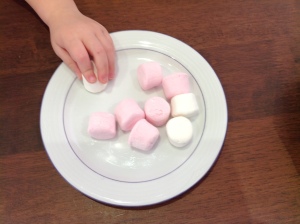
    marshmallow 5

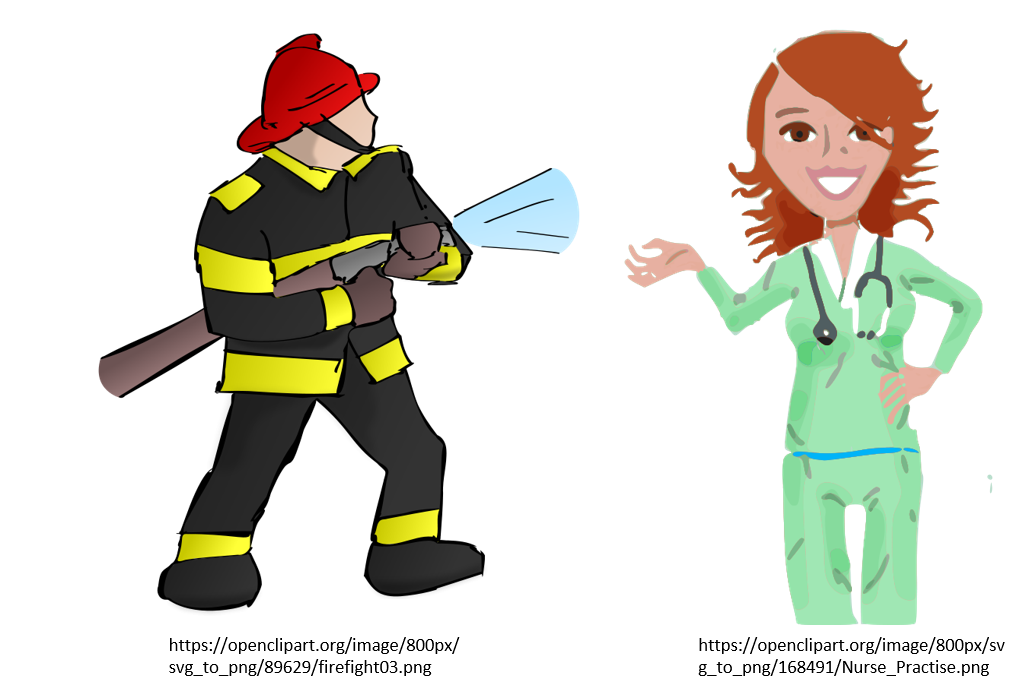
    In previous posts I have referred to related ideas including The importance of emotional intelligence and the ability to delay gratification, for example when studying towards a degree or saving to purchase a car. Recently I wrote about future-proofing kids by preparing them to embrace the future. Schooling is often considered a preparation for the future, for ‘what you want to be when you grow up’.
    firefighter and nurse

    Are the concepts of living in the present moment and preparing for the future contradictory?

    Generally I would say that a balance is needed. We need to live in the present while making some preparation for the future. Hopefully the choices made can still be appreciated now and enjoyment is not all delayed until the future “When I . . .”

    https://openclipart.org/image/800px/svg_to_png/544/Gerald_G_Balance_Scale.png
    https://openclipart.org/image/800px/svg_to_png/544/Gerald_G_Balance_Scale.png

    Recently I read an article that caused me some concern because, it seemed to me, there was little balance between appreciating the present and preparation for the future. Of greater concern was that the one for whom balance was lacking was not the one making the choice.

     

    https://openclipart.org/image/800px/svg_to_png/2312/liftarn_Scissors_and_ribbon.png
    https://openclipart.org/image/800px/svg_to_png/2312/liftarn_Scissors_and_ribbon.png

    The article described a situation in which a 3½ year old was being taught to use scissors by an occupational therapist. The teaching, which had been occurring in regular sessions for over seven months, began before the child was three years of age.

    Like I did, you might assume the child had a developmental delay which required regular sessions with the occupational therapist (OT). However no mention of that was made in the article.

    The parent, writing the article, described feeling sad while watching the child experience difficulty in using the scissors.  Additionally, it was mentioned that the child had not been requested by the parent to use scissors at home as it just made the child miserable.

    After seven months the parent finally broached the subject with the OT, asking why the use of scissors was being pushed at this time.

    It was the reported response of the OT that caused me greatest concern.

    http://pixabay.com/en/birthday-cake-cake-food-candles-25388/
    http://pixabay.com/en/birthday-cake-cake-food-candles-25388/

    The OT explained that when the child entered kindergarten at age five, the ability to use scissors appropriately would be expected. The lessons in learning to use scissors were being given to avoid the child being behind when beginning kindergarten. The OT went on to further explain that the use of scissors was not developmentally appropriate until age five!

    The OT, presumably a trained professional, who believed it was not developmentally appropriate for a child to be using scissors until age five, began teaching a child to use scissors before that child was even three years of age!

    The child was miserable when using scissors and the parent was saddened when viewing the attempts!

    If using scissors is developmentally appropriate at age five, then when the child is entering kindergarten, unless there is a development delay, coordination or muscular problem, that child will easily learn to use scissors appropriately, without the need for lessons from an OT. Forcing a child to practice a skill before developmentally ready is definitely not in the child’s best interests.

    Think of the wonderful things about a child of two or three years of age; the things they are learning and doing. I am always amazed at how quickly children learn and progress. They grow up so quickly and are only little for such a short time. Why try to pressure them through to stages beyond their current development? These years of enormous growth and potential are precious. We are adults for most of our lives. What is wrong with appreciating the special two-ness or three-ness of a child? It will not matter in the future if scissors can be used at age three, age five or age seven.

    If the child is constantly pressured to perform in ways that are not developmentally appropriate then feelings of inadequacy, loss of confidence and self-esteem may ensue, resulting in an ‘I can’t do it attitude’, a fear of failure and unwillingness to have a go. I believe many perceived behaviour problems are problems only because the expectations are not relevant to a child’s stage of development.

    When adults strive for a child to achieve beyond the age expected norms they are not appreciating, but rather showing a lack of respect for, who the child is and for the stage of development. This is not living in the present. It is attempting to live in the future, which can become very scary if one does not feel it can approached with confidence.

    One may hope this scissors example is an extreme and isolated incident, but sadly pressure placed upon children by expectations that are not developmentally appropriate is far too common.

    Teaching colleagues here in Australia often express their dismay that children in the first three years of school are crying every day because they find the expectations upon their learning and behaviour too great.

    I hear similar stories about trying to rush the children through from the UK, Canada and the USA. Maybe it is happening in other places too. Sadly the pressure of unrealistic expectations doesn’t achieve anything positive for the students, the teachers or the parents.

    How different would schools be if, instead of being considered a preparation for life, they were focused on living life now? If three year olds were appreciated and respected as three year olds, five year olds as five year olds, and eight year olds as 8 year olds, rather than as apprentices for the adult they will one day be, how different would their school situation be?
    https://openclipart.org/image/800px/svg_to_png/192642/Children_holding_hands.png
    https://openclipart.org/image/800px/svg_to_png/192642/Children_holding_hands.png

    An affirmation song I used to sing with my classes is one by Anne Infante called Just the way I am.

    The song is made up of a series of verses about appreciating oneself just as one is – now, not in the future – including characteristics such as responsible,  lovable, confident and friendly; for example:

    I am beautiful and I like me,

    I am beautiful and I like me,

    I am beautiful and I like me,

    Just the way I am.

    I have written about using Anne’s songs of affirmation in previous posts, here and here.

    What do you think? How have you seen developmentally appropriate programs in action? How have you seen them disregarded? What have been the effects?

    Further reading: The Cost of Ignoring Developmentally Appropriate Practice

    Thank you

    Thank you for reading. I appreciate your feedback. Please share your thoughts.


  • Home is where the start is

    © Norah Colvin
    © Norah Colvin

    Early childhood years, from 0-8, are the formative years. It is during these years that most is learned. Children learn about the world through their explorations. They learn about themselves through the responses they receive from others, and learn about others through these responses also. Attitudes to most things begin in the home.

    Children require warm, nurturing, positive relationships that demonstrate the way life should be lived, in actions, not just words. As Anne Goodwin, former psychologist says, the interactions with significant adults will greatly influence the adult that the child becomes.

    If home is where it starts, then we can’t wait until the children are of school age. By then it’s too late. It is relatively undisputed that it is difficult for children to catch up what may have been missed in those early years. Sadly, much of the intense formal work in school does more to alienate these children further, rather than improve their opportunities for learning.

    Therefore, we must begin in the home, and I don’t mean with formal structured programs. I mean with fun activities that validate parents and children and provide them with opportunities and suggestions for participation and learning.

    Guiding parents in play sessions for parents and children.
    Guiding parents in play sessions for parents and children. © Norah Colvin

    It is these beliefs that informed my home-based business Create-a-way,

    © Norah Colvin
    © Norah Colvin

    and my idea for an early learning caravan that, staffed with an early childhood educator, would

    •  go to the parents and children in their neighbourhoods, meeting in a local park or community greenspace, on regular weekly occasions;
    • invite parents to talk with, read to and play with their children using provided books, games and toys;
    • model positive parenting behaviour, explaining to parents the benefits to their children of engaging with them in activities and discussions;
    • provide suggestions for inexpensive and easy activities to do at home;
    • encourage borrowing from a book and toy library.

    Of course, for many parents, such as those reading this post, nurturing a child’s development is almost second nature. They have the education and resources, and a belief in the benefits, to empower them to nurture their children’s development. They require little additional support.

    Requiring most support are those without the benefits of education, resources or a belief that life could be improved. If all they have experienced through school systems is failure and rejection, they will have difficulty in perceiving any purpose in trying. It is these parents and their children that we need to reach. If they feel valued, they in turn may find value in others. If we improve the lives of those marginalised by poverty or lack of education, it must contribute to improving our society, and our world, in general. This will help us to feel safe in our homes, in our localities and in the wider world.

    This week at the Carrot Ranch, Charli Mills is talking about homes and the importance of having a roof over our heads. The way we treat each other, especially those hurting, indicates there is a greater need for compassion and for those in need to receive a helping a hand.

    In my response to Charli’s flash fiction challenge to In 99 words (no more, no less) write a story about home, I attempt to show that the situation in which one is raised is not always a self-fulfilling prophecy. Out of the cruellest situations, hope can be born. We, as a society, need to do what we can to give hope to many more, to help break the cycle of despair.

    81

    The birth of Hope

    Startled by the blueness of eyes and the intensity of unfamiliar feelings, she suddenly relaxed, as if finally, home.

    She’d not known home before: not locked in a room with hunger the only companion; not shivering through winters, barefoot and coatless; not showered with harsh words and punishments.

    She’d sought it elsewhere, mistaking attention for something more. When pregnancy ensued; he absconded. They kicked her out.

    Somehow she’d found a place to endure the inconvenience. Once it was out, she’d be gone.

    But now, feeling unexpectedly connected and purposeful, she glimpsed something different —a new start, lives entwined: home.

    Thank you

    Thank you for reading. I appreciate your feedback. Please share your thoughts.

  • Can I help?

    81

    I have written a few posts recently about requesting help and the difficulty many of us experience in doing so. It’s a topic that is oft repeated. Not only do many have difficulty in asking for help, we are often unsure about when to offer help, how to help, and whether any assistance will be beneficial.

    20

    In a comment on one of those posts Anne Goodwin, who blogs at Annecdotal, said that the way our first cries for help are responded to in infancy influences our attitudes to asking for help later in life. I suggest that the way we are responded to when offering to help in those early years also influences our attitudes later.

    In an earlier post entitled Lending a helping hand, I asserted that

     “Little ones love to help and hate to be helped in almost equal measure. “Let me do it!” and “I can do it myself!” are two frequently heard phrases in households with little ones. Opportunities for both are essential for their developing sense of self, independence and confidence. Both require a great deal of patience on the part of parents and a larger allocation of time than one would normally feel necessary.”

    Sometimes, when young children ask, “Can I help?”, parents are reluctant to involve them because of the additional time required, and often the extra effort it takes to clean up the mess that may also be created. However, I recommend that the time and energy expended are more than compensated for by the benefits to the parent-child relationship, as well as to the child’s development of knowledge and skills.

    Nor and Bec reading
    © Norah Colvin

    Just as time to play together and read together is factored into the family routine, it is important to set aside time for tasks such as cooking and cleaning that help to develop independence and life skills.

    With cleaning, as with other tasks, it is important to provide guidance and encouragement, and to accept the result. Don’t expect the child’s efforts to match yours. You can always finish off the task later, if you must, when the child is out of sight. Expecting too high a standard or being too critical will discourage a child’s willingness to try again.

    As at home, in the classroom children can take responsibility for cleaning up after themselves and working together to keep the room organised and tidy on a daily basis. It may take a little longer to establish good habits initially, but the benefits are reaped throughout the year.

    When I was in the classroom I provided children with a number of strategies to help them develop organisation skills.

    • At the beginning of the year I showed them how to organise their belongings in their tidy trays so that they could easily find what they were looking for. I made a photo display to provide visual as well as verbal reminders.
    • Throughout the day I would play music or transition games to help them move from one activity to another, and to indicate how much time remained until they were to be ready for the next activity.
    • We had a wonderful programme called You Can Do it! which helped children develop personal and social skills, one of which is organisation. We had a great set of songs to support development of the skills. At the end of each day when it was time to pack up, I would play the organisation song. The children would happily sing along and have the room neat and tidy and themselves ready for home by the time the song ended.

    These simple strategies helped the day run smoothly and required a minimum of instructions and reminders.

    cooking banner
    © Norah Colvin

    Cooking, or more specifically food preparation not necessarily requiring heat, in the classroom requires additional planning which will be influenced by the facilities and support available. Whenever possible I organised cooking experiences for small groups with the assistance of an aide or parent volunteer. This gave children more opportunities for discussion and involvement.

    © Norah Colvin 2016
    © Norah Colvin 2016

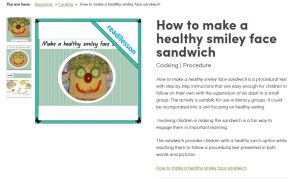
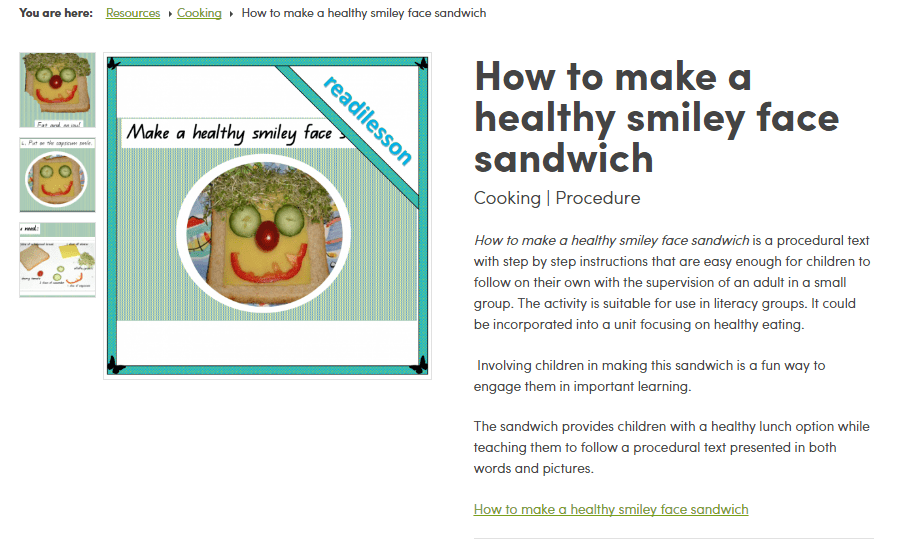
    I always organised for the healthy smiley face sandwich to be made in small groups.

    kebab 1
    © Norah Colvin

    Cutting up fruit and making fruit kebabs is suitable for small groups too. Children can be asked to bring in a serve of fruit to contribute to the choices. We used to have a daily mid-morning fruit snack so it did not require any extra effort on the part of parents, just scheduling on my part.

    © Norah Colvin
    © Norah Colvin

    One of my favourite cakes to cook with children is a moon cake. It is both fun to make and delicious to eat, and provides many opportunities for discussion. It is just as suitable for making in the classroom as it is for home. I have prepared a guided recipe which will be available on my readilearn website.

    © Norah Colvin
    © Norah Colvin

    I recently made the recipe with my grandchildren. They were eager to help and took turns to add and mix the ingredients. There are sufficient things to do to give everyone in a small group an opportunity of being involved. However, it is also suitable to do with the whole class observing while individual children do different tasks.

    tasks to do

    Making the cake provides great opportunities for observing, turn taking, vocabulary development, curiosity, and development of science knowledge. All of these contribute to life skills and experiences. And then there’s the treat at the end!

    © Norah Colvin
    © Norah Colvin

    Although involving children in tasks like cooking and cleaning at home or at school involves extra organisation and time, it is well worth it for the long-term, as well as immediate, benefits.

    Do you have any recollections of helping with tasks at home or at school? How did you feel about it? How has it influenced your current attitudes?

    Thank you

    Thank you for reading. I appreciate your feedback. Please share your thoughts.


  • You’d have to be mad!

    That is, as in M.A.D. — Making a Difference.

    I love to hear of children being involved in projects that help others, that aim to make a difference to the world. I have previously written about some of those projects here, here, and here.  Sarah Brentyn, who blogs at Lemon Shark, often shares about the wonderful ways in which she and her boys are making a positive difference in their community.

    This week I read about the M.A.D. projects of Canadian teacher Peter Cameron (a.k.a. Mr. C) and his students. At the beginning of the school year Mr. C challenged his students with the question, What will you do to make a difference? The projects, which were selected, organised, and conducted by the students, were recently completed. They included things such as:

    • Helping others on snowy days by shovelling driveways
    • Helping parents, grandparents, and great grandparents
    • Giving compliments
    • Supporting Doctors Without Borders
    • Helping the elderly
    • Helping at the Humane Society
    • Keeping their school tidy
    • Assisting the homeless by collecting socks, making supper, and hot chocolate
    • Encouraging kids to eat healthy, and to spend more time outdoors.
    • You can see a celebration of their projects in this video.

    Mr. C. said that it was one of the most rewarding aspects of his 20+ years teaching career. The acknowledgement received from their member of parliament in the Canadian House of Commons, and his encouragement for others to join in, further affirmed the merit of the project.

    Now Mr C. is reaching out to other classes around the world to join in with their M.A.D. projects and form a Global Make a Difference Team in which participants complete a M.A.D Project to help make our world an even better, happier, healthier place to live”.  Their goal is to have 100+ classes join in. Will yours be one of them?

    To make it easy, Mr. C is making available to teachers all of his resources which may be modified to suit individual classes and situations. He says,

    “The goal is simple: challenge your school, class, clubs and individual or groups of students to make a difference and see where it takes them! Be sure to let us know that your school/class will be participating and fill in the form to add your class to our M.A.D map!”

    Places on the map are so far confined to North America. How wonderful it would be for locations to be added from all around the world. Children would see not only the differences they are making in their own communities, but also the positive actions of others around the world, which may in turn, inspire further projects.

    Be sure to let us know of other projects that involve children in making a difference. I know there are many, some conducted by organisations, and others by individuals and families. They are what give us hope for the future.

    Thank you

    Thank you for reading. I appreciate your feedback. Please share your thoughts.


  • Recipes for the classroom

    cooking banner
    © Norah Colvin 2016

    As completion, and therefore launch, of readilearn, my website of early childhood teaching resources approaches, it has become obvious that some categories are less well-resourced than others.

    I consider food preparation to be a great way of involving children in learning that is fun, purposeful, integrates curriculum areas, and develops skills that can be applied in everyday life. I have previously written about learning in the kitchen with suggestions for parents at home.

    In the introduction to the readilearn cooking resources I write

    Cooking, including food preparation that doesn’t include any heating, is a great way to teach life skills and integrate learning in a meaningful and enjoyable way across curriculum areas. When children are involved in food preparation they may be developing:

    • Social skills of cooperation, turn taking, sharing, patience
    • Literacy skills – reading and following the recipe, selecting ingredients, writing a menu and invitations, writing a recount, writing a shopping list
    • Mathematics – counting e.g. the number of eggs, measuring with spoons and cups, measuring time, sharing (e.g. the number of cookies, how many slices to make)
    • Science – mixing, adding or removing heat
    • Safety – with knives, peelers and hot implements and ingredients
    • Social Studies: Culture – when preparing ethnic food

    readilearn materials are designed to engage children in activities that are both fun and purposeful, with opportunities for learning across the curriculum in a meaningful context.

    I was disappointed to realise that I had only one cooking resource prepared: How to make a healthy smiley face sandwich

    © Norah Colvin 2016
    © Norah Colvin 2016

    A remedy was required and I tried to think of other resources I could add.

    I have previously made ladybird biscuits by icing an Arrowroot biscuit and adding Smarties for spots. I will probably add that recipe in the future, but I was trying to think of something healthier to begin with. I wondered if it might be possible to make a ladybird from an apple. This is what I did:

    © Norah Colvin 2016
    © Norah Colvin 2016
    © Norah Colvin 2016
    © Norah Colvin 2016
    © Norah Colvin 2016
    © Norah Colvin 2016
    © Norah Colvin 2016
    © Norah Colvin 2016
    © Norah Colvin 2016
    © Norah Colvin 2016
    © Norah Colvin 2016
    © Norah Colvin 2016
    © Norah Colvin 2016
    © Norah Colvin 2016
    © Norah Colvin 2016
    © Norah Colvin 2016
    © Norah Colvin 2016
    © Norah Colvin 2016

    When I made one for my grandson on the weekend, I was pleased that he recognised it as a ladybird beetle, even without the spots!

    Unfortunately, it’s more suitable for an adult to make for a child than for children to make for themselves. Apples are too difficult for young children to cut. It is therefore not suitable for readilearn. However, I had fun making it and will continue to think of other recipes I can add to readilearn’s cooking collection.

    Thank you

    Thank you for reading. I appreciate your feedback. Please share your thoughts.
  • Teacher appreciation

    Readilearn bookmark

    In the US, for the entire month of May, people are encouraged to acknowledge and show appreciation for teachers who have influenced their lives. Although the first week is the main focus, I think it is wonderful to have a month dedicated to appreciating teachers. While I always felt the appreciation of my students and their parents, there seemed to be little shown in the community beyond that and it was often a struggle even to get World Teachers’ Day acknowledged in some places I worked.

    In previous posts here, here, and here, for example, I acknowledged teachers who had a positive impact upon my learning and my teaching. In this post I even shared a letter of appreciation written by a parent about me. It was lovely to read Emily Case’s Reflections on Teacher Appreciation Week and the acknowledgements she received from students and parents.

    From time to time I have shared the work of other inspiring teachers, and discussed with many, teachers who had influenced them. I was pleased to read this email in which President Obama honoured his fifth grade teacher, Ms Hefty. He said that she made everyone in the class feel special, and reinforced the value of empathy, a message which he carries with him every day.

    Thank you to my wonderful students, and their lovely Mum who made this for me!
    Thank you to my wonderful students, and their lovely Mum who made this for me!

    He wrote of librarians and their important role in bringing people and books together, and of programs to provide books for those who might otherwise not have access. He acknowledged that reading for just 20 minutes a day can have a powerful effect upon one’s life. I’m delighted to say that on those issues the President and I agree. They are familiar topics on my blog.

    For me there is nothing like passionate educators sharing their love of learning and the joy they receive from working with children.  I have to admit that it gives me goosebumps; but I am a softie at heart.

    In this post I am delighted to share with you a TEDX talk by teacher Lisa Lee who shares her passion for education and admits, as I also have, that she has learned more from her students than they ever learned from her.

    In the video she shares her belief that

    “Every single person has the capacity to make a difference”

    She also discusses the Common Core, but perhaps not in the form those words may conjure up for you. She speaks of the common core in the heart, and says it must come first. I can do nothing other than agree with her words:

    The common core – everyone one of us needs to be “valued, respected and accepted and seen as who we are”

    I hope you enjoy the video.

    Please share your thoughts and, if you care to, your appreciation for a teacher who inspired you. As President Obama said it can be a teacher who inspired you, a book that changed you, or a college that shaped you.”

    Thank you

    Thank you for reading. I appreciate your feedback.

  • Who teaches whom?

    GDJ, Playful stick figures https://openclipart.org/detail/230070/playful-stick-figure-kids
    GDJ, Playful stick figures https://openclipart.org/detail/230070/playful-stick-figure-kids

    The importance of play to a young child’s development and learning is a recurrent theme on my blog. Equally so is the recognition of parents as their child’s first and most important teachers. Alongside this is my acknowledgement of the contribution made by my children to my own learning, especially to my understanding of how children learn.

    Although I was often reminded that I had declared, “I’ll teach him,” when a younger brother was born, I had never given a great deal of thought to the teacher-role of siblings. How much that had to do with the reminders of my promise only coming when “naughty” things were occurring, I’m not sure.

    Whatever the reason for my lack of consideration, I was quite delighted when I came across the post Siblings are a young child’s most influential teacher by Deborah Stewart on Teach Preschool. In this lovely post Deborah provides a wonderful list of lessons learned from siblings, and supports it with beautiful photographic evidence of her three gorgeous grandchildren.

    Included in her list are things like learning to:

    • be imaginative
    • trust
    • be brave
    • try new things
    • be kind
    • laugh, and
    • love.

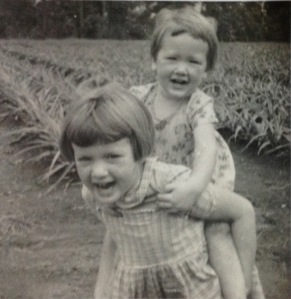
    I have a large number of siblings from whom I’m sure I learned many things. As my younger brother could testify, probably not all of them were good. Deborah’s post challenged me to think about what those lessons might have been.

    My big sister and me © Norah Colvin
    My big sister and me © Norah Colvin


    Here are some of the (better) ones I thought of, that weren’t on Deborah’s list:

    • to share, to take turns, and to wait (unless there’s only a few more cookies or lollies on the plate, then you’d better get in quickly before someone else does!)

    marshmallow 5

    • that you can’t always be first or win, and
    • that the world doesn’t revolve around you
    • to make our own fun by creating our own games
    • to get along with children of all ages
    • to play without the constant participation or supervision of adults
    • to look out for and look after each other
    • to plan together
    • to forgive and get on with it
    • that a combined effort was more likely to get us an ice cream from the ice cream van than a succession of individual appeals.
    www.morguefile.com
    http://www.morguefile.com

    Some of these lessons weren’t easy, and some are still in progress, but important life lessons nevertheless.

    What about you? Do you have siblings, or are you an only child? If you have siblings, what have you learned from them?

    Thank you

    Thank you for reading. I appreciate your feedback. Please share your thoughts.


  • Don’t fence me in

    This week at the Carrot Ranch Charli Mills is talking about anxiety, panic attacks and agoraphobia.

    The following statements taken from the Mayo Clinic website explain agoraphobia as:

    “a type of anxiety disorder in which you fear and often avoid places or situations that might cause you to panic and make you feel trapped, helpless or embarrassed.”

    “The anxiety is caused by fear that there’s no easy way to escape or seek help if intense anxiety develops.”

    “Most people who have agoraphobia develop it after having one or more panic attacks, causing them to fear another attack and avoid the place where it occurred.”

    “Agoraphobia treatment can be challenging because it usually means confronting your fears.

    Sometimes, as Charli says, we can face our fears head on and defeat them with the choices we make. Other times we may need support to help us overcome them. Sometimes therapy and medication may be needed to help those suffering the debilitating effects of anxiety. I will not be discussing those paths in this post. Nor am I going to talk about the anxieties of children with Asperger’s or Autism. There are others who do a much better job of it and are much more knowledgeable than I, such as Sherri Matthews and Shawna Ainslie.

    school cropped

    However, it is not uncommon for a child to occasionally feel anxious and stressed by situations that occur at school. The incidence increases when children are placed in situations that are inappropriate to their development and don’t respect their needs. Sometimes the anxiety and stress is manageable and alleviated by more appropriate circumstances outside of the school environment. But sometimes the distress to the child and family can increase to a level at which more help and support is required.

    A school environment more suited to children’s needs would reduce the number of anxious and stressed students, parents, and teachers. Creating a nurturing and supportive school environment requires a firm understanding of child development and a belief in their ability to learn. It also requires that children are respected and appreciated for who they are, and that they receive timely and appropriate feedback, encouragement, and support.

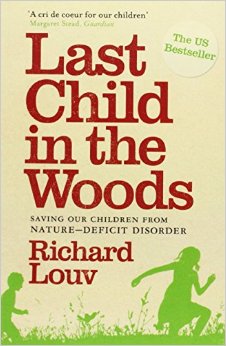
    last child in the woods


    In recent posts I have mentioned the importance of play, and of time spent in, and learning outdoors, in nature. In his book Last Child in the Woods, Richard Louv espouses the importance of nature to the development of healthy children, as well as to the physical health and well-being of adults. Perhaps more time in nature would provide the calm that is needed to combat the hustle and bustle of modern life and pressures of formal, test-driven classrooms.

    In fact, it is not just “perhaps”. In his article The School of Nature Louv provides evidence of benefits to learning that nature-based and place-based education can bring. He says, “greening schools may be one of the most cost-effective ways to raise student test scores.

    earth in mind

    David Orr agrees. In his book Earth in Mind: On Education, Environment and the Human Prospect, he also stresses the importance of learning about, from, and in nature.  He says, that, “all education is environmental education. By what is included or excluded we teach students that they are part of or apart from the natural world.”

    It is easy to talk about the failings of the school system and suggest ways it could be improved. It is more difficult to make the desired changes happen. While the majority of teachers work hard to create warm, supportive, nurturing environments for children, there are many situations over which they have no control. It is important then to have strategies for dealing with anxiety and stress if they occur.

    stress can really get on your nerves

    I recently came across a book that may be useful if your child tends towards anxiety.  Stress Can Really Get on Your Nerves aims to provide children with strategies for coping with stress. Written by Trevor Romain and Elizabeth Verdick, it is published by free spirit Publishing as one of a series aimed at helping 8 – 13 year-olds “get through life rough spots”. With Trevor’s fun, cartoon-like illustrations on every page, the book promises to turn stressed out kids into “panic mechanics” with a toolkit of suggestions for reducing their own stress levels. I’d have to say, they’re not bad strategies for anyone’s toolkit.

    https://openclipart.org/detail/2921/toolkit
    https://openclipart.org/detail/2921/toolkit

    I first heard about the book on the free spirit publishing blog in a post by Trevor in which he explains how drawing helped him cope with his learning difference. Trevor may be an outlier, but his story certainly provides inspiration for those who struggle in the traditional classroom.

    cropped forest

    I think time outdoors, breathing the fresh air, and enjoying the natural world is a great antidote to stress. I may no longer gambol in the grass, but I can sit in stillness and quiet, appreciating the beauty around me as I unplug from technology and reconnect by grounding myself in nature. I’m not sure how that works for agoraphobics with a fear of open places though. Perhaps having more time in nature as a child and learning techniques for coping with anxiety and stress could work as a preventative. But it’s only a thought. I am no expert.

    This brings me back to Charli Mills and her flash fiction prompt to In 99 words (no more, no less) write a response to an agoraphobic moment.  I have used the Mayo Clinic’s broader interpretation rather than the “narrow” definition of “fear of open spaces”. (I’d rather not be fenced in!) I hope my story portrays a recognisable response that could occur in a variety of circumstances. Please let me know what situation you think of as you read, and whether you consider my attempt successful.

    Confrontation

    She could hardly manage to chew, let alone swallow, the morsel of cereal occupying her mouth.

    Her vacant stare and stifled moans alerted him.

    “Are you okay?”

    “I’m trying,” she mumbled, and squeezed her hands between her quivering knees.

    “You’ll be fine. You haven’t had an attack for months. And, you’re prepared.”

    “I know.” She pressed her arms against her gurgling belly. “But …”

    He waited.

    Finally, she looked at him. “But …”

    He sponged her clammy forehead.

    She looked away. “What if they don’t like me?”

    “They won’t like you. They’ll love you. Come on. I’ll take you.”

    What did you think of as you read? I wrote the piece about young teacher about to meet her first class. Did you pick it?

    While anxiety about school is more commonly thought of as presenting in children, it is not uncommon for teachers to suffer from school anxiety as well. We accept that teaching is a stressful role, but for some it can also cause anxiety.

    I think there are few who are immune from anxiety. We need to be more open in talking about mental health in general. Recognition, acknowledgment and supportive discussion are important factors in helping to overcome the effects of anxiety.

    Thank you

    Thank you for reading. I appreciate your feedback. Please share your thoughts.

  • Let’s Talk About Purposeful Play

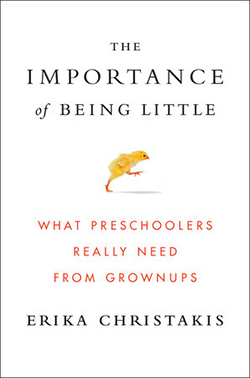
    Earlier this week I shared a post and a new book, The Importance of Being Little by Erika Christakis, about the importance of play for young children.

    the importance of being little
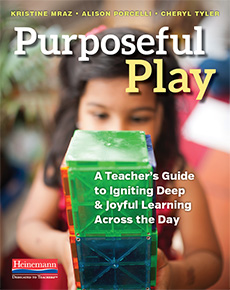
    Today I wish to share another post and another new book about the importance of play. This book by Kristi Mraz, Alison Porcelli, and Cheryl Tyler is called Purposeful Play with the tagline Igniting Deep and Joyful Learning Across the Day. (Hint: Click on Kristi’s post here for a chance to win a copy of the book. Read more about the book here to download the first chapter free!)

    Purposeful play
    These three teachers begin by stating that all play is purposeful and explain ways of honouring children and their play throughout the day in early childhood classrooms. This book is full of practical ideas for teachers who want to incorporate more play to foster children’s learning and maintain their enthusiasm for and enjoyment of it.
    If you wish to make your teaching day more playful, either of these books will provide ideas to get you started.

    Thank you

    Thank you for reading. I appreciate your feedback. Please share your thoughts.
    kristimraz's avatarkinderconfidential

    I am so excited to share that in a week or so my new book (with Alison Porcelli and Cheryl Tyler- play gurus and authors of this handy book on choice time) about PLAY will descend upon this fine earth!!!! Now, listen, there is nothing I like to do more in advance of a new book coming out then have imaginary conversations of excitement and anxiety in my head. As a matter of fact, if you wake up at 3 AM to go to the bathroom, please rest assured that I am staring at my ceiling trying to execute everything I learned while writing A Mindset for Learning.

    So, in the hopes of getting the word out about the book, and also maybe stop communing with my ceiling in the wee hours of the morning, I thought it might be nice to put out a post that conquers some of the…

    View original post 1,278 more words

  • Let them play!

    GDJ, Playful stick figures https://openclipart.org/detail/230070/playful-stick-figure-kids
    GDJ, Playful stick figures https://openclipart.org/detail/230070/playful-stick-figure-kids

    Play is essential to learning, and creating an environment which allows for play while nurturing children’s learning and development is as important as creating an environment that nourishes and encourages the growth of plants in a garden. The link between the two was first recognised by Froebel in the early 19th century when he coined the term “kindergarten” which translates to “garden for children” (kinder meaning child and garten meaning garden), and created the first educational toys.

    Froebel “devoted his life to educating children and developing methods to maximize human potential”. He was the first to recognise the importance of a child’s early years (birth to three) and considered creativity to be something in all of us.

    Froebel’s kindergartens were the first “formal” education for young children and his work greatly influenced that of other educators such as Maria Montessori and Rudolf Steiner. His beliefs, for example that children have both unique needs and capabilities are still influential today. He believed in the importance of play and some of his toys were favourites of people such as Buckminster Fuller and Albert Einstein.

    I have touched on the topics of playcreativity and children’s uniqueness in previous posts. A respectful, encouraging, nurturing and stimulating environment underpins all that I value in education; as does a belief in the power of play to develop understandings of self, of others and relationships, of the world and how things work, and to inspire thoughts of what could be, to imagine possibilities never before imagined.

    johnny_automatic_playing_dress_up

    While Froebel’s beliefs, and those of his followers, are still valid, sadly they are often disregarded by those who wield the power in education, who dictate otherwise.

    In a previous post I shared an article by Paul Thomas who attributed his readiness to learn at school to the richness of his home environment. He also decried the formal tedium of school lessons which contribute much to curbing a child’s enthusiasm for learning. Paul is not alone in his views. There are many teachers who agree with him, myself included, as I have shared many times before, including here and here.

    I am not the only early childhood teacher to be saddened and appalled by the formal approach that has been enforced upon teachers, replacing play-based approaches in classrooms for children as young as four. With the administration of standardised tests and the publication of graded results, children are labelled successes or failures before they have had a chance to develop. Those children from privileged backgrounds, as described by Thomas in Formal Schooling and the Death of Literacy will be immediately successful. Those from less advantaged backgrounds will be labelled failures. Unfortunately, the labels are often reinforced with little chance of replacement.

    A+   F

    I am always gladdened when I hear another expounding the benefits of play and the importance of child-centred approaches to learning and teaching. I hope that when enough voices unite in this important message, the tide will start to turn, and those with the power to make changes will do so in favour of children.

    the importance of being little

    This week I read another article stressing the importance of play for young children. The article, written by Susan Gonzalez for Yale News, introduces a recently published book by Erika Christakis The Importance of Being Little. I have not yet read the book, but I know that I will agree wholeheartedly with its content. The title itself tells me the value of its message.

    © Norah Colvin
    © Norah Colvin

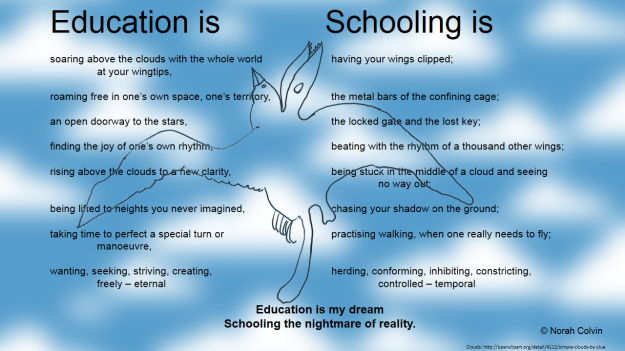
    In words reminiscent of my poem “Education is” Christakis says that “schooling and learning are often two different things.” Here is just a sprinkling of her thoughts reported in the article.

    • children are capable and powerful but our expectations are often mismatched
    • we ask too much of children pragmatically but not enough cognitively
    • there is too much teacher-direction and not enough time for play in many preschool classrooms
    • teachers need to take the time to listen to children’s stories, to laugh with them, to get down on the floor, at their eye level, and figure out what makes them tick … (through) … respectful observation
    • childhood pedagogy should be based on ideas, not on the repetition of simple skills
    • respect for early childhood as a life stage worthy in its own right and not merely as a training ground for an adult future

    These are ideas I have oft repeated here on my blog. Please read the article in full and, if you are as inspired as I am, read the recently published book The Importance of Being Little. I’d love to know what you think.

    Thank you

    Thank you for reading. I appreciate your feedback. Please share your thoughts.