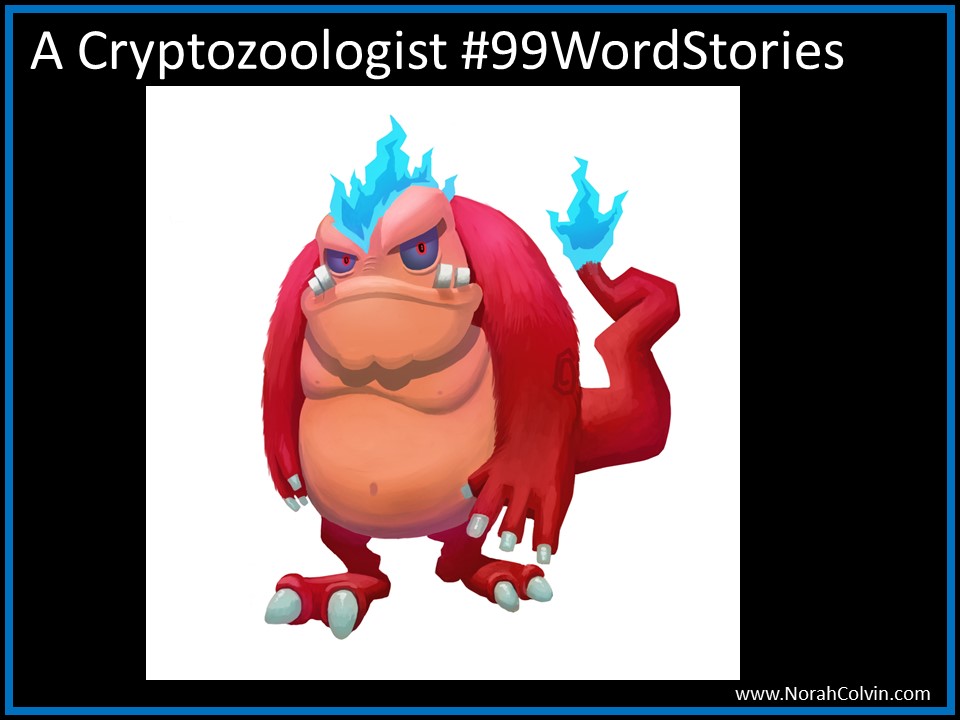
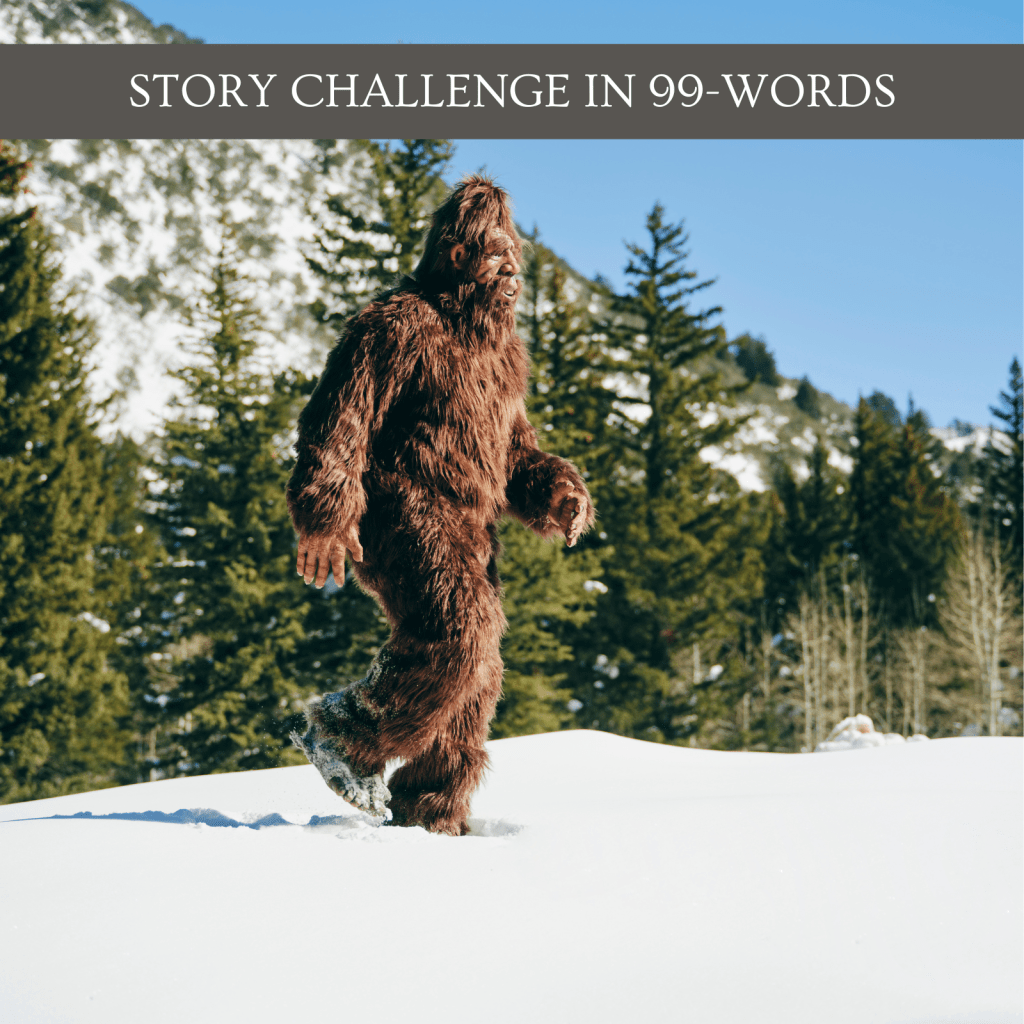
For my story, I’ve gone back to the family reunion for another take with Jodie and the dark stranger. Like Josie, I’d never heard of a cryptozoologist before. Do they really exist?
The Cryptozoologist
Josie and her cousins stood around the punch bowl, quenching their thirst after a rowdy line dance (family tradition). Josie was catching up on all the goss she’d missed out while away: who was with whom, who’d broken up, etcetera.
“What about him? Who’s he with?” she nodded towards the lone one in the shadows.
“Don’t worry about him. He’s just with himself.”
“What do you mean?”
Susie laughed. “He’s a cryptozoologist.”
“A crypto-what? Does he mine cryptocurrency?”
“Not that interesting. He studies cryptids.”
“What are cryptids?”
“Imaginary monsters. They’re all in his mind.”
“Oh?” said Josie.
Everyone laughed.
Thank you for reading. I appreciate your feedback. Please share your thoughts.
Note: The collection of stories made in response to the previous prompt Confidence, including mine, can be read at the Carrot Ranch.
In a number of previous posts I questioned the importance of getting the facts right in fiction, especially for young children. Obviously there is a lot of fiction that is pure make-believe and fantasy and the facts don’t have to match those of the “real” world. However they do need to hold true for that imagined world.
The posts (links provided at the end if you wish to read) incited a great deal of discussion. A variety of opinions were expressed ranging from it doesn’t matter at all to it matters a lot. It seems many are willing to forgive inaccuracies in fiction if the book’s positive qualities make it more appealing. If the book as a whole is good, what is a little inaccuracy?
On the other hand, a book that “fails” for other reasons such as inadequacies or inconsistencies in plot, poor sentence structure, incorrect punctuation and spelling errors would fail regardless of the accuracy of the “facts”. Perhaps it is easier to accept one fault in an otherwise worthy product than it is to accept a faulty product with one redeeming feature?
“Write a nonfiction book, and be prepared for the legion of readers who are going to doubt your facts. But write a novel, and get ready for the world to assume every word is true.”
In the post Thomas refers to the movie Lucy, released in July 2014, which explored the effects of using more than 10% of our brains. Of course we do use more than 10% (100% in fact) but there is a commonly held myth that we don’t, and the movie served to perpetuate it.
In his post Thomas questions “when is fact, fact, and when is fiction merely fiction?” similar to the discussion in my posts. He says that the 10% of our brains myth is still widely accepted despite advances in neuroscience and understandings of how our brains work. He refers to the way “we” seek out information that supports our beliefs and ignore that which doesn’t. Mind you, in his article he mentions some myths related to education which I am going to ignore for now. I’ll leave those for another time.
Working towards his conclusion Thomas states:
“How much of our brains we use seems pointless if we remain a species characterized by closed minds, unable or unwilling to build on evidence to form new ideas, unable or unwilling to check our existing ideas against evidence.”
I’m inclined to agree.
What do you think? Do you accept the 10% myth or do you know it to be untrue?
Did you watch the movie Lucy? If so, how did your understanding of the 10% premise affect your enjoyment?
I’d love to know what you think.
Thank you for reading. I do appreciate your feedback. Please share your thoughts.
Links to my posts exploring false “facts” in fiction:
I am not a reader of adult fantasy novels. I have never read Lord of the Rings, The Hobbit or Watership Down. I just couldn’t buy into it. I’m sorry I have to admit it – it is true.
However, I don’t mind a bit of fantasy in children’s books and, in fact, really enjoy it. I didn’t mind the rats’ use of language in Robert C. O’Brien’s The Rats of Nimh while I couldn’t handle the talking rabbits in Watership Down by Richard Adams. I cannot explain why my response is different but I’m sure it has something to do with the ability to suspend disbelief. I am obviously more able to do that when encountering fantasy in children’s stories than in adult fiction.
As both parent and teacher (and now grandparent) I love sharing stories with children. In addition to all the good things I know it is doing for them, it is doing lots of good things for me as well. Reading children’s stories written by masterful authors is one of life’s greatest pleasures and I love having excuses for doing so.
This week the flash challenge issued by Charli Mills at the Carrot Ranch was to
I am taking the opportunity of sharing with you some of my favourite fantastic creatures and magical realms from children’s stories. Each of these stories is wonderful to read aloud and share with children.
Charli mentioned rainbows, unicorns and the phoenix.
I thought of The Iron Man by Ted Hughes (a story in five nights, suitable for children from age 5 – 104)
“Taller than a house, the Iron Man stood at the top of the cliff, on the very brink, in the darkness.
The wind sang through his iron fingers. His great iron head, shaped like a dustbin but as big as a bedroom, slowly turned to the right, slowly turned to the left. His iron ears turned, this way, that way. He was hearing the sea. His eyes, like headlamps, glowed white, then red, then infra-red, searching the sea. Never before had the Iron Man seen the sea.
He swayed in the strong wind that pressed against his back. He swayed forward, on the brink of the high cliff.
And his right foot, his enormous iron right foot, lifted – up, out, into space, and the Iron Man stepped forward, off the cliff, into nothingness.”
and The BFG by Roald Dahl. (a longer tale for school age, and older, children)
“It wasn’t a human. It couldn’t be. It was four times as tall as the tallest human. It was so tall its head was higher than the upstairs windows of the houses. Sophie opened her mouth to scream, but no sound came out. Her throat, like her whole body, was frozen with fright.
This was the witching hour all right.
The tall black figure was coming her way. It was keeping very close to the houses across the street, hiding in the shadowy places where there was no moonlight.
On and on it came, nearer and nearer. But it was moving in spurts. It would stop, then it would move on, then it would stop again.
But what on earth was it doing?”
I thought of Joan Aiken’s wonderful collections of fairy tales like A Necklace of Raindrops (for children in early years of schooling)
“And when she had nine raindrops Laura found that she could make the rain stop, by clapping her hands. So there were many, many sunny days by the sea. But Laura did not always clap her hands when it rained, for she loved to see the silver drops come sliding out of the sky.
Now it was time for Laura to go to school. You can guess how the other children loved her! They would call, “Laura, Laura, make it stop raining, please, so that we can go out to play.”
And Laura always made the rain stop for them.
But there was a girl called Meg who said to herself, “It isn’t fair. Why should Laura have that lovely necklace and be able to stop the rain? Why shouldn’t I have it?”
and The Kingdom Under the Sea (for children approx. 8 -12), each beautifully illustrated by Jan Pienkowski adding another element of wonder to the tales.
Charli suggested that we “think of how (we) can use the fantastical to enrich realities” and I thought of the mouse who invented The Gruffalo in Julia Donaldson’s story and showed how imagination could be used to solve problems that arise. (The Gruffalo is suitable for children in pre-school and early years of schooling)
While the above excerpts are short, like flash fiction, each demonstrates the skill of the author in choice of words and sentence structure. In his book On WritingStephen King refers to these as forming the top level of the tool box. But these excerpts show a depth greater than that also. They create a connection, forming a relationship with and a need in the reader to know what happens.
It is the ability of the author that sweeps us away, as if on a magic carpet, to other places and other lives. It is the ability of the reader to suspend disbelief that allows the journey to occur.
I thought about how we, as either child or adult, use fantasy to escape realities that we may not wish, or not feel strong enough, to face. This brought me back to Charli’s unicorn.
And now I offer my own bit of flash, which is not suitable for reading to children of any age.






 Norah Colvin