Live Love Laugh Learn … Create the possibilities

Tag: explicit knowledge

  • Ignorance is bliss … Learning to be explicit

    My Dad used to say that what I didn’t know wouldn’t do me any harm. He was not impressed when a brother wrote in my autograph book when I was in my early teens that what I didn’t know wouldn’t do me much good either!

    © Norah Colvin
    © Norah Colvin

    I’m torn between the two. I have come to realise that the more I know, the more there is to learn.

    the more I know the more there is to learn

    This learning journey never ceases. Each step is just one further into the unknown. I seem to know less now, or need to know more now, than I ever have before. How can that be?

    There are those around me who are content with who they are, with where they are, with what they are doing, and wake up to each day wanting no more than it brings. I strive to achieve that contentment, and practice the joy of being in the present moment, believing strongly in its rewards. But at the same time I strive to do more, to learn more, to achieve more. The doing and learning is joy in the present moment, for me. It is both exhilarating and disheartening to realise that the learning journey stretches so far ahead.

    Learning about learning

    I have spent almost my entire life thinking and learning about learning and education, particularly literacy education and the education of young children. Though the journey has been long, my knowledge is narrow and small, and of absolutely no use in a trivia quiz, unless the question happens to be about a nursery rhyme, and then don’t ask me too much about its “real” or original meaning.

    GDJ, Humpty Dumpty https://openclipart.org/detail/223086/humpty-dumpty
    GDJ, Humpty Dumpty https://openclipart.org/detail/223086/humpty-dumpty

    When I set upon my journey to create a website of teaching resources that I had made, I thought it was an easy thing. I had many resources already made. I just needed to get some illustrations done and put them on a website. What could be simpler than that?

    Simple?

    Every step I take drives me deeper into complexity, into the unknown. Unravelling the complexity demands that I be explicit, that I see and describe each minute step.

    Being explicit

    I always considered the ability to be explicit, to see and understand each step, essential to effective teaching in an early childhood classroom. If one was unable to see the exact spot where a child was going wrong, where a misunderstanding had been formed, or a misconception learned, or the potential for its occurrence, it was difficult to either prevent or repair it. I considered that ability to be one of my strengths as a teacher.

    nicubunu, broken chain https://openclipart.org/detail/22063/broken-chain
    nicubunu, broken chain https://openclipart.org/detail/22063/broken-chain

    Over the past few years when I have been giving art briefs to illustrators, my need to be explicit was stretched anew. I had to describe in precise detail exactly what I wanted. It was no use saying I wanted a castle on a hill and expect that the artist would be able to fill in all the details I could see in my mind. I had to explicitly describe it in detail:  did it need a moat or a drawbridge, was the drawbridge to be up or down, were there turrets or flags, and if there were flags, what colour and design they would have, how many windows, how many people, and what were they doing and how were they dressed …
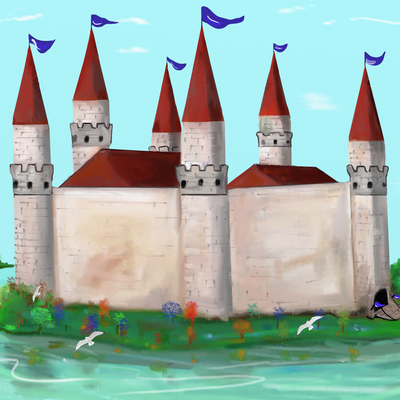
    © Norah Colvin Artwork by Kari Rocher Jones
    © Norah Colvin Artwork by Kari Rocher Jones

    Then it was time to start thinking more specifically about what I required of the website … More complexity to unravel!

    frankes, ship – colored  https://openclipart.org/detail/214500/ship-coloured
    frankes, ship – colored https://openclipart.org/detail/214500/ship-coloured

    Oh for a journey across the seas rather than deeper into complexity!

    It is said that it is darkest before the dawn. How much darker will it get?

    A recent comment by Sarah Brentyn of Lemon Shark alerted me to the fact that although I have mentioned my website in previous posts, I had not made it clear that the purpose of the website is to make my resources available through subscription i.e. to sell my resources. While some will be available without subscription, many will be available only by paid subscription. I have received a quote for establishing the website, which I am considering. I have previously referred to it being my jetski. I think I was fairly explicit about my requirements in discussions with the designer.

    However, I want some of my resources to be interactive, not downloadable, used only on the website by paid subscribers. It appears that creating the types of interactivity I have in mind will be more problematic, but they are what I consider will be my point of difference. I have had to learn to explain, very explicitly, the types of interactions I require. I even made videos demonstrating the interactions in the hope of achieving greater clarity.

    However, it was while being explicit about these steps that I realised I had omitted something from my website brief that will be necessary for the interactions to be used effectively, if they can be made at all.

    © Norah Colvin
    © Norah Colvin

    And so I go in my merry dance – up the ladders and down the snakes, hoping to fall into a pool of clarity rather than a puddle of complexity.

    Thank you for allowing me to express my muddle through writing in an attempt to make sense of it all.

    Thank you

    Thank you for reading. I appreciate your feedback and suggestions. Please share your thoughts.


  • Experiential learning – what’s good and what’s hot

    farm

    I am a proponent of learning by experience, of learning through one’s own explorations and making one’s own discoveries. In early childhood centres it is sometimes called ‘hands on’ learning. The recommendation is to provide opportunities for children to learn by doing rather than simply by listening to someone tell about it or by reading information in a book. For example, experiencing the sights, smells and sounds of a farm create an enriched understanding of farm life that is not possible simply from looking at pictures of farm animals in a caption book. Activities like mixing and making with modelling dough, or building and creating with construction sets provide opportunities for developing numerous skills and understandings.

    That’s not to say that experiential learning is best in every situation or that learning from the explanations of others, including reading information in a book, is less worthy. Indeed there is a place for each and it is important to get the balance, timing and application right. You would not need to view many posts on my blog (for example here and here) to realise that I am a proponent of reading also and believe that instilling a love of reading is one of the greatest gifts a parent can give a child.

    In their book A New Culture of Learning: Cultivating the Imagination for a World of Constant Change, Douglas Thomas and John Seely Brown discuss the differences between explicit knowledge and tacit knowledge.  This chart shows my understanding of some of the differences.

    Explicit and tacit learning


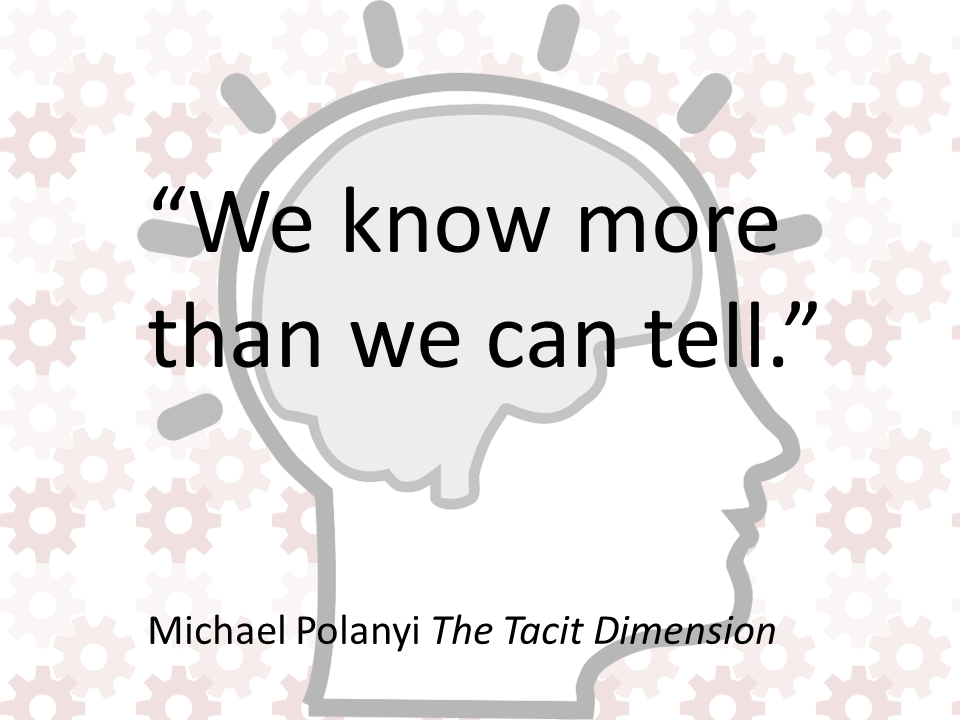
    Michael Polanyi  The Tacit Dimension

    I think it would be undisputed that there is knowledge best learned through explicit instruction and other best learned through experience. I am sure you can think of many examples in your own life, like riding a bicycle, learning a foreign language or playing a musical instrument.

    netalloy, glossy flame https://openclipart.org/detail/91951/glossy-flame
    netalloy, glossy flame https://openclipart.org/detail/91951/glossy-flame

    But what about teaching young children about heat? It is not far into the life of any young child that they are cautioned about the heat of an oven or stove, heater or barbecue plate. But what is “hot” if you have never experienced it?

    Thomas and Brown say that “when a parent first tells a child not to touch a flame because it is hot, the child will almost always put out her hand and get burned” because the child has only been given the explicit part of the information, the part that could be articulated: that “Fire is hot”. When the child is burned much more information is learned by the body: that it hurts and is unpleasant. The child is then able to make connections with other similar “hot” things and situations.

    I think neither of the authors nor any parent would suggest a child be burned “for educational purposes” but the power of experience can be seen in this example. Perhaps it also helps to explain why young children need constant reminders to stay away, or precautions need to be taken to protect them, from hot things. Without the burning sensation they have not formed a true understanding.

    thomas and brown - learning

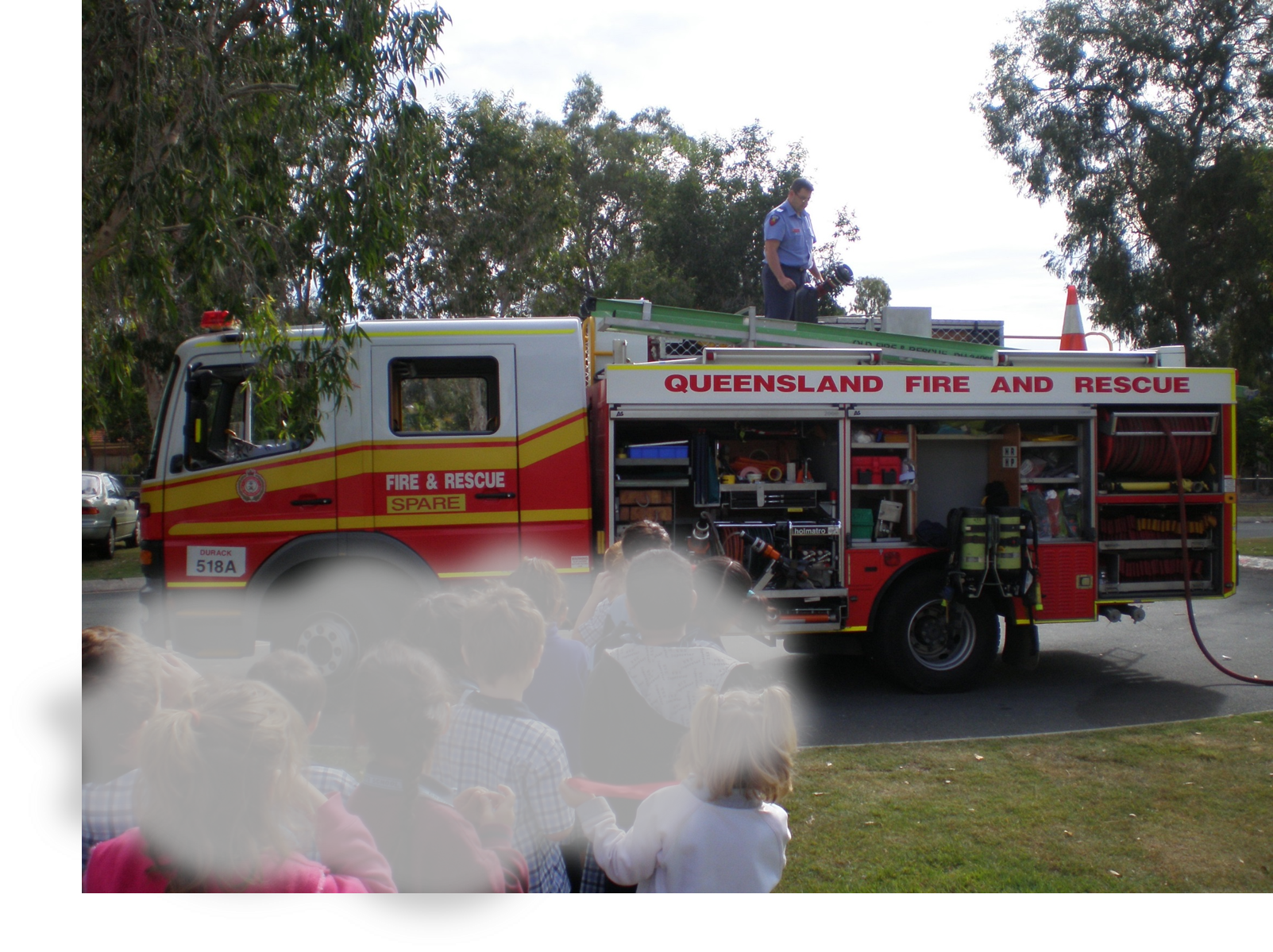
    At my previous school our year one classes were always visited by the local fire fighters who talked about fire safety, explaining the difference between “good” fires (like birthday candles, barbecues and campfires) and “bad” fires, while warning that even good fires could quickly become bad  if not monitored correctly.

    They talked about the need for smoke alarms in the home and the importance of having escape routes and meeting places planned and practised. They ensured students knew their full name and address and the procedure for calling emergency (000 in Australia) if the need should arise. These are things that all young children should know.

    firetruck

    The children were always excited about the firefighters’ visit as they got to look at the firetruck close up, maybe even sit in it or, if they were lucky, see how high they could spray water with the large hose. The tacit knowledge learned through this type of experience, combined with explicit knowledge provides a context that allows children to learn the realities of fire danger and the importance of safety. It wasn’t unusual for the crew to receive a call and rush away during one of their visits, adding further to the overall experience for the children.

    rg1924, unexpected frog in my tea    https://openclipart.org/detail/21079/unexpected-frog-in-my-tea
    rg1924, unexpected frog in my tea https://openclipart.org/detail/21079/unexpected-frog-in-my-tea

    Thinking about heat and education, and the hold that explicit knowledge and its testing has on current practice makes me think of the story about a frog in a pot of hot water.

    The story says that if you were to put a frog into a pot of hot water, it would jump out immediately; but that if you were to put the frog into a pot of cold water which is warmed slowly, the gradual increase in temperature wouldn’t be noticed and the frog would be boiled alive.

    Perhaps this is why some educational practices are accepted without question. People have become so used to them, with small incremental changes seeming insignificant and unworthy of comment. However the cumulative effects over time can be enormous. By the time they are realised, making amends would require so great a change, possibly a total restructuring, that it would defy plausibility.

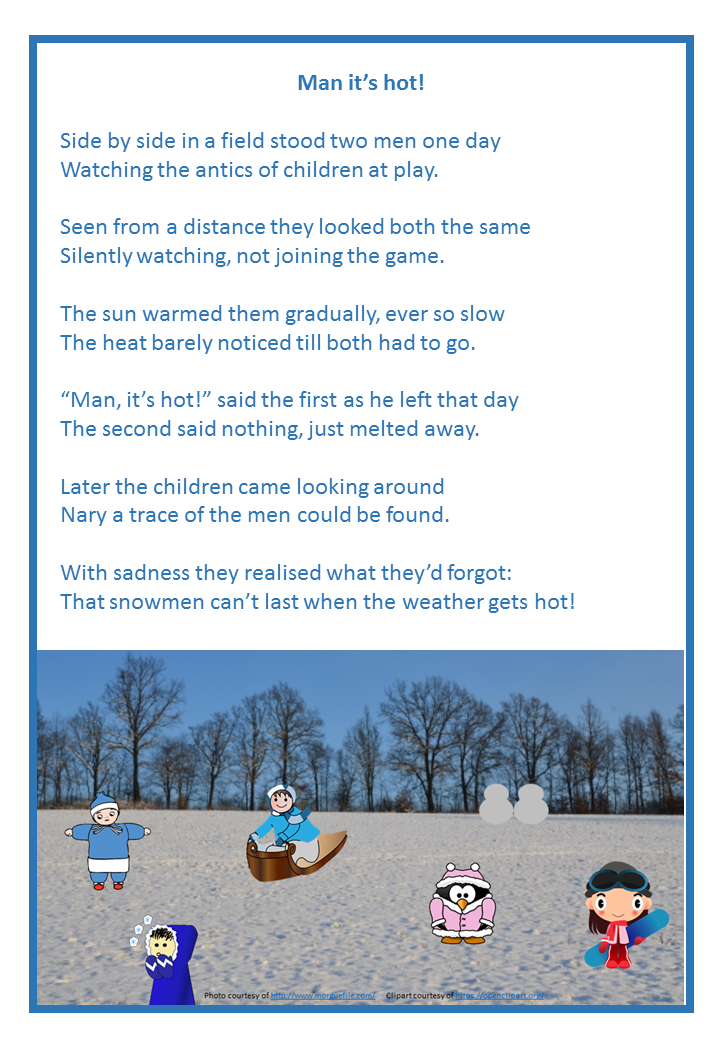
    It is this thinking that has led to me my flash response to the challenge set by Charli Mills at the Carrot Ranch this week to In 99 words (no more, no less) write a story that includes the phrase, “Man, it’s a hot one.” I hope my contribution is a little more environmentally friendly and suitable for young children than boiling frogs.

    Man it's hot

    Thank you

    Thank you for reading. I appreciate your feedback. Please share your thoughts about any aspect of this post or flash fiction.