The themes of emotional intelligence, empathy and compassion have featured frequently on my blog, especially the need for them to be incorporated into classroom practice and taught, particularly through modelling, to children.
My most recent series of posts about compassion, starting with Who cares anyway? and concluding with Ripples through time, with three more in between, were prompted by the #1000Speak for Compassion Project.
I thought I was done with that theme for a little while at least, but last night I read a very moving post by Julieanne Harmatz on her blog To Read To Write To Be.
Julieanne wrote with much emotion and compassion about a child in her class; a child who tears at your heartstrings, (and sometimes makes you want to tear out your hair), a child most teachers will recognise from their practice, a child you wish to be everything to but know that at least if you can be someone who really sees the child within, for a little while, you have done something worthwhile.
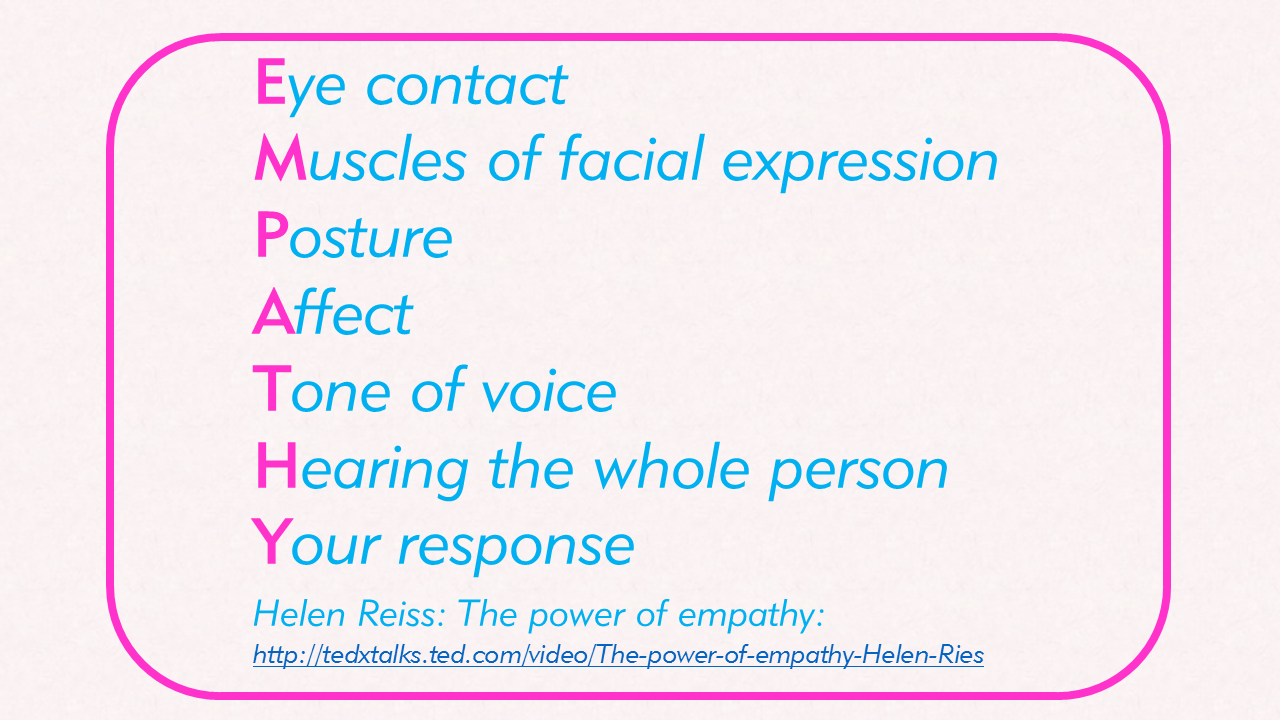
I urge you to read Julieanne’s story, and watch the TEDxtalk by Helen Riess that Julieanne has embedded in her post. Riess explains what empathy means through this acronym:
Thank you for reading. Please share your thought about any aspect of this post.
Magic moments happen in teaching, and they make our hearts soar.
But, there are moments that can break. Us and our hearts.
Z is struggling. He lies down on the picnic table outside the room. When we’re all inside, he enters saying, “I don’t want to sit there.” He paces. We look for a place. He settles beside N. Then moves. Again and again. Searching for a spot.
Sitting is painful. School doesn’t fit, and the discomfort emanates from his being.
Someone says something about dads. He blurts, “My dad doesn’t come home no more.”
Gulp.
Enter Reading Workshop. Z gets together with his book group they are planning. Z says, “I don’t read at home. I read here, not at home.”
Later, Z paces in the corner, reading his book, Reading and walking, in circles. This is his way.
Lunch happens. Z doesn’t eat. He doesn’t want to. Can’t. He just…
Today is the day that over 1000 bloggers have answered the call to unite in dedicating a post to and voicing an awareness of the need for compassion. The call is to “flood the blogosphere with good”. I am adding my voice to the number.
In my most recent post Who cares anyway? I linked to a TED talk by Joan Halifax.
In her talk Halifax explains that compassion is good for us, it enlivens us and makes us resilient, it also develops our immunity. She asks “if compassion is so good for us, I have a question. Why don’t we train our children in compassion?”
I think Halifax’s question is an excellent one. It has great appeal and interest to me as an educator. In this and one or two future posts I will explore and provide suggestions for developing compassion.
In the talk Daniel talks about a study into the reasons why, when we have many opportunities to help, we don’t always do so. He suggests that one reason is that we are not focused in the right direction. He says, “if we attend to the other person, we automatically empathize, we automatically feel with them.” He suggests that if we are focused on ourselves; our own needs and problems like time constraints; then we won’t be focused on the needs of the other, and are therefore less likely to help, less likely to be compassionate.
This issue of attention has been raised previously on my blog, including in the guest post written by Anne GoodwinExamining Praise which discussed the work of psychoanalyst Stephen Grosz. Paying full attention to the other seems to be the best form of praise as it means really tuning in to the other. It is only by that tuning in, by attending to the other than any real understanding, and therefore compassion can be felt.
In his talk about compassion, Goleman says that the differences between focusing on self and focusing on the other can be subtle, but he urges us to be mindful of them. He talks about atrocities being done because the perpetrator was able to “turn off” the part of himself that would feel empathy. If that part had not been turned off, the actions would have been impossible.
He goes on to talk about “the possibilities of a compassionate consumerism”, pointing out that everything we buy has hidden consequences. He says that often “we’re oblivious to the ecological and public health and social and economic justice consequences of the things we buy and use.”
These hidden consequences are something that I am learning to be mindful of, but although I use my Shop ethical supermarket and Sustainable Seafood guides, I know that I still have a long way to go to be truly ethical and, as a consequence, compassionate in all my purchases.
Goleman raises a lot of interesting issues regarding compassion. I urge you to watch his entire video. There is sure to be at least one idea worthy of your further consideration. Goleman concludes the video saying that all it takes to get people to act compassionately is “that simple act of noticing, and so I’m optimistic.”
Goleman says that compassion is implicit to TED talks. There are many others about compassion. You can find a list of them here.
For me, Daniel’s talk highlights the fact that there are many ways of expressing compassion. Some are of those ways affect people who are near to us, and the effects are clearly visible. Others have a more lasting impact upon people we may never see, but for whom the effects can be just as, if not more, life changing.
Two important actions we can begin implementing immediately, and which we can model for children to implement, in order to become more compassionate are:
Pay attention
be more attentive to others
take notice of those around us
give our full attention to those we engage with by focusing on what they are saying rather than what we can say next
Consume ethically
become aware of hidden consequences:
to others who are engaged in the production processes
to the environment
to the long-time economy
In future posts I will explore further suggestions for developing compassion.
Thank you for reading. I value your feedback. Please share your thoughts about any aspect of this post. Please visit #1000Speak for Compassion to read many more thoughts and suggestions about Compassion.
Use the ripple effect to spread compassion around.



 Norah Colvin

