Live Love Laugh Learn … Create the possibilities

Tag: development

  • Who gives a crap?

    This week at the Carrot Ranch, Charli Mills asks “Who gives a crap?” and about what. She declares some things that are important to her, things she gives a crap about, including, but not limited to:

    • the environment
    • nature
    • truth
    • principles
    • equality
    • diversity
    • jobs for all
    • literature and it’s role in society, and
    • conflict resolution.

    She says that

    “Conflict resolution is finding a peaceful solution to a disagreement. It’s drawing back my hand from the urge to smack. It’s letting go of a need to punish. It’s hearing both sides of the concerns and working toward a way to save our environment and jobs. It means acknowledging the rights or privileges of all. It means agreeing to disagree with compassion for the other. It means uplifting the lowest in our midst instead of only seeking to better our own. It also means checking our words and behavior.”

    I give a crap about education. I care about the education of our children. It is through education that we can make a difference in the world; but we can only do that if we educate our children to be thinking, caring, responsible, contributing participants in society and inhabitants of the planet.

    We need to teach children about their relationship with the environment, and the impact of their individual, and our collective, actions.

    We need to give children time to experience nature and the outdoors; to marvel at its beauty, to appreciate its diversity, and to wonder …

    We need to model for children a principled life, in which truth, equality, and diversity are valued, and in which the collective good is more important than an individual’s need for fame or fortune.

    We acknowledge that making mistakes is integral to an individual’s learning and tell children it is okay to make, and learn from, mistakes. We encourage them to think for themselves and to be innovative, to see alternative solutions to problems.

    If we were to teach them to just accept things as they are because that’s the way they’ve always been (and I query that statement!) how can we expect them to come up with solutions to issues that confront us?

    Some of the conflicts mentioned by Charli; for example, providing jobs and preserving the environment, have resulted from our learning, our development, our education.

    Maybe we should consider that making mistakes is also integral to our collective learning and development; and be prepared to accept them as such, learn from them, and devise alternative solutions.

    For example: We learned about fossil fuels. We saw how they would enhance our lifestyle, and we implemented that learning, creating many new jobs as a consequence.

    Now we see that some of those advancements are not as beneficial overall as was initially thought. We made a mistake. It is time for reassessment, for learning, and for thinking of new strategies. We need to leave behind what does not work, and embrace the next step in our development.

    Charli asks, “When did we start thinking that only our crap matters and stop giving a crap about others?”

    For a while the focus moved away from the importance of community to the importance of the individual and individual rights. Maybe now it’s time to put the focus on community and the role of the individual in it. Let’s not ask what the community/humanity/the world can do for me, but what I can do for the community/humanity/the world.

    This brings me back to Charli’s flash fiction prompt to: “In 99 words (no more, no less) write a story that expresses a strong concern, something to give a crap about. Something that brings out the feeling to stand up. How can you use it to show tension or reveal attitudes?”

    This is my response. I hope you enjoy it.

    Pulling together

    “It’s mine!” they spat at each other. With faces red and contorted, they pulled in opposite directions.

    The object finally stretched to its limit and ripped apart, catapulting the opponents backwards to land on their derrieres.

    “Now look what you’ve done!” they accused each other, and scrambled to retrieve what was salvageable.

    They contemplated the useless fragments. There were no winners, only losers. Their eyes, previously filled with hate, now brimmed with sorrow.

    “What have we done?”

    Moving together, each comforted the other, feeling as much for the other’s loss as for their own.

    “Let’s start anew,” they said.

    I’d love to know what situation you think my story might be about. I’d also love to know what it is that you give a crap about.

    Oh, and thanks to Bec’s reminder, I will mention the Who gives a crap toilet paper (that is far from crappy and great for the environment) that Charli mentioned in her post, and I previously mentioned in Around the Campfire.

    Thank you

    Thank you for reading. I appreciate your feedback. Please share your thoughts.

  • Can I help?

    81

    I have written a few posts recently about requesting help and the difficulty many of us experience in doing so. It’s a topic that is oft repeated. Not only do many have difficulty in asking for help, we are often unsure about when to offer help, how to help, and whether any assistance will be beneficial.

    20

    In a comment on one of those posts Anne Goodwin, who blogs at Annecdotal, said that the way our first cries for help are responded to in infancy influences our attitudes to asking for help later in life. I suggest that the way we are responded to when offering to help in those early years also influences our attitudes later.

    In an earlier post entitled Lending a helping hand, I asserted that

     “Little ones love to help and hate to be helped in almost equal measure. “Let me do it!” and “I can do it myself!” are two frequently heard phrases in households with little ones. Opportunities for both are essential for their developing sense of self, independence and confidence. Both require a great deal of patience on the part of parents and a larger allocation of time than one would normally feel necessary.”

    Sometimes, when young children ask, “Can I help?”, parents are reluctant to involve them because of the additional time required, and often the extra effort it takes to clean up the mess that may also be created. However, I recommend that the time and energy expended are more than compensated for by the benefits to the parent-child relationship, as well as to the child’s development of knowledge and skills.

    Nor and Bec reading
    © Norah Colvin

    Just as time to play together and read together is factored into the family routine, it is important to set aside time for tasks such as cooking and cleaning that help to develop independence and life skills.

    With cleaning, as with other tasks, it is important to provide guidance and encouragement, and to accept the result. Don’t expect the child’s efforts to match yours. You can always finish off the task later, if you must, when the child is out of sight. Expecting too high a standard or being too critical will discourage a child’s willingness to try again.

    As at home, in the classroom children can take responsibility for cleaning up after themselves and working together to keep the room organised and tidy on a daily basis. It may take a little longer to establish good habits initially, but the benefits are reaped throughout the year.

    When I was in the classroom I provided children with a number of strategies to help them develop organisation skills.

    • At the beginning of the year I showed them how to organise their belongings in their tidy trays so that they could easily find what they were looking for. I made a photo display to provide visual as well as verbal reminders.
    • Throughout the day I would play music or transition games to help them move from one activity to another, and to indicate how much time remained until they were to be ready for the next activity.
    • We had a wonderful programme called You Can Do it! which helped children develop personal and social skills, one of which is organisation. We had a great set of songs to support development of the skills. At the end of each day when it was time to pack up, I would play the organisation song. The children would happily sing along and have the room neat and tidy and themselves ready for home by the time the song ended.

    These simple strategies helped the day run smoothly and required a minimum of instructions and reminders.

    cooking banner
    © Norah Colvin

    Cooking, or more specifically food preparation not necessarily requiring heat, in the classroom requires additional planning which will be influenced by the facilities and support available. Whenever possible I organised cooking experiences for small groups with the assistance of an aide or parent volunteer. This gave children more opportunities for discussion and involvement.

    © Norah Colvin 2016
    © Norah Colvin 2016

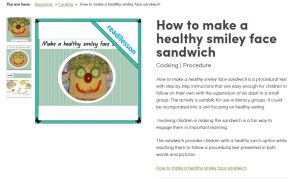
    I always organised for the healthy smiley face sandwich to be made in small groups.

    kebab 1
    © Norah Colvin

    Cutting up fruit and making fruit kebabs is suitable for small groups too. Children can be asked to bring in a serve of fruit to contribute to the choices. We used to have a daily mid-morning fruit snack so it did not require any extra effort on the part of parents, just scheduling on my part.

    © Norah Colvin
    © Norah Colvin

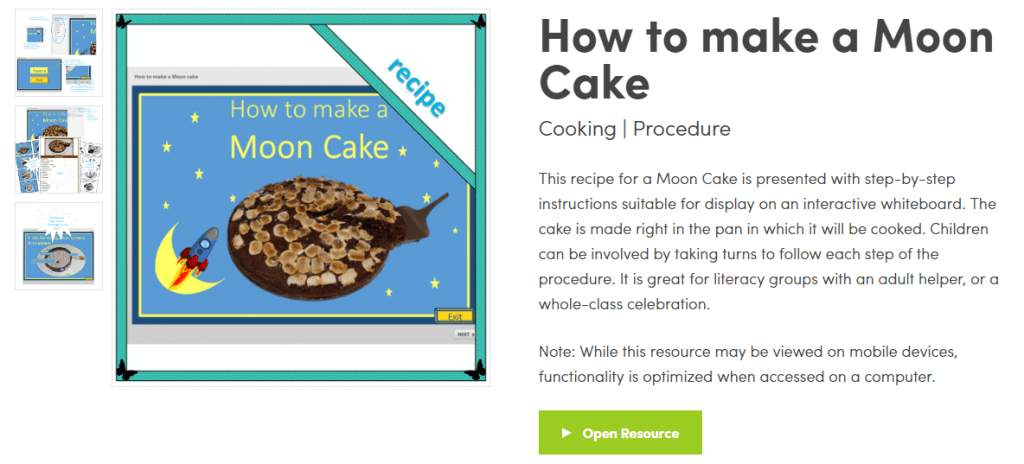
    One of my favourite cakes to cook with children is a moon cake. It is both fun to make and delicious to eat, and provides many opportunities for discussion. It is just as suitable for making in the classroom as it is for home. I have prepared a guided recipe which will be available on my readilearn website.

    © Norah Colvin
    © Norah Colvin

    I recently made the recipe with my grandchildren. They were eager to help and took turns to add and mix the ingredients. There are sufficient things to do to give everyone in a small group an opportunity of being involved. However, it is also suitable to do with the whole class observing while individual children do different tasks.

    tasks to do

    Making the cake provides great opportunities for observing, turn taking, vocabulary development, curiosity, and development of science knowledge. All of these contribute to life skills and experiences. And then there’s the treat at the end!

    © Norah Colvin
    © Norah Colvin

    Although involving children in tasks like cooking and cleaning at home or at school involves extra organisation and time, it is well worth it for the long-term, as well as immediate, benefits.

    Do you have any recollections of helping with tasks at home or at school? How did you feel about it? How has it influenced your current attitudes?

    Thank you

    Thank you for reading. I appreciate your feedback. Please share your thoughts.