When I first stepped, rather tentatively, into the world of blogging and tweeting I had no idea of the pleasures I would find. I found a whole community of others who share my passion for education, learning, literacy and writing. I found a comfortable niche, discussion group, and a place for sharing ideas like I hadn’t for a long time. I’ve “come home” on the internet.
In these few short months I have come across some bloggers with very powerful messages that I wish everyone could read and act upon in the ways described. What a wonderful world we would have!
Over the coming months I will let you know about some articles I consider ‘must reads’.
Please let me know of others you think I should also be reading!
Thanks for sharing and supporting me on my learning journey thus far.
The story has just begun!
This first in the series is a lecture given by Neil Gaiman entitled “Reading and obligation”
“It’s important for people to tell you what side they are on and why, and whether they might be biased.”
If you have read any other articles on my blog, you will know that I am biased; biased towards a child-centered, hands-on, creative and innovative approach to education. I believe that children are capable of far more than a structured didactic approach to schooling gives them credit for; and that big changes in the way education is delivered are necessary if we are to make best use of our most valuable resource – human potential.
As a reader, writer and literacy educator I am biased towards approaches which foster a love of reading and writing. The pleasures to be gained from a literate existence are immeasurable. But more than that, being literate is not only personally empowering, it is a basic human right.
Obviously the articles on my must read list will be those that share my biases.
Please follow the link to watch the video or read the complete transcript of Neil’s lecture.
I offer a few teasers below to incite your interest.
“everything changes when we read”
Wow! How powerful is that statement!
“The simplest way to make sure that we raise literate children is to teach them to read, and to show them that reading is a pleasurable activity. And that means, at its simplest, finding books that they enjoy giving them access to those books and letting them read them.”
“Fiction has two uses. Firstly, it’s a gateway drug to reading. . .
And the second thing fiction does is to build empathy.”
“Fiction can show you a different world. It can take you somewhere you’ve never been. Once you’ve visited other worlds, like those who ate fairy fruit, you can never be entirely content with the world that you grew up in. Discontent is a good thing: people can modify and improve their worlds, leave them better, leave them different.”
Don’t you love that last statement? I do. If we are always “happy” with the way things are, why would we ever try to improve or change them? A little discontent can be a good thing!
“We need to read and write, we need global citizens who can read comfortably, comprehend what they are reading, understand nuance, and make themselves understood.”
Neil goes on to talk about our obligations as readers, writers and citizens of the world.
He lists the following (read or listen for his explanation)
Read for pleasure
Support libraries
Read aloud to our children
To use the language
We writers – and especially writers for children, but all writers – have an obligation to our readers: it’s the obligation to write true things, especially important when we are creating tales of people who do not exist in places that never were – to understand that truth is not in what happens but what it tells us about who we are. Fiction is the lie that tells the truth (underlining is mine)
not to bore our readers
not to preach, not to lecture, not to force
never, ever, under any circumstances, to write anything for children to read that we would not want to read ourselves.
to understand and to acknowledge that as writers for children we are doing important work,
to daydream We have an obligation to imagine. . . . individuals change their world over and over, individuals make the future, and they do it by imagining that things can be different.
to make things beautiful.
to tell our politicians what we want
Neil reminds us that
“Albert Einstein was asked once how we could make our children intelligent. His reply was both simple and wise.
“If you want your children to be intelligent,” he said, “read them fairy tales. If you want them to be more intelligent, read them more fairy tales.“
I couldn’t agree more.
What about you? What do you think of Neil’s list of obligations? Are there any you would omit, or any you would add?
First of all, let me say, there is nothing scientific in this article.
The notions, unless otherwise attributed, are just my thoughts and ideas.
Or are they?
Have you ever had an idea just ‘pop’ into your head?
What about an entire poem or song? Maybe even a story?
Have you ever had an idea; only to find out that another has had almost the exact idea at roughly the same time as you with no chance of collaboration or leak?
Where have these ideas come from?
Do you really think you have thought them up when they have come fully-formed and unbidden?
Sometimes an idea pops into my head; an idea with no connection to any current thought. It may take me by surprise and make me think: Why didn’t I think of that before? Or rather, why did I think of that at all?
I can’t explain the force that at times propels my hand across the page, fervently trying to keep pace with and capture the words as they spill forth, lest they escape to a region from which they would never be retrieved.
Sometimes I’ve written stories, which I may, or may not, have submitted to a publisher, only to find another very similar in print not long after. How can this be? There was definitely no collusion. My story had been written before the other was in print; and the other would have been underway by another publisher before mine had been submitted.
Have you ever noticed that often two movies on a similar topic or theme are released almost simultaneously? Is this coincidence or planned?
I know that sometimes songs are very similar, and in fact, there have been court cases over certain bars and riffs. I am surprised this doesn’t happen more often. How can new combinations of notes still be arranged? How difficult it can be to get a melody out of one’s head. How much more difficult it must be to be certain whether that melody is one of your own creation or one that your ears have captured.
image courtesy of openclipart.org
I remember hearing someone suggest, many years ago, that there are many ideas out there (floating around somewhere in the universe?) ready to be picked. Sometimes they are picked simultaneously by different people in different places around the world.
I wasn’t too sure about that, but it did provide an explanation, of sorts, for the duplication of ideas.
A few months ago, I listened to a fascinating TED talk by Elizabeth Gilbert: Your elusive creative genius.
The focus of Elizabeth’s talk is a little different from my own, but she did offer some thoughts on this topic also.
I was particularly interested to hear that in ancient Greece and Rome
The Romans called this entity a “genius”. A genius was not a clever individual. It was the spirit that would help shape the artist’s work. The artist did not need to take full credit or responsibility for the work, as the work was that of the “genius’ working through the artist.
Now that seems to support the notion of ideas arriving fully-formed, as does this next one:
Elizabeth went on to talk about the American poet, Ruth Stone, who described how “she would feel and hear a poem coming at her from over the landscape” and she would have to run back to house in order to “collect it and grab it on the page” before it thundered on to another poet. I won’t quote the whole story here. Please follow the link to read the rest. It may surprise you as much as it surprised me!
“Synchronicity is when two or more people have the idea at the same time. Science is littered with examples of this. Darwin only published his Origin of the Species because a fellow biologist had also deduced the concept of natural selection, and sent him his own book in manuscript; several people can claim to have invented the computer, and so on. So, too, in literature. I still remember a Spectator Diary Susan Hill wrote when she found out that Beryl Bainbridge was working on a novel about Scott’s doomed expedition to the Antarctic. She had to abandon it. Rival biographies of the same person are commissioned simultaneously, and sometimes even films (like the two versions of Les Liasons Dangereuses).”
Now, is that just what I’ve been talking about?
Follow the link to her entire article to find out what she thinks about synchronicity.
Still eager for more, this article about Multiple discovery explains that scientists, also, are similarly burdened and, according to Robert K. Merton
“Sometimes the discoveries are simultaneous or almost so; sometimes a scientist will make a new discovery which, unknown to him, somebody else has made years before.”
So where is all this leading me?
It is simply to introduce the poem, “A leaf floated down” which came to me as I was preparing for my day. The thoughts were not connected to any others of the moment; the first verses simply wrote themselves, and the parts that I am least happy with, are the parts I laboured to bring forth. I hope it is my own!
I’d love to know what you think about this synchronicity that we, as creatives, often experience. Please share your thoughts!
In a previous post “To school or not to school” I discussed thoughts I had pondered and issues I had considered when deciding the future education of my daughter.
Although the main focus of that article was whether to school or not, home education was not only not my first choice, but not even a consideration.
The merest hint of an idea of starting my own school had niggled away in the back of my thoughts for a long time. More than ten years before that article was written, I was in college studying the teaching of literacy when the idea popped into conscious thought. In response to an assigned task, which required that I explain how I would implement a literacy program in a school, I surprised my lecturer (and myself) by explaining how I would do so in a school that I established. Although I was never afraid of placing my own spin upon a set task, I never really expected the idea of establishing a school of my own to be anything more than just that.
In the ensuing years prior to the birth of my daughter, my son completed his primary schooling and I taught in a variety of roles, some of which were the most rewarding of my career. During those years I met many other teachers with a similar dream of starting their own school. They were mostly creative and innovative teachers, passionate about their own learning as well as the learning of their students. They inspired their students with an energy that at times seemed infinite. But they felt stymied by the formality and top-down approach of traditional schooling which they, like me, believed to be detrimental to children’s learning and personal growth.
Many of these teachers left the profession, unable to conquer the battle between philosophy and practice waging within. Others continue teaching, constantly trying to balance their beliefs about learning and the needs of their students within the confines of the expected formal and didactic approach to teaching. Others have become burnt out, feeling isolated and unsupported, succumbing to the pressure to conform.
Few teachers take action to make their dream a reality. Whatever one’s beliefs, it takes a great deal of courage to step outside the norm of accepted practices. To establish an alternative school, in addition to this courage, requirements include a bottomless well of financial resources, an infinite ability to persist under the onslaught of unremitting obstacles, and a firm commitment to ideals and philosophies.
When Bec was born the nagging of this idea was so insistent that I was compelled to bring it out from where it was hiding and give it some serious consideration. Without any real understanding of the magnitude of the task ahead, without a well of financial resources, but with a firmly-held belief in what I was undertaking, I set upon the road to turn the dream to reality.
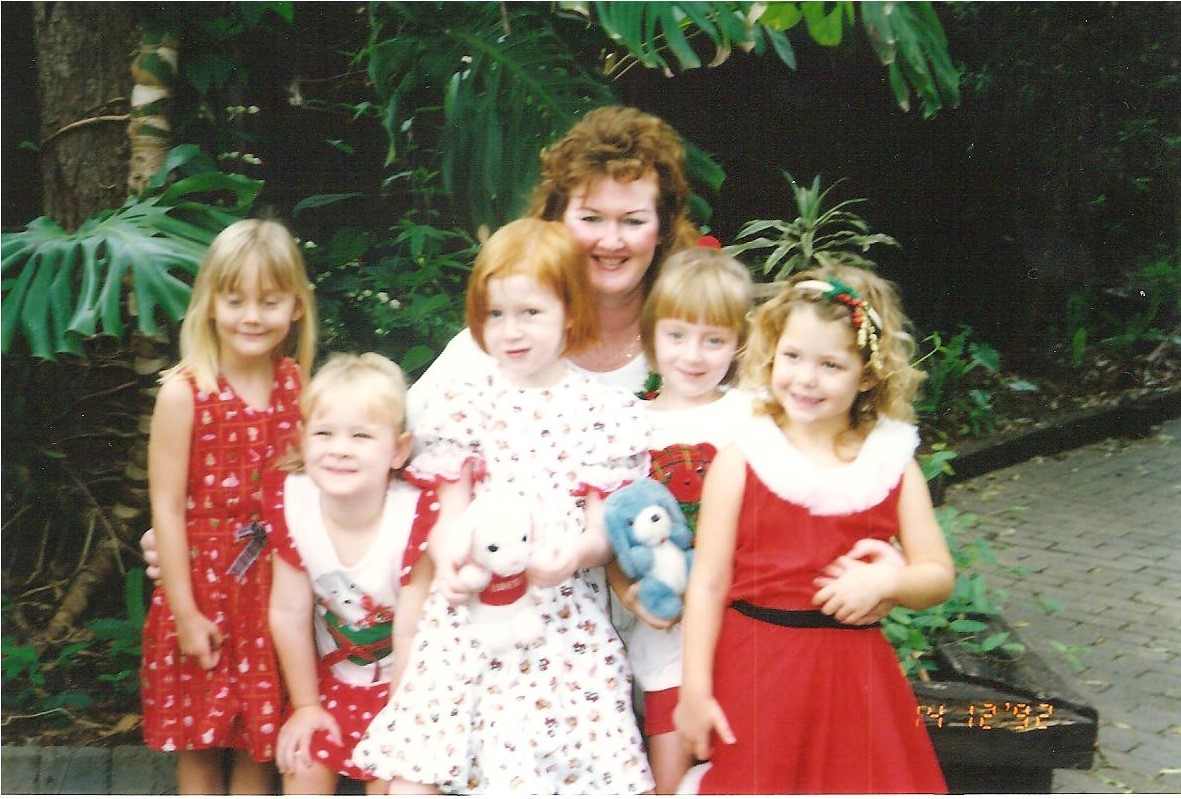
Me with a group of “my” children, including Bec in the middle.
When Bec was about 2, I established a small home-based (but not profitable) business providing educational care for other 2-3 year olds and educational play sessions for parents and children.
For the children in care, I provided a stimulating learning environment with lots of talk, books and hands-on exploratory activities. I provided support as they learned to have a go and developed confidence in their abilities.
In the play sessions I guided parents’ engagement with their children in play, explained how they could develop vocabulary and concepts, and provided suggestions for them to continue at home. Even after 20 years, parents still tell me how valuable those session were to their children’s education.
At the same time I investigated and explored alternatives to traditionally schooling available in my area but was disappointed that none exactly met my criteria. Some were too laissez faire, others followed pedagogical approaches I believed to be unsupportive of children’s learning, and others were based on philosophies I didn’t agree with.
I began constructing a vision of what my ideal school would be. I invited other like-minded teachers to join me and we got to work on building a team, enlisting families, and seeking out a facility.
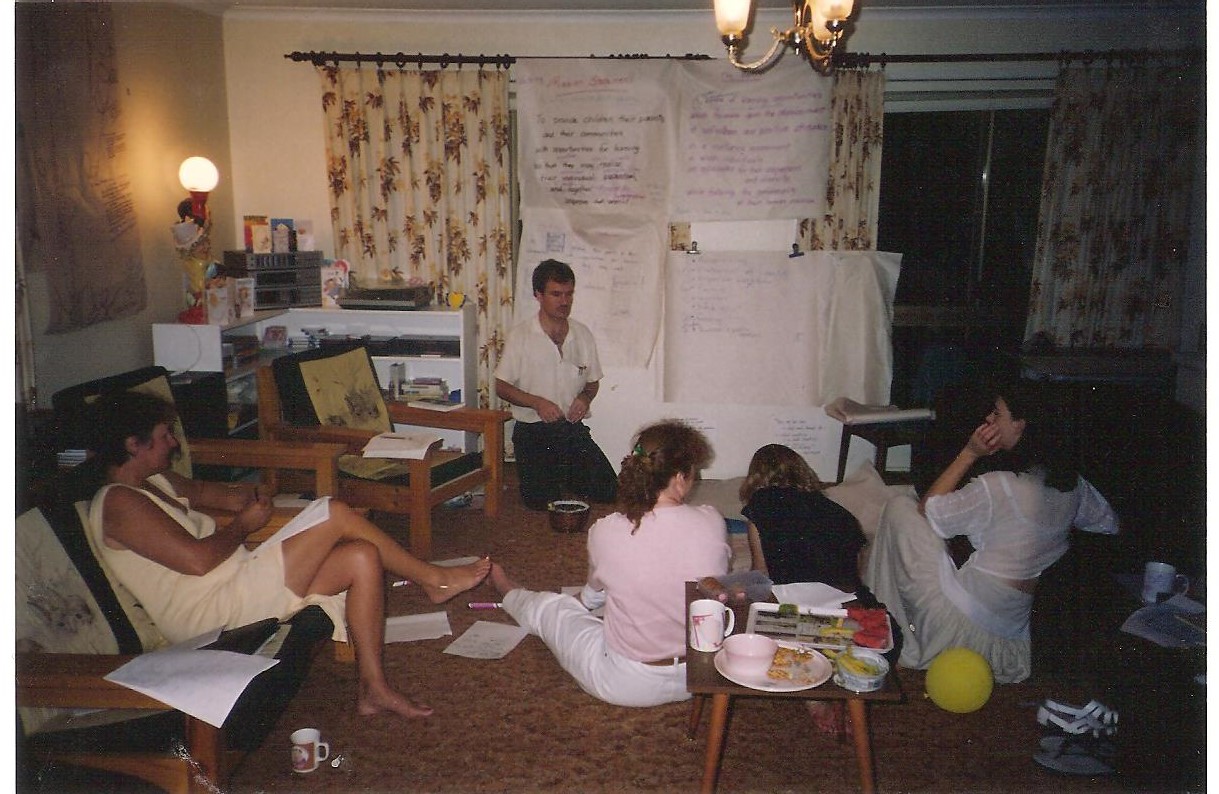
Composing the vision statement.
Approval by the education department was easily achieved and interest of parents was forthcoming. In the end, the greatest stumbling block and final inhibitor of the project was town planning.
Throughout those establishment years Bec was not enrolled in a school. She was educated at home while we waited for my alternative school to open. We participated in some home schooling group activities, and I continued to conduct home-based educational sessions for Bec and other children. After about 5 years and two aborted starts, the project was terminated and Bec’s home education came to an end. Well, it really didn’t come to an end. She continued to do a lot of learning at home, but as she was enrolled in the local government school, it was her official education provider.
I often wonder what our lives would be like now if my dream of opening an alternative school had been achieved.
It was difficult making the decision to let it go. I was torn between two equally compelling but conflicting pieces of advice which vied for my attention:
I do believe I gave the dream my best shot, but after a long time and many false starts, I decided that perhaps I should listen to the messages. With most families, like ourselves, more interested in an alternative school than in home schooling, it was time to let it go. Other families, like me, were not enamoured with the local offerings, but then, also like me, had to decide the future of their children’s education.
I no longer felt comfortable asking families to stay committed to the goal with no tangible start date in sight, and after a final search for a suitable property hit another dead end, the idea was abandoned. I was not committed to home education as a long-term alternative for Bec’s education, and so finally, in year 4, she started school.








 Norah Colvin