Children can be read to from the moment they are born, if not earlier. Preferably earlier!
One of my favourite picture book authors and passionate advocate for reading to children is Mem Fox. I own, and have given as gifts, many of her wonderful books. I have attended her seminars and been mesmerised by her reading from her selection of stories. “Read more!” the adults beg. There are no children at these literacy seminars. This time it is a treat for only us: parents and teachers, literacy educators all.
Currently Prince William, Kate and baby Prince George are visiting Australia. I was delighted to hear that they were given a gift of books by Australian authors, including some by Mem Fox. Over the years I have given many of Mem’s books as gifts; and kept just as many for myself!
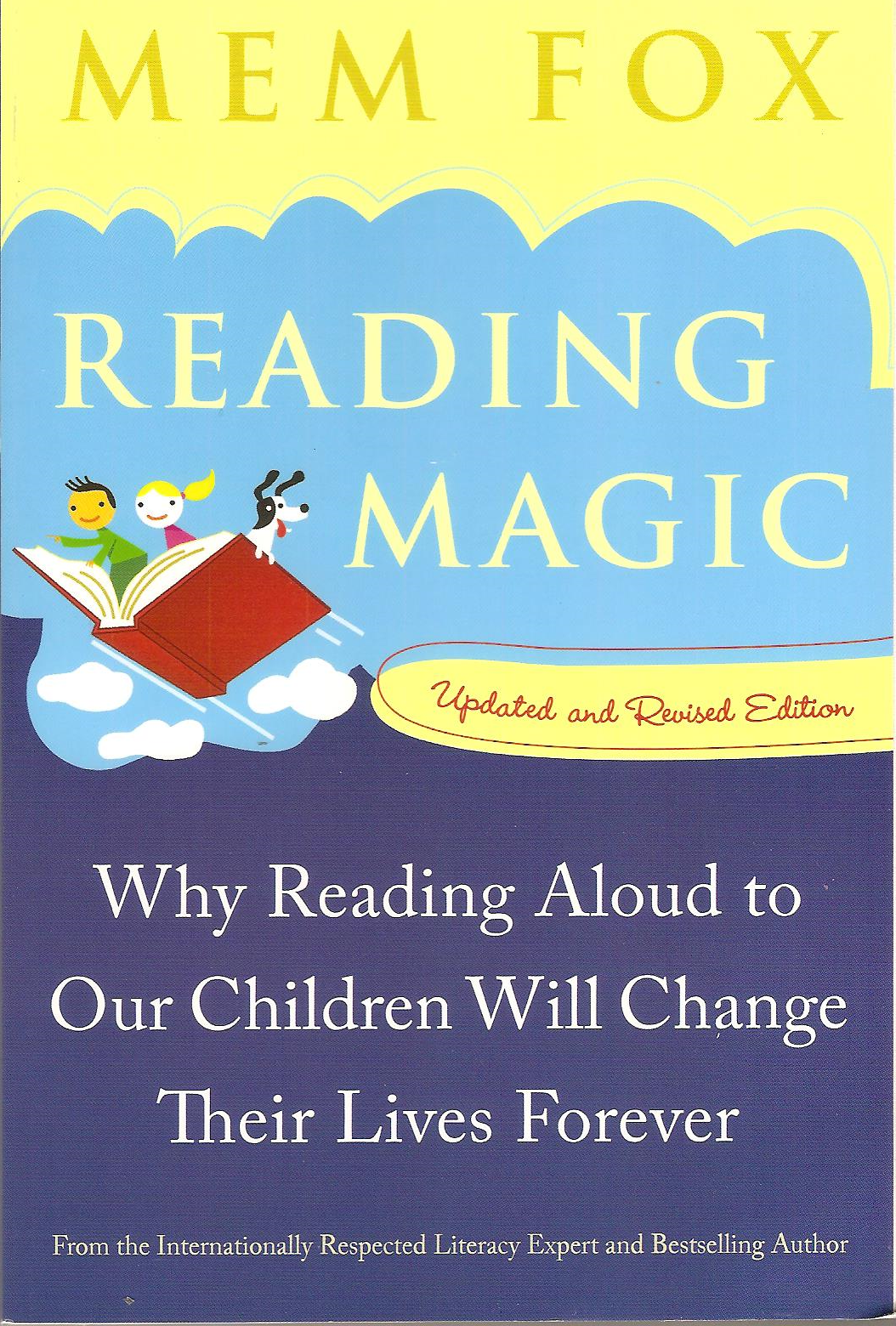
One that I have given to many new or expectant parents, as I consider it a “must read”, is Mem’s book “Reading Magic – Why Reading Aloud to Our Children Will Change Their Lives Forever”.
I would love to quote the entire book for you, but it is better you read it for yourself. I will provide you with this quote from the foreword as a taster for the richness to be found inside.
“It stands to reason that if we’re able to raise happier, brighter children by reading aloud to them, the well-being of the entire country will ramp up a notch. Children who realize in their first few weeks and months of life that listening to stories is the purest heaven; who understand that books are filled with delights, facts, fun, and food for thought; who fall in love with their parents, and their parents with them, while stores are being shared; and who are read aloud to for ten minutes a day in their first five years, usually learn to read quickly, happily and easily. And a whole lot of goodness follows for the entire community.”
Mem’s website, too, is a treasure trove just waiting to be explored by writers, teachers, parents, children and children-at-heart.
You can listen to Mem read from her selection of books on the Current Read Aloud page. She reads three different books each month. Currently the books are Possum Magic,Harriet, You’ll Drive Me Wild! and Goodnight, Sleep Tight. Be quick to listen to these, though, as they will change at the end of the month. But never mind, there’ll be another three to enjoy next month!
In a previous series of posts I wrote about science inaccuracies in a picture book and questioned with whom lay the responsibility for providing young children with correct information.
While this post builds upon those posts, it also takes a divergent path: the need for children to have a voice; to be empowered to ask questions, to state their needs and report wrongdoings.
On a highly respected educational website Scholastic, with the by-line “Read Every Day. Lead a Better Life.”, in an article about Eric Carle author of The Very Hungry Caterpillar, children are told that
“Eric already knows that a caterpillar emerges from a chrysalis, not a cocoon! So don’t bother writing to tell him.”
This seemingly innocuous statement may be easily overlooked but packs a powerful message.
What does it tell children?
The author has been told many times, already knows and isn’t going to do anything about it.
The author is tired of being told he is wrong and doesn’t want to hear it any more.
The author is “right” and not to be questioned. (The book, with its misinformation, is highly acclaimed by millions around the world. However if, in answering a question on a test, children were to write that a butterfly comes out of a cocoon, they would be marked wrong. Explain that to them.)
For me the most insidious part of this message is
He already knows, “so don’t bother writing to tell him”!!!!!!!!
You can’t change it.
You know it’s wrong, but you can’t change it, so don’t bother trying.
Although many societies are now moving to eradicate it, child abuse is still far too common worldwide. Not only must the attitudes of societies change, but children must be empowered, they must be encouraged to speak up and they must be listened to: their voices must be heard.
In a recent child abuse case that occurred at a Queensland primary school, the student protection officer reportedly said that she couldn’t understand why the children who had been sexually abused did not come forward.
The accused had continued in his role as child protection contact for a year after the first complaint was made. The student protection officer found it hard to believe that her colleague was a paedophile;
and still she says she doesn’t understand why the children didn’t come forward!
It seems to me the children did come forward if the first (indicates there were more) complaint was made more than a year before anything was done about it.
The children tried to say, but were not believed. The predator was believed and protected while the plight of the innocent victims was ignored. The report states that parents who complained about the abuse of their children were ostracised by the school community and made out to be the “bad guys”.
Is it any wonder that, if not listened to and not believed, and if more is done to protect the offenders than the abused, the children become increasingly reluctant to tell?
After the first children had come forward and not been listened to or believed, may not they have said to others, “There’s no point in saying. They already know. They won’t do anything about it?”
Or what about the parents who were ostracised and made out to be the bad ones?
Doesn’t it make the message very clear – you are powerless. Your voice won’t be heard. Your opinion doesn’t matter.
Carry this message over into countless other situations and you have a population who is afraid to speak up, fearing the disdain of reproach, the embarrassment of being unvalued and the helplessness of one’s message being unheard.
How many times have you felt you must remain silent for fear of ridicule, rejection, or worse?
How many opportunities for creating a positive change have been missed because the task seemed insurmountable or the personal repercussions too unpleasant?
When have you stepped up and made that change happen because you were not afraid to speak up or speak out when faced with an issue you felt strongly about?
What changes can we make to empower children (and adults) everywhere?
By the way, in that article on the Scholastic website, it is reported that Eric Carle believes that “the most important part of developing a book . . .is working with editors to revise it.”
Would it make any difference to the magic of The Very Hungry Caterpillar if, after all these years, Eric Carle rewrote a corrected version with a butterfly emerging triumphantly from a chrysalis?
What would that act tell all the countless children who have written to tell Eric about his mistake, and the many others who wanted to but were told there was no point?
I suggested ways of including The Very Hungry Caterpillar in an early childhood classroom and discussed the responsibility that authors have in differentiating between fact and fiction in story books.
“When speaking to teachers I often find raised eyebrows when I explain that butterflies’ larvae do not make cocoons. The teachers refer to Eric Carle’s book, The Very Hungry Caterpillar, where he refers to a ‘cocoon’.”
Note that Jacqui refers specifically to this book, rather than to sources in general.
As shown by Jacqui, though, it can be difficult, even for teachers without specialist entomological knowledge, to sort out fact from the fiction.
These are two pieces of misinformation contained in the story:
Misinformation 1:
Caterpillars eat a lot of different food
Fact
Most caterpillars are fussy about their diet, some eating only one specific plant, others eating a variety of plant foods.
Misinformation 2:
Butterflies come out of a cocoon.
Fact
Butterflies emerge from a chrysalis.
Moths come out of a cocoon.
Watch these two videos:
This one by Strang Entertainment shows the caterpillar becoming a chrysalis.
This one shows a silkworm caterpillar spinning a cocoon (about 2 mins in).
They are two very different processes.
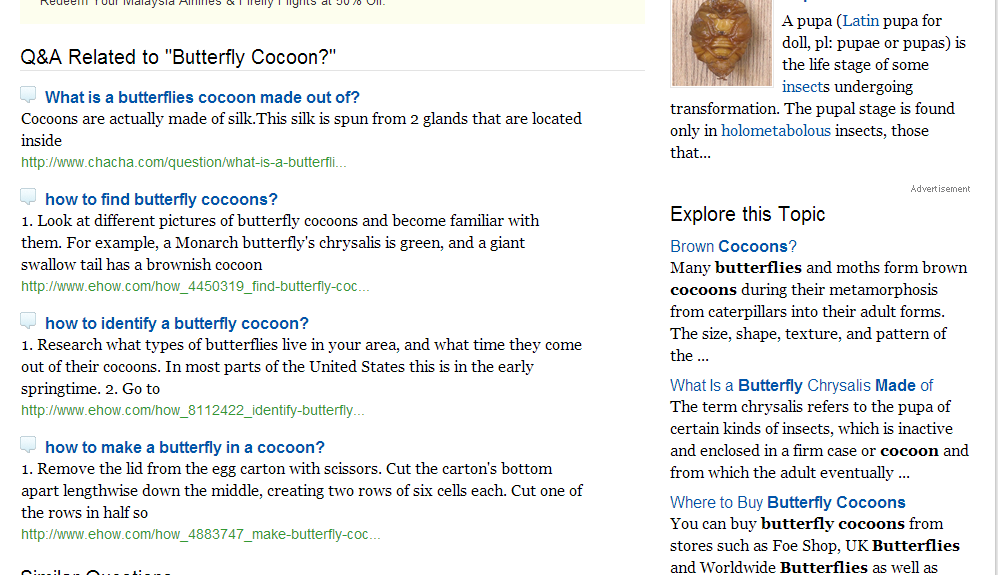
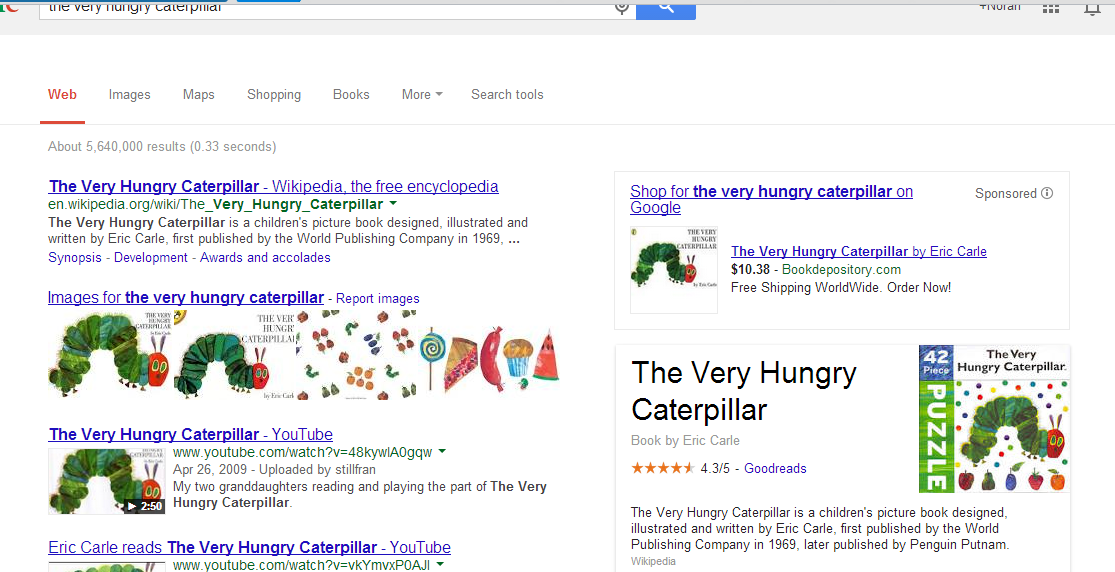
However a quick glance at these Google search results shows just how pervasive the misconceptions are:
Even seemingly authoritative educational websites misinform. Look at the way these two websites promote themselves, and consider the misinformation they are peddling.
states that The Very Hungry Caterpillar is “factually accurate . . . teaches your child to understand this biological process … a butterfly. . .(is) a caterpillar that has emerged from its cocoon”
Primary upd8 which promotes itself as “UKs most exciting science resource”
also suggests using The Very Hungry Caterpillar for teaching about the life cycle of a butterfly.
If self-professed “authorities” can’t get it right, how are we laypeople meant to make sense of it. Suggestions like these reinforce the need for the skills of critical analysis to be developed.
Unlike those above, I contend that this book has no place in the science curriculum. Its greatest value is as a tool for teaching critical literacy.
When children have learned about the life stages of a butterfly and then listen to The Very Hungry Caterpillar, they are very quick to pounce on the inaccuracies and immediately want to write to the author and tell him of his mistake.
When told that he already knows and that he isn’t going to change it, as confirmed in an interview reported on the Scholastic website, they are incredulous.
“Why would he do that?” they ask.
Why indeed.
When told that he doesn’t care that it isn’t right, they are indignant.
But herein lies its value:
I am able to affirm their learning: they know more than Eric Carle; and, more importantly, I am able to reinforce with them that just because something is in print, doesn’t make it true.
In addition, it is important for them to realise that misinformation does not occur only in picture books, nor only in this picture book. It is just as common in news media, as shown by this article from Brisbane’s Courier-Mail on December 7 2013
Nor is misinformation restricted to caterpillars and butterflies.
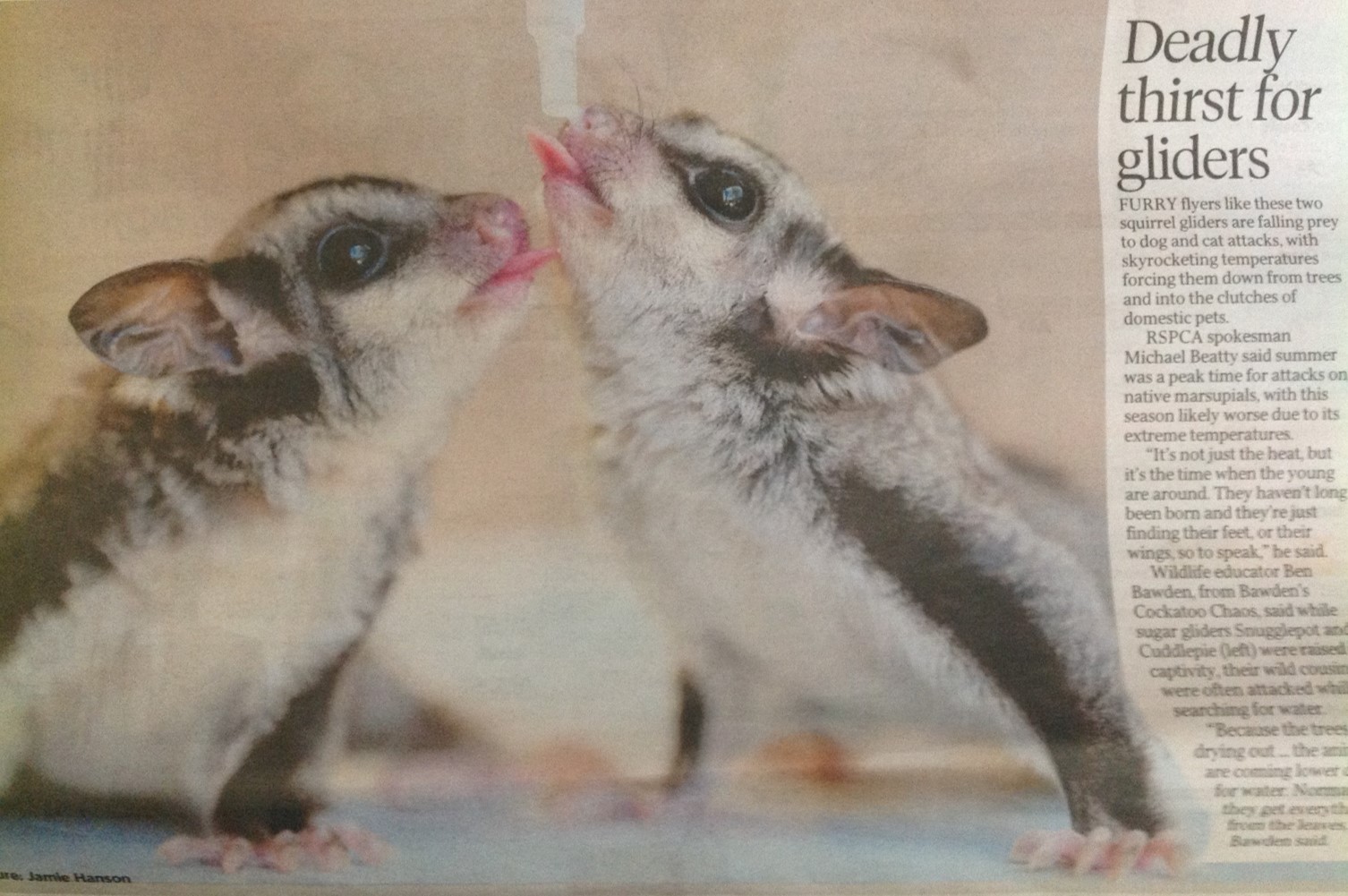
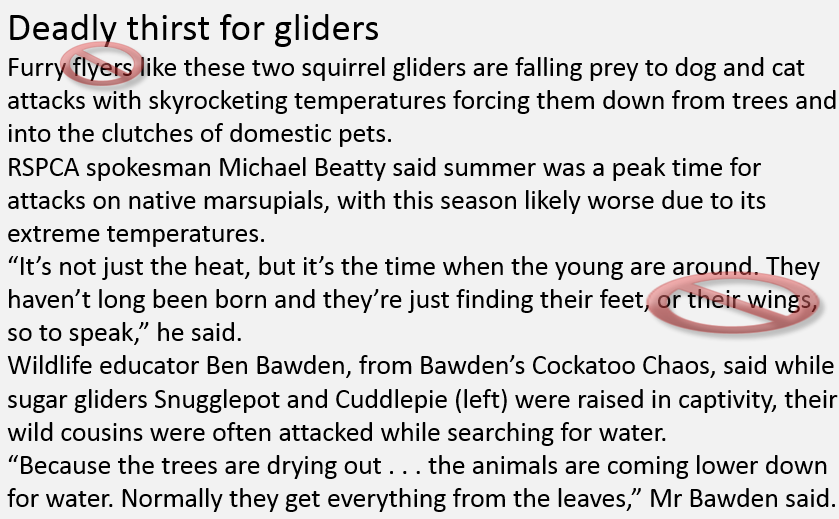
This article, again from the Courier-Mail, on January 26 2014 also contains inaccuracies:
Squirrel gliders don’t fly, and they don’t have wings.
Suggestions for teachers and parents:
point out inaccuracies and inconsistencies
encourage children to think about what they are reading and hearing and to evaluate it against what they know
support children to verify the source of the information and to check it against other more authoritative/reliable sources
help them to recognise that every author has a purpose and to identify that purpose
invite children to ask questions about what they are reading and to interrogate the content
encourage them to question, question, question.
As demonstrated by the Google results shown above, there is a good deal of misinformation available, often cleverly disguised as fact. Being able to navigate one’s way through it is a very important skill.
Eric Carle says “If we can accept giants tied down by dwarfs, genies in bottles, and knights who attack windmills, why can’t a caterpillar (sic) come out of a cocoon?”
What do you think?
Do picture book authors have a responsibility for informing their audience? Is a butterfly coming out of a cocoon in the same realm as giants tied down by dwarfs? Would we accept a child hatching out of an egg? What parts of a story should be based in reality and which parts can be imagined?
“Why can’t a butterfly come out of a cocoon?” asks Eric.
Rita’s entire life centred around education. Her parents and her mother’s parents were teachers, and she was a teacher.
She observed numerous teachers at work – some of the best and some of the worst – and believed that relationships are the key to learning.
She said that
“kids don’t learn from people they don’t like.”
Rita spoke about having classes of students whose academic level was so low she wondered how she could “raise the self-esteem of a child and his academic achievement at the same time”.
One year she told her students
“You were chosen to be in my class because I am the best teacher and you are the best students, they put us together so we could show everybody else how to do it.”
Affirmation, encouragement, praise . . .
She talked about giving a student a +2 with a smiley face for getting 2 out 20 questions correct. She encouraged the student by saying
“you’re on a roll . . . and when we review this, won’t you do better?”
The student agreed “I can do better”.
Affirmation, encouragement, praise . . .
Rita told of her mother’s past students expressing their gratitude for the difference she made in their lives, saying
“You made me feel like I was somebody, when I knew, at the bottom, I wasn’t. And I want you to just see what I’ve become.”
Affirmation, encouragement, praise . . .
She tells us that teachers won’t always like all the children they teach, but it’s important that the children never know it. Acting is part of the role description!
She says that
“Teaching and learning should bring joy. How powerful would our world be if we had kids who were not afraid to take risks, who were not afraid to think, and who had a champion? Every child deserves a champion, an adult who will never give up on them, who understands the power of connection, and insists that they become the best that they can possibly be.”
Affirmation, encouragement, praise . . .
Go ahead and listen to this inspirational talk. It will take less than 8 minutes listening time but its effect will be more lasting. It has already had more than 2 600 000 views. Why not add one more to the total. I’m certain you won’t regret it.
I can find nothing to dispute in Rita’s talk. I’d like to underline every word and make it compulsory viewing for all aspiring and practising educators in any field.
Affirmation, encouragement, praise . . . helpful or harmful?
What do you think? Please share your thoughts below.
Refer to these previous posts for discussions on self-esteem, affirmations and praise:
Praise may be defined as an expression of approval or admiration.
Who wouldn’t want that?
If you write a blog, don’t you love it when others “like” a post, leave a positive comment, re-blog your article or link to it via theirs? I do. Aren’t these all expressions of approval or admiration?
What about on Twitter when someone Re-tweets, favourites or replies positively to your comment, engaging you in conversation?
Aren’t these also expressions of approval or admiration?
I love to receive all these signs of encouragement and support that let me know that my efforts are appreciated and confirm that I am on the right track. If I did not receive any of this feedback I would feel quite isolated and consider my efforts to be fruitless and a waste of time. I would probably just give up.
As a teacher I have always considered it of primary importance to create a happy and welcoming classroom environment in which children feel valued, affirmed and supported. Expressions of approval and admiration for behaviour, effort and achievement were generously given with the aim of encouraging the desired response, a happy child being foremost. I have written about this in previous posts, including:
As a parent too I considered it important to affirm my children and display my approval and admiration for them. I still do, even now they are adults. The need for approval never ends. I know sometimes you just have to go out there and say what you know is right, even though others will disagree or ridicule you. I am not talking about those instances here.
My strong belief in the power of affirmations and approval stems partly from the dearth of them in my childhood and school days. I have also mentioned this in a previous post:
Recently I listened to a fabulous (audio)book, “The Examined Life: How We Lose and Find Ourselves” by Stephen Grosz. I wrote about it in my previous post A book worth reading: Stephen Grosz “The Examined Life” saying that
“What appeals to a reader about a book, or what a reader takes away from a book is as individual and personal as the reader. What is of most significant to one, may be of lesser importance, or even insignificant to another. “
For me the chapter of most significance is chapter 3 “How praise can cause a loss of competence”.
To say I was startled by the title would be an understatement. I was puzzled, intrigued and challenged. How could praise cause a loss of competence? Surely negative feedback or a lack of encouragement altogether would be major contributors to diminishing competence. Was everything I had believed and practiced wrong? (Oh no –there’s my need for approval and affirmation!)
Grosz says that during the past decade studies into self-esteem have found that praising a child as “clever” may not only inhibit school achievement, it may cause under performance. He suggests children may react to praise by quitting. Why would you try to improve or do something new if you have already done something really well or are the “best”?
Studies showed that children who were praised for effort, rather than for being clever, were more willing to try new approaches and were more resilient. Children who were praised for being clever, tended to worry more about failure and chose unchallenging tasks, tasks they knew they could achieve or had already achieved. Being told they were clever led to a loss in self-esteem and motivation and to increased anxiety. Some children who had been praised for being clever (rather than working hard), when confronted with a more difficult task and asked to comment on it, were so unhappy with the results they lied about them, exaggerating their achievements to others.
Grosz questions whether we may lavish praise on our children nowadays in order to demonstrate that we are different from our parents who possibly used criticism, rather than praise, on us. I hinted at something similar earlier in this article.
While admiring our children with words like “Good boy” or “Good girl” may temporarily lift our self-esteem by showing others what wonderful parents we are or how wonderful our children are, Grosz says, it isn’t doing much for a child’s sense of self. He says that in trying to be different from our parents we end up doing the same thing: doling out empty praise where an earlier generation doled out thoughtless criticism.
Grosz says that if we offer this empty praise without thinking about the child’s individuality and needs we are effectively showing the child indifference.
So what do we do?
I think the emphasis here is on the empty praise. I think support, encouragement and positive feedback are all essential. Sure, knowing in yourself that you have done well is fine but a little recognition certainly helps too. I think the difference is in recognizing what has been achieved, the learning or progress made, and the effort it took, the message communicated in a story or painting and the techniques used; not a hollow “Well done”, “Good work” or “Good boy” but “Tell be about . . .”, “Why do you think that?” “How did you work it out?” “I like the way you . . .”
As Grosz says, this is being attentive to the child, to what the child has done and how it has been done.
To read more on this topic:
Sian Griffiths interviewed Stephen Grosz and reported on the interview in the article “Praise her . . . and see her fail” which adds even more clarity to my precis above.
Being attentive, being present, being really with someone, noticing what they have done and how they have done it – is it more precious than praise?
In these days of constant distractions and must-dos to put all aside to be in the present with the child, friend or partner to talk, listen share and laugh, what better affirmation is there than that?
What do you think?
How has praise encouraged or discouraged you? When has criticism hindered you?
At this time of the year children, parents and teachers in Australia are thinking about the return to school which is approaching with haste. For some those thoughts are of excitement and expectation. For others they are of anxiety and dread.
While children have enjoyed the break from imposed structure and the pressure of school days and homework, many look forward to seeing their friends again and the routine of having something to do after long, lazy summer days. Others may feel anxious about being in a new class with a new teacher and new yet-to-be-made friends. For those starting at a new school, or school for the first time, there may be a confusion of feelings and vacillation between excitement and fear.
Parents, too, have mixed feelings about their children starting or returning to school. They may look forward to a return to routine and a relief from the pressure of providing full-time entertainment or alternative care arrangements. They may also experience feelings of loss when they hand their children over to the care of a stranger for most of the day. However, I think what parents most want for their children when they return to school, or indeed at any time, is for them to be happy. Teachers experience a similar range and vacillation of feelings from excitement and expectation through to anxiety and dread. Even now many of those teachers are out fossicking through the cheap shops, scouring stationery and educational supply stores, looking for items for use in their classrooms. Others will be at home trawling the internet looking for resources, or making their own resources in preparation for the new school year.
One thing that is important to all is to begin the year positively and happily.
Strategies for parents
Some strategies parents can use to ensure their children begin the school year happily include:
Talk to children in positive and supportive ways that will strengthen their optimism about returning to school, allay any fears and settle anxieties.
Ensure children are aware of how they will travel to and from school, and of any arrangements that have been made for before or after school care.
Familiarize children with the route to and from school by travelling it as they will be expected to, whether by foot, cycle, bus or car. If necessary, point out landmarks along the way.
Make sure children know their first and last names, address and parents’ phone number/s.
Have children’s equipment ready with books covered and every item identified with the child’s name.
If possible, take the child to school on the first day and meet the teacher.
The positive feelings can be continued throughout the year by:
Daily conversations about the school day: learning, events and friends.
Volunteering in the class or school, or being involved with after school activities.
Maintaining open and positive communication with the class teacher.
Strategies for teachers
Some strategies teachers can utilize to ensure that children (and parents) begin the school year happily include:
Create a welcoming classroom with signs, posters, items of interest and inviting reading corners and activity nooks.
Greet children and parents with a friendly smile.
Engage children in activities that help you get to know them, and them to get to know each other.
Display children’s work to give them a sense of ownership and belonging.
Explain management and behaviour expectations and include children in composing a classroom management and behaviour plan.
Ensure children know the school timetable; when the breaks will occur and any lessons to be taken by specialist or other teachers.
Explain playground behaviour expectations, including showing areas where they may / may not play.
Take them on a walk around the school to show them the library, office, bathrooms and any other areas they may need to know.
Include singing during the day and send them home with a song and a reminder of what has been learned or engaged with during the day. (In a previous post Happy being me I wrote about Anne Infante’s songs of affirmation. Any of these are great ones to sing and help to create a positive environment.)
What other suggestions can you make?
What helped you as a child, parent or teacher prepare for the new school year?
Teachers, check out my new products on TEACHERSpayTEACHERS to help you set up your classroom and greet your new students with a Busy Bee theme. There are many resources to get you started, ready to download and print out.
Bee courtesy of Bernadette Drent, used with permission.
The school year in Australia is over and the long summer holidays have begun.
Parents often wonder how they will keep their children entertained during the long days with few structured or timetabled activities.
When returning to school after many weeks without the formal practice of skills taught during the previous year, teachers often lament that children’s reading fluency and level has fallen.
Here are 20 suggestions for keeping your children entertained while maintaining their reading skills.
I’m sure you can think of many more!
Please keep in mind, as you read the list, that the amount of support given, or independence allowed, in each activity will need to be adjusted to the individual child’s age and reading ability. Even young children who are not yet reading independently can be included in most activities.
Read to and with your child every day – continue the practice established throughout the year with special sharing times during the day or at bed-time — or both!
Demonstrate that you value reading by making time for your own reading, or setting aside a special quiet time when everyone in the family reads.
Visit the library and borrow to read, read, read!
Read poetry books, song books, picture books, joke and riddle books, crossword books, information books, chapter books (these can be read to younger children, or with older children – taking turns to read a page or a chapter each) — what are your favourites?
Trade books no longer read for others at a second-hand book store.
When dining out, have your children read the menu and choose their own meal.
Include your child in holiday cooking and have them read the recipe – ingredients and method. Perhaps they could read the recipe book to select the meal for the day.
Suggest your child read the TV guide to find when favourite programs are showing and establish a timetable for viewing, rather than haphazard watching with random flicking through channels.
Provide your child with bookstore catalogues and encourage them to read book descriptions to guide their next selection.
Bestow upon your child the title of ‘Family weather watcher’ and have them consult weather forecasts in the newspaper or online to select the most suitable days for planned outings and activities.
Include your child in making decisions about holiday activities. Give them the guide, or read the guide together and jointly choose the activities.
Make the library, museums and art galleries high on the list of must-dos. Many of these offer a wonderful assortment of free holiday entertainment for children, and reading is an essential part of getting the most from each visit!
Engage your child in some craft activities which require them to follow written instructions. The ability to understand and follow procedures is empowering and requires the ability to read written, as well as visual, instructions.
Encourage your child to ask questions about every day events and phenomena. Help them to research in books at home, in the library or on the internet.
Provide eBooks as well as books in print. Good ones bring a new dimension to the reading experience.
When going out for the day, or journeying further away on a holiday, support your child in locating destinations on a map and in selecting an appropriate route. Engage your child in giving directions while en route.
Include your child when reading bus or train timetables.
When doing the family grocery shop, give your child their own list of items to look for.
Listen to recorded books on long car journeys, or have books for listening to or reading along with in bed.
Make the most of every reading opportunity that occurs throughout the day!
What are your favourite ways of incorporating reading into everyday activities?
When I was a child, I loved receiving books as gifts. I still do! Books are among my most treasured possessions.
I remember the delight when, on awaking in the dark of an early Christmas morning, I would reach down to end of my bed and discover a book there. I couldn’t see it, but I could feel the smooth glossy cover and the familiar roughness of the pages. I would lift the book up and breathe in the rich, delicious smell which promised so much pleasure I almost wanted to devour it. I knew that something delightful was in-store for me, and as the dawn’s soft glow began light the room, I watched the colours, pictures and words slowly take form and reveal themselves to me. What joy!
I am forever grateful to my parents for encouraging my love of reading.
The love of reading is one of the greatest gifts a parent can give a child.
So, here is #21, it probably should have been #1!
21. Give books as gifts!
Read! Read! Read!
You are welcome to download and distribute the 21 suggestions FREE from my TEACHERSpayTEACHERS store.
You can read another post on this topic by Nanny SHECANDO by clicking here.
According to the website of the author Eric Carle, since its publication in 1969 it has been published in over 50 languages and more than 33 million copies have been sold worldwide. It ranks highly in the Wikipedia List of best-selling books.
Most primary schools, preschools and kindergartens would have numerous copies in their libraries with a copy in most classrooms as well as in teachers’ private collections. Most homes with young children would have a copy in their storybook collection.
In addition to the books, many of those schools, classrooms and homes would have some of the associated merchandise; including toys, games, puzzles, posters and colouring books, which are now available.
When I typed ‘the very hungry caterpillar’ into the Google search bar about 5,640,000 results were listed in 0.33 seconds!
There are activities, lesson plans, printables, videos, and advertisements for merchandise. There is a plethora of suggestions for using the book as a teaching resource, including counting, days of the week and sequencing.
I think you would be hard pressed to find someone that hasn’t at least heard of the book. That is quite an impact, wouldn’t you say?
For a book to have done so well, it must have a lot going for it. And it does.
There are many things I like about this book, including:
The bright, colourful, collages with immediate appeal
The natural flow and rhythm of the language making it easy to read, dramatize and recall
The sequence of numbers and days encouraging children to predict and join in with the reading and retelling
The match between the illustrations and the text supporting beginning readers as they set out upon their journey into print
The simple narrative structure with an identifiable beginning, a complication in the middle with which most children can empathise (being ill from overeating) and a “happy” resolution with the caterpillar turning into a beautiful butterfly.
Reading to children
Sharing of picture books with children from a very young age has a very powerful effect upon their learning.
There are many benefits to both parent and child of a daily shared reading session.
It can be seen as a special time of togetherness, of bonding; of sharing stories and ideas. It can be a quiet and calming time; a time to soothe rough edges and hurt feelings; a time for boisterous fun and laughter; or a time for curiosity, inquiry, imagination and wonder.
Whatever the time, it is always a special time for a book; and all the while, children are learning language.
They are hearing the sounds and rhythm of their language. They are being exposed to new vocabulary, sentence structures, concepts and ideas. They are learning important understandings that will support them on their journey into literacy e.g. they are learning that the language of a book differs from oral language and that the words in a book always stay the same.
They begin to realise that it is the little black squiggly marks that carry the message, and they may even start to recognise some words.
Many of these, and other, features make “The Very Hungry Caterpillar” suitable for incorporation in an early childhood curriculum, for example:
Literature appreciation – love of language, knowledge of story, interest in books
Reading – the clear, simple and predictable text make it an easy first reader
Maths – counting and sequencing the numbers, sequencing the days of the week
Visual arts – learning about collage and composition of a picture
Philosophical inquiry —sharing interpretations and discussing feelings about the story, asking questions raised including the ‘big questions’ of life
Eric Carle, in an interview with Reading rockets, describes it as a book of hope. He says:
“You little, ugly, little, insignificant bug: you, too, can grow up to be a beautiful, big butterfly and fly into the world, and unfold your talents.”
He goes on to explain that,
“I didn’t think of this when I did the book, but I think that is the appeal of the book.”
But I’m not going to let him have the last word!
While “The Very Hungry Caterpillar” has always been one of my very favourite picture books, I do have some misgivings about the impact that this book has had.
In future posts I will share what I consider to be some limitations of the text, and what I consider to be the most powerful use of all.
What do you think?
What appeals to you about this book?
What questions does it raise for you?
Please share your ideas. I look forward to hearing what you think.
Back in the early days of my teaching career, back before many of our younger teachers were born, let alone teaching, we used to have a visit from a school inspector every year or two. The role of the inspector was to monitor and evaluate the implementation of school programs as well as to provide advice and support to teachers.
However many teachers tended to think of them in less positive ways and these visits often engendered a sense of fear in some teachers as the inspector could appear at the classroom door at any time and ask to see current curriculum programs and mark books, test the spelling and computational ability of the class as a whole, and hear individual children read.
Because of this, when one of these visits was imminent there was often a flurry of activity getting curriculum documents and assessment up to date, and displaying children’s work in the classrooms and foyer.
But I wasn’t one of those teachers frantic in preparation and fear of being found out. I firmly believed that if what I was doing each day for the children in my class wasn’t good enough, then so be it. They were the ones that mattered after all and their education was my priority. I could not see what else I could do to prepare for these visits.
My programs were well researched, up to date and innovative. They were responsive to individual needs which were well documented with anecdotal records and diagnostic assessments as well as required testing, and supported by samples of student work. My classroom had an ever-changing display of children’s current work allowing visitors to see what we had been working on as well as giving the students a sense of pride in their achievements.
I guess also, for me back then, the school inspector was only one of the many visitors to my classroom as I was used to people coming to see what we were doing. Parents were always welcome and there were many who helped out on a regular basis and others who made the effort to come for special events and celebrations.
The principal was very involved and supportive and often popped in to see what we were up to and to provide additional support for children’s learning. In addition, teachers from other schools would visit in order to observe and take ideas back to their own classrooms; and pre-service teachers (student teachers they were called then) were often involved.
So, for me, the inspector’s visit was just another day, business as usual.
I am having difficulty in summoning words to describe how I felt when I saw the teacher next door (our classrooms were open, separated only by cupboards and shelves) busily testing children and writing marks in mark books, filling in “current” curriculum programs for the preceding term’s work and covering the previously bare classroom walls with displays of children’s work completed that day.
I guess you could say I was aghast at what I considered to be blatant dishonesty. I felt it was so wrong that I almost wanted to remove what I had on display for fear of the inspector thinking it was simply there for his benefit.
I didn’t.
Instead I turned to poetry, as I often do, to express my feelings; and I would like to share it with you, its first readers.
I had forgotten all about it until I came across it unexpectedly while looking for something else. It reminded me of the attempt at deception I saw enacted. I say “attempt” because, of course, the principal would have been aware of the situation and I have no doubt that these trained inspectors would be able to see through the veneer.
I think if I was writing the poem now, rather than 30 years ago, I would not be so generous with my analogy, nor so disrespectful to the butterfly.
The end of the school year in Australia coincides with Christmas and the summer holidays.
This coincidence provides an opportunity to not only reflect on the year’ achievements, but to share appreciation of friendships made throughout the year while developing understanding of Christmas traditions.
During the last few weeks of the school year, I use friendship trees with my early childhood classes for these purposes.
About three weeks before the end of the school year each of the children make their own tree which is then displayed in the classroom until taken home on the last day of school. By then the trees are filled with messages of friendship and affirmation which the children write anonymously to each other each day.
Although the end of the school year is when I use friendship trees in my classroom, they could be used at any time throughout the year. However they will work better when the children have been working together for a while and know a little about each other.
These are some of the benefits of incorporating the friendship tree into the class program:
Is inclusive with its emphasis upon friendship
Provides an opportunity for reflection on friendships made
Encourages students to comment positively to classmates
Affirms students by the receipt of multiple positive comments
Encourages a giving attitude
Provides an opportunity to discuss Christmas traditions (tree as a bearer of gifts) as a way of developing cultural understandings
Develops understanding that kind words and actions are the greatest gift
How it works
Children make and decorate a “friendship tree”, attaching or writing their name prominently on it. Trees are then displayed in the classroom.
Each day children select a name “from the hat”. (In preparation I prepare a class list of names in a table, one name per row, which I print out and cut into strips for the students to select and write their messages on.)
Children write a friendship note to the child whose name they have drawn, but they are to not tell anyone who it is or what they have written.
They may return the name and select another only if it is their own name or the name of someone for whom they have already written a message
They are to write something they like about the person, something the person is good at or something they appreciate about them.
I check what the children have written, ostensibly for readability, but also to ensure appropriateness of the message. However I have never had to edit the content. I have always been impressed by the messages the children write.
Children then fold and “secretly” place the messages into the tree of the recipient.
On the last day of school children take their trees, filled with positive messages, home to read and share with their family.
Before children write their first message, we brainstorm what a friendship message might be. These are some examples:
Thank you for being my friend.
I like the way you laugh at funny stories.
You are a good writer.
You always do the right thing.
Thank you for playing with me.
However these ideas are only a starting point. I have always been amazed at the very appropriate and personalised messages the children write for each other. They really do notice the lovely things their classmates do throughout the year, and the different things that make them special.
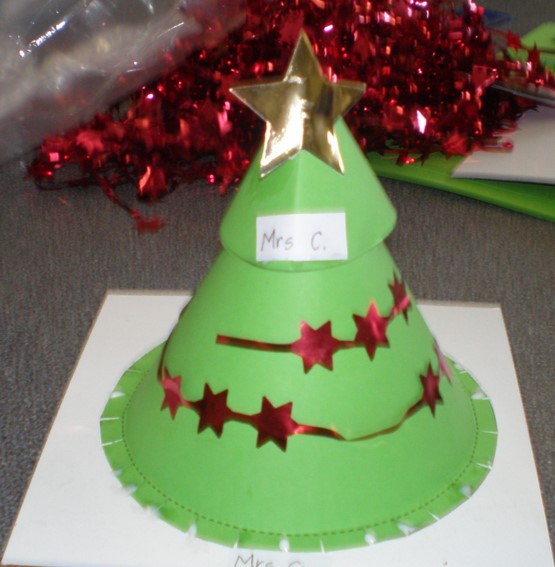
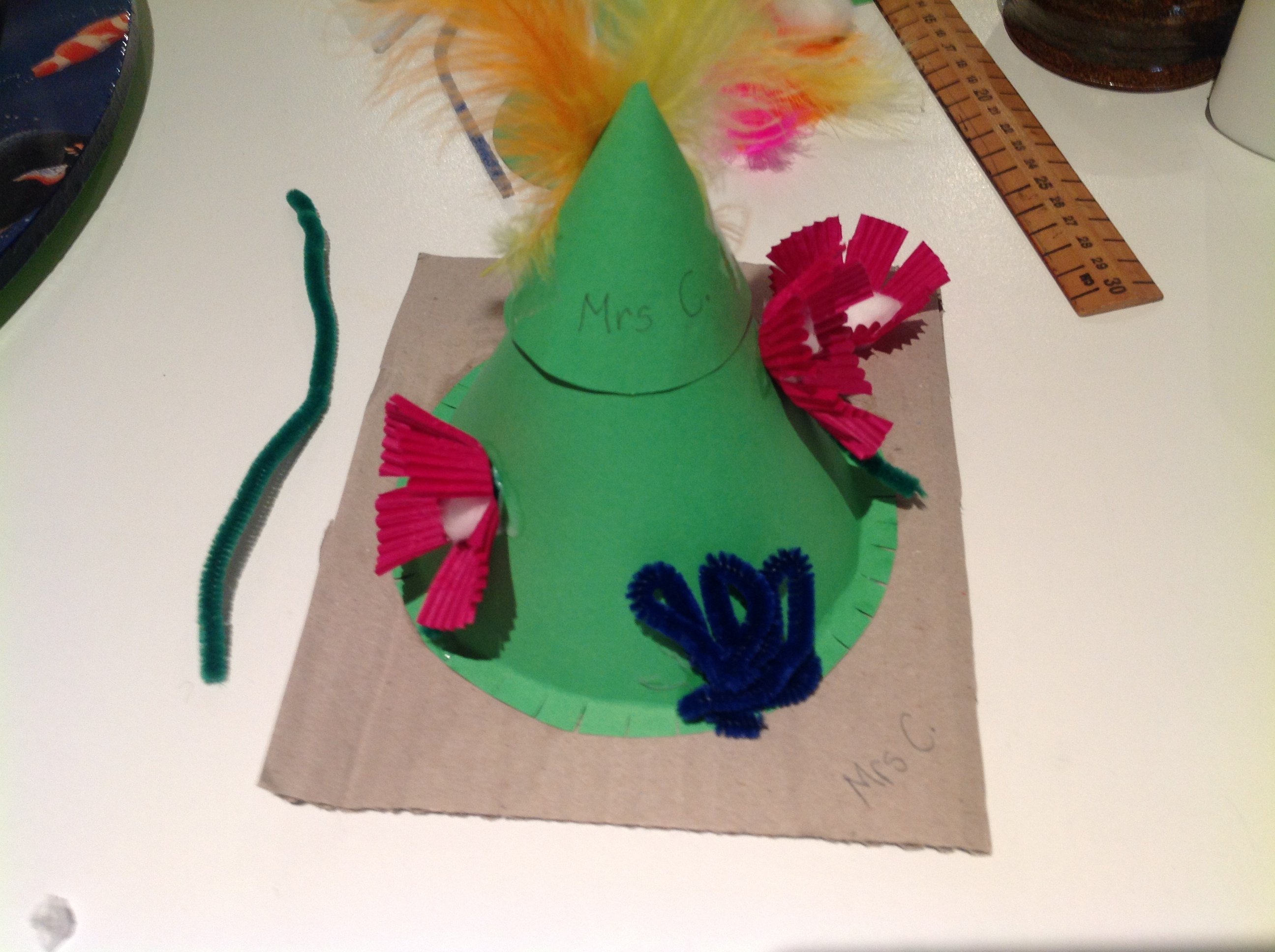
Here are photographs of two friendship trees I have made, one decorated for Christmas, the other for friendship:
A cardboard cone (with a cut-off top) is attached to a cardboard base. A smaller cone (removable lid) tops the tree. Children lift the top to place their messages inside.
If you would like to use a template for making the cone or view step-by-step instructions, I have made these available on the website TeachersPayTeachers. Please click here to follow the link.
If after viewing this site, you decide to join up as I have, I would appreciate it if you refer your membership back to me my using this link. Thank you.
I hope you and your students enjoy the friendship tree experience as much as I and my students have!



























 Norah Colvin