
I have previously mentioned the enjoyment I get from commuting. It’s not the sitting in traffic I enjoy, it’s the extra time for reading I have while I’m driving: reading with my ears rather than my eyes. I have a new-found love of audiobooks.
Over the past few years my library of audiobooks has grown alongside my library of ebooks and printed books. The range of genres represented in each category is pretty much the same when considering recent acquisitions, though measured alongside the collection of a lifetime the comparative numbers may differ. My collections include fiction and nonfiction, memoir and biography, children’s stories and picture books. Sadly, books of poetry are almost absent from recent purchases, though I do have one on order. Maybe I should improve on that sometime soon.
Although I have rarely been disappointed by any narrator, I especially enjoy it when authors read their own work. I recall disappointment and the need to correct, in my head, the narration of only one book. (It wasn’t read by the author.)
Three things I like about audiobooks:
- They increase reading time. I can listen while I do other things like driving, walking, ironing.
- I can take them anywhere and, with a pair of headphones, listen anywhere.
- There are many genres and titles to choose from. I can catch up on classics I’ve missed, or read new releases.
Five things that disappoint me about audiobooks:
- Not all titles I would like to read are available.
- They are not cheap, with prices equivalent or higher than a hardback edition. The last audiobook I bought was A$38; the next on my list is A$52!
- It is difficult to skip forward or back, find a particular place, make notes, or highlight quotes (if I find I want to do this with a book I have listened to, I invariably purchase it as an ebook or printed book, and sometimes both).
- Sometimes, but not always, my place has been lost when I have closed one book and opened another.
- They cannot be lent or transferred to another device (or maybe that’s because I buy them on iTunes for my iPad and I do not own any other Apple devices. Maybe someone can let me know.) This is probably better for the authors and their royalty payments.
I find that I very much enjoy being read to, listening to the words spoken by another, thinking about the richness of the voice and its accent, allowing me to be transported into the writer’s world through the voice’s musicality. It is like the author is speaking directly to me.
I was interested then, to recently read the opinions of two other writers about audiobooks:
Virginia Franken wrote My Sweet Love Affair With The Audio Book for Women Writers, Women(‘s) Books, and
Daniel Willingham posted Is listening to an Audiobook “Cheating” on his own blog.
Virginia explains her recent delight in finding audiobooks as a way of making more time for reading after her first child was born. She wonders how much boredom may have been prevented in previous years had audiobooks been available. She says,
‘even the most frantic among us probably has a few minutes in the day when we can listen to a book, even if there’s no time to physically sit down and read one. Working out, cleaning, commuting, watching your kid’s baseball practice, procrastinating at the office and yes, even grading bananas – now all have the potential to be a lot less dull.”
As I do, she finds listening to books as she commutes to work a real bonus. In addition to the excitement of listening, Virginia is excited that her novel Life After Coffee is to be produced as an audiobook. How exciting.
Virginia refers to the Association of American Publishers and its findings that sales of audiobooks are increasing and may be overtaking those of ebooks. Obviously Virginia and I are not the only ones enjoying audiobooks. But are we cheating by listening rather than decoding? Is listening not real reading?
Daniel Willingham, a cognitive scientist, also has books available in audio format. I listened to and enjoyed Why Don’t Students Like School?: A Cognitive Scientist Answers Questions About How the Mind Works and What It Means for the Classroom a few months ago. The focus of Willingham’s post about audiobooks is a little different from that of Virginia’s. I guess we should expect that from a cognitive scientist.
Willingham says that he’s been asked numerous times if listening to an audiobook is cheating. As I indicated in the title, I wouldn’t have thought of it in that way, other than perhaps cheating time. Is making more efficient use of time cheating?
Willingham says he doesn’t like the question. He chooses to rephrase it this way:
“does your mind do more or less the same thing when you listen to an audio book and when you read print?”
He says mostly it does, that “listening to an audio book is exactly like reading print, except that the latter requires decoding and the former doesn’t.” The same language processes are involved, and this is especially true when the purposes for reading are similar to the purposes for listening.
He cites research showing that differences in reading ability in lower grades are due to differences in decoding ability rather than language processes, and that in higher grades the differences are more to do with language processes that support comprehension. He says that there is a high correlation between listening and reading comprehension in adults.
However, he says that the processes may differ according to purpose; for example, when studying for a test or a quiz, or scanning for information, perhaps a printed text may be of more benefit. I agree but suggest print is definitely a better choice in these circumstances (see things I listed as disappointments earlier). He implies that listening, however, might provide additional meaning and aid comprehension through intonation. I think this is possibly true too.
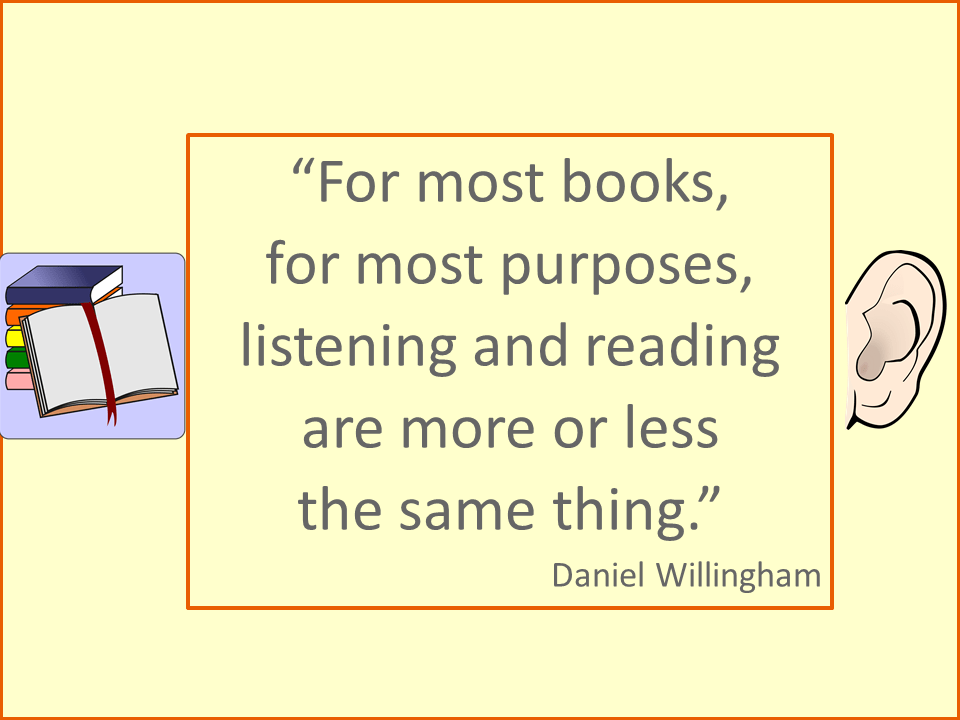
In conclusion, Willingham explains that
Listening to audiobooks is not cheating because:
- “Cheating” implies an unfair advantage, as though you are receiving a benefit while skirting some work. Why talk about reading as though it were work?
- Listening to an audio book might be considered cheating if the act of decoding were the point; audio books allow you to seem to have decoded without doing so. But if appreciating the language and the story is the point, it’s not.
- Comparing audio books to cheating is like meeting a friend at Disneyland and saying “you took a bus here? I drove myself, you big cheater.” The point is getting to and enjoying the destination. The point is not how you travelled.
What do you think? Do you listen to audiobooks? Do you consider it cheating? Why would you, or would you not, choose to listen to audiobooks?

Thank you for reading. I appreciate your feedback. Please share your thoughts.


 Norah Colvin