The classrooms of today are filled with children from a diversity of backgrounds and with a multiplicity of perspectives. The futures of those children are filled with opportunities that were unimaginable when I was a child and possibly even now. The world’s landscape — physical, political and social — is changing rapidly. Maybe we are not too far away from finding the pot of gold at the end of the rainbow. Could our ‘wealth’ be bound up in acceptance of our diversity?
Beach adventures were a big part of my childhood. I spent many long days swimming, sunbaking and exploring with friends and siblings at the beach no more than 500 metres from home. Generally, the instruction was to be home by tea time so, on our long summer holidays, we could spend as much time on the beach as we liked.
It wasn’t the most beautiful of beaches. The sand was coarse and yellow and the shore rocky in places. The water was often filled with jellyfish and seaweed. The narrow beach was edged by tall red cliffs which prompted Captain James Cook to name the area Redcliffe when he passed by in 1770. But we loved it anyway.
There were huge cotton trees, as perfect for climbing as the red cliffs were for scaling, and a playground with swings and slides, many of which are no longer considered child-safe. But we survived.
We’d explore the rocks for sea life, avoiding the jellyfish and seaweed as best we could, both in and out of the water. We’d play in the water and on the sand and lie on our towels talking, laughing and dreaming of whatever we did as children back then.
Sun safety
It may sound idyllic and perhaps it was, though to us, it just was. Most of us are now paying for those long days at the beach with sun damaged skin. If anyone was aware of the dangers of being too long in the sun back then, we certainly weren’t. We considered a bad dose of sunburn as nothing more than inconvenient and we took turns to peel layers of skin off each other’s backs when the blisters burst.
Nowadays, my beach adventures are mostly confined to observations of sparkling white sands and perfect blue water from a shady deck with a cool drink in hand. However, I may venture out for a stroll in the late afternoon when the sun’s light has dimmed, leaving the water and sky to meet and greet in shades of pink and lilac.
Our Australian culture has a love-hate relationship with the beach and sunshine. At the first hint of warm summer weather, we’ll be told it’s a great day for the beach and we’ll be presented with images of beaches crowded with sunbathers. On another occasion, we’ll be advised to stay out of the sun and avoid the damage to our skin. Queensland is, after all, the skin cancer capital of the world. I’ve never figured out why we don’t get a more sensible approach that combines enjoyment with safety.
But let’s not dwell too long on the negatives. Hopefully now with better education and the availability of protective products, the younger generation will not be so nonchalant about time spent in the sun.
A beach excursion
A beach excursion, whether with school or family, presents as many opportunities for learning as it does for fun. There are phenomena to inspire wonder and stimulate curiosity, and countless questions to ask and answers to discover; for example,
Ten beach-inspired questions
What makes the waves?
Why does the tide come in and out?
How is sand made?
Where do the shells come from?
Why does the sand squeak when we walk on it?
What lives in the ocean?
Why should we take our rubbish home with us or put it in a bin?
How do fish breathe?
What made these tracks on the sand?
My sandcastle was here this morning. What happened to it?
Some answers can be discovered through investigation and exploration at the beach. Others require research.
Three fun beach activities that involve learning
Shells are not only fun to collect, they are great for sorting and counting, measuring and making, creating patterns and trading.
Fish might be fun to catch (for some); but they can also be identified, measured and weighed. Children can research the different types of fish and regulations for catching them.
Photographs provide a great record of beach adventures. Children can be encouraged to compile them and write a recount or report about the outing.
And of course, there are always wonderful books to read about the beach; such as:
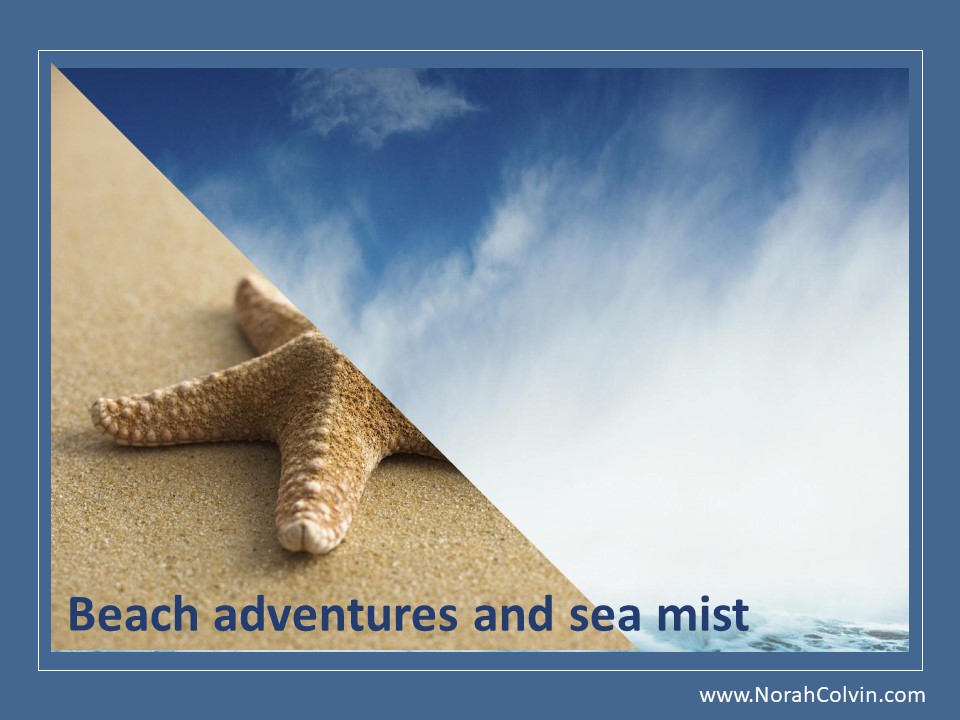
No more than a hint of sea spray and she was flown back on wings of joy to carefree childhood days frolicking in the shallows, basking on golden sands, fossicking for hints of life in rockpools and amassing precious collections of shells and other treasures arranged for her pleasure by the tide. Lulled by a gentle breeze and waves whispering a heart’s rhythm, she dozed, uninterrupted by seagulls squawking, murmured conversations, hushed laughter, or the shuffle of approaching and receding footsteps. As the sun glowed bright above, she sighed her last, now and forever one with the sea’s mist.
Thank you for reading. I appreciate your feedback. Please share your thoughts.
I had an idea I wanted to craft into a story. I’ve had a go. I’m not certain that it expresses quite what I was hoping, and certainly not as explicitly as I hoped. I had wanted it to stand alone, requiring no other explanation or padding and, while it fails, I’ve let it do just that.
Analyse the Detail
The artisan turned each piece to the light, this way and that, fitting and refitting, arranging and rearranging. Finally, it was done. Each piece necessary and perfectly positioned creating the whole— exquisite, harmonious, illuminating—not one greater nor outshining any other. It filled each open heart with hopes of dreams fulfilled.
Another sought to analyse its beauty, the power of its message to explore. He picked out all the pieces one by one and examined each in every detail. Too late he saw that, shattered and alone, not one shard revealed a secret. Only united did their meaning shine.
Thank you for reading. I appreciate your feedback. Please share your thoughts.
The results of the Carrot Ranch Rodeo Contest #5 The Sound and the Fury have been announced. What fabulous stories. Ride on over to the Ranch to read the winners, the Honourable Mentions and all the entries. Great writing everyone!
Now that the 2018 Carrot Ranch Flash Fiction Rodeo has ended and winners of each contest are being announced weekly, the regular flash fiction challenges have resumed.
“Help children to see that, although they may have some special friends, they can be friendly towards everyone. No one should be excluded. Everyone should be included.
Explain that being friendly towards others encourages others to be friendly towards them. Being a friend is like a superpower. It helps everyone, including yourself, have a good day.”
I also discussed some new and existing resources to support the teaching of friendship skills in early childhood classrooms.
How could I not choose friendship as my superpower, but how could I mash it with potatoes as Charli suggested?
Of course, there is the Wiggles song Hot Potato that includes mashed banana, why not mashed potato?
And there is the popular party game Hot Potato where everyone sits in a circle and passes an object like a ball, bean bag, or even a potato around the circle while music plays. Whoever is holding the object when the music stops is out, so it is important to pass it quickly, like a hot potato, so as to not be caught with it. Could the game be played with mashed potato? It could get rather messy, I think.
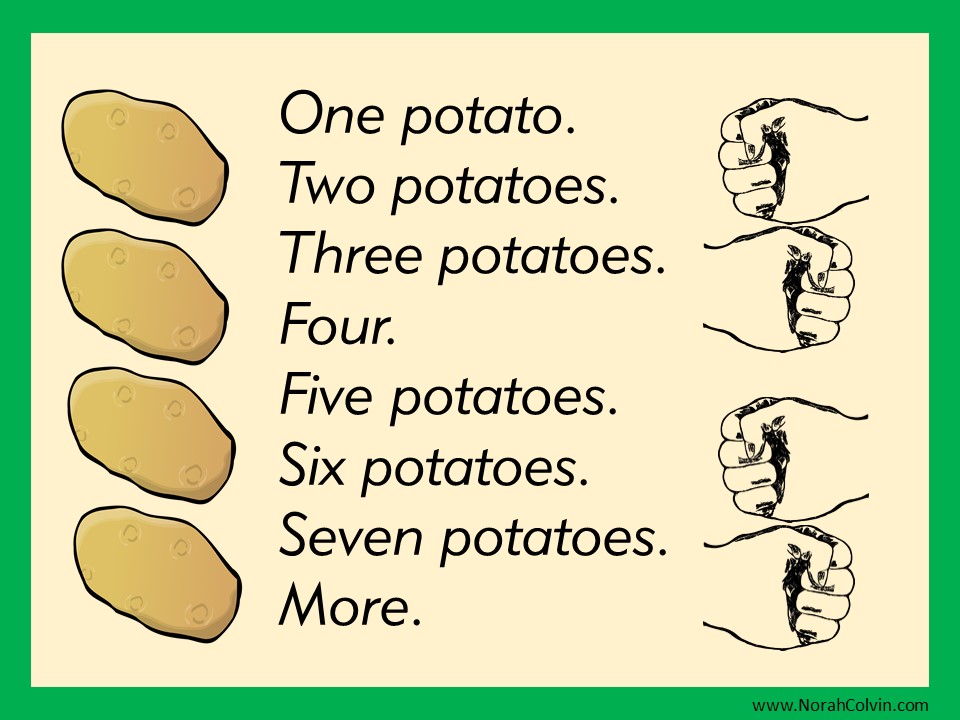
When I was a child, we used to play an elimination game using the song One potato, Two potatoes. Everyone would stand in a circle and put out both fists. “It” would go around the circle, bumping each fist in turn. Whichever fist was bumped on ‘more’ would be put behind the player’s back. The song and actions would then be repeated until only one fist (one player) remained.
Then, of course, there is the Mr Potato Head toy which made a comeback in the Toy Story movies.
Singing songs and playing games, including these, is always a great way to help develop that friendship superpower.
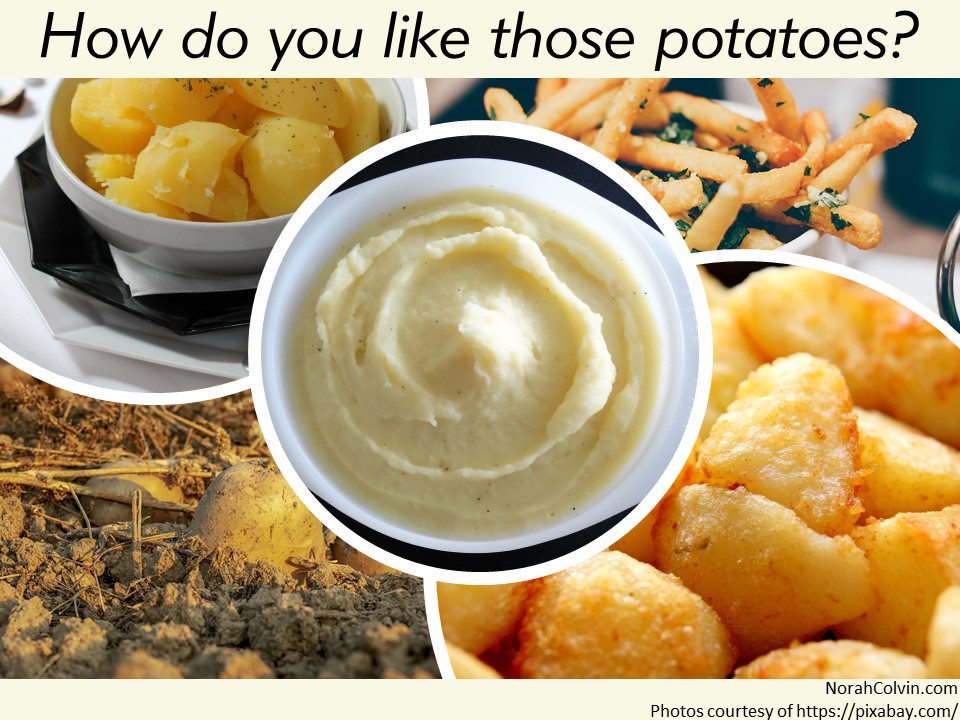
Although I’ve presented quite a mash of potato ideas, I haven’t even mentioned real potatoes yet.
If I stayed with childhood stories, I would say that mashed potato was a regular feature of evening meals with a humble serving blobbed unceremoniously on the plate. Roast potatoes were traditional for Sunday lunch and always much preferred. I never saw mashed potato as anything to get excited over, but Hub, who hails from Northern Ireland, has high praise for the champ of his younger days. Though I’ve tried, my attempts haven’t ever matched his expectations. I am surprised to see that mash is now a popular item on many restaurant menus —not quite so humble anymore, and perhaps a healthier choice than chips, which seem to be served with nearly everything.
So where to for a mashed potato superhero? Sometimes you need to look no further than the plate in front of you.
Here’s my response.
If only
Jake pushed the plate away. “Don’t like mash.”
Mum sighed and turned away.
As Jake stared at the potato, out popped a tiny, lumpy, and obviously grumpy, old man. He shook his fists.
Jake leaned forward. “Pardon?”
“I’m leaving.”
“Why?”
“Ya always push me away. Say ya’d rather chips or roasties. Doncha know we’re all the same—inside—only outside’s different.”
“Didn’t think—”
“Your kind—unkindness—never do. Gotta learn ta look beyond the differences, kid. Learn ta love us all.”
“Wait—”
“What?” said Mum, turning as Jake scooped the last spoonful of mash into his mouth.
Thank you for reading. I appreciate your feedback. Please share your thoughts.
I’m excited. It’s now time for the fourth Carrot Ranch Flash Fiction Rodeo Contest, and it’s mine! Are you up for writing a fractured fairy tale? Head on over to the Ranch for contest details. I can’t wait to read your stories.
Fancy yourself as an advertiser? Now’s your chance to try it out for free with a Bonus Contest at the Carrot Ranch for the Continental Fire Company. There are prizes for the three best entries. Time to get those fires lit!
Are you saddled up ready to write in the Carrot Ranch Flash Fiction Rodeo 2018? The contests get underway this week and continue throughout October with plenty of opportunities to join in and the chance of winning a prize.
Who will be among the TUFF 5 writers? Did you enter? Could one be you.? Or maybe me? Charli reveals all on 1 October. Not long to wait!
My children were early readers. Both began reading real books well before their fourth birthdays. Of course, the timing, whether early or late, matters little now that they are adults. What matters is that they are readers who read competently and confidently for a range of purposes including for information and pleasure. They are readers by choice as well as purpose.
The ability to read is something that most of us take for granted. Many have no recollection of learning to read, only of being able to do so all of a sudden, as if we just could, by magic.
But, as with any spell, there are certain essential ingredients that make the magic happen and others that inhibit the process. Creating readers of choice and not just purpose is the real magic. Creating non-readers is the effect of a spell in reverse, of a bad mix of ingredients, that sadly occurs all too often.
Bec reading to herself at 12 months
My children were readers of choice long before they could read anything for themselves. I wouldn’t say I set out to “teach” them to read. In fact, I didn’t at all. I set out to encourage in them a love of books and writing. Their learning to read was a by-product of sharing the love of words, language and reading.
The magic ingredients for developing readers:
Talk
Play
Read
Write
Love
Fun
I loved having time with my children. Being with them, watching them grow and develop was special, the best and most magical of days. They taught me as much or more about love, life and learning as they learned from me.
Talk
From their earliest days I talked to them, explained things to them — what was happening, what we were doing, and how things worked. I pointed things out and told them what it was called, what it was doing, what it was used for, or how it worked. When we were out and about, I’d point out signs and explain how I knew to stop or where to go. I avoided “baby” talk and always used appropriate everyday language.
Play
We played and had fun together, using our imaginations to create our own games. Sometimes we played simple board games and completed jigsaw puzzles. Whatever we played, talk always accompanied it.
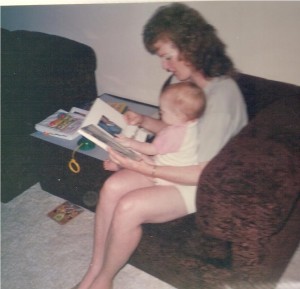
Reading to Bec at about 12 months old.
Read
I read to them, every day, not just one but many books. As I read, we discussed details in the illustrations and made predictions about the stories, sharing our thoughts. If a word was presented in a large or colourful font, I’d point to it as I read it. We’d laugh at the funny stories and cry at the sad and discuss all the story events. When they could read, they’d read to me, and we took turns reading together until they were early teens.
Write
When they first started to talk, I made books with pictures and words from their growing vocabulary. I labelled items in their rooms; for example, bed, shelf, window, door.
I made books about things we did with photographs and text. A book about our family made for my daughter’s first birthday was one of the favourites when cousins came to visit too.
The environment
I provided my children with an environment rich in language, books and opportunities for thinking. I’d read and write with them and to them, and they’d see me reading and writing for myself as well.
When son Rob was little, I didn’t yet know what I now know about the development of language, reading, and thinking. He taught me much that was later confirmed by my studies.
Rob, aged two, reading to some of his toys.
When he was only two, Rob would line up his toys on the couch, sit in the middle, and “read” to them. He would almost recite the stories from beginning to end. He already knew that the words in a book remain the same each time they are read — an important concept for beginning readers to grasp. When he was only three, he’d jump into bed beside me in the early morning after Hub had gone to work, prise my eyes open, and read to me! Magic!
Daughter Bec was born twelve years after Rob. Meanwhile, I had returned to college and studied the development of reading and language. I was amazed to find that we had unwittingly created the essential mix of ingredients for his learning to occur
Naturally, armed with experience as well as understanding, I did things pretty much the same for Bec — talking, reading, writing, playing, having fun and enjoying time together.
Bec sharing one of her favourite books.
When she was five, Bec was invited to participate in a study of children who learned to read before starting school. Of the children (maybe half a dozen) involved in the study, Bec was the only one the researcher considered to be really reading. She was reading fluently, with comprehension and at a higher level than the other children.
Some of the children were able to recognise isolated words, but not read them in continuous text. Others had been taught letters and sounds using flashcards and stopped to ‘sound’ out every word. They hadn’t become real readers.
Bec was not subjected to reading “lessons” as the other children had been. She was immersed in an environment that encouraged a love of learning, language and literacy. The other parents had a need for their children to read as if their value as parents depended on it.
While I had an expectation that Bec would read, I was confident that she would come to it in her own time. My credibility as a parent was not tied to her ability. Having said that, both children (adults) are now very successful in their chosen fields, so I must have done something right. Or perhaps we were just lucky that we chanced upon the magic mix of ingredients.
I do wish that all parents would include a sprinkle of language and a pinch of reading mixed with love and fun into their children’s lives every day. It would contribute greatly toward eradicating illiteracy.















 Norah Colvin