This week I have great pleasure in introducing you to Robbie Cheadle author and illustrator of the Sir Chocolate Book series.
What most appeals to me about the Sir Chocolate Books is Robbie’s amazing fondant illustrations. I am also impressed that her twelve-year-old son Michael co-authors the books with her, and has been since he was ten. Perhaps your children will also find this aspect interesting.
About the books
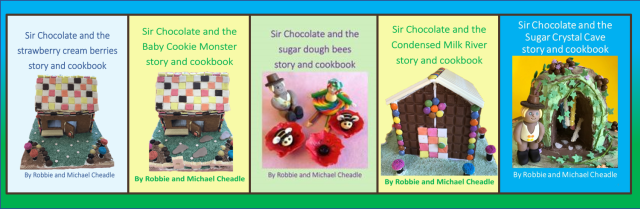
Sir Chocolate and Lady Sweet live in Chocolate Land where everything can be eaten. In each story, told in rhyme, Sir Chocolate and Lady Sweet have a new adventure or problem to solve. Robbie also includes recipes from the story in each book.
To date, there are five books in the Sir Chocolate Book series.
About Robbie
Robbie Cheadle was born in London. Her father died when she was three months old, and she and her mother emigrated to South Africa where they lived in Johannesburg, George and Cape Town. While growing up, Robbie attended fourteen different schools. This gave her many opportunities to develop social skills and meet new people as she was often “the new girl”.
Robbie is a qualified Chartered Accountant and writes in that field about equities and investments in South Africa.
While Michael co-authors the books with her, Robbie’s other son Gregory (aged 14) assists Robbie and Michael with filming and editing their YouTube videos and editing their books. The books are very much a family affair.
For other books written by Robbie, see the end of the blog post.
The interview
Welcome to readilearn, Robbie.
Thank you for inviting me.
Robbie, the number of books in the Sir Chocolate book series is continually growing with five books now available. What gave you the idea for this series?
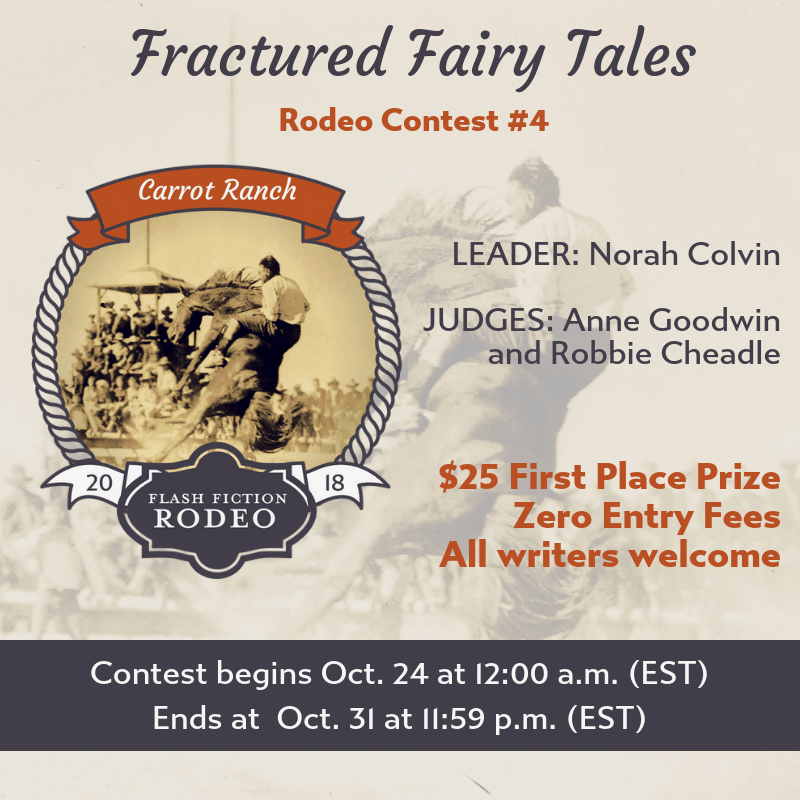
As promised, here’s some information to start your thinking in preparation for the fractured fairy tale flash fiction contest in the Carrot Ranch Rodeo next month. (Try saying that five times real fast!)
Please note: The correct date is Oct 24, not Oct 17 as shown below.
Education is my theme. It’s my passion. Sometimes I think I should get another interest, but I’m stuck with this one. Sometimes I get stuck with a theme within a theme too. That’s happening at the moment.
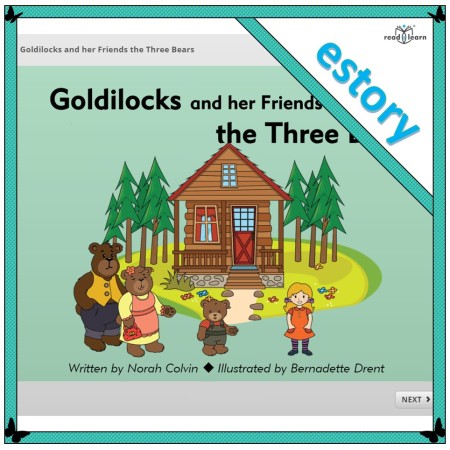
A couple of weeks ago, I uploaded an innovation on the traditional story of Goldilocks to readilearn, a collection of teaching resources for the first three years of school. I also added some suggestions for using the resource to teach reading and writing, including sight words in context. I have other supporting resources in progress to be added to the collection soon.
While my story Goldilocks and her Friends the Three Bears is not really a fractured fairy tale, it’s simply a retelling with an alternative ending; I’ve also been thinking of fractured fairy tales for my Carrot Ranch Rodeo Contest coming up next month. (Look for further details to be published at the Ranch this week.)
So stuck on this theme am I, that I wrote a 297 (3 x 99) word story as a response to Charli’s Tuff prompt “Papa’s Bar”. While this Free-Write contest is now closed (writers have only twenty-four hours to respond to the prompt), there will be four more chances to enter the TUFFest Ride event with the next one scheduled for September 19. Be sure to look out for it if you want to be in it.
Note: I’m not sure where or what the Papa’s bar is that Charli alluded to, but I am sure that it’s not what I wrote my story about. In Australia, when we play tiggy, that you might know as tag or tig, or some other name, we might allocate a certain spot as ‘bar’. This means that you are safe and cannot be tagged when on or touching that spot. Sometimes, players will attempt to allocate a spot as bar just as they arrive at it in order to avoid being tagged.
While I have no thoughts that I may win any of the TUFF contests, it is fun having a go. This is what I wrote in response to the Papa’s Bar prompt. I hope you enjoy it.
Papa’s Bar
Out in the woods lived a family of bears; Papa Bear, Mama Bear and baby bears five. All summer long, Papa Bear toiled, ensuring his family were contentedly fuelled, ready to sleep through the winter’s long dark. They filled up their bellies with berries hung low, with fish in abundance in streams flowing clear, and hives’ full bounty of gold. Mama and babies had no need to complain, every meal Papa made, a sumptuous feast. When autumn arrived, and food became scarce, Papa Bear said, ‘Now’s time for bed. Close your eyes little ones, dream sweet dreams until spring.’
The babies were restless, not ready for sleep.
‘We need a story,’ a little one said. ‘Tell us about life when you were a cub. What did you eat? Where did you play?’
‘Just one story — then sleep.’
‘We need a drink first,’ said the cubs.
‘Okay, but lickety-split.’
They had just settled back when another voice said, ‘I’m hungry.’
‘Me too,’ chimed the others.
‘Can’t be,’ said Papa Bear. ‘No food until spring.’
‘Awh,’ they chorused.
‘I could make some porridge,’ yawned Mama Bear.
‘Yay! Porridge!’ said the baby bears.
‘But then you must sleep,’ said Papa Bear.
But they didn’t. Before his story was through, Papa Bear was snoring with Mama Bear nestled beside him.
‘Let’s play tag,’ smirked one.
‘I’m It,’ said another.
They took turns to run and catch, and through it all, the parent bears slept.
At last, the littlest bear yawned. No more running and catching, he was ready for sleep. He scrambled over Papa Bear, escaping the tagger’s clutches with a warning, ‘Can’t get me. Papa’s bar.’
His eyes closed and then, one by one, they snuggled into a big bear hug, murmuring ‘Papa’s bar’ as they drifted off to sleep.
This week I have great pleasure in introducing you to Sonia Bestulic author of Reece, Give Me Some Peace. While interviews with authors and illustrators have featured regularly on the readilearn blog, this interview marks a new collaboration with Romi Sharp and the team from Books on Tour. This post is but one of several celebrating the launch of Sonia’s beautiful picture book. Please read to the end of the post for details of other posts celebrating Sonia’s work.
About Sonia Bestulic
Sonia grew up in Sydney Australia enjoying a childhood filled with wonderful books, a passion for writing and music entwined. She played the violin until her late teens, including performances at the Sydney Opera House. Sonia is Founder of Talking Heads Speech Pathology established in Sydney in 2006. A long-term advocate for children’s learning and literacy, Sonia continues to write and speak about all things children.
About Reece Give Me Some Peace
Reece Give Me Some Peace is a fun-loving book about the wonderful world of music and noisy play. Reece is a very cheeky and curious boy who loves making noise. His mother’s requests for him to be quieter only seem to make him louder. As his exuberance grows, so does his mother’s exasperation. Will she ever get any peace?
The simple rhythmic text combined with delightful illustrations by Nancy Bevington reminds us of the power of learning through play and exploration. Children will love to join in making the sounds and adults will identify with the challenge of being able to enjoy some quiet.
Now, let’s meet Sonia.
The interview
Hello, Sonia. Welcome to readilearn.
Thank you for inviting me.
Sonia, today we will discuss your beautiful new picture book Reece, Give Me Some Peace, but first, can you tell us what inspired you to be a writer?
For a relative newcomer, in my terms anyway, Pinterest has made quite an impact on the world, particularly on the world of the classroom.
If you’re in doubt, just Google ‘Pinterest classroom’. Your search will bring up hundreds, indeed thousands, of ‘best’ classroom décor ideas.
Decorating classrooms seems to be the thing of the moment. It would be easy to believe that an elaborately decorated classroom is of greatest importance to teachers today. While we always did it (decorated our classrooms), we didn’t share and compare on social media. How could we? Social media didn’t exist. Oh, horrors! Really? Really. Pinterest is not only new to this century. It’s new to this decade, and the sharing phenomenon isn’t exclusive to Pinterest.
Concerns about harmful effects of social media messages on young, and not-so-young, people’s body image are often expressed. I wonder if there may be similar harmful effects of these classroom images. If teachers compare their classroom décor with that of others, perhaps in very different situations, will they constantly come up short? If they spend copious amounts of time, and money, on decorating their room, how much will they have left for professional reading and planning? As with body image, are these images sending the wrong message?
While I agree with the importance of setting up a bright, welcoming classroom, I also believe that space must be left for the display of children’s work. While I don’t believe in the bare wall theory as proposed by some, if there is too much on the walls, and particularly if they didn’t contribute to it, children may either ignore it or simply find it distracting.
What do you think? Do you remember the walls of your childhood classroom? Mine were mostly bare. I don’t remember anything other than a Crucifix (I went to a Catholic school), a photo of the Queen, and a flip book of large cloth charts.
What about your children’s classrooms, or your own (if you are a teacher)? How are they decorated? I’d love to know your thoughts.
Most of my working life (and all of my school days, which together equate to most of my life 😊) has taken place in a classroom. I had brief tilts at other minor roles, but overall, the classroom has been my workplace. With a career spanning five decades (but not fifty years – yet), I think it could be categorised as epic.
However, rather than tackle my career, I realised that Pinterest-Inspired Classrooms fitted neatly into the EPIC acronym. as long as I could find that exceptional ‘e’ word. This is my response. I’d love to know what you think.
It’s EPIC
Roll up! Roll up! Come one, come all. This new attraction will have you enthralled. Bring parents, bring partners, siblings and friends. No one’s excluded. It’s Earth’s latest trend. Your eyes won’t believe. Your ears won’t deceive. It’s a sensory explosion, for all to explore. It’s entertaining, electrifying, edifying too. It’s a universe first, and it happened on Earth. It’s empowering, engrossing. There’s so much to see. With no space left empty, it’s elaborate, exciting, extols energy. With exquisite exhibits and enlightening exposures, it’s the most, enticing, enriching, educational environment, established on Earth. It’s EPIC, the Exceptional Pinterest-Inspired Classroom.
Thank you for reading. I appreciate your feedback. Please share your thoughts.
Tomorrow is International Literacy Day. It has been celebrated on 8 September for over fifty years. The purpose of the day is to remind the international community of the importance of literacy and to eradicate illiteracy around the world. It values literacy education for young people the world over. This year’s theme is Literacy and skills development and focuses on the integration of literacy with other skills to enhance people’s lives and employment opportunities.
In our early childhood classrooms, the focus is always on the development of literacy. A strong foundation in both reading and writing enables children to be more successful learners at school and independent learners out of school. It provides them with skills essential to full participation in and contribution to our world. While we may not be ostensibly training them for future employment, the literacy skills they learn in early childhood form the foundation upon which that learning develops.
The idea of integrating literacy development with other skills is not unfamiliar to early childhood classrooms. The most effective approaches focus on teaching skills in meaningful contexts rather than in isolation.
In celebration of International Literacy Day this year, I have uploaded some new resources to the literacy collection. As with other readilearn literacy resources, the focus is on teaching literacy skills in context.
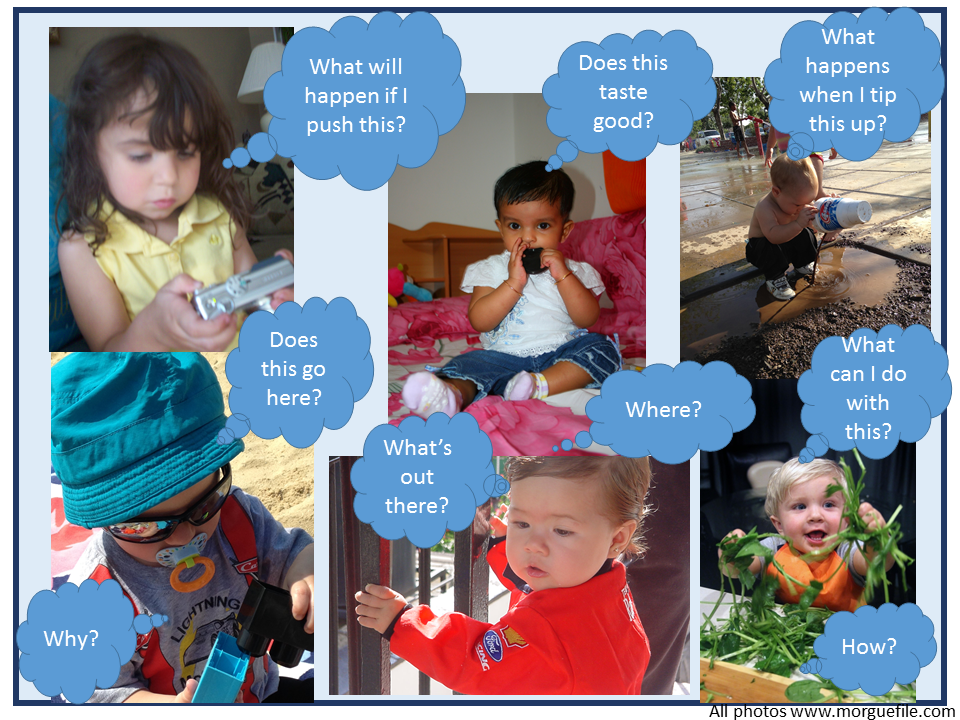
Children are question machines, churning out question after question: why is it? how does it? Their mission is to find out about the world and everything in it, not to drive their parents crazy, as many believe.
Of course, the best response to children’s questions is to help them find the answers, unlike in this scenario.
Unknown source. Apologies. Happy to attribute if informed.
I always love the story of David Attenborough shared by Michael Rosen in his wonderful book Good Ideas: How to Be Your Child’s (and Your Own) Best Teacher. Rosen says that, as a child, David took an interest in bones and if he was out walking and found some he would take them home and ask his father (a GP so would probably know) about them.
But his father didn’t just tell him. Wanting his son to be curious and interested in finding things out for himself, he responded, for example: “I wonder if we can work it out . . .” They would then look through books about zoology and anatomy and try to identify the bone’s origin.
I would like to have been a parent like David Attenborough’s father, perhaps more often than I was. But sometimes the situation is not conducive to an immediate quest for answers, and oftentimes we don’t have a satisfactory one to give.
Our language, with multiple meanings for the same word, and an abundance of phrases that can’t only be taken literally, is not the easiest to learn. I often marvel at how well our children learn it and wonder even more about the complexity our language has for learners of English as another language.
Bottleneck is one of those words that can’t always be taken literally. I’ve used my response to Charli’s prompt to honour parents who are under constant scrutiny and bombardment with questions from their little ones. Sometimes it feels more like a battleground and they do well to maintain a peaceful composure. I hope you enjoy it.
Lemons, Limes and Other Mysteries
She hit the brakes and thumped the steering wheel.
“Mummy swore.”
“Didn’t.”
“I heard.”
“Why we stopped, Mummy?”
“There’s a traffic jam.”
“Jam? I love stawbrey jam sammich.”
“Not that jam — must be a bottleneck up ahead.” Please be a merge, not an accident.
“We learned ‘bout bottlenecks today.”
“What?”
“Live in the ocean. Maminals, like us. Where’s bottleneck, Mummy?”
It’s not always easy being a casual teacher, taking over another teacher’s class for the day. You might be in a different class at a different school, working with a different age group and a different set of expectations, and probably playground duty, every day of the week.
But it does have its advantages too. You can arrive just before school begins and leave when it finishes. You don’t have to do assessment, write reports or be involved in parent meetings.
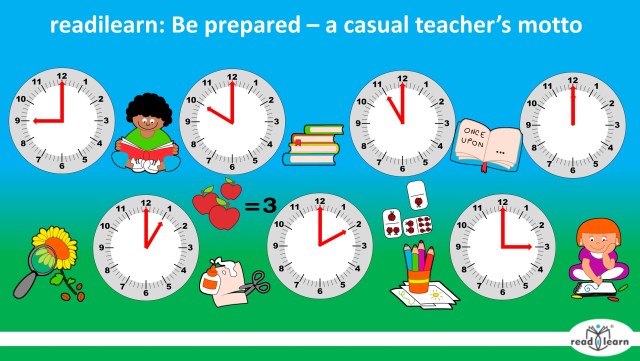
But it is important to be prepared.
Familiarise yourself with the class timetable and program
Many teachers leave a program for relief teachers to follow and, if one is available, it is important to follow it to maintain continuity for the children and to avoid interrupting the teaching and learning schedule. However, there may be days when a program is not available, and a casual teacher needs to be prepared for these.
Whether a day’s program is available or not, it is important to remember that it’s not your class. There will be established class expectations, procedures and timetables. The day will work best if these can be followed as closely as possible, particularly if teacher aides, support personnel and specialist teachers are involved.
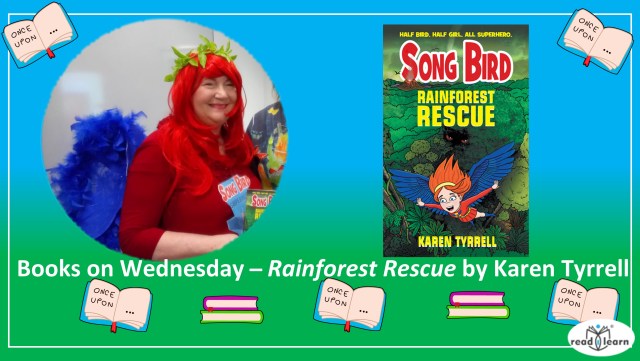
A review of Rainforest Rescue the third in the Song Bird series of empowering junior fiction books by author Karen Tyrrell.
This week, I want to let you know about Rainforest Rescue, newly released and third junior fiction novel in the Song Bird series of empowering books for young people, by Karen Tyrrell.
I have previously interviewed Karen about the other books in her Song Bird series, Song Bird Superhero and The Battle of Bug World so wanted to let you know that the third is now available.
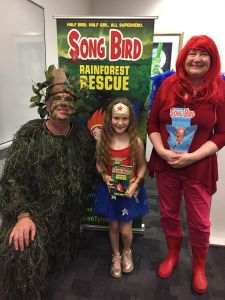
I was delighted to attend the recent launch of Rainforest Rescue. Song Bird (Karen) and Tree Man (Karen’s husband and co-author, Steve) wowed their audience that included other superheroes as well as mere mortals like me.
Since the launch, Karen and Steve have been busy visiting schools and making bookshop appearances as part of Book Week Celebrations. If you would like a visit from Karen with one of her empowering presentations or pantomimes, you can contact her on her website here, or connect with her on social media — Twitter: @Karen_Tyrrell. FB: @KarenTyrrellAuthor.
Visit Karen’s website for free teacher resources, a special offer for Australian readers, and information about purchasing Rainforest Rescue elsewhere.
This is my review of Rainforest Rescue, which you can read on Amazon here.
Rainforest Rescue is the third book in the Song Bird series by Karen Tyrrell and the best yet.
My children were early readers. Both began reading real books well before their fourth birthdays. Of course, the timing, whether early or late, matters little now that they are adults. What matters is that they are readers who read competently and confidently for a range of purposes including for information and pleasure. They are readers by choice as well as purpose.
The ability to read is something that most of us take for granted. Many have no recollection of learning to read, only of being able to do so all of a sudden, as if we just could, by magic.
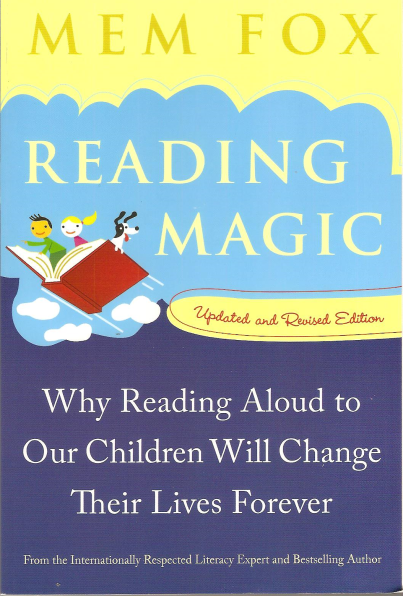
But, as with any spell, there are certain essential ingredients that make the magic happen and others that inhibit the process. Creating readers of choice and not just purpose is the real magic. Creating non-readers is the effect of a spell in reverse, of a bad mix of ingredients, that sadly occurs all too often.
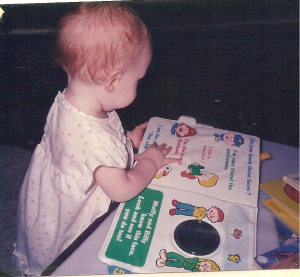
Bec reading to herself at 12 months
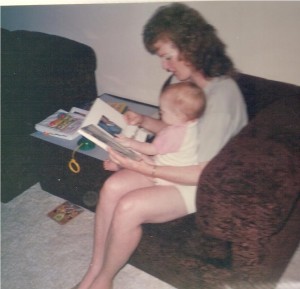
My children were readers of choice long before they could read anything for themselves. I wouldn’t say I set out to “teach” them to read. In fact, I didn’t at all. I set out to encourage in them a love of books and writing. Their learning to read was a by-product of sharing the love of words, language and reading.
The magic ingredients for developing readers:
Talk
Play
Read
Write
Love
Fun
I loved having time with my children. Being with them, watching them grow and develop was special, the best and most magical of days. They taught me as much or more about love, life and learning as they learned from me.
Talk
From their earliest days I talked to them, explained things to them — what was happening, what we were doing, and how things worked. I pointed things out and told them what it was called, what it was doing, what it was used for, or how it worked. When we were out and about, I’d point out signs and explain how I knew to stop or where to go. I avoided “baby” talk and always used appropriate everyday language.
Play
We played and had fun together, using our imaginations to create our own games. Sometimes we played simple board games and completed jigsaw puzzles. Whatever we played, talk always accompanied it.
Reading to Bec at about 12 months old.
Read
I read to them, every day, not just one but many books. As I read, we discussed details in the illustrations and made predictions about the stories, sharing our thoughts. If a word was presented in a large or colourful font, I’d point to it as I read it. We’d laugh at the funny stories and cry at the sad and discuss all the story events. When they could read, they’d read to me, and we took turns reading together until they were early teens.
Write
When they first started to talk, I made books with pictures and words from their growing vocabulary. I labelled items in their rooms; for example, bed, shelf, window, door.
I made books about things we did with photographs and text. A book about our family made for my daughter’s first birthday was one of the favourites when cousins came to visit too.
The environment
I provided my children with an environment rich in language, books and opportunities for thinking. I’d read and write with them and to them, and they’d see me reading and writing for myself as well.
When son Rob was little, I didn’t yet know what I now know about the development of language, reading, and thinking. He taught me much that was later confirmed by my studies.
Rob, aged two, reading to some of his toys.
When he was only two, Rob would line up his toys on the couch, sit in the middle, and “read” to them. He would almost recite the stories from beginning to end. He already knew that the words in a book remain the same each time they are read — an important concept for beginning readers to grasp. When he was only three, he’d jump into bed beside me in the early morning after Hub had gone to work, prise my eyes open, and read to me! Magic!
Daughter Bec was born twelve years after Rob. Meanwhile, I had returned to college and studied the development of reading and language. I was amazed to find that we had unwittingly created the essential mix of ingredients for his learning to occur
Naturally, armed with experience as well as understanding, I did things pretty much the same for Bec — talking, reading, writing, playing, having fun and enjoying time together.
Bec sharing one of her favourite books.
When she was five, Bec was invited to participate in a study of children who learned to read before starting school. Of the children (maybe half a dozen) involved in the study, Bec was the only one the researcher considered to be really reading. She was reading fluently, with comprehension and at a higher level than the other children.
Some of the children were able to recognise isolated words, but not read them in continuous text. Others had been taught letters and sounds using flashcards and stopped to ‘sound’ out every word. They hadn’t become real readers.
Bec was not subjected to reading “lessons” as the other children had been. She was immersed in an environment that encouraged a love of learning, language and literacy. The other parents had a need for their children to read as if their value as parents depended on it.
While I had an expectation that Bec would read, I was confident that she would come to it in her own time. My credibility as a parent was not tied to her ability. Having said that, both children (adults) are now very successful in their chosen fields, so I must have done something right. Or perhaps we were just lucky that we chanced upon the magic mix of ingredients.
I do wish that all parents would include a sprinkle of language and a pinch of reading mixed with love and fun into their children’s lives every day. It would contribute greatly toward eradicating illiteracy.






















 Norah Colvin