
And the results of the TUFFest Contest of all in the Carrot Ranch #FFRODEO are out. Congratulations Liz Husebye Hartman for TUFFing it out to win the contest!
Category: Writing
-
Winner of Flash Fiction Contest #7
Did you enter Contest #7 of the Carrot Ranch #FFRodeo? The winner is announced. It wasn’t me. Could it have been you? Read the fabulous entries. Who would have thought a murder story could be told in so few words?
Share this:
-
Winner of Flash Fiction Contest #6
What fabulous stories in the Carrot Ranch #Contest 6 Bucking Bull go round, lead by the winner Kerry E.B. Black. Congratulations, Kerry, and to all the runners up, and entrants alike. Judge D. Avery says the judging was difficult. Reading these stories, that seems obvious. Well done, everyone!
Share this:
-
How do you perform?

This week at the Carrot Ranch Charli Mills talks about her years as a ballet-Mum, working behind the scenes to ensure the performers were ready to take to the stage.
She talks about the pleasure of watching from theatre stalls, a recent performance of dancers taught by the daughter she’d taken to lessons all those years before.
She sees connections between her role as stage-Mom and her role as Lead Buckaroo at the Carrot Ranch; and similarities between ballet performances and performing with flash fiction.
This, of course led to the week’s flash fiction prompt in which Charli challenged writers to In 99 words (no more, no less) write that features a performance. You can interpret what is a performance any way the prompt leads you.
There is little in which Charli is unable to find an analogy to writing. Likewise, I am always keen to find the connections, similarities and analogies to teaching. I have long considered teaching to have elements consistent with entertaining and performing, with our classroom the stage, and the students the interactive audience, the participants for whom and by whom the daily enactment evolves. Regardless of how we feel, each day we enter our classrooms ready to perform, determined to give our students the best educational experience possible.
But I am also familiar with other performances. I performed in many plays as part of studying Speech and Drama throughout school. Both children had a big interest in drama at school also, and I spent many hours ferrying them to classes around the city, making costumes, and watching rehearsals as well as final performances.
As a teacher, I would provide opportunities for children to role play, improvise impromptu scenarios, create puppet plays, and perform songs or plays for parents throughout the year.
Then there are the other impromptu performances that toddlers are great at turning on when the inappropriate moment takes them.
Tonight, I had the pleasure of viewing a presentation, rather than performance, of a story written by local author Yvonne Mes. The story A Starry Christmas was animated and displayed in a spectacular light show on Brisbane City Hall. What an amazing way to have one’s work shared. Congratulations must go to Yvonne for writing the story, and the teams who animated it and produced it. You can watch a video of the story and read some additional information about the event on Yvonne’s website here.
I thought I’d combine a few of these ideas into my response to Charli’s flash fiction prompt this week. I hope you enjoy it.
Christmas lights
A two-day city visit is never enough, but they were determined – trekking the city, visiting in-store Santas, viewing Christmas-dressed windows, watching street performers, even attending a pantomime, with just a brief playground stop for lunch. The light show was the day’s finale. The tired parents and niggly children collapsed onto the lawn in anticipation. Suddenly the littlest began to perform – crying, screaming, stamping, flailing. Nothing would soothe. The eldest observed, zombie-like. Soon the light-show distracted, occasionally interrupting the performance. Only when the fireworks began, drowning out his cries, did he give in to sleep, sprawled indecorously on the grass.
Thank you for reading, I appreciate your feedback. Please share your thoughts.
Share this:
-
The art of choosing – self-care
This week, Charli Mills challenged the Carrot Ranch Literary Community to In 99 words (no more, no less) write a story that includes self-care. Does the character need it? What does the character do? Think about how you can use this action to deepen a character or move a story. Go where the prompt leads. She talks about being easy on ourselves and taking time to celebrate our progress and avoid being shackled by the imposter syndrome that masquerades as our harshest critic.
Dr. Andrea Dinardo is also talking about self-care this week on her blog Thriving Under Pressure. Her post urges us to Work hard. Rest. Repeat, and recommends
“If you get tired, learn to rest not quit.”
Resting can be difficult when there is much we want to do and achieve, both personally and professionally; but sometimes, if we don’t rest by choice, we have it thrust upon us.
This week, when I’m already masquerading as an overposter, as a mini-rest, an exercise in self-care, and care for you too, I’m presenting my flash response without the padding of a post. Here it is. I hope you like it.
Rest. In. Peace.
“You really should take a break,” they suggested.
“I can’t. Too much to do.”
“You need time off,” they said.
“I know. Soon.”
…
Eventually, “I’m taking a break,” she said.
The afternoon sun warmed as the sand caressed her aching body. Her eyes closed. Only an occasional seagull’s squawk interrupted the repetitive swoo-oosh of the waves that jumbled with the office cacophony looping incessantly.
…
“What? What happened?” they asked.
He scrolled quickly, searching for details.
“Sleeping. On beach. Seagull – ha!– dropped a baby turtle – landed on her head – died instantly.”
“And we thought work would kill her!”
Thank you for reading. I appreciate your feedback. Please share your thoughts.
Share this:
-
That’s what friends are for
At this time of year, minds and hearts turn to friends and family, and contemplations of what we can do to make the world a better place. When we think of global events, we may feel overwhelmed, wondering what possible effect our actions could have. But when we focus on our own circle, any positive difference we make can effect changes of which we may never be aware. That’s the ripple effect, and that’s what friends are for.
I belong to a very supportive online community whose encouragement helps to keep me going.
With my focus on education, particularly early childhood education, and their work mostly targeting adult audiences, I struggle to find ways of supporting them and their creative pursuits during the year, other than the usual shares on Twitter and Facebook.
However, come Christmas time, what’s to stop me doing a little more?

In a recent readilearn post, I acknowledged authors and illustrators of children’s literature whom I was fortunate enough to interview throughout the year. You can read that post here. I was also delighted to be invited by Christy Birmingham to write a guest post about them for her blog When Women Inspire.

In this post, I acknowledge and promote recent works published by my SMAG community; lovely people who support me both here and over at readilearn. SMAG is an acronym for Society of Mutual Appreciation and Gratitude. The community is open to anyone. All that is required is friendship. If you’d like to add the badge to your blog, I’d be honoured. If you’re not sure how to do so, you can find instructions here.
I know I won’t catch all my SMAGgers, but I’ll do my best. If I miss you, I apologise. Please add your details in the comments.
I hope as you read through my list your will find some books to add to your own collection or to gift to another for Christmas, or holiday, or anytime reading.

My first acknowledgement goes to Charli Mills of the Carrot Ranch Literary Community.
Participation in the Carrot Ranch weekly flash fiction challenges inspires many of the posts shared here. The support of Charli, Lead Buckaroo, and the team of Rough Writers has been a constant source of encouragement.

While we eagerly await the publication of Charli’s two novels-in-progress, she has compiled an anthology of flash fiction submitted to the weekly prompts. The Congress of Rough Writers Flash Fiction Anthology Volume 1 will be available soon. I am rather delighted to say that some of my writing features in the Anthology. (Check out books by other Rough Writers featured on the Books page.)

I very much enjoyed Anne Goodwin’s debut novel Sugar and Snails, and was not disappointed with her second novel Underneath, released earlier this year. Anne is also a prolific writer of short stories, many of which are available from her website. An anthology (Annethology) will be available soon. I’ve yet to read a story of Anne’s I didn’t like.

Sarah is a micro-fiction expert. She packs a whole lot of story into just a few words. I described her first book Hinting at Shadows as a box of chocolates – bite-sized pieces of dark delight; once you’ve tasted you can’t stop! Her second anthology On the Edge of a Raindrop, just released, holds equal promise.

If you haven’t yet checked out Robbie Cheadle’s Sir Chocolate Books you really must. Robbie’s unique style of illustrating her stories with fondant creations will make your mouth water.
The Sir Chocolate Books series of stories were written by Robbie and her son Michael. The rhyming stories are supplemented by the inclusion of recipes and links to YouTube videos.

Debby Gies writes memoir; stories from her life and her heart; stories that will resonate with us, inspire us, make us laugh, and make us cry. When I read Have Bags Will Travel, I couldn’t believe how much of my experience she was sharing.
Debby has numerous books in her collection, including her new release Twenty Years: After “I Do”. I’m sure you’ll find at least one to take your fancy.

Christy Birmingham’s book of poems Versions of the Self is an exploration of the emotions experienced in relationships and the personal growth that occurs through them.

D. Avery’s books of poems make excellent reading. Chicken Shift combines philosophy, humour and utter nonsense by contemplating answers to the old riddle “Why did the chicken cross the road?” Who would have thought there could be so many responses? – Only D.
For the girls explores responses to a diagnosis of breast cancer and what it means personally and to others. It’s a must read for anyone whose life has been touched by cancer. There are few of us who haven’t supported a loved one as they work through their emotional, as well as physical, response.

Sally Cronin is a prolific author of both fiction and non-fiction. Her most recent publication What’s in a Name? Stories of Life and Romance Volume 2 is a book of short stories in which she explores why we find the names of some people memorable.
Sally is also an amazing support for writers and all things writing. I was delighted to be recently featured in her series Posts from my Archives here and here. Thank you, Sally.

This year Susan Scott published Aging and Becoming – A Reflective Inquiry, which she cowrote with Susan E. Schwartz. The Susans reflect on life and its effects on the physical, mental and emotional experience as we age. Throughout the year, Susan shared excerpts on her lovely Garden of Eden blog.
Not just books
Pauline King has many lovely crafts and artworks for sale in her Contented Crafter’s Gift Shop.
Robin Etter-Cleave plays Notes from Squire Street on her melodic alto flute.
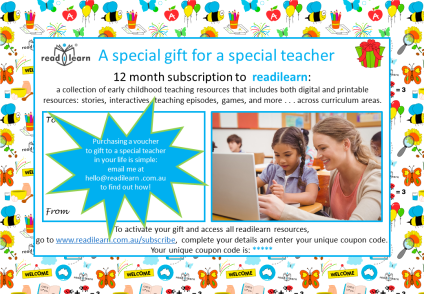
For an early childhood teacher, a readilearn subscription makes a thoughtful gift. Contact me for details.
For other suggestions, check out last year’s list here.
Apologies again if I have missed your current publications. Please know that each of you is greatly appreciated. The purpose of writing is to connect with readers. If you “like” or share a post, that is wonderful. If you leave a comment and engage in conversation, that is even better still. Thank you.
Thank you for reading. I appreciate your feedback. Please share your thoughts.
Share this:
-

Readilearn: Wrapping up a year of books – the gift of reading
The love of reading is one of the greatest gifts a parent can give a child.
Reading is empowering, and a book is a gift that continues to give, long after the occasion has past. It’s effects cannot always be measured.

To help you decide which books to give to whom for Christmas, I thought I’d make your task a little easier by reminding you of the lovely books I shared throughout the year in interviews with their authors and illustrators.
Below you will find a list the books and their authors and illustrators. I also include links to
- the interview on the blog
- the interview in the Author or Illustrator Spotlight
- the creative’s website
- a place where the book may be purchased.
Many of these authors and illustrators have more than one book, some for readers in other age groups, including adult, so please check out their websites for additional information.
At the conclusion of the post, I list other books read and enjoyed. Sadly, there’s just not enough time for all the interviews I’d love to do.
Of course, the list is not exhaustive. These are just a few suggestions to get you started. Enjoy!
Continue reading at: Readilearn: Wrapping up a year of books – the gift of reading
Share this:
-
When ideas mesh

CC0 https://pixabay.com/ Have you ever had that moment of inspiration when two ideas mesh and you know you’ve found the answer? I’m certain you have. It’s creativity. It’s energising. It’s like bubbles in a can, popping all over the place, bursting with exuberance, needing to express; and there’s no keeping it in.
Writing is like that for me. Writing or teaching. Writing and teaching!
Except for when it’s not.
I can think and think and think and struggle to find an idea. But as soon as the two (or more) right ideas come together, there’s an explosion, and I just can’t wait to get it down, or try it out.
It’s what I love about creating teaching resources. I think: how can I best explain this concept, what will children enjoy most, how will they best learn? Fizz! And I’ve just got to do it. I love the creative outlet. Without it, life’s just, well – dull.
I like to think that what I write is different; that my teaching resources differ from the millions of repetitive worksheets that are written to keep children busily unengaged in the learning process. I imagine myself using them, and having fun with my class. I like to think of other teachers using them to encourage children to think creatively, critically, logically, imaginatively, and learning through discussion with their teachers and peers. But do they? I like to think.
Do you hear that self-doubt? Like so many creatives, I find self-promotion difficult. I struggle to put my work out there for fear it might not be good enough. Each new step requires blinkered determination, focus, and practice, practice, practice to strengthen self- belief that wavers at the first hint of a breeze.
But did you see that? I called myself a creative. Should I? Do I have the right? I always say that one thing I loved about teaching was the opportunity it gave me to be creative. Though I may think I was creative, does my thinking allow me the label?
A few years ago, I gave myself some good talking-tos, took some deep breaths, and attended a writer’s group. Sure, they were the creative types – picture book writers and junior fiction writers. And me. Well, I was aspirational, but had a number of educational publications behind me and was working on my own collection of teaching resources.
In turn, around the circle, we were required to introduce ourselves to the group, sharing what writing we were working on. I could have said I was working on picture books and junior fiction. I have several stuck away in drawers for future development, many with rejection slips to prove I was aspiring. I’d been collecting rejection slips since long before many of these writers were born. I must admit that none of them were recent though, as I’d been more involved in other things, including educational writing.
When it was my turn, I took a deep breath, and stated that I was involved in educational writing at the moment. “Oh,” said the leader. “Educational writing. That’s so formulaic.” And she quickly turned to the next person. Well, if that didn’t burst my bubble. The confidence I’d struggled to muster to even attend the meeting was felled in one swoop.
Not only was she wrong, (well, I believe she was wrong), her attitude was wrong, and her response to an aspiring writer was wrong. She asked no questions, gave no opportunity to discuss why my work may be considered creative, or what other more creative writing I might engage in. She obviously considered I had no business being there among the “real” creatives.
Similar difficulties can be experienced by children in school. People are quick to judge, assess and dismiss on perceptions of background, ability and potential. It can be difficult to stay strong and persistent when the brush of other’s biases paints you inadequate. Without a strong framework and inner fortitude, the will may crack and crumble at the first sign of tension.
Surely, one purpose of education must be to build those strong foundations in order to avoid wreckage in the future. Just as for buildings, we start from the bottom, building on a strong base, adding more to each layer. There’s no starting at the top, or even the middle. Each new layer must mesh with the one before.
Charli Mills at the Carrot Ranch challenged writers to In 99 words (no more, no less) use the word mesh in a story. Mesh is both an object and a verb, which you can freely explore. You can play with its sound, too. Go where the prompt leads.
I immediately thought of the mesh that is embedded in concrete to give it inner strength, to hold it together when under pressure, to prevent it cracking and crumbling. What a great analogy for both personal core strength and a foundation of a great education. How could I resist?
Here’s my story. I hope you enjoy it.
Strong foundations
Jamie heard the vehicles; the doors slam; then men’s voices. He looked to his mum. She smiled and nodded. Dad was already there, giving instructions.
“Watch, but don’t get in the way,” he’d said.
Clara arrived, breathless. “What’s happenin’?”
“Carport. Pourin’ the slab,” he answered. “That’s the frame. Keeps it in shape.”
Beep. Beep. Beep. The concrete truck backed into position.
The men quickly spread the mix, then lifted the mesh into place.
“Makes it strong,” said Jamie.
Another load of mix was spread.
“All done,” said Jamie.
Later, in the sandpit, the children experimented with strengthening their structures.
Thank you for reading. I appreciate your feedback. Please share your thoughts.
P.S. If you are a teacher of children of about 5 to 7 years of age in their first three years of school, I’d love your feedback on readilearn, my collection of early childhood teaching resources. Please complete the survey here and share this post with other early childhood educators you know. I am keen to receive honest feedback about the site’s visual appeal and usability, as well as suitability of resources. Thank you. 🙂
Share this:
-
Readilearn: Introducing Kim Michelle Toft, author and illustrator

This month it is my great pleasure to invite Kim Michelle Toft to the blog. I have been an admirer of Kim’s work for many years. Not only does she do the most marvellous and unique silk paintings to illustrate her work, her books inspire children, and adults, to share her passion for protecting the ocean and its inhabitants.
I have previously written about Kim’s work here, here and here. In this post I am talking with her about her innovation of the familiar Christmas carol The Twelve Days of Christmas.
Kim’s book The Twelve Underwater Days of Christmas is a celebration, not only of the season, but of the beauty of our world and its gift to us. Our gift in response is to care for and preserve it. As well as information about all the animals featured, it includes a stunning six-page foldout poster as well as information about the original carol.
Welcome to readilearn, Kim. We are looking forward to getting to know you better.
Thank you for having me.
Kim, you tell your stories with words and pictures? When did you know you wanted to be a storyteller and share your stories with others?
I started drawing when I was 4 years old. I would spend hours on my own, drawing. My mother would buy me small Golden Books and take me to see all the Walt Disney movies. I knew then that I wanted to have a career in art. I started writing and illustrating my picture books when my daughter Casey arrived, 26 years ago.
Continue reading: Readilearn: Introducing Kim Michelle Toft, author and illustrator
Share this:
-

Never Too Many Cooks: Literary Recipes in a Flash
How is cooking like writing?
One’s a feast for the body, the other a feast for the mind. For some great flash fiction to get your teeth into (including one of mine!) read on:Share this:


 Norah Colvin