Live Love Laugh Learn … Create the possibilities

Category: Writing

  • School Days, Reminiscences of Miriam Hurdle

    School Days, Reminiscences of Miriam Hurdle

    Welcome to the School Days, Reminiscences series in which my champion bloggers and authors share reminiscences of their school days. It’s my small way of thanking them for their support and of letting you know about their services and publications.
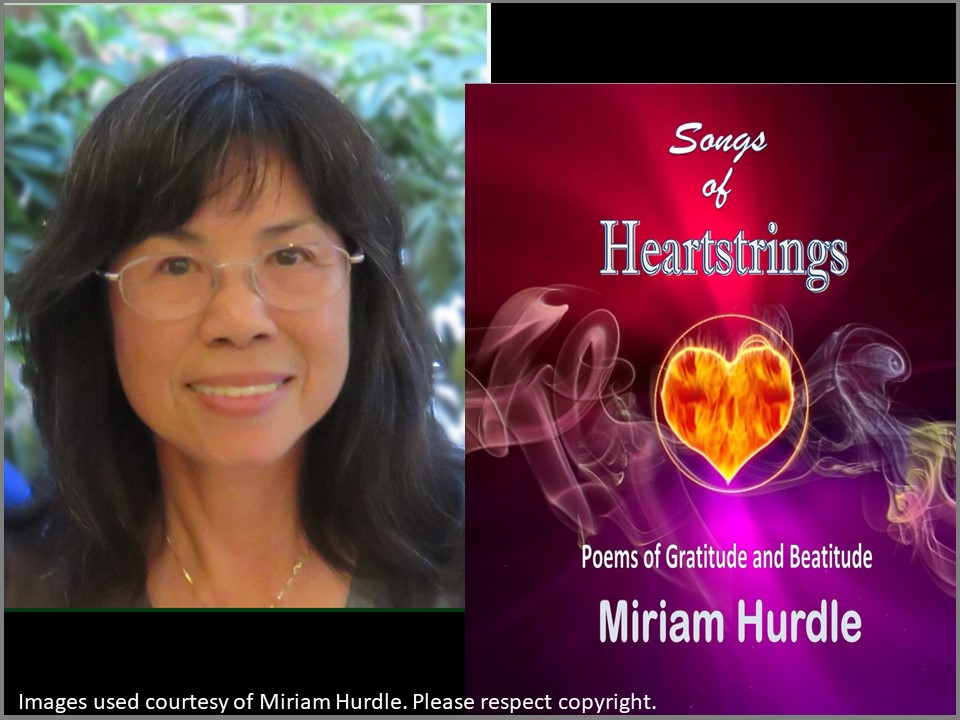
    Miriam Hurdle, poet

    This week, I am pleased to introduce Miriam Hurdle, poet, blogger, flash fiction writer, photographer, ex-teacher and educator. She blogs at the Showers of Blessings and recently published a book of poems entitled Songs of Heartstrings: Poems of Gratitude and Beatitude.

    I first met Miriam at the Carrot Ranch when she rode up and joined in the flash fiction challenges. Since then, we’ve met up in many different places around the blogosphere. Considering she’s been blogging even longer than I; I’m surprised we hadn’t met earlier. We share our thoughts on education and grandchildren, and in fact on anything to do with making our journeys through life the best we can. It is always a pleasure to converse with Miriam.

    Before we begin the interview, I invite Miriam to tell you a little of herself:

    Miriam Hurdle is a multi-genre writer. She writes poetry, flash fiction, short stories and memoir.

    Music has rooted in her life. Being a soloist as a teenager led her to taking voice lessons and to have ongoing singing engagements. She continues to sing soprano in choral groups. Lyrics have a major influence in the natural flow of her melodic writing. She writes memoir in the form of poetry.

    She took photos when the films were black and white. Photography is still her enjoyable hobby. Drawing and painting were fun activities as a child. She resumed drawing and watercolor painting several years ago. In her poetry collection, she includes photos and paintings to illustrate the poems.

    She earned a Doctor of Education from the University of La Verne in California. After two years of rehabilitation counseling, fifteen years of public-school teaching and ten years in school district administration, she retired and enjoys life with her husband in southern California. She makes frequent visits to her daughter, son-in-law and granddaughter in Oregon.

    Welcome, Miriam.

    Let’s talk school. First, could you tell us where you attended school?
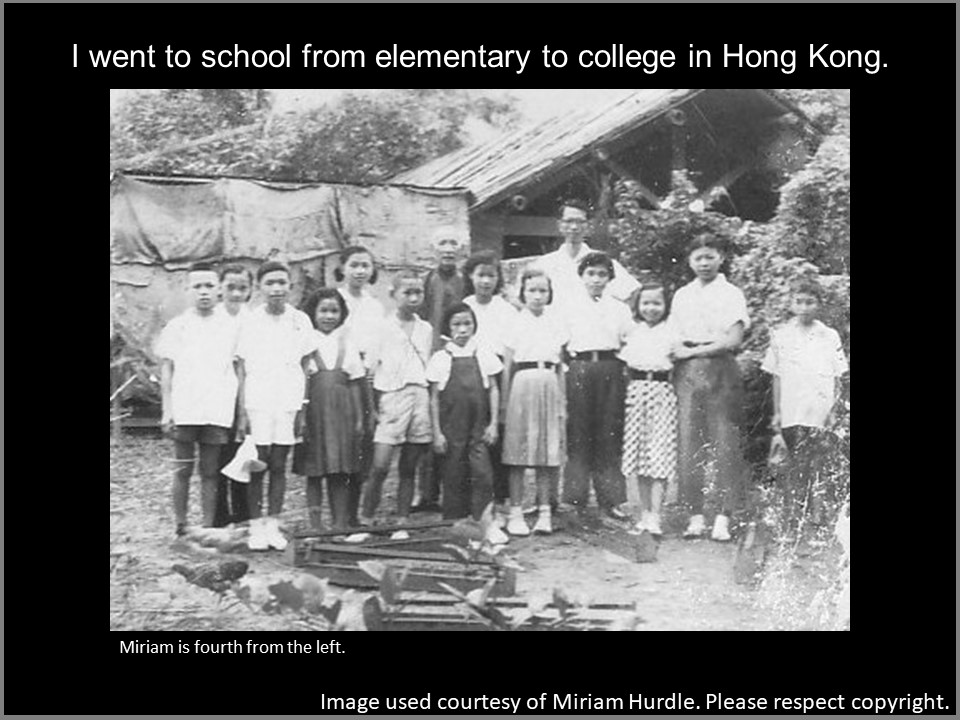
    Miriam Hurdle school photo

    I went to school from elementary to college in Hong Kong.

    Did you attend a government, private or independent school?

    In Hong Kong, there are public schools, government subsidized schools, and private schools. I attended two elementary schools sponsored by organizations and they were tuition free schools. One was a Buddhist organization sponsored school, and we had to take a Buddhism class. I remember the nun chanting in class.

    What is the highest level of education you achieved?

    After I graduated from the college in Hong Kong, I worked for five years, then came to the United States for my graduate studies. I got three master’s degrees – in Religious Education, Counseling, and Educational Administration and a Doctor in Education.

    What work or profession did you choose after school and was there anything in school that influenced this choice?

    I love music since I was a kid. I sang solos in churches as a teenager. As a result, I took voice lessons and had more singing engagement. It would be my first choice to become a professional musician or teach music, but I could only afford to do music as an enjoyment, not a profession.

    When I was in college, I volunteered in Far East Broadcasting Company in several programs. I did singing and recorded children’s stories. When I finished college, FEBC wanted to hire me full time, but the job didn’t pay too much.

    Many girls chose to be teachers or nurses back in those days. I accepted a teaching job. I taught Chinese as a Second Language for three years in the Baptist University of Hong Kong. I was also a Director of Children’s Department for two years at Asian Outreach where I wrote four children’s books.

    In the U.S. I worked as a Rehabilitation Counselor for two years, taught preschool for two years, taught elementary school for fifteen years, and worked as a school district administration for ten years.

    What is your earliest memory of school?

    My earliest memory was when I won the Abacus Competition in first grade. The second-grade teacher taught abacus. He came to our classroom to present me the award. Another wonderful memory was that my first-grade teacher Mrs. Leung said I was bright. The thought of being bright influenced my whole life.

    When I studied counseling and child development, I learned that positive reinforcement encourages desirable behavior. In fact, it is also true with adults. Instead of pointing fingers or saying, “don’t do this, don’t do that,” we can praise and encourage desirable behavior or responses.

    What memories do you have of learning to read?

    We did a lot of memorization in reading. We had to recite the reading lessons in early elementary school. My dad helped with my homework and had me memorized the lessons every week. I learned everything in the current lesson before the teacher taught a new lesson. At the fourth grade, I read my dad’s newspapers. My dad and I traded sections to read. I read the horrible news describing the details of crime scenes, read adult fantasy, comic strips and the Sunday children’s section.

    My favorite literature was Aesop’s Fables. I also remember learning English grammar such as the regular tenses as walk, walking, walked, walked; and the irregular tenses as go, going, went, gone.

    What memories do you have of learning to write?

    There was not a lot of creative writing in the lower grades in elementary school. We did a lot of copying the reading lessons. I guess by copying; we remember writing in a proper sentence structure. In upper grade, I learned how to write a story with an opening, the middle, the climax and the conclusion. I remember how I paced my writing and made sure the climax was at the three fourth of the paper. We had a subject in Letter Writing and learned to write different letters.

    I learned to write both Chinese and English calligraphy. For Chinese, we wrote in vertical and right to left progression. For English, we wrote alphabet and spellings. I like calligraphy and I still write in calligraphy style in my handwriting. I bought a calligraphic set to address my daughter’s wedding invitations.

    What do you remember about math classes?

    We learned math the traditional way and learned the mental math. I did addition and subtraction well with an abacus. Doing multiplication and subtraction on the abacus is harder so I don’t remember how to do them. I won the Abacus Competition in the first grade.

    What was your favorite subject?
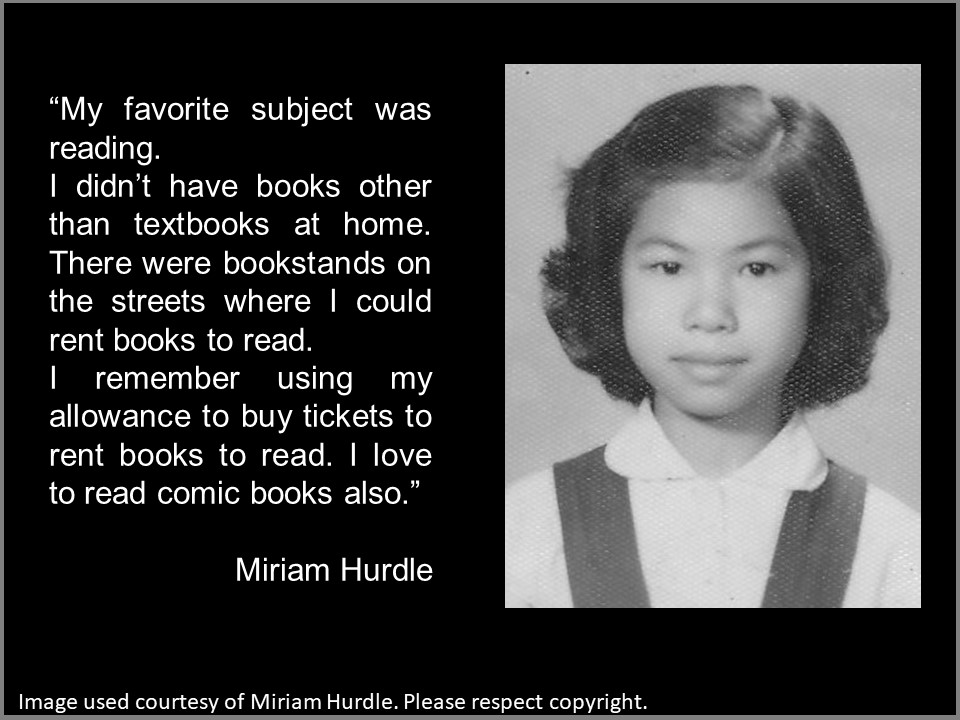
    Miriam Hurdle's favourite subject at school was reading

    My favorite subject was reading. I didn’t have books other than textbooks at home. There were bookstands on the streets where I could rent books to read. I remember using my allowance to buy tickets to rent books to read. I love to read comic books also.

    What did you like best about school?

    I like to be with my friends. My best friend Shirley at the fourth grade was my teacher Mrs. Cheung’s daughter. Mrs. Cheung was also a music teacher for the upper grades. We had a singing contest. I entered the competition and got fourth place. Shirley got second place. Shirley played the piano. I went to her house on the weekends and listened to her play for hours.

    I keep in touch with Shirley. When we traveled to London, she and her husband took us sightseeing for five days.

    What did you like least about school?

    I can’t think of anything I didn’t like. There were forty students in each class. We received two report cards a year; they showed our ranking among the class. I got second to ninth places from first to sixth grade. It broke my heart when I got the ninth place. I can’t remember what happened, but it wasn’t because of any subject.

    How do you think schools have changed since your school days?

    I think the elementary schools in Hong Kong still do a lot of memorization rather than creative learning. My sister and her husband sent their two children to Canadian system International School, and they eventually migrated to Canada. After they got the Canadian citizenship, because of my brother-in-law’s health issue, they went back to Hong Kong and keep the dual citizenship.

    What do you think schools (in general) do well?

    Since I left Hong Kong forty years ago, I can’t comment about the schools there anymore. But I taught in California thirty years ago, I can comment on the schools in California.

    Class size–Kindergarten is 20 students, first to third grades is 25 or fewer students, and fourth to sixth grades is up to 35 students average.

    Schools get special funding for English learners to get extra help to learn at their current English levels to catch up with the levels of their classes.

    There is special funding to help students from the low-income family because statistic shows that these students have low academic levels.

    Many families can afford to send their children to go to preschool. For low-income families, they can send their children to the Headstart program to prepare for the kindergarten.

    There are breakfast and lunch served at schools. Low-income families receive free meals for their children. Other children have meals for reduced or full fees. Students can bring their lunches to school also.

    How do you think schools could be improved?

    At elementary school, there is not enough time of the day to teach all the subject to prepare the students for Junior High or High school. Schools end at 2:30 p.m. for lower grade and 2:45 p.m. for upper grade. For lower grades, teachers teach reading and math in the morning. After lunch, they may teach social studies and physical education. There is no time to teach science. Since the State test at the end of the year doesn’t test science, the teachers give up on teaching that subject.

    For upper grade, teachers teach reading and math in their homeroom. Some of them team teach social studies and science so the teacher could do the preparation and teach for more than one class. Students can benefit more learning if the school days are longer.
    thank you for your participation

    Thank you for sharing your reminiscences of school and thoughts about education in general, Miriam. It’s been wonderful to have you here. I learned so much about you. I am impressed by your doctorate degree, curious about whether you learned English at school, fascinated by the thought of renting books and envious of your singing ability.

    Find out more about Miriam Hurdle

    Visit her website: https://theshowersofblessings.com

    Or her Amazon Author Page: https://www.amazon.com/Miriam-Hurdle/e/B07K2MCSVW?ref=dbs_p_ebk_r00_abau_000000

    Connect with her on social media

    Twitter: https://twitter.com/mhurdle112

    Facebook: https://www.facebook.com/miriam.hurdle.1

    Purchase Songs of Heartstrings from

    Amazon Universal Link: http://smarturl.it/SongsofHeartstrings

    Amazon UK Link: http://www.amazon.co.uk/dp/B07K1S47W9 

    Amazon.com Link: http://www.amazon.com/dp/B07K1S47W9 


    If you missed previous reminiscences, check them out here:

    Charli Mills

    Sally Cronin

    Anne Goodwin

    Geoff Le Pard

    Hugh Roberts

    Debby Gies

    Pauline King

    JulesPaige

    D. Avery

    Christy Birmingham

    Look for future interviews in this series to be posted on Sunday evenings AEST.

    Coming soon:

    Robbie Cheadle

    Marsha Ingrao

    Susan Scott

    Mabel Kwong

    Sherri Matthews

    with more to follow.

    Thank you blog post

    Thank you for reading. I appreciate your comments. Please share your thoughts.


  • What lives in trees?

    What lives in trees?

    Carrot Ranch flash fiction challenge - trees

    This week at the Carrot Ranch, Charli Mills challenged writers to In 99 words (no more, no less) write a story that goes in search of trees. It can be one particular tree, a grove, woods, or forest. What makes the tree worth seeking? Go where the prompt leads!

    This week, we’re observing a science lesson with a group of 5 – 6-year-olds in search of knowledge about life in trees.

    What lives in trees?

    The teacher displayed photographs of trees.

    “We’ve been learning about where animals live. Today, we’ll list animals that live in trees.”

    Hands shot up, bursting to contribute.

    The teacher wrote:

    possums, koalas, beetles, snakes, birds …

    Amir’s English was developing but his classmates were puzzled when he said what sounded like ‘goat’.

    “Repeat,” encouraged the teacher.

    “Goat.”

    When asked, Amir drew a tree with a recognisable goat standing in it.

    “Not story,” smiled the teacher. “Real.”

    Amir nodded and pointed to the laptop. “Google.”

    A quick search confirmed it.

    Everyone cheered. Amir added to their knowledge tree that day.

    ……….

    Many of you who have travelled may have seen the tree goats of Morocco. However, I wasn’t aware of them until, a couple of weeks ago, a photo popped up on my desktop. Intrigued, I had to find out more. A search for the goated tree began.

    I discovered that the photo wasn’t fake, as I had first thought. The tree is the Argania tree from which we get Argan oil, and the goats like to eat its fruit.

    Although more hygienic methods are now often employed, the oil used to be pressed from the seeds which were passed in the goats’ poop after the fruit had been eaten. I’m certain that 5 and 6-year-old children would love this titbit of information.

    If you are interested, here are some links to help you learn more about the tree goats:

    The Tree Goats of Morocco

    The Story Behind Bizarre Tree-Climbing Goats of Morocco

    Moroccan argan oil: the ‘gold’ that grows on trees

    However, it seems, as with so many things, some people thought they could make extra money from tourists wanting to photograph goats in trees. Sadly, it is not only the goats that suffer from these unkind practices. The trees suffer too and, according to one article I read, “are in danger and the forest is listed by UNESCO as an International Biosphere Reserve.”

    Iconic ‘tree-climbing’ goats of Morocco revealed to be a scam

    Thank you blog post

    Thank you for reading. I appreciate your feedback. Please share your thoughts.


  • School Days, Reminiscences of Christy Birmingham

    School Days, Reminiscences of Christy Birmingham

    Welcome to the School Days, Reminiscences series in which my champion bloggers and authors share reminiscences of their school days. It’s my small way of thanking them for their support and of letting you know about their services and publications.

    This week, I am pleased to introduce Christy Birmingham, prolific blogger, author and poet. I’m not sure how or where I first met Christy but I do know that we have been regular visitors of each other’s blogs since the beginning of 2015, not long before the launch of her book of poetry Versions of the Self.

    I would have thought I read her book not long after that, but Amazon tells me I didn’t purchase it until 2017, so I guess Amazon knows? It also doesn’t display a review from me, though I thought I had added one. However, I do remember enjoying Christy’s insightful poetry and being touched by the exploration and depth of emotion portrayed in many of the pieces which delve into ways in which the self may change over time and in response to circumstances.

    Christy Birmingham 'When Women Inspire'

    On her blog When Women Inspire, Christy shares information on a wide range of helpful topics especially those aimed at helping women live healthier, happier and more fulfilling lives. No topic is too big or too small for Christy. She covers anything which she expects women, however young or old, will find interesting or beneficial. But her blog isn’t just for women. Numerous men regularly read and comment too. If you don’t already follow Christy’s blog, please pop over and say hello.

    Before we begin the interview, I invite Christy to tell you a little of herself:

    Christy Birmingham is a blogger, author, and poet who lives in Victoria, BC, Canada. She uses her writing to show others that they too can get through difficult times as she has, personally with anxiety and depression, as well as professionally with starting her own business. Find her blogging at When Women Inspire, at the gym, reading, or out with her family and friends.

    The interview

    Welcome, Christy.

    Let’s talk school. First, could you tell us where you attended school?

    All of my schooling has been on Canada’s west coast. Specifically, I went to schools in Victoria, British Columbia until after high school graduation, when I then did a mix of college and university in Victoria and Vancouver, BC.

    Did you attend a government, private or independent school?

    I’m a public-school kid!

    What is the highest level of education you achieved?

    I am proud to have a BA in Criminology and Psychology from Simon Fraser University.

    What is your earliest memory of school?

    I recall my elementary school teacher telling us she had published a book. I was wowed by it and never forgot that inspiration!

    What memories do you have of learning to read?

    I was taken out of class regularly to see a speech therapist for problems I was having with pronunciation. It made me self-conscious reading aloud and talking in general.

    What memories do you have of learning to write?

    Learning cursive was so much fun! Learning how to spell out my full name and create different styles of writing for it provided hours of delight for me. I’ve always loved language.

    What do you remember about math classes?

    Not liking them very much, unfortunately. It often took me a while to catch onto concepts, and once math homework was done, I wanted to read books or write short stories.

    What was your favourite subject?

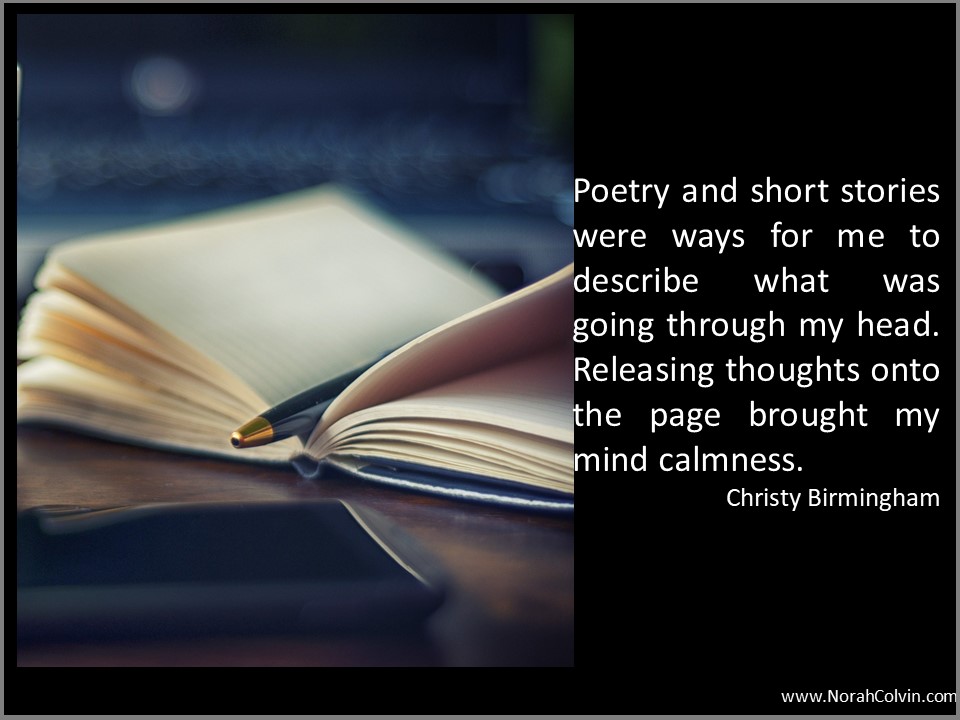
    Christy Birmingham poetry quote

    English, by far. Poetry and short stories were ways for me to describe what was going through my head. Releasing thoughts onto the page brought my mind calmness and then seeing the positive feedback from teachers for what I wrote in English class was amazing to me. I’ve never forgotten the encouragement of certain teachers for my writing in elementary and high school.

    What did you like least about school?

    Trying to find where I fit in. Books brought me happiness, as did the writing. Thankfully I found friends throughout my years of school who supported me in my artistic projects. Once I realized that it was about the quality of friendships rather than the number of friends I had, I was happy.

    How do you think schools could be improved?

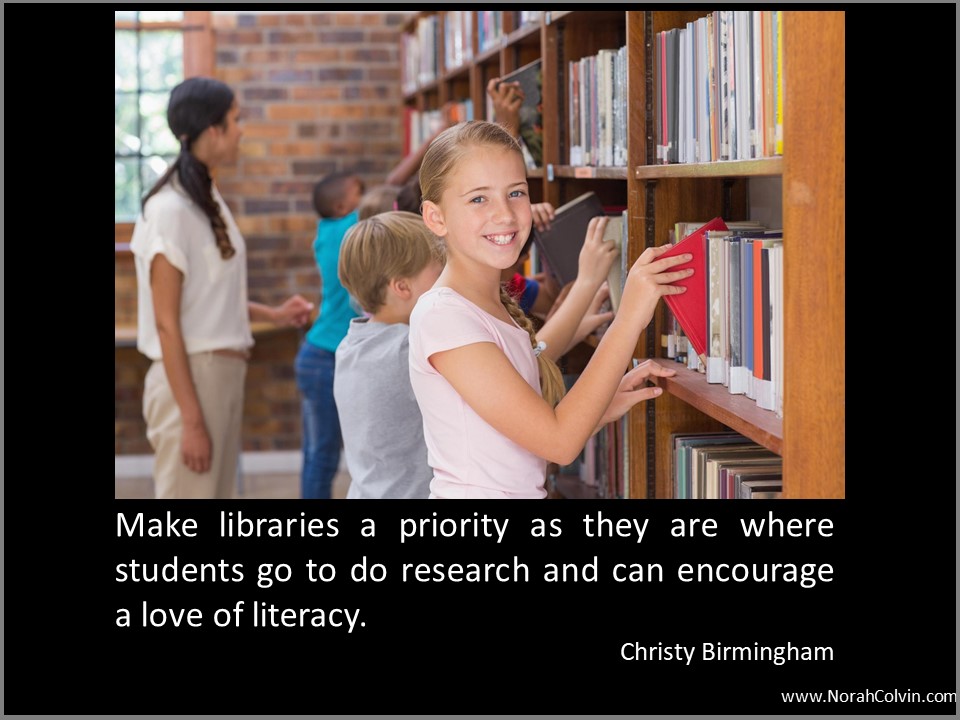
    Christy Birmingham on the importance of libraries

    By listening to students, no matter their age. Hear what students want to see change about your school and determine if it’s feasible. Also, make libraries a priority as they are where students go to do research and can encourage a love of literacy.

    Lastly, engage with the local community rather than being independent of it as a school. By schools partnering with the communities they’re nestled within, students can enjoy a fuller educational experience. Also, schools can get ideas and support from the general community that can take the institutions further than they might otherwise go.

    thank you for your participation

    Thank you for sharing your reminiscences of school and thoughts about schools in general, Christy. It’s been wonderful to have you here. I’m not surprised you enjoyed expressing yourself in writing from a young age.

    Find out more about Christy Birmingham

    on her website When Women Inspire

    Connect with her on social media

    Twitter

    Facebook

    Pinterest

    Purchase your own copy of Christy’s books of poetry:

    Pathways to Illumination

    Versions of the Self

    Previous reminiscences

    If you missed previous reminiscences, check them out here:

    Charli Mills

    Sally Cronin

    Anne Goodwin

    Geoff Le Pard

    Hugh Roberts

    Debby Gies

    Pauline King

    JulesPaige

    D. Avery

    Look for future interviews in this series to be posted on Sunday evenings AEST.

    Coming soon:

    Miriam Hurdle

    Robbie Cheadle

    Susan Scott

    with more to follow.

    Thank you blog post

    Thank you for reading. I appreciate your comments. Please share your thoughts.


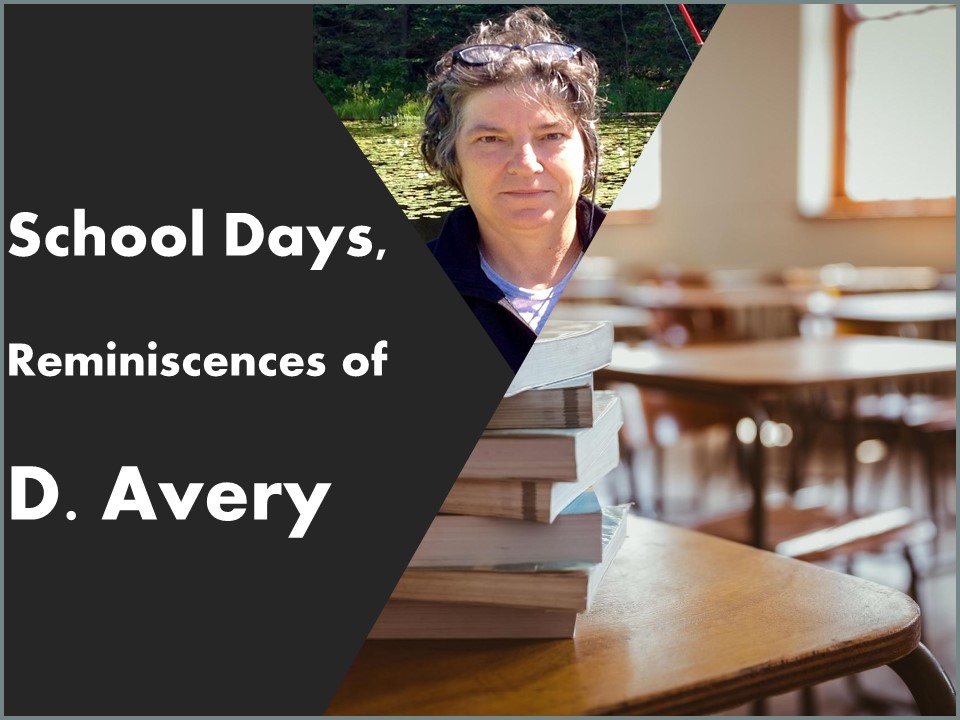
  • School Days, Reminiscences of D. Avery

    School Days, Reminiscences of D. Avery

    Welcome to the School Days, Reminiscences series in which my champion bloggers and authors share reminiscences of their school days. It’s my small way of thanking them for their support and of letting you know about their services and publications.

    This week, I am delighted to introduce D. Avery, poet, writer, blogger. I met D. when she rode up to the Carrot Ranch, dismounted and took a lead role around the campfire with her humorous tales and witty conversation. I also try not to miss her posts on ShiftnShake where she shares poetry, flash fiction and short stories sprinkled with philosophical pearls of wisdom and creates characters as like and unlike any you may chance to meet. Whatever the topic, there’s sure to be beauty in her words, wisdom in her ideas and smiles to lighten your day.

    Books by D. Avery

    I have read and enjoyed all three of D.’s books and was both honoured and delighted when she quoted me on the back cover of After Ever. This is what I wrote:

    An interesting and eclectic collection of short stories and even shorter flash stories, this collection has something for everyone. Whether the situation be mundane or mystical, tragic or cheerful, D. Avery records events matter-of-factly, telling how it is or was, and leaves it to the reader to choose how to respond. After Ever is great for reading in bites or as an entire feast.

    I thought I’d reviewed all three of D.’s books on Amazon, but all I could find was my review of For the Girls:

    After receiving her own pre-Christmas un-gift of a cancer diagnosis, D. Avery unwrapped how the diagnosis affected her personal journey and view on life. Written from her own need and for others facing similar situations, D. Avery explores through poetry, the emotions that fluctuate in intensity from the moment of diagnosis until, hopefully, remission is declared. Anyone who has endured the pain of diagnosis or suffered alongside another who has, will find something with which to identify. None of us are ever free of the fear, but hope has a stronger pull. These poems are food for the soul.

    Before we begin the interview, I’ll allow D. Avery to tell you a little of herself:

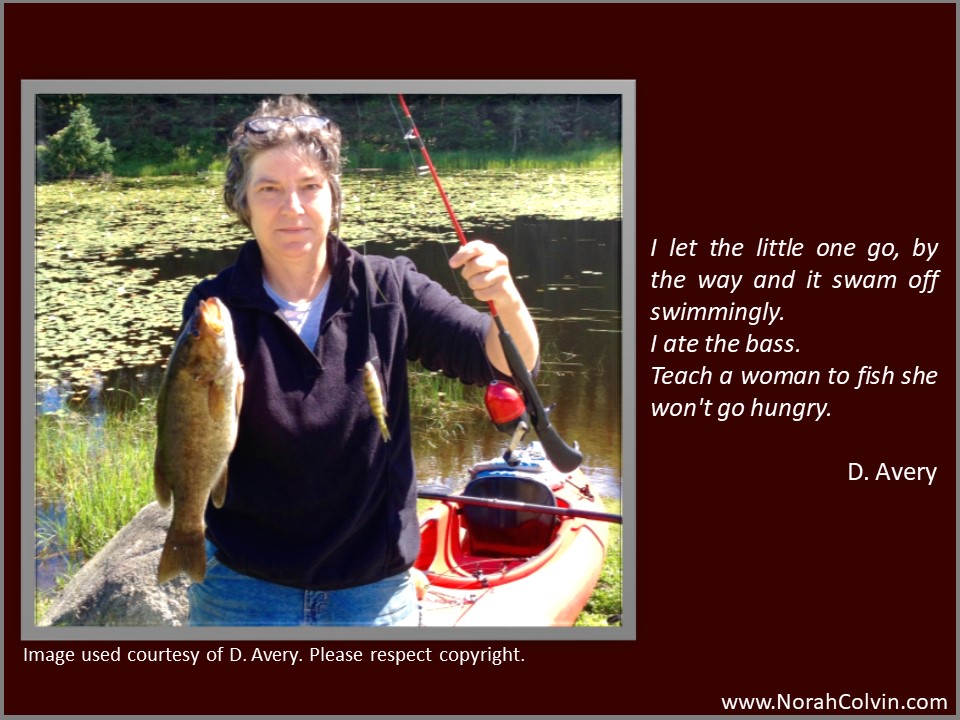
    D. Avery, writer, fisherwoman

    Born and raised in rural New England, D. Avery is never quite out of the woods, though she has been in other fields. She has been a veggie vendor, landscape gardener, and a teacher.

    Cursed with a compulsion for wordplay and a growing addiction to writing, D. Avery blogs at Shiftnshake, where she pours flash fiction and shots of poetry for online sampling. D. Avery tweets ‪‪@daveryshiftn‪‪ and is a Rough Writer at Carrot Ranch. She is the author of two books of poems, Chicken Shift and For the Girls. Her latest release,  After Ever; Little Stories for Grown Children,  is a collection of flash and short fiction.

    Welcome, D. Now let’s talk school. First of all, could you tell us where you attended school?

    I attended public school, my first three years at a K-12 school in Skagway, Alaska, then third through sixth grade in a four room graded school in Vermont, before attending a 7-12 regional school that serves a number of small towns.

    What is the highest level of education you achieved? What work or profession did you choose after school and was there anything in school that influenced this choice?

    I experienced a year of small private liberal arts college in Ohio and that was enough of that. After a year off from school I completed a two-year program at the Stockbridge School of Agriculture at UMass Amherst, earning an Associate’s Degree in Science, Commercial Floriculture. This course of study had practical and immediate application for me, and served me well. I spent the off season from greenhouse work and landscape gardening subbing and volunteering in the elementary school and after a few years I decided to answer the call and get my teaching certificate. I got my Masters of Education at Antioch New England Graduate School and switched careers, becoming a fourth grade classroom teacher and more recently a sixth grade math teacher.

    What is your earliest memory of school?

    I have lots of early memories. I do think back on how cool it was to be in a small K-12 school that was the center of a small (and isolated) community. The entire school, K-12, took part in a Christmas pageant every year for the town to see. Likewise Field Day had everyone involved and the high school kids might be on the team of a kindergartner or would somehow be helping out.

    What memories do you have of learning to read?

    I was reading before attending school, something I picked up at home. We were read to, and there was plenty of print around. One day while looking through a comic I realized I knew the words. It was pretty exciting. I went through the stack of comics and numerous picture books. By second grade I had read all my brothers’ Hardy Boys books. And we had quite a stack of Classics Illustrated, classic novels condensed into comic book form; I started in on those at this time. When we moved back to VT I read every Vermont heroes and histories books on those dusty shelves of that old graded school. There was a collection of William O’Steele books too, historical fiction for kids, pioneers headed west. Of course there were the Little House books. Then they instituted the Dorothy Canfield Fisher program and our school library got built up with more modern young adult novels. I still enjoyed the historical fiction the most though.

    What memories do you have of learning to write?

    D. Avery was always confident as a writer

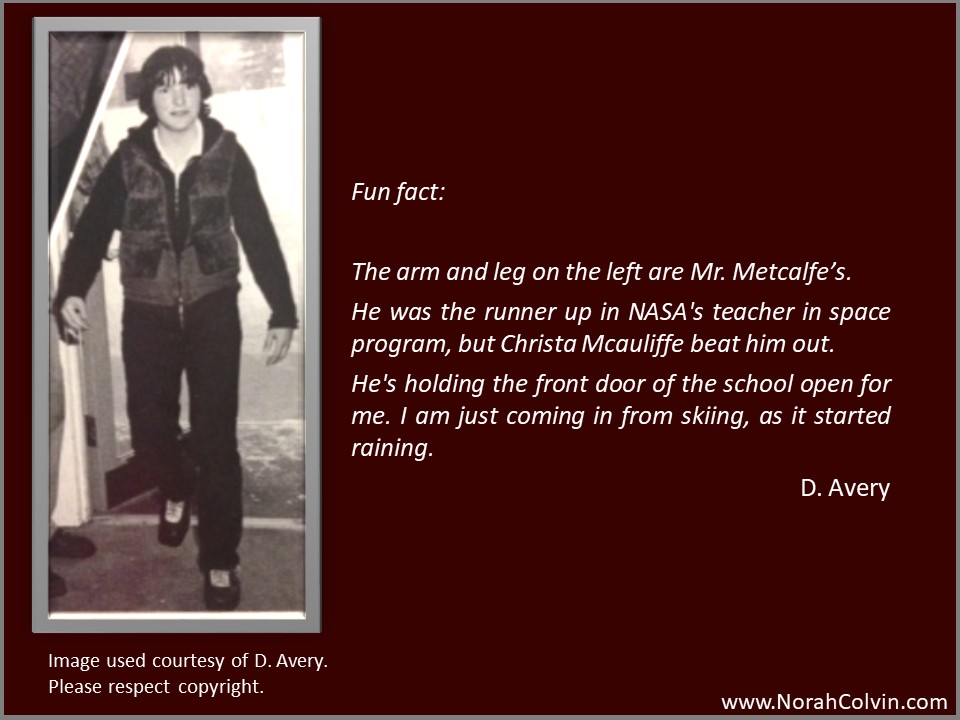
    Norah, you might remember when I gave some detail about being taught to form my letters in school. It was kind of fun so here’s a LINK. But school did get better after that. My second grade teacher did a great job of integrating reading and writing. I became a writer the day that my writing was hanging in the hall and some of those high school kids were reading it and even complimented me for it. Throughout my school years some of my writing got some attention and publication. I had encouraging teachers and still remember the Poets in Schools program. I was always fairly confident as a writer, using it to baffle them with bullshit if I couldn’t dazzle them with brilliance.

    What do you remember about math classes?

    D. Avery: maths should be accessible and meaningful

    I could neither baffle nor dazzle with math. Math was never taught very well, I realize now, and I did not like it. It was a lot of rote drill-and-kill work.

    Fortunately, my great grandmother got me straightened out with times tables in one briefing so that helped.

    I managed, barely, but never “got” math until a course at ANE Graduate School. Since then I have taken a number of courses. Now I truly enjoy math and have enjoyed demystifying the subject for students third through sixth grades.

    I don’t remember ever having fun in math class, but my own math students have had fun. Math students need to see patterns and to make connections, to keep math accessible and meaningful.

    I also realize that the best math practice I ever had, and what really built number sense, was not from school at any level but from my summer work as a teenager on a truck farm where there was no cash register or calculator. My mental math got quite good. Working there and earlier helping my dad out with different projects also built my math skills.

    What was your favourite subject?

    D. Avery: it's the people who make a subject more interesting and more accessible

    I have always enjoyed history and social studies, and those were probably my favorite subjects in high school. But I also enjoyed Latin and English (reading and writing). I also was very fortunate to have had some remarkable people as my teachers. That’s what one remembers as much as anything; it’s the people who make a subject more interesting and accessible.

    What did you like best about school? 

    D. Avery, what did you like best about school

    I liked learning. I found most of my subjects interesting. There were some excellent teachers and also an excellent library. School had books and magazines to be read, it was a place to pursue ideas and interests. It was a path to possibilities. And school was where my audience was, it’s where I performed and entertained. But I did manage to learn in spite of myself.

    What did you like least about school?

    I liked being with friends at school, but people are also what I liked least in school. Kids are always having to navigate the social waters and to find their own balance between conformity and individuality. It’s stressful. I was always grateful and glad to be home at the end of the day, where I could have quiet alone time in the woods.

    I feel bad for the kids today who, because of their devices, are never able to be alone and to decompress. I feel bad for people who do not have the outside time and space. I know it was vital for my time in school to have good work and play experiences out of school and time to get re-centered. People now are never alone and never lonelier. I still require lots of alone time.

    How do you think schools have changed since your school days?

    School girl D. Avery coming in from skiing

    With the pervasiveness of computers and social media parents have an extra responsibility, an extra worry now, and most don’t fully comprehend the depths of that. Technology has made teaching and learning more difficult; it has distanced people from nature, from each other, from generational wisdom- from their selves. “Knowledge” at our fingertips is not lasting; internet access in many ways erodes curiosity and problem solving skills, critical reading and thinking skills, and the stamina required for meaningful learning.

    I know arguments could be made in defence of technology, but I rarely see a healthy balance. Gaming addictions, cyber-bullying, plagiarism and general distractions are some of the issues that impact teaching and learning nowadays. That maybe didn’t really speak about schools, but these phones are a huge change in our society and so our schools.

    What do you think schools (in general) do well?

    Schools have changed, but they are still staffed with people, most often good caring people who are educated in their subject area and also in pedagogy and in best practices based on research. Educators take into account how students best learn, and how to engage them in that enterprise.

    More than ever before, schools look out for and provide services for a student’s mental health, their social/emotional wellbeing. A person with trauma or health issues is not the best learner, and schools are learning to take a more holistic approach to all students.

    How do you think schools could be improved?

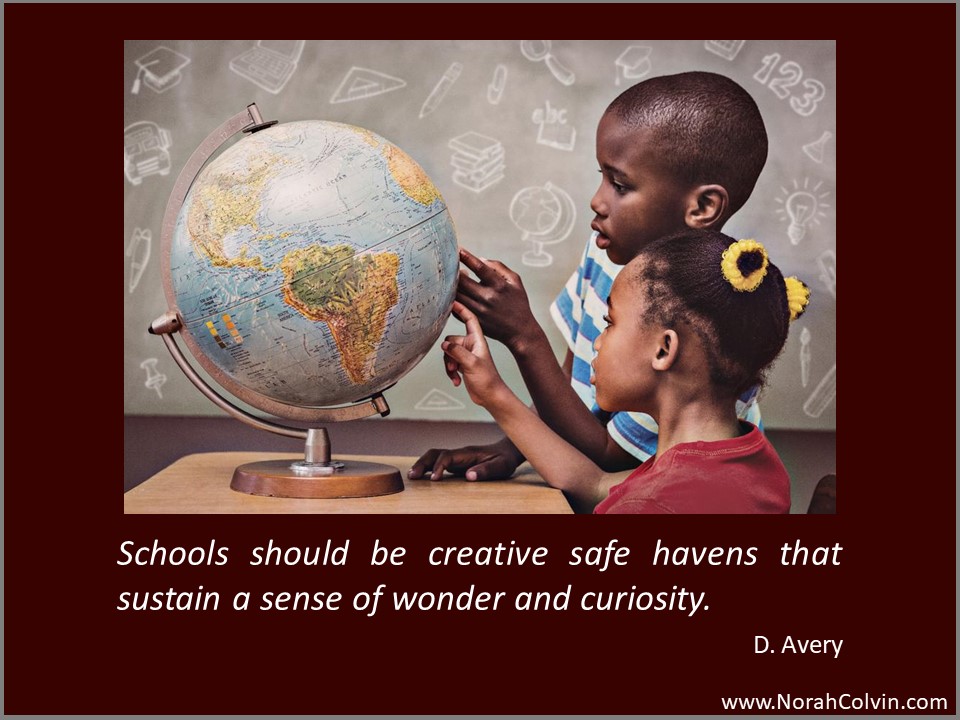
    D. Avery "Schools should be creative safe havens"

    Our schools don’t always seem to measure up, but what is the measure? Not everyone is measuring up to standardized tests, but if we really want to close achievement gaps, if we really want to leave no children behind then we need to reform much more than our schools.

    While I think we should first focus on out of school factors, within school we have to do more than give lip service to Gardner’s Multiple Intelligences. Which means schools need to not succumb to the testing culture; schools need to be less programmatic and prescriptive. Curricula should encourage empathy and build flexible and adaptive skills and strategies required for individuals to pursue their own interests and inclinations. Schools should be creative safe havens that sustain a sense of wonder and curiosity.

    thank you for your participation

    D., thank you for sharing your reminiscences of school and thoughts about education in general. I would have liked to take your responses to the last three questions and make them all quotes. You express it all so perfectly.  It’s been a delight to have you here. I learned so much from and about you. I enjoyed learning about your own school days and totally agree with what you have to say about education in general.


    Find out more about D. Avery

    from her website ShiftnShake

    Connect with her on social media

    Twitter: @daveryshiftn

    Purchase your own copy of her books from

    Amazon

    If you missed previous reminiscences, check them out here:

    Charli Mills

    Sally Cronin

    Anne Goodwin

    Geoff Le Pard

    Hugh Roberts

    Debby Gies

    Pauline King

    JulesPaige

    Look for future interviews in this series to be posted on Sunday evenings AEST.

    Coming soon:

    Christy Birmingham

    Miriam Hurdle

    Susan Scott

    with more to follow.

    Thank you blog post

    Thank you for reading. I appreciate your comments. Please share your thoughts.

  • School Days, Reminiscences of JulesPaige

    School Days, Reminiscences of JulesPaige

    Welcome to the School Days, Reminiscences series in which my champion bloggers and authors share reminiscences of their school days. It’s my small way of thanking them for their support and of letting you know about their services and publications.

    This week, I am pleased to introduce JulesPaige, poet, flash fiction artist and creator of gems that sparkle on the page.

    I met Jules at the Carrot Ranch where we both participate in flash fiction challenges set by Charli Mills each week. Jules is one of the most engaged and supportive participants. She always has something encouraging to say and is quick to offer helpful advice when a request is made.

    We have wonderful conversations about education, parenting and grandparenting on her frequent visits here. I think we would have a lot of fun entertaining our grandchildren together, if only we lived closer.

    Before we begin the interview, Jules will tell you a little of herself:

    I use the nom-de-plume JulesPaige because words are like jewels on a page. I am a poet for over fifty years, writer of flash fiction, and crafty creative person. More than less retired and love learning, but on my own terms. I have included a shadow photo as I wish, at this time, to remain anonymous.

    I’ve had poetry included in school and college literary magazines. Poetry has also been accepted in chapbooks, the local newspaper, and online zines and linked to both poetry and flash fiction prompt sites. Recently I earned two first places and an honorable mention in Flash fiction contests via Carrot Ranch. Some of my stories feature in The Congress of Rough Writers Flash Fiction Anthology Vol 1.

    I am an active participant in several prompts for Flash Fiction and poetry:

    Carrot Ranch

    Mindlovemisery’s Menagerie

    Pure Haiku

    Thanks, Jules, and welcome. Let’s talk school.

     First, could you tell us where you attended school?

    New York and New Jersey, USA.

    Did you attend a government, private or independent school?

    All public schools. The last being a two-year community college that I paid my own tuition for.

    What work or profession did you choose after school and was there anything in school that influenced this choice?

    The profession I choose was Early Childhood Education Assistant. I did not want to go into business or be in the same classes of a sibling who chose the arts. I wanted to help children with their educational beginnings.

    What is your earliest memory of school?

    I remember being in a kindergarten class and wanting to play house, I didn’t get too many turns there. Then in first grade I ended up in the same room with the same teacher – who apparently didn’t like me. Since during the first days of class she allowed me to play in the housekeeping section that had not yet been restocked. I don’t have many memories of early school. I had a family tragedy and withdrew from getting attention which ended up getting me labeled as ‘slow’.

    What memories do you have of learning to read and write?

    I do not have all that many early memories of school. But since I was labeled ‘slow’, my stepmom made it a point to help me learn to read by reading to me every night. Perhaps in 5th grade I was in what was called an intermediate school. That was when I was around ten. That’s when I had a couple of English teachers who encouraged creative writing. At that time in the late 1960’s in that school, creativity was more of a focus than basics. So my math and grammar skills are lacking.

    What did you like best and least about school?

    I was always the new student at my schools. The odd one out and did not have many friends even in High School. No bonds were made in College. I liked my art classes. I did not like the negative or lack support of either my parents or most of my teachers. I only had a select few teachers that encouraged my creative avenues. While I attended the same High School for all four years 9-12, we moved mid-way through, which made seeing the friends I had difficult, and left no chance of participating in any after school programs.

    How do you think schools have changed since your school days?

    I am not entirely sure that public schools have changed for the better. While addressing bullying, special health needs and catering to highly intelligent prodigies… there still lacks a complete need to address all children with equal fairness. This is from the experience of raising my own children in the local public school system and having to invoke my ‘Parental Rights’ for my own children’s needs. The Parental rights to fair education is not something that the schools promote. I found out about them through another friend who was a teacher.

    How do you think schools could be improved?

    Public Schools need to prepare our children by starting language in the early grades and not waiting until older grades. Special language immersion classes were available in later years (of my children’s schools) for a select amount of students who were selected by a lottery. Public Schools also need to make sure basic math and estimation skills are taught without the assistance of calculators or iPads. Public schools also need to encourage acceptance of differences.

    If you choose to send your child to a public school, then you need to accept the parameters set therein. Public Schools also need to keep religion out of the schools. And if vaccines are a requirement, there should be no exceptions. Just one unvaccinated child can bring disease to a whole school population.

    thank you for your participation

    Thank you for sharing your reminiscences of school and thoughts about education in general, Jules. It’s been wonderful to have you here. I am sorry that your school days were not the most pleasant for you, but I am happy to know that you have done what you can to ensure the school days for your own children and others were more positive. It is always encouraging to hear stories of negative cycles being broken.

    Read more of Jules’ work on her blog Jules Pens Some Gems.

    If you missed previous reminiscences, check them out here:

    Charli Mills

    Sally Cronin

    Anne Goodwin

    Geoff Le Pard

    Hugh Roberts

    Debby Gies

    Pauline King

    Look for future interviews in this series to be posted on Sunday evenings AEST.

    Coming soon:

    D. Avery

    Christy Birmingham

    Miriam Hurdle

    Susan Scott

    with more to follow.

    Thank you blog post

    Thank you for reading. I appreciate your comments. Please share your thoughts.


  • Create the possibilities

    Create the possibilities

    Carrot Ranch flash fiction challenge - exhaustion

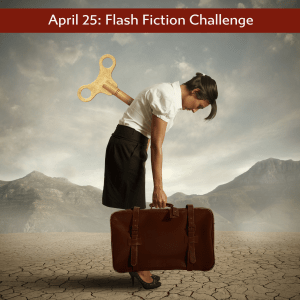
    This week at the Carrot Ranch, Charli Mills challenged writers to In 99 words (no more, no less) write a story that includes exhaustion. Who is exhausted and why? Can you make art of exhaustion? Go where the prompt leads!

    Feeling a little overwhelmed with extra demands on my time over the past few of months, coupled with a recent battle with the flu, I didn’t know if I could muster enough energy to respond this time. But when this blog’s tagline includes the words ‘Create the possibilities’, I thought I should give it a go. I hope you like my response.

    Exhausted possibilities

    Jolted awake when the bus reached the terminal, they grabbed their belongings and stumbled out. The driver shrugged when asked about accommodation.

    ‘NO VACANCY’ signs flashed along narrow streets. ‘NOT WELCOME’ lists accompanied the few with vacancies.

    Trudging back to the terminal, hoping for seclusion, a ‘VACANCY’ appeared where none before. An old man bade them enter, waved away their money and installed them comfortably.

    “Thank you. Thank you,” they bowed, and collapsed into sleep.

    In the morning, they were alone. A note lay on the table:

    When you think you have exhausted all possibilities, there is always more.”

    Thank you blog post

    Thank you for reading. I appreciate your comments. Please share your thoughts.


  • A rainbow of opportunities

    A rainbow of opportunities

    The classrooms of today are filled with children from a diversity of backgrounds and with a multiplicity of perspectives. The futures of those children are filled with opportunities that were unimaginable when I was a child and possibly even now. The world’s landscape — physical, political and social — is changing rapidly. Maybe we are not too far away from finding the pot of gold at the end of the rainbow. Could our ‘wealth’ be bound up in acceptance of our diversity?

    Charli Mill's flash fiction challenge - Gender fluidity

    When Charli Mills of the Carrot Ranch challenged writers this week to In 99 words (no more, no less) write a story about gender. It can be fixed or fluid. Explore the topic on your own terms and open your mind to possibilities and understanding. Go where the prompt leads! I thought I’d have a little play.

    Rainbow futures

    The children went around the circle telling what they’d be when they grew up: police officer, paramedic, teacher, doctor, prosecutor, influencer …

    Laughter erupted when Rudii responded, “Mother.”

    “You can’t be a mother,” taunted one.

    “Can too.”

    “But you don’t have, you know, boobies,” said another, glancing at the teacher.

    “Dad said I can be anything I want,” retorted Rudii.

    “But—”

    The teacher shushed them and the circle continued, punctuated only by an occasional half-giggle or nudge.

    A rainbow of opportunity awaits, Teacher smiled inwardly, contemplating the question he and his partner were processing: who would be Mom?

    Thank you blog post

    Thank you for reading. I appreciate your feedback. Please share your thoughts.

  • School Days, Reminiscences of Debby Gies (D.G. Kaye)

    School Days, Reminiscences of Debby Gies (D.G. Kaye)

    Welcome to the School Days, Reminiscences series in which my champion bloggers and authors share reminiscences of their school days. It’s my small way of thanking them for their support and of letting you know about their services and publications.

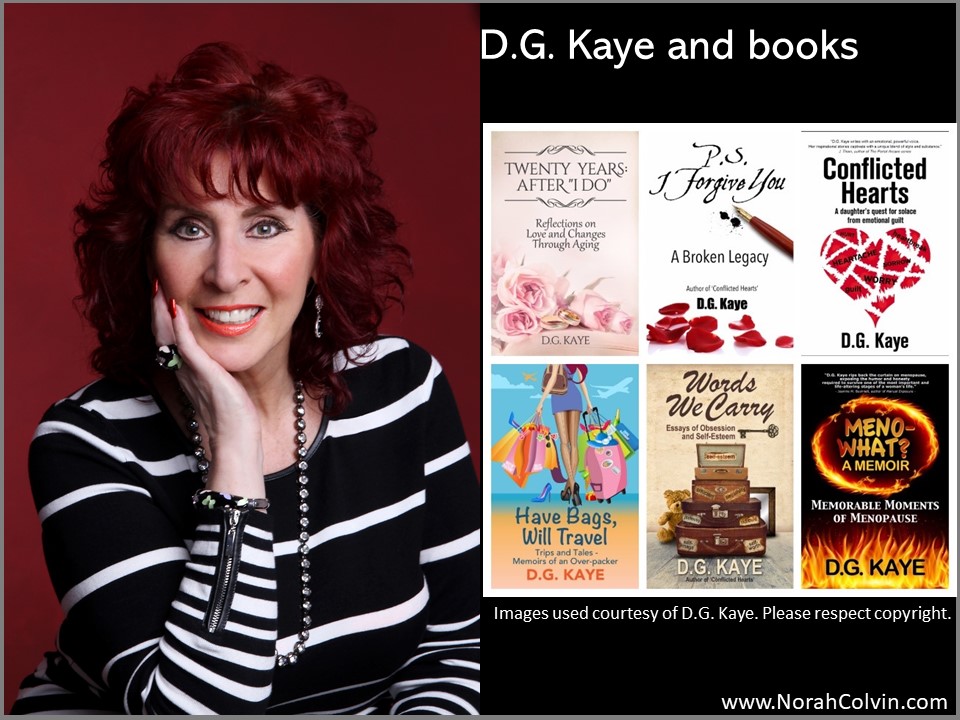
    This week, I am pleased to introduce Debby Gies (D.G. Kaye), author and blogger extraordinaire. I can’t remember when or how I met Debby, but I do know that very early on I read and thoroughly enjoyed her travel memoir Have Bags, Will Travel. While Debby has done far more travel than I, there was much in her book with which I could identify. I remember laughing out loud in places, surprised to find there was someone else who shared similar obsessive behaviour.

    Debby is a prolific writer, mainly of memoir. I have read others of her books and never been disappointed. Her style is open, from the heart, and conversational. You could be having a chat with a best friend over coffee, sharing love, life and laughter. In fact, those are things we both have in our blog taglines. How could we not be friends?

    Since our first encounter, Debby has been a constant supporter of both my blogs, always dropping by to share some words of wisdom or encouragement — a true champion.

    D.G. Kaye and books

    But perhaps I should allow Debby to tell you a little of herself:

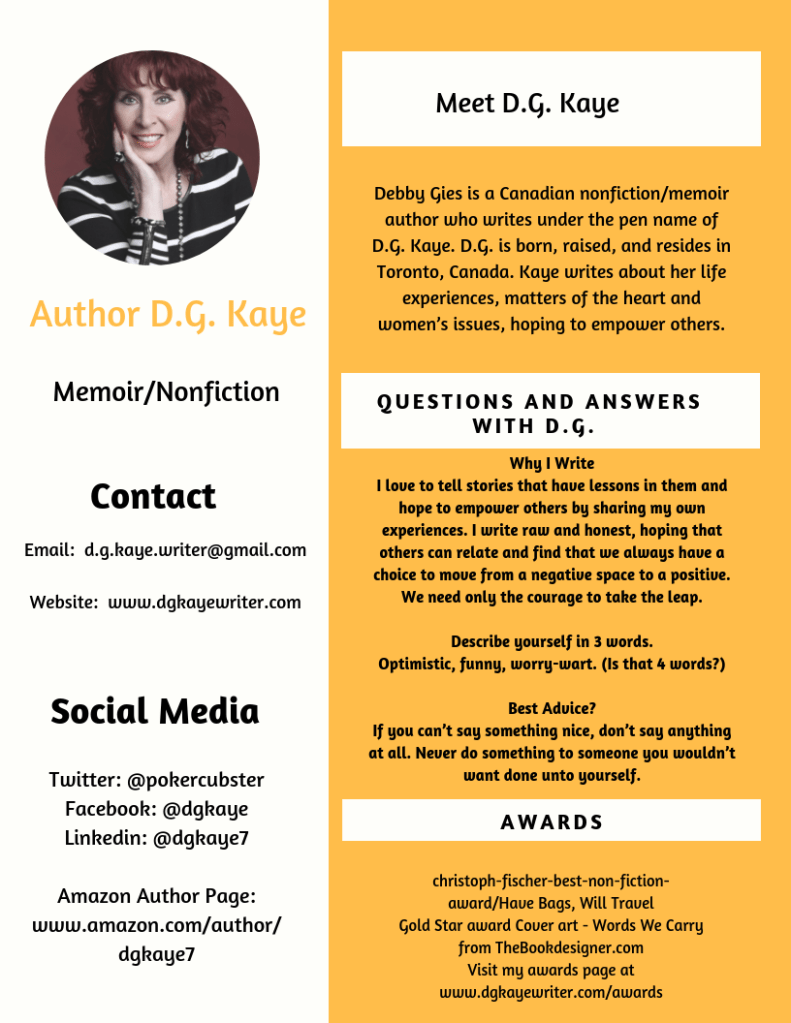
    Debby Gies is a Canadian non-fiction/memoir author who writes under the pen name of D.G. Kaye. D.G. is born, raised, and resides in Toronto, Canada. Kaye writes about her life experiences, matters of the heart, and women’s issues hoping to empower others.

    Why I write: I love to tell stories that have lessons in them and hope to empower others by sharing my own experiences. I write raw and honest, hoping that others can relate and find that we always have a choice to move from a negative space to a positive. We need only the courage to take the leap.

    Describe yourself in three words: Optimistic, funny, worry-wart. (Is that four words?)

    Best advice: If you can’t say something nice, don’t say anything at all. Never do something to someone you wouldn’t want done unto yourself.

    Welcome Debby.

    Now let’s talk school. First of all, could you tell us where you attended school?

    I’m born and raised in Toronto, Canada. I originally began grade 1 going to a parochial school. Before the school year ended, I was stamping my feet demanding I wanted to go to ‘real school’, lol, meaning public school. I got my wish and grade 2 was Kenton Drive Public School where I was thrilled to have Miss Jacobs for my teacher as she was very compassionate toward me. In middle of grade 4, we moved (again) and changed schools to Rockford Road Public School till grade 7 where I spent my 3 years at Fisherville Junior High. In grade 10 I went to high school at William Lyon Mackenzie Collegiate – far out of my living district,  but considered higher academically than the one near my home. It was a half mile walk to the bus and 3 busses there and back a day throughout high school.  After high school I moved away from home and began working and taking night school classes for business and accounting where I received diplomas, which proved useful for many of the secretarial and admin jobs I had through the years. I also became a certified travel agent and then proceeded back to University of Toronto to study voice and theory in music.

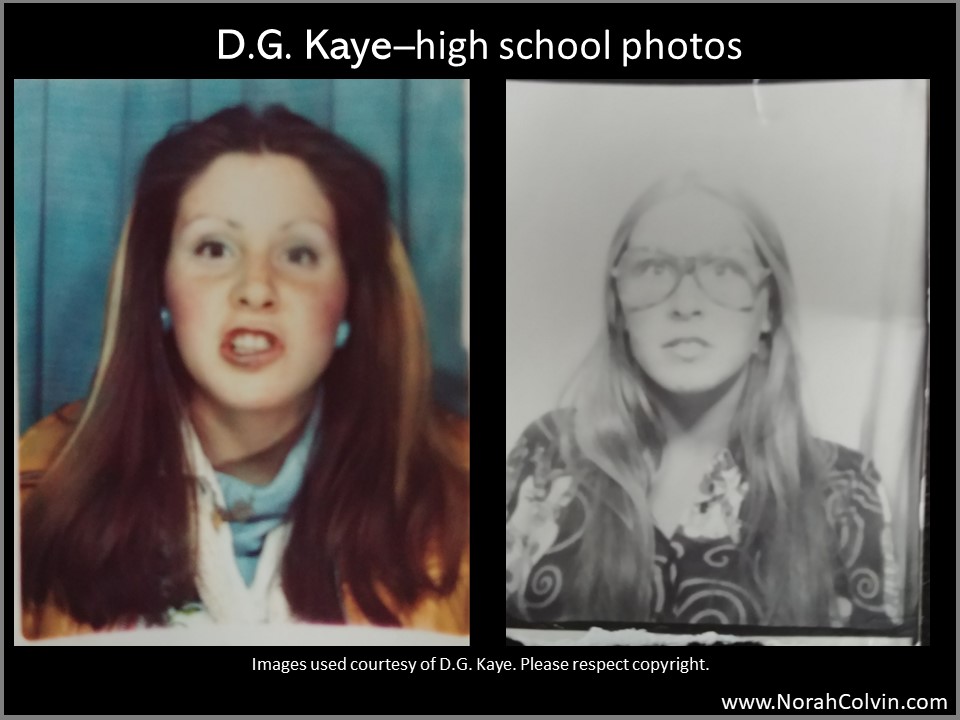
    Debbie Gies High School Photos

    Did you attend a government, private or independent school?

    They were all government schools.

    What is the highest level of education you achieved?

    High school diploma and the school of hard knocks.

    What work or profession did you choose after school and was there anything in school that influenced this choice?

    While in school I couldn’t make up my mind what I wanted to do. My initial goals were to become a journalist or a lawyer. I had the grades to do so but not the inspiration nor the encouragement to follow through. I worked in the clothing industry for a few years in my early twenties, started as a salesgirl, working my way up to managerial positions and buyer. The fashion bug hit me early. I then became an executive secretary for a general manager of the Carlton Inn Hotel – best job ever! And then I moved on to run an office for a construction company for a friend and later did the same work for an architectural firm. After ‘those days’ I went to ‘dealer’ school where I became a licensed blackjack and poker dealer and worked in the casino business until I met my husband. I also spent the better part of my twenties trying to catch a break in the music industry as a singer. Fun times in bands doing gigs. I recorded a demo tape, but eventually I gave up the dream.

    What is your earliest memory of school?

    My earliest memory of school was a kind teacher I had in kindergarten – Mrs. Wagner. She knew my emotional struggles and paid me extra attention. I came from a severely, ongoing, broken home situation and a few of these teachers I pointed out were like angels with radar.

    What memories do you have of learning to read?

    Honestly, I don’t have any memories of learning to read other than I loved reading. Nobody ever read to me at home and we didn’t have any books. I must have had some great teachers!

    What memories do you have of learning to write?

    I couldn’t wait how to learn to write. I do remember I began writing as soon as I learned how to write as a tool to release my thoughts and feelings. I wrote poems and love notes on scraps of paper and made cards. Some I gave to intended recipients – some I never showed a soul.

    What do you remember about math classes?

    I enjoyed math until high school and always had good grades, but I lost interest when we began learning physics and calculus. I much preferred English and French classes. Languages have always fascinated me.

    What was your favourite subject?

    It’s a toss up between history and geography. I loved to learn about other countries and cultures, even as a child. But I’ll have to go with geography, which I think stimulated my interest to travel.

    What did you like best about school?

    My teachers. I had developed several rapports with teachers in many grades. When I look back on those days, I know it had to do with the compassion and extra attention they gave me that I didn’t receive at home.

    What did you like least about school?

    I hated gym class. I was not an active child, more of a thinker than a doer. I didn’t like the ugly uniforms we wore that weren’t the least flattering, especially for girls carrying extra weight, and I didn’t enjoy sports. I was the proverbial girl chosen last when picking teams. Here’s the girl who always kept a high 80s average throughout high school until the year I actually failed gym, which cut into my good grade average. Seriously, who fails gym?

    How do you think schools have changed since your school days?

    Oh my, that’s a loaded question. Even though I never had children, I’m quite aware how much the system has changed. There have been many cutbacks in after school programs, classrooms have too many students in them, and I hear complaints from parents that their kids are inundated with homework nowadays. Not to mention, the whole computer era that wasn’t our world then. The saddest thing I think that’s happening is the decision to no longer teach cursive writing. How on earth can they not teach that anymore? It’s sad the art of letter writing is on its way out with time. It also makes me wonder if children will even learn how to sign their name where print doesn’t cut it.

    What do you think schools (in general) do well?

    I’m not too familiar with what’s happening nowadays in classrooms, but I do know from having a 7-year-old great niece and having picked her up from school a few times, the system for safety seems to be excellent before picking up children from school. I must sign in, and my niece (her mother) must call the school to alert them someone else will be picking up her child.

    How do you think schools could be improved?

    They could definitely use more government funding, more teachers, more after school programs, and more benefits for the children whose families can’t afford supplies and books for their kids, and for field trips.

    thank you for your participation

    Thank you for sharing your reminiscences of school and thoughts about education in general, Debby. It’s pleasing to know that you enjoyed school and that you had compassionate teachers who helped you blossom. It’s been wonderful to have you here. I learned so much I didn’t already know about you.

    Find out more about Debby Gies (D.G. Kaye)

    and connect with her on social media or any of her author and blog pages

    www.dgkayewriter.com

    www.goodreads.com/dgkaye

    www.amazon.com/author/dgkaye7

    www.twitter.com/@pokercubster (Of course there’s a story to this name!)

    www.facebook.com/dgkaye

    www.linkedin.com/in/DGKaye7

    www.mewe.com/i/debbygies

    www.instagram.com/dgkaye

    www.pinterest.com/dgkaye7

    Debby invites you to come join our Literary Diva’s Library Facebook group for writers and authors

    And our #ABRSC –Authors/bloggers rainbow support club.

    We are also on Mewe – https://mewe.com/join/theliterarydivashangout


    BOOKLINKS:

    Conflicted Hearts

     Conflicted Hearts

    Meno-What

    MenoWhat? A Memoir

    Words We Carry

    Words We Carry

    Have Bags, Will Travel

    Have Bags, Will Travel

    P.S. I Forgive You

    P.S. I Forgive You

    Twenty Years After I do

    Twenty Years: After “I Do”

    Visit me at my Amazon Author Page

    School Days, Reminiscences of Charli Mills Welcome to the School Days, Reminiscences series in which my champion bloggers and authors share reminiscences of their school days. It’s my small way of thanking them for their support and of letting you know about their services and publications. This week, I am pleased to introduce Debby Gies (D.G. Kaye), author and blogger extraordinaire. I can’t remember when or how I met Debby, but I do know that very early on I read and thoroughly enjoyed her travel memoir Have Bags, Will Travel. While Debby has done far more travel than I, there was much in her book with which I could identify. I remember laughing out loud in places, surprised to find there was someone else who shared similar obsessive behaviour. Debby is a prolific writer, mainly of memoir. I have read others of her books and never been disappointed. Her style is open, from the heart, and conversational. You could be having a chat with a best friend over coffee, sharing love, life and laughter. In fact, those are things we both have in our blog taglines. How could we not be friends? Since our first encounter, Debby has been a constant supporter of both my blogs, always dropping by to share some words of wisdom or encouragement — a true champion. But perhaps I should allow Debby to tell you a little of herself: Debby Gies is a Canadian non-fiction/memoir author who writes under the pen name of D.G. Kaye. D.G. is born, raised, and resides in Toronto, Canada. Kaye writes about her life experiences, matters of the heart, and women’s issues hoping to empower others. Why I write: I love to tell stories that have lessons in them and hope to empower others by sharing my own experiences. I write raw and honest, hoping that others can relate and find that we always have a choice to move from a negative space to a positive. We need only the courage to take the leap. Describe yourself in three words: Optimistic, funny, worry-wart. (Is that four words?) Best advice: If you can’t say something nice, don’t say anything at all. Never do something to someone you wouldn’t want done unto yourself. Welcome Debby. Now let’s talk school. First of all, could you tell us where you attended school? I’m born and raised in Toronto, Canada. I originally began grade 1 going to a parochial school. Before the school year ended, I was stamping my feet demanding I wanted to go to ‘real school’, lol, meaning public school. I got my wish and grade 2 was Kenton Drive Public School where I was thrilled to have Miss Jacobs for my teacher as she was very compassionate toward me. In middle of grade 4, we moved (again) and changed schools to Rockford Road Public School till grade 7 where I spent my 3 years at Fisherville Junior High. In grade 10 I went to high school at William Lyon Mackenzie Collegiate – far out of my living district, but considered higher academically than the one near my home. It was a half mile walk to the bus and 3 busses there and back a day throughout high school. After high school I moved away from home and began working and taking night school classes for business and accounting where I received diplomas, which proved useful for many of the secretarial and admin jobs I had through the years. I also became a certified travel agent and then proceeded back to University of Toronto to study voice and theory in music. Did you attend a government, private or independent school? They were all government schools. What is the highest level of education you achieved? High school diploma and the school of hard knocks. What work or profession did you choose after school and was there anything in school that influenced this choice? While in school I couldn’t make up my mind what I wanted to do. My initial goals were to become a journalist or a lawyer. I had the grades to do so but not the inspiration nor the encouragement to follow through. I worked in the clothing industry for a few years in my early twenties, started as a salesgirl, working my way up to managerial positions and buyer. The fashion bug hit me early. I then became an executive secretary for a general manager of the Carlton Inn Hotel – best job ever! And then I moved on to run an office for a construction company for a friend and later did the same work for an architectural firm. After ‘those days’ I went to ‘dealer’ school where I became a licensed blackjack and poker dealer and worked in the casino business until I met my husband. I also spent the better part of my twenties trying to catch a break in the music industry as a singer. Fun times in bands doing gigs. I recorded a demo tape, but eventually I gave up the dream. What is you earliest memory of school? My earliest memory of school was a kind teacher I had in kindergarten – Mrs. Wagner. She knew my emotional struggles and paid me extra attention. I came from a severely, ongoing, broken home situation and a few of these teachers I pointed out were like angels with radar. What memories do you have of learning to read? Honestly, I don’t have any memories of learning to read other than I loved reading. Nobody ever read to me at home and we didn’t have any books. I must have had some great teachers! What memories do you have of learning to write? I couldn’t wait how to learn to write. I do remember I began writing as soon as I learned how to write as a tool to release my thoughts and feelings. I wrote poems and love notes on scraps of paper and made cards. Some I gave to intended recipients – some I never showed a soul. What do you remember about math classes? I enjoyed math until high school and always had good grades, but I lost interest when we began learning physics and calculus. I much preferred English and French classes. Languages have always fascinated me. What was your favourite subject? It’s a toss up between history and geography. I loved to learn about other countries and cultures, even as a child. But I’ll have to go with geography, which I think stimulated my interest to travel. What did you like best about school? My teachers. I had developed several rapports with teachers in many grades. When I look back on those days, I know it had to do with the compassion and extra attention they gave me that I didn’t receive at home. What did you like least about school? I hated gym class. I was not an active child, more of a thinker than a doer. I didn’t like the ugly uniforms we wore that weren’t the least flattering, especially for girls carrying extra weight, and I didn’t enjoy sports. I was the proverbial girl chosen last when picking teams. Here’s the girl who always kept a high 80s average throughout high school until the year I actually failed gym, which cut into my good grade average. Seriously, who fails gym? How do you think schools have changed since your school days? Oh my, that’s a loaded question. Even though I never had children, I’m quite aware how much the system has changed. There have been many cutbacks in after school programs, classrooms have too many students in them, and I hear complaints from parents that their kids are inundated with homework nowadays. Not to mention, the whole computer era that wasn’t our world then. The saddest thing I think that’s happening is the decision to no longer teach cursive writing. How on earth can they not teach that anymore? It’s sad the art of letter writing is on its way out with time. It also makes me wonder if children will even learn how to sign their name where print doesn’t cut it. What do you think schools (in general) do well? I’m not too familiar with what’s happening nowadays in classrooms, but I do know from having a 7-year-old great niece and having picked her up from school a few times, the system for safety seems to be excellent before picking up children from school. I must sign in, and my niece (her mother) must call the school to alert them someone else will be picking up her child. How do you think schools could be improved? They could definitely use more government funding, more teachers, more after school programs, and more benefits for the children whose families can’t afford supplies and books for their kids, and for field trips. [thank you] Thank you for sharing your reminiscences of school and thoughts about education in general, Debby. It’s pleasing to know that you enjoyed school and that you had compassionate teachers who helped you blossom. It’s been wonderful to have you here. I learned so much I didn’t already know about you. Find out more about Debby Gies (D.G. Kaye) and connect with her on social media or any of her author and blog pages www.dgkayewriter.com www.goodreads.com/dgkaye www.amazon.com/author/dgkaye7 www.twitter.com/@pokercubster (Of course there’s a story to this name!) www.facebook.com/dgkaye www.linkedin.com/in/DGKaye7 www.mewe.com/i/debbygies www.instagram.com/dgkaye www.pinterest.com/dgkaye7 Debby invites you to come join our Literary Diva’s Library Facebook group for writers and authors And our #ABRSC -Authors/bloggers rainbow support club. We are also on Mewe - https://mewe.com/join/theliterarydivashangout BOOKLINKS: [image] Conflicted Hearts [image] MenoWhat? A Memoir [image] Words We Carry [image] Have Bags, Will Travel [image] P.S. I Forgive You [image] Twenty Years: After “I Do” Visit me at my Amazon Author Page [books] If you missed previous reminiscences, check them out here: Charli Mills Sally Cronin Anne Goodwin Geoff Le Pard Hugh W. Roberts Look for future interviews in this series to be posted on Sunday evenings AEST. Coming soon: Pauline King Jules Paige D. Avery With more to follow. Note that, as next Sunday is Easter Sunday, I won’t be posting an interview. Pauline’s interview will be posted on 28 April. See you then. [thank you] Thank you for reading. I appreciate your comments. Please share your thoughts.

    bio infographic of D.G. Kaye

    If you missed previous reminiscences, check them out here:

    Charli Mills

    Sally Cronin

    Anne Goodwin

    Geoff Le Pard

    Hugh W. Roberts

    Look for future interviews in this series to be posted on Sunday evenings AEST.

    Coming soon:

    Pauline King

    Jules Paige

    D. Avery

    With more to follow.

    Note that, as next Sunday is Easter Sunday, I won’t be posting an interview. Pauline’s interview will be posted on 28 April. See you then.

    Thank you blog post

    Thank you for reading. I appreciate your comments. Please share your thoughts.
  • School Days, Reminiscences of Hugh Roberts

    School Days, Reminiscences of Hugh Roberts

    Welcome to the School Days, Reminiscences series in which my champion bloggers and authors share reminiscences of their school days. It’s my small way of thanking them for their support and of letting you know about their services and publications.

    This week, I am pleased to introduce Hugh Roberts, author, blogger and WordPress Whiz who generously shares his knowledge and advice to assist others along their blogging journey.

    I’m not quite sure when or how Hugh and I met, but it was probably over at Geoff Le Pard’s blog some years ago. They are both now involved in the organisation of the Annual Bloggers’ Bash celebrating its fifth anniversary in London later this year (find out more on Hugh’s blog here).

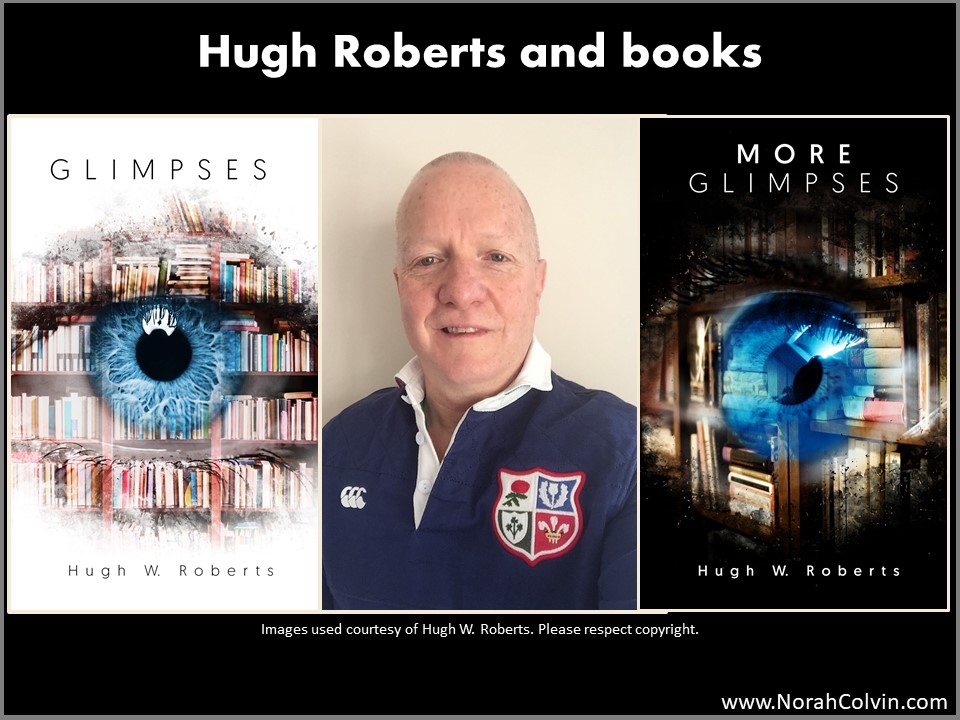
    Hugh Roberts and Books

    Hugh features many interesting series on his blog and always welcomes new readers and often contributors. I read and enjoyed Hugh’s first book of short stories Glimpses. The second volume More Glimpses has recently been released, and I am looking forward to seeing what twists and delights Hugh has in store for me now.

    Hugh also entered both Carrot Ranch Rodeo Contests that I hosted. Although they are judged blind, Hugh won the first competition and came second in the second. That’s a fair indication of what I think of his story telling. 😊

    Before we begin the interview, I’ll allow Hugh to tell you a little of himself:

    Hugh W. Roberts lives in Swansea, South Wales, in the United Kingdom.

    Hugh gets his inspiration for writing from various avenues including writing prompts, photos, eavesdropping and while out walking his dogs, Toby and Austin. Although he was born in Wales, he has lived around various parts of the United Kingdom, including London where he lived and worked for 27 years.

    Hugh suffers from a mild form of dyslexia but, after discovering blogging, decided not to allow the condition to stop his passion for writing. Since creating his blog ‘Hugh’s Views & News’ in February 2014, he has built up a strong following and now writes every day. Always keen to promote other bloggers, authors and writers, Hugh enjoys the interaction blogging brings and has built up a group of on-line friends he considers as an ‘everyday essential’.

    His short stories have become well known for the unexpected twists they contain in taking the reader up a completely different path to one they think they are on. One of the best complements a reader can give Hugh is “I never saw that ending coming.”

    Having published his first book of short stories, Glimpses, in December 2016, his second collection of short stories, More Glimpses, was published in March 2019. Hugh is already working on the next volume.  

    A keen photographer, he also enjoys cycling, walking, reading, watching television, and enjoys relaxing most evenings with a glass of red wine.

    Hugh shares his life with John, his civil-partner, and Toby and Austin, their Cardigan Welsh Corgis.  

    Welcome, Hugh. Now let’s talk school.

    First, could you tell us where you attended school?

    I spent my whole school life in the town of Chepstow; a town on the south-east border of Wales and England in the UK.

    Did you attend a government, private or independent school?

    They were government-run schools.

    What is the highest level of education you achieved?

    I left school at the age of 16 with five ‘O’ Levels and three GSCEs.  I then did a brief stint in college on a hotel and catering management course. A job offer meant I left the class before it finished.

    What work or profession did you choose after school and was there anything in school that influenced this choice?

    My first job was as an office junior before I went into retail.  I enjoyed an office environment, but it wasn’t customer facing (which is what I wanted). I told my careers teacher at school that I wanted to join the police force or fire brigade. Unfortunately, I didn’t qualify to join either because you had to be above a certain height. I was a couple of inches too short!

    What is your earliest memory of school?

    I was the only one standing up in class crying my eyes out while I watched all the mums and dads walking away. It was my first day at school, and I didn’t want my mum to leave me there. I was very emotional and felt she had abandoned me and was not coming back. Of course, she did.

    What memories do you have of learning to read?

    I remember the ‘Peter and Jane’ books which started at 1a, 1b and 1c and went up to 12c (which was the last book in the series). They got harder as you moved up to each one, and you were only allowed to move on to the next book when your teacher was satisfied that you could read the current book satisfactorily.

    What memories do you have of learning to write?

    I remember the first ink pens given to us to practice writing. They were very thin and had to be filled with ink from a bottle, which we had to fill ourselves. It could sometimes get very messy.

    While many of the children around me were doing ‘joined-up’ writing, I was doing all mine in block letters. I can remember being taken aside and told that I had to join the letters together. It took me a long time to gets to grips with joining the letters together, and it wasn’t long before I was left behind.

    What do you remember about math classes?

    I was not too fond of maths. Numbers did not interest me. All I wanted to do was make up stories. All my maths teachers were rigorous, which didn’t help in me gaining any confidence in numbers. I saw them as nasty, uncaring people, who didn’t seem to care about the children around them. I’m sure they did, but I didn’t see it that way.

    What was your favourite subject?

    Geography. I enjoyed learning about other countries and the people who lived in them. I was fascinated by maps and the names of towns and cities and the roads that connected them. Even the positions of countries intrigued me, and when I discovered time zones and realised that it wasn’t ‘lunchtime’ everywhere at the same time, ‘time-travel’ entered my life.  I remember wishing that it would become part of the Geography education module before I left school.

    School Photo - Hugh Roberts

    What did you like best about school?

    Drama class. In primary school, I could run around being who or what I wanted to be. Whether it was a tree, an animal or somebody driving a vehicle, I enjoyed the fun, laughter and enjoyment of the class.

    As I grew up, Drama got more serious, but I enjoyed playing different parts in the school play.

    What did you like least about school?

    Playing sport. I had no liking for playing any physical games, especially on cold, wet days on muddy fields. After Easter, we would do athletics which I enjoyed a lot more. The long jump was my speciality!

    How do you think schools have changed since your school days?

    Unfortunately, I think there are now more children who have no respect for their teachers than there were in my school days. Not only that, but some of the parents also have little regard for the teachers.

    It also saddens me to hear about schools not being able to afford to buy the basics like pens, pencils, books and even toilet rolls, because their budgets have been cut so much. Many now turn to the parents asking them to help fund children’s education when it really should be the government which funds it. I was so lucky to have ‘free’ education but, these days, ‘free education’ is something that is disappearing fast.

    What do you think schools (in general) do well?

    I hear more and more about schools inviting authors, writers and experts to come in and talk to the pupils about a particular subject. Whether it be about self-publishing, how to be safe on social media, or help and advice on careers or money matters, it gives those who want to help a chance to pass on their knowledge to new generations to come. I think it’s fantastic that they also ask people to come in and talk about their memories about specific events. It helps keeps memories and ‘past ways of lives’, alive.
    How do you think schools could be improved?

    More needs to be done in educating children about diversity and the hate crimes we hear so much about nowadays. Nobody should feel afraid to go to school because they are bullied or just because they’re told they are different and don’t fit in. Children should be encouraged to read about different ways of lives and to speak out about bullying. As a child who was bullied at school, my life was made much worse because I was afraid to tell an adult what was happening. These were the days before social media where bullying and hate crimes have now taken up residence. Children, these days, have a lot more to put up with, but I think there are also more bullies these days than there were when I was at school.

    thank you for your participation

    That’s an interesting observation with which to conclude, Hugh. Thank you for sharing your reminiscences of school and thoughts about education in general. It’s been wonderful to have you here. I’m sorry you were bullied in school and wish bullying was something we could eradicate.  


    Find out more about Hugh Roberts

    on his blog: Hugh’s Views and News

    Amazon Author Page

    Goodreads

    Connect with him on Social Media

    Twitter: @HughRoberts05

    Flipboard

    Mix.com

    Purchase Hugh’s books here:

    Glimpses by Hugh Roberts

    Universal Link for buying Glimpses

    More Glimpses by Hugh Roberts

    Universal Link for buying More Glimpses


    If you missed previous reminiscences, check them out here:

    Charli Mills

    Sally Cronin

    Anne Goodwin

    Geoff Le Pard

    Look for future interviews in this series to be posted on Sunday evenings AEST.

    Coming soon:

    Debby Gies

    Pauline King

    Jules Paige

    D. Avery

    with more to follow.

    Thank you blog post

    Thank you for reading. I appreciate your comments. Please share your thoughts.