Live Love Laugh Learn … Create the possibilities

Category: Teaching resources

  • Shaping up – activities with 2D shapes. – Readilearn

    Shapes are all around. Everything we see has a shape. Some of those shapes are regular, some not so regular. In early childhood, children are introduced to the basic regular shapes of circles, triangles and rectangles, including the special rectangle that we call a square.

    Even before they begin formal learning, most young children can recognise and name these four basic shapes. They see them in picture books and encounter them in puzzles and games.

    But learning about shape goes much deeper than just being able to recognise and label those colourful images.  An understanding of shape has relevance to many other activities such as reading maps, construction, laying tiles, and stacking items. They need to know how shapes can be combined to form others, and what happens when they are cut, flipped or turned. They will use their knowledge of shape in more advanced geometry such as finding perimeter, area, and volume.

    The colourful, and sometimes humorous cartoon-like, ways in which shapes are introduced to young children, can make them appear fairly basic, and parents and teachers may state with pride, “My child knows all the shapes.” But with shape forming a basis for so much other understanding, it is important to use language that enables understanding and discourages the formation of misunderstanding.

    Misunderstandings occur when objects

    Continue reading: Shaping up – activities with 2D shapes. – Readilearn

  • Fair trade – what’s it to you?

    What do you think of when you hear the word “trading”?

    International trade? Stock market trading? Trading one item for another? Perhaps a Trade Fair, or selling items at a market stall? Trading as your *business name*? Maybe you are committed to purchasing “Fair Trade” in support of the  World Fair Trade Organisation’s aim of making international trade more equitable?

    As an early childhood teacher, I think of trading games that we use in maths lessons to help children understand place value. In our decimal system, we use ten digits in various combinations to represent numbers. Placement of each digit is vital; for example, 290 is very different from 902.

    Without a firm understanding of place value, it is difficult to work with numbers efficiently. I believe that many difficulties with number stem from insufficient understanding of place value. Children need to experience numbers in a variety of contexts to fully understand the decimal system.

    For younger children just beginning to learn about two-digit numbers, we may connect interlocking blocks or bundle popsticks to form groups of ten.
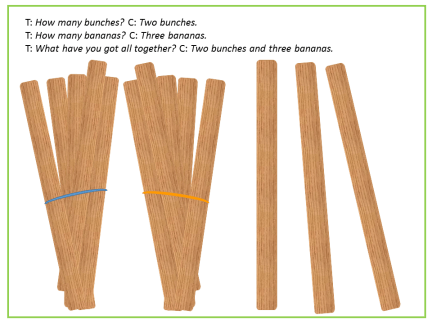
     

    When children have a firm understanding of the grouping process, and the way the numbers are represented with two digits, they move to a similar process with numbers over one hundred. It is at this time that we introduce trading.

    Instead of using interlocking cubes or other items that can be linked or bundled, ten individual cubes are traded for one ten, and ten tens are traded for a one hundred flat, and so on.

    I feel so strongly about the importance of children learning place value, that I have made a variety of resources for teaching it. The resources, available from readilearn; include:

    Beginning place value – the train game
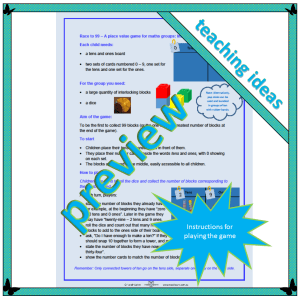
    Race to 99 – A place value game for maths groups

    The interactive resources
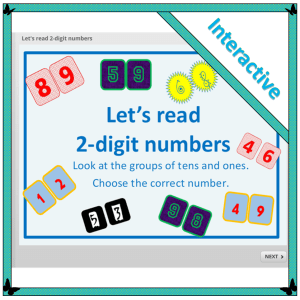
    Let’s read 2-digit numbers
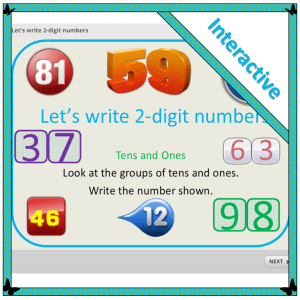
    and Let’s write 2-digit numbers

    Playing games has always been a favourite activity for me, and always popular for family gatherings. We’d quite often we’d spend holidays, like Christmas and Easter, when the children were growing up, playing board games or card games. One of our favourite games, especially if there were larger numbers of people (up to ten) was a trading game called “Billionaire”. It is a raucous game. Everyone is engaged all the time. Play involves trading cards (commodities) with each other, and this involves much shouting (over the top of each other) and laughter. If you have never played it, but enjoy games, and have a group of four or more to play, I highly recommend it. (Sorry, I couldn’t find it to add a photo. It’s hidden away in the games cupboard somewhere.)

    I couldn’t write about trading without mentioning Jack and the Beanstalk. Mother sends Jack off to the market to sell the cow. Along the way, he meets a man with a handful of “magic” beans which he offers to trade for the cow. Not having heard the saying, if it sounds too good to be true, it probably is, Jack agrees. Of course, Mother is none too pleased and throws the seeds out the window. But, as the story shows, Jack was right to trade and rewarded for his ignorance of the oft-touted adage. (The story also raises other issues regarding trespass, theft, and causing fatal injuries. But we won’t go there this time.)

    This week at the Carrot Ranch Charli Mills has challenged writers to In 99 words (no more, no less) write a story about trading. It can be the profession of old or of modern day traders on Wall Street. It can be trading places or lunches at school. What is traded? Is it a fair deal or a dupe? Trade away and go where the prompt leads you.

    For my response I’ve ended up in the playground yet again. It involves a little trading of cards, but more a trading of power. I hope it works.

    Trade fair

    Cards, were coveted like gold. To belong, one was enough; more better. Each lunchtime the boys showed off new acquisitions, compared intelligence and strength points, and traded duplicates. Fair and friendly battles pitted minds, the winner claiming card supremacy. Then bully Boris won, and none dared challenge. Until Justin, tired of Boris’s tactics, dared.  The group gasped. It seemed Justin would be crushed. But clever cardless Frank slipped in and showed the winning move.  Boris growled, “Inadmissible” and threatened repercussions. Defiant, Justin handed Frank a card, bestowing membership. Empowered, each boy followed, declaring Frank the Master, and trading opened.

    Thank you for reading. I appreciate your feedback. Please share your thoughts.


  • Thinking mathematically – Readilearn

    Mathematical thinking involves more than just being able to count and recite number facts. The ability to solve mathematical problems requires us to think flexibly and creatively with numbers. We need to see that there are multiple ways of interpreting a situation and reaching a solution. It is never too early to get children thinking.

    An easy way to get started is to give children a variety of objects to count. Rather than always counting groups of similar objects; for example, counters, bottle caps, or teddy bears, it is important for children to realise that collections for counting

    Continue reading: Thinking mathematically – Readilearn

  • Celebrating Mums – Readilearn

    Six early years activities for celebrating Mother’s Day. Develop literacy skills while making a personalised and special gift for Mums.

    Mother’s Day is celebrated on the second Sunday in May in many countries, including Australia, the United States, and Canada. With the celebration little more than a week away, I thought I’d share some suggestions that are low on cost but packed with learning opportunities to incorporate into your class literacy and art programs.

    Encouraging children to create and give a gift from the heart demonstrates that not all gifts need come from a shop. It allows children from even the poorest families to give their Mums a special Mother’s Day gift. It helps develop their creativity and teaches them skills that they can apply in future gift-giving situations. It shows how thoughtfulness and imagination can combine to make a unique gift that will be treasured.

    A gift of love lasts longer than many store-bought gifts.

    1. Read picture books featuring mothers

    A few of my favourites are:

    Continue reading: Celebrating Mums – Readilearn

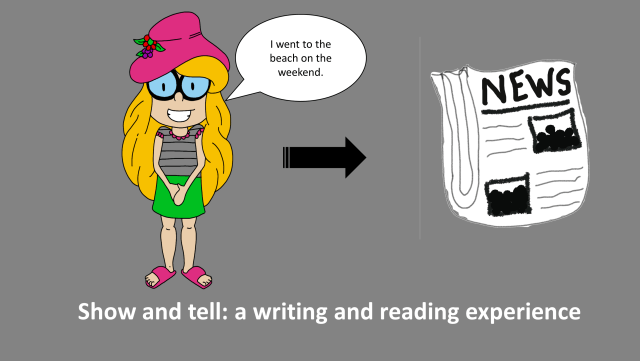
  • Show and tell: a writing and reading experience – Readilearn

    A “Show and tell” sharing session is a tradition familiar to many early childhood classrooms across the world.  Children take turns to tell their classmates about an item they have brought in to show, or to relate a recent event in their lives. While the practice introduces children to public speaking, helps to develop confidence and oral communication skills, and encourages them to listen attentively, I consider the learning achieved compared to the time spent to be of dubious value.

    Children tend to fidget, rather than listen and, with their minds elsewhere, are generally more interested in talking about themselves than in learning about others. This is a trait not exclusive to children though, and can be noticed in people of all ages.

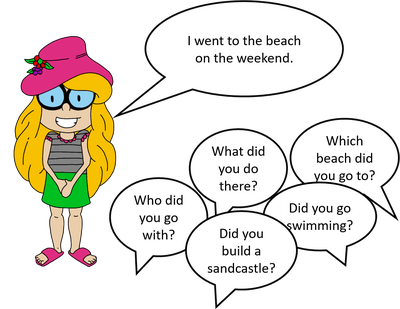
    Although encouraged to ask questions at the conclusion of each talk, children’s questions are often standard, repetitive, and lacking in thought. They may be unrelated to anything the speaker said, or may request information already supplied.  The asking is seen more as an opportunity of talking and of being seen to ask (that is; doing the right thing), than to know more or to participate in genuine discourse.

    Believing in the session’s greater potential, I innovated on the basic routine to make it a focussed literacy teaching episode. By incorporating features of approaches such as language experience, modelled writing, and shared book, the session became an avenue for teaching and learning in both reading and writing.

    From the first days of school, we wrote our Class News; creating meaningful texts which valued and connected with children’s lives. The jointly constructed texts became our first reading material; richer in interest, content, language, and vocabulary than any first reader. (Though these have their place and were also used.)

    Writing and reading Class News: The process

    Continue reading: Show and tell: a writing and reading experience – Readilearn

  • A cheap shot?

    A cheap shot?

    Michelle demonstrates through her article what she states in her final paragraph as the benefit of involving children in philosophical enquiry. She says, “We get children thinking critically, rigorously and sceptically, so that they’re less likely to succumb to ill-founded beliefs or be duped by self-deception, spin or rhetoric. We help children develop their reasoning, so that they become more adept at building logical arguments and rationally defending their views. We encourage children to question the assumptions underlying different points of view, enabling them to challenge dogmatic beliefs. And we cultivate deep and deliberative thinking – often neglected in traditional schooling, which tends to focus more on getting ‘the quick right answer’ – so that children have a chance to explore the nuances of complex ideas.”
    Who could disagree with that?

  • Meet author-illustrator Chrissy Byers – Readilearn

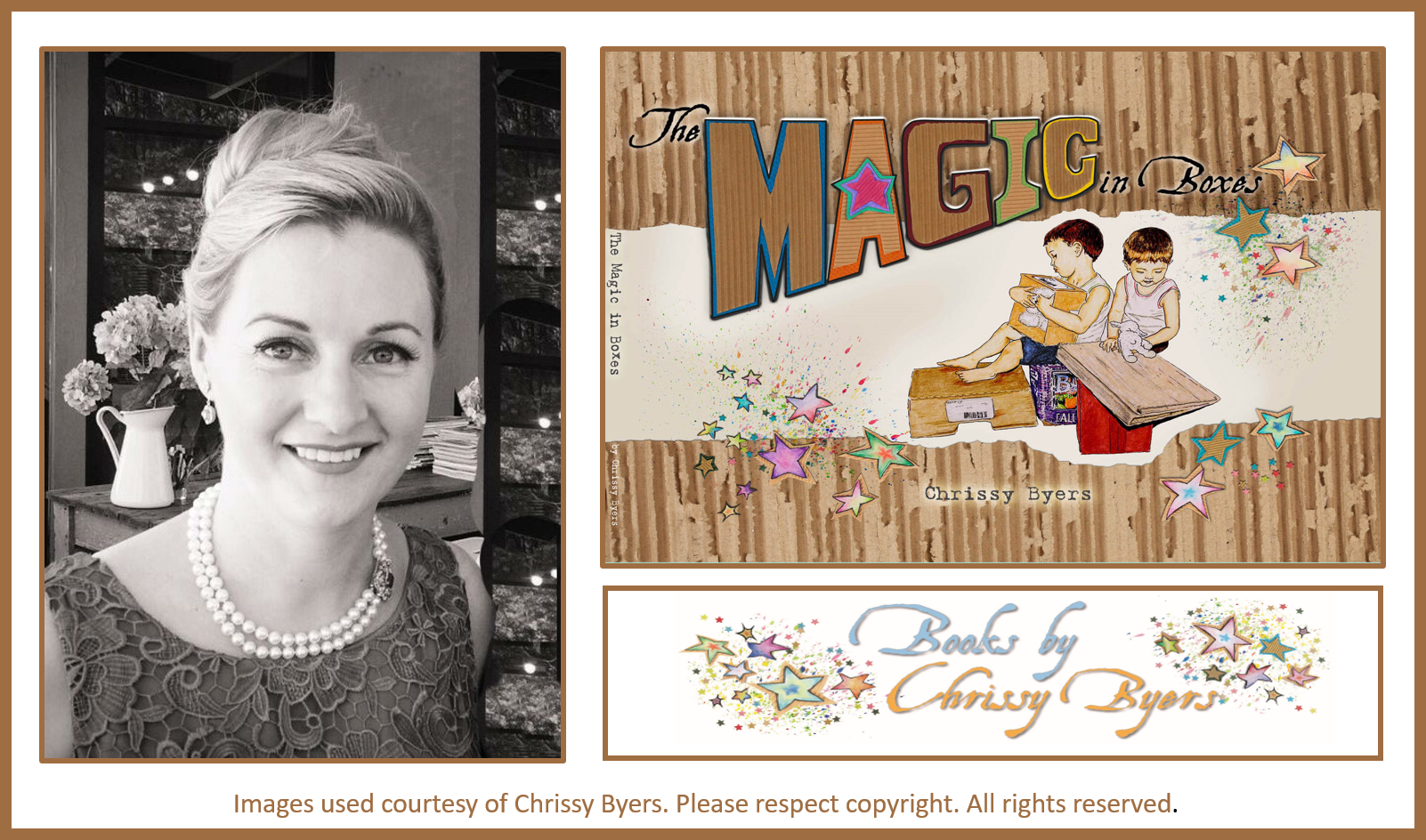
    This month it is my pleasure to introduce you to Chrissy Byers – author, illustrator, and early childhood educator. It was only after many years in the classroom and becoming a parent herself that Chrissy was able to fulfil her lifelong dream of being an author and illustrator. With the success of her first book The Magic in Boxes, and another on its way, Chrissy shows us that dreams can come true.

    Chrissy, what was your motivation for writing this book?

    As an experienced early years class teacher, I had noticed that, with the rise in technology there was a decline in the amount of time children spent engaging in imaginative play.  I was compelled to write and illustrate a children’s book which would remind parents, and inspire children, to see the magic in everyday household junk.

    Unlike a traditional children’s book, I felt that the recount genre would suit my intentions better than a narrative.  I saw this as being an additional bonus for primary teachers, as there are very few examples of recount picture books.

    The repetitive text elements encourage pre-reading children to join in a shared reading experience.  It also provides opportunity to incorporate hand gestures when reading, which helps focus young minds and occupy little hands during carpet time.  The rhyming couplets assist in reading prediction and keep the beat of a fast-moving text.

    Do you think of yourself more as a writer or an illustrator?

    Continue reading: Meet author-illustrator Chrissy Byers – Readilearn

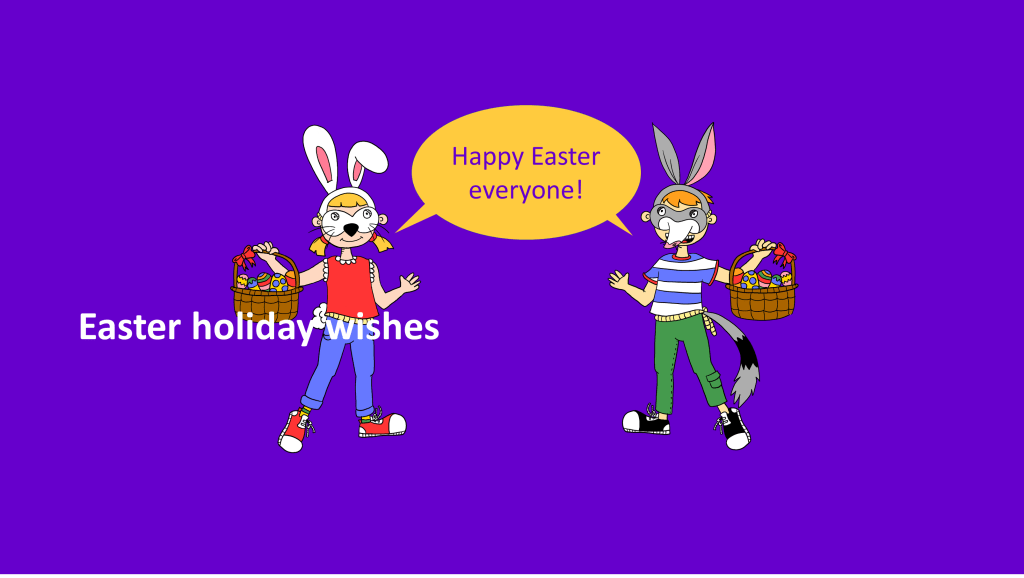
  • Easter holiday wishes – Readilearn


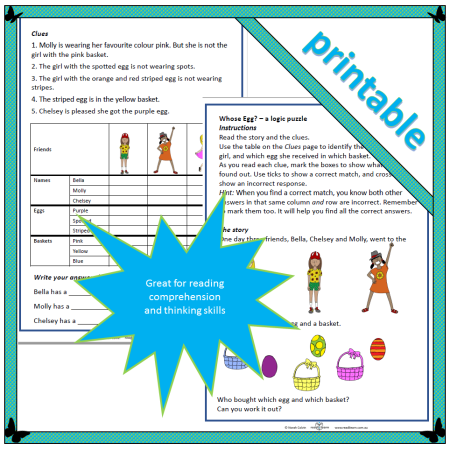
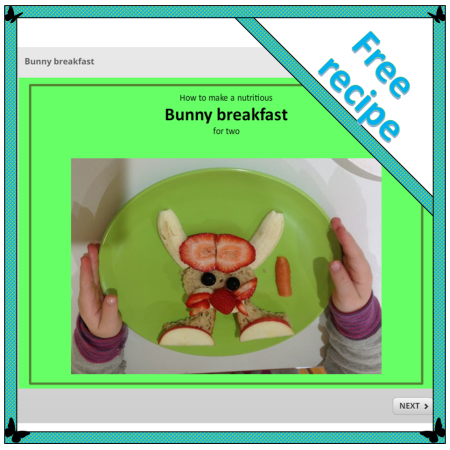
    This week I have uploaded two new resources which are just as suitable for Easter holiday fun at home as they are for learning in the classroom.

    Whose egg? A logic puzzle can be used with the whole class to introduce children to the steps involved in completing logic puzzles; or as an independent or buddy activity if children already know how to complete logic puzzles on their own.

    Three friends, three eggs, and three baskets. But which friend has which egg and which basket?

    Children read the story scenario and the clues, then use the information to deduce which friend bought which egg in which basket.

    Great for reading comprehension and creative thinking; and for collaboration in a paired activity!

    Continue reading: Easter holiday wishes – Readilearn

  • Can you guess: Who am I? – Readilearn

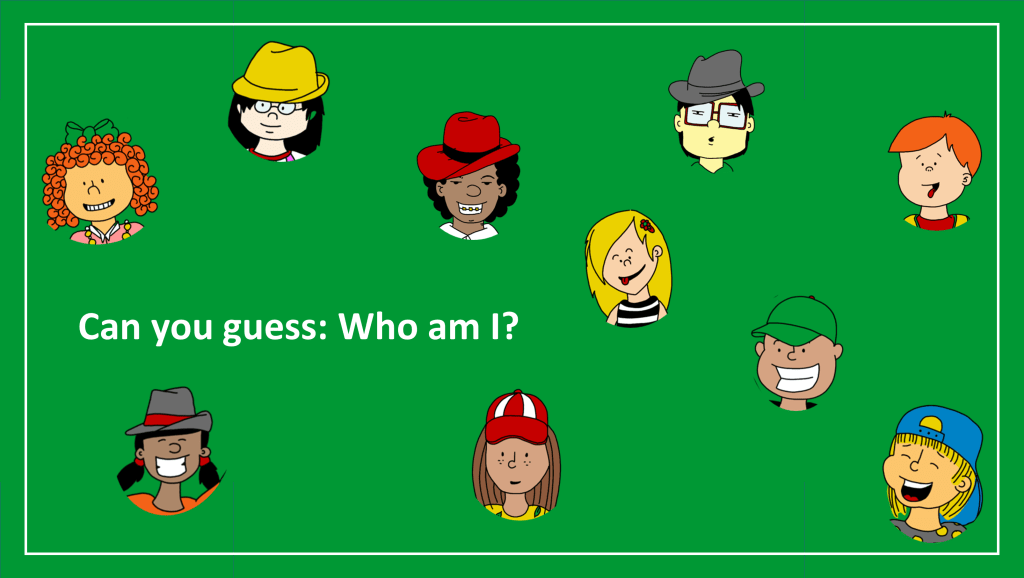
    can you guess - who am I

    Last week I shared an interview revealing a little about myself and my hopes and plans for readilearn. I also uploaded some little Who am I? Easter caption books. It’s seems timely then to discuss the value of creating, writing, and reading Who am I? puzzles in the classroom.

    Children love solving puzzles and it is good for them to engage in thinking activities. Who am I? puzzles involve deductive reasoning, and are easy for children to write. Solving them means listening attentively to the clues, remembering all the information, relating new information to existing information, and using the clues to eliminate options in order to identify the specific.

    In addition, the puzzles can be used to discuss and teach the difference between statements and questions and the appropriate way of punctuating each.

    Children can begin by writing statements about themselves, such as those they may have shared in About me booklets. They can also add interesting facts that others may not know about them. Remind children

    Continue reading at: Can you guess: Who am I? – Readilearn

  • Are you ready to learn? A shout out for readilearn – Readilearn

    About six months ago, not long after the launch of readilearn, I was invited by Dr Gulara Vincent to talk a little about it on her wonderful blog through which she provides support for writers as they find their inner voice. I thought you might be interested in finding out a little more about how readilearn came to be. Although I share the interview here, please click through to meet Gulara and read the interview on her blog.

    Hi Norah, Welcome to my blog.

    Thank you for inviting me. I am delighted to be here.

    Norah, congratulations on the recent launch of your website. Tell us a little about readilearn.

    Thank you. I am very excited about my new website. readilearn is a collection of early childhood teaching resources that I have written. Many of the resources I used, trialled if you like, in my own classroom. I had always thought about sharing them with others but, when I was teaching full time, didn’t have the time to present them professionally or even think about marketing them.

    Norah, what makes your resources different? Why would people choose readilearn resources?

    Continue reading at: Are you ready to learn? A shout out for readilearn – Readilearn