Live Love Laugh Learn … Create the possibilities

Category: Teaching resources

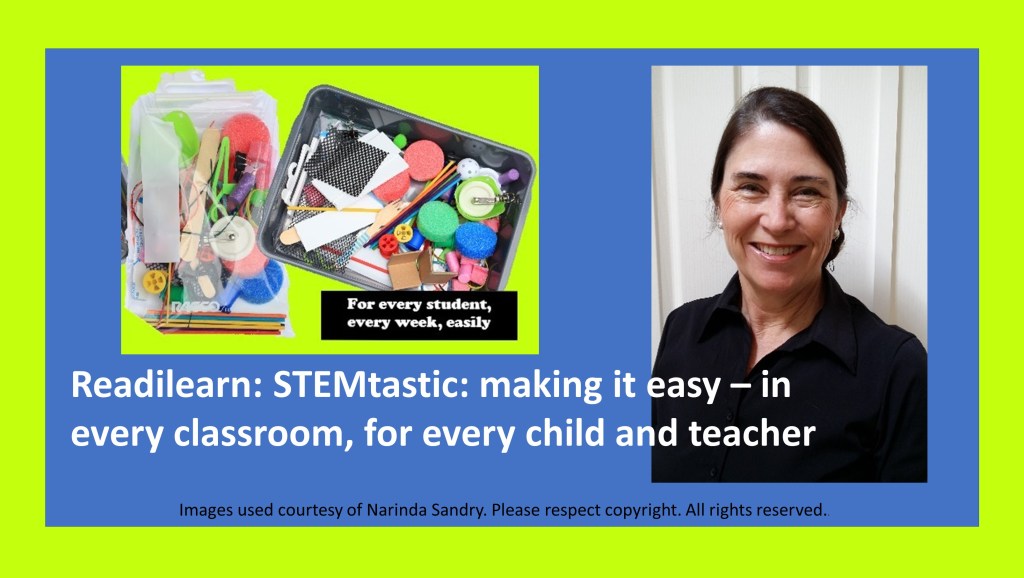
  • Readilearn: STEMtastic: making it easy – in every classroom, for every child and teacher

    STEMtastic Narinda Sandry

    STEM (Science Technology Engineering Mathematics) subjects are being rejuvenated in schools. Many of us remember them as uninteresting, unfathomable and seemingly unrelated to anything we needed to know in the real world of our daily lives. Fortunately for us, some “nerdy” types found them interesting enough to imagine, explore and create new possibilities that improve our lives in countless ways.

    I’ve previously written about the importance of making space for STEM in early childhood classrooms. In this post I talk with early childhood educator Narinda Sandry who is spreading the word and showing even STEM-averse educators how they can “deliver STEM experiences to every student, every week, in class and easily in an overcrowded curriculum.”

    Narinda is a teacher, curriculum writer and advisor. She spent many years teaching in early childhood classrooms, wrote educational materials for the Queensland Museum, and curriculum documents to support implementation of the Australian Curriculum. She now shares her combined love of learning, passion for early childhood education, and interest in STEM subjects, with teachers through her new STEMtastic project promoting “STEM education for every student, every week, easily.”

    Hello, Narinda, and welcome to readilearn.

    Absolute pleasure to talk with you and your readers Norah.

    Narinda, tell us a little about why you feel STEM education is so important in early childhood and all classrooms.

    The world we live in is changing, faster now than it ever has before. It is predicted that many of the jobs we know now will be either non-existent or at least disrupted in the near future. Think about the

    Continue reading at Readilearn: STEMtastic: making it easy – in every classroom, for every child and teacher

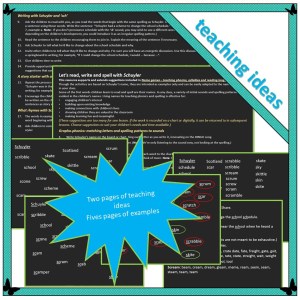
  • Let’s read, write and spell with Schuyler: readilearn

    I don’t normally post twice a week, but this post is really an addendum to the previous post What’s in a name? Teaching phonics, syllabification and more! so I decided to break with tradition and share it.

    For the inspiration for this post and the resource it describes, I must thank Pamela Wight, who featured in the author interview last month.

    In commenting on the What’s in a name? post, Pamela mentioned the awkwardness of singing and spelling her grandson’s name – Schuyler, a name with which I was unfamiliar. I joked to Pamela that I’d thought of recording a few names, innovating on the tune of BINGO, to show how “easy” it might be. Pamela suggested I should, even though I explained that my singing voice is anything but, and she told me the pronunciation for Schuyler: Skylar. Well, I couldn’t help myself. My head started racing with ideas of incorporating Schuyler’s name into reading and writing lessons teaching phonics and spelling skills. The result is the resource Let’s read, write and spell with Schuyler,

    and the recording.

    Continue reading: Let’s read, write and spell with Schuyler: readilearn

  • Readilearn: What’s in a name? Teaching phonics, syllabification, and more! – Readilearn

    teaching phonics syllabification

    The first words children learn to recognise, read and spell are usually their own names. It’s not surprising, these words hold significant meaning and power for them. Why not harness that energy to teach the skills that are basic to literacy development?

    Even before they begin formal schooling, children are able to read and spell their own names; and possibly the names of significant others in their lives, including parents, siblings, other close relatives and friends. When we write their names on pictures they’ve drawn, inside the covers of books they own, on letters and envelopes written to them, as well as on their belongings, they come to understand “that word means me”.

    However, not all children are exposed to the same opportunities for learning prior to beginning school. It is important that we make connections with the children and help them learn in ways that are both fun and meaningful.

    In this post I suggest some strategies that can be implemented in the first three years of school, starting from the very first day when children can write their names to demonstrate their knowledge of letters and sounds and fine motor coordination. Throughout the early years, children’s names can be used as a starting point in teaching phonics, initial sounds and syllabification.

    The ideas suggested in this post are presented in more detail in a new resource uploaded this week:

    name phonics syllabification

    Name Games – teaching phonics, syllables and reading long words

    Suggestions for before, or in early days of, school

    Teaching letter sound relationships

    An easy way to teach young children to recite the letters of their names in sequence, is to utilise their love of music, singing and recall of lyrics. Even if sung out of key, children enjoy special songs about them and their names. Simply adjust the tune of B-I-N-G-O to the children’s names as you sing.

    After just a few repetitions, they are able to join, and even sing their names independently. If you sing

    Continue reading: Readilearn: What’s in a name? Teaching phonics, syllabification, and more! – Readilearn

  • readilearn: Introducing Pamela S. Wight, author of Birds of Paradise – Readilearn

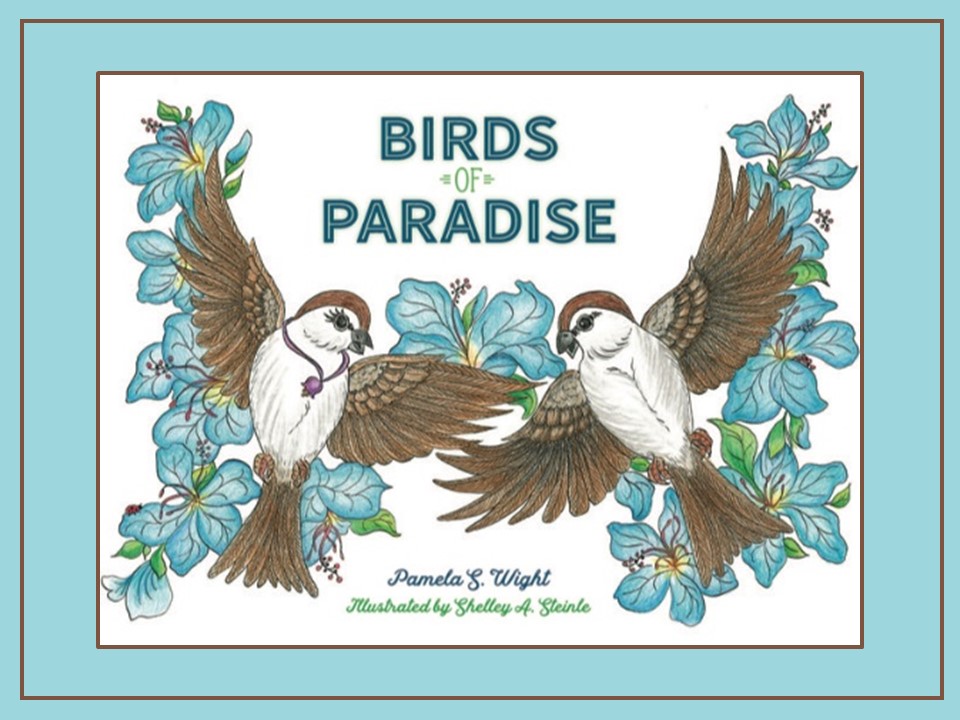
    In the author spotlight this month is Pamela S. Wight, a fellow blogger, writer, and teacher of creative writing. I enjoy the stories of life Pamela shares on her blog Rough Wighting, and also enjoyed reading her adult novels. But it was the story of how this picture book Birds of Paradise came to be, a picture book 35 years in the making, that really captivated me. I knew I wanted to share it with you. Before we start talking about the book, though, let me introduce you to Pamela.

    yellow bird Pamela Wight

    Pamela Wight has joined the ranks of authors who are, as she calls it humorously “bi-genre” or “ambi-writers.” Think of Ian Fleming, who yes, wrote the James Bond books, but also switched genres and wrote the children’s book Chitty Chitty Bang Bang. Before A.A. Milne wrote the Winnie-the-Pooh books, he penned a popular whodunit entitled The Red House Mystery.

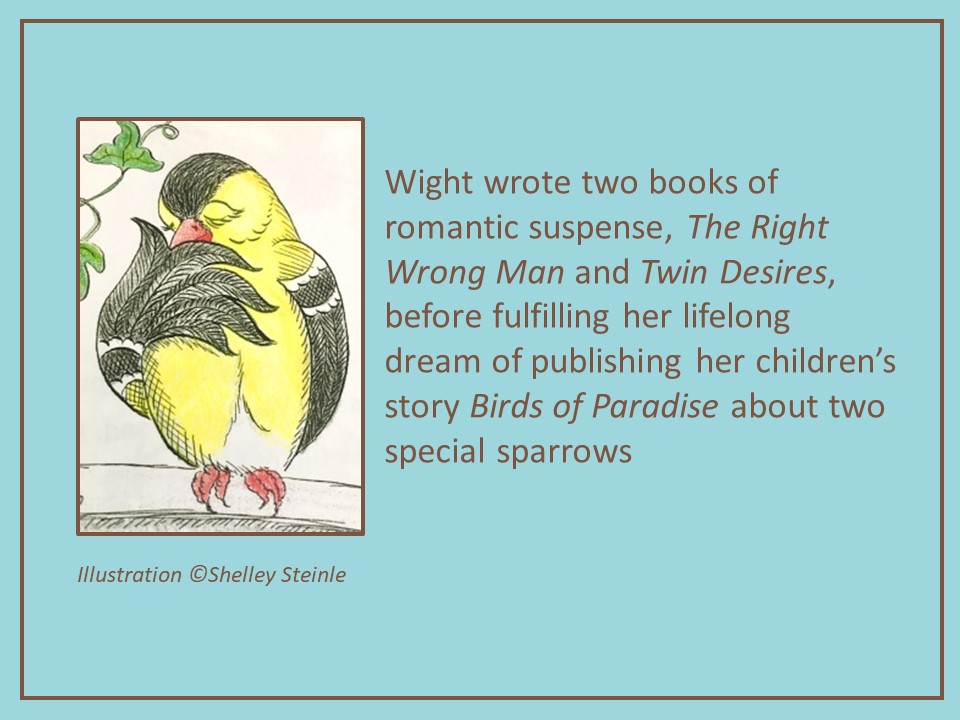
    Wight wrote two books of romantic suspense, The Right Wrong Man and Twin Desires, before fulfilling her lifelong dream of publishing her children’s story Birds of Paradise about two special sparrows.

    About the story:

    Birds of Paradise

    Sweet sparrows Bessie and Bert grow up as differently as night and day. Bessie is fearful of the dangers inherent in being a bird. She’s scared to leave her cozy branch. But Bert relishes flying in the sky and

    continue reading: readilearn: Introducing Pamela S. Wight, author of Birds of Paradise – Readilearn

  • I spy butterflies – Readilearn

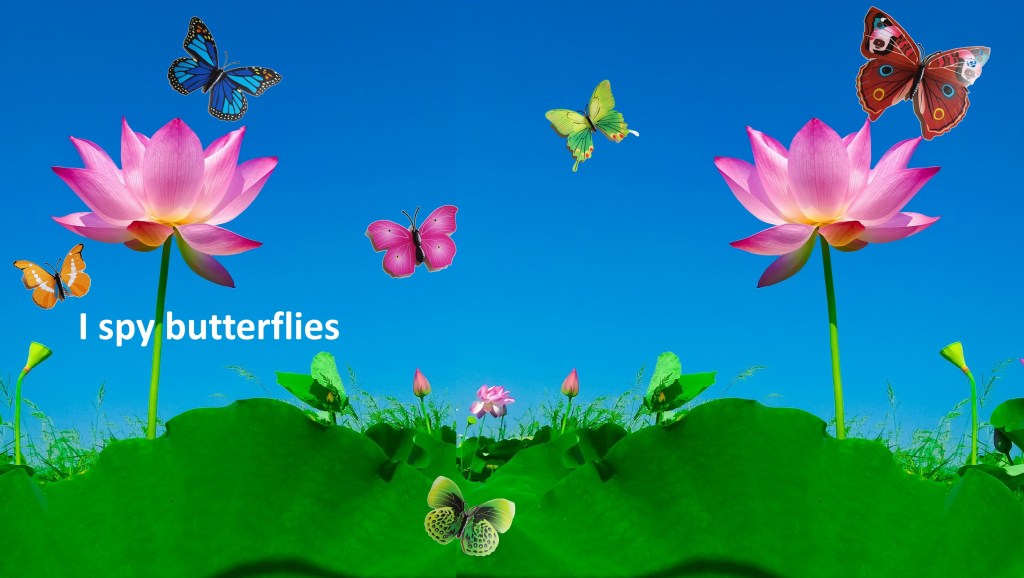
    I spy butterflies

    Learning about butterflies in the classroom, especially when observations of the life stages with a live learning kit are possible, is almost magic for children. The growth of the caterpillars is obvious and children can watch as they moult and pass through each instar. The voracious appetite of the caterpillars means that plants are quickly stripped of their leaves and, if children listen carefully, the munching of the mandibles can be heard.

    Many resources to support an early childhood science biology unit about butterflies in particular, or minibeasts in general, already exist in the readilearn collection; including:

    Butterfly diary

    Minibeast project

    My minibeast ABC

    Code for Caring

    I included suggestions for teaching about minibeasts, including butterflies, in a previous post Classroom minibeasts. While there are many minibeasts suitable to study in the classroom, butterflies are my favourite. This week the readilearn collection has grown with some new resources to support learning about butterflies; including:

    butterfly word cards

    Butterfly word cards

    Butterfly word cards is a collection of forty butterfly-relevant words which may be printed and displayed on a word wall or used to label a butterfly display. The words are presented in three different formats for printing choice.

    The words include some fascinating scientific terms; such as:

    • instar
    • frass
    • chrysalis
    • prolegs

    Continue reading: I spy butterflies – Readilearn

  • Award winning Rainforest Camp – interview with Rebecca Johnson – Readilearn

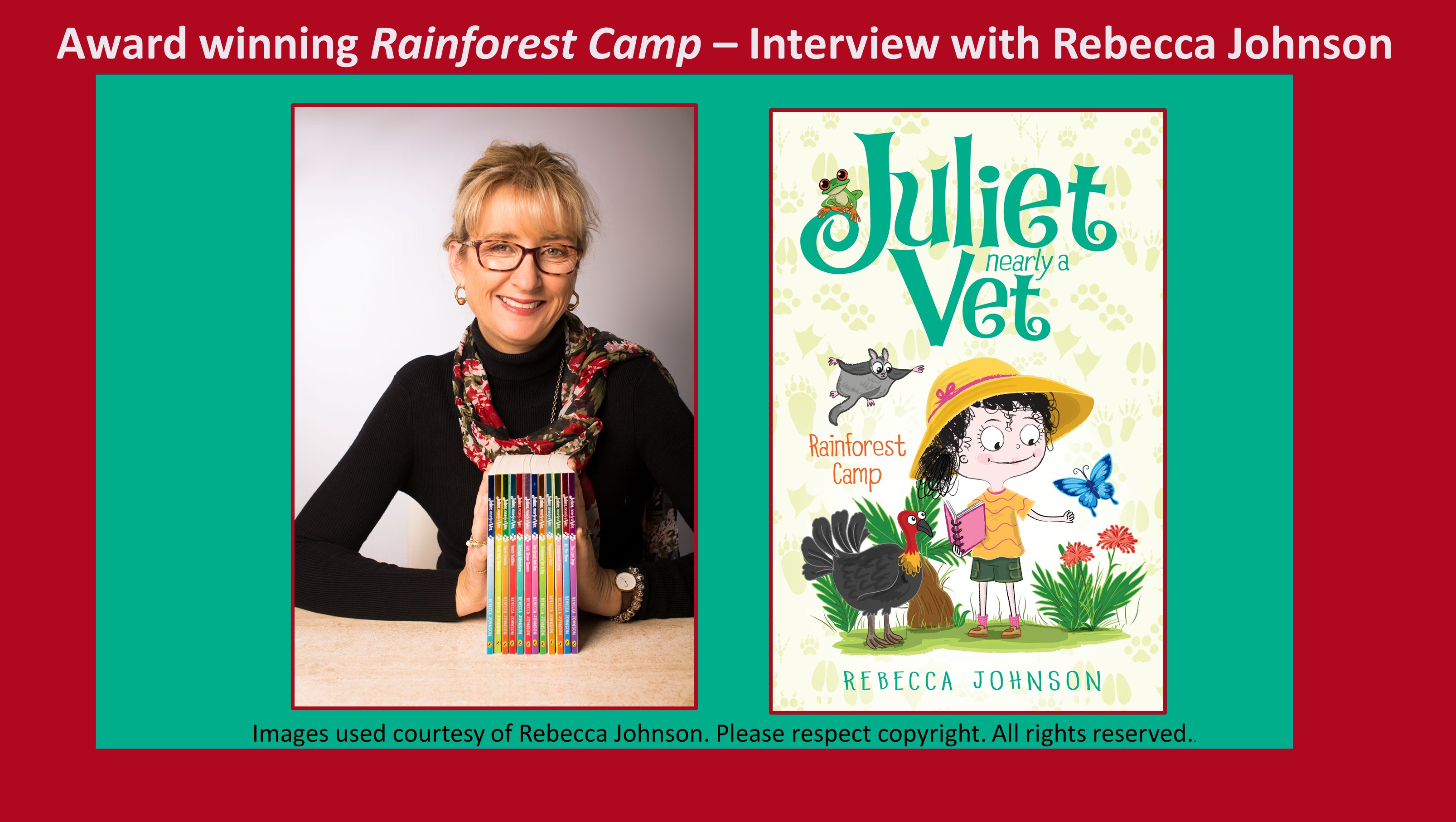
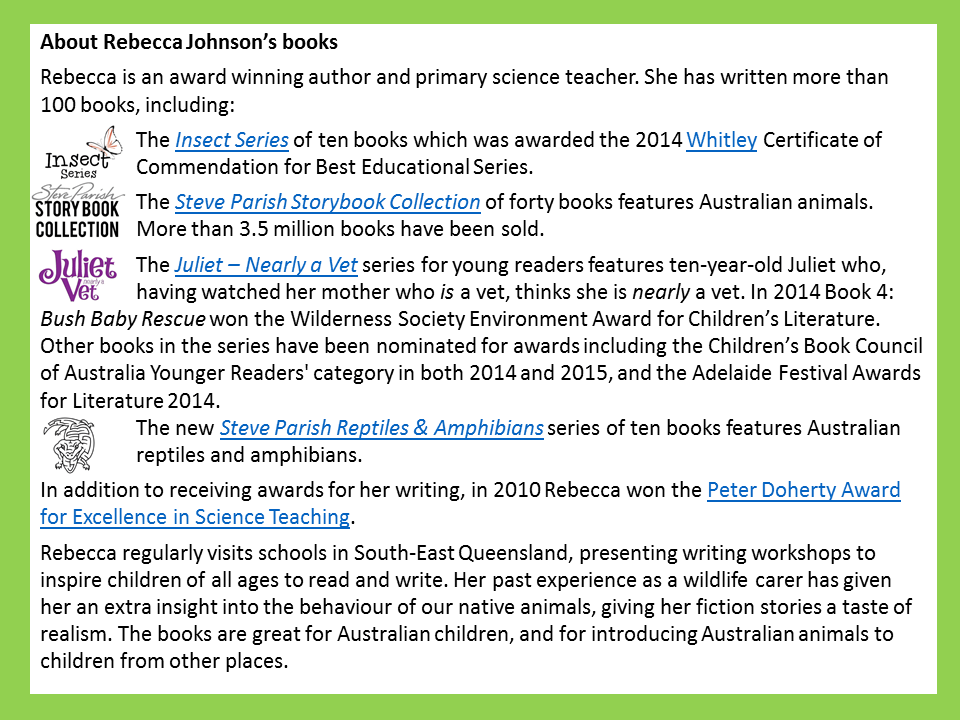
    Just over a year ago, in my very first author interview, when I introduced you to Rebecca Johnson and her award winning Insect Series, I shared the following information about her publications and awards:

    Since then, Rebecca’s list of publications has continued to grow, including two new series of books:

    Vet Cadets “an exciting new four book series for smart, animal and science-loving girls who aren’t afraid to get their hands dirty!”

    First Facts “designed to give children a clear understanding of the six main groups of animals.”

    Rebecca’s popular junior fiction series Juliet nearly a Vet, for readers from about 7 years of age, continues to attract attention. The series features ten-year-old Juliet who believes she is nearly a vet after watching her mother, who is a vet, at work.

    Rebecca’s purpose in telling these stories is to blend science with fiction in a way that engages children’s interest in wildlife and nature. She does it successfully. In 2014, the fourth in the series Bush Baby Rescue won the Wilderness Society Environment Award for Children’s Literature. This year, the most recent title Rainforest Camp received the same award.

    Continue reading at: Award winning Rainforest Camp – interview with Rebecca Johnson – Readilearn

  • Logical thinking and problem solving – Readilearn

    logical thinking and problem solving

    Logical thinking and problem solving are important skills for children of all ages to develop, including those in early childhood classrooms. We employ thinking skills each day, in many situations, from deciding the order in which to dress ourselves, complete simple tasks, collect items for dinner or set the table; through to more complex problems such as assembling furniture, writing work programs, juggling timetables, and organising class groupings for activities.

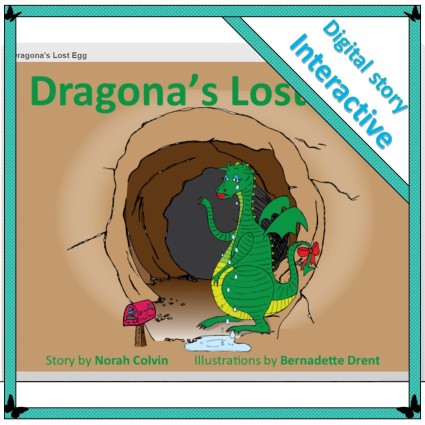
    This week I am excited to upload a new interactive digital story that encourages children to use logical thinking to solve a problem.

    Dragona's Lost Egg

    Dragona has lost her egg and turns to her friend Artie, owner of a Lost and Found store, for help. Artie is confident of helping her as he has many eggs on his shelves. He asks Dragona to describe features of her egg, including size, shape, pattern and colour. He uses a process of elimination to identify which egg might be Dragona’s. Children join in the process by choosing eggs with the characteristic described.

    What is Dragona’s egg really like, and will Artie be able to help her find it?

    You’ll have to read the story to find out.

    The process of writing this story also required a problem to be solved; and I love nothing better than a good problem to solve.

    What’s an ovoid? Do you know?

    what's an ovoid


    To find out, continue reading at: Logical thinking and problem solving – Readilearn

  • Sucked out or sucked in

    We often hear stories of swimmers being sucked out to sea by dangerous riptides and of the heroic efforts of lifeguards to save them. In Australia, life savers are volunteers who generously give up their time to help ensure the safety of others. According to this article from news.com.au,  most drownings in Australia occur in ocean rips; many because people are overconfident of their ability to recognise them. Though surf life savers who patrol our beaches clearly identify areas under surveillance, many beachgoers choose to swim outside the flags, believing they will be safe, that it won’t happen to them.
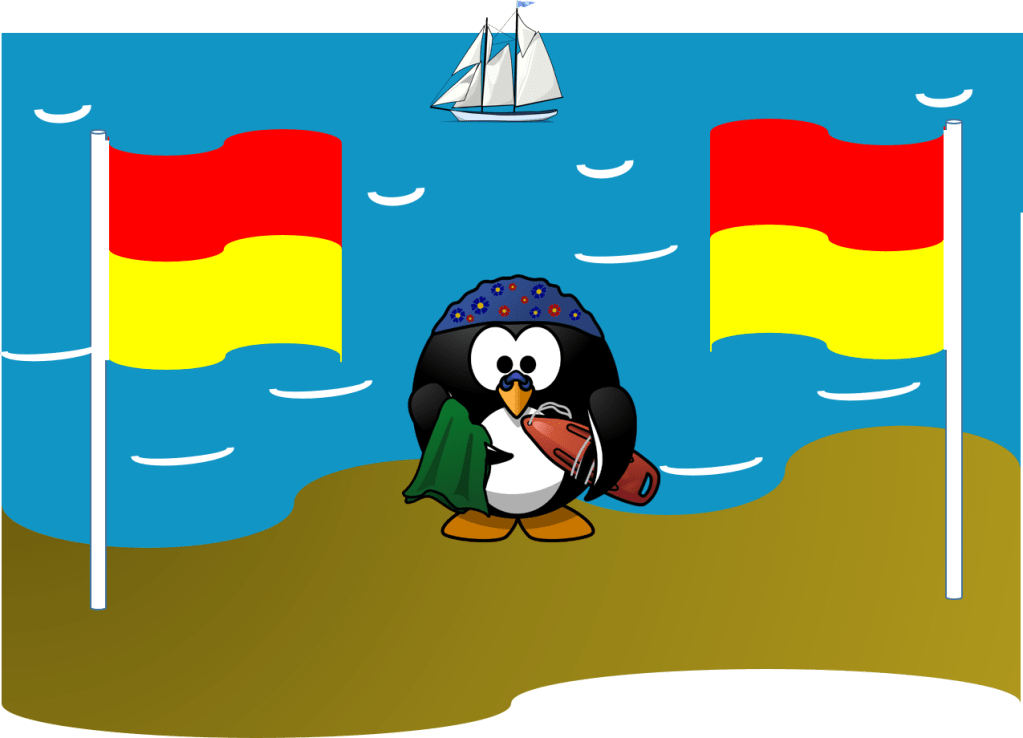
    With summer on its way and warmer weather already (or still) here, people, including my grandchildren and their parents, are heading to the beaches for our spring school holidays. I urge everyone to stay safe and be wary of those unseen rips. I also offer a huge word of thanks to the generous volunteers who safeguard our swimmers.

    swimmer

    This news report, which aired on Saturday evening, explains some reasons for their generosity:

    “Life is just that precious. If we can’t see you, we can’t help you.”

    “We get paid nothing, but it’s worth it.”

    “It’s about the community giving back to the community, and you know, helping out.”

    dear life savers

    This week at the Carrot Ranch, Charli Mills is talking about riptides. She has sucked me along in the current with her challenge to In 99 words (no more, no less) write a story about a riptide. How can it be used to move a story? It could be a stretch of turbulent water or a pull of another kind. Go where the prompt leads even if you find it unexpected.

    In her post, Charli repeats a line, reminiscent of a song of which I was unaware:

    “I run down to the riptide”.

    Each time Charli reaches the riptide, she opens a hatch of treasures and possibilities, of ideas and achievements with which she could swirl away. Me? At the mention of riptide, I was thinking of being sucked in and drowning, of being carried away from safety. But to be picked up and carried to a land of possibilities may be more enticing with more opportunities to explore. There may be more to currents than the ocean’s deadly pull. Let’s see where this one goes.

    Where else but education?

    For teachers, it’s important to not get carried away by the latest fads with their deceptive surfaces hiding dangers in their depths. Many teachers flounder in overwhelming workloads, unrealistic expectations, and defective advice. They lose sight of the shore and get dragged out to sea where, sadly, many drown.

    It is also important for teachers to know where the (figurative) waters are safe for children, and where there are just enough ripples to challenge them, strengthening their grit and confidence.

    Children themselves need to know how to interpret the waters, to avoid the dangers so that they might enjoy what is on offer. Standing on the edge in fear while others are having fun may spark “if only” thoughts of dissatisfaction. Jumping recklessly in too deep may be just as disastrous.

    The same is true in life. If we don’t have a go, how will we ever know if success is possible?
    readilearn

    I jumped into blogging just over three years ago, tested the waters and developed my swimming skills. I thought I was doing okay. A little over a year ago, I dived in deeper, perhaps a little recklessly though it didn’t seem so at the time, with the launch of readilearn, an online collection of early childhood teaching resources. I sometimes feel that I am treading water, struggling to hold my head above the surface and avoid the rip that threatens to suck me under. I knew it would be a learning journey. I just didn’t realise how much I needed to learn.  Belief in what I’m doing and hope for what the future may hold, drives me forward. I swim, hoping to find the current that carries me towards my goal rather than away from it.

    So, I’m thinking about the child on the beach, feeling the drag of the water underfoot, unsure of whether to enter or not. No dangerous undercurrents here. I hope you enjoy it.

    Sucked in

    The older ones squealed, dropped their towels, and raced for the water. The little one toddled beside Mum, each laborious step prolonged by distractions of beach debris, flapping gulls, and footprints in soft white sand. Mum’s eyes flitted between him and the two in the waves. Thankfully, guards were on duty. When they reached the water’s edge, he baulked, shook his head, and plopped backwards. Gentle waves lapped his feet, then tickled as they sucked out the sand. Mesmerised, he chuckled. His siblings joined him. When they offered their hands, he accepted, stepping joyfully alongside them in the shallows.
    Thank you for reading. I appreciate your comments. Please share your thoughts.

  • Introducing co-authors Brenda Miles and Susan Sweet – Readilearn

    Brenda Miles and Susan Sweet

    This month I have great pleasure in introducing you to two fine authors, Brenda S. Miles and Susan D. Sweet, who co-wrote the wonderful picture book Cinderstella: A Tale of Planets Not Princes.

    With both World Space Week and International Day of the Girl Child just a few weeks away, I couldn’t think of a better book and authors to spotlight this month. This year’s theme for World Space Week is “Exploring new worlds and space”, and the theme for International Day of the Girl Child is “Girls’ Progress = Goals’ Progress: What Counts for Girls.”

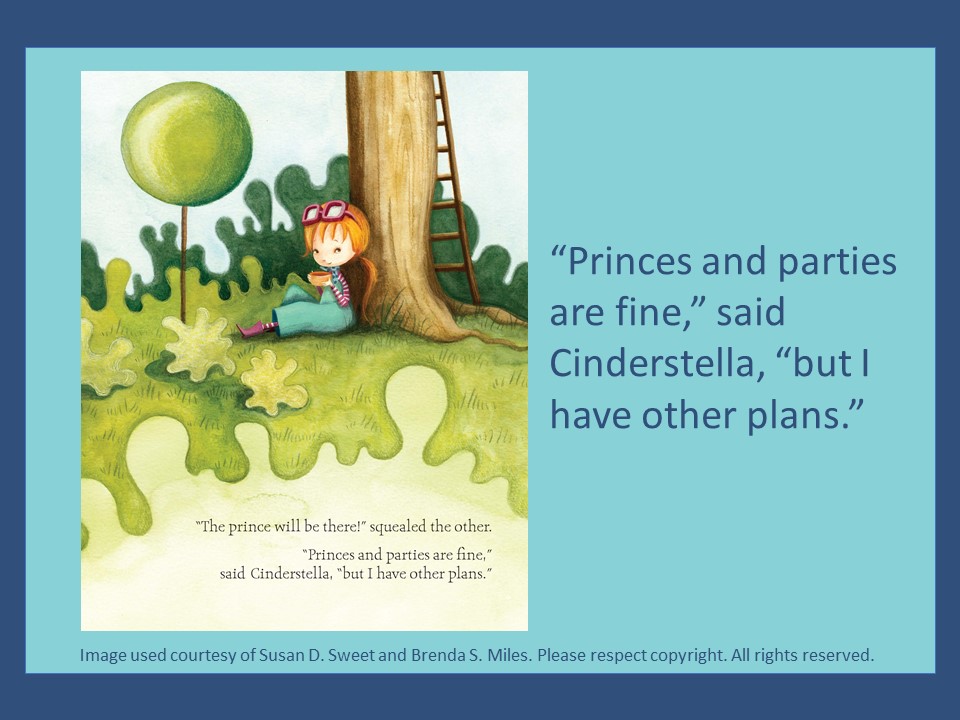
    princes and parties

    Cinderstella sees no prince in her happily ever after. She’d rather be an astronaut exploring space. Challenging the role of girls as portrayed in traditional fairy tales, Cinderstella determines to take control of her own destiny and be what she wants to be in a universe of unlimited possibilities. The story encourages girls, and boys, to take an interest in science, technology, engineering and mathematics (STEM) and break the limits imposed by gender stereotypes and biases.

    Continue reading: Introducing co-authors Brenda Miles and Susan Sweet – Readilearn