We wish you and your loved ones a very HappyNew Year!
May 2018 be filled with love, good health, peace and joy.
Thank you for your support throughout 2017. We hope the year has been kind to you, and look forward to 2018 with hopes of even better times.
For a little inspiration at the end of the year and to get you started on the right foot in the new year, here is a wonderful talk by an amazing educator, Rita Pierson. If you’re ever feeling a little unsure about the difference you can make to even one child’s life, listen to Rita – she’ll tell you how important you are.
If you are looking for activities to keep the children occupied during the holidays, check out the readilearn Christmas collection. Many are suitable for use at home as well as in the classroom.
Three free resources provide additional suggestions for keeping the children engaged in mathematical thinking, and reading and writing activities while they are having fun. Don’t let the year’s learning slide away during the holidays.
I loved the addition of the interactive whiteboard to my classroom about ten years ago. I embraced the use of computer technology from when I bought my first home computer in 1985 and first used computers in my classroom in 1986. The interactive whiteboard was a way of making use of the technology inclusive. Instead of one or two children taking a turn on the computer while the rest of the class were engaged in other things, we could all be involved at the same time, if desired.
I used the interactive whiteboard with the whole class for introducing topics, brainstorming ideas and explaining concepts. It was great for modelled writing lessons and collaborative reading. I found it particularly useful for demonstrating the processes to follow in the computer lab.
I used some purchased software, but also spent a lot of time creating activities to teach or practice particular concepts or skills. Versions of many of these lessons are now available here on readilearn.
I’m honoured to once again be featured among Sally Cronin’s Smorgasbord Archive Posts. This time it’s about including Christmas in the classroom. Thank you, Sally. 🙂
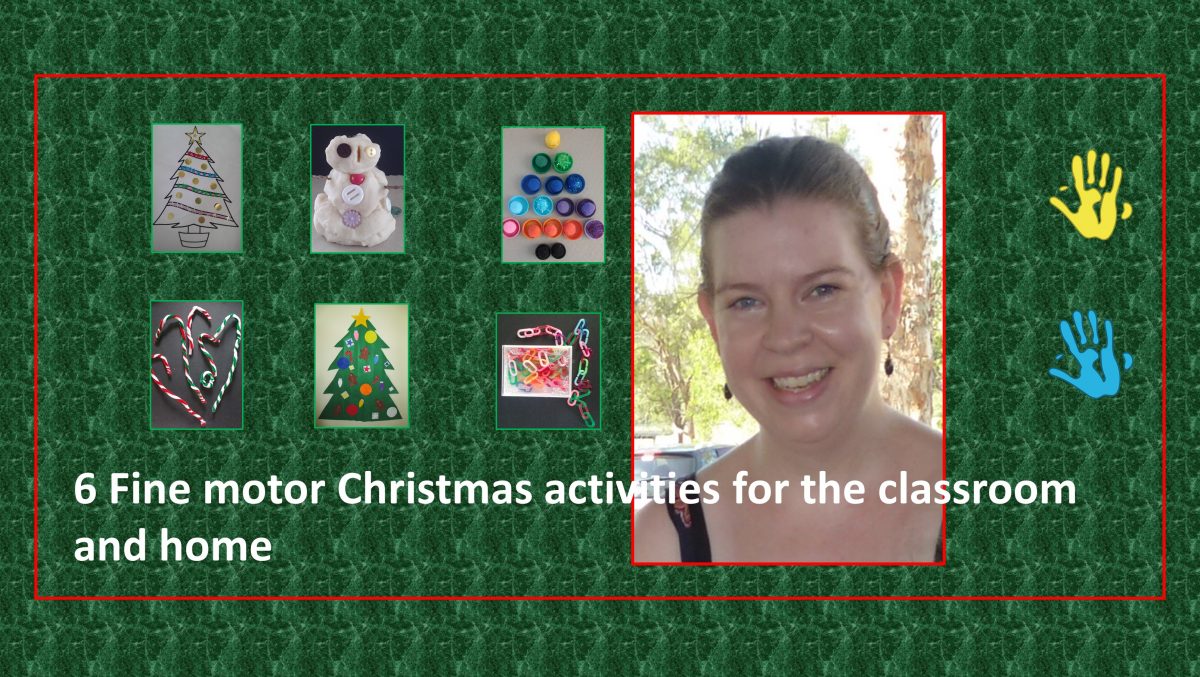
In this post, I welcome early childhood educator Johanna Clark to the blog with ideas for developing fine motor skills in fun Christmas activities that are suitable for both the classroom and home.
Johanna Clark is an early childhood educator, with a background in early primary teaching. She is passionate about developing children’s early literacy and fine-motor skills in the years before formal schooling begins to build a solid foundation for learning. She believes in creating a classroom that children love coming to every day, and that helps all children to succeed.
In her spare time, she can be found reading or crocheting (or both!). She also combines her teaching and creativity by designing handmade, educational toys for her small business and Etsy shop, ‘Jo and Co. Design’. She specialises in crochet dolls and felt travel games.
She has two small children who love testing out her new toy designs and raiding her picture book collection!
Over to you Johanna.
Whether December in your classroom means the end of the school year or the end of the calendar year, it’s always fun to work some Christmas-themed activities into the schedule. It’s a great way to discuss students’ own experiences and expose them to different ways of celebrating, both around the world or in their own community.
Fine motor skills are so important to develop, in pre-school settings, the first 3 years of schooling and beyond! They allow children to build their hand-eye coordination, concentration and finger/hand/arm muscles. All of these skills are needed for pencil grip, using scissors and other general life skills such as buttoning, zipping and using cutlery.
So why not combine fine-motor skills and Christmas?
Following are some ideas for Christmas themed fine motor activities that can be used both in the early years classroom and at home. Most are suitable for small groups or independent work and some can even be used to decorate your classroom and share the festive spirit!
The love of reading is one of the greatest gifts a parent can give a child.
Reading is empowering, and a book is a gift that continues to give, long after the occasion has past. It’s effects cannot always be measured.
To help you decide which books to give to whom for Christmas, I thought I’d make your task a little easier by reminding you of the lovely books I shared throughout the year in interviews with their authors and illustrators.
Below you will find a list the books and their authors and illustrators. I also include links to
the interview on the blog
the interview in the Author or Illustrator Spotlight
the creative’s website
a place where the book may be purchased.
Many of these authors and illustrators have more than one book, some for readers in other age groups, including adult, so please check out their websites for additional information.
At the conclusion of the post, I list other books read and enjoyed. Sadly, there’s just not enough time for all the interviews I’d love to do.
Of course, the list is not exhaustive. These are just a few suggestions to get you started. Enjoy!
I am very honoured to be invited to write a guest post for Christy Birmingham to feature on her lovely blog When Women Inspire.
I wrote about the inspirational female authors and illustrators I interviewed this year.
Please pop over to Christy’s blog to read the full post.
Today I proudly welcome educator and writer Norah Colvin here to guest post. I was delighted when she accepted my offer to visit and chat about some of the women she has highlighted on her website so far in their roles as writers and illustrators for children’s books. I hope you enjoy this post as much as I did upon receiving it. Norah, the floor is yours.
As December draws nigh, thoughts all over the world turn to celebrations of Christmas, a time for spreading joy through sharing acts of friendship and kindness to others.
Those of us in the Southern Hemisphere are also thinking about finalising the school year and taking a much-deserved long summer break.
Before we do, we look for ways of celebrating Christmas in the classroom while maintaining children’s focus and keeping them engaged in meaningful learning until the final moments of the school year.
While there are a variety of readilearn resources already existing to help you do that, this week I have uploaded four more, all of which support use of the popular interactive digital story Who’s hiding at Christmas?
The Who’s hiding at Christmas -template is a printable resource with both template and instructions for children to make their own Who’s Hiding at Christmas book based upon the original. Children love to share their own Who am I? puzzles, and, as well as providing ongoing practise with both reading and writing skills, the booklets make a lovely gift for sibling or parent.
Have you ever had that moment of inspiration when two ideas mesh and you know you’ve found the answer? I’m certain you have. It’s creativity. It’s energising. It’s like bubbles in a can, popping all over the place, bursting with exuberance, needing to express; and there’s no keeping it in.
Writing is like that for me. Writing or teaching. Writing and teaching!
Except for when it’s not.
I can think and think and think and struggle to find an idea. But as soon as the two (or more) right ideas come together, there’s an explosion, and I just can’t wait to get it down, or try it out.
It’s what I love about creating teaching resources. I think: how can I best explain this concept, what will children enjoy most, how will they best learn? Fizz! And I’ve just got to do it. I love the creative outlet. Without it, life’s just, well – dull.
I like to think that what I write is different; that my teaching resources differ from the millions of repetitive worksheets that are written to keep children busily unengaged in the learning process. I imagine myself using them, and having fun with my class. I like to think of other teachers using them to encourage children to think creatively, critically, logically, imaginatively, and learning through discussion with their teachers and peers. But do they? I like to think.
Do you hear that self-doubt? Like so many creatives, I find self-promotion difficult. I struggle to put my work out there for fear it might not be good enough. Each new step requires blinkered determination, focus, and practice, practice, practice to strengthen self- belief that wavers at the first hint of a breeze.
But did you see that? I called myself a creative. Should I? Do I have the right? I always say that one thing I loved about teaching was the opportunity it gave me to be creative. Though I may think I was creative, does my thinking allow me the label?
A few years ago, I gave myself some good talking-tos, took some deep breaths, and attended a writer’s group. Sure, they were the creative types – picture book writers and junior fiction writers. And me. Well, I was aspirational, but had a number of educational publications behind me and was working on my own collection of teaching resources.
In turn, around the circle, we were required to introduce ourselves to the group, sharing what writing we were working on. I could have said I was working on picture books and junior fiction. I have several stuck away in drawers for future development, many with rejection slips to prove I was aspiring. I’d been collecting rejection slips since long before many of these writers were born. I must admit that none of them were recent though, as I’d been more involved in other things, including educational writing.
When it was my turn, I took a deep breath, and stated that I was involved in educational writing at the moment. “Oh,” said the leader. “Educational writing. That’s so formulaic.” And she quickly turned to the next person. Well, if that didn’t burst my bubble. The confidence I’d struggled to muster to even attend the meeting was felled in one swoop.
Not only was she wrong, (well, I believe she was wrong), her attitude was wrong, and her response to an aspiring writer was wrong. She asked no questions, gave no opportunity to discuss why my work may be considered creative, or what other more creative writing I might engage in. She obviously considered I had no business being there among the “real” creatives.
Similar difficulties can be experienced by children in school. People are quick to judge, assess and dismiss on perceptions of background, ability and potential. It can be difficult to stay strong and persistent when the brush of other’s biases paints you inadequate. Without a strong framework and inner fortitude, the will may crack and crumble at the first sign of tension.
Surely, one purpose of education must be to build those strong foundations in order to avoid wreckage in the future. Just as for buildings, we start from the bottom, building on a strong base, adding more to each layer. There’s no starting at the top, or even the middle. Each new layer must mesh with the one before.
I immediately thought of the mesh that is embedded in concrete to give it inner strength, to hold it together when under pressure, to prevent it cracking and crumbling. What a great analogy for both personal core strength and a foundation of a great education. How could I resist?
Here’s my story. I hope you enjoy it.
Strong foundations
Jamie heard the vehicles; the doors slam; then men’s voices. He looked to his mum. She smiled and nodded. Dad was already there, giving instructions.
“Watch, but don’t get in the way,” he’d said.
Clara arrived, breathless. “What’s happenin’?”
“Carport. Pourin’ the slab,” he answered. “That’s the frame. Keeps it in shape.”
Beep. Beep. Beep. The concrete truck backed into position.
The men quickly spread the mix, then lifted the mesh into place.
“Makes it strong,” said Jamie.
Another load of mix was spread.
“All done,” said Jamie.
Later, in the sandpit, the children experimented with strengthening their structures.
Thank you for reading. I appreciate your feedback. Please share your thoughts.
P.S. If you are a teacher of children of about 5 to 7 years of age in their first three years of school, I’d love your feedback on readilearn, my collection of early childhood teaching resources. Please complete the survey here and share this post with other early childhood educators you know. I am keen to receive honest feedback about the site’s visual appeal and usability, as well as suitability of resources. Thank you. 🙂
This month it is my great pleasure to invite Kim Michelle Toft to the blog. I have been an admirer of Kim’s work for many years. Not only does she do the most marvellous and unique silk paintings to illustrate her work, her books inspire children, and adults, to share her passion for protecting the ocean and its inhabitants.
I have previously written about Kim’s work here, here and here. In this post I am talking with her about her innovation of the familiar Christmas carol The Twelve Days of Christmas.
Kim’s book The Twelve Underwater Days of Christmas is a celebration, not only of the season, but of the beauty of our world and its gift to us. Our gift in response is to care for and preserve it. As well as information about all the animals featured, it includes a stunning six-page foldout poster as well as information about the original carol.
Welcome to readilearn, Kim. We are looking forward to getting to know you better.
Thank you for having me.
Kim, you tell your stories with words and pictures? When did you know you wanted to be a storyteller and share your stories with others?
I started drawing when I was 4 years old. I would spend hours on my own, drawing. My mother would buy me small Golden Books and take me to see all the Walt Disney movies. I knew then that I wanted to have a career in art. I started writing and illustrating my picture books when my daughter Casey arrived, 26 years ago.
















 Norah Colvin