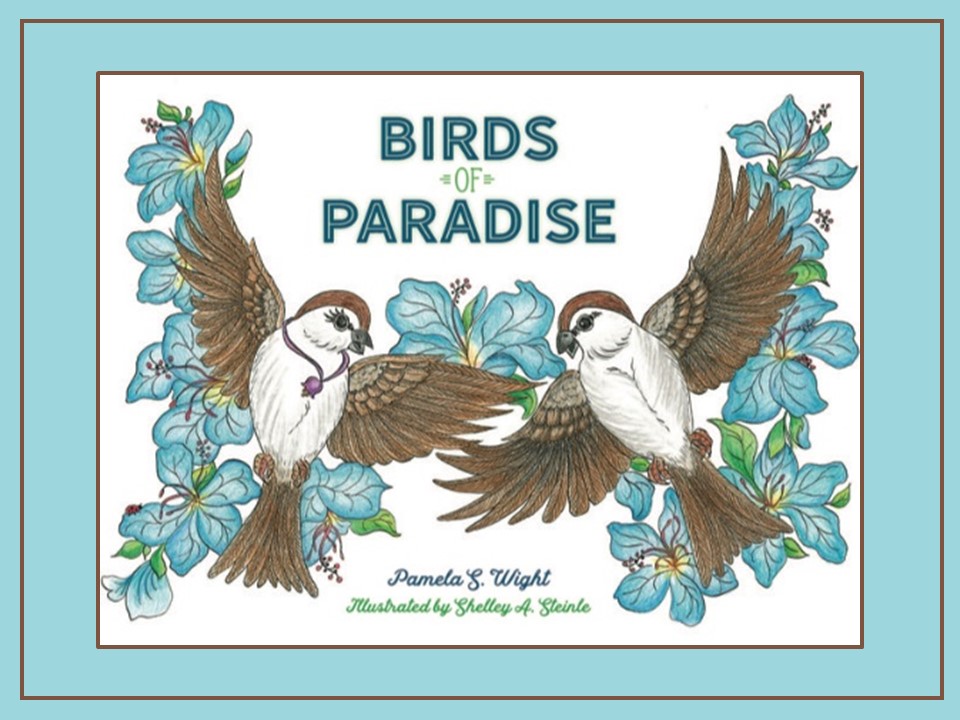
In the author spotlight this month is Pamela S. Wight, a fellow blogger, writer, and teacher of creative writing. I enjoy the stories of life Pamela shares on her blog Rough Wighting, and also enjoyed reading her adult novels. But it was the story of how this picture book Birds of Paradise came to be, a picture book 35 years in the making, that really captivated me. I knew I wanted to share it with you. Before we start talking about the book, though, let me introduce you to Pamela.
Pamela Wight has joined the ranks of authors who are, as she calls it humorously “bi-genre” or “ambi-writers.” Think of Ian Fleming, who yes, wrote the James Bond books, but also switched genres and wrote the children’s book Chitty Chitty Bang Bang. Before A.A. Milne wrote the Winnie-the-Pooh books, he penned a popular whodunit entitled The Red House Mystery.
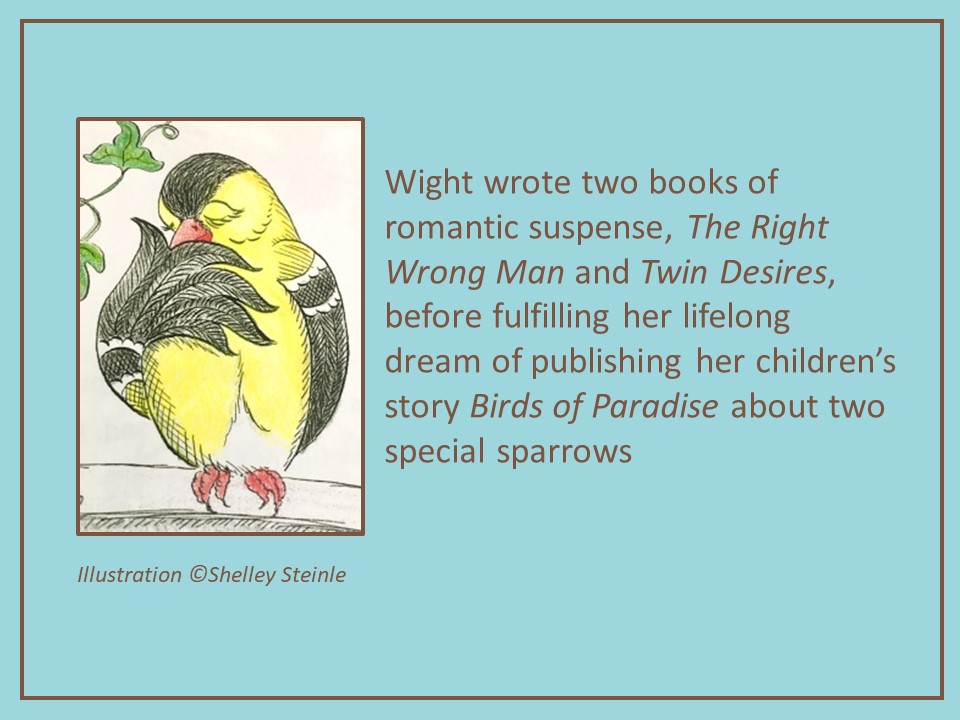
Wight wrote two books of romantic suspense, The Right Wrong Man and Twin Desires, before fulfilling her lifelong dream of publishing her children’s story Birds of Paradise about two special sparrows.
About the story:
Sweet sparrows Bessie and Bert grow up as differently as night and day. Bessie is fearful of the dangers inherent in being a bird. She’s scared to leave her cozy branch. But Bert relishes flying in the sky and
Making space for STEM in early childhood classrooms is easy; or should be.
Children are naturally curious about the world. They want to know:
Why is it so?
How does it work?
What will happen if?
How can I?
It is important to harness their curiosity, explore their questions, engage their interests and inspire their imaginations.
Provide them with opportunities to investigate objects and phenomena in the world around them. Don’t always be in a rush to provide answers to their questions. Help them explore ways of finding the answer for themselves, if possible, or conduct the research with them.
A story reported by Michael Rosen in his book Good Ideas: How to Be Your Child’s (and Your Own) Best Teacher inspires me. The story explains that, as a child, David Attenborough took an interest in bones. If he was out walking and found some bones, he would take them home and ask his father about them.
His father, who was a GP and would have known, didn’t just tell him. Wanting his son to be curious and interested in finding things out for himself, he responded, for example: “I wonder if we can work it out . . .” They would then look through books about zoology and anatomy and try to identify the bone’s origin.
However, the answers don’t always have to be found in a book or on the internet. Some answers can be discovered through explorations and experimentation. Experts can also be consulted.
In a stimulating early childhood classroom where children have access to a range of resources and opportunities
Usually at this time on a Tuesday evening (my time) I am posting a flash fiction response to the prompt by Charli Mills at the Carrot Ranch. But not tonight, and for good reason.
The usual weekly Carrot Ranch flash fiction prompt is on hold during the month of October, replaced by the Flash Fiction Rodeo which kicks off today. There are many prizes for both writers and readers. Check out the post for details of how you can win.
My contest runs first with a prompt about childhood ambitions. It will go live at the Ranch, and again here, on Thursday. I do hope you will join in.
You may have read my contribution to the We Are The World Blogfest with the story I posted on the weekend, #WATWB The Teacher Helping Hurricane Harvey’s Youngest Victims – And How You Can Help / A Mighty Girl | A Mighty Girl The story tells of a teacher from Texas who created the online Hurricane Harvey Book Club. The Club involves children recording videos of themselves reading books to share with children who, as a result of the devastation of Hurricane Harvey, have no access to books. Hundreds of videos were uploaded to Facebook, and the Club is also raising money to help restock classrooms devastated by the storm.
Hurricane Harvey was just the first. More was yet to come with Irma and Maria following close behind. Fellow Blogger and Rough Writer at the Carrot RanchSarah Brentyn, who blogs at Lemon Sharkhas extended a helping hand to those in need with her own flash fiction challenge #Flash4Storms.
For each flash fiction response to her prompt “Help”, Sarah will donate $1 to hurricane relief. Check out Sarah’s post to find out how you can join in and lend a helping hand. Let Sarah know in the comments that I sent you, and I’ll add another dollar to Sarah’s donation.
Here’s my response to Sarah’s challenge for a story of 50 words or less on the theme ‘Help’.
Kindness repaid
He was proud, never asking for or accepting help. If he couldn’t do it, it wasn’t worth doing. He’d always be first to help others though. Never too much trouble, there was little he couldn’t do. But, one day, when his world came tumbling down, they eagerly repaid his generosity.
Thank you for reading. I appreciate your feedback. Please share your thoughts.
On the last Friday of each month in the We Are The World Blogfest, bloggers post positive news items that demonstrate that “love, humanity, and brotherhood” still exist in a world where negative news items seem to proliferate. They encourage as many bloggers as possible to join in and share good news stories.
I’m a bit late joining in this week, but I wanted to ensure you heard this wonderful news about teachers and children helping out those affected by the recent devastating hurricanes – education of the heart.
Books, children, reading, children helping children, teachers, compassion, empathy. Great ingredients for a better world.
If you would like to join in, click Here to enter their link . As they say, “Bigger the #WATWB group each month, more the joy!”
This is the story I share with you as part of the Blogfest this month:
When Hurricane Harvey struck this week, second grade teacher Kathryn Butler Mills of Katy, Texas quickly learned how many of her students were affected. In photos on social media, she saw “several of my students, past and present, sitting under staircases, in bathrooms, and in pantries, waiting out tornado watches and warnings.” She wanted to find a way to “bring a little normal to them in very not normal circumstances.” After seeing a number of kids pictured with books in hand, she hit on the idea of creating an online boo
Logical thinking and problem solving are important skills for children of all ages to develop, including those in early childhood classrooms. We employ thinking skills each day, in many situations, from deciding the order in which to dress ourselves, complete simple tasks, collect items for dinner or set the table; through to more complex problems such as assembling furniture, writing work programs, juggling timetables, and organising class groupings for activities.
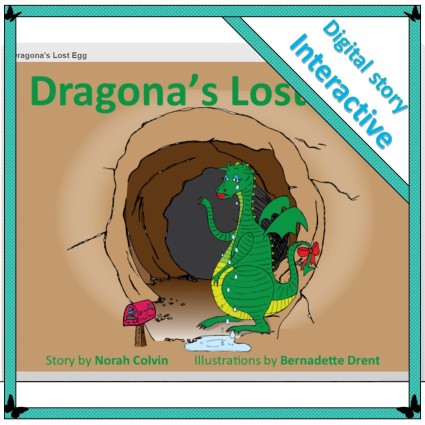
This week I am excited to upload a new interactive digital story that encourages children to use logical thinking to solve a problem.
Dragona has lost her egg and turns to her friend Artie, owner of a Lost and Found store, for help. Artie is confident of helping her as he has many eggs on his shelves. He asks Dragona to describe features of her egg, including size, shape, pattern and colour. He uses a process of elimination to identify which egg might be Dragona’s. Children join in the process by choosing eggs with the characteristic described.
What is Dragona’s egg really like, and will Artie be able to help her find it?
You’ll have to read the story to find out.
The process of writing this story also required a problem to be solved; and I love nothing better than a good problem to solve.
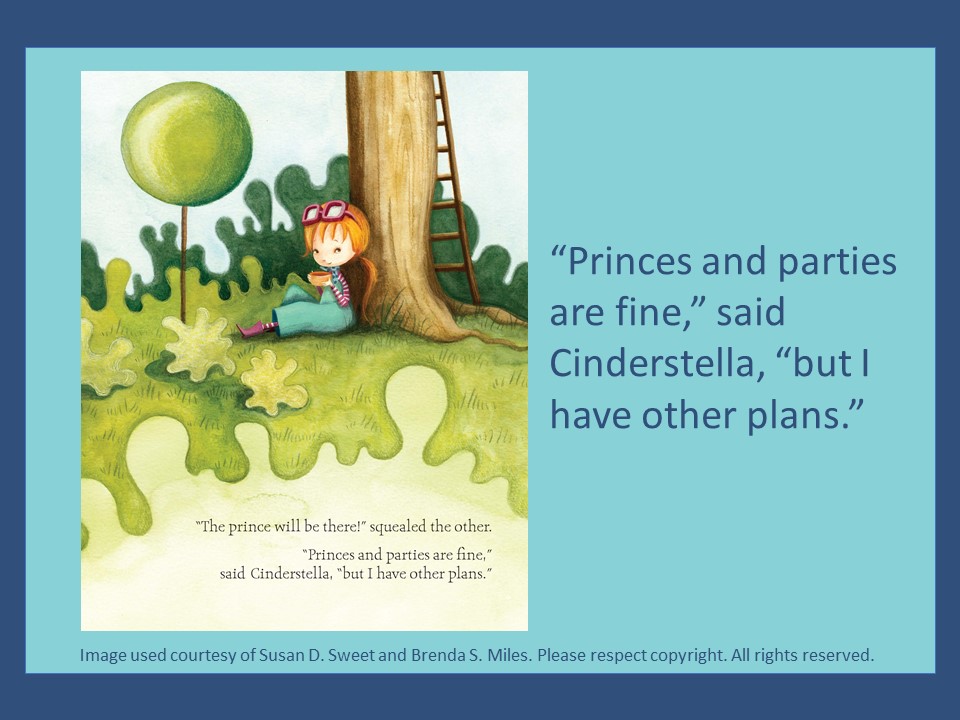
This month I have great pleasure in introducing you to two fine authors, Brenda S. Miles and Susan D. Sweet, who co-wrote the wonderful picture book Cinderstella: A Tale of Planets Not Princes.
With both World Space Week and International Day of the Girl Child just a few weeks away, I couldn’t think of a better book and authors to spotlight this month. This year’s theme for World Space Week is “Exploring new worlds and space”, and the theme for International Day of the Girl Child is “Girls’ Progress = Goals’ Progress: What Counts for Girls.”
Cinderstella sees no prince in her happily ever after. She’d rather be an astronaut exploring space. Challenging the role of girls as portrayed in traditional fairy tales, Cinderstella determines to take control of her own destiny and be what she wants to be in a universe of unlimited possibilities. The story encourages girls, and boys, to take an interest in science, technology, engineering and mathematics (STEM) and break the limits imposed by gender stereotypes and biases.
Next Friday 15 September is International Dot Day, a day for celebrating and promoting creativity, courage and collaboration.
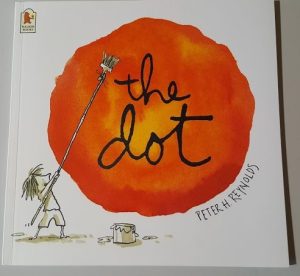
Celebration of the day was initiated in 2009 with teacher Terry Shay introducing his class to the picture book The Dot by Peter H. Reynolds.
The story is of Vashti and a teacher who encouraged her to make a mark and have a go. Lacking self-belief and courage, Vashti was reluctant to participate in art class. When the teacher framed and hung her signed painting of a tiny dot, Vashti was determined to do better. She painted all kinds of dots that wowed the people at the school art fair. What happened when one little boy admitted to Vashti that he wished he could draw will inspire children everywhere to be brave, have a go, and be creative.
For a wealth of celebratory suggestions, visit the International Dot Day Get Started page and sign up to download a free Educator’s Handbook, which includes a lovely certificate of participation which can be printed and personalised for each child.
I have included a link to the page in the new resource Getting creative with dots in which I suggest additional ideas to add to the celebration.
The suggestions, of which examples are shown below, can be used in conjunction with International Dot Day, or any day when you feel like going a little dotty.
We sometimes think of reading as a form of escapism. But many stories, including those in picture books, feature an escape as part of the complication or resolution.
It doesn’t require much thought to create a list. Here are just a few to start:
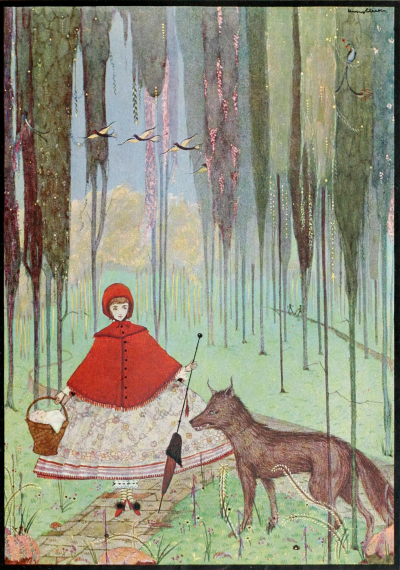
#6 Traditional stories
By Charles Perrault, Harry Clarke (ill.) [Public domain], via Wikimedia CommonsJack and the Beanstalk– Jack escapes from the giant
Hansel and Gretel – the children escape from the witch
Snow White– escapes death ordered by the jealous queen
The Three Pigs – escape from the Big Bad Wolf
The Lion and the Mouse – the mouse helps the lion escape the hunter’s trap
The Gingerbread Man – escapes from the oven and those who pursue him
I had a little more difficulty in finding modern tales involving an escape, but here are a few:
#6 Modern tales
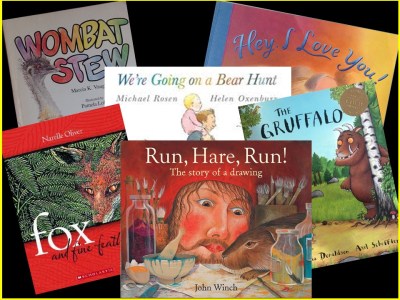
Hey, I Love You!by Ian Whybrow – father and son mouse escape the claws of the cat
The Gruffalo by Julia Donaldson – the mouse uses his wiles to escape being eaten
Wombat Stew by Marcia Vaughan – Wombat’s friends help him escape being Dingo’s dinner
Fox and Fine Feathers by Narelle Oliver – with the help of the nightjar the birds escape being a feast for fox
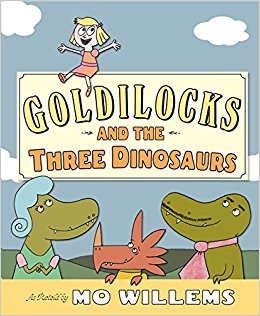
This Mo Willems story is an innovation on the traditional tale of Goldilocks escaping from the three bears. In Goldilocks and the Three Dinosaurs, Goldilocks has a lucky escape out the back door just as the dinosaurs return home through the front door. Willems concludes his story with two morals, one for the dinosaurs:
Lock the back door!
And one for Goldilocks:
If you ever find yourself in the wrong story: leave.
What a great philosophy that we could perhaps employ more often. If we don’t like where we’re at, just leave. Life’s decisions are not always that easy though.
I rather like the idea of characters appearing in the wrong story. What a great topic for discussion with children and a wonderful stimulus for their writing.
What if the Big Bad Wolf knocked on the Giant’s door?
What if the Three Pigs chased the Gingerbread Man?
What if Goldilocks came to the house of Red Riding Hood’s grandma?
What if?
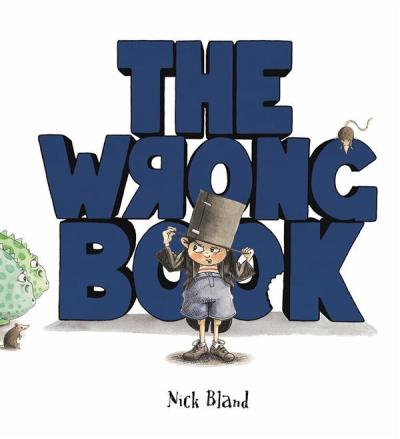
In fact, Nick Bland has written a story that utilises this concept. In The Wrong Book, Nicholas Ickle tries to tell his story but keeps getting interrupted by other characters such as an elephant, monsters, a queen and a pirate. Nicholas tells them that they are in the wrong book and to go away. By the time they leave, we get to the end of the book and there is no time for him to tell his story.
But what if the story characters didn’t want to be in the book at all, and decide to escape? How would they escape? What would the writers do if their characters revolted and walked off the job?
Where could I escape to if not picture books? Here’s my contribution. I hope you like it.
Let’s get out of here
Delaying the inevitable, she was picking wildflowers when she heard sobbing. She gasped to see him cowering behind the bushes but ignored instructions to avoid strangers.
“What’s wrong?”
“I can’t do it anymore. Every day: first the pigs; then your grandma. They’ve painted me bad. I’m not. I’m –“
A giant with a goose crash-landed beside them.
“I’ll not let that nasty boy steal my goose, again. And he says I’m bad.”
A diverse troupe in T-shirts emblazoned “Freedom for princesses” appeared.
“We want out,” they all chanted.
A witch magicked a rocket from a pinecone and everyone disappeared.
Thank you for reading. I appreciate your feedback. Please share your thoughts.
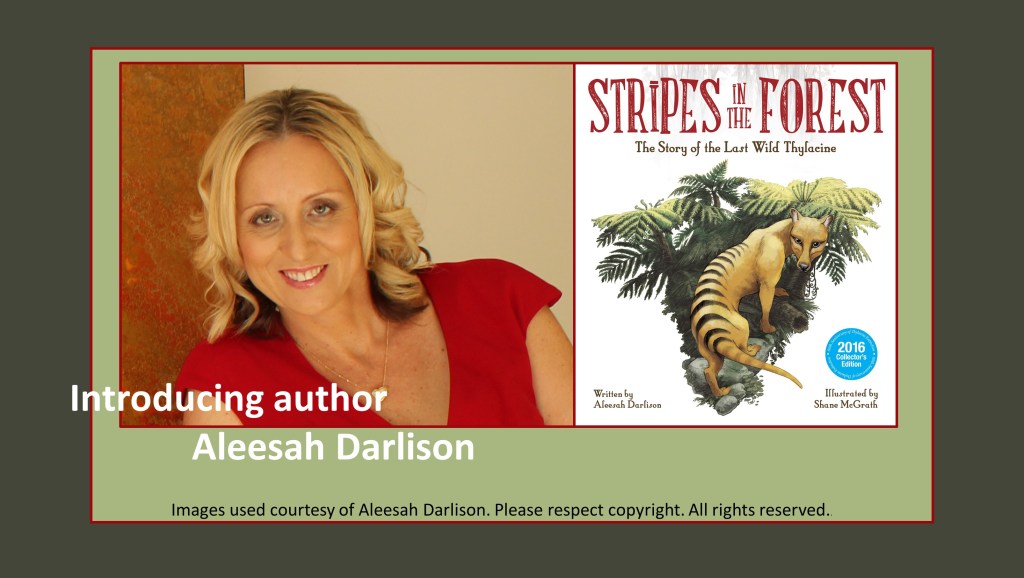
This month, it is my pleasure to introduce you to award-winning Australian author Aleesah Darlison. Aleesah writes picture books, chapter books and novels. Her much-loved stories promote courage, understanding, anti-bullying, self-belief, teamwork and environmental themes. In 2015, she won the Environment Award for Children’s Literature (Non-Fiction) for her picture book, Our Class Tiger. She has won numerous other awards for her writing.
Aleesah has written over thirty-five books for children and in 2016, she set up Greenleaf Press, a business designed to provide critical support services to authors and illustrators. The company also acts as a booking agency for school and preschool visits.
Today, Aleesah and I are talking about her picture book Stripes in the Forest. With National Threatened Species Day just a couple of weeks away on 7 September, it is a timely interview. Stripes in the Forest is the story of an iconic species lost.
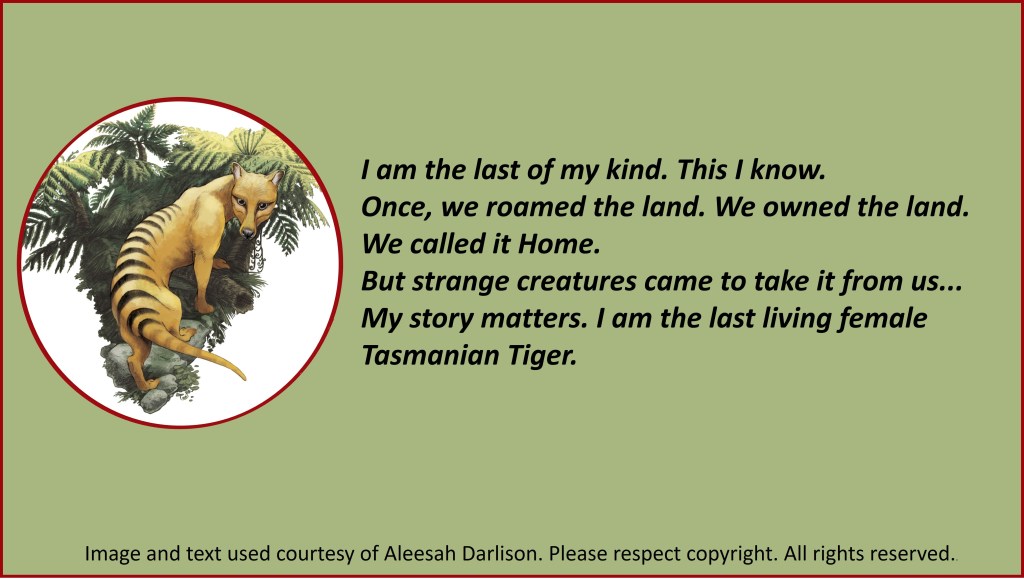
Told from the perspective of the last wild female thylacine, it provides readers with an insight into the rare beauty and uniqueness of these amazing animals, explains their fight for survival and provides important lessons for future generations.
An emotive and moving story, children will connect with the solitary, stoic and courageous female thylacine who does all she can to protect her young – just as a human mother would do. The story takes readers to a place in the past, but also offers a twist that projects them









 Norah Colvin