Live Love Laugh Learn … Create the possibilities

Category: Self esteem

  • But I want it now! How long can you wait? The importance of emotional intelligence

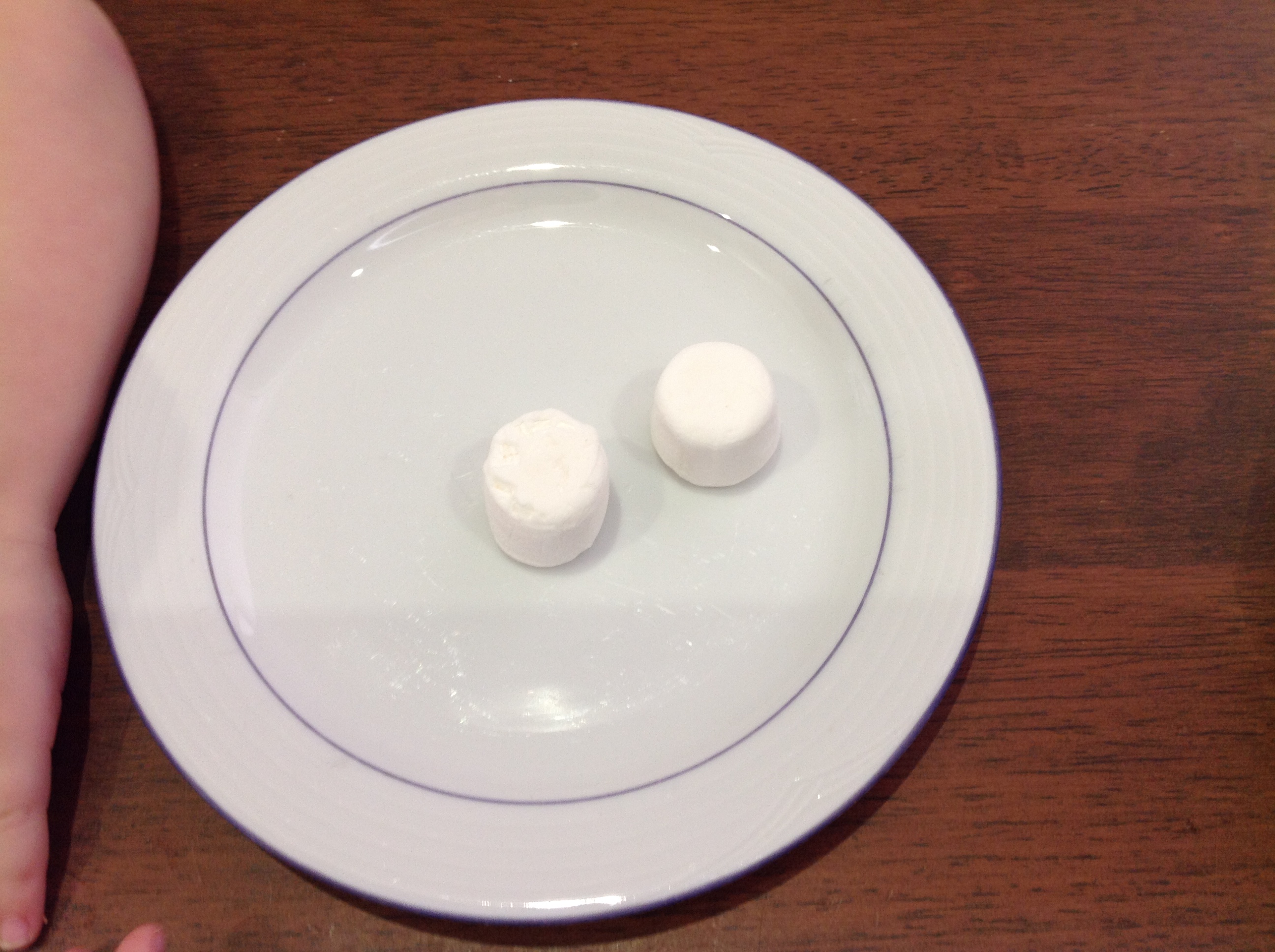
    marshmallow 5

    In my previous post Life: a choose your own adventure – how do you choose I discussed the difficulties we may experience in prioritising options and choices, and the need to be self-regulatory in performing tasks and achieving goals.

    The discussion reminded me of the marshmallow test I had heard about from Daniel Goleman in his book “Emotional Intelligence”.

    The marshmallow test was a study conducted in the 1960s by Walter Mischel .

    As described by Daniel Goleman, In this experiment four-year-olds from the Stanford University pre-school were brought to a room and sat in a chair in front of a juicy marshmallow on a table. The experimenter then told them they could eat it now, or get two if they were willing to wait until the experimenter came back from running an errand.

    You can watch a video demonstrating the experiment here:

    Some children could not wait and ate the marshmallow as soon as the examiner left the room. Others toyed with the idea of waiting, but were unable to resist the temptation. Others were able to wait and scored two marshmallows when the examiner returned.

    While this study revealed certain aspects of childhood behaviour, follow-up studies into the behaviour of these children when young adults and graduating from high school revealed that Those who waited, compared to those who grabbed, were more popular with their peers, had less trouble delaying gratification, and scored far higher on achievement tests.”

    A further study, conducted 40 years later, as reported by Sylvia R. Karasu writing for Psychology Today, found that the ability to resist temptation is fairly stable over the lifecycle and predictive of behaviors 40 years later!

    Goleman talks about the important role of parents in supporting children to develop the ability to control impulses and choose behaviour. As children learn to internalise and choose the ‘no’ imposed by others, they learn to regulate impulsive behaviour. He calls it the ‘free won’t’, the capacity to squelch an impulse.”

    Karasu supports this by saying that “The researchers also suggested that a family environment where self-imposed delay” is “encouraged and modeled” may give children “a distinct advantage” to deal with frustrations throughout life.”

    Goleman says that the ability to curb dangerous impulses is an aspect of emotional intelligence, “which refers to how you handle your own feelings, how well you empathize and get along with other people. (He says it) is just a key human skill.”

    He continues by saying that “it also turns out that kids who are better able to manage their emotions . . .  can pay attention better, take in information better, and remember better. In other words, it helps you learn better.”

    It sounds like emotional intelligence is something that all schools should be developing, don’t you think?

    www.openclipart.org http://goo.gl/XhPCyE
    http://www.openclipart.org http://goo.gl/XhPCyE

    Goleman says that the ability to delay gratification hinges on a cognitive skill: concentrating on the good feelings that will come from achieving a goal, and so ignoring tempting distractions. That ability also lets us keep going toward that goal despite frustrations, setbacks, and obstacles.”

    Without that ability it may be difficult for any of us to achieve our goals. Saving for the future, studying towards a qualification, working harder now to have time off later; none of these would be possible without the ability to delay gratification.

    But can emotional intelligence be taught? And should it be taught in schools?

    It seems to me that if emotional intelligence is able to predict “success” in later life, then it is important to develop it as early as possible. This can begin in the home with parents helping their children learn to delay gratification, build resilience and develop empathy.

    I believe it is important to make a place for programs that develop emotional intelligence in schools. Children need opportunities to internalise emotionally intelligent responses to a variety of situations. A very structured, force-fed, content driven, test based approach where almost every action is directed and monitored leaves little room for students to develop skills of self-regulation.

    Discussions of whether emotional intelligence can, or importantly should, be taught in schools can be read here and here. The theory is that children can no more “pick up” emotional intelligence than they can “pick up” maths or English. To leave it to chance seems to be denying our children the opportunity to develop skills that will help them lead happy and successful lives.

    What do you think? Would you have one marshmallow now, or double it later?

    1 marshmallow      marshmallow 2

    Please share your ideas.


    You can read more of Daniel Goleman’s work at Edutopia, and hear his talks and conversations at More Than Sound.


    If you enjoyed this post, you may enjoy others. Please click the button at the top on the right to receive future posts by email.


  • Empowerment – the importance of having a voice

    In a previous series of posts I wrote about science inaccuracies in a picture book and questioned with whom lay the responsibility for providing young children with correct information.

    While this post builds upon those posts, it also takes a divergent path: the need for children to have a voice; to be empowered to ask questions, to state their needs and report wrongdoings.

    On a highly respected educational website Scholastic, with the by-line “Read Every Day. Lead a Better Life.”, in an article about Eric Carle author of The Very Hungry Caterpillar, children are told that

    “Eric already knows that a caterpillar emerges from a chrysalis, not a cocoon! So don’t bother writing to tell him.”

    This seemingly innocuous statement may be easily overlooked but packs a powerful message.

    What does it tell children?

    The author has been told many times, already knows and isn’t going to do anything about it.

    The author is tired of being told he is wrong and doesn’t want to hear it any more.

    The author is “right” and not to be questioned. (The book, with its misinformation, is highly acclaimed by millions around the world. However if, in answering a question on a test, children were to write that a butterfly comes out of a cocoon, they would be marked wrong. Explain that to them.)

    For me the most insidious part of this message is

    He already knows, “so don’t bother writing to tell him”!!!!!!!!

    You can’t change it.

    You know it’s wrong, but you can’t change it, so don’t bother trying.

    Although many societies are now moving to eradicate it, child abuse is still far too common worldwide. Not only must the attitudes of societies change, but children must be empowered, they must be encouraged to speak up and they must be listened to: their voices must be heard.

    In a recent child abuse case that occurred at a Queensland primary school, the student protection officer reportedly said that she couldn’t understand why the children who had been sexually abused did not come forward.

    couldn't believe 1

    The accused had continued in his role as child protection contact for a year after the first complaint was made. The student protection officer found it hard to believe that her colleague was a paedophile;

    couldn't believe 2

    and still she says she doesn’t understand why the children didn’t come forward!

    Click here to read the complete article.

    It seems to me the children did come forward if the first (indicates there were more) complaint was made more than a year before anything was done about it.

    The children tried to say, but were not believed. The predator was believed and protected while the plight of the innocent victims was ignored. The report states that parents who complained about the abuse of their children were ostracised by the school community and made out to be the “bad guys”.

    Is it any wonder that, if not listened to and not believed, and if more is done to protect the offenders than the abused, the children become increasingly reluctant to tell?

    After the first children had come forward and not been listened to or believed, may not they have said to others, “There’s no point in saying. They already know. They won’t do anything about it?”

    Or what about the parents who were ostracised and made out to be the bad ones?

    Doesn’t it make the message very clear – you are powerless. Your voice won’t be heard. Your opinion doesn’t matter.

    Carry this message over into countless other situations and you have a population who is afraid to speak up, fearing the disdain of reproach, the embarrassment of being unvalued and the helplessness of one’s message being unheard.

    How many times have you felt you must remain silent for fear of ridicule, rejection, or worse?

    How many opportunities for creating a positive change have been missed because the task seemed insurmountable or the personal repercussions too unpleasant?

    When have you stepped up and made that change happen because you were not afraid to speak up or speak out when faced with an issue you felt strongly about?

    What changes can we make to empower children (and adults) everywhere?

    By the way, in that article on the Scholastic website, it is reported that Eric Carle believes that “the most important part of developing a book . . .is working with editors to revise it.”

    Would it make any difference to the magic of The Very Hungry Caterpillar if, after all these years, Eric Carle rewrote a corrected version with a butterfly emerging triumphantly from a chrysalis?

    What would that act tell all the countless children who have written to tell Eric about his mistake, and the many others who wanted to but were told there was no point?

    The Very Hungry Caterpillar

    Please share your thoughts.

    Related posts:

    Searching for meaning in a picture book — Part A

    Searching for purpose in a picture book – Part B

    Searching for truth in a picture book – Part C

    Finding power in a picture book – the main event

  • “You say it long enough, it starts to be a part of you.” (Rita Pierson)

    Affirmation, encouragement, praise . . .  

    “You say it long enough, it starts to be a part of you.”

    Recently I came across this great TED talk by Rita Pierson “Every kid needs a champion”.

    Rita’s entire life centred around education. Her parents and her mother’s parents were teachers, and she was a teacher.

    She observed numerous teachers at work – some of the best and some of the worst – and believed that relationships are the key to learning.

    She said that

     “kids don’t learn from people they don’t like.”

    Rita spoke about having classes of students whose academic level was so low she wondered how she could “raise the self-esteem of a child and his academic achievement at the same time”.

    One year she told her students

    “You were chosen to be in my class because I am the best teacher and you are the best students, they put us together so we could show everybody else how to do it.”

    Affirmation, encouragement, praise . . .

    She talked about giving a student a +2 with a smiley face for getting 2 out 20 questions correct. She encouraged the student by saying

    “you’re on a roll . . . and when we review this, won’t you do better?”

    The student agreed “I can do better”.

    Affirmation, encouragement, praise . . .

    Rita told of her mother’s past students expressing their gratitude for the difference she made in their lives, saying

    “You made me feel like I was somebody, when I knew, at the bottom, I wasn’t. And I want you to just see what I’ve become.”

    Affirmation, encouragement, praise . . .

    She tells us that teachers won’t always like all the children they teach, but it’s important that the children never know it. Acting is part of the role description!

    She says that

    “Teaching and learning should bring joy. How powerful would our world be if we had kids who were not afraid to take risks, who were not afraid to think, and who had a champion? Every child deserves a champion, an adult who will never give up on them, who understands the power of connection, and insists that they become the best that they can possibly be.”

    Affirmation, encouragement, praise . . .  

    Go ahead and listen to this inspirational talk. It will take less than 8 minutes listening time but its effect will be more lasting. It has already had more than 2 600 000 views. Why not add one more to the total. I’m certain you won’t regret it.

    I can find nothing to dispute in Rita’s talk. I’d like to underline every word and make it compulsory viewing for all aspiring and practising educators in any field.

    Affirmation, encouragement, praise . . .  helpful or harmful?

    What do you think?  Please share your thoughts below.

    Refer to these previous posts for discussions on self-esteem, affirmations and praise:

    Happy being me

    Affirmations: How good are they?

    Seeking praise – Stephen Grosz revisited

    Examining praise: Stephen Grosz – the third instalment (guest post by Anne Goodwin)

    I came across this talk on a great educational website edutopia. It was included in a Five-Minute Film Festival: Videos on Kindness, Empathy, and Connection. Check the others out. You may find something else to inspire you.

    Sadly Rita Pierson passed away in June 2013. I’m grateful that we may continue to share the strength of her wisdom through her appearance with TED.

    Click here to find out more about Rita and to read a tribute posted by Tedstaff.

    “You say it long enough, it starts to be a part of you.” (Rita Pierson)

    Let’s make sure it’s the good stuff that learners everywhere are hearing!

  • Examining praise: Stephen Grosz – the third instalment!

    Guest post by Anne Goodwin (Annethology)

    Earlier this year, after reading 7 Reasons Why Lovers of Fiction Should Read The Examined Life by Stephen Grosz on Anne Goodwin’s writing blog, I decided the book sounded too good to resist and promptly listened to it as an audiobook on my commute to and from work.

    I was delighted with Anne’s recommendation, and like her, found the book compelling reading and thought provoking. So much so that I wrote a post about it: A book worth reading: Stephen Grosz “The Examined Life”.

    However the chapter that captured my attention and challenged my thinking more than any other was the one about praise. I also blogged about this: Seeking praise: Stephen Grosz revisited.

    My post about praise got Anne Goodwin thinking further about this issue and she was able to delve into it more deeply with her background in psychology. She has very generously written this guest post to share her thoughts.

    Thanks Anne – over to you:

    Although I was enchanted by The Examined Life from the first page, I glossed over the chapter on praise. Reading primarily for the parallels between these therapeutic case studies and reading and writing fiction, I didn’t stop to analyse my reaction, to acknowledge I was challenged by the suggestion that praise could be detrimental. Perhaps I dismissed this chapter as a reaction to the rarefied atmosphere of that cosy part of North London that is the hub of British psychoanalysis. In my neck of the woods, as reflected in my flash fiction piece, Peace-and-Quiet Pancake, I’m more concerned about a shortage of praise and encouragement than an excess.

    I was initially disappointed when Norah mentioned on Twitter that, with over thirty chapters to choose from, she’d decided to blog about the chapter on praise. Yet her wonderful post showed me what I’d missed in my initial (defensive) reading and inspired me to go back to the book and ponder the depths of wisdom within those four and a half pages for myself.

    “Stephen Grosz calls into question where our ideas of good practice originate.”

    In suggesting we rethink what’s best for our children, Stephen Grosz calls into question where our ideas of good practice originate. We tend to respond to the mistakes of our forebears by striving to do the opposite, so those of us who suffered from a dearth of praise ourselves might be inclined to lavish praise on the next generation. Yet we can become so fixated on turning our backs on the approaches we know from experience to be unhelpful, we’re blinded to the potential pitfalls of the alternative path. Cutting back on praise feels treacherous, like siding with the harsh disciplinarians of days gone by. Stephen Grosz points us towards a third way.

    “Behavioural strategies are invaluable for introducing the necessary structures and routines in which children can prosper and learn.”

    Behavioural psychology shows that targeted rewards, either tangible, or intangible like praise, increase the frequency of desired behaviours. Rewards are actually most effective when they’re doled out intermittently, which might be one argument (although not the author’s) for soft-pedalling on the praise. Behavioural strategies are invaluable for introducing the necessary structures and routines in which children can prosper and learn. However, they can also result in the over-controlled and compliant child, one who is well versed in pleasing adults but struggles to think for him or herself.

    “Stephen Grosz suggests that parents and educators can become as addicted to praise as these children.”

    Stephen Grosz suggests that parents and educators can become as addicted to praise as these children. The mother who continually tells her child she is good might be vicariously praising herself. Underlying this might be a lack of confidence in her own parenting skills and a difficulty accepting her child as a separate person, with potentially different values and preferences. This is unlikely to enhance the child’s confidence and self-esteem.

    “He also cautions us to be wary of praising children for what they are rather than for what they do.”

    He also cautions us to be wary of praising children for what they are rather than for what they do. He cites a study in which, consistent with attribution theory, children praised for their effort rather than their intelligence, developed a more positive approach to problem solving. We can always put in more effort, but if we believe success is down to stable and unchangeable factors we might be less resilient in the face of the failure we will all, however talented, meet at some point in our lives.

    “a third position where the adult is benignly attentive to the child and curious about what he/she is doing.”

    What the author recommends is not a return to a pedagogy of threat and punishment, but a third position where the adult is benignly attentive to the child and curious about what he/she is doing. The child who believes that an adult is genuinely interested in their ideas, thoughts and feelings, is likely to develop a strong sense of agency and self-worth. While this might seem a radical approach, it’s not dissimilar to the behaviour of a tuned-in mother who watches over and mirrors her baby’s moves. It’s also the stance taken by the psychoanalytically orientated psychotherapist.

    This is familiar ground for me, but I didn’t recognise it on an initial reading. Having already decided I loved the book from hearing snippets on the radio, I was reading it for what I could praise. I hope it wasn’t empty praise, but I was unwilling to engage with parts that were hard to swallow. On the second reading, my stance flipped to critical, almost punitive, focusing more on what was missing from the chapter than what was actually there. Now this process of putting my thoughts into words has brought me towards the position of curiosity and attentiveness I wish I’d had first time round. Whilst other readers might be less defensive, it does make me wonder, if it’s a struggle to reach this position in relation to a text, how difficult might it be to apply this learning in the real world and on a larger scale?

    “While parents, politicians and educationalists might all claim to value individual expression and personal growth, this has to be weighed against an equally strong pressure for the achievement of standardised performance goals.”

    On a sociopolitical level, we might resist this understanding because of conflicting views as to what education is for. While parents, politicians and educationalists might all claim to value individual expression and personal growth, this has to be weighed against an equally strong pressure for the achievement of standardised performance goals.

    On the individual level, as Stephen Grosz says in his final paragraph, being present with others is hard work. Therapists have their own therapy in addition to training and supervision; parents striving to do a similar job with only their experience of their own parenting to draw on could struggle to find the position of attentiveness beyond both praise and chastisement.

    “Children who have never been praised, even for attributes outside their control, might have no concept of their own ability to impact on their environment.”

    Furthermore, for the child entering school knowing only neglect and criticism, a teacher’s benign curiosity could be experienced as threatening, just as the neutrality of therapist can provoke anxiety in his or her client. Children who have never been praised, even for attributes outside their control, might have no concept of their own ability to impact on their environment. Does the busy classroom teacher have the resources to be truly present with them in the way they require?

    Thanks, Norah, for challenging me to revisit this chapter and for the invitation to rework my comment into a guest post. For those who’ve had the patience to stay present this far, I look forward to your reactions.

    Thank you Anne for the insight and challenge you have offered with much for us to think about.

    I reiterate Anne’s invitation for you, the reader, to share your thoughts on this topic, and suggest you head on over to Anne Goodwin’s writing blog (Annethology) for a great assortment of interesting fare.

  • Seeking praise – Stephen Grosz revisited

    Praise may be defined as an expression of approval or admiration.

    Who wouldn’t want that?

    If you write a blog, don’t you love it when others “like” a post, leave a positive comment, re-blog your article or link to it via theirs? I do. Aren’t these all expressions of approval or admiration?

    What about on Twitter when someone Re-tweets, favourites or replies positively to your comment, engaging you in conversation?

    Aren’t these also expressions of approval or admiration?

    I love to receive all these signs of encouragement and support that let me know that my efforts are appreciated and confirm that I am on the right track. If I did not receive any of this feedback I would feel quite isolated and consider my efforts to be fruitless and a waste of time. I would probably just give up.

    As a teacher I have always considered it of primary importance to create a happy and welcoming classroom environment in which children feel valued, affirmed and supported. Expressions of approval and admiration for behaviour, effort and achievement were generously given with the aim of encouraging the desired response, a happy child being foremost. I have written about this in previous posts, including:

    Happy being me

    Affirmations: How good are they?

    As a parent too I considered it important to affirm my children and display my approval and admiration for them. I still do, even now they are adults. The need for approval never ends. I know sometimes you just have to go out there and say what you know is right, even though others will disagree or ridicule you. I am not talking about those instances here.

    My strong belief in the power of affirmations and approval stems partly from the dearth of them in my childhood and school days. I have also mentioned this in a previous post: 

    Mouthing the words – the golem effect

    Recently I listened to a fabulous (audio)book, “The Examined Life: How We Lose and Find Ourselves” by Stephen Grosz. I wrote about it in my previous post A book worth reading: Stephen Grosz “The Examined Life” saying that

    “What appeals to a reader about a book, or what a reader takes away from a book is as individual and personal as the reader. What is of most significant to one, may be of lesser importance, or even insignificant to another. “

    For me the chapter of most significance is chapter 3 “How praise can cause a loss of competence”.

    To say I was startled by the title would be an understatement. I was puzzled, intrigued and challenged. How could praise cause a loss of competence? Surely negative feedback or a lack of encouragement altogether would be major contributors to diminishing competence. Was everything I had believed and practiced wrong? (Oh no –there’s my need for approval and affirmation!)

    Grosz says that during the past decade studies into self-esteem have found that praising a child as “clever” may not only inhibit school achievement, it may cause under performance. He suggests children may react to praise by quitting. Why would you try to improve or do something new if you have already done something really well or are the “best”?

    Studies showed that children who were praised for effort, rather than for being clever, were more willing to try new approaches and were more resilient. Children who were praised for being clever, tended to worry more about failure and chose unchallenging tasks, tasks they knew they could achieve or had already achieved. Being told they were clever led to a loss in self-esteem and motivation and to increased anxiety. Some children who had been praised for being clever (rather than working hard), when confronted with a more difficult task and asked to comment on it, were so unhappy with the results they lied about them, exaggerating their achievements to others.

    Grosz questions whether we may lavish praise on our children nowadays in order to demonstrate that we are different from our parents who possibly used criticism, rather than praise, on us. I hinted at something similar earlier in this article.

    While admiring our children with words like “Good boy” or “Good girl” may temporarily lift our self-esteem by showing others what wonderful parents we are or how wonderful our children are, Grosz says, it isn’t doing much for a child’s sense of self. He says that in trying to be different from our parents we end up doing the same thing: doling out empty praise where an earlier generation doled out thoughtless criticism.

    Grosz says that if we offer this empty praise without thinking about the child’s individuality and needs we are effectively showing the child indifference.

    So what do we do?

    I think the emphasis here is on the empty praise. I think support, encouragement and positive feedback are all essential. Sure, knowing in yourself that you have done well is fine but a little recognition certainly helps too. I think the difference is in recognizing what has been achieved, the learning or progress made, and the effort it took, the message communicated in a story or painting and the techniques used; not a hollow “Well done”, “Good work” or “Good boy” but “Tell be about . . .”, “Why do you think that?” “How did you work it out?” “I like the way you . . .”

    As Grosz says, this is being attentive to the child, to what the child has done and how it has been done.

    To read more on this topic:

    Sian Griffiths interviewed Stephen Grosz and reported on the interview in the article “Praise her . . . and see her fail” which adds even more clarity to my precis above.

    Maria Popova delves into the messages of this same chapter in her article “Presence, Not Praise: How to Cultivate a Healthy Relationship with Achievement

    Being attentive, being present, being really with someone, noticing what they have done and how they have done it – is it more precious than praise?

    In these days of constant distractions and must-dos to put all aside to be in the present with the child, friend or partner to talk, listen share and laugh, what better affirmation is there than that?

    What do you think?

    How has praise encouraged or discouraged you?   When has criticism hindered you?

    I’d love to hear your thoughts.

  • Mouthing the words – the golem effect

    Mouthing the words – the golem effect

    Singing is a wonderful gift. To be able to entertain oneself and others with no instrument other than one’s voice must give enormous pleasure.

    But I can only imagine the joy it must bring, for I am no singer.

    When I was at school and we were all lined up and squished in on the stairs performing for parents in our end-of-year concerts, I was told to mouth the words.

    www.openclipart.org
    http://www.openclipart.org

    Unlike the recommendation in the song written by Joe Raposo for Sesame Street and made famous by the Carpenters “Sing a Song

    “Don´t worry that it´s not good enough for anyone else to hear.
    Just sing.
    Sing a song.”

    I was told to not sing, for it was not good enough for anyone else to hear. I accepted the verdict without question, as was expected of us at school, and mouthed the words.

    Of course, my school days were long over before Joe wrote his wonderful song, and maybe no one since then has been subjected to the same humiliation.

    Over the years various family members and friends have tried to be encouraging but their words have seemed hollow, for I “knew” the truth to be otherwise. One family member even told me that, when I “sang” nursery rhymes, I sounded just like Patsy Biscoe. But that’s not true. Patsy has a beautiful voice. You can listen to her here.

    Sometimes it is difficult to not sing along for music is so inviting, often almost demanding that one join in.

    In an early childhood classroom, music is a very important part of the day; and as an early childhood teacher, I incorporate music and singing into the program, always at the beginning and end of the day, and many times in between. I have blogged about this before here and here.

    Fortunately for me, and the students, music is so readily available on CD or the internet, that finding songs for the children to sing along with is no longer a problem.  I apologise here to all the students who have had to suffer my joining in and “singing” along with them though, when I couldn’t resist the temptation. I must admit that none of them ever complained when I joined in. But I have no idea what they went home and told their parents either!

    I believe strongly in the power of positive encouragement to improve children’s self-esteem, confidence, willingness to have a go, and learning outcomes.

    I also know that a negative attitude encourages children to have a negative attitude towards themselves and their abilities, decreases self-esteem, erodes confidence and creates anxiety and a fear of trying new things or of having a go.

    According to Wikipedia

    “The Pygmalion effect, or Rosenthal effect, is the phenomenon in which the greater the expectation placed upon people, the better they perform. The effect is named after the greek myth of Pygmalion.

    A corollary of the Pygmalion effect is the golem effect, in which low expectations lead to a decrease in performance. The Pygmalion effect and the golem effect are forms of self-fulfilling prophecy. People will take the belief they have of themselves (negative in this case) and attribute traits of the belief with themselves and their work. This will lead them to perform closer to these expectations that they set for themselves. Within sociology, the effect is often cited with regard to education and social class.”

    Surprisingly I had never thought of this in relation to my singing disability, until recently.

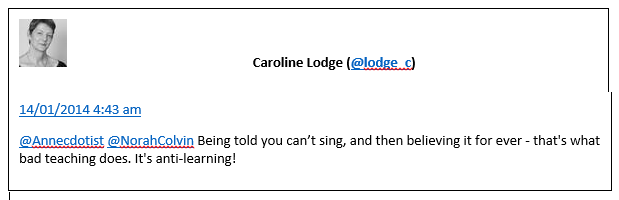
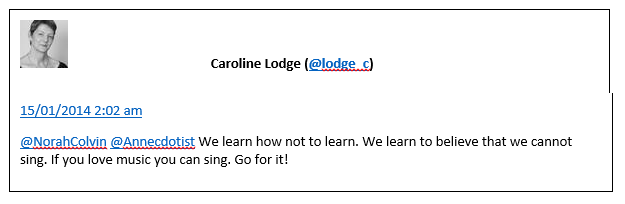
    Engaged in a Twitter discussion with Anne Goodwin (@Annecdotist) and Caroline Lodge (@lodge_c) I mentioned that I listen to audiobooks on my drive to work. Anne replied that she listens to music on long journeys, trying to “fix choral music in my head”.

    I replied, innocently enough, I thought:

    1

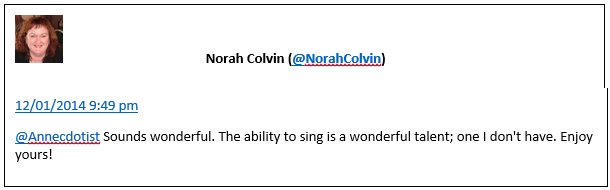
    To which they both responded with the type of “encouragement” I had heard many times before “Give it a go. Everyone can sing.”

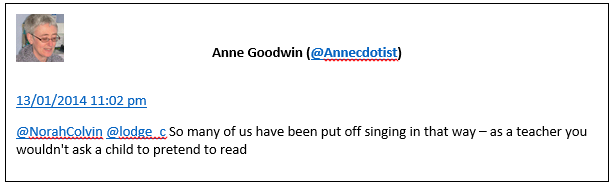
    So I told them about being told to mouth the words, and I was both surprised and challenged by their responses:

    2

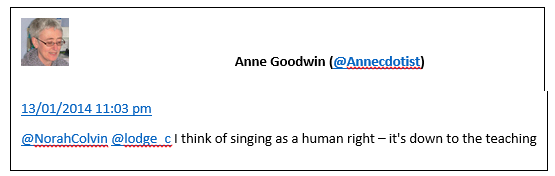
    3

    4

    I had never thought of my singing disability as a learned disability. I had always thought of it being a physiology issue and, later, perhaps a hearing issue.

    I am not very good at mimicking vocal (other than speech) sounds, or at identifying which note, of two given notes, is the higher or lower. I did enrol in a brain training program which included aural exercises involving recognition of higher or lower pitch. While I did make some improvement, my scores weren’t high (I could tell that high/low difference).

    The comments of Anne and Caroline made me think about this:

    What came first: the singing disability or the disability teaching?

    Could I have learned, if given the opportunity, to sing a least a few bars in tune? Could I still be taught?

    It has sometimes crossed my mind that singing lessons could be an interesting experiment.

    Anne and Caroline are both encouraging, and Caroline commented:

    6

    I do love music and perhaps, one day, I will go for it and find out the truth about my singing ability.

    Perhaps I will learn to sing and fulfill the dream “to teach the world to sing in perfect harmony”.

    But for now, the experiment will have to wait, I have other things to learn.

    What do you think?

    Do you consider yourself a singer?

    Can everyone learn to sing?

    Is it a human right?

    Could my singing ability really be a “golem effect”?

    What disability have you learned, if any?

    As a parent or teacher, how do you ensure your children do not suffer from a learned disability?

    You can read more from Anne or Caroline by clicking on their names.

  • Friendship trees

    Friendship trees

    Summer_2010_ClipArt10_HeaderThe end of the school year in Australia coincides with Christmas and the summer holidays.

    TheresaKnott_christmas_tree

    This coincidence provides an opportunity to not only reflect on the year’ achievements, but to share appreciation of friendships made throughout the year while developing understanding of Christmas traditions.

    During the last few weeks of the school year, I use friendship trees with my early childhood classes for these purposes.

    About three weeks before the end of the school year each of the children make their own tree which is then displayed in the classroom until taken home on the last day of school. By then the trees are filled with messages of friendship and affirmation which the children write anonymously to each other each day.

    Although the end of the school year is when I use friendship trees in my classroom, they could be used at any time throughout the year. However they will work better when the children have been working together for a while and know a little about each other.

    These are some of the benefits of incorporating the friendship tree into the class program:

    • Is inclusive with its emphasis upon friendship
    • Provides an opportunity for reflection on friendships made
    • Encourages students to comment positively to classmates
    • Affirms students by the receipt of multiple positive comments
    • Encourages a giving attitude
    • Provides an opportunity to discuss Christmas traditions (tree as a bearer of gifts) as a way of developing cultural understandings
    • Develops understanding that kind words and actions are the greatest gift

    happy_sun_gm

    How it works

    • Children make and decorate a “friendship tree”, attaching or writing their name prominently on it. Trees are then displayed in the classroom.
    • Each day children select a name “from the hat”. (In preparation I prepare a class list of names in a table, one name per row, which I print out and cut into strips for the students to select and write their messages on.)
    • Children write a friendship note to the child whose name they have drawn, but they are to not tell anyone who it is or what they have written.
    • They may return the name and select another only if it is their own name or the name of someone for whom they have already written a message
    • They are to write something they like about the person, something the person is good at or something they appreciate about them.
    • I check what the children have written, ostensibly for readability, but also to ensure appropriateness of the message. However I have never had to edit the content. I have always been impressed by the messages the children write.
    • Children then fold and “secretly” place the messages into the tree of the recipient.
    • On the last day of school children take their trees, filled with positive messages, home to read and share with their family.

    Before children write their first message, we brainstorm what a friendship message might be. These are some examples:

    Thank you for being my friend.

    I like the way you laugh at funny stories.

    You are a good writer.

    You always do the right thing.

    Thank you for playing with me.

    However these ideas are only a starting point. I have always been amazed at the very appropriate and personalised messages the children write for each other. They really do notice the lovely things their classmates do throughout the year, and the different things that make them special.

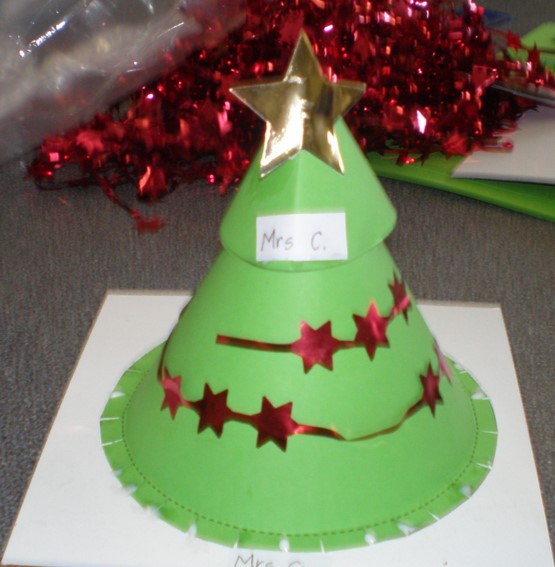
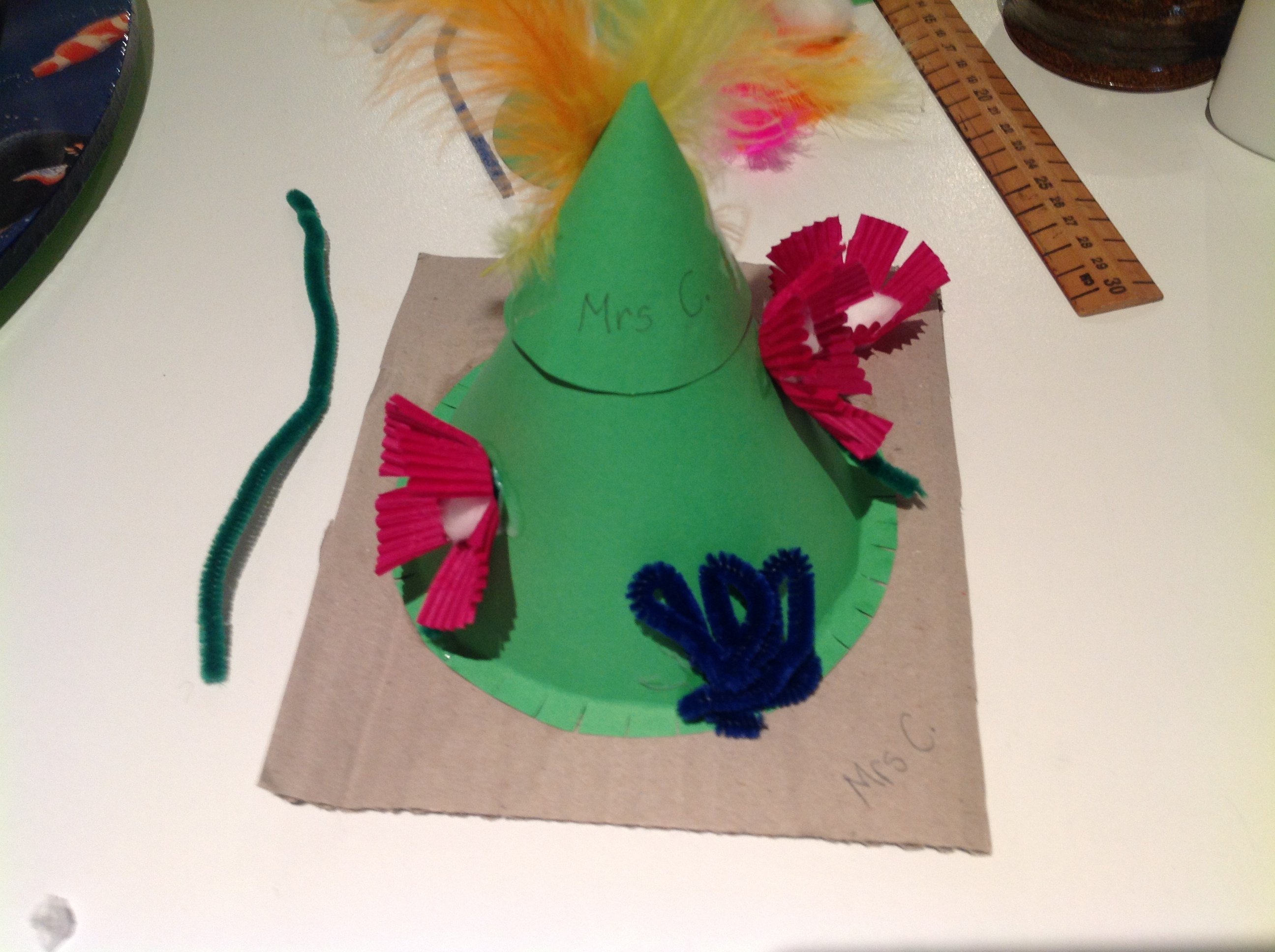
    Here are photographs of two  friendship trees I have made, one decorated for Christmas, the other for friendship:

    Friendship tree

    completed tree

    A cardboard cone (with a cut-off top) is attached to a cardboard base. A smaller cone (removable lid) tops the tree. Children lift the top to place their messages inside.

    If you would like to use a template for making the cone or view step-by-step instructions, I have made these available on the website TeachersPayTeachers. Please click here to follow the link.

    If after viewing this site, you decide to join up as I have, I would appreciate it if you refer your membership back to me my using this link. Thank you. tomas_arad_heart

    I hope you and your students enjoy the friendship tree experience as much as I and my students have!

    Let me know how it goes.

    Clipart courtesy of www.openclipart.org

  • Being childwise, cultivating habits of the heart

    As a regular commenter on my blog Rosie has contributed additional value and insight, demonstrating her unlimited passion for the education of young learners as well as those who engage with them in a professional capacity.  A recurring topic in her comments is the importance of self-actualisation.

    I feel that Rosie’s message is important to share and, in response to my invitation, she has contributed a post, not just a comment, in order to more fully explain her views.

    Please enjoy Rosie’s contribution and feel welcome to add your own insights and comments in response.

    Growth toward self-actualisation (Maslow) requires integration of habits of heart and habits of mind.

    tomas_arad_heart             ryanlerch_thinkingboy_outline

    The development of these habits is essential to the balanced self. Schools have long attended to the habits of mind providing for a range of capabilities from the academic to the intellectual to the cognitive. The habits of the heart have received far less attention. Critically, however, attention to the first, habits of the mind, does little if it is not complemented by attention to habits of the heart.

    school cropped

    Curriculum frameworks have varied in the last forty years to the amount of attention focussed on habits of the heart. The trend to teach only that which is assessable and hence, that which can be measured, has resulted in many habits of the heart being neglected. To some teachers, habits of the heart, known also as the affective domain, are not within their role statement.

    CoD_fsfe_Checklist_icon

    Early years teachers have long recognised the importance of scaffolding the development of all aspects of the child. The belief that teaching the whole child has as its focus, the integration of emotional, social, physical, and cognitive. All interact as conditions for learning. When one area of development is not receiving attention, growth of the other areas may be restricted as well.

    58294main_The_Brain_in_Space-page-21-asian-girl-jumping

    From this perspective, words such as motivation, attitude, well-being, responsibility, independence, self-control, self-concept and identity become the “bread and butter” of a teacher’s daily activity. When learning is not occurring, the answer is not another worksheet or more of the same. These other conditions that form the habits of the heart are examined to formulate the next step to ensure growth.

    image courtesy of www.openclipart.org

    Views toward conditions for learning are slowly changing. For example, the Australian curriculum has at its focus, General capabilities embedded across all Learning areas. One of these capabilities refers to personal and social capability, bringing the affective domain into the realm of respectability as a teaching focus, at last. Despite this, the term ‘behaviour management’ continues to attract funding in some education systems.

    A proposal is to redirect attention away from behaviour management and engage with the direction of the Australian Curriculum. To do this, there is a need to view what needs to be taught and how to teach it if the habits of the heart are to develop.

    image courtesy of www.openclipart.org

    In looking at how to work with habits of the heart, some preservice teachers (now teachers), lecturers and a psychologist adapted “On becoming childwise” (Ezzo & Ezzo) to the needs of teachers and the classroom context. Documentation related to this program is available at www.teachersbeingchildwise.com.au. Videos are also available.

    teachersBeingChildwise

    All images, except Childwise, courtesy of www.openclipart.org

  • Affirmations: How good are they?

    In a recent post, Happy being me I wrote about the fragility of self-esteem and how affirmation songs such as those by Anne Infante, can help to build a positive environment.

    ‘I am Freedom’s Child’ by Bill Martin Jr. (mentioned in a previous post ‘I love the mountains’) is another great song of affirmation.

    Click on the link to view a poster outlining the benefits of singing Affirmation songs in the classroom.

    I invite you to submit any additional benefits of singing affirmations that you would like included on the list and I’ll be happy to update it.

    Feel welcome to make a copy of the poster to share with others if you wish.

    PS I made this poster using a template and cutout people I purchased (along with many others) from the eLearning Brothers. Check out their website here. I found out about them on another great site: the elearning coach.

  • Happy being me

    Self-esteem

    One of the most precious but fragile qualities of a person is their sense of self and self-esteem.

    A positive word of encouragement can reinforce the strength of one’s self-image.

    Machovka_Happy_fish
    image courtesy of http://www.openclipart.org

    But that image can be shattered all too easily through a sigh, a grimace, an ill-chosen word or careless remark.

    image courtesy of www.openclipart.org
    image courtesy of http://www.openclipart.org

    Our self-esteem flourishes when we are happy and wilts when we are sad. It is much easier to boost someone when they are up, and to hit them when they are down. Maintaining a healthy self-image requires just the right amount of self-knowledge and confidence to be resilient when faced with negative feedback and to not adopt an inflated sense of importance when receiving false, or genuine, positive input.

    Fostering self-esteem in the classroom

    image courtesy of www.openclipart.org
    image courtesy of http://www.openclipart.org

    As a teacher I have always considered it to be equally or more important to strengthen a child’s self-image as it is to extend their thinking and learning abilities.

    My primary aim has always been to cultivate a group of happy children, with strong senses of self, confident in what they could do and willing to have a go to extend their learning. I believe that these qualities are necessary in order for children to learn efficiently.

    A child who lacks confidence and is fearful of having a go lest a mistake be made, will make slow progress, finding it difficult to move out of the “comfort zone” into the unknown.

    Because children have no choice in whether to be in school or not, despite whether they like it or not, then, I believe, it must be a happy place, a place where they want to be and look forward to coming. How powerless must they feel if they are compelled to attend every day in a situation which gives them no pleasure.

    www.openclipart.org
    image courtesy of http://www.openclipart.org

    Sometimes the response to this remark is, “It’s life. They just have to get used to it.”

    But really, when you think of it, adults, no matter how trapped they may feel in certain situations, do have a choice. The choices may be no more palatable than the one they are in, but they are able to make that choice. My point is: children don’t make this choice. The choice is made for them. We are lucky that most children accept, and most rather willingly, indeed with enjoyment, this institution of childhood.

    Start each day with a song

    image courtesy of openclipart.org
    image courtesy of openclipart.org

    Because these beliefs and values guided the choices I made as a teacher, I started every day with at least a song or two, and always one of affirmation. It is almost impossible to frown when singing, and almost as impossible to not join in when everyone around is singing too.

    There were mornings when it was just as important for me to sing the songs as it was for the children. As for them, it gave me time to forget the problem that had occurred outside the classroom, the difficulty getting something to work the required way, or the disagreement that had taken place some time earlier. As for them, it gave me a quiet time to reflect and reassure myself, “I’m okay. I can do this. Let’s get on with our day.”

    I noticed, too, that when parent volunteers or other visitors were with us for our song, they also joined in with our singing and invariably followed up with a spontaneous comment about how much they appreciated, and needed, the song as well. Many times I received comments from passers-by about how the class’s happy singing had helped them start their day.

    image courtesy of www.openclipart.org
    image courtesy of http://www.openclipart.org

    I took every possible opportunity to remind parents of how wonderful their children were and we always shared at least one of these songs with parents during end-of-term celebrations of work. I believe the songs help to model, for parents as well as teachers, a way of sharing positive feedback and affirmations with their children.

    Affirmation songs

    Some of the songs we sang regularly in the mornings were from Anne Infante’s “Special as I can be” CD, the title song of which is my favourite and always the first I introduce to the children.

    Anne Infante (image courtesy of Anne)
    Anne Infante (image courtesy of Anne)

    Image courtesy of Anne

    Click here to find out more about Anne and her songs.

    I always wrote the songs out on charts so that, from the first day of school, we could follow along with the words as Anne sang them, even before most of the children could recognise any of them. The melody and repetitive structure of each verse invited the children to join in:

    Nobody else is just like me. 

    I’m as unique as I can be.

    I am beautiful, wonderful and

    beautiful, special as I can be.”

    The following verses substituted things such as “Nobody’s face, nobody’s smile, nobody’s eyes.” I simply told them, before the verse started, the words that changed each time.

    It wasn’t long before the children were joining in with the singing and recognising some of the words repeated in the songs e.g. “I” and “beautiful”.

    If ever I was called away during the song, they took great delight in being the one to point to the words for the rest of the class to follow.

    As the children became confident with one song, I would introduce another; and as our repertoire built, we would sing a different one each day. Sometimes the children would change the chart I had selected for another of their choosing for that particular day.

    The children loved these songs, and often during the day, while they were working on another task, someone would start quietly singing a song, and before long everyone would be joining in with joyful affirmation. I loved it when they left the classroom in the afternoon singing another of Anne’s songs, “Today I’m feeling happy. I am, I am, I am.”

    image courtesy of www.openclipart.org
    image courtesy of http://www.openclipart.org

    Singing an affirmation song is a little “happiness pill” you can take every day without any side effects.

    Happy being me

    Affirmation songs provide benefits in many ways:

    • Share the joy of being alive and happiness with self
    • Put a smile on everyone’s face
    • Invite everyone to participate
    • Encourage acceptance of and respect for self and others
    • Reinforce self-esteem
    • Insulate the classroom from outside troubles
    • Quiet the mind and settle the body in preparation for the day’s work
    • Provide words to express feelings
    • Give musical pleasure
    • Are an avenue for literacy learning.

    Please feel welcome to share your thoughts.

    If you enjoyed this post please subscribe.