It’s not uncommon to see apostrophes used incorrectly, even in professional writing. But apostrophes don’t have to be difficult. They really have just two uses — for contractions and to show possession. Apostrophes aren’t confusing or tricky when the rules are understood.
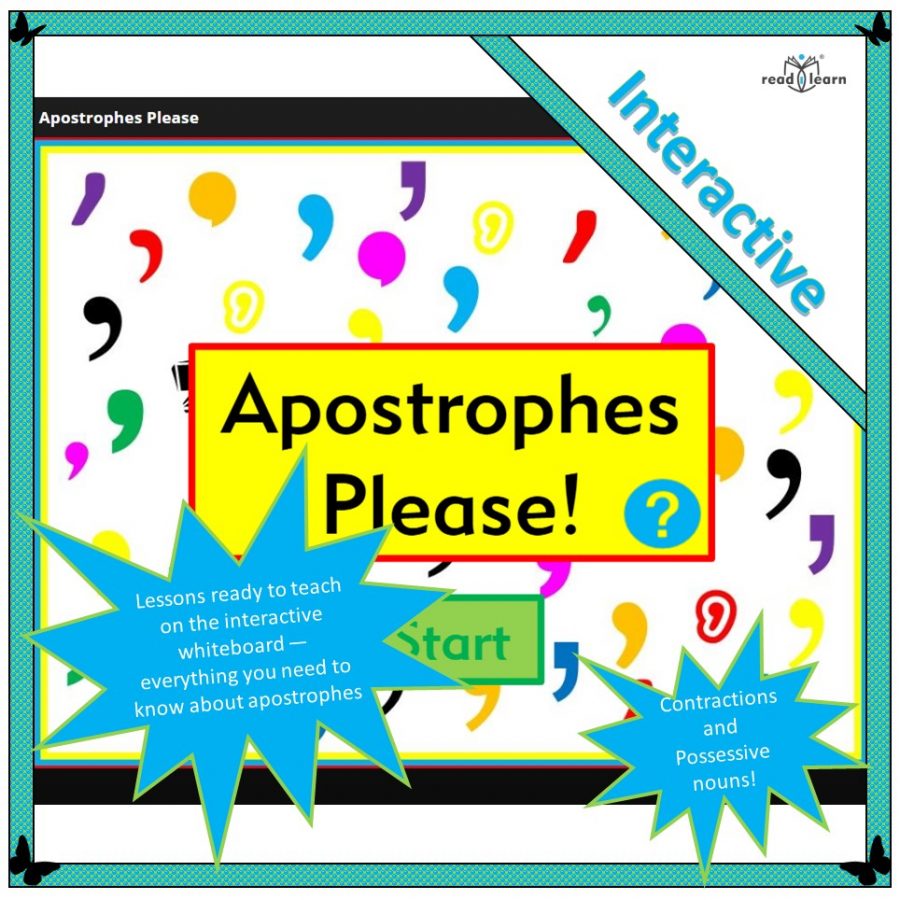
To support your teaching of this punctuation mark and to encourage writers to get their writing right, I have produced an interactive resource that explains, demonstrates and provides practice in its correct use. It is called Apostrophes Please!
About Apostrophes Please!
Apostrophes Please! is an interactive resource, ready for use on the interactive whiteboard. It consists of enough material for a series of lessons teaching the correct use of apostrophes in both contractions and possessive nouns.
Like other readilearn resources, Apostrophes Please! recognises the value of teacher input and the importance of teacher-student discussion. It is not designed for children to use independently. It relies simply on effective teaching.
The resource provides flexibility for the teacher to choose activities which are relevant to student needs and teaching focus. All lessons and activities encourage explanation, stimulate discussion and provide opportunities for children to practise, explain and demonstrate what they have learned. There are nineteen interactive slides and over thirty slides in all.
Organisation of Apostrophes Please!
Contractions and possessive nouns are introduced separately.
Apostrophes Please! Contractions menuApostrophes Please Possession menu
Both sections include three subsections, each consisting of a number of slides:
Learn — explanatory teaching slides introduce how apostrophes are used
Practice — interactive activities provide opportunities for teachers and students to discuss, demonstrate and explain how apostrophes are used
Check — a review of the use of apostrophes provides additional opportunities for practice, discussion and explanation to consolidate learning.
Fostering self-esteem, a willingness to have a go and an ‘I can’ attitude was always important to me as both a teacher and a parent. These are important aspects of any supportive environment, whether in the home, in the classroom or in the workplace. I have written many posts and made many resources to help you develop a supportive classroom environment. In this post, I feature just one — a story you can personalise for your own class.
The Clever Children is a story about a kingdom in which a mean witch has put a spell on all the people, causing them to be confused and to forget everything they once knew. The king, who has heard about a class of very clever children (your class) asks for their help in teaching his subjects what they need to know. Every child suggests something they are good at and writes and draws a picture of them doing it on a page for inclusion in the book. When the children have taught their skill, the king throws a great party in the castle to celebrate and, of course, the children are invited.
The story not only helps develop an ‘I can do it’ growth mindset, but it helps develop friendship skills too. It was one of the first uploaded to the collection and includes a diversity of children and abilities gorgeously illustrated by Kari Rocha Jones.
The story is available in two formats.
It is an estory, ready to be displayed and read on the interactive whiteboard.
It is also a booklet that can be downloaded and printed, ready to be completed with pages written by your own children.
While both these formats are available to purchase independently, if you purchase the estory, the printable version is included.
This post is a revisit of one of the first posts I published on readilearn almost six years ago in 2016. Since it was first shared, I have added many more procedures to the collection. All procedural texts and activities can be found in the Procedures subsection of Literacy resources.
Why teach procedures?
Reading and following procedures are a part of everyday life. We need to follow a procedure to make a cake, take medicine, repair a bicycle, treat head lice, assemble a DIY bookcase, or install an app on a digital device. The list in inexhaustible.
Sometimes procedures are presented as text, sometimes as illustrations or diagrams, and sometimes as a combination of both. They work best when each step of the sequence is accurately described and illustrated.
However, not all procedural texts are created equal. Sometimes the language may be inappropriate and unclear. Sometimes steps are omitted or sequenced incorrectly. Sometimes diagrams have little resemblance to what is required and confuse, rather than clarify, the process.
Trying to figure out what to do can cause a great deal of frustration in such circumstances. The more practised we are with following procedures, the more adept we are at interpreting inadequate instructions to achieve a good outcome.
It is never too soon for children to learn to read and follow procedures. The inclusion of procedural texts in a classroom literacy program has many benefits.
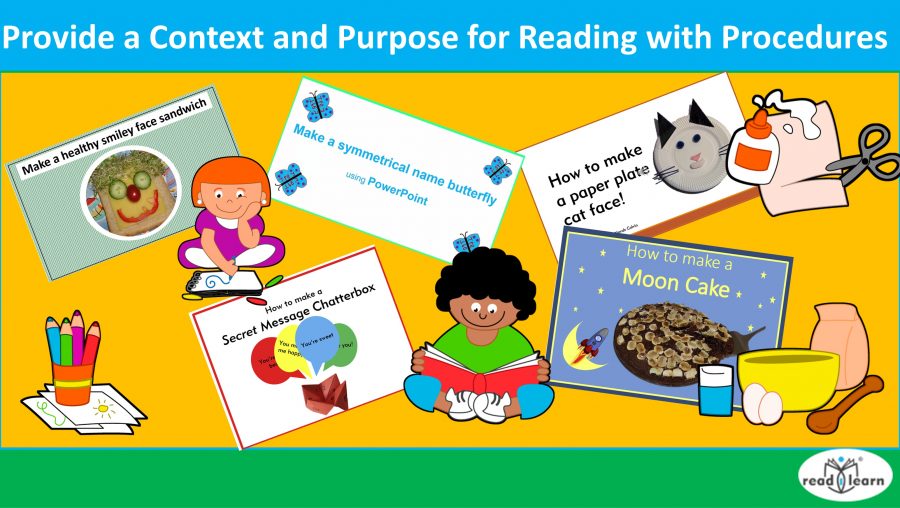
Following a procedure provides a context and purpose for reading. It requires children to interpret instructions through a combination of text and visual representation. It generally implies that children are doing or making something, which engages their interest and encourages participation. It develops an essential real-life skill that is transferrable to a range of situations. The sense of achievement in successfully completing a project is both affirming and empowering and often requires no other feedback.
Procedural texts can be easily incorporated into a class reading program as an independent or group reading activity. An assistant to support, encourage and oversee can be invaluable.
Features of procedural texts
The reading of procedural texts differs from reading fiction or other non-fiction texts.
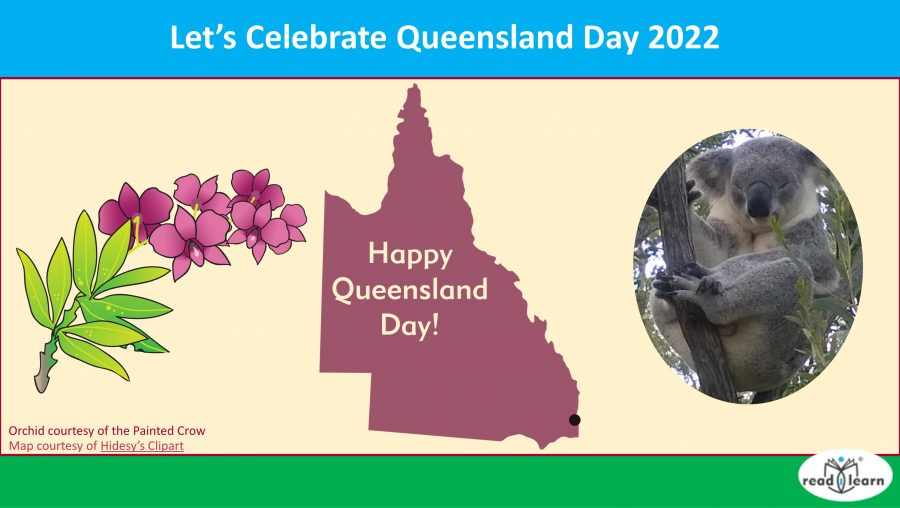
Next Monday 6 June is Queensland Day, and, since I am a Queenslander, I thought I’d share a little about my home state, including Queensland authors and illustrators I have interviewed over the years.
12 Facts about Queensland
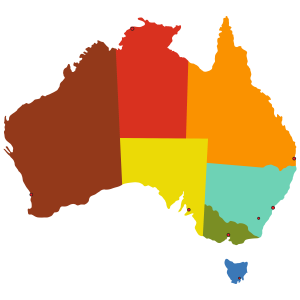
Queensland is in north-eastern Australia. It is the second-largest state by area (after Western Australia) and the third-largest in population (after New South Wales and Victoria).
2. Queensland is bordered by New South Wales, Northern Territory and South Australia. The Pacific Ocean is along its eastern coastline.
3. The most northern part of Australia, Cape York, is in Queensland. Though I am told it is very beautiful and is a popular camping and four-wheel drive destination, I’ve never been there. (I’m not a camper or a four-wheel driver.)
4. One of the seven wonders of the natural world, the Great Barrier Reef, is located along Queensland’s coastline.
5. The world’s three largest sand islands, Fraser, Bribie and Stradbroke, are also located on Queensland’s coast.
6. The capital of Queensland, Brisbane (where I live), is located in the south-east corner of the state.
7. Queensland Day celebrates the day in 1859 that Queensland separated from New South Wales to become an independent colony.
8. Queensland’s state fauna emblem is the koala. The koala is a marsupial (mammal with a pouch) that is native only to Australia and lives mainly along the east and south coasts.
Today, Friday 27 May is the first day of National Reconciliation Week which runs until 3 June. The theme this year is ‘Be Brave. Make Change.’
As expressed on the Reconciliation Australia website, the theme ‘is a challenge to all Australians— individuals, families, communities, organisations and government—to Be Brave and tackle the unfinished business of reconciliation so we can Make Change for the benefit of all Australians.’
It ‘is a time for all Australians to learn about our shared histories, cultures, and achievements, and to explore how each of us can contribute to achieving reconciliation in Australia.’
The dates are chosen to commemorate two events:
On 27 May 1967, more than 90% of Australians voted ‘Yes’ in a referendum to ensure that Aboriginal and Torres Strait Islander people would be recognised in the Census.
On 3 June 1992, the Australian High Court delivered the Mabo decision which recognised the incorrectness of the term ‘terra nullius’ (land belonging to no one). This decision led to the legal recognition of Aboriginal and Torres Strait Islander people as Traditional Owners and Custodians of the land and paved the way for recognition of Native Title.
The day before Reconciliation Week, 26 May, is National Sorry Day which remembers and honours the Stolen Generations.
The website lists actions we can all take to make a change toward reconciliation.
The basis of many of these actions is education. It begins with us, teaching our children to honour and respect the cultures of our First Nations, to learn the truth of our history, and to implement actions for change.
I rarely mention politics in my posts, but with our recent change in government, I was very proud to be an Australian when the incoming Prime Minister Anthony Albanese acknowledged our First Nations peoples in both the introduction and content of his victory speech. These are the words with which he opened his speech:
“I begin by acknowledging the traditional owners of the land on which we meet. I pay my respects to their elders past, present and emerging. And on behalf of the Australian Labor Party, I commit to the Uluru Statement from the heart in full.”
And these are the words which he used further in:
“And together we can embrace the Uluru Statement from the Heart.
“We can answer its patient, gracious call for a voice enshrined in our constitution. Because all of us ought to be proud that amongst our great multicultural society we count the oldest living continuous culture in the world.”
In further recognition, in his first press conference as Prime Minister, Anthony Albanese hung the Aboriginal and Torres Strait Islander Flags alongside the Australian flag in the media room at Parliament House. These statements give me hope for the recognition that our First Nations deserve and is long overdue.
In this post, I share some wonderful books by our Aboriginal and Torres Strait Islander authors and illustrators. This is only a small selection of the growing number available. Magabala Books is a great resource to check out as it publishes only books by First Nations authors and illustrators. Other publishers also have a collection of titles, so it is worth checking out others too. I will be adding these titles to the list already available in readilearn resources Indigenous Australian picture books and resources. A previous post Resources for teaching Aboriginal and Torres Strait Islander Histories and Culture has links to many other useful resources also.
Books for Reconciliation
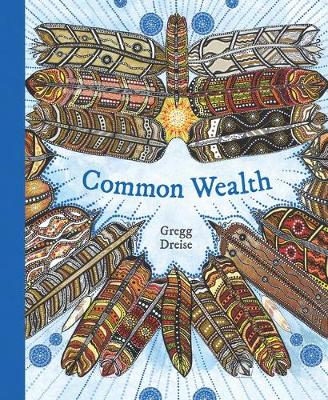
Common Wealth by Gregg Dreise
Published by Scholastic in 2021
Dreise is the author of many wonderful picture books. I first came upon his delightful stories in books such as Kookoo Kookaburra and Mad Magpie which introduce children to the stories of Aboriginal and Torres Strait Islander peoples.
Common Wealth is different. It is a book that challenges us to acknowledge our true history and to ‘break down the barriers of division … by discussing without ammunition, a willingness to listen … to a true common wealth vision.’
The book may not be as suitable for sharing with our younger children, but it makes valuable reading for us anyway as it can empower us in our knowledge and discussions. The half-title page informs us that this book is ‘A Slam Poetry Persuasive — A picture book for older readers. Contains some confronting imagery.’
Dreise opens the book with the words, ‘All that I’m wishing, is that you take a moment to listen …You see, I’m on a mission, to spread unity — not division.’ He takes us on a journey through our national anthem and our history, pointing out the parts that are incorrect and what we need to do to make them more inclusive and true. His illustrations pull no punches and the text added to the illustrations add to the depth of the story and its message. There is much to contemplate and discuss. It may be challenging but it is also empowering and I, for one, can’t help myself wishing for change along with Gregg.
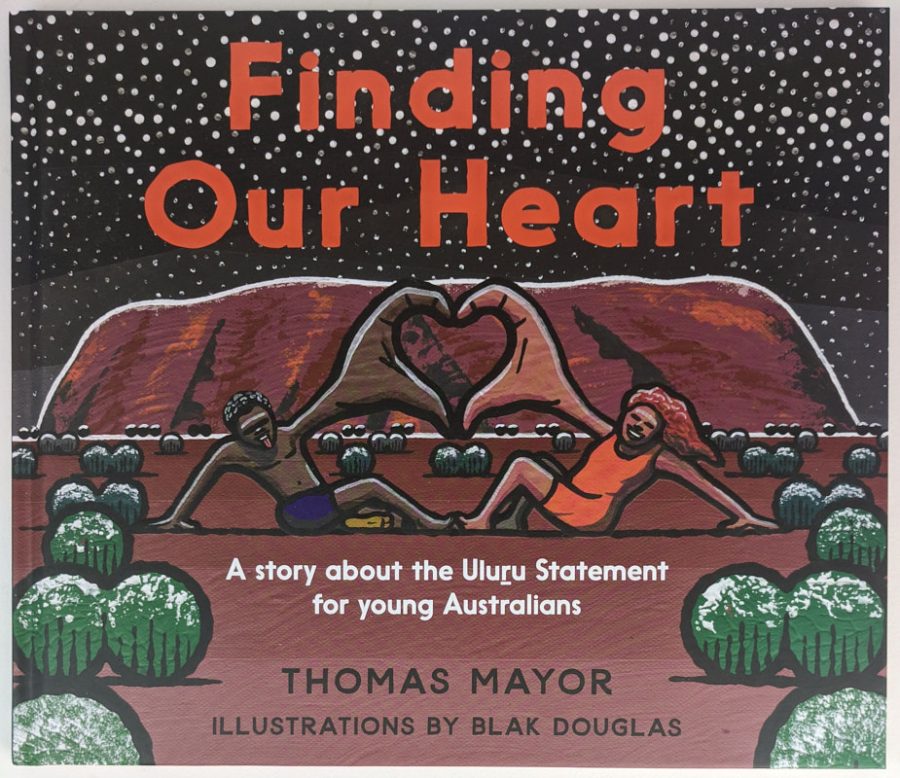
Finding Our Heart by Thomas Mayor, illustrated by Blak Douglas
Published by Hardie Grant 2020
Thomas Mayor was involved in the writing of the Uluru Statement of the Heart. His book for adults titled Finding the Heart of the Nation: The Journey of the Uluru Statement Towards Voice, Treaty and Truth talks about the writing of the statement and reports discussions with many Aboriginal and Torres Strait Islander people whom Mayor met with as he took the Statement on a journey around Australia. It is a very valuable read for adults.
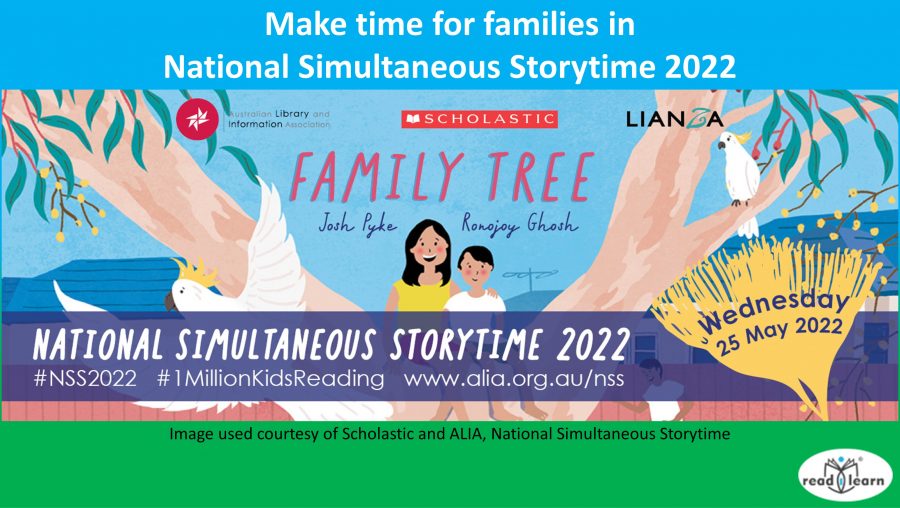
Next week, on Wednesday 25 May at 11:00am AEST, we will be celebrating the 22nd National Simultaneous Storytime (NSS). Are you ready?
The event
National Simultaneous Storytime is an annual event organised by the Australian Library and Information Association (ALIA) with the aim of promoting the value of reading and literacy.
Each year an Australian picture book is chosen to be read simultaneously in libraries, schools, pre-schools, childcare centres, family homes, bookshops and many other places around the nations on either side of the Tasman Sea. Selected books explore age-appropriate themes and address key learning areas of the National Curriculum for Foundation to Year 6.
It is free to register for the event. If you do, on Monday 23 May you will receive various free downloadable material, including a PDF of the book, to support your own event. You can register right up until the event begins. There are also many other free teaching resources available on the website, including resources from Learn From Play, Clever Patch, and Clever Bean.
The book
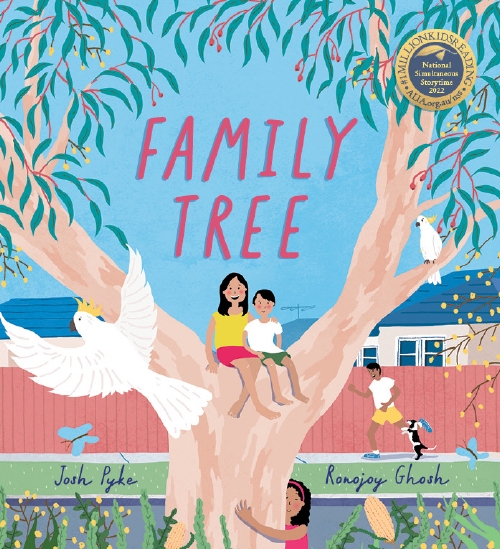
The book selected for this year’s simultaneous story time is Family Tree written by Josh Pyke, illustrated by Ronojoy Ghosh and published by Scholastic Australia. Family Tree is a celebration of family, community and the circle of life. It begins with the planting of a seed and is told from the tree’s point of view. As the tree grows, so does the family.
‘It started with a seed,
and that seed was me.
And, over time, laughter filled my garden…
A heartfelt celebration of family, community and the seasons of life, to cherish and to share.’
To help build your enthusiasm, here is a video of Josh talking about his book Family Tree.
I hope you and your children enjoy this exciting event. I’d love to know how you celebrate. I’ll be joining in, reading along with my own copy or perhaps joining in with the event organised at my local library. There’s so much fun to be had in books and libraries.
What I like about Family Tree
I love the way this book is told from the point of view of the tree, the way it notices changes in the family and the community through the
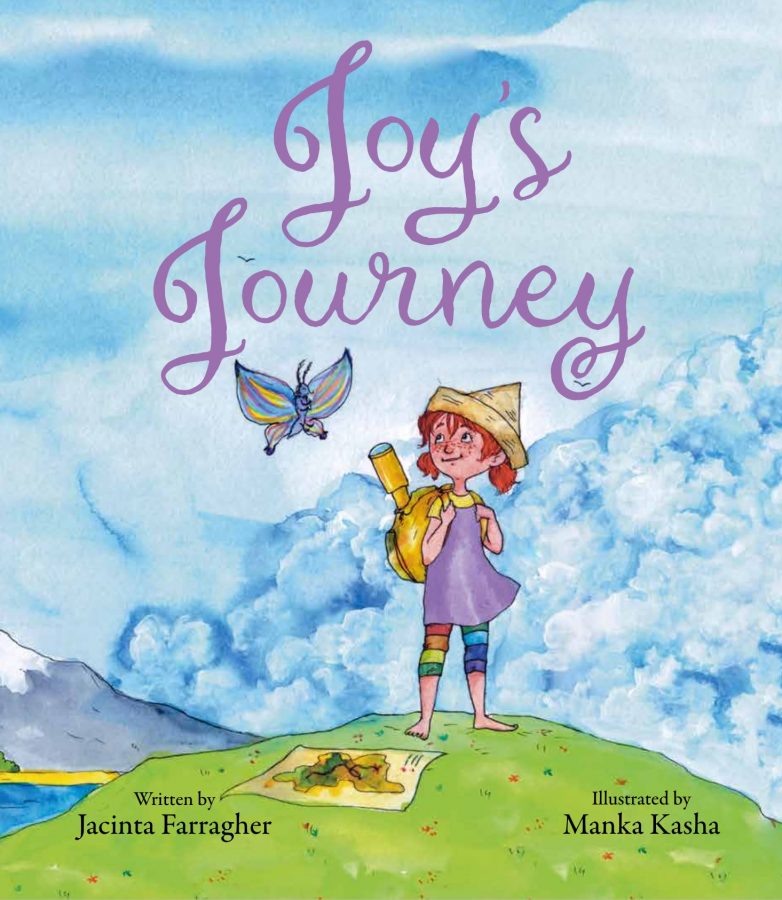
Today it is my pleasure to review a beautiful new picture book Joy’s Journey, written by Jacinta Farragher, illustrated by Manka Kasha and published by Little Steps Publishing. This post is part of a Books on Tour promotion.
About author Jacinta Farragher
While living in Thailand, Jacinta Farragher found that snippets of quirky verse popped into her brain every time she had a massage. Naturally, she wanted to explore this further and started having massages twice a week. Now she’s a children’s picture book author! Jacinta is a member of The Society of Children’s Book Writers and Illustrators (SCBWI), Creative Kids Tales, and the Australian Society of Authors. She dedicates her time to writing and having massages. Jacinta’s passion is writing fun picture books with messages that uplift and empower. She plans to spend the next few decades writing books that will inspire children and adults alike for generations to come. Jacinta’s debut picture book, Joy’s Journey, is an adventurous quest story about realising the joy is in the journey. This will soon be followed by a second book, Joy’s Way – a fun story about doing things your own way.
About Joy’s Journey
She travels over land and sea, to see what she can see. She becomes a bold adventurer, to be what she can be… Join Joy as she travels through four seasons, meets friends, and ultimately discovers that the joy is in the journey, and the most precious thing you can find is yourself!
What I like about Joy’s Journey
Joy’s Journey is a delightful tale from start to finish. For me with my own red-haired family, a redheaded freckle-faced protagonist has extra appeal, 😉 but of course there’s far more in the book to delight than that.
The story begins with Joy setting off to find a paradise where lives a teacher ‘strong and kind and wise’ and where, she’s heard, all her wishes will come true. She travels across the seas to different lands, exploring every terrain including a desert island, a cave, mountains and valleys. She meets many new friends and even finds a chest full of treasure.
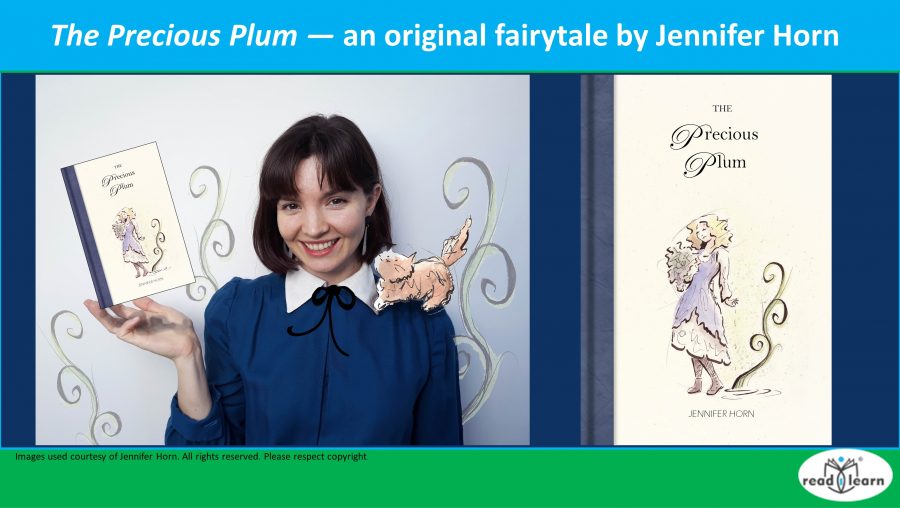
Today it is my pleasure to introduce you to Jennifer Horn, author and illustrator of a delightfully nostalgic but contemporary fairytale The Precious Plum.
About Author-Illustrator Jennifer Horn
Jennifer Horn is a Brisbane-based freelance illustrator and budding children’s writer. Her debut picture book “The Precious Plum” was released in October 2021 amongst some very musical live book launches. She illustrated the cover of Anthology Angels’ children’s fundraising anthology, Once Upon a Whoops!: Fractured Fairytales and Ridiculous Rhymes (2021). Her short stories have appeared in each of Anthology Angels’ annual publications since 2018: It’s Beginning to Look A Lot Like Christmas (2018), Spooktacular Stories (2019) and Tell ‘Em They’re Dreaming (2020). Her first Young Adult short story, Faulty Connection, was published in Rhiza Edge’s dystopian and sci-fi anthology, Crossed Spaces earlier this year. She was awarded a Highly Commended for her submission of middle grade illustrations at the 2020 CYA Conference.
With a background in Architecture, Jen draws on her love of stories and adventure to create whimsical illustrations in a Quentin-Blake-inspired squiggle style. She enjoys reading books over local community station Reading Radio, and playing keys, including the piano accordion. She has also been part of Art Department teams on several Brisbane-based films, including Romance on the Menu on Netflix and The Umbrella on Amazon Prime.
About The Precious Plum
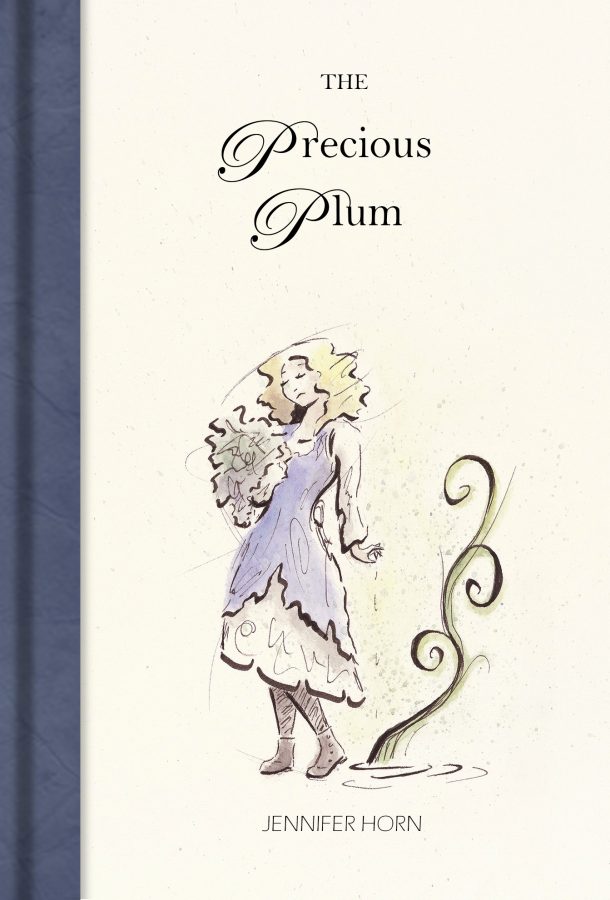
When a baker of magical goods for her village attempts to help her good friend the Gentleman, she finds an important ingredient goes missing in the process.
A tale for all who have unwittingly left a piece of themselves behind, The Precious Plum is a whimsical fairytale about finding that sometimes the things we are looking for are right where we left them.
What I like about The Precious Plum
The Precious Plum is a beautiful fable about love and kindness that will appeal to adults as well as to children, or to children as well as to adults.
I have read this book a number of times, and each time, I have been left with a sense of peace and contentment. It makes me want to pause and breathe in all of nature’s beauty, all the joys of the world. It is like a brief interlude stopping to smell the roses but through the words of a book.
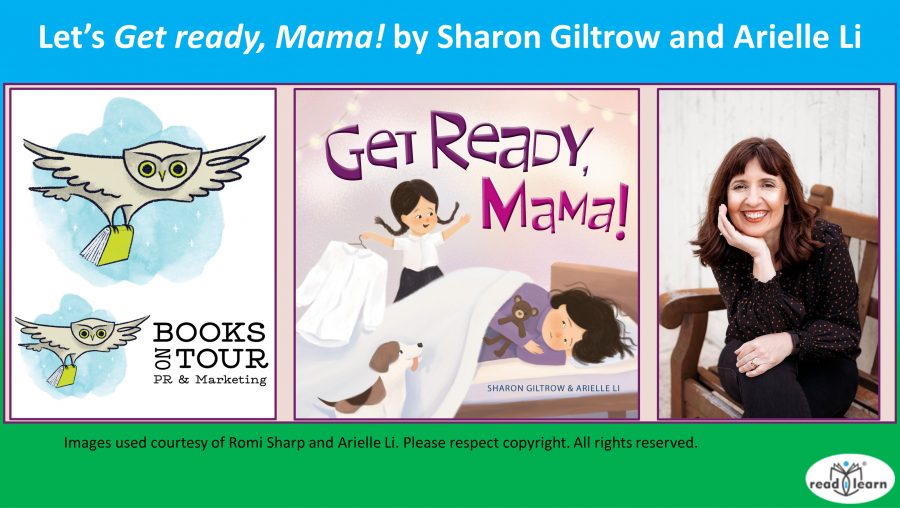
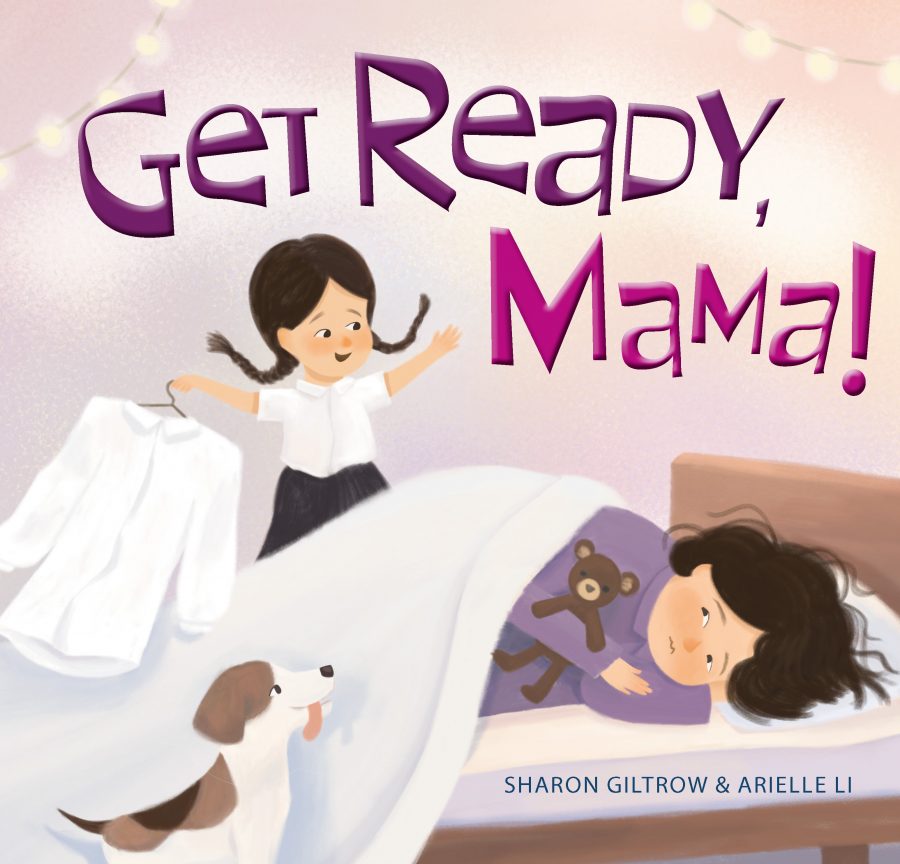
Today it is my pleasure to review a beautiful new picture book Get Ready, Mama! written by Sharon Giltrow, illustrated by Arielle Li and published by EK Books. This post is part of a Books on Tour promotion.
About author Sharon Giltrow
Sharon Giltrow is an Authorcator, an Author Educator, based in Western Australia. She writes humorous picture books and middle grade speculative fiction. Her humorous debut picture book Bedtime Daddy, released in May 2020, is a companion book to this new release Get Ready, Mama!
Sharon has worked with children for all of her career, formerly as a teacher of children who are hearing impaired and Deaf-Blind, and now as an Early Childhood Educator and Teacher Education Support working with Young Children with Developmental Language Disorder.
Sharon is an enthusiastic and inspirational speaker with a passion for developing children’s oral, visual, and written literacy. She has experience presenting to children from zero- to ten-year-olds. Through Sharon’s author talks students, inspired by a real-life author, will discover the joy of literacy and unlock their hidden creativity.
Find out more about Sharon Giltrow on her website.
About Get Ready, Mama!
Even the most reluctant risers will find the fun in the morning routine with this lively role-reversal story about a mama who just doesn’t want to get ready!
Getting ready in the morning is a mission for many families with young children, but this inventive, tongue-in-cheek story provides a fun way of speeding things along. Full of heart and humour, Get Ready, Mama! is for anyone who has heard enough of “5 more minutes”.
What I like about Get Ready, Mama!
Get Ready, Mama! is a fun role-reversal picture book in which an enthusiastic child attempts to motive a reluctant mother to get up and going in the morning. What a hilariously non-threatening way to discuss those very same avoidance tactics used by many children, and even more, a fun way for parents to play-act reluctance in order to motivate their own children to take responsibility for getting up and getting ready in the mornings.
Any parent who has ever had to coax a child to get ready in the morning, and I think that’s probably most of us, will identify with Mum’s
The day is a call to action. Mother Earth herself is calling us to action because nature is suffering.
While I’m sure you don’t need any reminders, the signs of that suffering include:
pollution
extreme heat
fires
floods
drought
storms
the pandemic
vulnerability and extinction of fauna and flora
Humans contribute to the suffering through pollution, deforestation and changes in land-use.
We are all called to take individual, as well as collective, action. As stated on the website:
‘The healthier our ecosystems are, the healthier the planet – and its people. Restoring our damaged ecosystems will help to end poverty, combat climate change and prevent mass extinction. But we will only succeed if everyone plays a part.’
He tells us there are no excuses and lists 19 of those most often expressed. Perhaps you’ve heard some of them. He tells us how to end the excuses with information and action.
“I’m already doing as much as I can.”
“We’ll lose too many jobs if we phase out fossil fuels.”
“I’m just one person, I can’t make a difference.”
“We need fossil fuels for our economy.”
“I won’t see the effects of climate change in my lifetime.”













 Norah Colvin