Live Love Laugh Learn … Create the possibilities

Category: readilearn

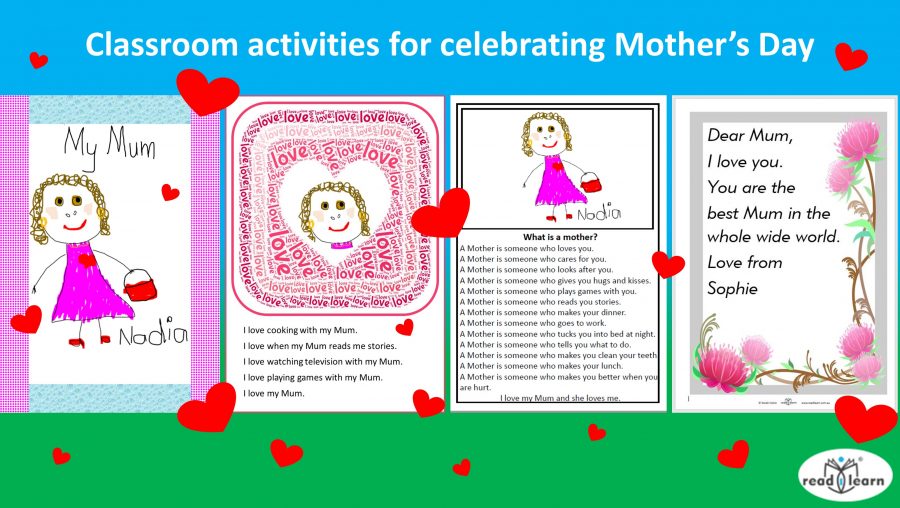
  • Classroom activities for celebrating Mother’s Day – readilearn

    Classroom activities for celebrating Mother’s Day – readilearn

    With Mother’s Day just a little over a week away on Sunday 12 May, teachers are looking for classroom activities that are easy to implement but foster learning while making something special for the children’s mums to treasure. readilearn Mother’s Day suggestions help you do just that.

    Benefits of written gifts

    Writing letters, cards and books for mothers is one of the best ways of fulfilling all these requirements.

    Written gifts:

    • are easily slotted into the class writing program
    • provide opportunities for teaching and learning writing skills
    • encourage creativity
    • are gifts from the heart
    • are unique and personalised for each mother or carer
    • become treasures that never wear out and are easy to keep
    • require little to no additional purchases or expenditure on the part of the teacher

    Start with discussion

    The best preparation for writing is discussion.

    Discussion provides children with an opportunity to:

    • share ideas
    • be inspired by others’ ideas
    • decide what they wish to write and how they might express it
    • consider alternative recipients for their writing

    Read books for inspiration

    Many beautiful picture books celebrate mothers.

    Reading aloud to children helps to:

    • Foster a love of books and language
    • Develop language and vocabulary
    • Stimulate ideas
    • Inspire creativity

    A few of my favourite picture books about mothers are:

    Continue reading: Classroom activities for celebrating Mother’s Day – readilearn

  • Remembering: Anzac Day in the classroom – readilearn

    Remembering: Anzac Day in the classroom – readilearn

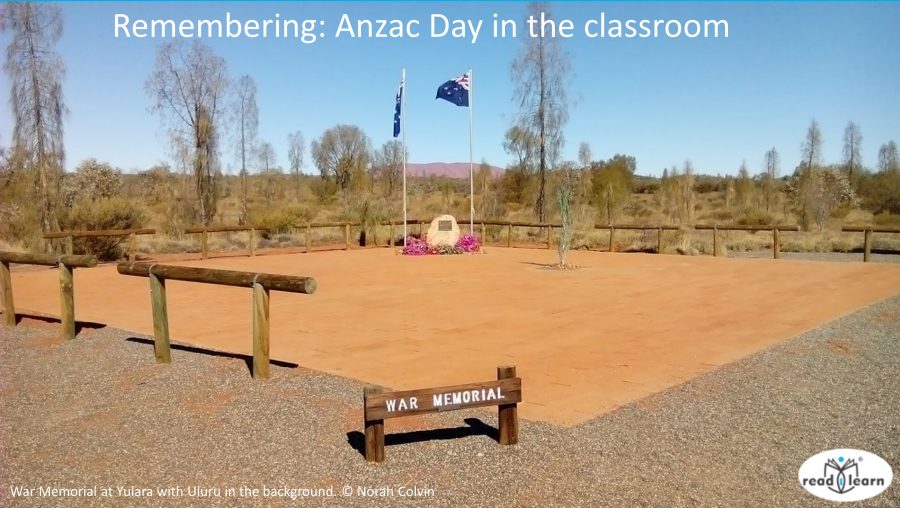
    Tomorrow, 25 April is Anzac Day, a day of national significance and a public holiday in both Australia and New Zealand. The day is the anniversary of the first major military campaign fought by Australian and New Zealand forces in World War I, but now commemorates all who have served in any military campaign or operation since. The acronym stands for Australian and New Zealand Army Corps. Ceremonies are held around the country and well-attended by past and present servicemen and women, their families and friends, and the general public.

    While most children and teachers in both Australia and New Zealand are still on school holidays, they will undoubtedly discuss, and conduct ceremonies in recognition of ANZAC Day when school returns.

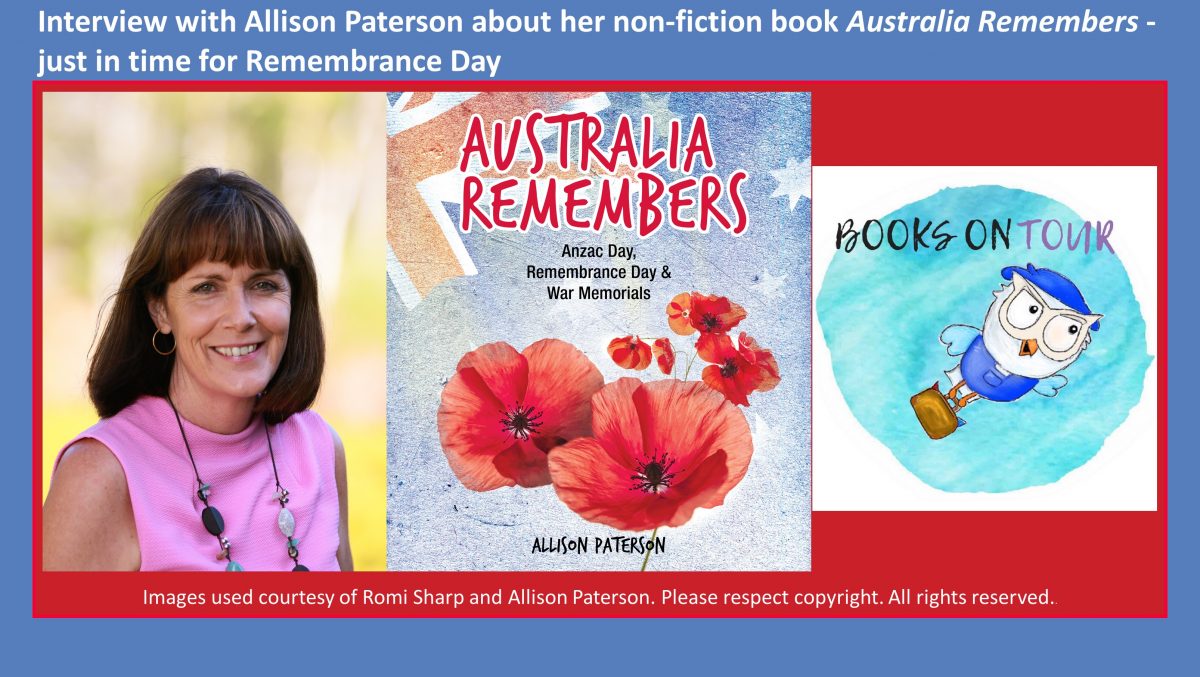
    To assist your discussions, I remind you of Allison Paterson’s wonderful book Australia Remembers: Anzac Day, Remembrance Day and War Memorials, about which I interviewed Allison in November last year as part of the Books on Tour promotion.

    About the book

    The book explains, in a way that is detailed but accessible for a young audience, the origins and significance of both Anzac Day and Remembrance Day. Explanations of the traditions and symbols ensure that children understand why it is important to observe these historical events and why we should never forget those who fought for our country and those who keep us safe today.

    Here are some reminders of Allison’s book:

    Continue reading: Remembering: Anzac Day in the classroom – readilearn

  • Wishing you a Happy Easter Holiday – readilearn

    Wishing you a Happy Easter Holiday – readilearn

    Wishing you a Happy Easter Holiday!

    It’s Easter time again and I wish you and your loved ones a very happy holiday, however you celebrate it.

    I’ve been brought down by the flu and haven’t uploaded as many new resources for you as I’d hoped. However, there are many Easter-themed resources already available on readilearn and, now that you can purchase them individually, access is even easier.

    Previous posts provide many suggestions to keep the learning in fun Easter lessons and activities, including:

    Learning literacy and mathematics with Easter classroom activities

    Easter holiday wishes (2017)

    Delivery – just in time for Easter

    Favourite Easter-themed lessons

    interactive mathematics lessons for the first three years of school

    One of my favourite lessons is Easter Delivery: a fun story I wrote and produced as an interactive lesson to support the development of mathematical understanding of number combinations to ten.

    This video tells you about it.

    Continue reading: Wishing you a Happy Easter Holiday – readilearn

  • Why Kindergartners Must Learn Technology – readilearn

    Why Kindergartners Must Learn Technology – readilearn

    Today I am delighted to introduce you to Jacqui Murray, the Tech Teacher, who is able to answer all your questions about using technology in schools.

    Jacqui’s blog Ask a Tech Teacher is very informative. It is packed with helpful advice for both teachers and parents on children’s use of technology and the suitability of tools and software for use in different situations and with different age groups, especially in the classroom. If I need to know anything about technology, Jacqui’s blog is an excellent resource.

    As Jacqui is often asked questions about teaching Kindergartners to Tech, a topic that is dear to her, this is the topic of discussion in this post. Please feel free to ask Jacqui any additional questions you may have in the comment section at the end!

    Note: Jacqui is based in the US and the kindergarteners she refers to are 5-to-6-year-olds.

     Welcome to readilearn, Jacqui. Over to you.

    When I started teaching technology almost twenty years ago, I taught K-8, three classes in each grade every week. I was buried under lesson plans, grades, and parent meetings. I remember suggesting to my principal that he ease my schedule by eliminating tech for kindergartners. They wouldn’t miss anything if I started them in first or second grade.

    And back then, that was true.

    Even a decade ago, technology was an extra class in student schedules where now, it is a life skill. Today, my teacher colleagues tell me kids arrive at school already comfortable in the use of iPads and smartphones, doing movements like swipe, squeeze, and flick better than most adults. Many teachers, even administrators, use that as the reason why technology training isn’t needed for them, arguing, “They’re digital natives.”

    Continue reading: Why Kindergartners Must Learn Technology – Readilearn

  • Teachers! Save time and money with readilearn K–2 teaching resources – Readilearn

    Teachers! Save time and money with readilearn K–2 teaching resources – Readilearn

    Teachers! Save time and money with readilearn K–2 teaching resources

    readilearn teaching resources for the first three years of school save teachers time and money with lessons ready to teach. More than just worksheets to keep kids busy, readilearn lessons and activities are designed to progress children’s learning.

    Now available to purchase individually

    Over the past few weeks, we have been working to make it easier for you to access readilearn teaching resources.  All readilearn resources are now priced for individual purchase, many with a $0.00 price tag. While a subscription is still the best value for money, being able to purchase resources individually means you can purchase what you want when you want to use it.

    Resources across the curriculum

    Resources are available across curriculum areas and include lessons in character development such as confidence and friendship skills. Many integrate learning from different subjects. Child-focused, engaging and connecting with experiences familiar to children, the resources develop language and thinking skills alongside learning in other subject areas.

    Easy to use

    Browse through the resources. When you see a lesson that’s just right for you and your class, add it to the cart and continue shopping or proceed to the checkout. Complete your details and, as a registered user, a record of your purchases will always be available on your accounts page.


    Continue reading: Teachers! Save time and money with readilearn K–2 teaching resources – Readilearn

  • Interview with Teena Raffa-Mulligan, author of The Apostrophe Posse

    Interview with Teena Raffa-Mulligan, author of The Apostrophe Posse

    Today, it is with great pleasure that I introduce you to Teena Raffa-Mulligan, author of a fun story for young readers The Apostrophe Posse.

    This interview is part of Romi Sharp’s Books On Tour PR & Marketing and just one of several celebrating the launch of Teena’s book. Please read to the end of the post for details of other posts celebrating Teena’s work.

    Note: Mostly, I publish these interviews first on readilearn but, until the readilearn blog schedule is resumed, I am sharing them here first.

    About Teena Raffa-Mulligan
    About Teena Raffa-Mulligan

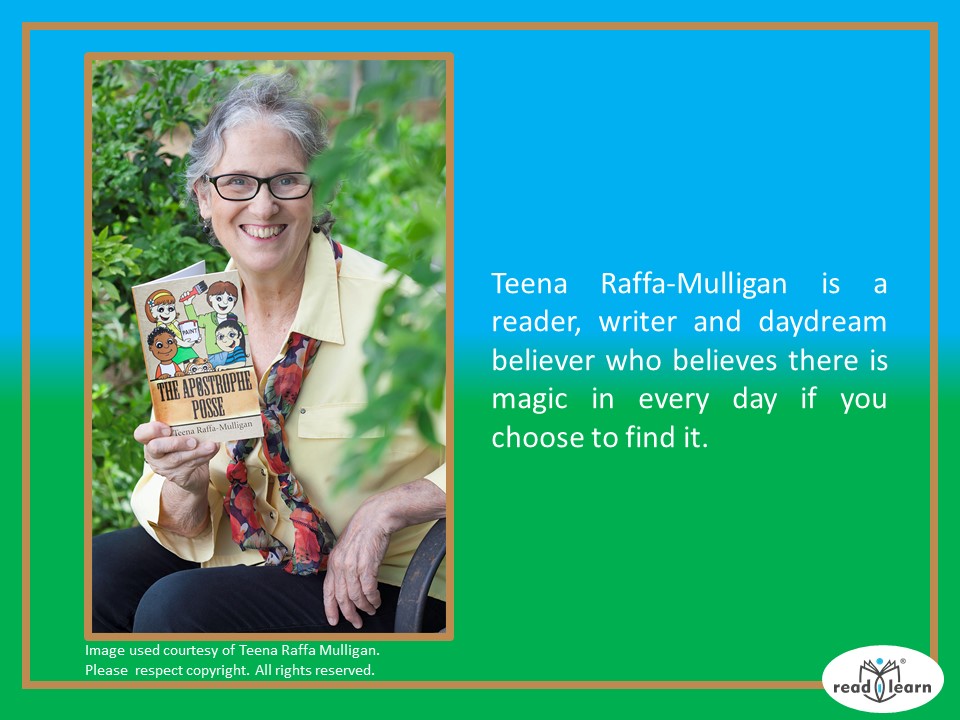
    Teena Raffa-Mulligan is a reader, writer and daydream believer who believes there is magic in every day if you choose to find it. She discovered the wonderful world of storytelling as a child and decided to become a writer at an early age. Teena’s publications for children include poetry, short stories, picture books and chapter books. Her writing life has also included a long career in journalism. She shares her passion for books and writing by presenting talks and workshops to encourage people of all ages to write their own stories.

    About The Apostrophe Posse

    Trouble comes to Tea Tree Bend…

    In cowboy movies the sheriff forms a posse to round up all the bad guys. Cam and Ellie from Daisy Cottage and their friends Billy and Louisa have formed a different posse. Their mission is to find and fix all the signs in Tea Tree Bend with missing apostrophes. The summer holidays are almost over so they have just nine days to complete their task.
    How can doing the right thing go so wrong?

    My thoughts

    I couldn’t resist reading a book with the title The Apostrophe Posse. Many writers, children and adults alike, have difficulty with apostrophes and I could just imagine a posse going out after all the missing or misused apostrophes. I see so much of it myself and would love to round up all those apostrophes and put them where they should be.

    I also found the consonance and assonance in the title appealing. It hinted that the book would be fun, and it is.

    The book would be a great stimulus to discussions about the placement of apostrophes, but it’s too good a read to be limited to that alone.

    Let’s find out what Teena has to say.

    The interview.

     Hi, Teena. Welcome to my blog.

    Thanks for inviting me.

    Teena, when did you know you wanted to be a writer?

    I grew up in an English/Italian family, surrounded by natural story tellers whose tales about their lives captured my imagination. Once I learnt to read, books opened a wonderful window into the world of make believe and I knew from a very early age that I wanted to become a writer. I also wanted to be a ballerina, so I thought I’d write novels in the dressing room between performances while travelling the world. Reality woke me from the dancing dream, but I didn’t give up on the ambition to become an author and began submitting short adult fiction and poetry to publishers in my late teens. When I became a mum at the age of 21 and began sharing books with my small son, I realised I wanted to write for children.

    Where do you write? Do you like to be by yourself in the quiet, or do you like to write in a noisy space?  

    Teena Raffa-Mulligan's roll-top desk

    I write in the lounge room in my recliner chair near the front window, in bed, at the kitchen bench, on the back patio, out on the deck overlooking the back garden, and I also have the luxury of my own office at home. When my children were small, I wrote anywhere around the house in snatched fragments of time. I didn’t have an office (they needed somewhere to sleep!) so I had a gorgeous timber roll-top desk in the kitchen that I bought with my first earnings from writing stories. It wasn’t quiet or peaceful with the business of the household going on around me and that didn’t seem to matter then. Those days are long gone, and I have become accustomed to my peace and quiet. I don’t even play music while I’m writing.

    What do you use to write – pencil and paper or computer?
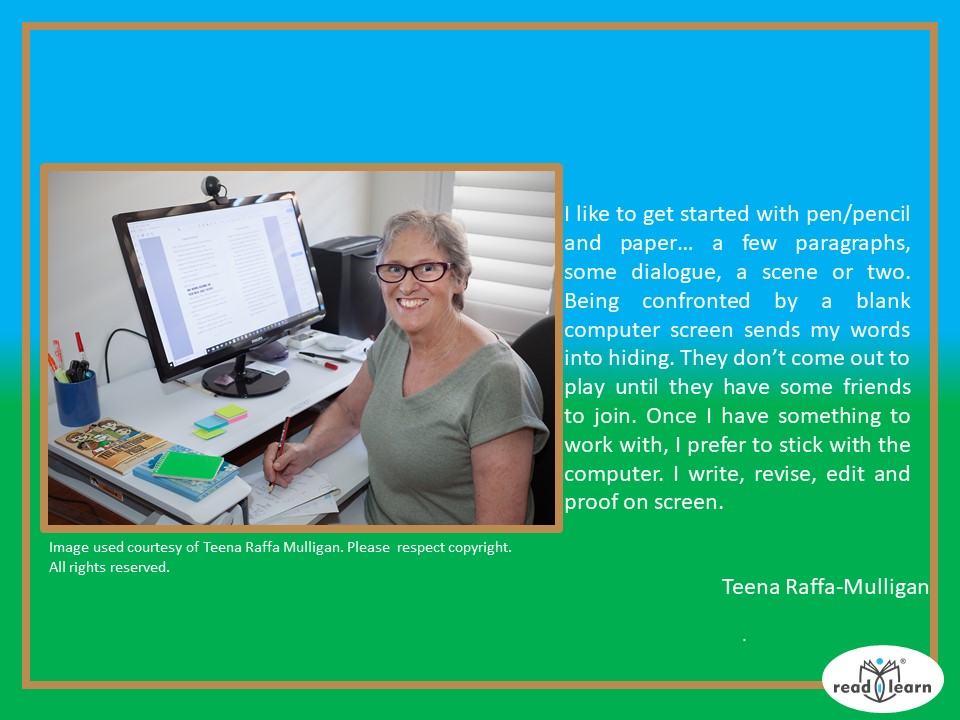
    Teena Raffa-Mulligan's writing process

    I like to get started with pen/pencil and paper… a few paragraphs, some dialogue, a scene or two. Being confronted by a blank computer screen sends my words into hiding. They don’t come out to play until they have some friends to join. Once I have something to work with, I prefer to stick with the computer. I write, revise, edit and proof on screen.

    When do you write?

    Not often enough! I spend hours every day on writing related activities but not necessarily on progressing my current WIP. I’m volunteer coordinator of the local writing centre so that keeps me busy. I also visit schools, libraries and community groups to present author talks and writing sessions whenever I get the opportunity. I recently ventured into indie publishing, releasing some of my own books and also my late father’s collection of spiritual writing. Then there’s social media to keep up with, plus reading blogs and watching videos to develop new writing and publishing skills. My new writing happens around all of that. I do set myself deadlines each week but they’re rather elastic.

    When do you get your ideas?

    They can come anytime and anywhere. The best ideas often arrive unexpectedly in the middle of the night, especially in winter when the last thing I want to do is leave my cosy, warm bed. I’ve learnt to keep notebooks handy after losing some wonderful stories because I thought I’d remember them in the morning. Once I have an initial idea, I don’t plan my stories. I start writing and see where they take me. This means I often don’t know what happens next. Walking, driving and washing dishes are great times for figuring that out.

    Do you think of the story in your head before you write it?

    Always. I compose sentences, mentally write paragraphs, describe scenes and devise conversations.

    What gave you the idea for The Apostrophe Posse?
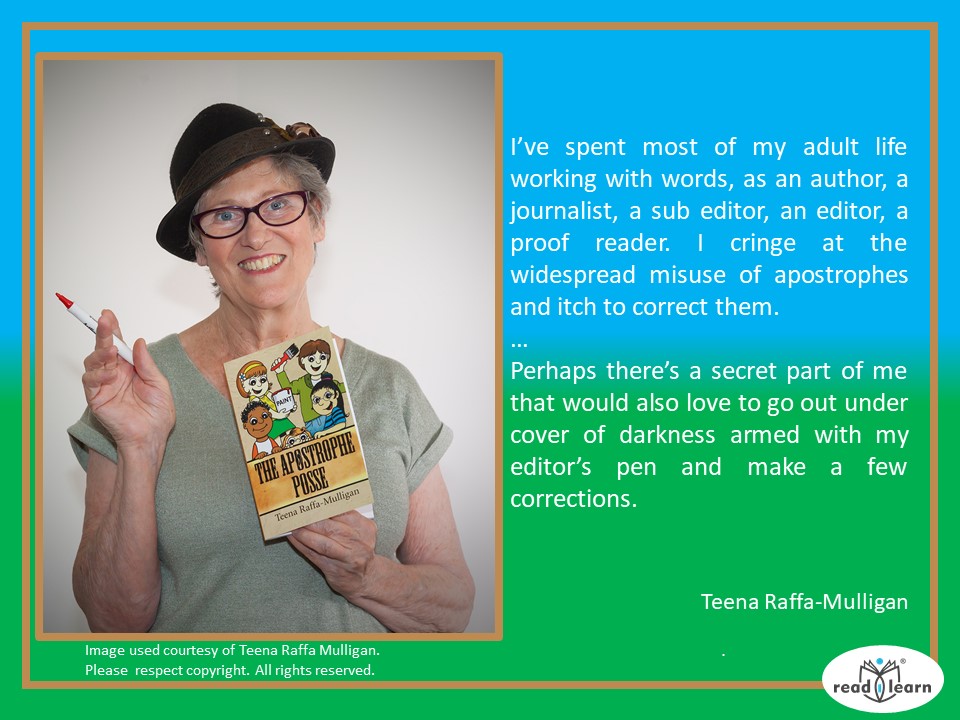
    Teena Raffa-Mulligan's thoughts about apostrophes

    I’ve spent most of my adult life working with words, as an author, a journalist, a sub editor, an editor, a proof reader. I cringe at the widespread misuse of apostrophes and itch to correct them. I love the book Eats, Shoots and Leaves by Lynne Truss. I was driving to my job at the local paper one morning after dropping my children off at school when the idea for The Apostrophe Posse popped into my head. I watched quite a few cowboy movies as a kid and the sheriff often gathers his posse of men to ride out of town to catch the bad guys. In my story that’s Cam and company and they want to find and fix all the incorrect signs around town.  Perhaps there’s a secret part of me that would also love to go out under cover of darkness armed with my editor’s pen and make a few corrections.

    What do you like best about The Apostrophe Posse?

    The way Cam, Ellie, Billie and Louisa want to put something right, but everything goes wrong.

    Do you like the way Veronica Rooke illustrated the cover?
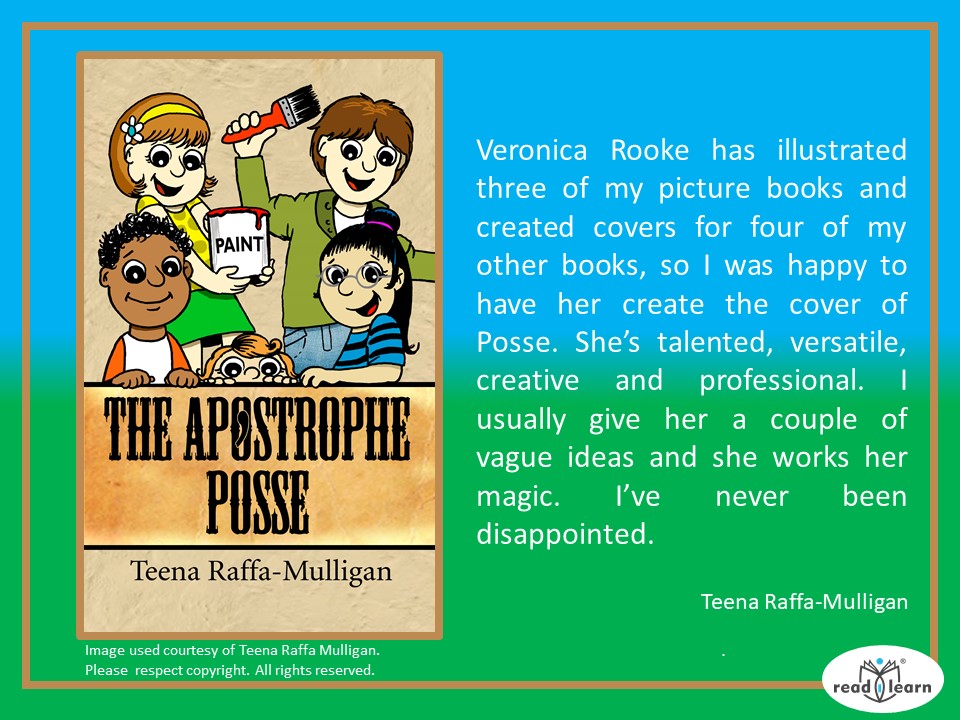
    Teena Raffa-Mulligan's thoughts on Veronica Rooke's illustrations

    Veronica has illustrated three of my picture books and created covers for four of my other books, so I was happy to have her create the cover of Posse. She’s talented, versatile, creative and professional. I usually give her a couple of vague ideas and she works her magic. I’ve never been disappointed.

    How did you feel when you wrote The Apostrophe Posse?

    It was fun coming up with what could go wrong when a group of well-meaning country kids set out to do their good deed for the community. Of course, everything worked out happily in the end, as it always does in my stories, so I sat at my computer with a big smile on my face.

    How do you hope readers will feel?

    It would be great if my story brought a smile to their day and left them with the feeling they’d made some new friends.

    How would you like teachers to present The Apostrophe Posse? to children?

    I hope it will be presented first as a book to enjoy, a fun story about a group of kids whose good intentions get them into trouble. Discussion could follow about community, cooperation, consequences and, of course, punctuation and why we need it if we are going to communicate clearly with each other.

    Are there any messages you would like them to discuss?

    Cooperation and the importance of working together to achieve something positive. Facing the consequences of our actions. Children could also think about why we have rules and guidelines in our communities and what might happen if there were none.

    Do you have any advice for teachers in their role as writing guides?

    If you’re excited about books and language, students will pick up on this. Create a spirit of adventure around writing stories and encourage them to explore where words can take them. A lot of kids get stuck at the start because they’re convinced they don’t know what to write or how to express the ideas they do have. It’s important to stress that they don’t have to get it right, just get it down. In the beginning, it’s all about creating something to work on.    

    Do you have any advice for children as writers?
    Teena Raffa-Mulligan's advice for children as writers

    Writing stories is fun. You get to create characters, put them in weird and wonderful situations and then decide what happens next. In your imagination you can be anyone, go anywhere and do anything at all. What will you be today? A super hero? A detective? An astronaut? Where will you go? Deep beneath the sea? To the top of the world’s highest mountain? To the farthest stars? It’s up to you! Don’t worry about whether what you’re writing is an amazing story. Just play with the words. Let one follow another and see where they take you. It’s an adventure.

    What is your favourite children’s book?

    I’ve read so many wonderful books for children over the years and it’s impossible for me to choose just one. Books I loved reading when I was in primary school were Enid Blyton’s Famous Five and Secret Seven series, E. Nesbitt’s Five Children and It and The Railway Children and Frances Hodgson Burnett’s The Secret Garden. What Katy Did also struck a chord, as did books by Elizabeth Goudge. As a teenager I discovered John Wyndham and read all of his books including The Chrysalids, Day of the Triffids and The Kraken Wakes. Fantasy also captured my imagination, particularly Anne McCaffrey’s Dragon Riders of Pern series.

    Who is your favourite children’s author? What do you like about his or her work?

    When I visit schools and children ask me which of the books I’ve written I like best, I always tell them I have three children and they are all special in their own way. I could not choose one ahead of the other. I feel the same about authors. I am in awe of some of the writing being produced, from picture books to YA novels, and I’ve lost count of the times I’ve come to the final word in a story and closed the book on the thought, ‘Wow! I wish I’d written that!’

    When my children were small, I enjoyed sharing the Dr Seuss books with them. I loved the way he played with words.

    thank you authors and illustrators

    Thank you, Teena. I enjoyed meeting you and finding out a little more about your writing process, your fun book The Apostrophe Posse and your purpose for writing it. As you said, there is much more to your book than a lesson in apostrophes. It is a lesson in life. You have shared so many valuable thoughts with us. I found myself nodding along with you and thinking, “I wish I’d said that!”


    Find out more about Teena

    from her website: Teena Raffa-Mulligan

    or her blog: In Their Own Write

    Connect with her on social media

    Facebook: Teena Raffa-Mulligan.Author


    The Apostrophe Posse blog tour schedule

    Check out other posts about The Apostrophe Posse on the Blog tour schedule:

    Monday April 1 – Friday April 5: www.justkidslit.com/blog

    PLUS!

    Tuesday April 2: www.instagram.com/thebyrdandthebookworms

    Thursday April 4: www.authorjillsmith.wordpress.com

    Friday April 5: www.littlebigreads.com

    SPECIAL FEATURE!

    Middle Grade Mavens Podcast: www.middlegradepodcast.com
    Thank you blog post

    Thank you for reading. I appreciate your feedback. Please share your thoughts.

  • What do you love?

    What do you love?

    We use the word ‘love’ to mean care deeply about, as in people, or like a lot, as in food, objects and activities. Questions such as “Who do you love?” and “What do you love?” will elicit very different responses and we generally have little difficulty in distinguishing between the intensity of the feelings. Mostly the whos are more important to us than the whats, and it is easy to distinguish between the likes and the loves, though they can sit along a continuum.

    love of vegetables on a continuum

    For me, housework sits at the opposite end of the continuum from reading and writing. You won’t find me writing any posts about housework. But you will find lots of posts about reading and writing, especially encouraging a love of reading and writing in children. I find sharing a love of reading and writing to be almost equal in enjoyment as reading and writing for myself. To see children light up with enthusiasm for reading and writing is sheer joy.

    the love of reading is one of the greatest gifts a parent can give a child

    I have often said that one of the greatest gifts a parent can give a child is a love of reading. A love of reading and writing, and indeed for all learning, is the best gift a teacher can give.

    the love of reading and writing is contagious

    It is often said that a love of reading is caught, not taught. The same goes for writing. It is important for teachers to ensure that there is time every day to read aloud to children, to inspire them and excite their imaginations with wonderful literature and to provide them with time for expressing their own thoughts and imaginative ideas through writing and any other of the expressive arts.

    I have written many blog posts, both here and for readilearn, with suggestions for making time for literature and literacy, but it was the prompt set by Charli Mills at the Carrot Ranch that kept me thinking that way this week.

    Carrot Ranch flash fiction challenge Valentines

    You see, Charli challenged writers to In 99 words (no more, no less) write a story about valentines. It can be Valentine’s Day, the exchange, love for another, romance, or friendship. Have a heart and go where the prompt leads!

    But, as well as being Valentine’s Day, 14 February is also Library Lovers’ Day and International Book Giving Day.

    Why wouldn’t I write about one of my loves — reading and writing? I hope you enjoy it.

    Just for the love of it

    The teacher closed the book, but the children were abuzz.

    “Keep going,” they urged.

    “Will they be alright?”

    “What will happen?”

    The teacher looked at the clock. The minutes had passed like seconds. Was there time?

    “Pleeeease!”

    The teacher opened the book.

    “Yay!” cheered the children, then hushed as the words flowed.

    As the story unfolded, their eyes lit up and imaginations sparked. They discussed the story’s intricacies and contemplated outcomes as they journeyed with the author through good and fearsome times. Finally, just as the dragon was about to swoop, the teacher stopped. “Now write! What happens next?”


    reading is a super power

    Here are links to just five of the posts I’ve written about reading and writing:

    A sprinkle of this, a pinch of that, and Poof! It’s reading — magic!

    Wrapping up a year of books — the gift of reading

    I love poems

    Reading is all it’s cracked up to be: 10 tips for an early childhood classroom!

    Writing poetry with children

    And two more about libraries:

    Libraries: A wondrous universe to explore — a guest post by Dimity Powell

    Libraries, books and reading = infinite worlds to explore

    Thank you blog post

    Thank you for reading. I appreciate your feedback. Please share your thoughts.
  • Announcing: It’s Time for Change – readilearn

    Announcing: It’s Time for Change – readilearn

    Over the coming weeks, we are making improvements to the readilearn site.

    During the changeover period, until mid-to-late March, we will not be adding new resources to the collection or publishing blog posts.

    Access as usual

    If you are already a readilearn subscriber or have registered to access the free teaching resources, you will still be able to log in and access resources during and after the changeover, as usual.

    Changes

    1. Individual prices

    Once the changes take effect, readilearn resources will be available as individually priced items.

    Note: If you are already a readilearn subscriber, your access to all readilearn resources will be uninterrupted while ever your subscription is current. The individual pricing will not affect your ability to access resources.

    1. Cost of subscription

    Continue reading: Announcing: It’s Time for Change – readilearn

  • Interview with author Wenda Shurety – Readilearn

    Interview with author Wenda Shurety – Readilearn

    This week, it is my pleasure to introduce you to author Wenda Shurety as she discusses her new picture book Eva’s Imagination. I especially enjoy Wenda’s book for its focus on imagination, something I consider very important to encourage in young children. Without imagination, we are unable to see beyond what is and have little chance of progress being made.

    About Wenda

    Wenda grew up in the beautiful county of Norfolk in England and now resides in Brisbane with her supportive husband, cheeky daughter and two rescue dogs. Wenda loves to write children’s stories with heart; whether it involves diversity, science or the magical world of the imagination.

    About Eva’s Imagination

    Eva doesn’t know what an imagination is. With the help of her dog Chops, Eva goes on a hunt to find it. Eva’s Imagination is a delightful story about the power of the imagination that aims to inspire young children to find adventure in their surroundings rather than from screens.

    Now let’s meet Wenda.

    The interview

    Continue reading: Interview with author Wenda Shurety – Readilearn

  • Teaching place value to young children – readilearn

    Teaching place value to young children – readilearn

    Teaching place value is a vital part of mathematics programs in lower primary classrooms. This post outlines lessons and activities to teach place value.

    Teaching place value is a vital part of mathematics programs in lower primary classrooms. It is essential that children develop a firm understanding of place value right from the start to avoid later confusion and maths anxiety.

    Sadly, many children and adults confess to having an aversion to mathematics. My belief is that the aversion is often learned from ineffective teaching methods. For this reason, there is a strong focus on number in readilearn resources with lessons and activities that provide opportunities to develop understanding in fun and meaningful ways.

    It starts with understanding number

    Before we begin to teach place value, we must ensure that children have a strong sense of number. Understanding number is more than simply being able to rote count or recognise numerals. While even very young children may learn to memorise and recite the sequence of numbers from one to ten, they don’t always understand what the words mean.

    Rushing children through to abstract processes before they have developed a strong foundation creates confusion. It sets them up for frustration, fear, failure, and a dislike of maths.

    This can be avoided by encouraging an “I can do it. I get this. Maths is fun” attitude.

    To develop an understanding of number, children require many and varied experiences using concrete materials in many different situations.

    One-to-one correspondence

    Continue reading: Teaching place value to young children – readilearn