Live Love Laugh Learn … Create the possibilities

Category: Quotes

  • It’s no surprise! Talking education

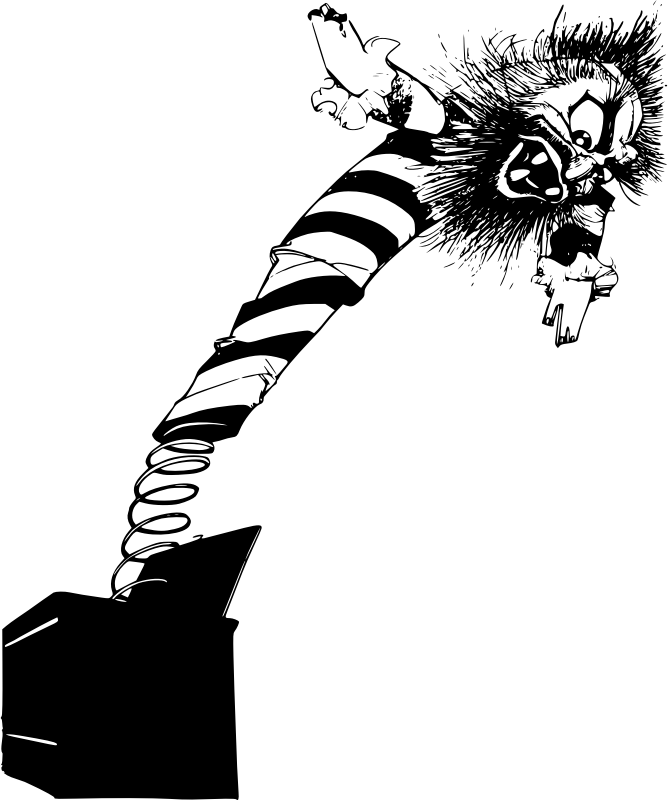
    https://openclipart.org/image/800px/svg_to_png/185077/creepyjackinthebox.png
    https://openclipart.org/image/800px/svg_to_png/185077/creepyjackinthebox.png

    We all like a surprise, right?

    Well, you might say, that all depends on whether the surprise is a good surprise or a bad surprise.

    A surprise is simply something unexpected, and everyday life is full of surprises; some so little they go almost unnoticed, others of larger more life-changing proportions. Some are pleasant and others far less so.

    What got me thinking about surprises this week is the flash fiction prompt posted by Charli Mills at Carrot Ranch Communications.

    Charli’s challenge this week is to

    In 99 words (no more, no less) write a story that shows surprise without using the word. 

    I have been thinking of all sorts of surprises I could write about but decided to maintain my focus on education.

    There are many opportunities for surprises to occur throughout one’s education, which is not limited to (but probably, dare I say, by) one’s schooling experiences.

    For example:

    • Discovering you can read a book, all by yourself
    • Discovering an author whose work you just can’t put down
    • Finding a solution to a problem that had seemed insurmountable
    • Achieving a favourable result in a dreaded test
    • Being offered a place in the course you were wanting
    • Having work accepted, valued and receiving payment


    There are many situations in which the surprise could go either way.

    For example:

    • Being called to the principal’s office
    • Having a parent-teacher interview about your own child, or student
    • Receiving exam results or course placement offer
    • Meeting a new teacher
    • Working in a group to solve a problem


    Being a lover of stories, especially picture books, it is rare that a situation doesn’t trigger a thought connection to a story or book I have read.

    Thinking about the good surprises and bad surprises that could happen in some of these situations made me think of a book I had read to my own, and classes of, children years ago. Maybe you will remember it also.
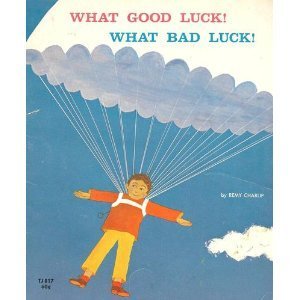
    what good luck what bad luckThe book is What Good Luck! What Bad Luck! by Remy Charlip and relates a sequence of events alternating between good and bad.

    It appears, from what I can find out, that it was first published by Ashton Scholastic in 1964 and sold for 60 cents.

    Today Amazon has used copies on offer for $34.99 or $122 and a collectible as high as $157.70.

    What good luck, I used to have a copy.

    What bad luck, it is no longer in my possession.

    I was at the stage of mentally composing my story with my fingers itching to get to the keyboard to translate it into print when I glanced at the morning paper1 and came across this headline:

    Lesson 1: Bad teachers = bad results

    As a teacher who is passionate about education but also critical of top-down force-fed schooling institutions, headlines/comments like these have me vacillating between defiant self- (and professional-) protection and agreement with the criticisms.

    Teachers come in for a lot of criticism, some of it deservedly so, other of it not so much.

    One quote I love is “Teaching is the one profession that creates all other professions”.

    On the flip-side of this is “Those who can, do. Those who can’t, teach.”

    While I take offense at this one, sometimes I am inclined to think it alludes to an important quality in a teacher. Frequently those who are expert at something, find it difficult to break a process into a series of steps that would enable an explanation to be easily understood by others. If one has struggled to master a task, the process can seem clearer and easier to explain. However there does come a point below which knowledge and experience must not fall or effective teaching cannot exist.

    In her article Bad teachers = bad results, Kylie Lang says that

    “C-grade teachers will not produce A-grade results”.

    She says,

    “Too many mediocre minds are becoming teachers. Universities usher them in, these academic underperformers who fail to qualify for courses with higher entry requirements.”

    She says that

    “A federal education department report shows a rise in the number of school leavers with poor grades being offered places on teaching courses. This year, 55 percent of Year 12 students that were allowed to undertake teaching degrees had an Australian Tertiary Admission Rank below the average . . .”

    It is a bit scary, isn’t it?

    She also says that,

    “If we are a nation that values education . . . we must attract brighter, more creative thinkers to classrooms.”

    I couldn’t agree more. However I wonder where they will get those creative thinkers if higher order thinking skills, creativity and innovation are sacrificed in the relentless quest for scores on academic tests which require students to spit back information forced upon them in hours of didactic instruction and rote learning.

    It’s no surprise that anyone who maintains the ability to think outside the square would rather not return to it!

    And so to my flash piece for this week, which comes with a warning – there’s no rhyme because there is no reason:


    What luck!

    No books, no talk were in the home.

    What luck!

    He was happy to play on his own.


    School began when he was five.

    What luck!

    Learning from flash cards, how hard he tried.


    “My boy can’t do it!” his Mum once wailed.

    What luck!

    With ‘forged’ test scores no child would fail.


    Leaving school, the options were few.

    What luck!

    Teaching was the one he could do.


    Uni years flashed by so fast.

    What luck!

    Number requirements meant he passed.


    Then into the classroom he unprepared went.

    No future joy for any student.

    What bad luck!


    I always enjoy reading your comments. I invite you to share your thoughts.


    1 Courier-Mail, Sunday May 25 2014


    If you enjoyed this post, you may enjoy others. Please click the button at the top on the right to receive future posts by email.

  • Child’s play – the science of asking questions

    Unknown source. Apologies. Happy to attribute if informed.
    Unknown source. Apologies. Happy to attribute if informed.

    I often say that children are born scientists. From the moment they are born they are actively finding ways of figuring out how the world works, and how they can get it to work for them.1

    Some people say children are sponges. But I say they are more than that. They are creators. They don’t just copy what they see. They don’t just repeat what they hear. They find new ways of working things out, new ways of expressing ideas, and new ways of thinking about things. Parents often remark, when children exhibit new behaviours or cute new phrases or ways of expressing themselves, “Where did they get that from? Where did they learn that?” Often the source cannot be identified, for the source is within the child.

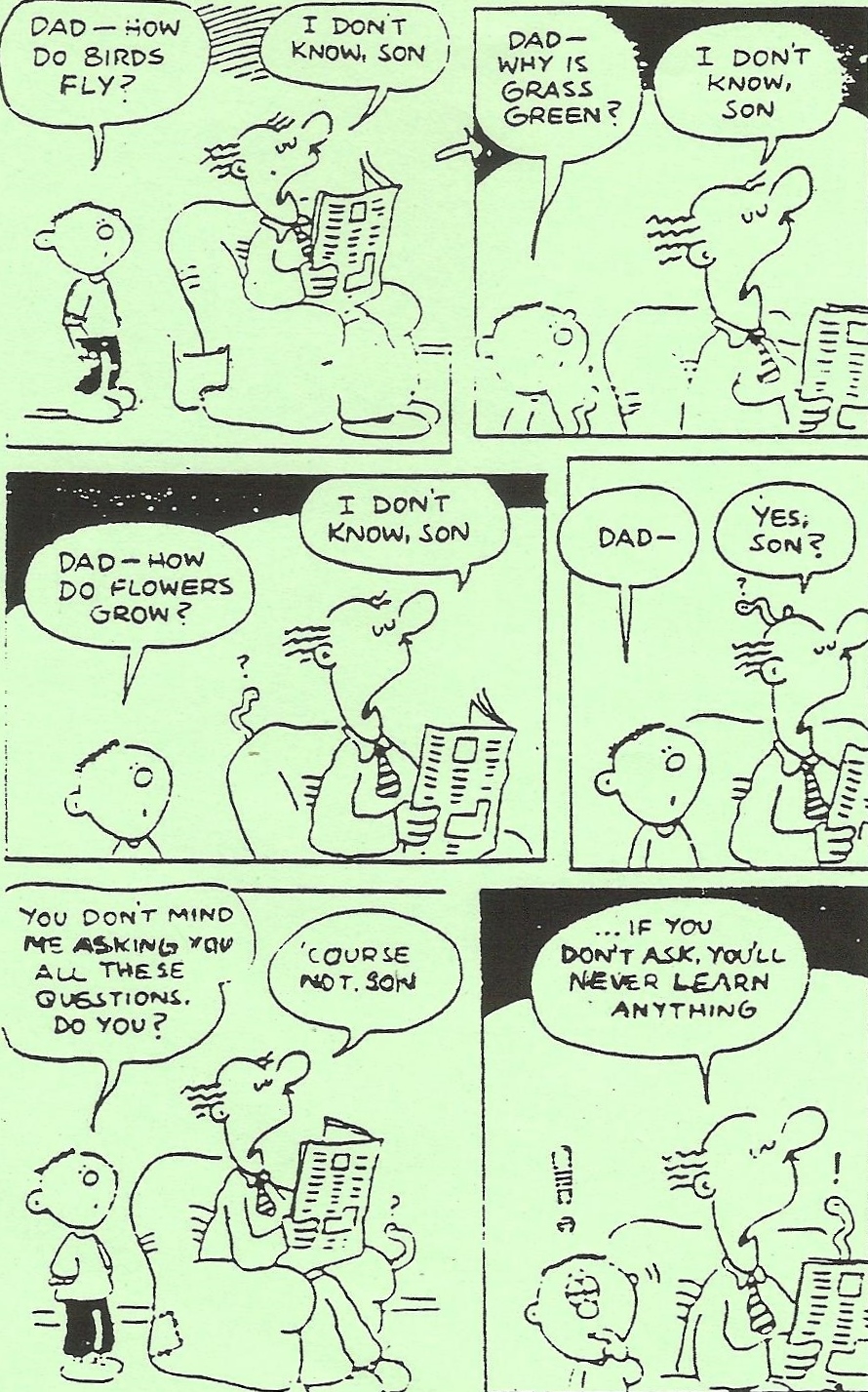
    An important way to keep children creating their own understandings and ideas is to not only allow them to ask questions, but to actively encourage them to do so, and to help them seek answers to their questions. Adults can be quick to quiet children’s questions for a number of reasons including not knowing the answer, being too busy at the time to investigate an answer, or even considering the question unimportant or “dumb”.

    Unknown source. Apologies. Happy to attribute if informed.
    Unknown source. Apologies. Happy to attribute if informed.

    Remember, many things that adults may take for granted or that they may no longer question but simply accept (possibly as a result of not receiving appropriate answers or responses to their childhood questions) are new and unfamiliar to the child.

    Sometimes it is easier to accept than to question for questioning means that something is unknown; and not knowing can lead to feelings of insecurity, doubt and instability. But it is these self-same feelings which drive innovation and progress. If everything was known, there would be no room for improvement, no need for anything new, no need for greater understanding.

    This inspiring TED talk by Beau Lotto and Amy O’Toole, Science is for everyone, kids included emphasizes the need for children to be given the opportunity of asking, and exploring answers to, questions.

    Beau explains that what we see is based upon our experience, upon our expectations. But he asks,

    “if perception is grounded in our history, . . . (and) we’re only ever responding according to what we’ve done before . . . how can we ever see differently?”

    He goes on to explain that seeing things differently begins with a question and that questions lead to uncertainty. He says that

    The-best-questions-are

    and explains that the answer to uncertainty is play. He says that play “is a way of being” and is important for five reasons:

    • Uncertainty is celebrated in play and makes play fun
    • Play is adaptable to change
    • Play is open to possibility
    • Play is cooperative
    • Play is intrinsically motivated

    “Play is its own reward.”

    Beau says that science, also, is a way of being; and that science experiments are like play.

    He describes working with a group of 8-10 year old children, encouraging them to ask questions and involving them in an investigation of a question they posed.

    Amy O’Toole, one of the children involved, joins Beau and describes the experiment which investigated the ability of bees to “adapt themselves to new situations using previously learned rules and conditions.”

    The really exciting thing about the project, Amy says, was that they “had no idea whether it would work. It was completely new, and no one had done it before, including adults.”

    The process of taking the findings of the project to publication, as Beau explains, was rather complex with a variety of complications, taking two years to achieve. The experiment itself took only four months! Publication of the paper made Amy and her friends the youngest ever published scientists.

    The response to the paper, The Blackawton Bees is amazing:

    30 000 downloads on the first day

    Editor’s Choice in Science (a top science magazine)

    the only paper forever freely accessible on Biology Letters and

    the second-most downloaded paper from Biology Letters in 2011

    Amy wraps up the talk by stating that

    “This project was really exciting for me, because it brought the process of discovery to life, and it showed me that anyone, and I mean anyone, has the potential to discover something new, and that a small question can lead into a big discovery.”

    She finishes by saying that

    “science isn’t just a boring subject … anyone can discover something new.”

    We might not all make those big scientific discoveries, but it is the questions we ask each day which lead to our own discoveries, no matter how small; it is our curiosity which keeps us learning.

    What have you learnt today?

     Changing-the-way-a

    1 This is just my opinion formed from observations, discussions and reading. I am not supporting it with research references.

  • Going on a treasure hunt!

    we're going on a bear hunt

    A few weeks ago I had the great pleasure of taking my two gorgeous grandchildren to a performance of Michael Rosen’s “We’re Going on a Bear Hunt”. To say we enjoyed it would be an understatement. We had a rollicking good time.

    The performance involved a lot of audience participation including spraying the entire audience with water from the “deep cold river”; an event which left everyone slightly wet, screaming with anticipation and laughter, and genuinely having a wonderful time interacting with this fabulous text.

    We were already familiar with the text, of course, and had read it, recited it, acted it out and played a board game which has been made to accompany the text. None of this really prepared us for the delightful stage performance; but these pale in comparison with a telling by the master storyteller himself, Michael Rosen.

    Michael Rosen’s website is a veritable treasure chest with much to explore and delight.  From his home page you can visit his blog which he describes a as a place where he’ll

    “post up some thoughts and ideas – especially on literature in education, children’s literature in general, poetry, reading, writing, teaching and thoughts on current affairs.”

    You can also check out a full list of his publications. He’s very prolific!

    After attending the performance of “We’re Going on a Bear Hunt” I shared with my grandchildren the video of Michael Rosen performing the story, which is also available from his home page. They loved it and we watched it “Again!”

    Then I showed them the video of Rosen performing his fabulous poem Chocolate Cake. We watched it four times! Artie, who is four (and a half) was joining in with the telling the second time, and by the fourth time was copying many of Michael’s actions as well as facial and vocal expressions. Artie laughed along with the story and excitedly called other members of the family to watch it with him.

    The next time Artie came to visit he was performing his own version, “Lollipop”, with similar actions and both facial and vocal expressions. His younger sister also had to have her turn telling the story. It was delightful and convinced me, though I needed no convincing, of the power of a great performer to turn children onto the fun of language, of playing with words, of performing, and of composing writing of their own. Creativity ignited!

    If you haven’t yet watched Michael perform Chocolate Cake, I urge you to do so. You are in for a treat. I’m certain you will not be able to watch it without a smile on your face.

    Michael is so passionate about making poetry come alive for children, he has made many videos on his website freely available to teachers for use in their classrooms.

    In his article “Teachers write to me saying, ‘What about poetry?’”, Michael begins by saying,

    The-best-thing-you-can

    He then goes on to present many fun ways of engaging children with poetry, none of which involve word study or comprehension exercises. He makes suggestions for performing, writing and talking about poems; and says that

    “The best and most important thing you can do with any poem that a child writes is either get it performed or ‘published.”

    and offers suggestions of how to do just that.

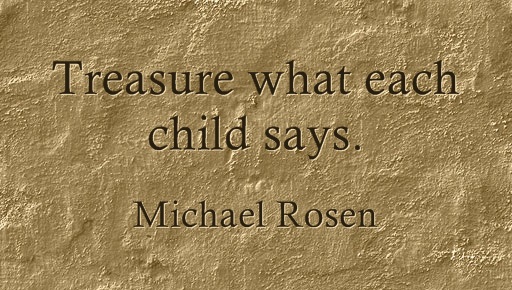
    Another thing he says in that article, which was the inspiration for the title of this post, is

    Treasure-what-each-child

    I couldn’t agree more.

    This is just a brief sample of the riches to be found on the Michael Rosen website. There are so many videos of Michael’s performances available that I have not yet watched them all. Please let me know your favourites and I will make sure I watch those too.

    Thanks Michael Rosen. We can learn so much from you while we are having fun!

  • The magic effect – why children need books

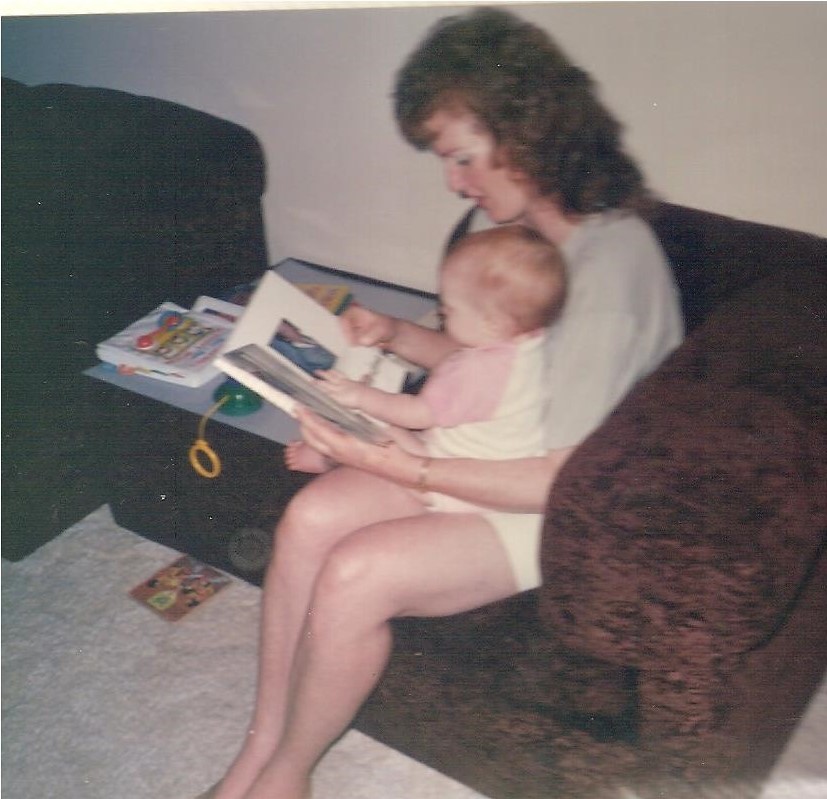
    Nor and Bec reading


    Children can be read to from the moment they are born, if not earlier. Preferably earlier!

    One of my favourite picture book authors and passionate advocate for reading to children is Mem Fox. I own, and have given as gifts, many of her wonderful books. I have attended her seminars and been mesmerised by her reading from her selection of stories. “Read more!” the adults beg. There are no children at these literacy seminars. This time it is a treat for only us: parents and teachers, literacy educators all.

    Currently Prince William, Kate and baby Prince George are visiting Australia. I was delighted to hear that they were given a gift of books by Australian authors, including some by Mem Fox. Over the years I have given many of Mem’s books as gifts; and kept just as many for myself!

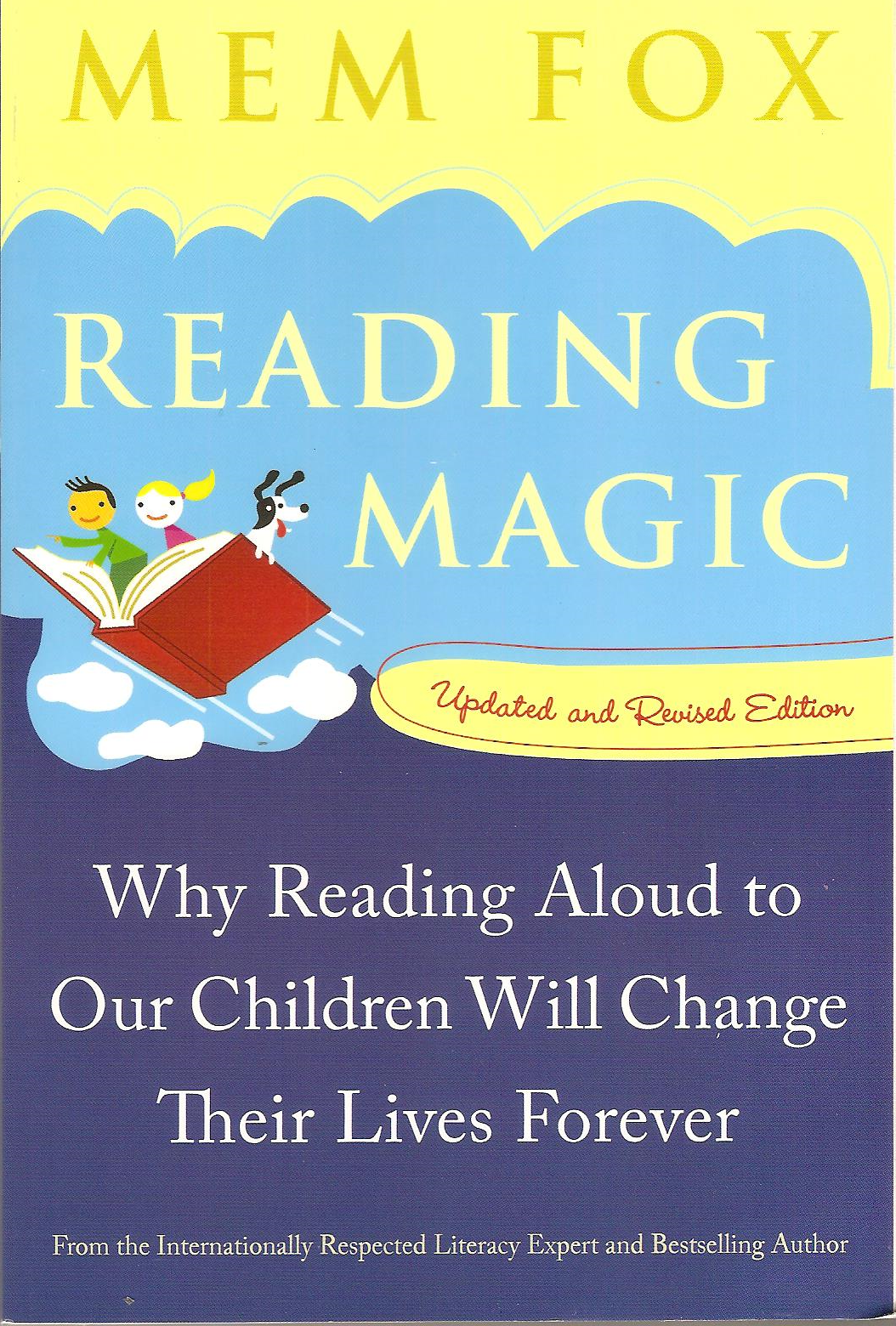
     Reading magic

    One that I have given to many new or expectant parents, as I consider it a “must read”, is Mem’s book “Reading Magic – Why Reading Aloud to Our Children Will Change Their Lives Forever”.

    I would love to quote the entire book for you, but it is better you read it for yourself. I will provide you with this quote from the foreword as a taster for the richness to be found inside.

    “It stands to reason that if we’re able to raise happier, brighter children by reading aloud to them, the well-being of the entire country will ramp up a notch. Children who realize in their first few weeks and months of life that listening to stories is the purest heaven; who understand that books are filled with delights, facts, fun, and food for thought; who fall in love with their parents, and their parents with them, while stores are being shared; and who are read aloud to for ten minutes a day in their first five years, usually learn to read quickly, happily and easily. And a whole lot of goodness follows for the entire community.”

    Mem's website


    Mem’s website, too, is a treasure trove just waiting to be explored by writers, teachers, parents, children and children-at-heart.

    You can listen to Mem read from her selection of books on the Current Read Aloud page. She reads three different books each month. Currently the books are Possum Magic, Harriet, You’ll Drive Me Wild! and Goodnight, Sleep Tight. Be quick to listen to these, though, as they will change at the end of the month. But never mind, there’ll be another three to enjoy next month!

    Mem even gives a read-aloud lesson! Now there’s no excuse! As she says,

    “. . . let’s get on and change the world, one page at a time.”

    Yes, Mem, let’s!


    What are your favourite read-aloud books? What did you enjoy as a child? What do you enjoy now?

  • This is nice

    If you haven’t yet visited Brain Pickings by Maria Popova, this week’s newsletter is a great place to start.

    Maria Popova describes herself as “an interestingness hunter-gatherer and curious mind at large”. She gathers up all sorts of things that you didn’t know you were interested in, until you are.

    Brain Pickings — “is a cross-disciplinary LEGO treasure chest, full of pieces spanning art, design, science, technology, philosophy, history, politics, psychology, sociology, ecology, anthropology, and more”.

    I’m sure you will find something of interest to you!

    This week’s offering If This Isn’t Nice, What Is? Kurt Vonnegut’s Advice to the Young on Kindness, Computers, Community, and the Power of Great Teachers  provides ideas, quotations and excerpts from speeches made by Kurt Vonnegut at college graduation ceremonies between 1978 and 2004.

    Here are just a few that I found particularly interesting or appealing. Please visit Brain Pickings for a more complete synopsis.

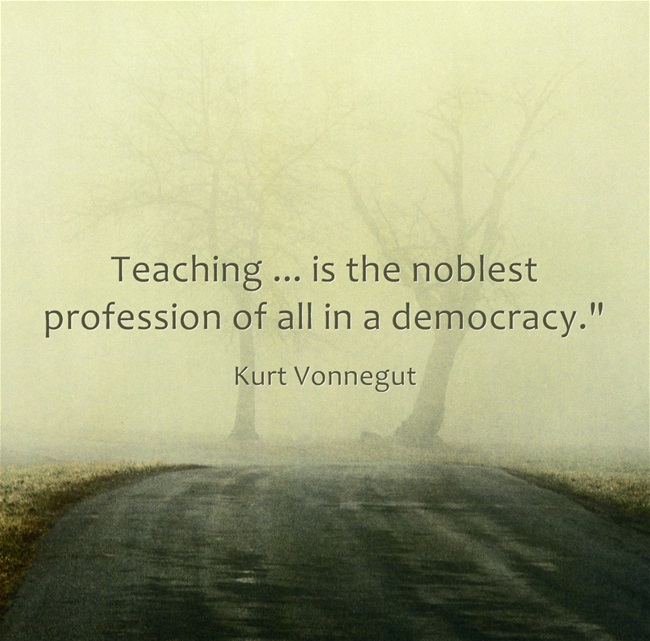
    Teaching-is-the-noblest

     “But I say with all my American ancestors, “If what Jesus said was good, and so much of it was absolutely beautiful, what does it matter if he was God or not?”

    If Christ hadn’t delivered the Sermon on the Mount, with its message of mercy and pity, I wouldn’t want to be a human being.

    I would just as soon be a rattlesnake.”

    “But in our personal lives, our inner lives, at least, we can learn to live without the sick excitement, without the kick of having scores to settle with this particular person, or that bunch of people, or that particular institution or race or nation. And we can then reasonably ask forgiveness for our trespasses, since we forgive those who trespass against us. And we can teach our children and then our grandchildren to do the same — so that they, too, can never be a threat to anyone.”

    “I recommend that everybody here join all sorts of organizations, no matter how ridiculous, simply to get more people in his or her life. It does not matter much if all the other members are morons. Quantities of relatives of any sort are what we need.”

    “By working so hard at becoming wise and reasonable and well-informed, you have made our little planet, our precious little moist, blue-green ball, a saner place than it was before you got here.”

    “When things are going sweetly and peacefully, please pause a moment, and then say out loud, “If this isn’t nice, what is?”

    If-this-isnt-nice-what-is

    Which ideas of Kurt Vonnegut do you find interesting?

    With which do you agree or disagree?

  • Flash fiction – Vagaries of time

    The fifth flash fiction challenge from Carrot Ranch Communications:

    In 99 words (no more, no less) write a story that quotes from a song’s lyrics (could be a classical aria, a rock & roll song, anything).

    This is my contribution. I hope you enjoy it.

    Vagaries of Time

    She rubbed the grimy pane, squinting to peer inside.

    It was all boarded up now with chairs stacked haphazardly on tabletops and piled in corners decorated with cobwebs.

    On one side stood the jukebox covered in dust.

    Suddenly she was back in his arms, their bodies pressed tightly together, swaying to Mick singing “time is my side”. They thought they would be young and in love like this forever.

    “Hmmhmm! You okay, Miss?”

    “Yes,” she stammered, embarrassed.

    She stumbled down the steps, smiling as the words in her head became Van’s “precious time is slipping away…”

    Thanks for reading. I welcome all feedback.

  • Liebster Award acceptance responses

    liebster2

    Recently I nominated a number of bloggers for a Liebster Award. Out of the thirteen I nominated, six chose to share their thoughts by answering the questions I asked. Considering the percentage of responses that are often received to a survey, I think this is a great result.

    Below I have presented the questions that I asked and collated a summary of each response. If you wish to read each respondent’s answers in full, please visit their blogs. I’m sure you will find much more of interest.

    You may notice that not all respondents have answered every question, and that one respondent has chosen another question of her own. That’s okay. I gave them permission to do so!

    Remember, these were open-ended questions with no wrong answers and everyone did a marvelous job in answering them. I am very grateful to each for sharing the depth and openness of their thoughts. I think we have much to learn from them, and from each other. This is a list of respondents with links to their blogs.

    Anne Goodwin  annethology  annecdotal Anne Goodwin’s Writing Blog

    Nillu Nasser Stelter, Fiction and Freelance Writer

    Nicole Hewes Cultivating Questioners

    Charli Mills Carrot Ranch Communications Words for People!

    Caroline Lodge book word

    Nanny Shecando


    1. What do you value most in life?

    Anne Goodwin

    Authenticity; ambivalence; fairness; mutual respect.

    Nillu Nasser Stelter

    the ability to choose how I live my life. Freedom is everything.

    Nicole Hewes

    moments of possibility and opportunity, where the world seems open and the choices seem infinite

    Charli Mills

    living in such a way that I look for beauty all around me and find good even when life’s path gets rocky

    Caroline Lodge

    my daughter

    Nanny Shecando

    the chance I get everyday to make the most of it. That I can do whichever I chose to do.


    2. What activities do you enjoy and why?

    Anne Goodwin

    Reading and writing; walking in the countryside; choral singing and growing (some of) my own food.

    Nillu Nasser Stelter

    lazy afternoons in the park with my family; sinking into a bubble bath with a good book; singing when nobody is listening and dancing when nobody is watching

    Nicole Hewes

    reading

    Charli Mills

    Activities that connect me to living in the moment: gardening, cooking and writing about the birds outside my window

    Caroline Lodge

    Reading and writing, and talking about both with other enthusiasts.

    Nanny Shecando

    any activity that allows me to be creative


    3.What is something you wish you had more time for?

    Anne Goodwin

    I don’t think we can do everything (that’s what fiction is for – the chance to live other lives) and I’m reasonably happy with how I portion out my time.

    Nillu Nasser Stelter

    reading and writing; other creative pursuits

    Nicole Hewes

    travel, try new recipes, read more books, and to spend with my friends and family

    Charli Mills

    I’ve found that by taking time to stare at a sunset or falling snowflakes, I have all the time in the world. It’s what I do with it that matters.

    Caroline Lodge

    it’s not so much time as ability to fit all the things I love in my life

    Nanny Shecando

    read more books


    4.What is one change you would like to make in the world?

    Anne Goodwin

    a shift in emphasis from a culture of greed to one of equality and compassion

    Nillu Nasser Stelter

    more understanding for each other, first within our own countries and then across country boundaries; clean water for all!

    Nicole Hewes

    change our society so that equal educational opportunity could actually exist, so that everyone could have access to basic resources, and so that money and special interests wouldn’t dictate the media

    Charli Mills

    contribute to world change through one beautiful book at a time; honor the hero’s journey within us all and to actualize everyday beauty

    Caroline Lodge

    World peace; access to books for everyone

    Nanny Shecando

    people holding themselves accountable for their actions


    5.What is something you would like to change about yourself?

    Anne Goodwin

    I’d like to be more laid-back; a published novelist

    Nillu Nasser Stelter

    I’d like to care less about what other people think about me.

    Nicole Hewes

    I would like to be a tad more outgoing and a little less independent

    Charli Mills

    To stop worrying whether or not people approve of what I do.

    Nanny Shecando

    to practice a, “you’re full of greatness so long as you tap into it and utilise it” mentality


    6.What surprises you most about your life – something good in your life that you hadn’t expected, dreamed of or thought possible?

    Anne Goodwin

    taking part in choral concerts of major classical works along with some pretty decent singers and a full orchestra. It’s a real emotional hit

    Nillu Nasser Stelter

    The ease of transition from single person to family life; how tiring and rewarding it would be.

    I have evolved from a child with a mass of insecurities to someone who is comfortable with herself.

    Nicole Hewes

    Being in a relationship with a partner with a worldview quite different from mine who challenges my views and assumptions and is incredibly kind, supportive, and loving.

    Charli Mills

    an upheaval in my life would open the door for me to step into that writer’s life. It isn’t easy, but it is what I’ve dreamed of doing and I’m doing it.

    Caroline Lodge

    That it goes on getting better, that I go on learning, that there are so many amazing people in the world and I know some of them.

    Nanny Shecando

    that I am able to be so happy, comfortable, confident and secure in leading the life that I do.


    7.What ‘big” question do you often ponder?

    Anne Goodwin

    The fact that our species has invested so much energy and creativity in the technology of warfare and so little in strategies for living in peace with our neighbours.

    Nicole Hewes

    Why our differences continue to lead to such polarization and why empathy can be so selective.

    Charli Mills

    How do I listen to God’s calling and live in the light?

    Caroline Lodge

    How can articulate and intelligent people inflict direct and indirect suffering upon others?

    Nanny Shecando

    life vs the state of dreaming. How can we really distinguish which is which? How do we know if what we perceive to be real is actually so?

    8.What sorts of things amuse you?

    Anne Goodwin

    my husband’s dreadful punning jokes. And I quite like dark humour exemplified by the ditty Always Look on the Bright Side of Life from The Life of Brian

    Nillu Nasser Stelter

    Slapstick comedy and Ally McBeal; innuendo; the children

    Nicole Hewes

    comments that my second graders make in our classroom; when the ridiculousness of an idea is exposed by positing the same thinking in another situation.

    Charli Mills

    Silly little things

    Caroline Lodge

    Unintentional meanings in things like the sign “uncontrolled pedestrian crossing” in London.

    Nanny Shecando

    the daily conversations that I get to share with the kids.


    9.What do you like to collect?

    Anne Goodwin

    Slugs from the garden

    Nicole Hewes

    copies of student work that blows me away with its insight or hilarity (I have a “smile file” where I keep these items). I also like to collect quotes and articles and stories that suggest that gender roles are actually shifting and gender stereotyping is altering. And pasta recipes

    Charli Mills

    Stuff from the ground that’s old–rocks, fossils, arrowheads, purple glass.

    Nanny Shecando

    books and old sheet music


    10.If you could talk with anyone and ask them to explain their ideas and/or actions, who would it be, and why?

    Anne Goodwin

    I’d ask the women who doled out white feathers to men out of uniform in the First World War why they thought they had the right. If I couldn’t time travel, I’d ask our Prime Minister, David Cameron, why he isn’t ashamed that a rich country like ours has spawned so many food banks.

    Nillu Nasser Stelter

    both my grandfathers, who have both sadly died

    Charli Mills

    I’d love to talk to my 5th-great grandfather and ask him why he left North Carolina. He was a poet and wrote such sad verse about leaving those mountains as an old man.


    11.What is something you can’t do without?

    Anne Goodwin

    My glasses, voice-activated software

    Nillu Nasser Stelter

    feeling connected

    Nicole Hewes

    a good book on my person at all times

    Charli Mills

    Internet!

    Caroline Lodge

    my daughter

    Nanny Shecando

    a notebook and pen


    12.What is something important you learned about life, and how did you learn it?

    Anne Goodwin

    That, unlike a work of fiction, we can’t scrub out the bits that don’t work and start again.

    Charli Mills

    A life of truth is not an easy one.

    Nanny Shecando

    you don’t get anything unless you ask for it


    13.What is your earliest memory?

    Anne Goodwin

    I distinctly remember standing on the steps leading up to the front door of our house, replying “two in August” to a passerby who’d asked my age. However, this being one of the stories my mother liked to tell about me, and knowing what I do about the fallibility of autobiographical memories, especially those from early childhood, I doubt its authenticity, and regard it as my mother’s memory, not mine.

    Nillu Nasser Stelter

    Probably my gran singing ‘Nanu maru nak’ (my nose is small), a Gujarati nursery rhyme, to me, but I often question whether my memories are real or reconstructed, so I can’t be sure.

    Charli Mills

    One of my earliest memories is of a black cat that I coaxed into being a pet on a ranch where I lived the first seven years of my life. That cat made me feel safe

    Caroline Lodge

    Someone threatened to steal my little sister. It was an early experience of a quandary: if I went to get adult help she might get taken, but could I make sure she was safe on my own. I was scarcely 3 and she was newborn.

    14.What sorts of things irritate you? (Caroline Lodge)

    Caroline Lodge

    There are lots of things, and one of them is the pervasive idea of favourite books and writers in tweets and blogs. It’s such a simplistic, reductionist concept that I try to avoid it. I added this question, just so I could indulge in a favourite whinge.


    The responses reflect the richness of our humanity, both the commonality and its diversity. Which responses strike an accord with you? With which do you differ?

    Please share your thoughts and keep the conversation going.


  • Searching for truth in a picture book – Part C

    Cocoon or chrysalis – what’s in a name?

    In my previous post Searching for purpose in a picture book – Part B  I conducted this poll:

    If you didn’t participate in the poll, but would like to, have a go now.

    What did you answer?

    If you are familiar with this book

    The Very Hungry Caterpillar

    you may have chosen both statements as correct along with one third of respondents in the poll.

    In his book Eric Carle writes that

    “He (the caterpillar) built a small house, called a cocoon, around himself. He stayed inside for more than two weeks. Then he nibbled a hole in the cocoon, pushed his way out and . . . he was a beautiful butterfly!”

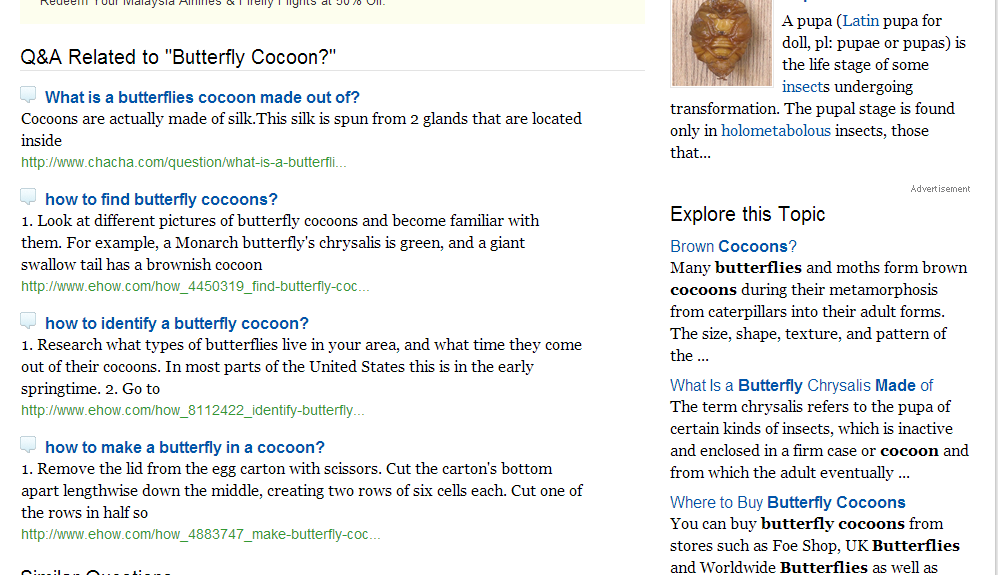
    If you either read or wrote one of the hundreds of thousands of articles about “The Very Hungry Caterpillar”, or about butterflies and caterpillars in general, published on the internet, you probably also identified those two statements as correct.

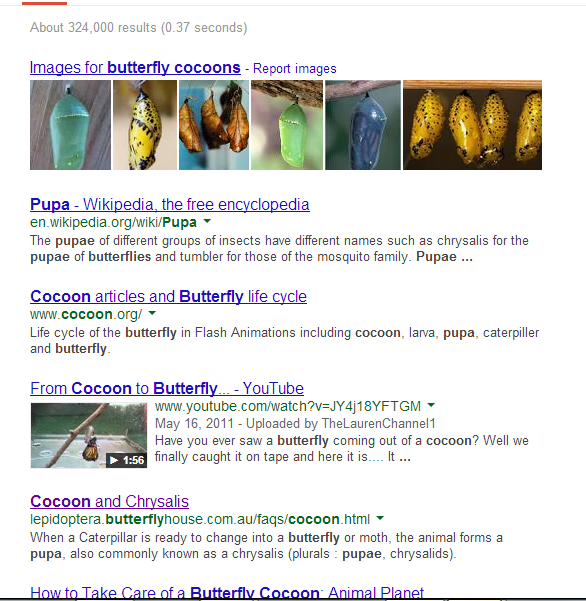
    butterfly cocoons Cocoon to butterfly

    But if you did, just like Eric Carle, you’d be wrong!

    A caterpillar that undergoes metamorphosis to become a butterfly does not spin a cocoon and does not nibble its way out. The fully grown caterpillar moults into a chrysalis and, when ready, it splits the chrysalis to emerge as a butterfly.

    Monarch butterfly

    For a series of beautiful photos showing the last moult of a caterpillar as it becomes a chrysalis, and another series showing a butterfly emerging from its chrysalis, click here.

    Or watch this video by Strang Entertainment showing the caterpillar becoming a chrysalis

    or this one by Neil Bromhall showing a butterfly emerging

    A moth’s caterpillar does spin a cocoon and does nibble its way out (think of a silkworm cocoon and moth).

    silkworms24a

    This video shows silkworm caterpillars nibbling hungrily away at the mulberry leaves. Then when a caterpillar is fully grown (about 2 mins in) it spins it cocoon.

    Compare the process with that of a monarch caterpillar forming a chrysalis. It is a very different thing.

    It is impossible to rely on the information provided by many of the websites to guide one’s use of “The Very Hungry Caterpillar” when working with children.

    For example, on the website Math & Reading Help, these suggestions are made:

    “Many Teaching Moments

    Though it’s a very brief picture book with sparse and simple language, The Very Hungry Caterpillar conveys an impressive array of wisdom and lessons for children. Most prominent among these is the life cycle of a caterpillar. The caterpillar in the story begins his life as an egg, then progresses through the larva stage. The time in his cocoon is his chrysalis stage, followed by his adult appearance as a butterfly.

    This is a factually accurate portrayal of how lepidopterans (sic), an order of insects including butterflies and moths, grow and change. It teaches your child to understand this biological process. When you encounter a caterpillar, you can refer to The Very Hungry Caterpillar and ask your child about what it’s doing, since it’s likely to be looking for food. Likewise, you can reference the book when you see a butterfly, noting how it’s a caterpillar that has emerged from its cocoon after its transformation.”

    You have already picked out the inaccuracies in that statement, haven’t you?

    Another website, Primary upd8 also suggests using the book for teaching children about the butterfly’s life cycle, and look how it promotes itself!

    Uks most exciting science resource

    This misinformation is so common and insidious that Jacqui, writing on the Monarch Butterfly New Zealand Trust website, said

    “When speaking to teachers I often find raised eyebrows when I explain that butterflies’ larvae do not make cocoons. The teachers refer to Eric Carle’s book, The Very Hungry Caterpillar, where he refers to a ‘cocoon’.

    Why does this misinformation persist, and why did Eric Carle use misleading statements in his book?

    Does it matter if children (and adults) think that butterflies hatch out of cocoons?

    Eric Carle didn’t seem to think it did.

    Unfortunately I was unable to locate for confirmation an article I’d read years ago. This article, if I recall correctly, reported a response of Carle’s to children enquiring why he had used “cocoon” rather than “chrysalis”. His response was one of disdain. What did it matter?

    If you search Eric Carle’s current website for cocoon, this is the response you will receive:

    Why a cocoon

    While Carle concedes that most butterflies come from a chrysalis, he triumphantly states that one rare genus pupates in a cocoon! I confirmed this with the Encyclopaedia Britannica .

    Does that one rare instance let Carle off the hook?

    I think not.

    In her article on the Monarch Butterfly New Zealand Trust website in response to Carle’s statement, Jacqui says

    “Actually, the Parnassians pupate inside cocoon-like webs usually constructed among leaves or in rubbish piles.” (my underlining)

    So not quite true and not quite off the hook Eric Carle.

    In addition, although I couldn’t find the article I was searching for, I found this from Scholastic which shows that Eric was aware of the error and declined to change it.

    “By the way, Eric already knows that a caterpillar emerges from a chrysalis, not a cocoon! So don’t bother writing to tell him. Eric explains how the famous “mistake” crept into the book:

    “My editor contacted a scientist, who said that it was permissible to use the word cocoon. Poetry over science. It simply would not have worked to say, ‘Come out of your chrysalis!’ If we can accept giants tied down by dwarfs, genies in bottles, and knights who attack windmills, why can’t a caterpillar come out of a cocoon?”

    There are many points for discussion in that statement:

    • His editor contacted a scientist – What sort of scientist? I would say one with questionable credentials or entomological knowledge.
    • Permissible to use the word “cocoon” – Why? For what purpose?
    • Poetry over science!!!!!!! Chrysalis is a beautiful word, specific to the butterfly. What could be more poetic than that? Poetic and scientific! What a great combination!
    • Why wouldn’t it have worked to say “Come out of your chrysalis”?
    • A caterpillar doesn’t come out of a cocoon. A caterpillar spins a cocoon; then a moth comes out of it; not a butterfly! (Except for the rare Parnassian butterfly.)

    Is this issue, as Carle suggests, the same as giants and dwarfs, genies in bottles and knights who attack windmills?

    What do you think?

    Do picture book authors have a responsibility in imparting factual information to children?

    Is it okay to choose “poetry over science”?

    In his talk Reading and obligation (reviewed in an earlier post) Neil Gaiman said that

    “We writers – and especially writers for children, but all writers – have an obligation to our readers: it’s the obligation to write true things, especially important when we are creating tales of people who do not exist in places that never were – to understand that truth is not in what happens but what it tells us about who we are. Fiction is the lie that tells the truth”

    Not quite the same thing I know, but an obligation nonetheless?

    Though not there now, when I first looked at the Reading Rockets interview with Eric Carle this quote was prominently displayed beside it:

     “The more that you read, the more things you will know. The more you learn, the more places you’ll go.”

    — Dr. Seuss

    A bit ironic, don’t you think?

    How much of the responsibility should remain with the reader to verify the correctness/accuracy of what is read? How does one go about that?

    I have always been a believer in the “question everything” approach. “Don’t believe everything you read,” I say. But sometimes knowing what to accept and what to question can be a difficult thing.

    I’d love to know what you think. Please leave a comment in the comment box.

    Here are links to some of the articles I referred to in this post:

    Monarch Butterfly Website

    Reading Rockets

    Eric Carle

    Encyclopaedia Britannica

    Scholastic

    Ask.com

    Google.com

    Neil Gaiman lecture in full: Reading and obligation

    This post is the third in a series

    Searching for meaning in a picture book – Part A

    Searching for purpose in a picture book – Part B


  • Goals of education

    reachstars
    http://www.openclipart.org

    The following quote from Jean Piaget, Swiss psychologist (1896 – 1980) is one that has driven the direction of my own thinking about education. It has guided many of my choices both as a teacher and as a learner.

    When I listen to the creative ideas and view the innovations demonstrated through TED talks, I know that the principle goal is being met by many.

    When I hear about the wonderful work being done, such as that by The Philosophy Foundation and P4C (Philosophy for Children), to introduce school children to philosophic enquiry, including critical thinking and reasoning, I know the second goal is also being met.

    “The principle goal of education is to create people who are capable of doing new things, not simply of repeating what other generations have done – people who are creative, inventive, and discoverers.

    The second goal . . . is to form minds which can be critical, can verify, and not accept everything they are offered.”

    What do you think?

    How did your education help you achieve these goals?

    How do you see these goals being achieved?