Live Love Laugh Learn … Create the possibilities

Category: Quotes

  • It’s all in how you look at it

    © Norah Colvin
    © Norah Colvin

    Is the jar half full or half empty?

    Many years ago I was employed to be an “agent of change” in a school. My job title was Resource/Remedial Teacher and my role was two-fold: to fix up the children who were “failing”, in reading especially, and to “teach” the teachers more effective strategies for teaching and learning. To say it was a difficult role is an understatement. Think of the old lightbulb jokes.

    psychologist lightbulb

    It is just as difficult for change agents.

    But the job wasn’t without some rewards.

    © Norah Colvin
    © Norah Colvin

    Easy fix

    Teachers considered that one brief session each week in a small group of other children would not only be sufficient to “fix” a child’s learning difficulty, it would also fulfil any requirement to provide differentiated instruction for the learners in their classrooms. “He goes to remedial,” both explained the child’s lack of progress and released the teacher from the obligation to make any other concessions or attempts to support the child.

    Improve teaching

    It soon became obvious that the attitudes of teachers fitted into two opposing “camps”, with a smattering of differences along a continuum stretched between. There were those who focused on the children, what they knew, what they needed to know and how to help them learn. These teachers were creative and innovative in their approaches, trying out new ideas and constantly on the lookout for ways to engage, motivate and inspire children.

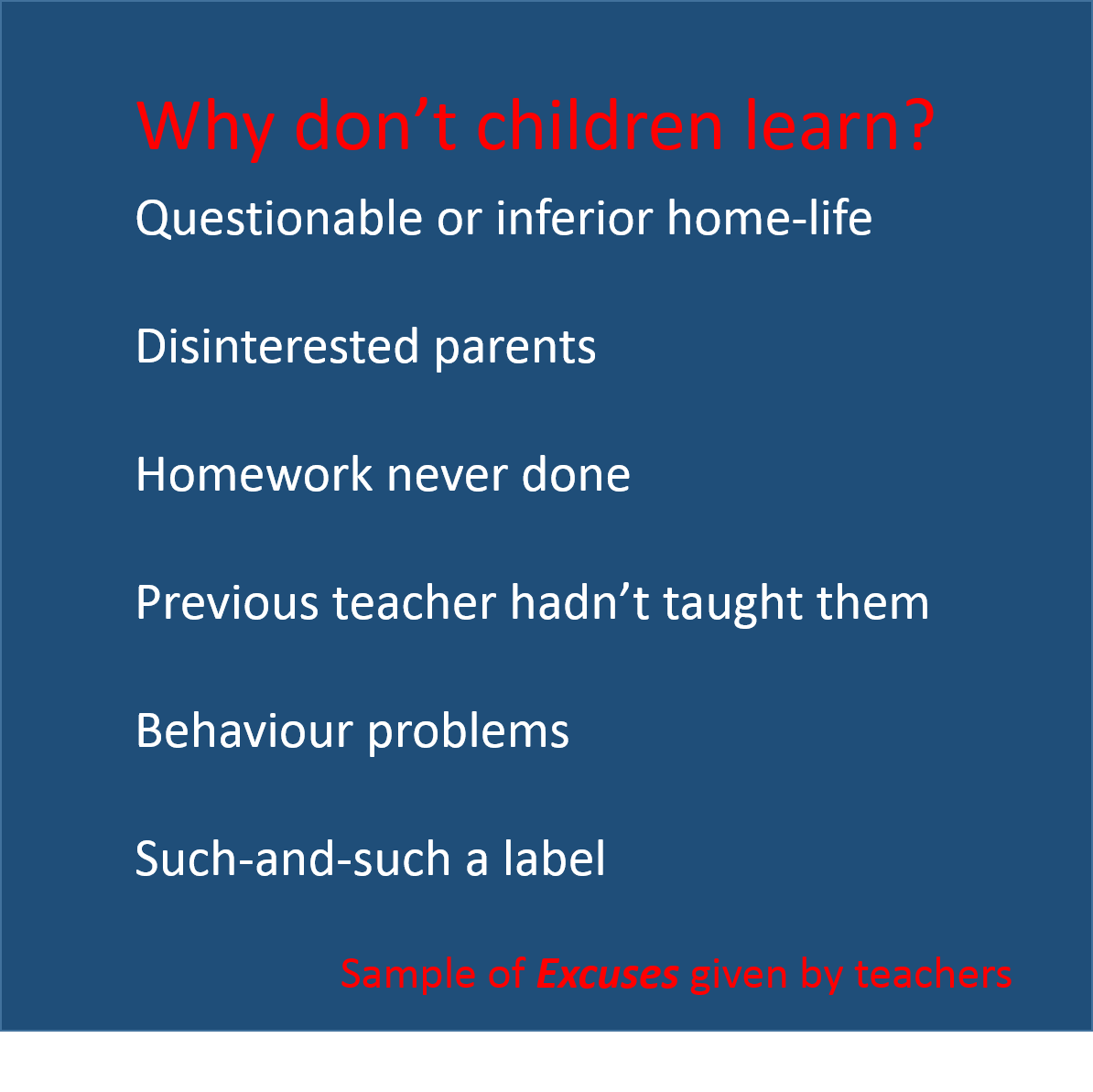
    There were those who were focussed on what was to be taught, on their lesson plans, assessment and results. They expected the children to attend, respond and learn because that was what was expected of them. If the students failed to learn what was taught, the teachers questioned neither their methods nor the content for its suitability to student needs. Rather they found the fault to be with the students who were lacking in some way. Their view was of students as empty vessels to be filled, and if they did not fill from what they were offered, then it was the vessel, not the method of filling that was faulty.
    © Norah Colvin
    © Norah Colvin

    So many times the teachers would complain that they had “taught” the work but the students hadn’t learned it.

    In “my world”, if there was no learning there had been no teaching; and I found this attitude difficult to comprehend or accept. Nonetheless I tried to be understanding, patient and supportive, listening to and restating their complaints to ensure them I had understood. I would then make gentle suggestions like “Have you tried?” “Have you thought about?” Rarely was I successful in getting them to reflect upon, interrogate or make adjustments to their practices. I guess if they saw no fault with their practices, why should they change?

    A current focus in assessment driven school programs is what the students can and can’t do, with the main focus on the “can’t”. I much prefer changing perspective to the “not yet” thinking and growth mindset of Carol Dweck.

    success


    This week at the Carrot Ranch Charli Mills is talking about perspective. She challenges writers to In 99 words (no more, no less) write a story that has a shift in perspective. It is right up my alley. Thanks Charli!

    Inside

    They slumped around the table, eyes transfixed on hands clasping coffee cups, bemoaning their lot, each desperate to outdo the other in frustration and despair.

    “They just don’t get it.”

    “I’ve tried everything.”

    “They don’t listen —”

    “They’re so rude —“

    “In my day we wouldn’t dream —“

    Outside

    They welcomed the kiss of sun upon their cheeks, the freshness of air to their lungs; and breathed as one in wonder.

    They found cloud-painted sky pictures, brightly coloured beetles in green grass stalks, claw-made scratches in the rough tree bark; and brimmed with wonder.

    and dared to dream …

    Thank you

    Thank you for reading. I appreciate your feedback. Please share your thoughts about any aspect of this post or flash fiction.

  • Breathe – a sense of wonder!

    Life is short – enjoy every moment!

    I have been privileged to spend time with young children throughout my adult life: my own, children I have taught, and now my grandchildren. Spending time with young children is one of the best ways of maintaining a sense of wonder and awe in the everyday. Opportunities abound, if one is willing to see the world afresh through their eyes,

    to notice:

    • the softness of petals in a newly opened flower
    • the collection of pollen on a bee’s legs as it rests within the flower
    • the snail’s silver trail on the pavement

    to question:

    • where the puddle goes after the rain
    • how the toothpaste gets into the tube
    • how aeroplanes stay in the air

     to wonder:

    • why the sky is blue
    • where clouds come from
    • why tigers have stripes and kangaroos hop
    • what came first: the chicken or the egg

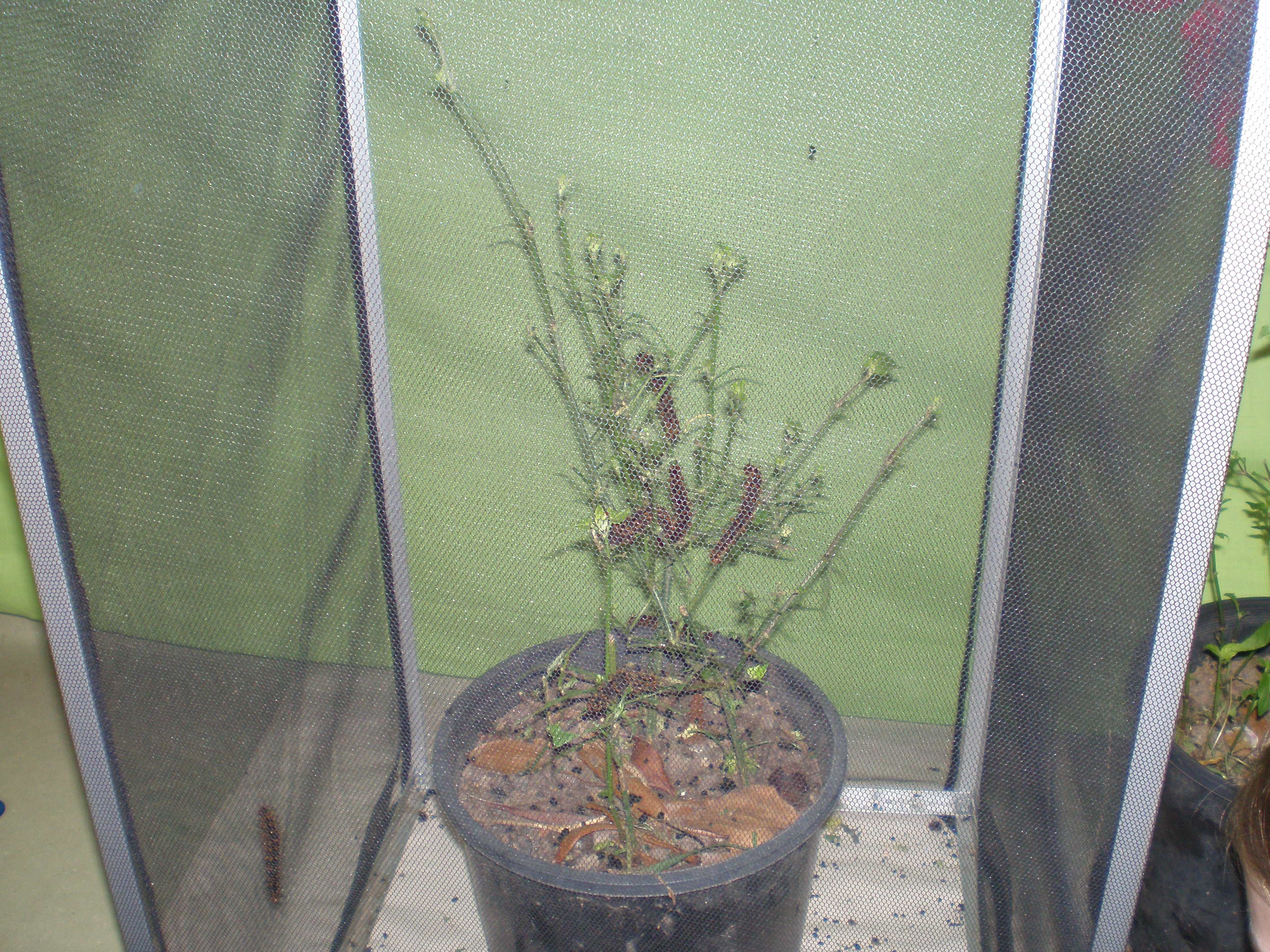
    One of my favourite ways of bringing the wonders of nature into the classroom is through observations of a live butterfly kit. We would watch the tiny caterpillars hatch, eat voraciously as they grew larger and larger, and then pupate before emerging triumphantly as beautiful butterflies.

    © Norah Colvin
    © Norah Colvin

    There are many opportunities to notice, to question and to wonder:

    • What will happen if the caterpillars eat all the leaves?
    • How big will the caterpillars grow?
    • How long will it take for the caterpillar to change into a butterfly?
    • How does the caterpillar breathe?
    • Does the caterpillar know it is going to be a butterfly?
    • Does the butterfly remember being a caterpillar?
    • What happens to the caterpillar in the chrysalis?
    • Why do they poo so much?

    We got to know that when a caterpillar was ready to pupate, it made a ‘j’ shape, hanging from under a leaf or branch, or from the top of the butterfly house. It would stay that way for a number of hours. Children (and teacher) would sneak over from time to time to see if anything was happening.

    As soon as the caterpillar started wriggling, we would quietly rush over to watch as it shed its last skin to become a pupa. It is an amazing spectacle, one that is not often seen “in the wild”. In fact it is a very quick process, and unless someone just happened to be watching at the time, we would miss it. Although we didn’t see every caterpillar pupate, we saw enough to appreciate and wonder.

    Equally as exciting was watching a butterfly emerge from the chrysalis. As the time was approaching the chrysalis would become transparent and we could see the shape and colour of the butterfly’s wings through the chrysalis. Watching the butterfly push open the chrysalis and emerge with crumpled wings was amazing. Oftentimes the butterflies would emerge in the mornings before the children arrived. But sometimes they waited, and we all watched as the butterflies pumped up their wings and spread them to dry in readiness for flying.

    When the butterflies’ wings were dry and they were almost ready to fly we would remove them from the house. If we timed it just right, we could hold them on our fingers, transferring carefully from fingertip to fingertip without touching the wings. When they were ready to fly, we would go outside and release them. The children loved to look for the butterflies at lunch time and learned that observation was the best way to appreciate them.

    varied eggfly
    Varied eggfly © NorahColvin

    The children’s interest and excitement was shared with anyone who visited the classroom: administrators, other teachers and children, siblings and parents.  I tend to think that the children’s sense of wonder may have ignited a spark in others too.

    This week at the Carrot Ranch Charli Mills challenged writers to In 99 words (no more, no less) write a story about a breathless moment. Write about life.

    Watching the short stages of a butterfly’s life is a good way to get children thinking about life, its beauty and its frailty, its dangers and its strength.  Watching the transformations that take place can certainly take one’s breath away. It is this that has inspired my response to Charli’s challenge.  I hope you enjoy it.

    Breaths - life is not measured

    Eclosion

    I heard the scurry of footsteps. Then he was in the doorway; eyes ablaze, breathless.

    “Come … quick … Miss,” he said, punctuating each word with puffs and pants.

    Before I had moved, there were others behind him, imploring me to come.

    With quickened pace I followed, hoping that I, that all, would be in time.

    Others were there already, clustered around. I peered over their heads, expectantly, holding my breath in a vain attempt to make time stand still.

    “Ahh!” we breathed in unison and awe as we watched the butterfly emerge from its now transparent shell.

    Thank you

    Thank you for reading. I appreciate your feedback. Please share your thoughts about any aspect of this post or flash fiction.
     

  • Experiential learning – what’s good and what’s hot

    farm

    I am a proponent of learning by experience, of learning through one’s own explorations and making one’s own discoveries. In early childhood centres it is sometimes called ‘hands on’ learning. The recommendation is to provide opportunities for children to learn by doing rather than simply by listening to someone tell about it or by reading information in a book. For example, experiencing the sights, smells and sounds of a farm create an enriched understanding of farm life that is not possible simply from looking at pictures of farm animals in a caption book. Activities like mixing and making with modelling dough, or building and creating with construction sets provide opportunities for developing numerous skills and understandings.

    That’s not to say that experiential learning is best in every situation or that learning from the explanations of others, including reading information in a book, is less worthy. Indeed there is a place for each and it is important to get the balance, timing and application right. You would not need to view many posts on my blog (for example here and here) to realise that I am a proponent of reading also and believe that instilling a love of reading is one of the greatest gifts a parent can give a child.

    In their book A New Culture of Learning: Cultivating the Imagination for a World of Constant Change, Douglas Thomas and John Seely Brown discuss the differences between explicit knowledge and tacit knowledge.  This chart shows my understanding of some of the differences.

    Explicit and tacit learning


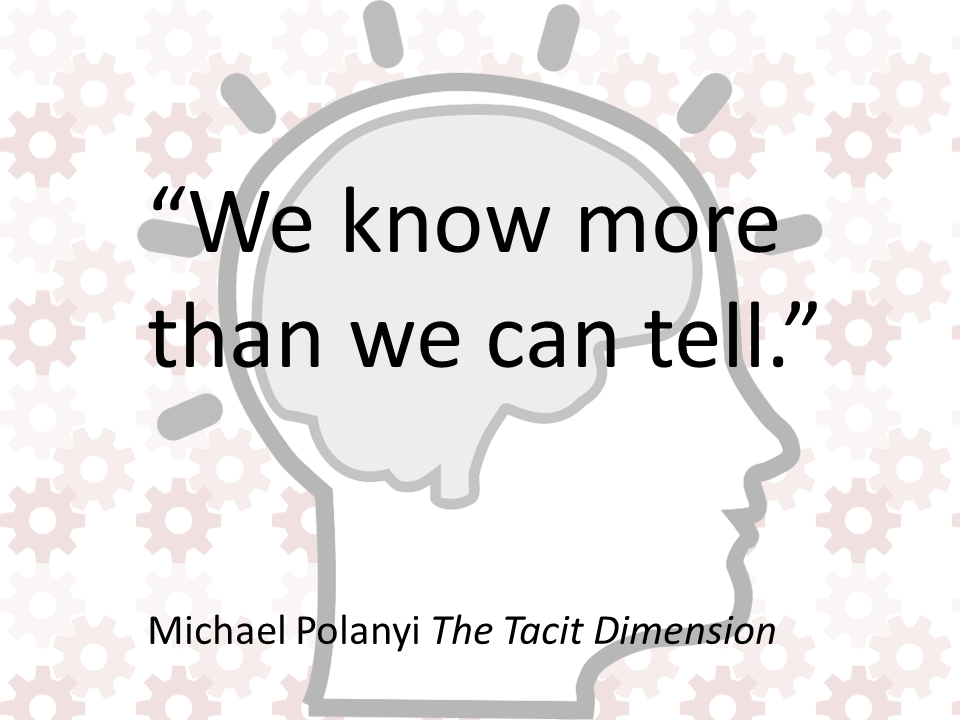
    Michael Polanyi  The Tacit Dimension

    I think it would be undisputed that there is knowledge best learned through explicit instruction and other best learned through experience. I am sure you can think of many examples in your own life, like riding a bicycle, learning a foreign language or playing a musical instrument.

    netalloy, glossy flame https://openclipart.org/detail/91951/glossy-flame
    netalloy, glossy flame https://openclipart.org/detail/91951/glossy-flame

    But what about teaching young children about heat? It is not far into the life of any young child that they are cautioned about the heat of an oven or stove, heater or barbecue plate. But what is “hot” if you have never experienced it?

    Thomas and Brown say that “when a parent first tells a child not to touch a flame because it is hot, the child will almost always put out her hand and get burned” because the child has only been given the explicit part of the information, the part that could be articulated: that “Fire is hot”. When the child is burned much more information is learned by the body: that it hurts and is unpleasant. The child is then able to make connections with other similar “hot” things and situations.

    I think neither of the authors nor any parent would suggest a child be burned “for educational purposes” but the power of experience can be seen in this example. Perhaps it also helps to explain why young children need constant reminders to stay away, or precautions need to be taken to protect them, from hot things. Without the burning sensation they have not formed a true understanding.

    thomas and brown - learning

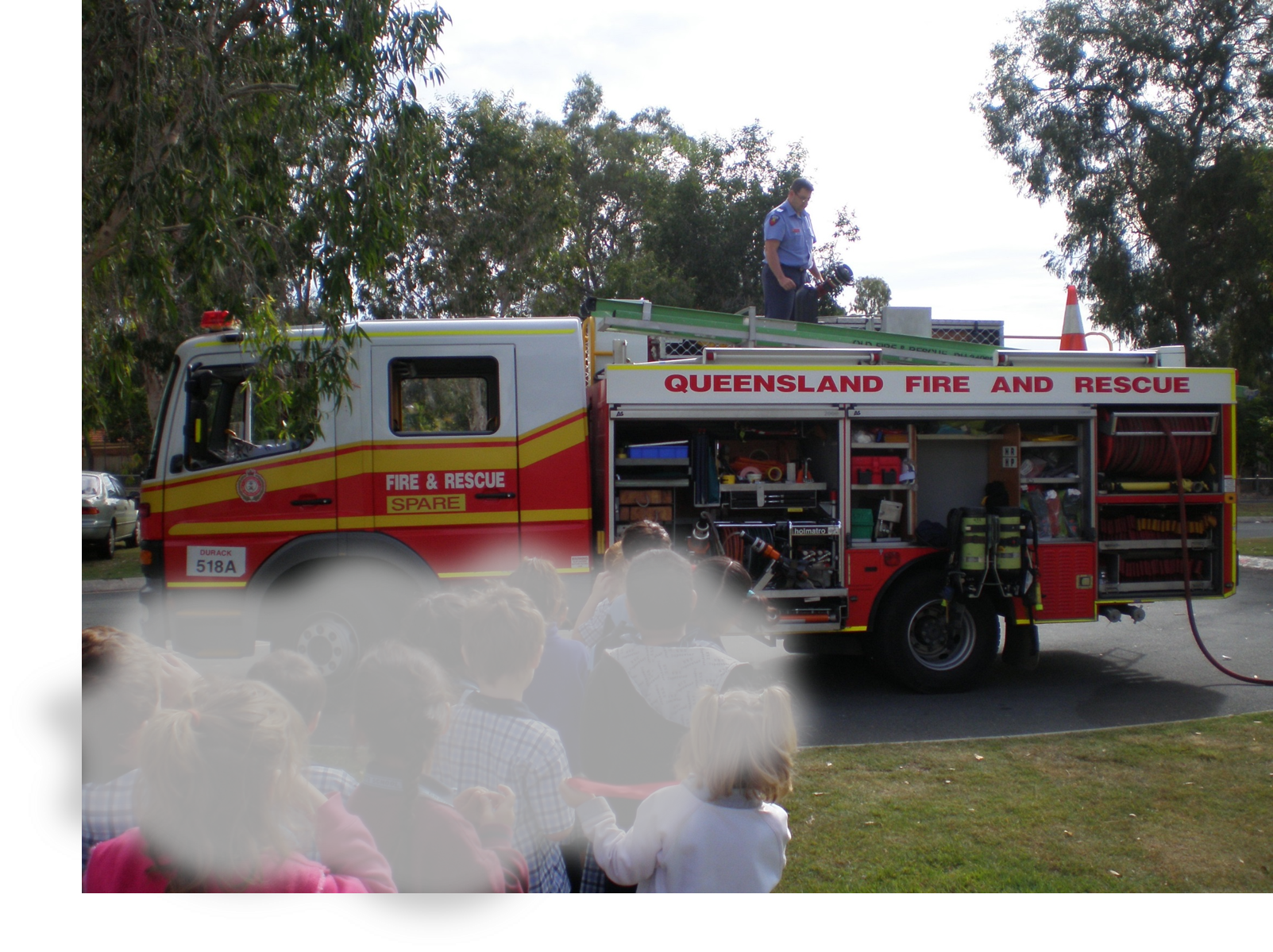
    At my previous school our year one classes were always visited by the local fire fighters who talked about fire safety, explaining the difference between “good” fires (like birthday candles, barbecues and campfires) and “bad” fires, while warning that even good fires could quickly become bad  if not monitored correctly.

    They talked about the need for smoke alarms in the home and the importance of having escape routes and meeting places planned and practised. They ensured students knew their full name and address and the procedure for calling emergency (000 in Australia) if the need should arise. These are things that all young children should know.

    firetruck

    The children were always excited about the firefighters’ visit as they got to look at the firetruck close up, maybe even sit in it or, if they were lucky, see how high they could spray water with the large hose. The tacit knowledge learned through this type of experience, combined with explicit knowledge provides a context that allows children to learn the realities of fire danger and the importance of safety. It wasn’t unusual for the crew to receive a call and rush away during one of their visits, adding further to the overall experience for the children.

    rg1924, unexpected frog in my tea    https://openclipart.org/detail/21079/unexpected-frog-in-my-tea
    rg1924, unexpected frog in my tea https://openclipart.org/detail/21079/unexpected-frog-in-my-tea

    Thinking about heat and education, and the hold that explicit knowledge and its testing has on current practice makes me think of the story about a frog in a pot of hot water.

    The story says that if you were to put a frog into a pot of hot water, it would jump out immediately; but that if you were to put the frog into a pot of cold water which is warmed slowly, the gradual increase in temperature wouldn’t be noticed and the frog would be boiled alive.

    Perhaps this is why some educational practices are accepted without question. People have become so used to them, with small incremental changes seeming insignificant and unworthy of comment. However the cumulative effects over time can be enormous. By the time they are realised, making amends would require so great a change, possibly a total restructuring, that it would defy plausibility.

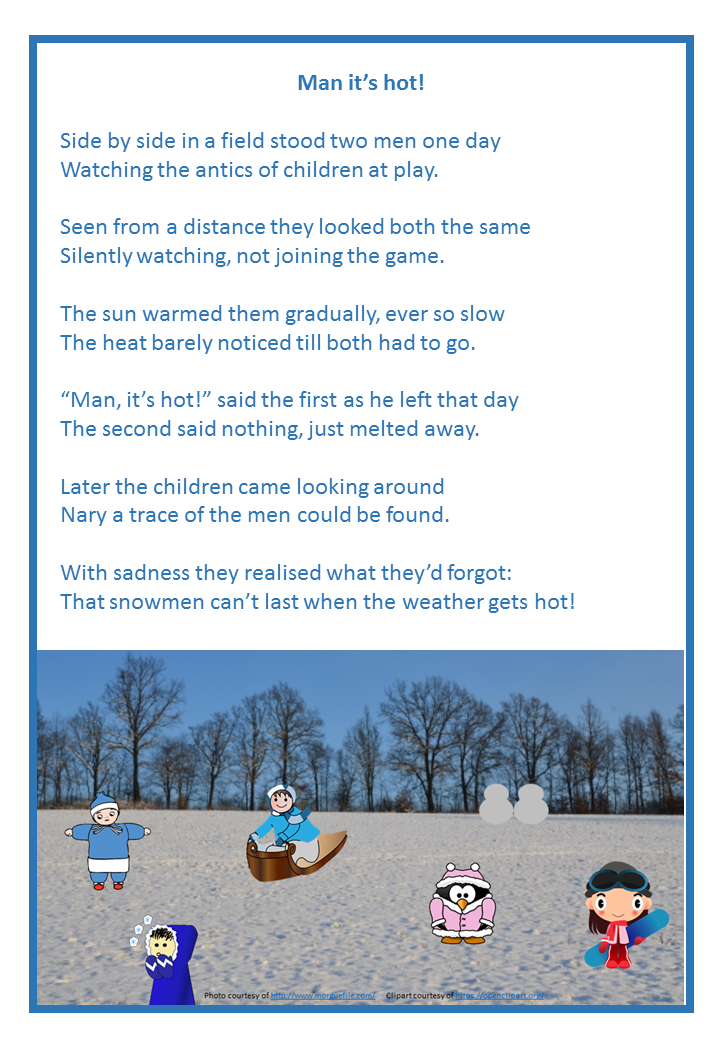
    It is this thinking that has led to me my flash response to the challenge set by Charli Mills at the Carrot Ranch this week to In 99 words (no more, no less) write a story that includes the phrase, “Man, it’s a hot one.” I hope my contribution is a little more environmentally friendly and suitable for young children than boiling frogs.

    Man it's hot

    Thank you

    Thank you for reading. I appreciate your feedback. Please share your thoughts about any aspect of this post or flash fiction.


  • Can you dig it?

    This week at the Carrot Ranch Charli Mills is talking about dirt and has challenged writers to In 99 words (no more, no less) write a story about dirt.

    In her post Charli says that,

    writing is like gardening - Charli Mills

    and talks about sowing compassion to make our world a “worthier place to live”.

    These are wonderful ways of thinking about dirt and good reminders of the importance of the earth beneath our feet, which is often taken for granted, even ignored, unless one is a farmer, a gardener, perhaps a miner, or possibly a child.

    Morguefile  http://mrg.bz/omEd2M
    Morguefile http://mrg.bz/omEd2M

    Children are often admonished about playing in the dirt, as if washing off a little soil  was the greatest difficulty. In our towns and cities we cover the soil with concrete and leave few patches of bare earth where children have an opportunity to dig.

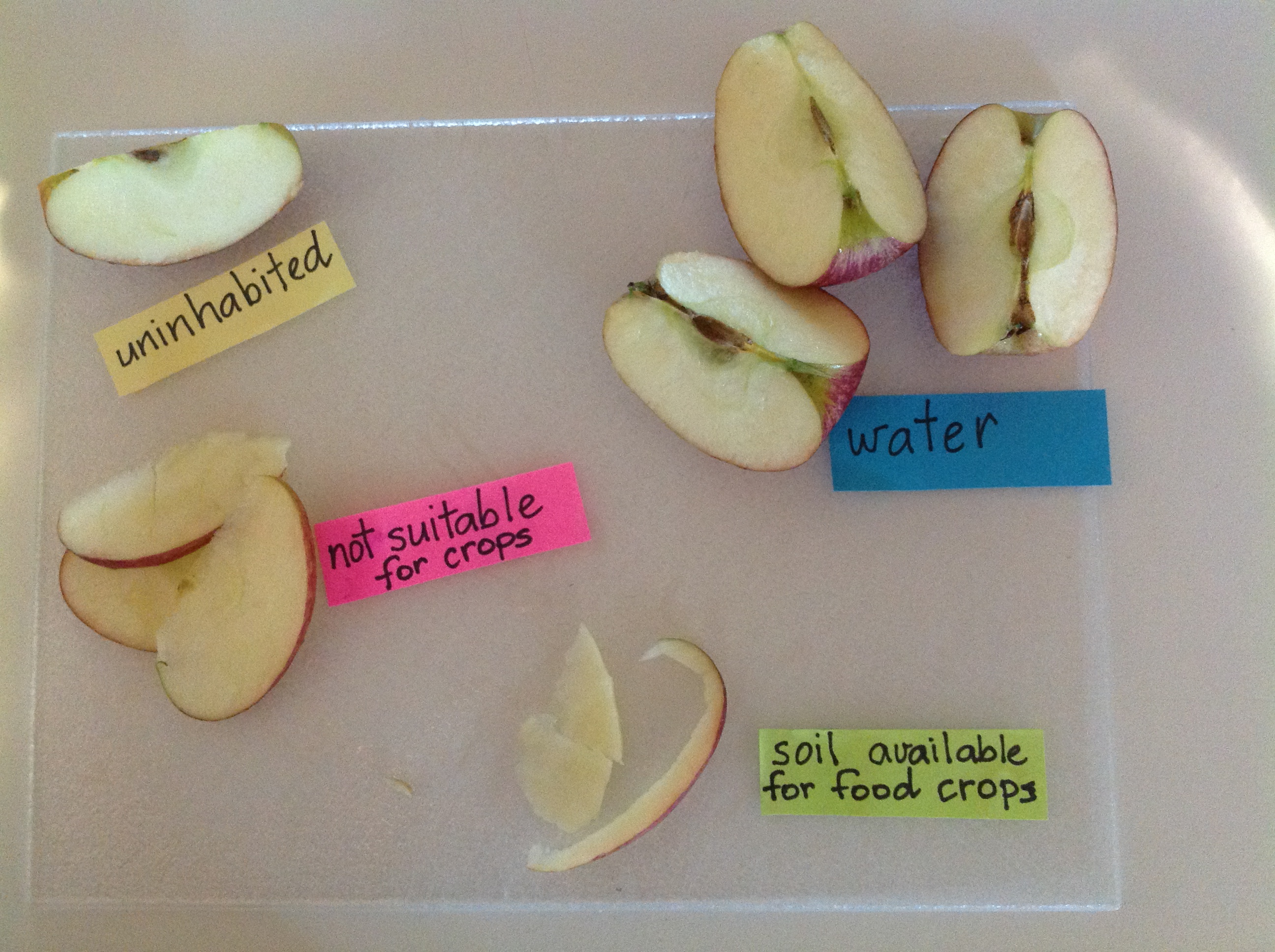
    Soil, though an essential resource of our Earth, is often overlooked. Ask a young child what living things need and they may say “water, air, food, sunshine and shelter”. Soil won’t rate a mention. But without it we wouldn’t have a thing to stand on! Nor would we have our other essentials: air, food and shelter – all dependent on the soil for their production.  The importance of soil and of conserving becomes even more evident with the realisation of how little of the Earth’s surface is available for producing food.

    © Norah Colvin
    © Norah Colvin If Earth was an apple . . .

    Another great gift from the soil is knowledge. Much of what we know of Earth’s history and human history has been revealed by the soil as successive layers have been exposed or excavated; uncovering secrets of the past and enabling a much richer understanding of earlier times.

    dinosaurs at museum Jan 91
    © Norah Colvin

    Our knowledge of dinosaurs has all been revealed from the earth with the first discoveries and identifications made only a few hundred years ago.  And there is still much more to be discovered. My children and grandchildren, along with many other children and adults, are fascinated by dinosaurs. How exciting it would be to make a new dinosaur discovery, find hidden treasures or unlock secrets of the past!

    © Norah Colvin
    © Norah Colvin

    It is possible that many more dinosaur, and other, discoveries are yet to be made. The world’s only known evidence of a dinosaur stampede was found in Australia just a little over fifty years ago.  Even more recently a gardener in the UK found a dinosaur bone in his backyard! In the US, if you find a dinosaur fossil in your backyard it’s yours to keep!

    According to this video, finding dinosaur fossils is quite easy:

    The excitement of making new discoveries  and finding answers to questions is motivation for many.

    In his book Good Ideas: How to Be Your Child’s (and Your Own) Best Teacher Michael Rosen relates a story told by David Attenborough. He says that, as a child, David took an interest in bones and if he was out walking and found some he would take them home and ask his father (a GP so would probably know) about them.

    But his father didn’t just tell him. Wanting his son to be curious and interested in finding things out for himself, he responded, for example: “I wonder if we can work it out . . .” They would then look through books about zoology and anatomy and try to identify the bone’s origin.

    Knowing that it is through the comparison of found bones with bones of familiar creatures that scientists have been able to work out much of what we now know about dinosaurs and other extinct creatures makes such an activity even more exciting and inspirational.

    Rosen goes on to share an experience from his own school days. When a teacher confessed to students that he didn’t understand Comus by Milton, which had been set for study, the class and teacher spent the year together figuring out its meaning. Rosen compares the effectiveness of this approach to many others, stating that study techniques, “didn’t teach me how to find things that I really wanted to learn about. It didn’t take me down interesting side-alleys where I would find things that I didn’t know I would be interested in until I found them.” But he says what he learned from exploring Comus was “something that’s more to do with feeling than knowledge or learning: it was a confidence that I could investigate and discover things for myself. It’s ironic, isn’t it, that I got that feeling from someone who quite genuinely didn’t understand something?

    A sense of wonder and curiosity, and a desire and willingness to find out for oneself answers to one’s own questions is fundamental to learning. Digging in the dirt occasionally can’t do that much harm. You never know what new discovery you may make!

    Moini, A treasure chest with lots of twinkling gold coins, https://openclipart.org/detail/188617/treasure-chest
    Moini, A treasure chest with lots of twinkling gold coins, https://openclipart.org/detail/188617/treasure-chest

    The thought of just such a discovery is what inspired my response to Charli’s challenge:

    Digging for gold

    Her spade crunched against the obstinate soil. Then tap, tap, tap, another thin layer loosened. She scooped up the soil and tossed it onto the pile growing steadily beside the excavation site. With expectant eyes and gentle fingertips she scanned each new surface. Then again: tap, tap, tap — toss; tap, tap, tap —toss!

    She pushed back her hat to wipe her sweaty brow, leaving a smudge of dirt as evidence. She glanced skyward. The sun was high. She’d been digging for hours. She must find something soon. What would it be? Pirate’s treasure or dinosaur bones . . .?


    Thank you

    Thank you for reading. I appreciate your feedback. Please share your thoughts about any aspect of this post or flash fiction.


  • Revisiting The Very Hungry Caterpillar

    Recently, in a post introducing the idea of S.M.A.G. (Society of Mutual Admiration and Gratitude), I reflected upon my blogging journey and the gradual growth of readership and development of a S.M.A.G. over time. With this reflection came the realisation that many have missed earlier posts. That realisation, along with a comment by Sarah Brentyn, prompted me to share a few of my favourites.

    The Very Hungry Caterpillar

    The first posts I will revisit are from a series about using Eric Carle’s picture book The Very Hungry Caterpillar for educational purposes in an early childhood setting.

    The series of four posts;

    • explores benefits of reading picture books to children
    • questions the place of factual information in fictional texts, and
    • suggests the importance of teaching critical literacy from a young age.

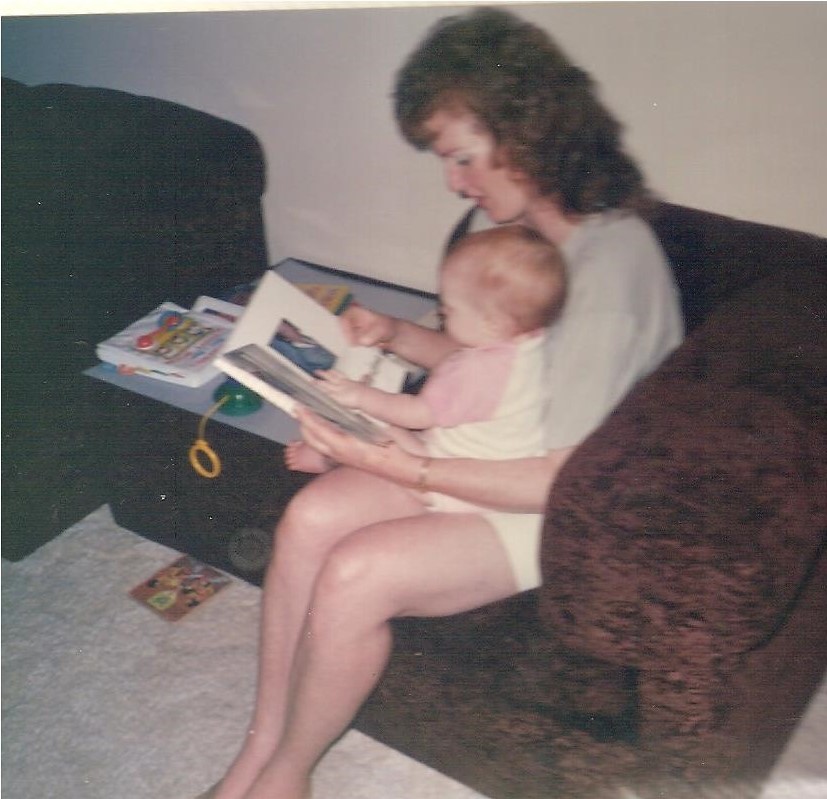
    Nor and Bec reading

    I will provide a brief overview of each post. I would be delighted to have you  follow the links to read the posts in full.

    Searching for meaning in a picture book — Part A

    In this post I explained that sharing picture books with children has many benefits, including:

    At home:

    • It can help strengthen the parent-child bond, becoming a special time of togetherness and of sharing stories and ideas.
    • It has a very positive effect upon their learning, helping them develop language, knowledge of print and books, and exposes them to new ideas and concepts.

    8-12-2013 7-38-33 PM

    In early childhood classrooms, The Very Hungry Caterpillar provides opportunities for work in many subject areas including:

    • Literature appreciation
    • Reading
    • Maths
    • Visual arts, and
    • Philosophical inquiry, but not Science (as I will explain later)


    Searching for purpose in a picture book – Part B

    In this post I discuss some purposes for using picture books and raise some questions about their content.

    A sampling of purposes:

    • encourages a love of reading and books
    • develops vocabulary and knowledge of language
    • provides a link between the language of home and the language used in the wider community and in education
    • supports beginning readers
    • inspires imagination
    • provides opportunities to discuss feelings, emotions, ideas, responses
    • develops feelings of empathy, identification, recognition, hope
    • instils an appreciation of art

    spiderswirl2

    Some questions:

    Do fictional picture books have a role, and do picture book authors have a responsibility, in imparting factual information in their books?

    Does it matter:

    • that, although lions don’t live in jungles, they are often referred to as “King of the jungle” and appears in that setting in many stories?
    • if animals that don’t co-exist, for example penguins and polar bears, appear in stories together?
    • if the portrayal of animals in stories is not anatomically correct, for example spiders shown with legs joined to their abdomens rather than cephalothoraxes?

    Do errors such as these influence children’s understanding of the world?

    How should adults handle the misinformation when sharing books with children?


    Searching for truth in a picture book – Part C

    In this post I refer specifically to inaccuracies in The Very Hungry Caterpillar and the pervasiveness of the misconceptions, if not totally attributable to the book, then at least in part. I suggest how acknowledging the inaccuracy can help develop critical literacy.

    In his book Eric Carle writes that

    “He (the caterpillar) built a small house, called a cocoon, around himself. He stayed inside for more than two weeks. Then he nibbled a hole in the cocoon, pushed his way out and . . . he was a beautiful butterfly!”

    Monarch butterfly

    However, as this (hopefully correct) information from the Australian Museum shows, butterflies do not spin cocoons around themselves. Moths do. Some butterflies and skippers do form a silken shelter, but not a cocoon as in Carle’s picture book.

    Unfortunately many articles found in an internet search share the same misinformation. I wonder how many adults grew up believing what Carle shared through his picture books. Even teachers have been surprised to learn that butterfly caterpillars do not spin cocoons.

    In the original post I share some lovely videos related to butterfly and moth metamorphosis. It is worth taking a peek at them.

    Does it matter if children (and adults) think that butterflies hatch out of cocoons? Eric Carle didn’t seem to think so. Do you?

    Finding power in a picture book – the main event

    In this post I argue that The Very Hungry Caterpillar has no place in a science lesson because of the misinformation contained therein: caterpillars do not eat many different foods and butterflies do not come out of cocoons.

    ryanlerch_thinkingboy_outline

    The greatest value of the book is as a tool for teaching critical literacy; for teaching children that just because something is in print, doesn’t make it true. It is also important to realise that misinformation is not restricted to picture books, and that they need to question all sources of information for the author’s credentials and purpose in writing.

    I suggest that teachers and parents:

    • point out inaccuracies and inconsistencies
    • encourage children to evaluate what they are reading and hearing against what they already know
    • support children to verify the source of the information and to check it against other more authoritative/reliable sources
    • help children to recognise that every author has a purpose and to identify that purpose
    • invite children to ask questions about what they are reading and to interrogate the content
    • encourage them to question, question, question.

    Eric Carle says “If we can accept giants tied down by dwarfs, genies in bottles, and knights who attack windmills, why can’t a caterpillar (sic) come out of a cocoon?”


    What do you think? Do picture book authors have a responsibility to be accurate? Is a butterfly coming out of a cocoon in the same realm as giants tied down by dwarfs? Would we accept a child hatching out of an egg? What parts of a story should be based in reality and which parts can be imagined?

     “Why can’t a butterfly come out of a cocoon?” asks Eric.

    Well, Eric, they just don’t.

    Thank you

    Thank you for reading. I appreciate your feedback. Please share your thoughts about any of issues I have raised in these posts.


  • Are you ready or what?

    When thinking about schooling and education there is always a lot of discussion about readiness and the things that must be done to have a child ready for school, ready for the next class, ready go to college or university . . .

    While I agree that a learner must be ready to take the next step, to broaden understanding of a concept or to grasp the complexity of deeper issues; just what that readiness requires is often up for conjecture.

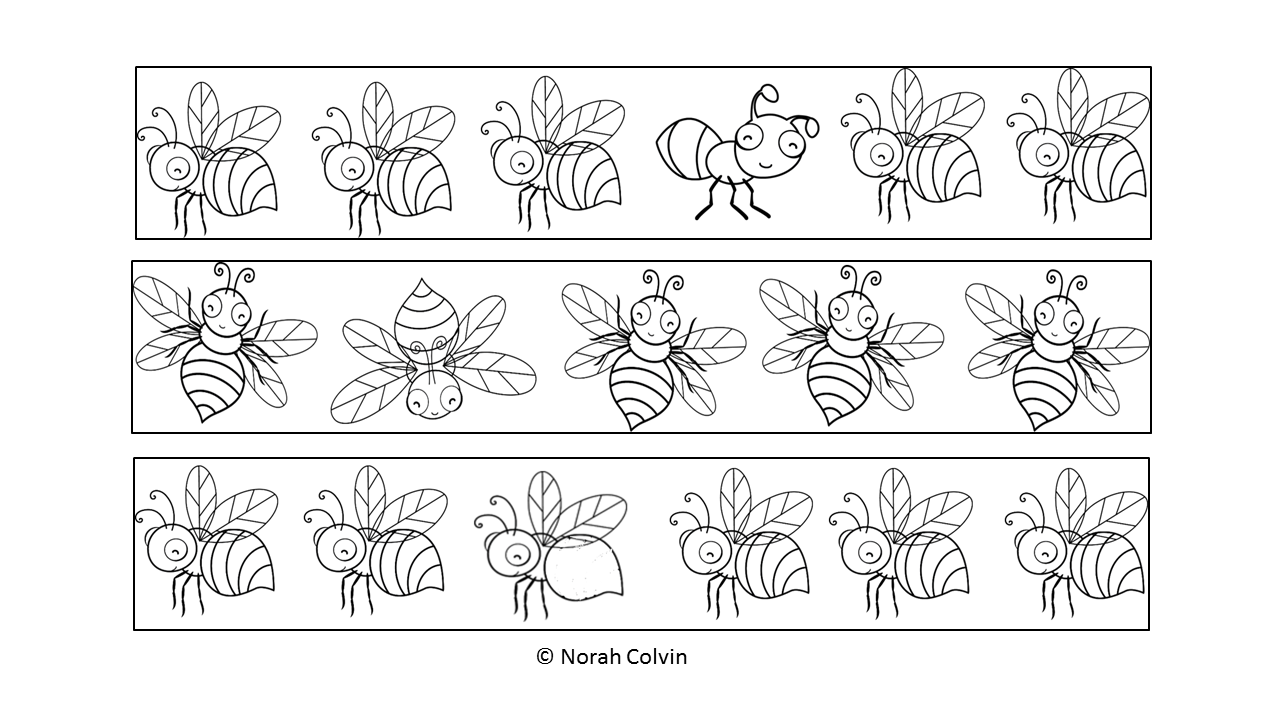
    Back in the early days of my teaching experience workbooks of ‘reading readiness’ exercises were frequently used with students in their first year of school. These activities generally required children to identify the one that was different in a group of objects. The exercises, such as those shown below, progressed through various levels of difficulty with the aim of preparing children for reading.
    reading readiness exercises

    Fortunately our understanding of how reading is learned has progressed since then and it is now recognised that exercises such as those did little to prepare children for learning to read. We now know that the best preparation for reading is to be immersed in language through conversations, with adults especially; to be read to frequently; and to develop a love of books and interest in print by sharing with others. The role of parents in preparing children for reading cannot be underestimated.

    This week I watched a video of a presentation by Yong Zhao about a type of readiness he referred to as “Out of basement readiness”. I admit I hadn’t heard the term before but the concept is definitely familiar.

    I do recommend you listen to Zhao’s talk. It is interesting, thought-provoking and humorous. I think I enjoyed listening to this talk as much as to Ken Robinson’s on How schools kill creativity which I have mentioned in previous posts here and here, amongst others. However at 55 minutes some of you may not be willing to commit the time. For me, it is 55 minutes of my life I’m very happy to not get back!

    I will not attempt to share all the content of the talk; there is too much of value, but here are just a few snippets that resonated with me:

    Zhao explains out of basement readiness this way:

    out-of-basement readiness - Yong Zhao


    Zhao says that students are being mis-educated, that they are being educated for something that doesn’t exist, and suggests that we should remove several phrases from the language we use to talk about education, especially

    • Under-performance
    • Evidence based
    • Data driven


    His description of the traditional education paradigm will be familiar to any frequent readers of my blog. He says that it is “about forcing people to do what some other people prescribe them to do” and that we reduce it to just a few subjects that can be tested.


    He talks about the “homogenisation” of schooling, and explained that homogenisation was the best way of getting rid of creative people and innovative thinkers.


    He mentioned kindergarten readiness tests, and suggests that the only test should be whether the kindergarten was ready for the children and parents.


    He recognises the uniqueness of every student, with different backgrounds, motivations and talents; and stresses the importance of effort. He says, “You cannot be born to be great. If you do not put effort into it you can never be good at it.” He explains it this way:

     “If you put ten thousand hours into something you are good at, something you are interested in you get great talent. But if I force you to spend time on something you have no interest in, you hate and something you are not good at, you at best become mediocre.”

    He says that countries that produce high test scores, score low on confidence and interest.

    He says,

    “Everyone is born to be creative, that’s a human being, that’s our gift: to be able to adapt, to learn and relearn and do new things. But school has typically tried to suppress it (with) . . . short term learning. . . Direct instruction may give the short-term gain but cause long term damages Studies show that if you teach children how to play with the toy, they lose creativity, lose curiosity and if you allow children to explore more they may not test very well but they maintain creativity and curiosity.”

    American schools _ Yong Zhao

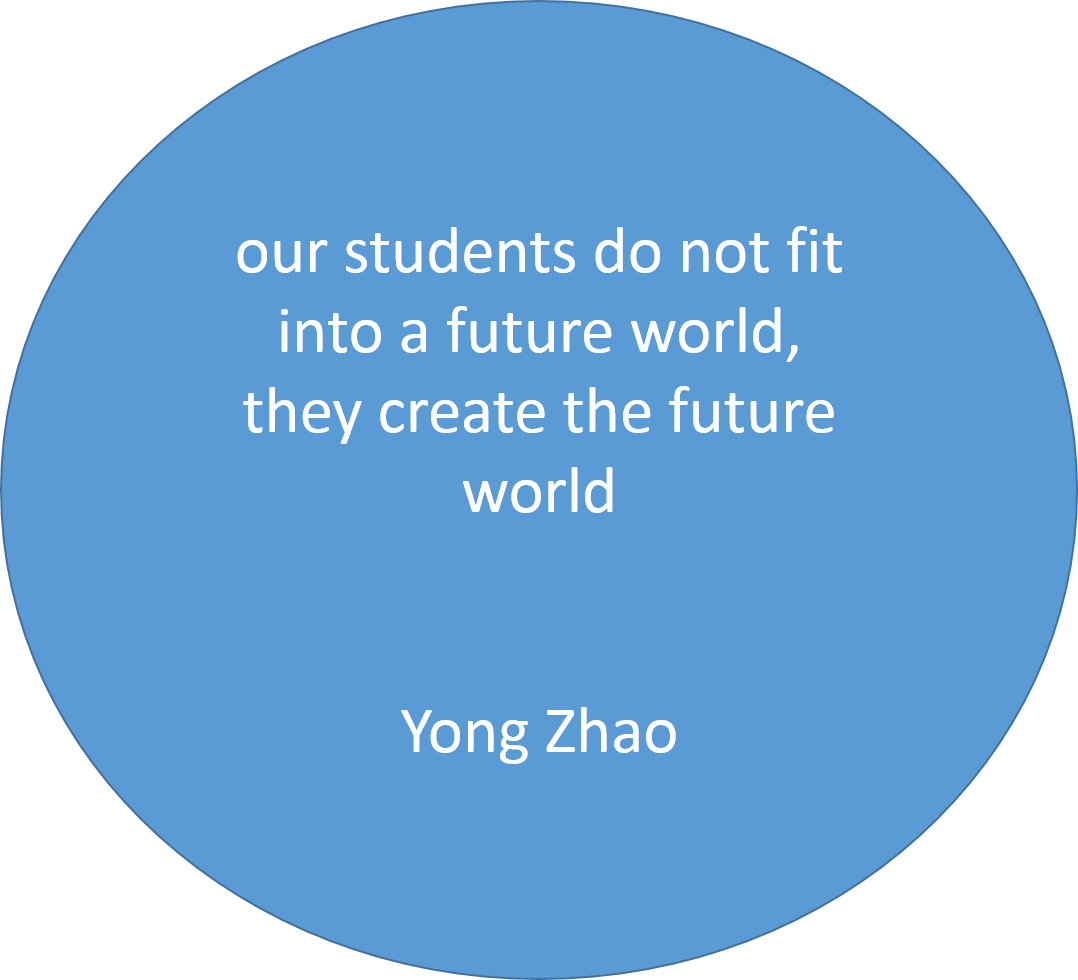
    Zhao says that “our students do not fit into a future world, they create the future world. This is why we need a different type of education.” He says that “education is to create opportunities for every individual student, they are not an average, they are not a probability, they need to be improved as individual human beings.”

    our students do not fit - Yong Zhao

    I couldn’t agree more. What do you think?


    I was led to Zhao’s talk via Diane Ravitch’s blog which is about the education system and situation in the US. Much of what she writes has applications further afield and I recommend it to anyone wishing to stay informed of current issues in education.

    Thank you

    Thank you for reading. I appreciate your feedback. Please share your thoughts on any aspect of this post.


  • Spelling tests – How well do you score?

    ABC

    Familiar to most will be the weekly spelling test held on a Friday morning after a week’s practice at learning a list of words. Some will have dreaded the test fearing they may forget the “i before e”, “silent” letter or double letter rules, for example, their inadequacies made all too obvious by the large red crosses. Others would have relished the experience, requiring little effort to learn words they already knew, seemingly by osmosis, with the expectation of large red ticks and 10/10.

    Spelling test

    I dare say that most of you reading this blog are of the 10/10 variety. Just to be sure this is so, I have set you a little spelling test to do before you read any further. Please get your pen and paper, finger and notebook, or keyboard ready, then press PLAY to take the test.

    So how did you go?

    I hope you could see from that exercise that knowing how to spell has a lot to do with meaning. In fact the spelling of many of our words in English has more to do with morphology than with sound, and although sound can be helpful there are often many different letters or letter combinations that can be used to represent the same sound, for example:

    eye

    According to the Bullock Report, published in 1975:

    “For 6092 two-syllable words among the 9000 words in the ‘comprehension vocabularies’ of a group of 6-9 year olds, 211 different spellings of the phonemes were needed – and these spellings required 166 rules to govern their use! Even at that, 10% of the words had to be left aside as ‘exceptions’; which means that ‘even if a young child memorised these rules while learning to read he would still encounter hundreds of words not governed by them.’”

    Lists of words, such as spelling lists, provide little support for learners, rarely providing context or meaning which might help them remember the words, or choose the correct meaning and therefore spelling, as shown by the spelling test exercise given above.

    Alphabetical

    In his book “Alphabetical: How Every Letter Tells a Story”, Michael Rosen explains that transmitting meaning is the reason for writing, for having an alphabet.

    Rosen describes the alphabet as “a stunningly brilliant invention. We could call it a ‘cunning code’ or a ‘system of signs’ whereby we use some symbols (letters) to indicate some of the sounds of a language. … Though it is wonderful, there are some snags for users …” including:

    • letters and letter combinations do not represent the same sound each time they are used (e.g. ‘c’ in ‘cat’ and ‘city’)
    • letters represents different sounds according to regional accents
    • a particular sound is not always represented by the same letters (see the ‘eye’ example above)

    He says that “Becoming or being a reader of English involves absorbing all these variations and then forgetting that they exist.”

    a phonic's teacher's lament

    He explains that the alphabet is more than a system of sounds and syllables and that “Our forebears devised alphabets so that they could store and retrieve meaning … over time and/or space”.

    While not speaking specifically about learning spelling words, in his book “Why Don’t Students Like School? A Cognitive Scientist Answers Questions About How The Mind Works and What It Means For Your Classroom” (referred to in a previous post here), Daniel T. Willingham consistently refers to the importance of meaning when acquiring knowledge. He says,

    “Teachers should not take the importance of knowledge to mean they should create lists of facts . . . some benefit may might accrue, but it would be small. Knowledge pays off when it is conceptual and when the facts are related to one another, and that is not true of list learning. Also … such drilling would do far more harm by making students miserable and by encouraging the belief that school is a place of boredom and drudgery, not excitement and discovery.”

    When a child scores poorly in a spelling tests and their errors are marked in red they see themselves as bad spellers, lose confidence in their ability and have a defeatist attitude before they even try.

    Why is spelling important?

    Standard spelling is essential to ensure the meaning of the message is transmitted correctly from writer to reader. While readers may very quickly notice spelling errors in text they are reading, these few errors, when embedded in meaningful text, rarely inhibit the transmission of meaning. However if the bulk of the text is in nonstandard spelling, the message would be virtually indecipherable.

    How do we learn to spell?

    The most effective way most of us use to learn to spell is reading. While reading we are exposed to a large number of correctly spelled works in context. If we read often enough, we see words frequently and learn to recognise them. We notice when they are misspelled and so recognise how they are spelled.

    The importance of spelling correctly is relevant to and a tool for our writing. The learning of particular words is best done in the context of writing.

    These are some strategies that can be used with beginning writers:

    • Model writing for them, let them see you write for real purposes, think out loud so they can see what you are doing, for example: “I going to write a . . . I’m going to start … I need to write … ”
    • Encourage them to write for self-expression, to share ideas, to tell a story . . . sustained and uninterrupted writing without the fear of a red pen anywhere.
    • Encourage them to listen to the sounds in the words and write any of the letters they know (Beginners usually start with the initial consonant, then perhaps the initial and final consonant. Vowel sounds are the most difficult to hear and differentiate and are irregular in how they are represented.)
    • Respond to their writing with written comments to their messages, modelling the correct form, for example: If the child writes “I wet to the bich on the weced” you could reply with “Did you have fun when you went to the beach on the weekend?” This enables the child to see the importance of writing for communication, demonstrates the correct spelling without being “corrected” and provides a model which can be used in future writing.
    • Encourage children to proofread their own writing by circling words they weren’t sure how to spell. Don’t always expect them to discover the correct spelling. Being able to recognise when a word is or is not spelled correctly is a first step in developing competence.
    • Notice and comment on any development that can be seen in the child’s spelling ability, for example: “You have written the word ‘kitten’. You have written the ‘k’, you know that it begins with ‘k’; you have written the ‘t’ you can hear in the middle and the ‘n’ at the end. You have listened very well to the sounds in the word.”  
    • If you want to give a child a list of words to learn, use words that have been misspelled in independent writing. Independent writing provides you with information about what the child wants to write about.
    • As they begin using technology for writing, show them how to use the tools available for checking their spelling.

    bee 5

    As a final note, in the Conversation this week was an article by Nathaniel Swain, entitled Spelling bees don’t teach kids literacy, or much else. The article discusses a soon-to-be aired television show that pits nine to thirteen year old children against each other in a spelling competition.

    Swain says,

    “How would you go spelling feuilleton, stichomythia, cymotrichous, or appoggiatura? More importantly, do you know the meaning of these words, and could you use them in a sentence?

    Challenging and insightful, or obscure and essentially pointless? Spelling bees encourage endless memorisation of complex but low-frequency words – and are a distraction from the core of literacy education.”

    Thank you

    Thank you for reading. I appreciate your feedback. Please share your thoughts about any aspect of this post.


  • Empowering women – International Women’s Day

    international women's day


    Yesterday, 8th March 2015, was celebrated as International Women’s Day around the world. While the day has a history (or herstory) of over one hundred years, yesterday marked the 40th anniversary of the date being claimed for this celebration by the United Nations and the 20th anniversary of the signing of the Beijing Declaration and Platform for Action.

     “The Platform for Action covers 12 critical areas of concern that are as relevant today as 20 years ago: poverty; education and training; health; violence; armed conflict; economy; power and decision-making; institutional mechanisms; human rights; media; environment; and the girl child.”

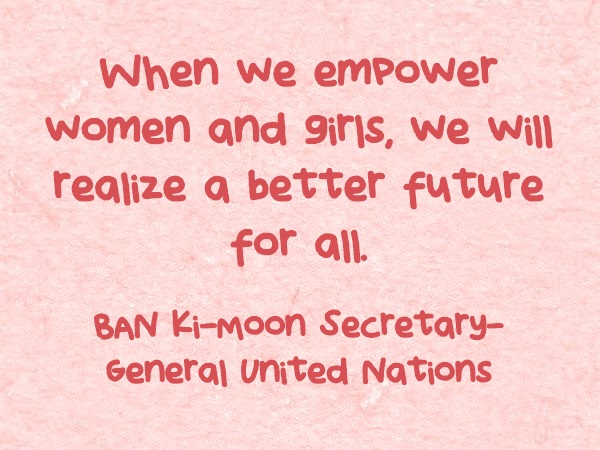
    The Secretary-General of the United Nations concludes the foreword to the 2015 paper with these words:

    When-we-empower-women

    The paper states that

     “Nearly 20 years after the adoption of the Platform for Action, no country has achieved equality for women and girls and significant levels of inequality between women and men persist.”

     This article in Time Magazine recognises that, while some gains have been made, there is still much more to be done to eliminate inequality. It repeats the call to action made by the UN Women Executive Director Phumzile Mlambo-Ngcuka:

    In line with the general achievements that have been made towards gender equality, and the gaps that still exist, is the situation for girls in schools, especially with regard to maths and science education. While more girls are moving into those areas than did when I was at school, there are still not enough.

    Ainissa Ramirez, who describes herself as a “Science Evangelist” says in her article Girls and Science: A Dream Deferred, that it is important to nurture girls’ interest in science and maths.

    She says that “the data . . . shows that the difference among graduates is not due to girls’ ability to do math and science; instead, the gender gap is caused by attitudes and behaviors toward girls and women, especially in the classroom.”

    This article by Claire Cain Miller in The New York Times reinforces this, saying that the attitude of elementary teachers is even more influential that attitudes in the home. Miller says that

    “Reversing bias among teachers could increase the number of women who enter fields like computer science and engineering, which are some of the fastest growing and highest paying.”

    This article by Sue Wilson cites research confirming the bias of teachers against girls showing that boys often received higher marks than did girls of equal ability. While the girls were discouraged from continuing their studies of maths and science subjects, the boys (whose teachers had over-assessed their ability) went on to be successful in those subjects.

    For the past three years during which time I have been writing science curriculum documents, I have had the extreme good fortune of working with one of Australia’s top science teachers. In fact Deb Smith has won many awards for her science teaching including the Prime Minister’s Prize for Excellence in Science Teaching in Secondary Schools in 2010. Throughout her career Deb has been an advocate for girls in science and has encouraged many girls, who otherwise would not have, to pursue careers in science.

    I haven’t yet considered whether Marnie, a character I have been developing through my flash fiction stories, would have, let alone pursue, an interest in maths and science subjects. I think it would be all she could do to survive.  You see, Marnie’s childhood had little to recommend it: a dysfunctional family in which she suffered neglect and abuse, and difficulties at school and with friendships as a result. However a teacher like Deb Smith or Ainissa Ramirez could make a difference to her engagement with those subjects. Marnie was fortunate that a teacher saw in her something special and provided support and guidance at a time that was crucial to her survival.

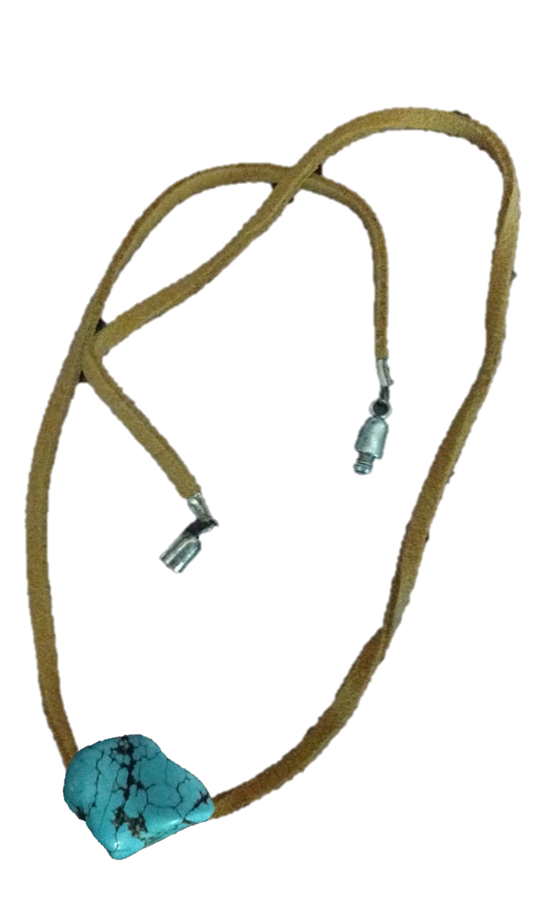
    This week, in response to the prompting by Charli Mills at the Carrot Ranch to In 99 words (no more, no less) color your story turquoise, I take Marnie one step closer to empowerment. Charli says that turquoise blue evokes trust and strength. I have also heard that it signifies protection, friendship and peace. What wonderful qualities to aspire to for Marnie, and for all women. Coincidentally, it is my favourite colour.

    Here is my flash fiction response to Charli’s challenge, with a Marnie who has found a new inner strength and sense of peace, and recalls the trust that was given in friendship along with a charm for protection.

    I hope you enjoy it.

    turquoie necklace

    Turquoise dreaming

    Marnie paused at the gate. The house looked the same: roses by the steps, bell by the door, windows open and curtains tied back; just as she remembered.

    She shuddered as the memory of her last visit flashed momentarily: she was running, almost blinded by tears, stumbling with fear, up the steps, to the open door and open heart. She rubbed the turquoise pendant Miss had given her then, for “protection and peace”. She had worn it always.

    Now, Marnie walked the path with an unfamiliar lightness. It was over. Really over!

    She knocked at the door.

    Thank you

    Thank you for reading.

    I appreciate your feedback. Please share your thoughts about any aspect of this post and flash fiction.


  • Ripples through time

    http://www.morguefile.com/archive/display/219606
    http://www.morguefile.com/archive/display/219606


    This week at The Carrot Ranch Charli Mills has challenged writers to in 99 words (no more, no less) write a story that includes a river and a person (or people). 

    A river? That brought to mind two ideas:

    ripples, and

    that you never step into the same river twice (from the Heraclitus quote).

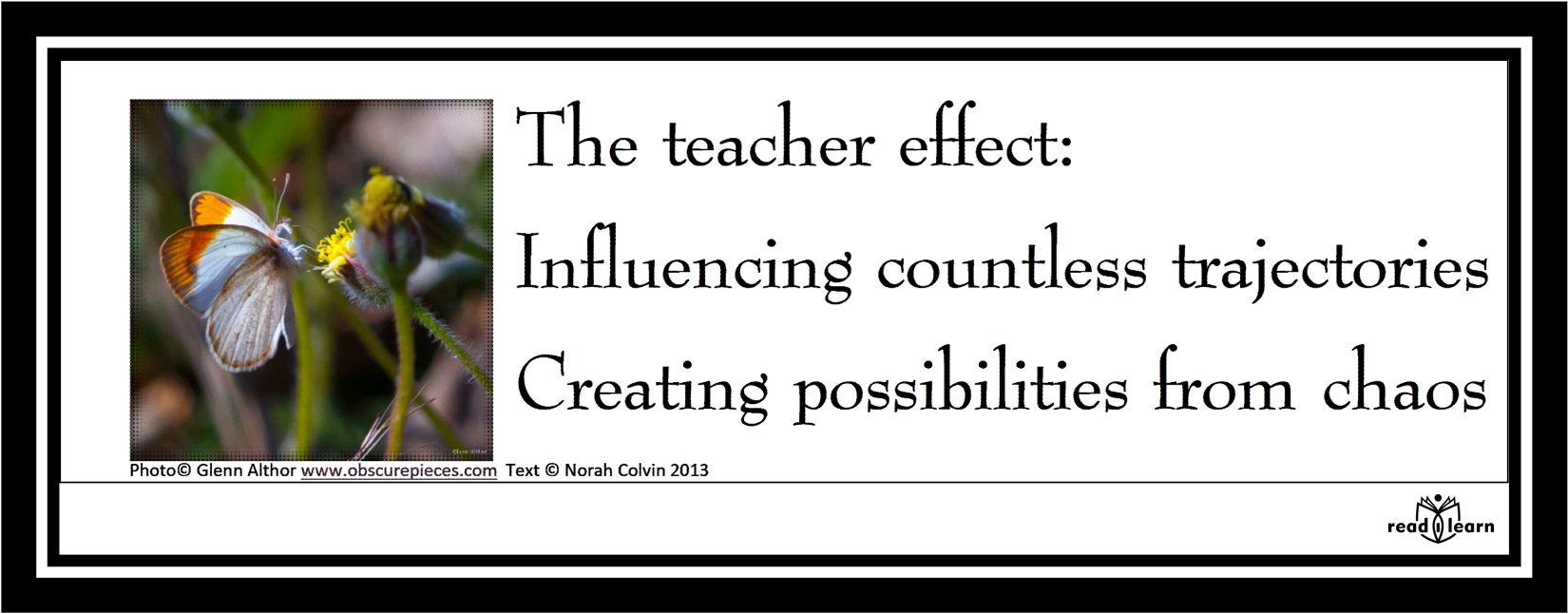
    You are probably familiar with the terms “the ripple effect” and “the butterfly effect”. Both terms refer to the effects, which can be far-reaching and unintended, of small changes or events which may seem insignificant or even go unnoticed at the time.

    In his book The Ripple Effect Tony Ryan shares many stories about small actions having a positive effect on the lives of others. He has a firm belief that each of us makes a difference with our everyday actions be it through a smile, a kind word or a helping hand. He says,

    “you must believe in your personal power to create ripples that spread out and change the world. In fact, if it is not you who is going to do it, then who else do you think is likely to make the effort? Remember that every change on this planet begins with a human being somewhere, somehow. It may as well be you.”

    None of us can ever know the full impact of words and actions.  The potential for teachers to create ripples is powerful and this knowledge, for them, can induce as much anxiety as it does joy. While I am always the first to acknowledge my shortcomings, I hope that positive effects far outweigh the negative.

    Readilearn bookmark

    Sometimes expressing an opinion that differs from the status quo can be considered ‘making ripples’ or even ‘making waves’. On his blog Theory and Practice, Matt Renwick is making waves this week talking about assessment and standardised testing. (I have expressed my thoughts on the subject here and here, for example.) I wish Matt’s waves a long journey with school-changing effects.

    Matt summarises five articles about testing, including one by Noam Chomsky from which he quotes,

    “All of the mechanisms – testing, assessing, evaluating, measuring – that force people to develop those characteristics… These ideas and concepts have consequences…”

    The consequences, the ripples, are not always the ones we want: stressed and anxious students afraid of trying and of failure are just part of it. The effects reach further: inappropriateness of tasks, reduced equity, mis-placed funding, teacher dissatisfaction . . .

    Matt’s voice is not alone. He expresses what most teachers know. Unfortunately teachers are not the ones writing policies and setting procedures about what happens in schools. Often they are not even consulted. The companies who have most to gain by sales of their testing programs can be very influential.

    Matt concludes his article saying,

    “I think this information needs to be shared over and over again.  . . . To not advocate is to concede our authority as the experts in our profession. We are in the right on this one. There is nothing to be afraid of.”

    I agree with Matt. We must advocate for the children, the students, their education and their teachers. So many administrators are talking about data, proclaiming that data is what is important. Now there is even “data mining”, big data mining, as explained in this article by the Australian Council for Educational Research. Check out this great new tool for use in mining data! Don’t they realise the children, their curiosity, wonder and creativity, are the treasure!

    http://www.morguefile.com/archive/display/941659
    http://www.morguefile.com/archive/display/941659

    And as for the quote that you can never step into the same river twice because you will have changed and the river will have changed. Well I think it’s possible that that situation doesn’t apply to schools. What happens in many schools probably doesn’t look all that different from what has happened for at least the last two hundred years: children sitting in rows chanting meaningless lists. Harsh? Maybe. Reality? Pretty much.

    http://www.morguefile.com/archive/display/902642
    http://www.morguefile.com/archive/display/902642

    And now to finish in a more positive way with my flash which combines both ideas: the life-changing consequences of a seemingly insignificant event at precisely the appropriate moment, and the difference in the person and the river on two separate occasions. And the person? None else but Marnie.

    Richmond Bridge 1825

    Ripples in the river

    Marnie paused on the bridge and gazed into river.

    “My life began here,” she thought.

    . . .

    More than twenty years before she’d stood there, begging for release from torments she could no longer endure; when a gentle voice beside her said, “Beautiful, isn’t it?” and stood there with her in silence a while before asking, “Care to walk a little?”

    . . .

    Marnie flicked the agent’s card into the water and watched momentarily as it carried away the last remnants of that other existence.

    “I wonder if Miss still lives there,” she smiled. “Must say hello.”


    Thank you

    Thank you for reading. I value your feedback. Please share your thoughts about any aspect of this post or flash fiction.

  • How to teach compassion – and why

    During the past few weeks I have been exploring the idea of compassion, along with many others in the blogosphere, in response to the #1000Speak for Compassion project.

    In a TED Talk I shared in a previous post Joan Halifax questioned why, if compassion was so important, didn’t we teach it to children.

    Man-resigning

    That question provided me with a challenge. Indeed I wondered if the question was really fair. The question implied that children were not being taught compassion. And while that assumption may be true for many, it is just as true that many children are being taught to be compassionate – in their homes, in their schools, and in other groups to which they belong. By recognizing the many who do, I in no way wish to indicate that enough is being done. Indeed, much more needs to be done, but let’s not make a sweeping statement that attempts to colour everyone with the same inadequacy in teaching compassion.

    I decided to investigate just what ideas were available for teaching children compassion. I had to look no further than one of my blogging friends for evidence that children are being taught compassion through their daily activities. In a number of posts on her own blog Lemon Shark, and in a number of comments on mine, Sarah Brentyn has described practices that she uses to teach her children to be compassionate by involving them in compassionate acts.

    Some practices that Sarah recommends for developing compassion include things from as simple as using common courtesies and good manners to volunteering and making personal donations to homeless shelters.

    I defy you to read her post 1000 Voices for Compassion without being moved by her generosity and compassion. It tells a beautiful story of compassion in action, a lesson for not only her children, but for all of us.

    In her following post entitled Defining Compassion vs. Compassion in Action Sarah described asking her children what the word “compassion” meant. They weren’t sure how to answer her. But when she asked them to describe something compassionate they had no difficulty coming up with examples – from their own lives. Why? Because from the moment they were born Sarah’s children have been living in a compassionate world. They have been treated compassionately and they have not only had compassionate actions modelled for them, they have been involved in those compassionate actions. I congratulate you Sarah, for inspiring us to be compassionate, and for being a role model for us to emulate.

    Sarah Brentyn = walk the walk

    Looking beyond Sarah’s examples for further suggestions, I came across a number of other articles. Each seemed to reiterate what Sarah had already shared.

    In an article for the Huffington Post Signe Whitson, author and child and adolescent therapist, says that “experts agree that fostering compassion in young people is among the best ways to prevent verbal, physical, and emotional aggression” and shares 8 Ways to Teach Compassion to Kids:

    1. Walk the walk

    “Show young people that anytime is the right time to engage in acts of service and compassion for others.”

    1. Put the Child on the Receiving End of Compassion

    “tending to a child when he is feeling down or under the weather is the best way to teach him how to show compassion to others.”

    1. Talk the Talk

    “talk explicitly about acts of compassion . . . communicate its importance as a prized family value”

    1. Volunteer Your Time

    “When children become actively involved I acts of showing compassion to others, they learn about his value in a very deep and enduring way”

    1. Care for a Pet

    “Children who care for pets learn important values such as responsibility, unconditional love, empathy, and compassion for all living things”

    baby bird

    1. Read All About It

    “Children’s books are great for providing a window into the experiences of others.”

    Whoever you are

    1. Compassion It TM

    Wear a Compassion It band as a daily and “personal reminder to act compassionately towards someone else”

    1. Make a Wish

    The “Make-a-Wish Foundation provides hope, strength, and joy to children with life-threatening medical conditions . . . can have a truly impactful experience of being able to provide tangible help and joy to a peer”

    https://openclipart.org/detail/30019/star-by-nefigcas
    https://openclipart.org/detail/30019/star-by-nefigcas

    Other than the references to the specific organizations, Compassion it and Make a Wish Foundation, the suggestions are things that have been discussed before in various posts about compassion, including Sarah’s.

    Like Sarah, Whitson believes that it is the accumulation of little everyday actions that make a difference. She states that, as a bullying prevention trainer, she considers “big” solutions — such as policies, procedures, and trainings are trumped each and every day by the seemingly little, yet extraordinarily powerful, acts of compassion and kindness that adults show to the young people in their lives.”

    In her article about How to Instill Compassion in Children Marilyn Price-Mitchell agreed about the importance of teaching compassion, saying that  “children who participate in programs that teach kindness, respect, empathy, and compassion and who have families that reinforce those strengths at home develop the muscles they need to become civically-engaged adolescents and adults.”

    Price-Mitchell suggested that parents could help teach their children compassion by providing opportunities to practice compassion, by helping children understand and cope with anger, and by teaching  children to self-regulate.

    https://openclipart.org/image/800px/svg_to_png/192642/Children_holding_hands.png
    https://openclipart.org/image/800px/svg_to_png/192642/Children_holding_hands.png

    Jane Meredith Adams, in her article Raising a Compassionate Child says that “children have an inborn capacity for compassion … they naturally identify with stuffed animals, other kids, pets, and underdogs. The tricky part is that their empathy must compete with other developmental forces, including limited impulse control – which makes them pull the cat’s tail – and their belief that their needs absolutely must come first – which makes it hard for them to let their cousin push the col fire truck.”

    Adams says that teaching compassion is “part of day-to-day life: how you answer your child’s questions, how you solve conflict at the park, how you nudge his or her growing capacity to understand and think about other people.” Adams suggests to Promote sweetness” every day by showing children how to be gentle to others, by speaking to them softly, by rejecting rudeness, and by saying sorry when you have made a mistake. I think Sarah would agree with all of those.

    Similar ideas are proposed by  Kim McConnell, and Leticia of techsavvymama who sums it all up nicely with these suggestions:

    • Model the kinds of behaviour we expect
    • Exercise patience
    • Listen to our kids
    • Teach resiliency by providing strategies, and
    • Use quality educational content to reinforce the concept (e.g. books, DVDs and downloadable material)

    I’m sure that many of these suggestions are familiar to you through your own personal experiences, either when growing up or as an adult. I think what my exploration of this topic shows me is that, while it may be useful to teach about compassion in schools, children really only learn to be compassionate if they are treated compassionately and have compassion modeled for them, if it is an integral part of their everyday lives.

    What do you think?

    Thank you

    Thank you for reading. I appreciate your feedback. Please share your thoughts about any aspect of this post.