Live Love Laugh Learn … Create the possibilities

Category: Picture books

  • Whose story is it anyway?

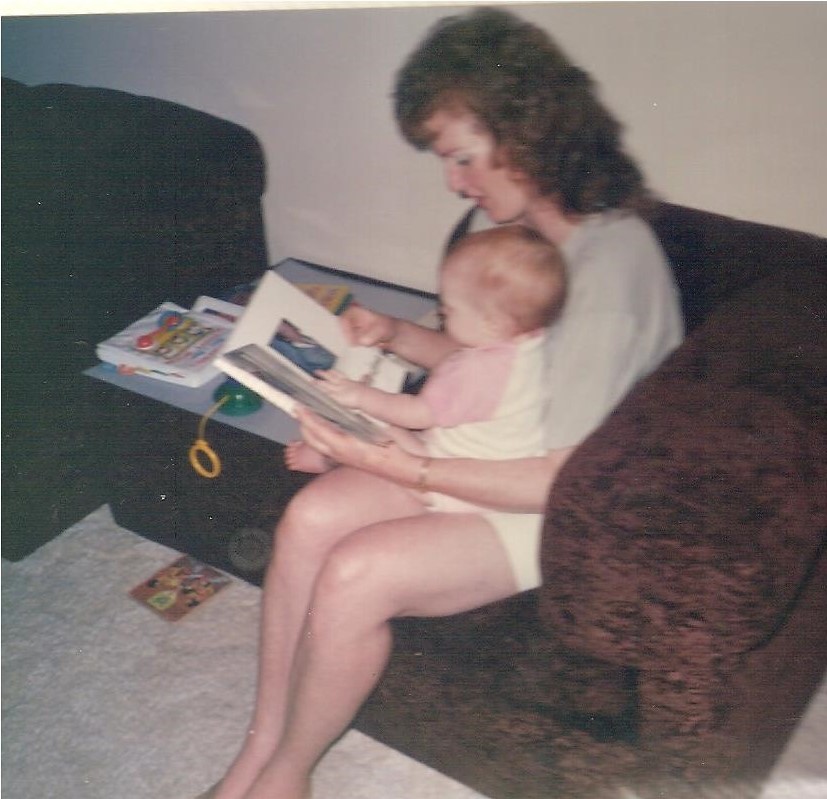
    Nor and Bec reading

    Children love stories.

    They love being read stories and beg for them to be read, over and over again.

    Equally as much, if not more, they love being told stories, especially stories of their own lives. They beg for them to be told over and over, listening attentively and with wonder as their own stories (her story and his story) are being revealed. They commit these tales to memory so that eventually it is difficult to distinguish the genuine experiential memory from the telling. Even as adults they seem to not tire of hearing tales of the cute things they did when they were little, or of shared experiences.

    They also love being told stories of their parents’ lives. These are the stories that help define them and their existence: how they came to be. The stories tell of times gone by, and of how things used to be. They marvel that their parents were once children and try to imagine how that might have been.

    My daughter would often ask for stories about herself, her brother, myself or other family members. One day when she was about six, she asked again, ‘Tell me a story about when you were a little girl.’ Before I could respond she jumped in with, ‘What were the dinosaurs like?’ She was teasing, of course, and her comedic timing was perfect. A story was created, one that has been shared many times.

    History is a story, though at school I never saw it as such. Had it been a story of lives, as its name implies, I may have been interested. But history at school was a list of wars and dates, and kings and queens to be memorised and regurgitated for a test at the end of the term. There was no story, no human emotion, no semblance to any narrative that may have lured me in.

    I hope that today’s students of history are not required to commit sterile lists of facts to memory without the stories that would give them meaning and significance, some human element to help the information stick.

    History, as a subject, had always been relegated to high school. It was not a discrete part of the primary school curriculum, though aspects were explored in other subject areas such as ‘Social Studies’ when I was at school, or more recently ‘Studies of Society and Environment’. With the introduction of the new Australian Curriculum, History is now a stand-alone subject.

    As an early childhood teacher I was a bit terrified that young children would be required to memorise lists of seemingly random facts and dates. I’m pleased to say that, for the early years anyway, this is not so. Children in the early years start by exploring their own history and the history of their family, considering similarities and differences between their lives, the lives of their parents, and of their friends.

    I applaud this as an excellent starting point. I believe, when working with children, connections must always be made with their lives and what they know. What better starting point than investigating the traditions of their own family and culture.

    In Australia, as I am sure it is in many other places, a great diversity of cultures is represented in each classroom. Encouraging children to share similarities and differences of traditions with their classmates helps to develop understanding of each other’s traditions and beliefs, which in turn fosters respect and empathy. For this purpose, I developed some materials to make it easy for children to share their traditions. These are available in my Teachers Pay Teachers store.

    Whoever you areMem Fox has written a beautiful picture book Whoever you are that I love to share with children when discussing their cultures and traditions. It explains in a simple and beautiful way that although children around the world may live in different houses, wear different clothes, eat different foods, for example ‘inside, their hearts are just like yours.’ Mem Fox explains the story on her website.

    I also like to sing I am Freedom’s Child by Bill Martin Jr.; and in Australia we have a great song that tells about our different beginnings, I am, you are, we are Australian by Bruce Woodley.

    Heal the World by Michael Jackson is another great one for appreciating diversity and fostering inclusivity.

    What got me thinking about history in particular for this post is the flash fiction prompt posted by Charli Mills at Carrot Ranch Communications. Charli’s challenge is to In 99 words (no more, no less) write a story that considers history, near or far.


    This is my contribution:
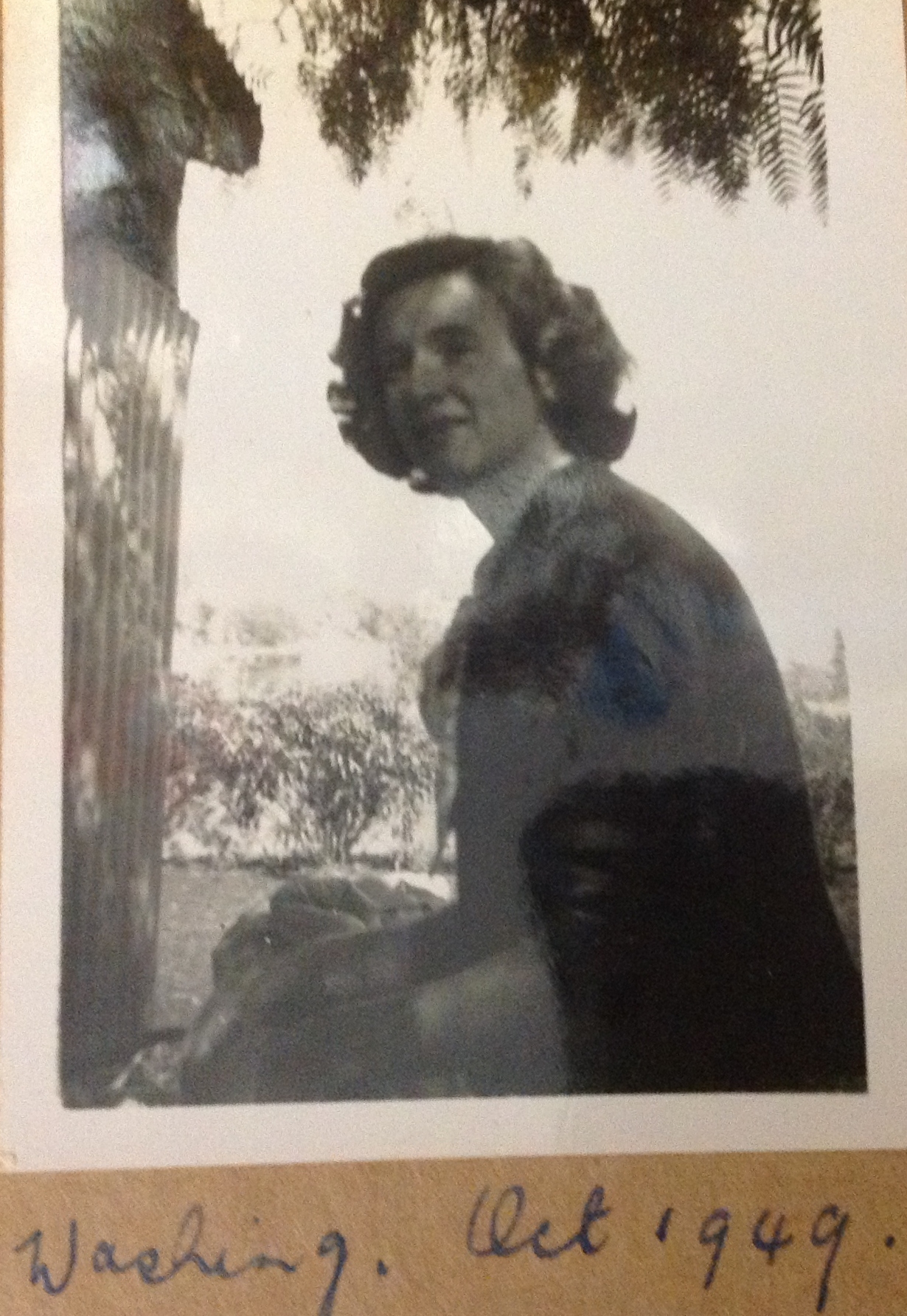
    washing 1949

    Washing day

    Her freckled, calloused hands were red and chaffed as they gripped the wooden stick and stirred Monday’s sheets in the large copper pot heating over burning blocks of wood.

    The children played in the dirt nearby, scratching like chickens, hopeful of an interesting find.

    The dirt embedded under her torn and splitting fingernails began to ease away in the warm sudsy water as she heaved the sodden sheets and plopped them onto the wooden mangles.

    The children fought to turn the handle, smearing dirty handprints on the sheets.

    She sighed, and hung them over the line. One chore done.


    I welcome your feedback. Please share your thoughts about any aspect of the article or my flash fiction piece.


  • What do you have in mind?

    This week Two Writing Teachers posted a wonderful article by Stacey Shubitz (one of the Two Writing Teachers) about A Picture Book that Pushes the Growth Mindset.

    This post coincided beautifully with the flash fiction prompt posted by Charli Mills at Carrot Ranch Communications. Charli’s challenge is to:

     In 99 words (no more, no less) write a story about getting stronger.

    This is a perfect prompt for a teacher as a major focus of our work is in developing children’s strengths:

    Strengths as in abilities; strength as in self-esteem and self-confidence; strength as in willingness to face setbacks and try, try again; strength as in keeping on going even when the going gets tough.

    The picture book discussed in the article by Stacey Shubitz is The Most Magnificent Thing by Ashley Spires. Stacey suggests that the book is a great opener for discussions with children about the importance of a growth mindset.

    According to Stacey, an understanding of ‘the power of having a growth mindset’ has been enabled by the work of Carol Dweck, a Stanford psychologist. It is grounded in a belief that

    Someone can accomplish a lot more through hard work and dedication, rather than by relying on their smarts alone.

    I agree with Stacey that

    ‘Educators know the benefits of having a growth mindset, rather than having a fixed one. We learn from trial and error. There is value in failure.’

    I will not quote Stacey’s article in its entirety, but suggest you pop over and read it for yourself. (If you do, and leave a comment prior to June 27th, you may win yourself a copy of The Most Magnificent Thing, if you live in the USA or Canada.)

    Stacey says that “The girl in the story tries over ten times to build something and get it right. Through hard work and some help from her trust sidekick, her pug, she eventually succeeds.” As well as a starting point for discussing the growth mindset, Stacey suggests eight features of the book which are useful for teaching writing. The article also includes a brief, but informative, interview with the author/illustrator Ashley Spires.

    In response to Stacey’s question about using The Most Magnificent Thing for discussing a growth mindset, Ashley responds:

    ‘The character is a perfectly capable girl with a great idea and the skill to make it, but she has to try, try and try again in order to succeed. Most kids (I was one of them) think that if it’s not perfect the first time, then they should move on to something that comes to them more easily. Working hard to succeed is what true success is.”

    <p><a href=”http://vimeo.com/89499612″>The Most Magnificent Thing Book Trailer</a> from <a href=”http://vimeo.com/kidscanpress”>Kids Can Press</a> on <a href=”https://vimeo.com”>Vimeo</a&gt;.</p>

    My flash fiction, told through the jottings of a classroom teacher over time, shows a growth mindset emerging from one that was previously crushed.

    Progress

    Day one

    Timid. Needed help getting things out of bag to put in drawer. Sat towards back of group. Drew knees up under chin. Hunched over. Sucked thumb. Twisted long tangled hair under nose. Rocked.

    Day twenty-six

    Responded in roll call! Sat with ‘friend’. Legs crossed. Back straight. Smiled – briefly. Someone looked! Screamed, “Stop looking at me!” Dissolved in tears. Again. Retreated under desk. Again.

    Day fifty-two

    Initiated conversation!! Hair combed!! Nose not running!! Brought toy for show and tell. Responded with one- or two-word answers. Small, dirty, pink unicorn. B laughed. Erupted, but went to desk, not under!


    I welcome your feedback. Please share your thoughts about any aspect of the article or my flash fiction piece.

  • Of rainbows and unicorns – Part 2 – Do fairy tales and fantasy still have a place for children?

    https://openclipart.org/http://goo.gl/zzNhFF
    https://openclipart.org/http://goo.gl/zzNhFF

    I have many discussions with parents about whether they should read fairy tales and stories with magical elements to their children. These parents raise a number of issues, for example:

    • Horrible things happen – Hansel and Gretel are abandoned in the woods (by their parents) and are captured by a wicked witch – the wolf tries to trick the seven little kids left at home alone
    • Parents are often dead or absent – Cinderella, Beauty and the Beast, Rapunzel, Red Riding Hood, Jack and the Beanstalk
    • Stepmothers are mean – Cinderella, Snow White
    • Sexism, especially the need for a female to be rescued by a handsome prince – Cinderella, Sleeping Beauty
    • They contain “magical” creatures such as fairy godmothers (Cinderella, Sleeping Beauty), witches (Snow White), giants (Jack and the Beanstalk), trolls (Three Billy Goats)
    • Myth of happily ever after
    • Stereotypes – beauty is good, ugly is bad
    • The presence of magic – good magic of fairies and bad magic of witches – Sleeping Beauty; magical bean seeds and geese (Jack and the Beanstalk)
    • Bullying – Cinderella

    Maria L. Hughes, writing for The Little Prickle Press sums up the concerns this way:

    “many of the older tales incorporated rather dark themes devoted to death, suffering and children being murdered. But then there is also a second incorporation that has to do with later Disney movies of these fairy tales and them being too happy and can result in parents thinking their child will be deluded with ideas that the world will just work for them and things will be good.”

    While I acknowledge these elements occur, I am not prepared to abandon fairy tales because of it.

    While I may consider a diet of only fairy tales problematic, I think something would be lacking if a child was refused access to the richness of their stories and tradition. Like most fiction, they offer an avenue for escapism. In addition, the stories can be used as a tool for initiating non-threatening discussions of the issues listed above.

    In Once upon an if The Storythinking Handbook Peter Worley writes

    “Stories are just one way that we are able to sharpen our own character in order to prepare for the narratives we will one day find ourselves in as the story of our life unfolds before, around and within us.” 

    Following a comment by Richard Dawkins, a recent discussion on The Guardian considered whether fairy tales are harmful to children. So far the consensus seems to be that they are not.

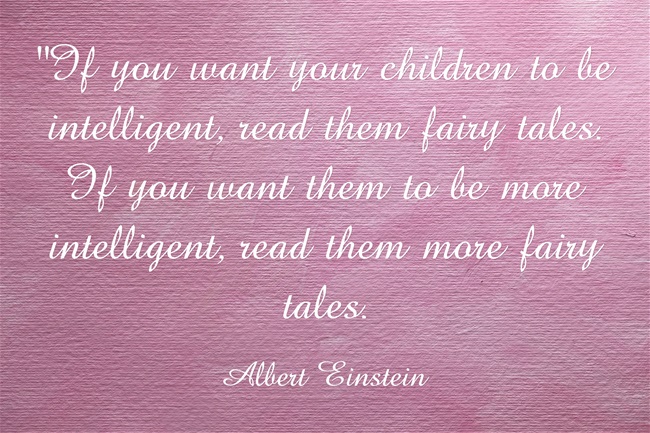
    Albert Einstein was a supporter of fairy tales and is often attributed with the following quote, discussed in more detail by Maria Popova on brain pickings.

    https://quozio.com/
    https://quozio.com/

    Anne Fine, in the Foreword to Once upon an if The Storythinking Handbook explains

    “In an increasingly complicated world, we more than ever want our children to be able to think with clarity, rather than lead lives hampered or derailed by all those false assumptions and unexamined prejudices that seem as easily inherited as freckles or brown eyes.

    How can we go about teaching them to peel back the surface of their first thoughts on a matter, or even their strongest beliefs, and look at them with more care? . . . fiction has always fostered the moral, intellectual and emotional development of the growing child. (‘Should she have done that?’ ‘Would I?’ ‘What else could have been done?’ ‘How would it feel?’) Good stories highlight the sheer complexity of things. They furnish a far greater understanding of the world and everyone in it. For most of us, fiction has always been the earliest – and many would argue the best – instrument we have had for ethical enquiry.”

    Think of the ethical inquiry that could occur when discussing Goldilocks and her break and enter, Jack’s theft of the giant’s belongings and the constant portrayal of the wolf as the bad guy; just to get you started.

    Melissa Taylor on her blog “Imagination Soup” suggests the following 8 reasons why fairy tales are essential to childhood:

    1. Show kids how to handle problems
    2. Build emotional resilience
    3. Give us a common language (Cultural literacy and canon)
    4. Cross cultural boundaries
    5. Teach story
    6. Develop imagination
    7. Can be used to teach critical thinking skills
    8. Teach lessons

    In a previous post about fairy tales, written in response to a flash fiction challenge set by Charli Mills  I mentioned that I was not a keen reader of adult fantasy. In a comment on that post Charli mentioned that she knew others with similar feelings. I will leave you with a link to another article on brain pickings in which Maria Popova discusses the thoughts of one of the masters of fantasy, J.R.R. Tolkien on Fairy Tales, Language, the Psychology of Fantasy, and Why There’s No Such Thing as Writing “For Children”

    What do you think? Should we read fairy tales to children? Why/why not?

    What are your favourite fairy tales and what lessons have you learned from them?

    Please share your thoughts.

  • It’s no surprise! Talking education

    https://openclipart.org/image/800px/svg_to_png/185077/creepyjackinthebox.png
    https://openclipart.org/image/800px/svg_to_png/185077/creepyjackinthebox.png

    We all like a surprise, right?

    Well, you might say, that all depends on whether the surprise is a good surprise or a bad surprise.

    A surprise is simply something unexpected, and everyday life is full of surprises; some so little they go almost unnoticed, others of larger more life-changing proportions. Some are pleasant and others far less so.

    What got me thinking about surprises this week is the flash fiction prompt posted by Charli Mills at Carrot Ranch Communications.

    Charli’s challenge this week is to

    In 99 words (no more, no less) write a story that shows surprise without using the word. 

    I have been thinking of all sorts of surprises I could write about but decided to maintain my focus on education.

    There are many opportunities for surprises to occur throughout one’s education, which is not limited to (but probably, dare I say, by) one’s schooling experiences.

    For example:

    • Discovering you can read a book, all by yourself
    • Discovering an author whose work you just can’t put down
    • Finding a solution to a problem that had seemed insurmountable
    • Achieving a favourable result in a dreaded test
    • Being offered a place in the course you were wanting
    • Having work accepted, valued and receiving payment


    There are many situations in which the surprise could go either way.

    For example:

    • Being called to the principal’s office
    • Having a parent-teacher interview about your own child, or student
    • Receiving exam results or course placement offer
    • Meeting a new teacher
    • Working in a group to solve a problem


    Being a lover of stories, especially picture books, it is rare that a situation doesn’t trigger a thought connection to a story or book I have read.

    Thinking about the good surprises and bad surprises that could happen in some of these situations made me think of a book I had read to my own, and classes of, children years ago. Maybe you will remember it also.

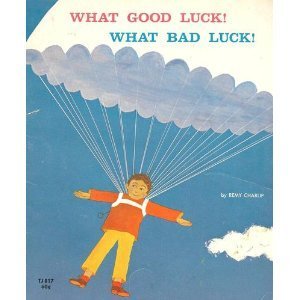
    what good luck what bad luckThe book is What Good Luck! What Bad Luck! by Remy Charlip and relates a sequence of events alternating between good and bad.

    It appears, from what I can find out, that it was first published by Ashton Scholastic in 1964 and sold for 60 cents.

    Today Amazon has used copies on offer for $34.99 or $122 and a collectible as high as $157.70.

    What good luck, I used to have a copy.

    What bad luck, it is no longer in my possession.

    I was at the stage of mentally composing my story with my fingers itching to get to the keyboard to translate it into print when I glanced at the morning paper1 and came across this headline:

    Lesson 1: Bad teachers = bad results

    As a teacher who is passionate about education but also critical of top-down force-fed schooling institutions, headlines/comments like these have me vacillating between defiant self- (and professional-) protection and agreement with the criticisms.

    Teachers come in for a lot of criticism, some of it deservedly so, other of it not so much.

    One quote I love is “Teaching is the one profession that creates all other professions”.

    On the flip-side of this is “Those who can, do. Those who can’t, teach.”

    While I take offense at this one, sometimes I am inclined to think it alludes to an important quality in a teacher. Frequently those who are expert at something, find it difficult to break a process into a series of steps that would enable an explanation to be easily understood by others. If one has struggled to master a task, the process can seem clearer and easier to explain. However there does come a point below which knowledge and experience must not fall or effective teaching cannot exist.

    In her article Bad teachers = bad results, Kylie Lang says that

    “C-grade teachers will not produce A-grade results”.

    She says,

    “Too many mediocre minds are becoming teachers. Universities usher them in, these academic underperformers who fail to qualify for courses with higher entry requirements.”

    She says that

    “A federal education department report shows a rise in the number of school leavers with poor grades being offered places on teaching courses. This year, 55 percent of Year 12 students that were allowed to undertake teaching degrees had an Australian Tertiary Admission Rank below the average . . .”

    It is a bit scary, isn’t it?

    She also says that,

    “If we are a nation that values education . . . we must attract brighter, more creative thinkers to classrooms.”

    I couldn’t agree more. However I wonder where they will get those creative thinkers if higher order thinking skills, creativity and innovation are sacrificed in the relentless quest for scores on academic tests which require students to spit back information forced upon them in hours of didactic instruction and rote learning.

    It’s no surprise that anyone who maintains the ability to think outside the square would rather not return to it!

    And so to my flash piece for this week, which comes with a warning – there’s no rhyme because there is no reason:


    What luck!

    No books, no talk were in the home.

    What luck!

    He was happy to play on his own.


    School began when he was five.

    What luck!

    Learning from flash cards, how hard he tried.


    “My boy can’t do it!” his Mum once wailed.

    What luck!

    With ‘forged’ test scores no child would fail.


    Leaving school, the options were few.

    What luck!

    Teaching was the one he could do.


    Uni years flashed by so fast.

    What luck!

    Number requirements meant he passed.


    Then into the classroom he unprepared went.

    No future joy for any student.

    What bad luck!


    I always enjoy reading your comments. I invite you to share your thoughts.


    1 Courier-Mail, Sunday May 25 2014


    If you enjoyed this post, you may enjoy others. Please click the button at the top on the right to receive future posts by email.

  • Going on a treasure hunt!

    we're going on a bear hunt

    A few weeks ago I had the great pleasure of taking my two gorgeous grandchildren to a performance of Michael Rosen’s “We’re Going on a Bear Hunt”. To say we enjoyed it would be an understatement. We had a rollicking good time.

    The performance involved a lot of audience participation including spraying the entire audience with water from the “deep cold river”; an event which left everyone slightly wet, screaming with anticipation and laughter, and genuinely having a wonderful time interacting with this fabulous text.

    We were already familiar with the text, of course, and had read it, recited it, acted it out and played a board game which has been made to accompany the text. None of this really prepared us for the delightful stage performance; but these pale in comparison with a telling by the master storyteller himself, Michael Rosen.

    Michael Rosen’s website is a veritable treasure chest with much to explore and delight.  From his home page you can visit his blog which he describes a as a place where he’ll

    “post up some thoughts and ideas – especially on literature in education, children’s literature in general, poetry, reading, writing, teaching and thoughts on current affairs.”

    You can also check out a full list of his publications. He’s very prolific!

    After attending the performance of “We’re Going on a Bear Hunt” I shared with my grandchildren the video of Michael Rosen performing the story, which is also available from his home page. They loved it and we watched it “Again!”

    Then I showed them the video of Rosen performing his fabulous poem Chocolate Cake. We watched it four times! Artie, who is four (and a half) was joining in with the telling the second time, and by the fourth time was copying many of Michael’s actions as well as facial and vocal expressions. Artie laughed along with the story and excitedly called other members of the family to watch it with him.

    The next time Artie came to visit he was performing his own version, “Lollipop”, with similar actions and both facial and vocal expressions. His younger sister also had to have her turn telling the story. It was delightful and convinced me, though I needed no convincing, of the power of a great performer to turn children onto the fun of language, of playing with words, of performing, and of composing writing of their own. Creativity ignited!

    If you haven’t yet watched Michael perform Chocolate Cake, I urge you to do so. You are in for a treat. I’m certain you will not be able to watch it without a smile on your face.

    Michael is so passionate about making poetry come alive for children, he has made many videos on his website freely available to teachers for use in their classrooms.

    In his article “Teachers write to me saying, ‘What about poetry?’”, Michael begins by saying,

    The-best-thing-you-can

    He then goes on to present many fun ways of engaging children with poetry, none of which involve word study or comprehension exercises. He makes suggestions for performing, writing and talking about poems; and says that

    “The best and most important thing you can do with any poem that a child writes is either get it performed or ‘published.”

    and offers suggestions of how to do just that.

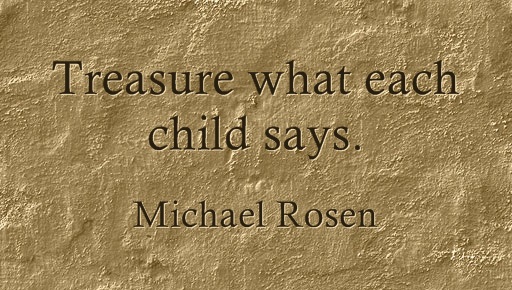
    Another thing he says in that article, which was the inspiration for the title of this post, is

    Treasure-what-each-child

    I couldn’t agree more.

    This is just a brief sample of the riches to be found on the Michael Rosen website. There are so many videos of Michael’s performances available that I have not yet watched them all. Please let me know your favourites and I will make sure I watch those too.

    Thanks Michael Rosen. We can learn so much from you while we are having fun!

  • The magic effect – why children need books

    Nor and Bec reading


    Children can be read to from the moment they are born, if not earlier. Preferably earlier!

    One of my favourite picture book authors and passionate advocate for reading to children is Mem Fox. I own, and have given as gifts, many of her wonderful books. I have attended her seminars and been mesmerised by her reading from her selection of stories. “Read more!” the adults beg. There are no children at these literacy seminars. This time it is a treat for only us: parents and teachers, literacy educators all.

    Currently Prince William, Kate and baby Prince George are visiting Australia. I was delighted to hear that they were given a gift of books by Australian authors, including some by Mem Fox. Over the years I have given many of Mem’s books as gifts; and kept just as many for myself!

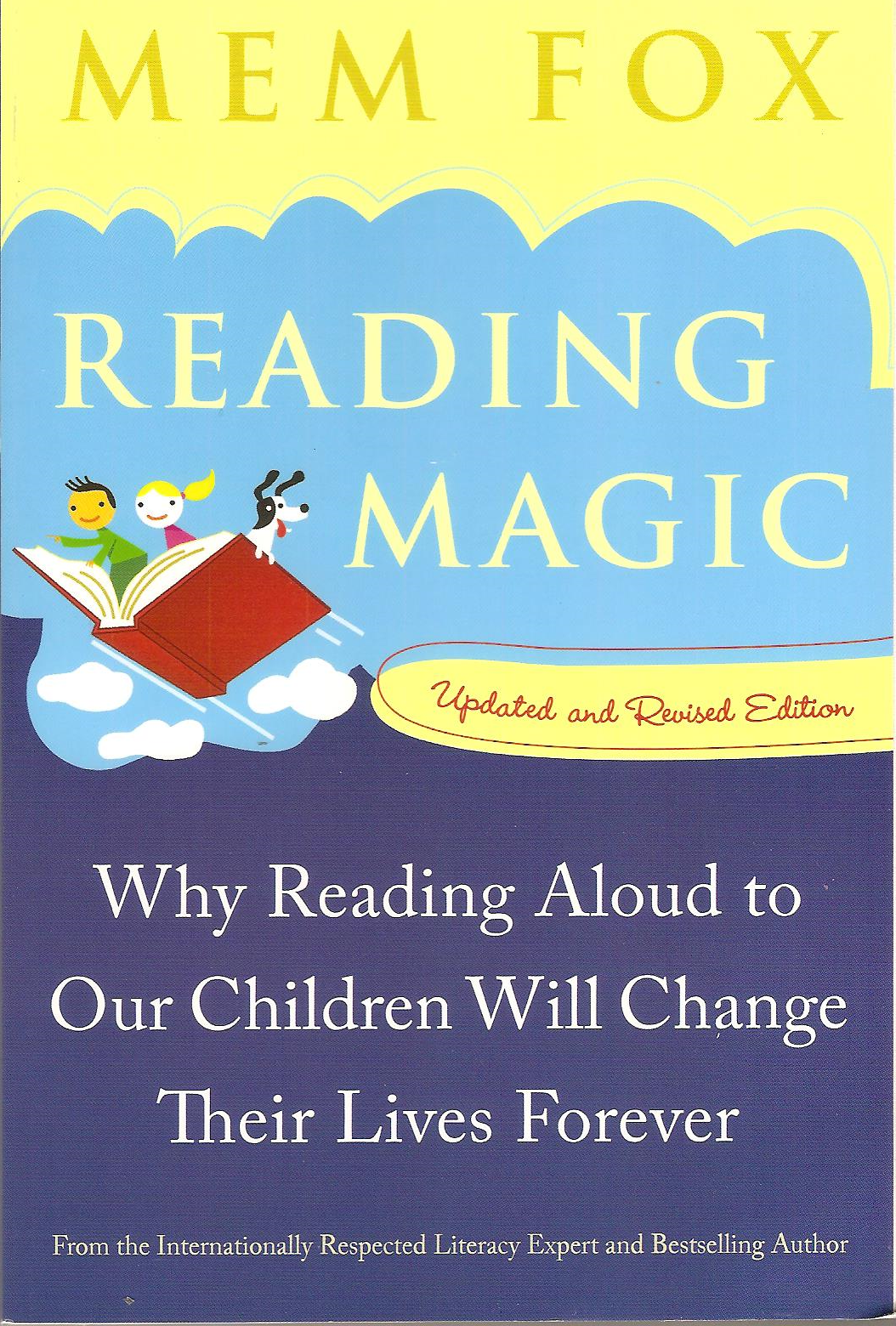
     Reading magic

    One that I have given to many new or expectant parents, as I consider it a “must read”, is Mem’s book “Reading Magic – Why Reading Aloud to Our Children Will Change Their Lives Forever”.

    I would love to quote the entire book for you, but it is better you read it for yourself. I will provide you with this quote from the foreword as a taster for the richness to be found inside.

    “It stands to reason that if we’re able to raise happier, brighter children by reading aloud to them, the well-being of the entire country will ramp up a notch. Children who realize in their first few weeks and months of life that listening to stories is the purest heaven; who understand that books are filled with delights, facts, fun, and food for thought; who fall in love with their parents, and their parents with them, while stores are being shared; and who are read aloud to for ten minutes a day in their first five years, usually learn to read quickly, happily and easily. And a whole lot of goodness follows for the entire community.”

    Mem's website


    Mem’s website, too, is a treasure trove just waiting to be explored by writers, teachers, parents, children and children-at-heart.

    You can listen to Mem read from her selection of books on the Current Read Aloud page. She reads three different books each month. Currently the books are Possum Magic, Harriet, You’ll Drive Me Wild! and Goodnight, Sleep Tight. Be quick to listen to these, though, as they will change at the end of the month. But never mind, there’ll be another three to enjoy next month!

    Mem even gives a read-aloud lesson! Now there’s no excuse! As she says,

    “. . . let’s get on and change the world, one page at a time.”

    Yes, Mem, let’s!


    What are your favourite read-aloud books? What did you enjoy as a child? What do you enjoy now?

  • Empowerment – the importance of having a voice

    In a previous series of posts I wrote about science inaccuracies in a picture book and questioned with whom lay the responsibility for providing young children with correct information.

    While this post builds upon those posts, it also takes a divergent path: the need for children to have a voice; to be empowered to ask questions, to state their needs and report wrongdoings.

    On a highly respected educational website Scholastic, with the by-line “Read Every Day. Lead a Better Life.”, in an article about Eric Carle author of The Very Hungry Caterpillar, children are told that

    “Eric already knows that a caterpillar emerges from a chrysalis, not a cocoon! So don’t bother writing to tell him.”

    This seemingly innocuous statement may be easily overlooked but packs a powerful message.

    What does it tell children?

    The author has been told many times, already knows and isn’t going to do anything about it.

    The author is tired of being told he is wrong and doesn’t want to hear it any more.

    The author is “right” and not to be questioned. (The book, with its misinformation, is highly acclaimed by millions around the world. However if, in answering a question on a test, children were to write that a butterfly comes out of a cocoon, they would be marked wrong. Explain that to them.)

    For me the most insidious part of this message is

    He already knows, “so don’t bother writing to tell him”!!!!!!!!

    You can’t change it.

    You know it’s wrong, but you can’t change it, so don’t bother trying.

    Although many societies are now moving to eradicate it, child abuse is still far too common worldwide. Not only must the attitudes of societies change, but children must be empowered, they must be encouraged to speak up and they must be listened to: their voices must be heard.

    In a recent child abuse case that occurred at a Queensland primary school, the student protection officer reportedly said that she couldn’t understand why the children who had been sexually abused did not come forward.

    couldn't believe 1

    The accused had continued in his role as child protection contact for a year after the first complaint was made. The student protection officer found it hard to believe that her colleague was a paedophile;

    couldn't believe 2

    and still she says she doesn’t understand why the children didn’t come forward!

    Click here to read the complete article.

    It seems to me the children did come forward if the first (indicates there were more) complaint was made more than a year before anything was done about it.

    The children tried to say, but were not believed. The predator was believed and protected while the plight of the innocent victims was ignored. The report states that parents who complained about the abuse of their children were ostracised by the school community and made out to be the “bad guys”.

    Is it any wonder that, if not listened to and not believed, and if more is done to protect the offenders than the abused, the children become increasingly reluctant to tell?

    After the first children had come forward and not been listened to or believed, may not they have said to others, “There’s no point in saying. They already know. They won’t do anything about it?”

    Or what about the parents who were ostracised and made out to be the bad ones?

    Doesn’t it make the message very clear – you are powerless. Your voice won’t be heard. Your opinion doesn’t matter.

    Carry this message over into countless other situations and you have a population who is afraid to speak up, fearing the disdain of reproach, the embarrassment of being unvalued and the helplessness of one’s message being unheard.

    How many times have you felt you must remain silent for fear of ridicule, rejection, or worse?

    How many opportunities for creating a positive change have been missed because the task seemed insurmountable or the personal repercussions too unpleasant?

    When have you stepped up and made that change happen because you were not afraid to speak up or speak out when faced with an issue you felt strongly about?

    What changes can we make to empower children (and adults) everywhere?

    By the way, in that article on the Scholastic website, it is reported that Eric Carle believes that “the most important part of developing a book . . .is working with editors to revise it.”

    Would it make any difference to the magic of The Very Hungry Caterpillar if, after all these years, Eric Carle rewrote a corrected version with a butterfly emerging triumphantly from a chrysalis?

    What would that act tell all the countless children who have written to tell Eric about his mistake, and the many others who wanted to but were told there was no point?

    The Very Hungry Caterpillar

    Please share your thoughts.

    Related posts:

    Searching for meaning in a picture book — Part A

    Searching for purpose in a picture book – Part B

    Searching for truth in a picture book – Part C

    Finding power in a picture book – the main event

  • Finding power in a picture book – the main event

    Finding power in a picture book – the main event

    Teaching critical literacy through picture books

    This is the fourth is a series of posts about the role of picture books, especially The Very Hungry Caterpillar by Eric Carle.

    The purpose of this post is to discuss the importance of critical literacy and the necessity to teach children to

    • think critically
    • not accept everything that is presented in text (oral, visual or print)
    • evaluate the source of the information and the intent of the author
    • match incoming information with prior knowledge,  and
    • question, question, question.

    In these previous posts

    Searching for meaning in a picture book – Part A

    Searching for purpose in a picture book – Part B

    Searching for truth in a picture book – Part C

    I suggested ways of including The Very Hungry Caterpillar in an early childhood classroom and discussed the responsibility that authors have in differentiating between fact and fiction in story books.

    In Searching for truth in a picture book – Part C I pointed out the inaccuracies in The Very Hungry Caterpillar and the pervasiveness of the misconceptions, if not totally attributable to the book, then at least in part. This is verified by Jacqui who, in 2011, wrote on the Monarch Butterfly New Zealand Trust website

    “When speaking to teachers I often find raised eyebrows when I explain that butterflies’ larvae do not make cocoons. The teachers refer to Eric Carle’s book, The Very Hungry Caterpillar, where he refers to a ‘cocoon’.”

    Note that Jacqui refers specifically to this book, rather than to sources in general.

    As shown by Jacqui, though, it can be difficult, even for teachers without specialist entomological knowledge, to sort out fact from the fiction.

    These are two pieces of misinformation contained in the story:

    Misinformation 1:

    Caterpillars eat a lot of different food

    Fact

    Most caterpillars are fussy about their diet, some eating only one specific plant, others eating a variety of plant foods.

    Misinformation 2:

    Butterflies come out of a cocoon.

    Fact

    Butterflies emerge from a chrysalis.

    Moths come out of a cocoon.

    Watch these two videos:

    This one by Strang Entertainment shows the caterpillar becoming a chrysalis.

    This one shows a silkworm caterpillar spinning a cocoon (about 2 mins in).

    They are two very different processes.

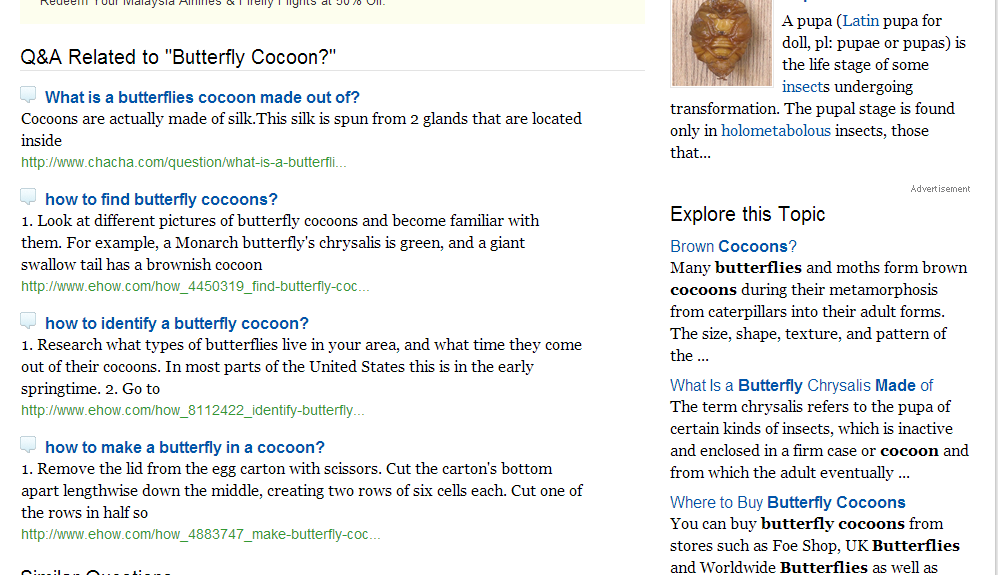
    However a quick glance at these Google search results shows just how pervasive the misconceptions are:

    Cocoon to butterfly

    butterfly cocoons

    Even seemingly authoritative educational websites misinform. Look at the way these two websites promote themselves, and consider the misinformation they are peddling.

    The website Math & Reading Help

    Maths and Reading Help

    states that The Very Hungry Caterpillar is “factually accurate . . . teaches your child to understand this biological process … a butterfly. . .(is) a caterpillar that has emerged from its cocoon”

    Primary upd8 which promotes itself as “UKs most exciting science resource”

    primary upd8

    also suggests using The Very Hungry Caterpillar for teaching about the life cycle of a butterfly.

    primary upd8 knowledge

    If self-professed “authorities” can’t get it right, how are we laypeople meant to make sense of it. Suggestions like these reinforce the need for the skills of critical analysis to be developed.

    Unlike those above, I contend that this book has no place in the science curriculum. Its greatest value is as a tool for teaching critical literacy.

    When children have learned about the life stages of a butterfly and then listen to The Very Hungry Caterpillar, they are very quick to pounce on the inaccuracies and immediately want to write to the author and tell him of his mistake.

    When told that he already knows and that he isn’t going to change it, as confirmed in an interview reported on the Scholastic website, they are incredulous.

    “Why would he do that?” they ask.

    Why indeed.

    When told that he doesn’t care that it isn’t right, they are indignant.

    But herein lies its value:

    I am able to affirm their learning: they know more than Eric Carle; and, more importantly, I am able to reinforce with them that just because something is in print, doesn’t make it true.

    In addition, it is important for them to realise that misinformation does not occur only in picture books, nor only in this picture book. It is just as common in news media, as shown by this article from Brisbane’s Courier-Mail on December 7 2013

    Butterfly emergingtext for photographs

    Nor is misinformation restricted to caterpillars and butterflies.

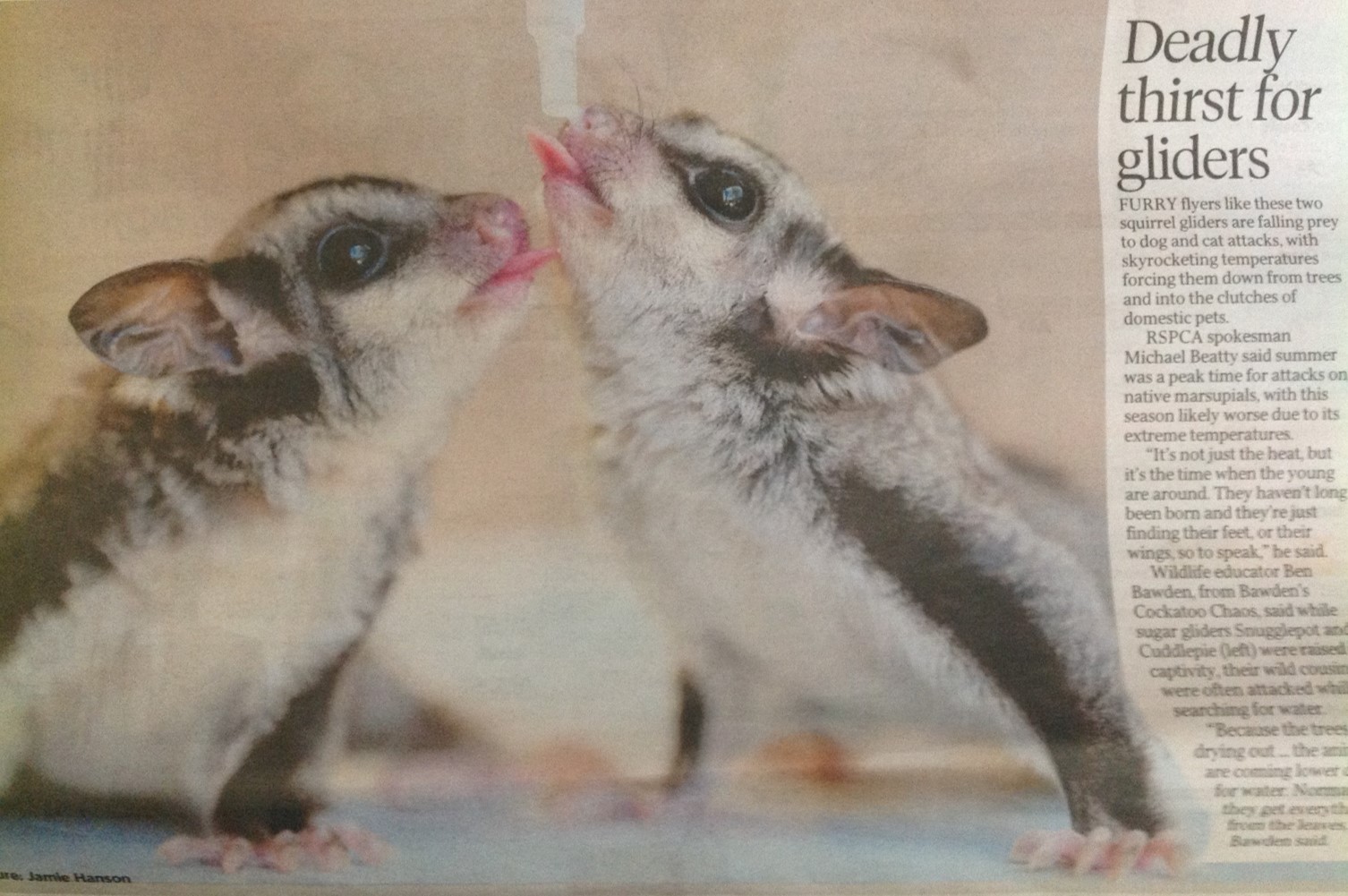
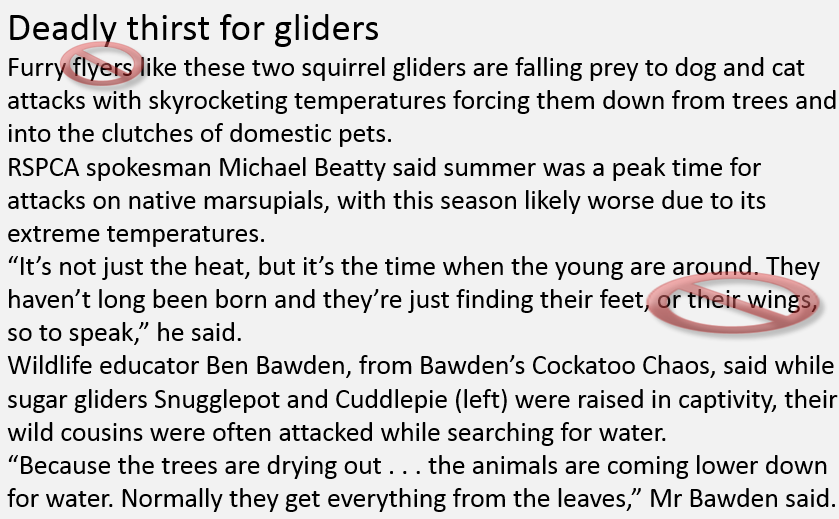
    This article, again from the Courier-Mail, on January 26 2014 also contains inaccuracies:

    Deadly thirst for glidersFurry flyers text

    Squirrel gliders don’t fly, and they don’t have wings.

    Suggestions for teachers and parents:

    • point out inaccuracies and inconsistencies
    • encourage children to think about what they are reading and hearing and to evaluate it against what they know
    • support children to verify the source of the information and to check it against other more authoritative/reliable sources
    • help them to recognise that every author has a purpose and to identify that purpose
    • invite children to ask questions about what they are reading and to interrogate the content
    • encourage them to question, question, question.

    As demonstrated by the Google results shown above, there is a good deal of misinformation available, often cleverly disguised as fact. Being able to navigate one’s way through it is a very important skill.

    Eric Carle says “If we can accept giants tied down by dwarfs, genies in bottles, and knights who attack windmills, why can’t a caterpillar (sic) come out of a cocoon?”

    What do you think?

    Do picture book authors have a responsibility for informing their audience? Is a butterfly coming out of a cocoon in the same realm as giants tied down by dwarfs? Would we accept a child hatching out of an egg? What parts of a story should be based in reality and which parts can be imagined?

    “Why can’t a butterfly come out of a cocoon?” asks Eric.

    Well, Eric, they just don’t.

    Please share your thoughts.

  • Reading aloud – sharing stories

    Reading aloud – sharing stories

    I have always loved reading aloud to an audience, be it my own children, a class of children or, more recently, my grandchildren. I love the opportunity to escape into other characters and other worlds. I love to see the expressions on the children’s faces – anticipation, amusement, trepidation, relief, joy.  I love the sounds and rhythms of the language. I love the intricacies of story, poem and information.

    Reading stories aloud to children provides a great opportunity to establish a connection between author, reader and listener, a platform for sharing ideas, thoughts and dreams, an avenue for discussing ethical questions and implications of choices. These discussions may arise spontaneously and be child-initiated, or they may be pre-determined and teacher-lead as in philosophical discussions and bibliotherapy.

    Some parents find reading to their children a chore, something tedious that must be squeezed in around the day’s busyness. I am lucky. I never did.

    Some teachers find it difficult to make time for books in a content-driven classroom; but for me it was always priority.

    boy with books
    http://www.openclipart.org

    Some parents are delighted when their children start reading for it means the daily read-aloud ritual can cease. I never was. Well, I was delighted that they could read, but we kept on reading together.

    I read aloud with my children until they were almost teenagers. The books changed, but the joy of reading and sharing never did. During the teenage, and older, years we continued to discuss and share ideas about books we read and recommendations for reading. We still do: some for ourselves and some for the children, my grandchildren.

    Many of you reading this post take your ability to read and write for granted, as do I. But around the world many children do not have the opportunity to learn literacy skills. According to LitWorld more than 793 million people worldwide remain illiterate. About two-thirds of those are women.

    Like the people at Lit World, I believe that “the right to read and write belongs to all people”.

    I was delighted when I read about World Read Aloud Day on Gail Terp’s blog. I have been following Gail’s blog for a little while now. She titles her blog: “The Best Blog for Kids Who Hate to Read”. She says that one of her top goals is to connect children with books they love and her posts provide recommendations of great books to read to and with children, as well as to be read by children.

    In her post Read Alouds: Supporting Literacy One Book at a Time, Gail suggests 7 reasons for reading (picture books and other books) aloud:

        1. They are fun.
        2. They are motivating.
        3. They are easier to follow.
        4. They often introduce new vocabulary and expressions.
        5. They introduce a variety of writing styles, authors, and illustrators.
        6. They provide an excuse to stay close.
        7. They provide windows to complex subjects and ideas.

    Why not join in reading aloud on World Read Aloud Day this Wednesday, March 5.

    LitWorld, sponsors of the day, urge you to

    “imagine a world where everyone can read . . .”

    “World Read Aloud Day is about taking action to show the world that the right to read and write belongs to all people. World Read Aloud Day motivates children, teens, and adults worldwide to celebrate the power of words, especially those words that are shared from one person to another, and creates a community of readers advocating for every child’s right to a safe education and access to books and technology.

    By raising our voices together on this day we show the world’s children that we support their future: that they have the right to read, to write, and to share their words to change the world.”

    owl_books
    http://www.openclipart.org

    How will you celebrate and share World Read Aloud Day?

  • Happy birthday Dr Seuss!

    Happy birthday Dr Seuss!

    Theodor Seuss Geisel: March 2, 1904 – September 24, 1991

    Picture1

    Today, March 2nd is the birthday of Theodor Seuss Geisel, better known as Dr Seuss, author of over 40 children’s books.

    While several of the Dr Seuss books were published before I was born, and many others published during my childhood, I have no recollection of meeting them prior to my years as teacher and parent. Fortunately those two roles provided me ample opportunity to catch up on the delights that I had previously missed.

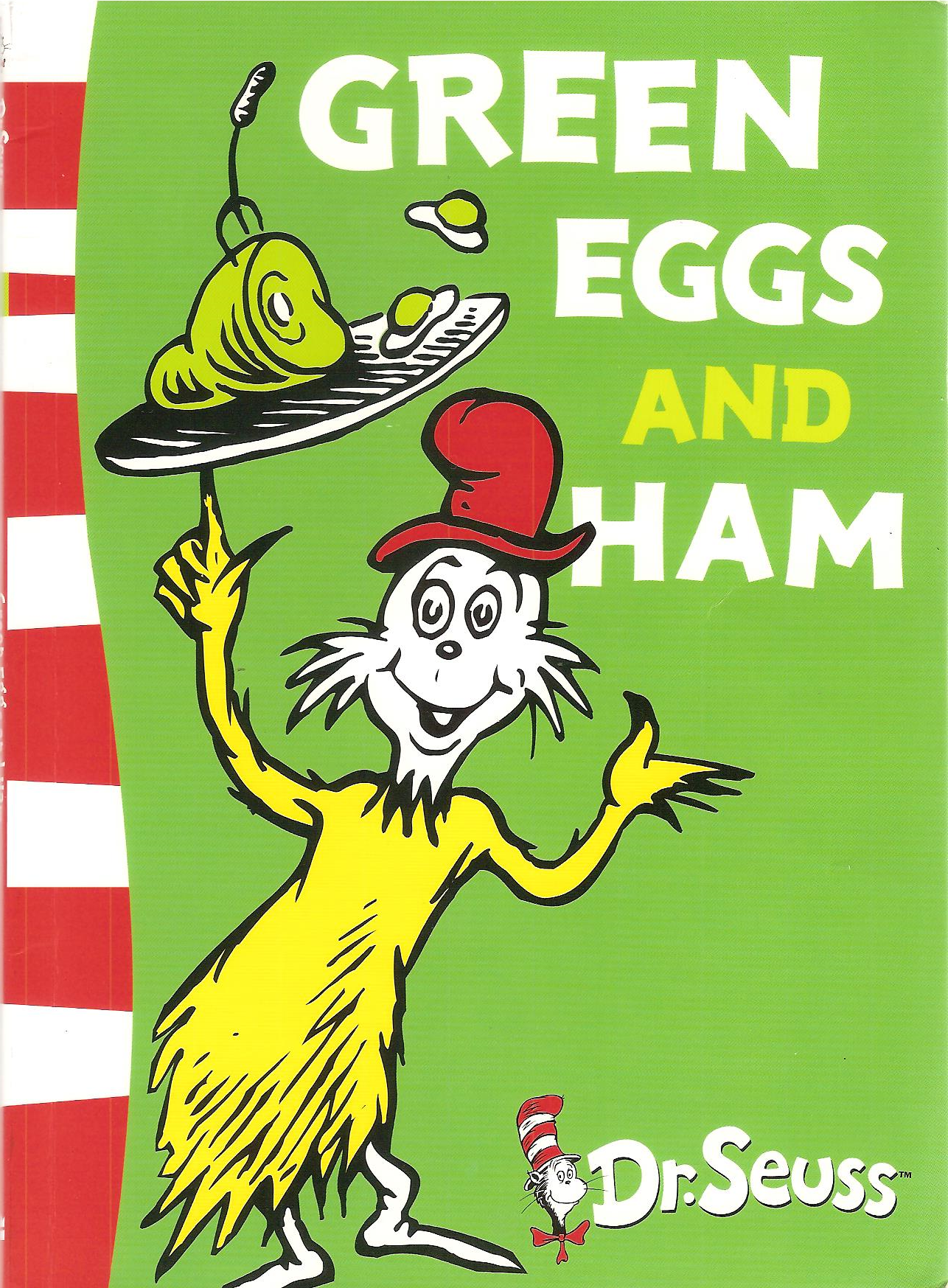
    Green Eggs and Ham

    I even apologised to Dr. Seuss in a previous post for leaning heavily on his book Green Eggs and Ham when writing about my relationship with exercise.  Click on Ode to Exercise to read my poem.

    You could celebrate his birthday by checking out the fun stuff and information on his author site seussville.com

    or pop over to Gail Terp’s Best Blog for Kids Who Hate to Read for lots of other suggestions:

    Celebrate Dr. Seuss’s Birthday with Books

    Dr. Seuss The Perfect Source for Literacy!

    Fun Dr Seuss games for the whole family

    How have the books of Dr. Seuss influenced your life?

    I invite you to share your thoughts.