Live Love Laugh Learn … Create the possibilities

Category: Picture books

  • More than all the stars in the sky

    When I read the challenge by Charli Mills at the Carrot Ranch this week to In 99 words (no more, no less) write a love story, I knew immediately that I would share some of my favourite picture books about love.

    Love books

    Of course these are about the love between parent and child, rather than romantic love, and it is from these I have drawn my inspiration. Finding a love angle that I was happy with was the first challenge and, as usual, telling a tale in 99 words was even more so. (I think I need some lessons about telling more in less.) This is my response. I’d love to know what you think.

    www.morguefile.com
    http://www.morguefile.com

    More than all the stars in the sky

    Child waited on the step, counting stars.

    Soon the clatter of dishes ceased. Feet padded out.

    Child snuggled into warm enveloping arms. The ritual began.

    They picked out stars and constellations.

    “And Venus,” said Child. “Tell me about the love planet!”

    “Well,” began Parent. “Long ago there were two people who loved each other …”

    “More than all the stars in the sky,” interjected Child.

    “That they wanted a child to love too …”

    “So you got me!” said Child.

    “Yes.” Parent scooped up the child. “And just as there’ll always be stars …”

    ”We’ll always love each other!”


    Now for the books, each of which is a delight to share with young children, for reading aloud at bedtime, or any time.
    2015-09-19 10.52.00

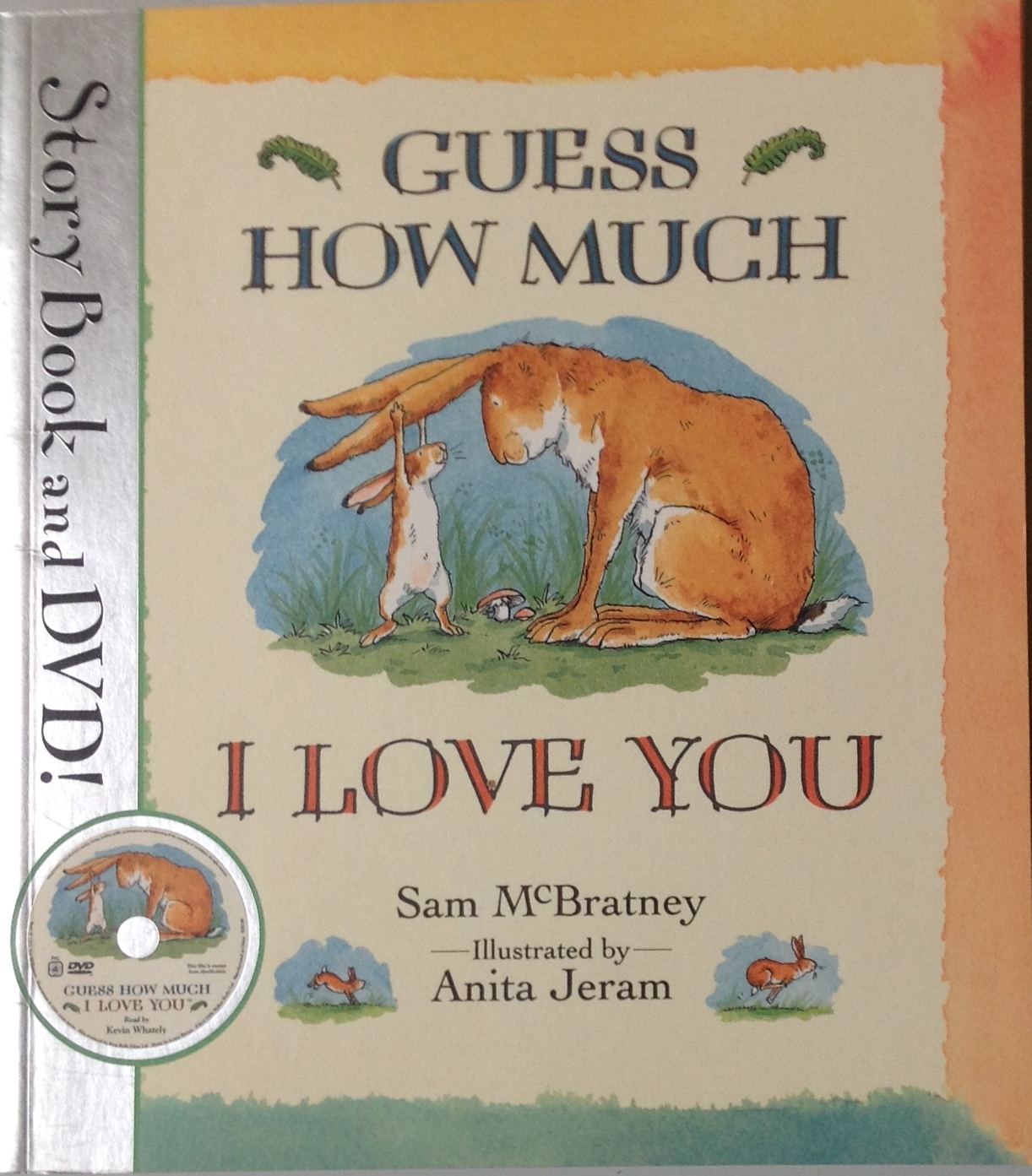
    Guess How Much I Love You by Sam McBratney (Northern Ireland) and illustrated by Anita Jeram (Northern Ireland) is a beautiful tale of the love between Little Nutbrown Hare and Big Nutbrown Hare. As they try to find a way of describing their love for each other, they find that love is not easy to measure. From this beautiful story comes the classic line “I love you to the moon … and back!”
    2015-09-19 10.53.12

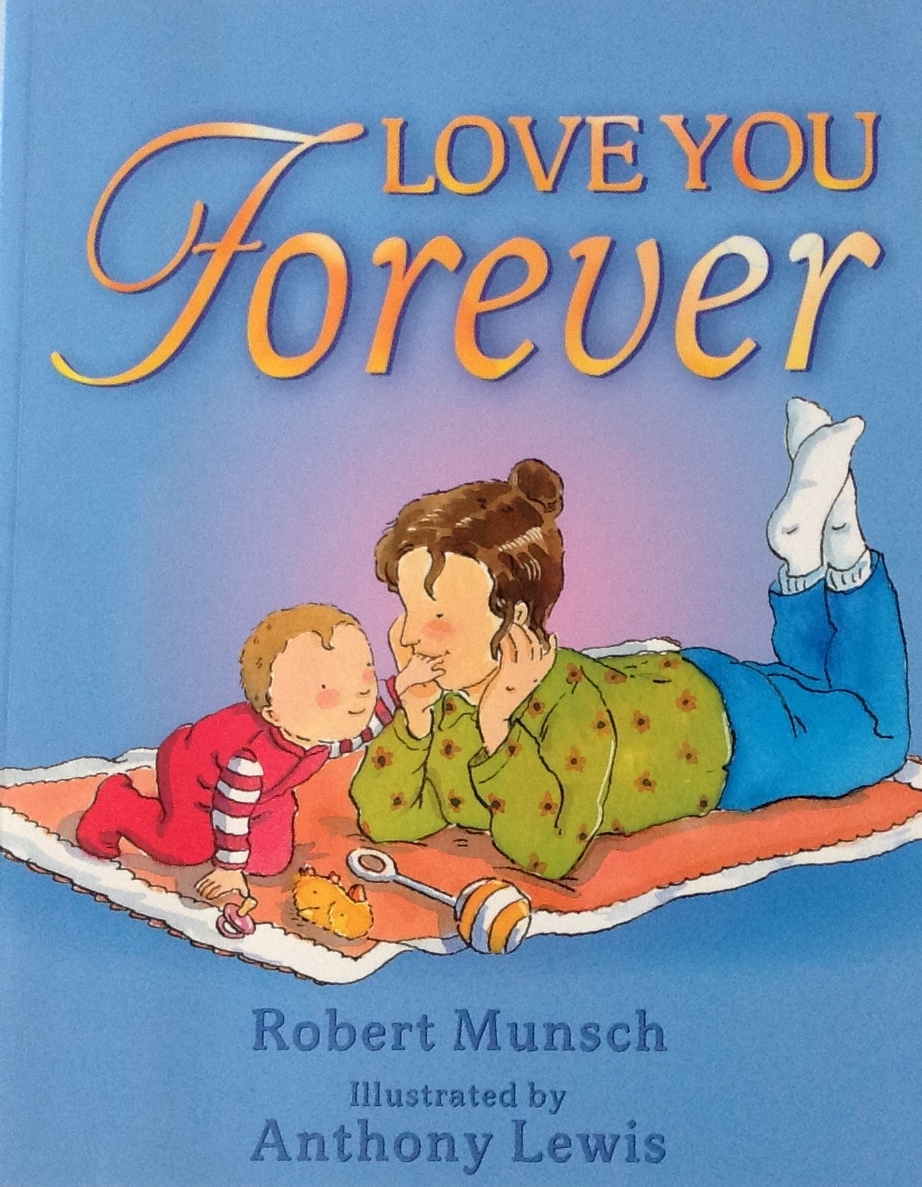
    Love You Forever by Robert Munsch (Canada) and illustrated by Anthony Lewis (U.K.) tells of a mother’s love that lasts a lifetime, a love that is returned by a son and passed on to the next generation through the words of a beautiful song:

    “I’ll love you forever.

    I’ll like you for always.

    As long as I’m living

    My baby you’ll be.”
    2015-09-19 10.54.00

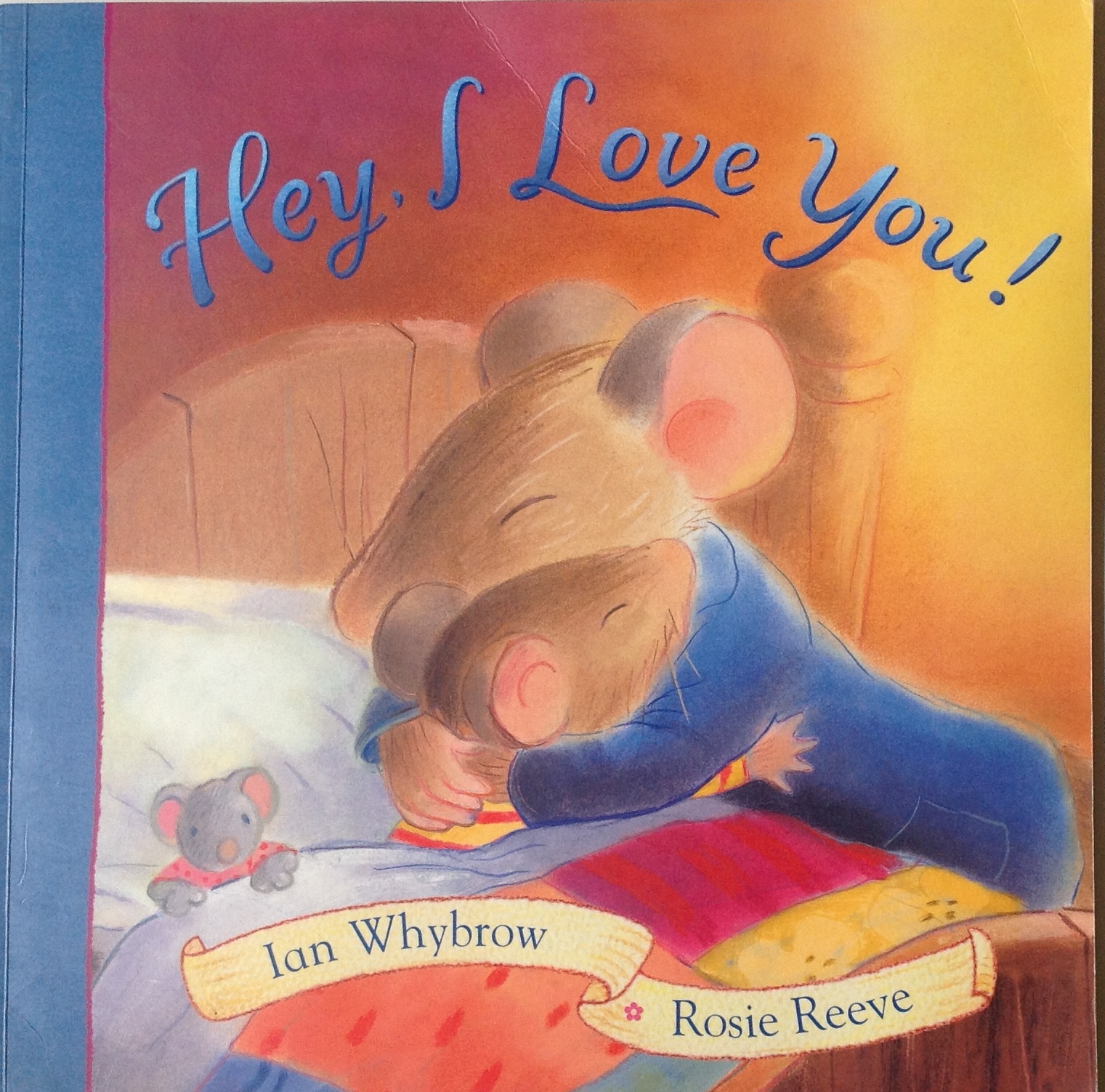
    Hey, I Love You by Ian Whybrow (U.K.) and illustrated by Rosie Reeve (U.K.) is about two mice, Small and Big. Before Big goes out to get supper Small shows that he knows what to do to stay safe when Big is away. Unfortunately they forgot to say their special words and Small doesn’t follow the instructions. Fortunately Small was able to catch up to Big without incident. Attention must be paid to the illustrations to see just how lucky that was!
    2015-09-19 10.54.42

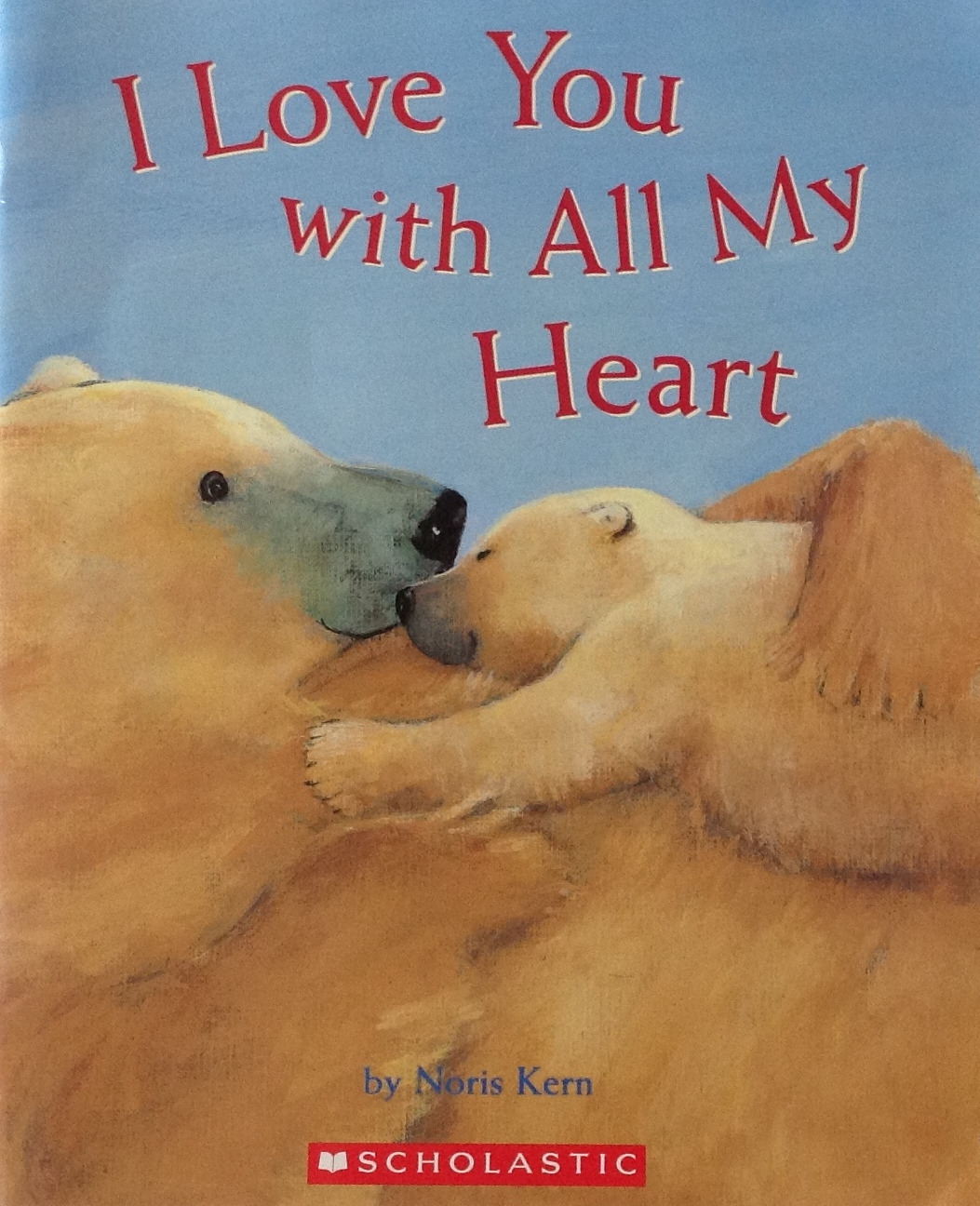
    I Love You With All My Heart by Noris Kern is about Polo the Polar Bear who wants to find out the meaning of his mother loving him with all her heart. He asks the other animals how their mothers love them and finally discovers how his mother loves him and that he loves her with all his heart too. (A possible concern with this book is the mix of Arctic and Antarctic animals.)

    2015-09-19 10.58.22

    Koala Lou by Mem Fox (Australia) and illustrated by Pamela Lofts (Australia) tells of Koala Lou who is loved by everybody, especially her mother. Every day her mother would say, “Koala Lou, I DO love you!” But after other koala siblings arrive, Mother Koala doesn’t have time to give Koala Lou the attention she craves. Koala Lou comes up with a plan to hear those special words again.

    Koala Lou leads beautifully into my next post which will showcase some books by Mem Fox. I hope you will join me for those.

    One last thought:

    I wonder what image of the Child, Parent and Family you formed from reading my flash. (I omitted some clues about other family members in the 99 word reduction.) I’d be pleased if you would share your thoughts about this.

    You see, I attempted to be inclusive by avoiding specifics about things such as gender, family composition, culture and location. I wondered whether a story could be written so that each reader could interpret it to fit their own situation. Illustration could be difficult, but perhaps worth considering. This attempt to be inclusive was very different from my first thoughts to be specific to Australia, through stars observed, for example, and had nothing to do with my thoughts or opinions of the picture books shared.

    However, looking back at the five books with these thoughts in mind, I notice that the relationships portrayed are:

    Guess How Much I Love You – father and son

    Love You Forever –mother and son

    Hey, I Love You – father and son

    I Love You With All My Heart – mother and son

    Koala Lou – mother and daughter

    What do you think? Is it worthwhile to attempt a story of the love between parent and child with an inclusive element, or is it enough that such a variety of books is already available? Do you have any other favourites, or suggestions, on this topic?

    Thank you

    Thank you for reading. I appreciate your feedback. Please share your thoughts about any aspect of this post or flash fiction.

     

  • A celebration of Australian picture books #1

    Recently my friend Sarah Brentyn, who blogs at Lemon Shark: Navigating the Unchartered Waters of Parenting and Life, shared a series of posts about first lines (paragraphs, sentences and pages). She discussed the importance of hooking the reader and shared some of her favourite first lines from a variety of genres. When she shared picture books I was inspired to share some by our many wonderful Australian authors and illustrators.

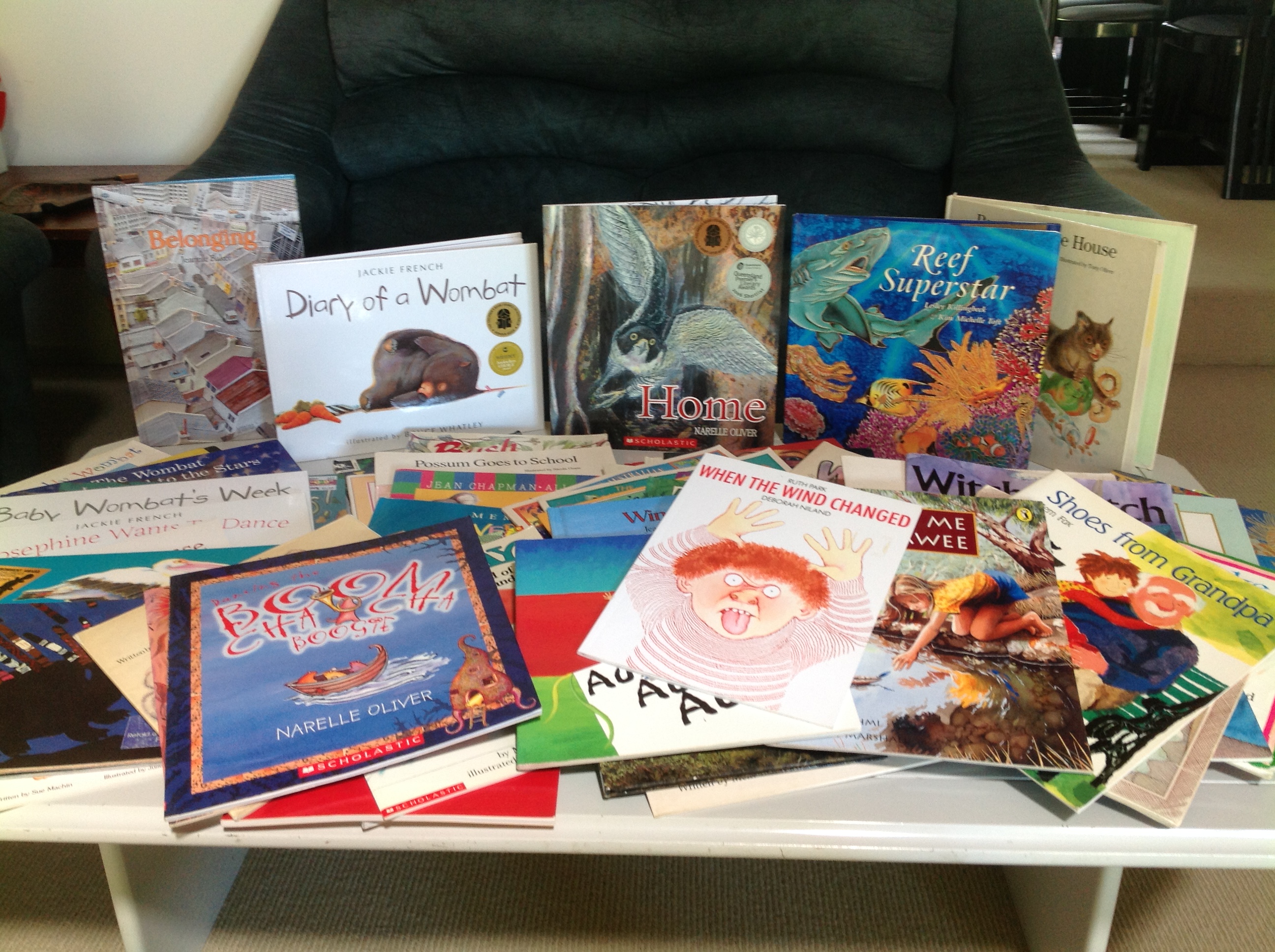
    These are just some of the Australian picture books I quickly located on my shelves:

    Australian picture books

    I own multiple titles of some authors’ work, and of others’ I own but one or two. Sadly, there are many whose work I don’t own. There are too many wonderful books to share in just one post so I have decided to write a series with a post dedicated to each author of whose work I own multiple titles, including Mem Fox, Narelle Oliver, Jeannie Baker and Kim Michelle Toft (and I might sneak in New Zealander Pamela Allen).

    In this post I share some lovely books, their first lines (according to Sarah’s definition) and tell you a little about why they are on my shelves.

    For this series I have commandeered “celebration” as a collective noun for Australian picture books so it is fitting that the first I share is A Compendium of Collective Nouns by Jennifer Skelly.

    A Compendium of Collective Nouns

    This delightful little book was a gift from my grandchildren (chosen by their mother). In the introduction Jennifer asks, “Do you remember laughing when you first learned that a group of crows is called a murder? Or a group of owls is called a parliament?” Like me, Jennifer has always been interested in collective nouns but, unlike me, she has published a collection of them. Her beautiful drawings illustrate collections such as “a crash of rhinoceroses”, “a flamboyance of flamingos” and “a wisdom of wombats”, but who ever heard of “a rabble of butterflies”?

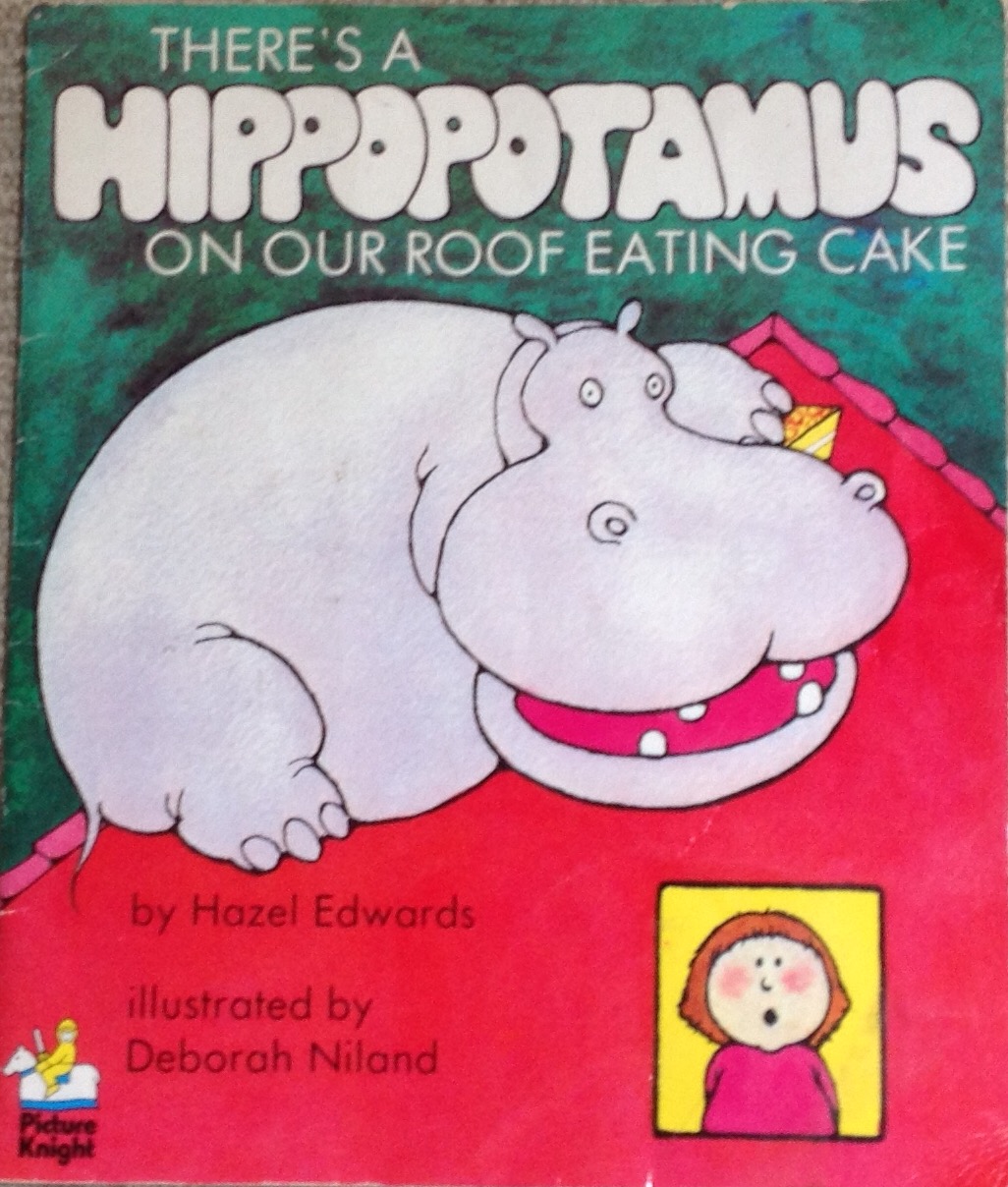
    While there are a number of Hippopotamus on the Roof books I have only the original, There’s a Hippopotamus on our Roof Eating Cake by Hazel Edwards (illustrated by Deborah Niland).

    There's a Hippopotamus on the Roof Eating Cake

    It begins,

    “Our roof leaks.

    Drip!

    Drip!

    Drip!

    My Daddy says there’s a hole in our roof.

    I know why there’s a hole.

    There’s a hippopotamus on our roof eating cake.”

    The copy on my shelf actually belongs to Bec. Her dad bought it for her on a trip back home to Belfast in 1990. He went all the way to Belfast and brought her back an Australian picture book! A good one though.

    In this video Hazel Edward talks about the original idea for the book, other contributing ideas and changes as well as the the important relationship between author and reader. She also reads the book.

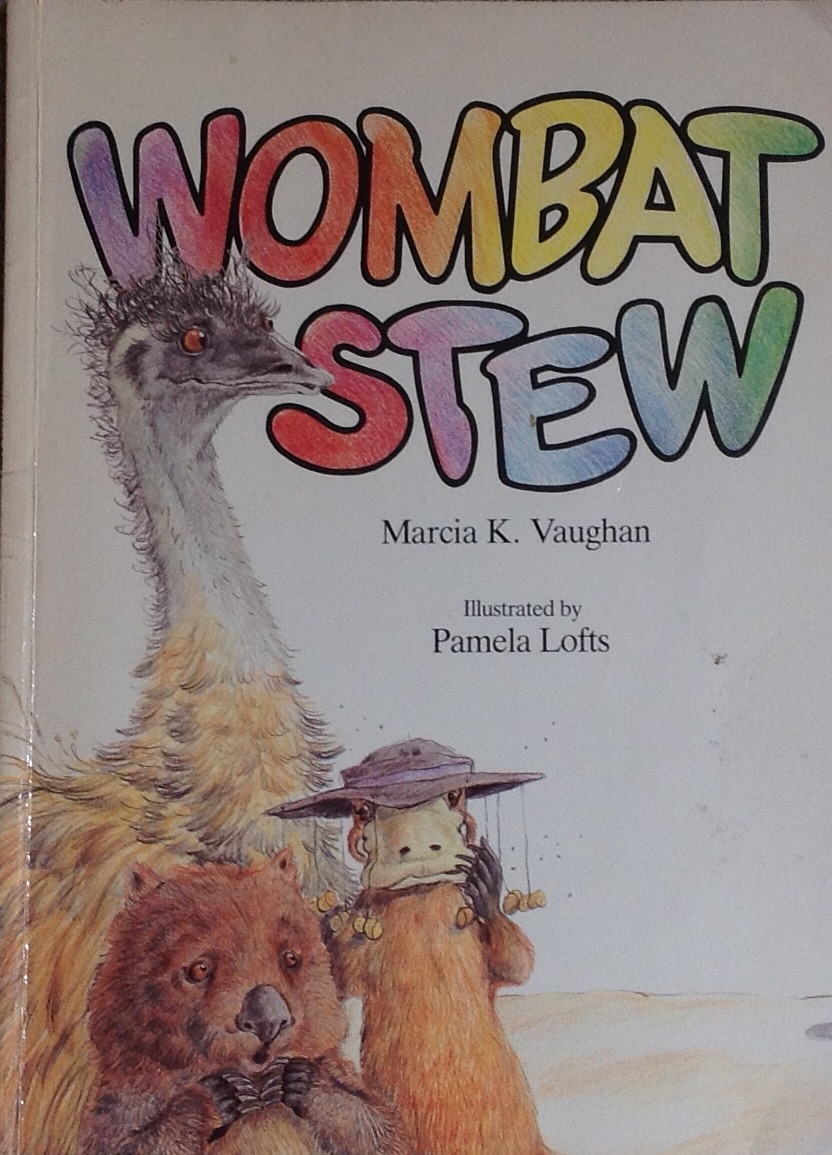
    Wombat Stew by Marcia K. Vaughan (illustrated by Pamela Lofts) is a favourite.

    Wombat Stew

    It begins,

    “One day, on the banks of a billabong, a very clever dingo caught a wombat …

    and decided to make  …

    Wombat stew,

    Wombat stew,

    Gooey, brewy,

    Yummy, chewy,

    Wombat stew!”

    The amusing story tells how the animals trick the dingo and save wombat from his fate. It is a great book to read aloud with its rhythmic language and repetition of the song “Wombat stew” with slight word changes each time. Children enthusiastically join in with the reading and love acting it out. One year I wrote a play with my year one class and they performed it for the school and their parents. It was a lot of fun.

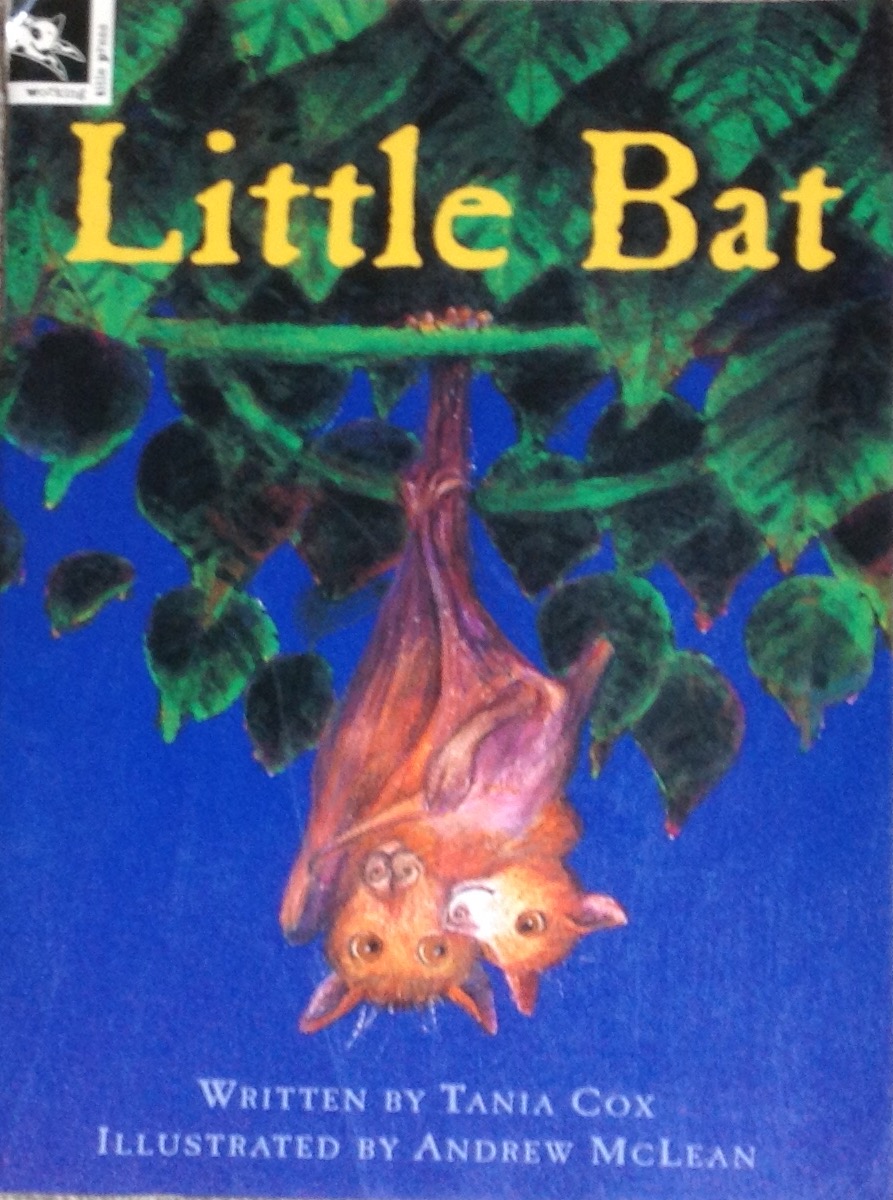
    Little Bat

    Little Bat by Tania Cox (illustrated by Andrew McLean) begins

    “Little Bat was nervous.

    She’d never done this before.”

    With the encouragement of her mother and other animal friends, Little Bat discovers that she can fly. I like the story’s positive message that if you try you can succeed. Books with this theme were always popular and inspired lots of discussion in my classroom.

    When I saw When the Wind Changed by Ruth Park (illustrated by Deborah Niland) in a bookstore, I had to have it for my bookshelf! When I was a child I, like Josh, must have been good at making faces, because my mother was always telling me that if the wind changed I’d stay like that. Well, I don’t think that happened to me, but it did to Josh! The book begins

    “There was this boy named Josh.

    He could do lots of things.

    There was one thing he could do best of all.

    He could make faces.”

    Of course one day the inevitable happens! Fortunately the story has a happy ending, for Josh anyway – I’m not so sure about Dad!

    Are you familiar with any of these books? Have you seen them in bookstores near you? What books by Australian authors have you read?

    Thank you

    Thank you for reading. I appreciate your feedback. Please share your thoughts.


  • Between the lines

    Morguefile http://mrg.bz/omEd2M
    Morguefile http://mrg.bz/omEd2M

    For a few months I had been aware of the new colouring books for adults craze that is sweeping the world but had chosen to ignore it. That is, until I read a blog post by Alana Munro stating that “According to Psychologists, Colouring is the Best Alternative to Meditation” and I thought I’d add my two cents worth.

    I had already been urged by some writing, publishing and marketing entrepreneurs to quickly create a colouring book and cash in on this new lucrative market. Apparently it’s easy to create a book using royalty free creative images found online and publish the books on Amazon where they have their own genre.  People are buying them by the dozens. The books are also displayed prominently in bookstores, and promoted on social media.  What is there to lose?

    As a teacher and parent I have never been in favour of colouring books for children. I know some argue that colouring does have a (small) place. Children may develop fine motor skills when colouring between the lines, and colouring is sometimes integrated with other things such as graphing, mapping, and colour-by-number activities.

    © Norah Colvin
    © Norah Colvin

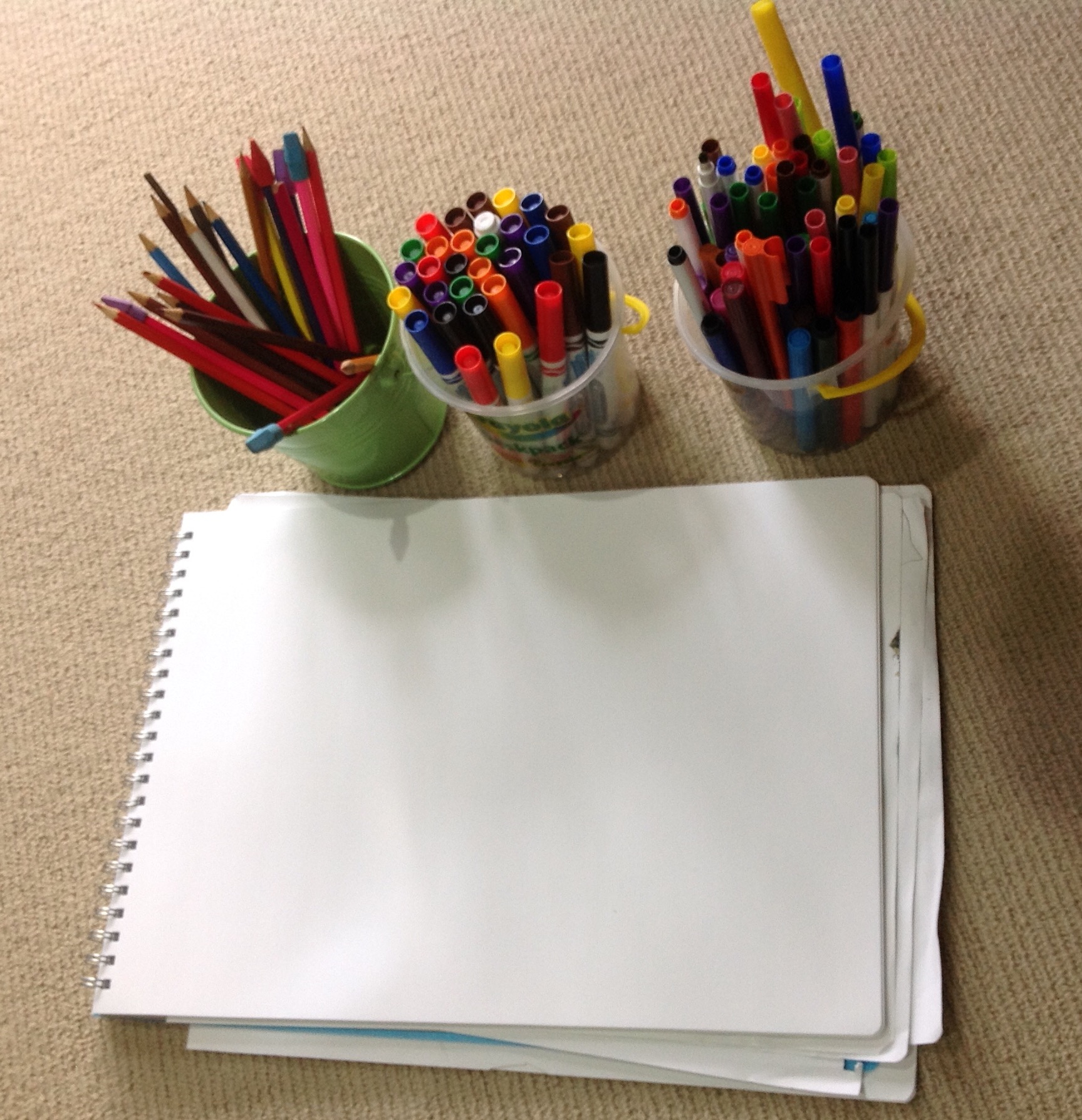
    But I have rarely given a colouring book as a gift. I would rather give a blank art book and a variety of pencils and pens for children to create images from their own imaginings. Their fine motor skills and their creativity will develop perfectly well that way and it may help to avoid the feelings of inadequacy that can develop from spending too much time colouring the works of others.

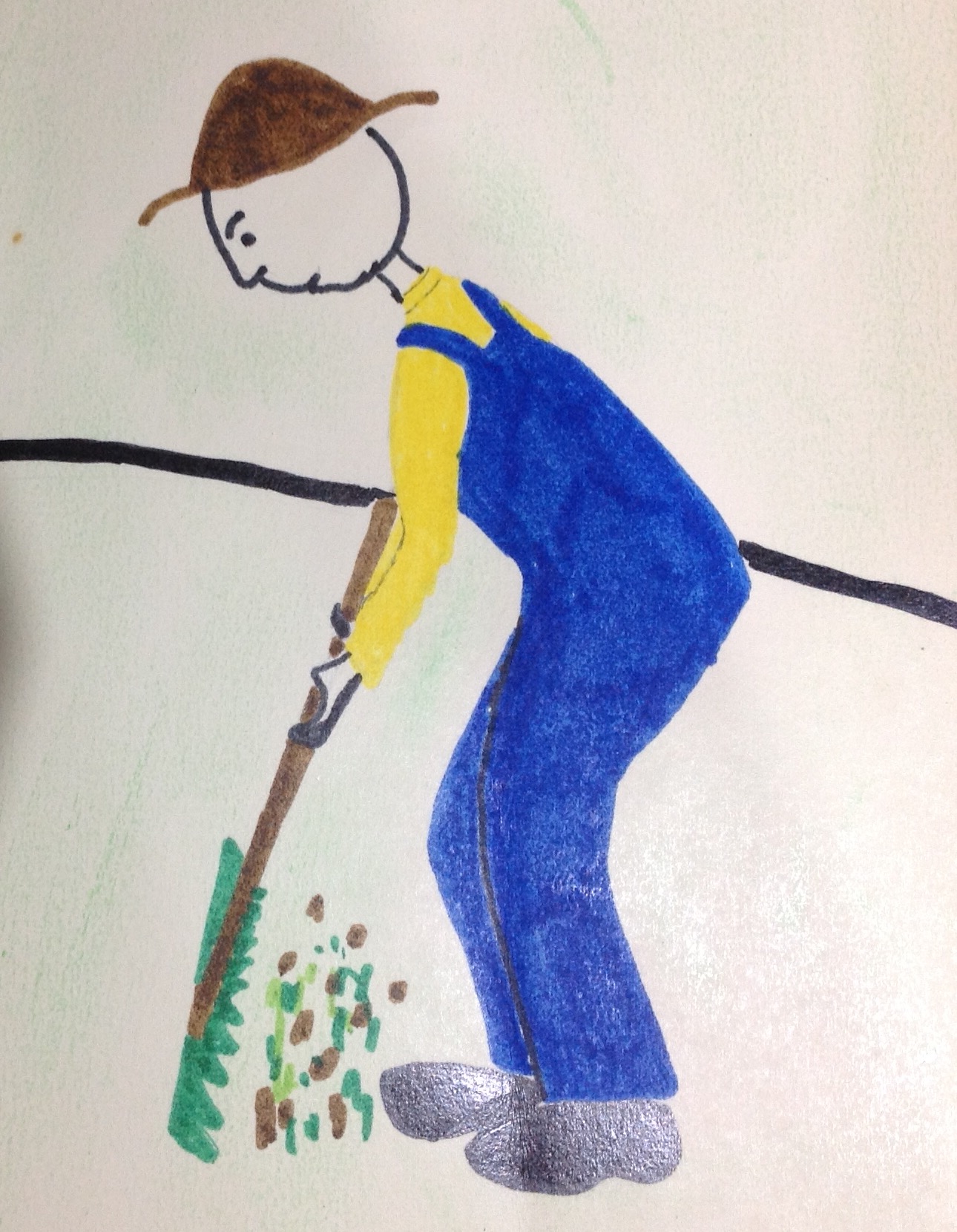
    That’s not to say that learning some of the artist’s techniques is a bad thing. Twenty-five years ago I did a short “Drawing on the Right Side of Your Brain” course, based on the work of Betty Edwards. I didn’t consider myself an artist, and still don’t, preferring to write than to draw. But being interested in learning and anything to do with the brain, I decided to see what I could do. I was amazed at the results. Unfortunately, I don’t have many pre-course drawings to share with you, just this one of a gardener, but please take my word for it that I showed little promise.

    © Norah Colvin
    © Norah Colvin

    In the course I learned the importance of drawing what the eye sees, not what the mind thinks it sees; for example we might think of the roundness of the rim of a cup, but what we actually see is an ellipse. The importance of seeing accurately is true whether drawing an actual or imagined object or scene.

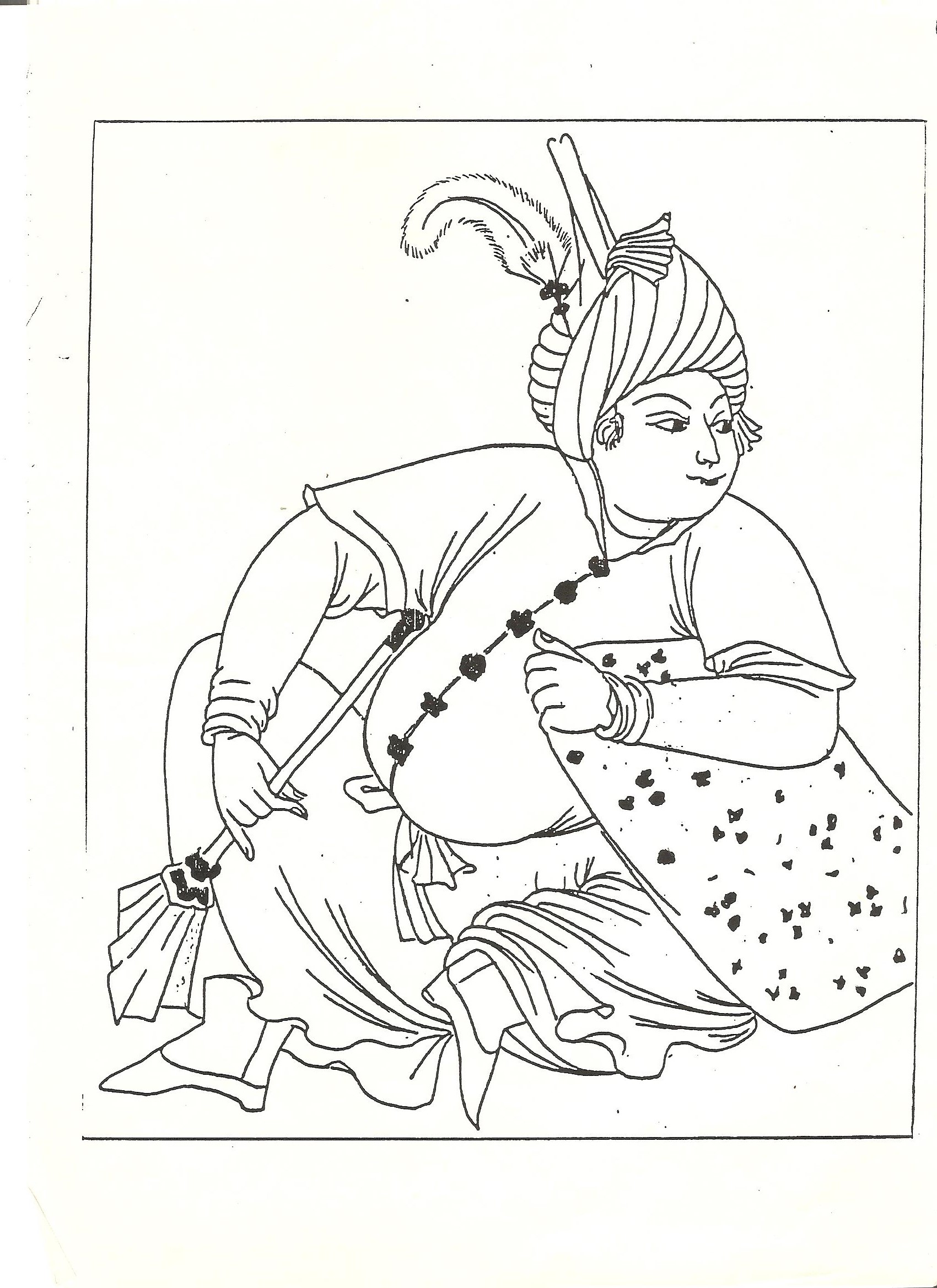
    In the first lesson we were given this picture to copy.

    original

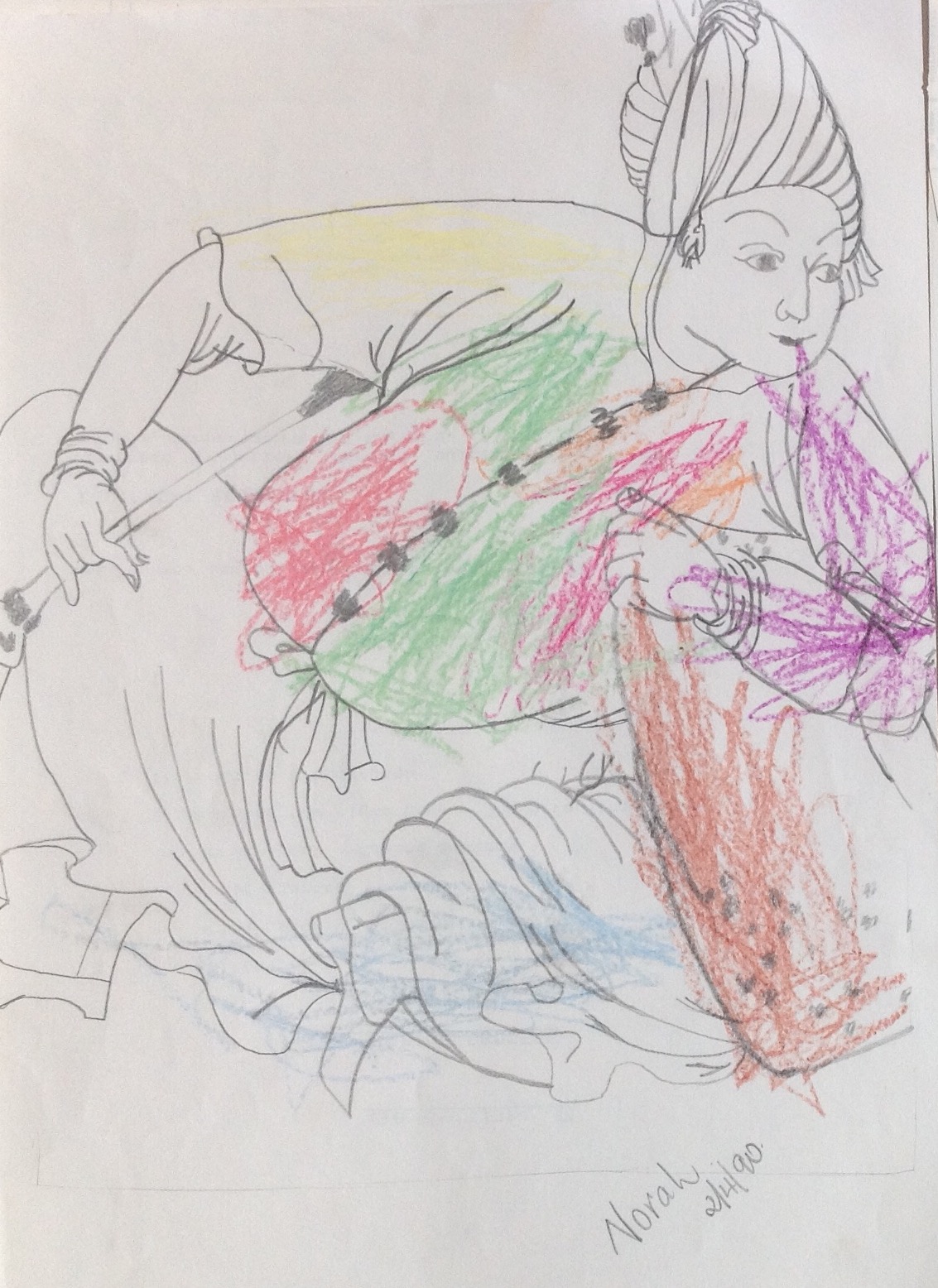
    I admit that I didn’t have high expectations as I began. We were told to turn the picture upside down and to start copying from one corner. In doing this we focussed only on each of the lines, drawing just what we could see. We were not to turn the picture the right way up until we had finished. There was to be no interference from what we thought we were drawing to what we were actually drawing. Everyone in the class was amazed with their results.

    This is mine:

    © Norah Colvin
    © Norah Colvin

    And thank you to Bec, who was three at the time, for deciding it needed some colour!

    For a short while I engaged in a flurry of drawing activities, but soon abandoned them to other more pressing or preferred activities. I had proved to myself it was possible. That was sufficient. Now someone just needs to come with a singing on the right side of the brain course for me!

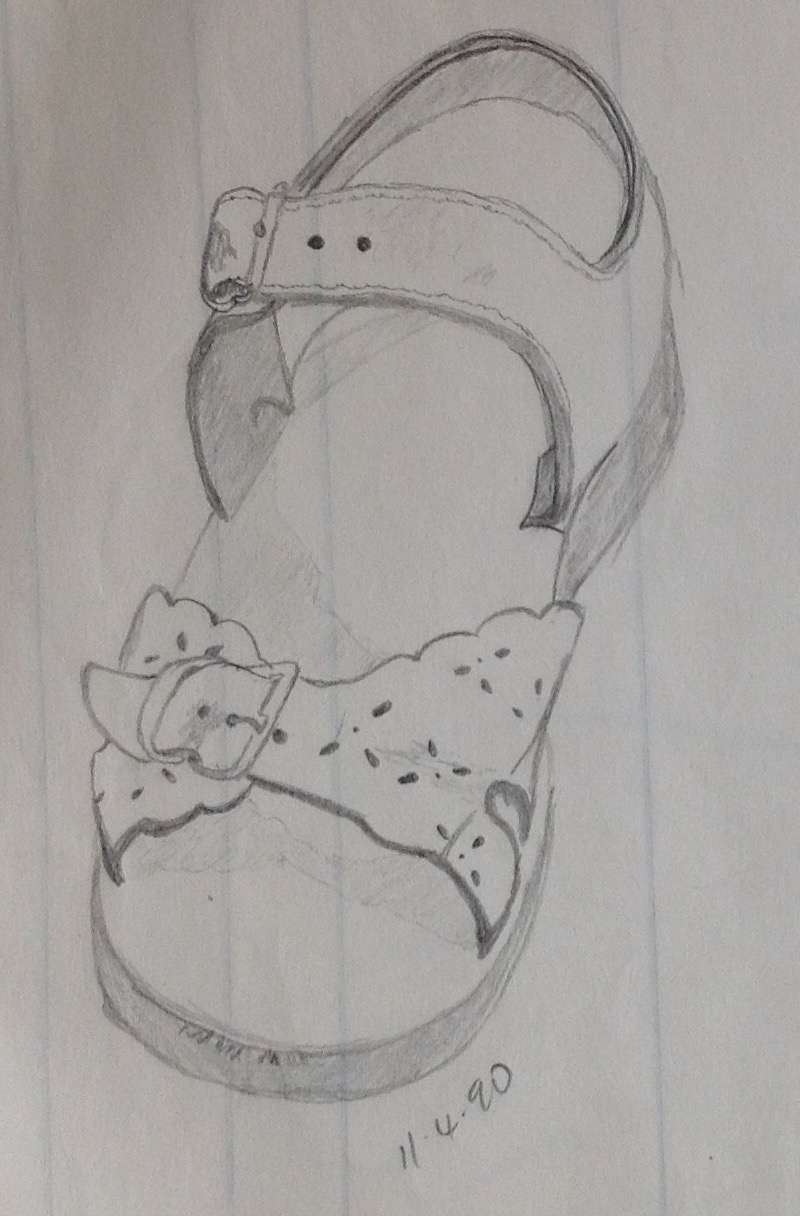
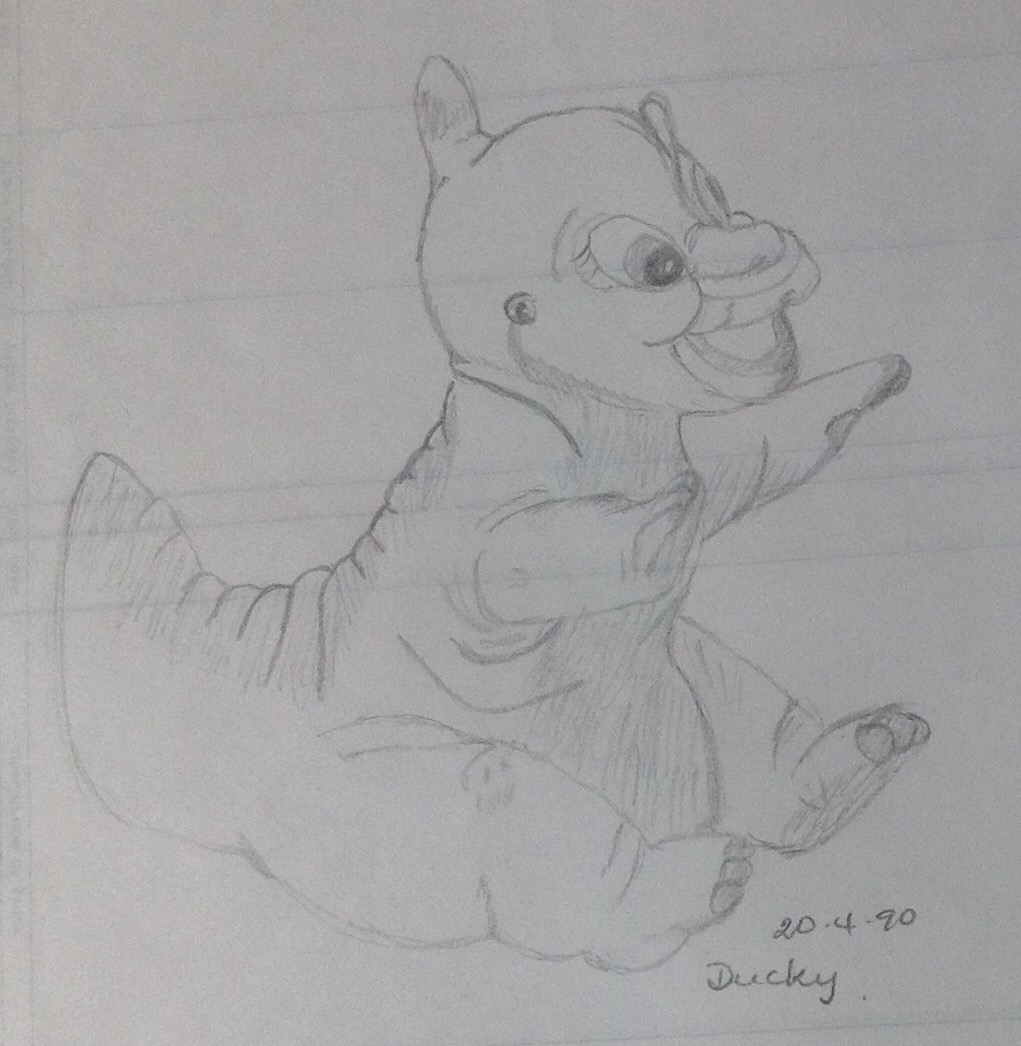
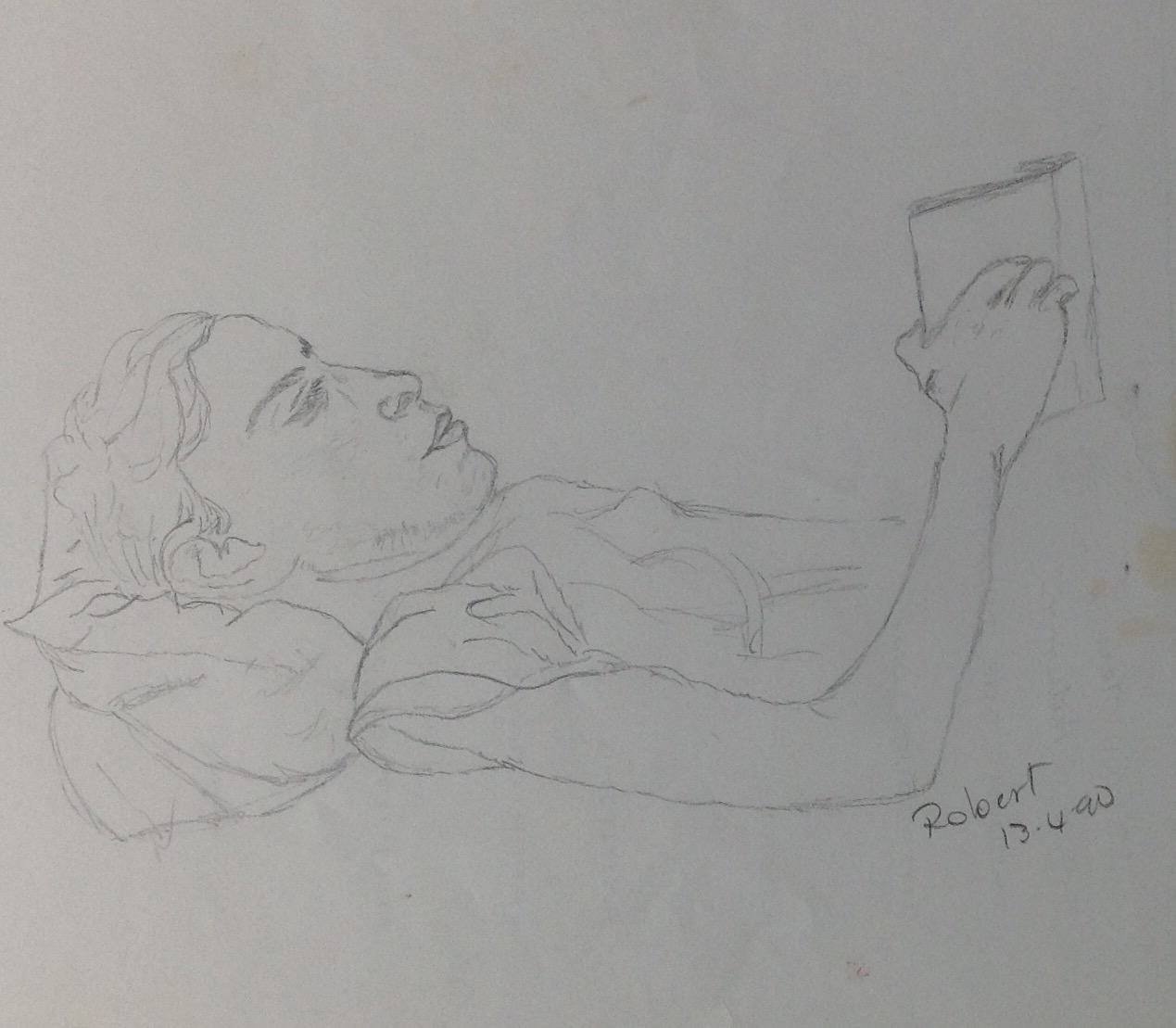
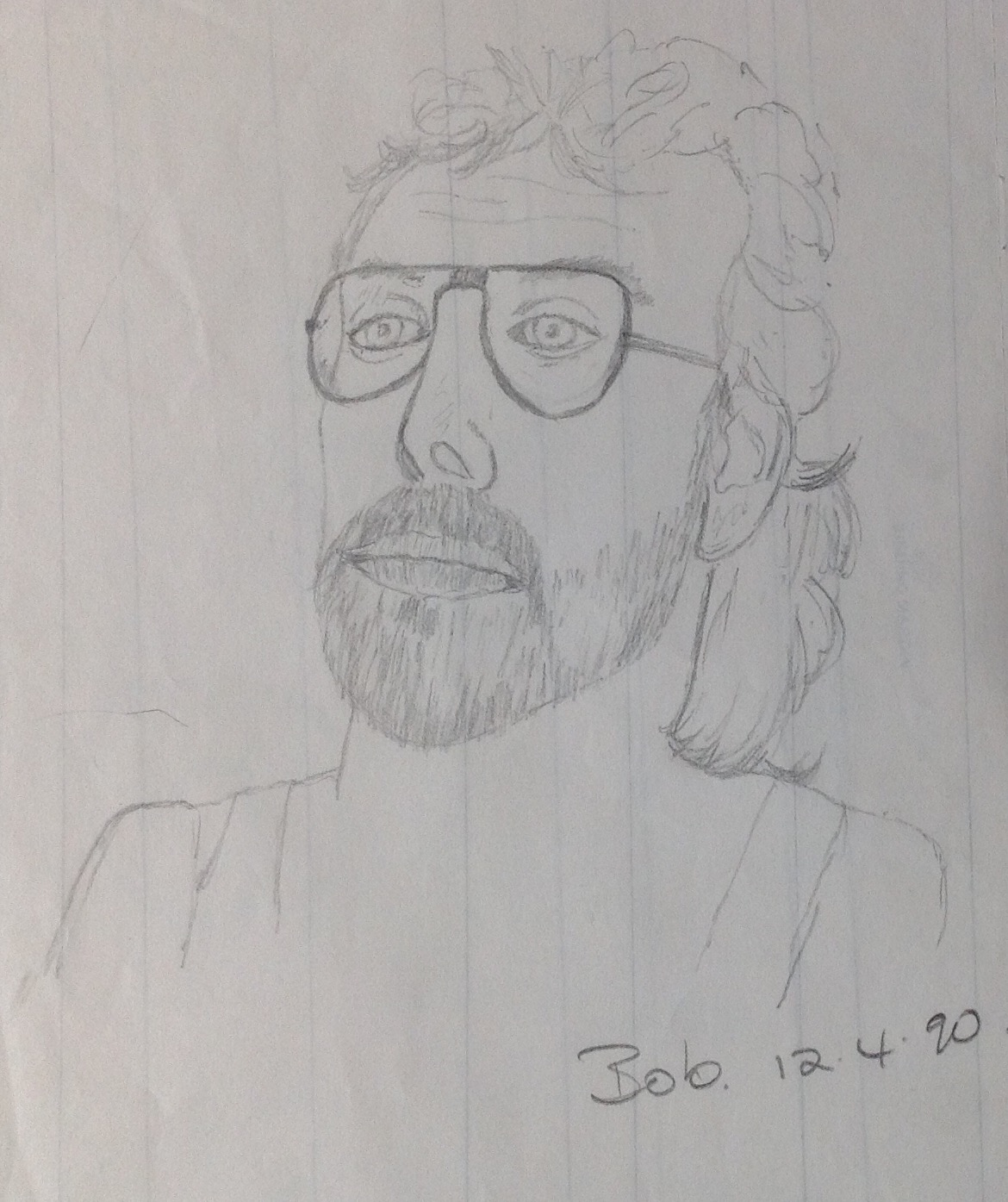
    These are some of the drawings I did at that time, each from observation of a real, not imagined object:

    © Norah Colvin
    © Norah Colvin
    © Norah Colvin
    © Norah Colvin
    © Norah Colvin
    © Norah Colvin
    © Norah Colvin
    © Norah Colvin

    In my pre-service teaching days I was cautioned to not use simple drawings on the board, for example a stick person or a smiley face sun, for the children to copy as it may limit their drawing ability. It was always a concern of mine. I didn’t want to limit anyone’s ability!

    After doing the drawing course I bought a copy of Drawing on the Right Side of the Brain for Children and used its recommendations in art lessons. In his article about How to Teach Drawing to Children Marvin Bartel warns against showing children how to draw and emphasises the need for close observation, and practice, practice, practice. I agree with his advice to not add one’s own changes or lines to a child’s drawing.

    In recent years I came across some fabulous picture books by Mo Willems.

    © Norah Colvin
    © Norah Colvin

    At first I didn’t find the books appealing with their simple black outlined drawings and minimal use of colour. It was only after a colleague’s repeated exhortations that I gave in and reluctantly read one. Halfway into the book The Pigeon Finds a Hot Dog!” I was a fan! With what appears to be a few simple lines, Mo creates a great variety of expressions and moods, telling stories that children can identify with and that have them (and their teachers) holding their sides with laughter.

    In the app Don’t Let the Pigeon Run This App Mo encourages children to add their voices, making the story their own. He also includes videos of how to draw the characters. The app is as much fun as the books. There are many videos by others on youtube sharing how to draw Mo’s characters, but none is better than Mo himself.

    Here is a PDF of his instructions for drawing the pigeon:

    Mo Williams pigeon_draw01

    and a video of Mo talking about how he creates his characters. Sorry, Mo, I underestimated you at first.

    So while I accept that colouring books may have benefits for mental health for adults who choose that activity and understand that colouring can induce a meditative state and be very relaxing, I think a blank piece of paper and a variety of pencils and pens would have the same effect and, who knows, you might unleash the artist within. I certainly don’t consider their use in the best interests of children’s development and creativity.

    What do you think of colouring books for children and adults? Is colouring a recreational pursuit for you? Have you bought your first colouring book for grown-ups yet?

    Thank you

    Thank you for reading. I appreciate your feedback. Please share your thoughts.


  • Which came first – the chicken or the duckling?

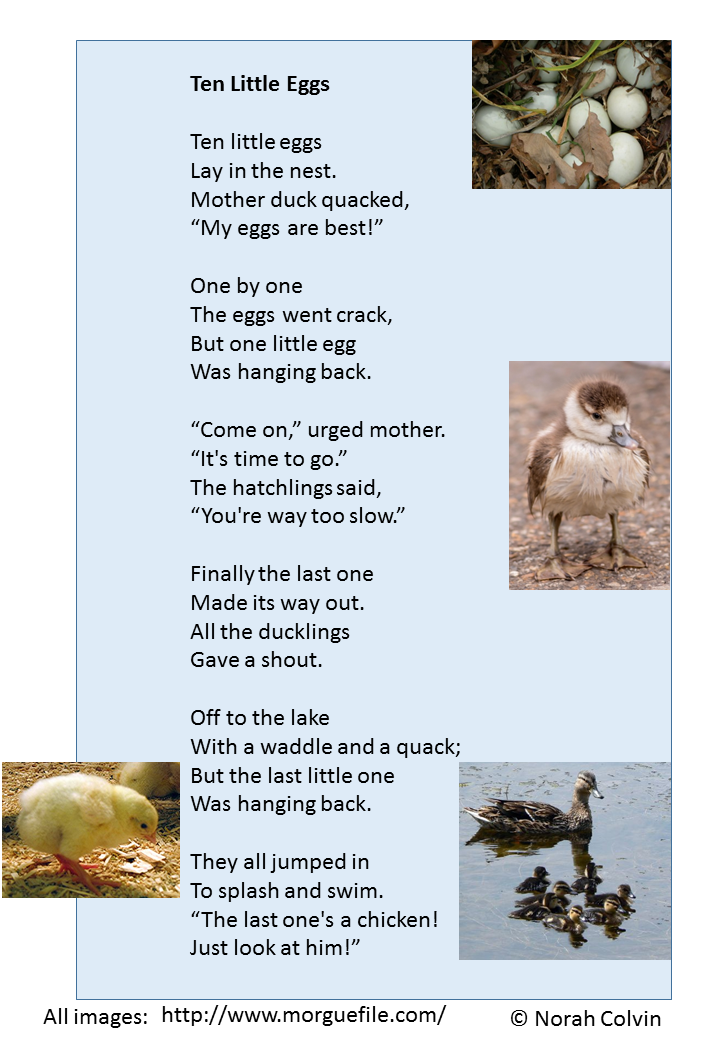
    First of all in this post I would like your opinion, if you are happy to give it, about a story for young children I have been working on.  This is it:

    Ten Little Eggs


    I recently revisited a series interrogating whether it is important for authors to ensure the correctness of information in picture books, and where the line between fact and fiction should be drawn.

    I questioned the inaccuracies in Eric Carle‘s book The Very Hungry Caterpillar and whether it mattered that what emerged from the cocoon was a butterfly rather than a moth (butterfly caterpillars don’t spin cocoons, moth caterpillars do).

    Responses varied greatly, but seemed to be evenly divided, from it doesn’t matter at all to it matters a lot. You can read the responses on the posts here, here, here, here, and here.

    I realise that the comments are subjective and personal and greatly dependent upon the readers’ experiences with the book and attitude towards the well-known, highly respected and prolific author.  I wondered what the attitude would be to my less worthy story.

    My intention was for an amusing twist at the end with the realisation that the 10th hatchling was slow because it really was a chicken, not just “chicken” as in scared.

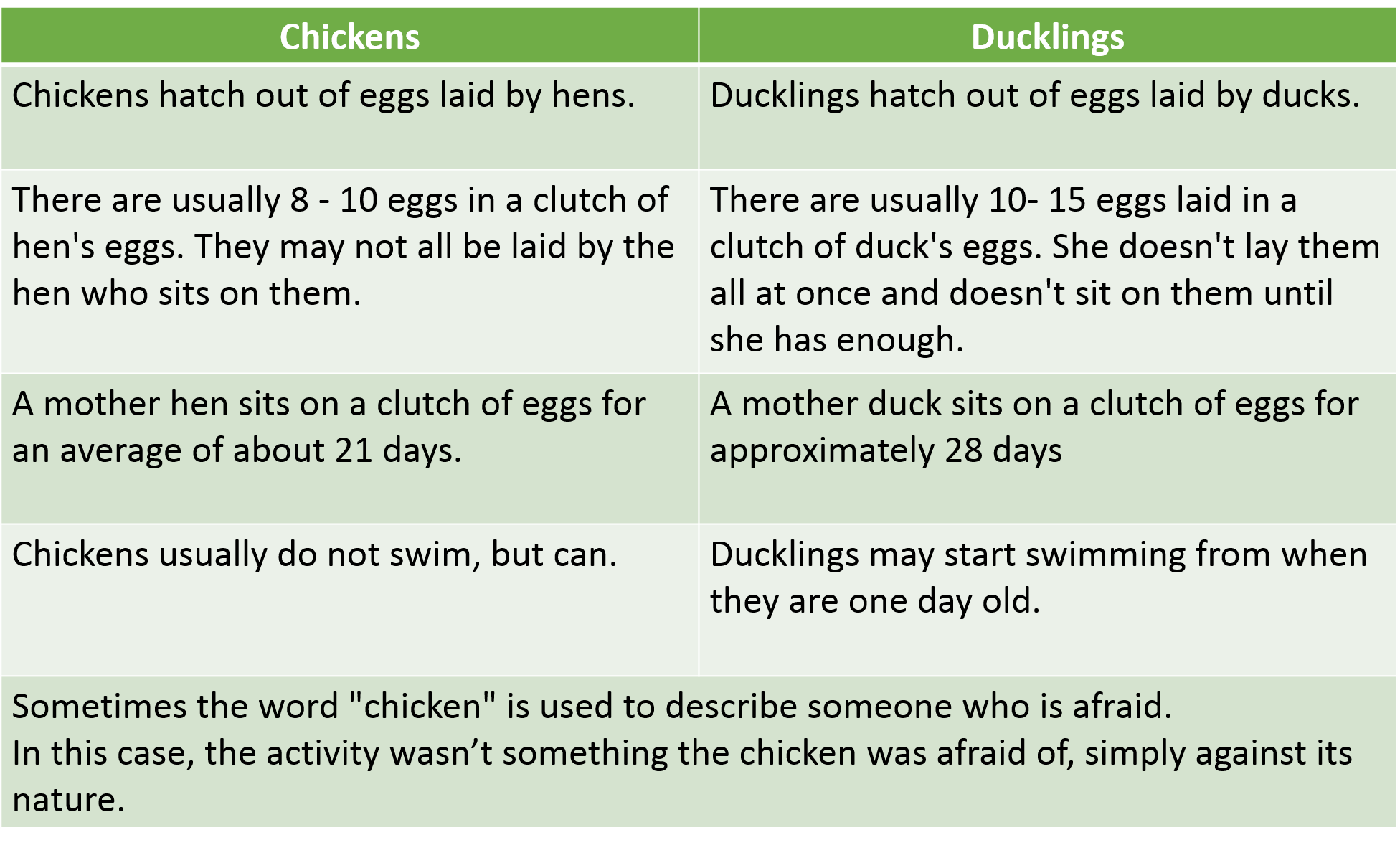
    However, when I researched incubation times for chickens and ducklings, I discovered that ducklings take longer to hatch than chickens. Therefore the story not only doesn’t work but, if I was to publish it, I would be misleading readers. While it is also unlikely that a chicken’s egg would turn up in a duck’s nest, it is possible and I am not as concerned about that inconsistency. However I stopped working on the story because of the inaccuracy and have let it sit.

    A suggestion made by Steven during the cocoon/chrysalis debate was that a page of facts at the end of the book would overcome any inaccuracies in the text. This made me think that perhaps I could include a page of facts about chickens and ducklings to counterbalance the inaccuracy in the story,  for example:

    Chickens and ducklings - Would you believe

    Thank you

    Thank you for reading. I appreciate your feedback. Please share your thoughts.

  • Five Photos Five Stories – Day one

    For the love of books

    This week I was surprised to be nominated by, writer extraordinaire, Geoff Le Pard in a Five Photos Five Stories challenge. Geoff blogs at TanGental where he shares numerous and beautiful photos of his garden, family, travels and adventures. He writes an eclectic assortment of prose and poetry, memoir and fiction, with content both challenging and humorous. He also posts at the speed of light with at least one post each day. I can understand why the challenge would appeal to Geoff.

    I’m not like that. I tend to stick to my routine of two posts each week and write mainly expository text about education with a response to a flash fiction prompt by Charli Mills thrown in. I rarely write explanations of or stories about photos and mostly use photos to support and add interest to the page. Why would Geoff nominate me?

    Well it seems Geoff must have known something about me that I didn’t, as I have decided to throw caution to the wind and join in the challenge.

    The rules of the Five Photos, Five Stories Challenge are:

    1) Post a photo each day for five consecutive days.
    2) Attach a story to the photo. It can be fiction, non-fiction, poetry, or a short paragraph. It’s entirely up to the individual.
    3) Nominate another blogger to carry on the challenge. Your nominee is free to accept or decline the invitation. This is fun, not a command performance!

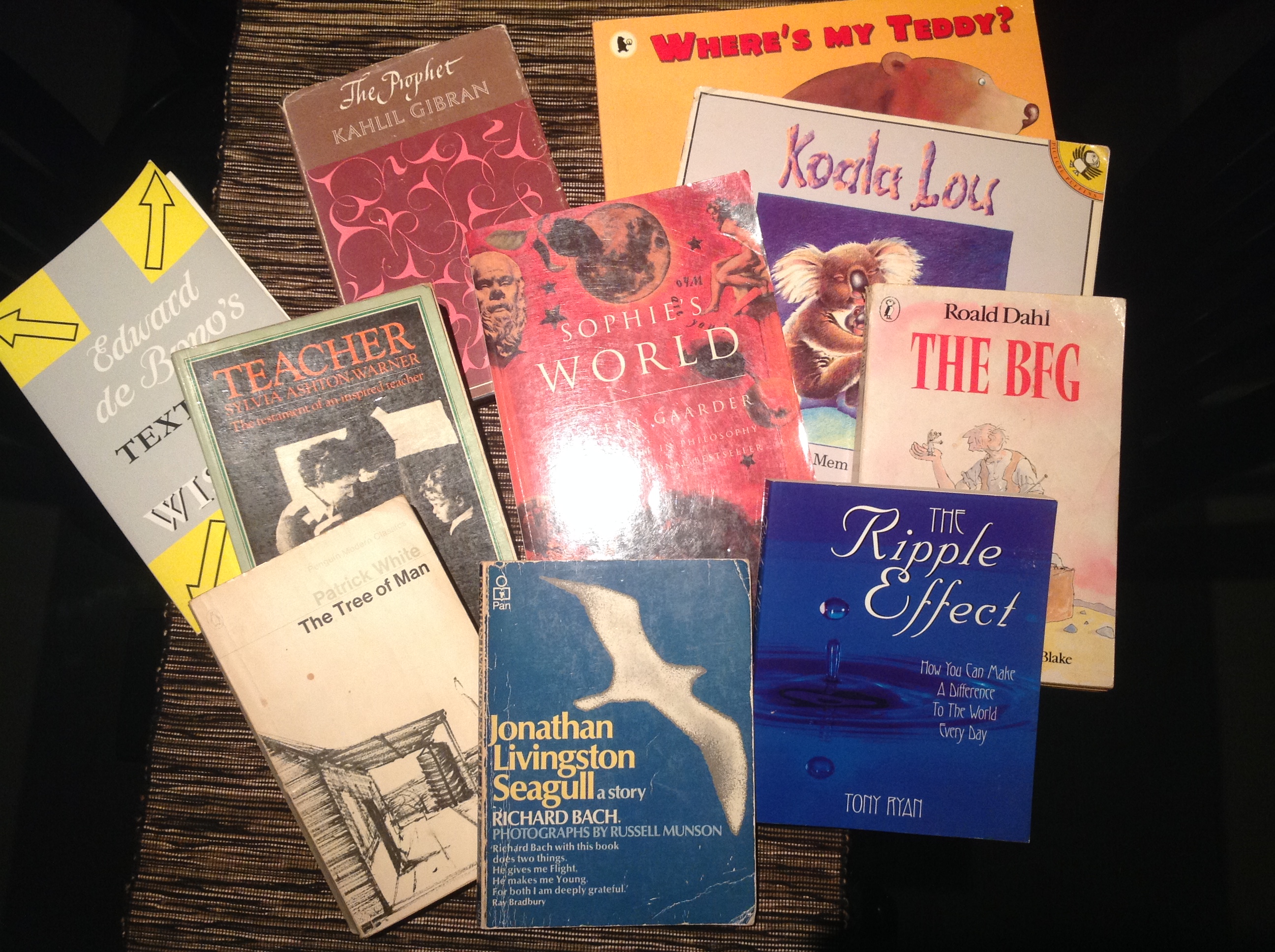
    For my first photo I have chosen, and you won’t be surprised, books:

    books

    These are just a few of my favourites. As you can see I have chosen a range including picture books and chapter books for children and both fiction and non-fiction titles for adults. There are others that should have been there but I could not fit my entire collection into one photo!

    Books have always been an important part of my life and I think a love of reading is one of life’s greatest pleasures. My love of books and reading is one of the reasons, if not THE reason I feel so passionately about education and the teaching of literacy. Sharing a learner’s excitement at becoming literate is both an honour and a joy. I have been privileged to share that excitement with many children during my teaching career, and of course with my own two children who both learned to read well before starting school.

    I have written about the importance of reading many times before, including here, here, and here.

    For this post, and for this photo, I will share ten totally random recollections of books and reading from my younger years.

    I remember:

    • books as gifts for Christmas and birthdays
    • an expedition to the council library, a six-kilometre walk there and back, each Saturday afternoon for an armful of books to read during the week
    • being deaf to the world when totally absorbed in a book for hours on end (particularly so when there were jobs to be done)
    • the eagerness of wanting to get to the end of a book and the sadness and reaching the last page
    • the excitement of finding the next book in a series or by a favourite author
    • marvelling at words and phrases for the imagery or feelings they evoked
    • enjoying an author’s style and trying to emulate it by writing and writing and writing, and wishing to one day be an author too
    • the smell of new books
    • tracing the embossed lettering on the hardcover when the jacket was removed
    • being fiercely protective of my books and having a great dislike of seeing them torn or marked
    • the joy of ownership

    And now I nominate the lovely Michelle James who blogs at Book Chat to take up this challenge if she so wishes. Her love of books is at least as great as my own!

    Thank you


    Thank you for reading. I appreciate your feedback. Please share your thoughts about any aspect of this post.

  • Revisiting The Very Hungry Caterpillar

    Recently, in a post introducing the idea of S.M.A.G. (Society of Mutual Admiration and Gratitude), I reflected upon my blogging journey and the gradual growth of readership and development of a S.M.A.G. over time. With this reflection came the realisation that many have missed earlier posts. That realisation, along with a comment by Sarah Brentyn, prompted me to share a few of my favourites.

    The Very Hungry Caterpillar

    The first posts I will revisit are from a series about using Eric Carle’s picture book The Very Hungry Caterpillar for educational purposes in an early childhood setting.

    The series of four posts;

    • explores benefits of reading picture books to children
    • questions the place of factual information in fictional texts, and
    • suggests the importance of teaching critical literacy from a young age.

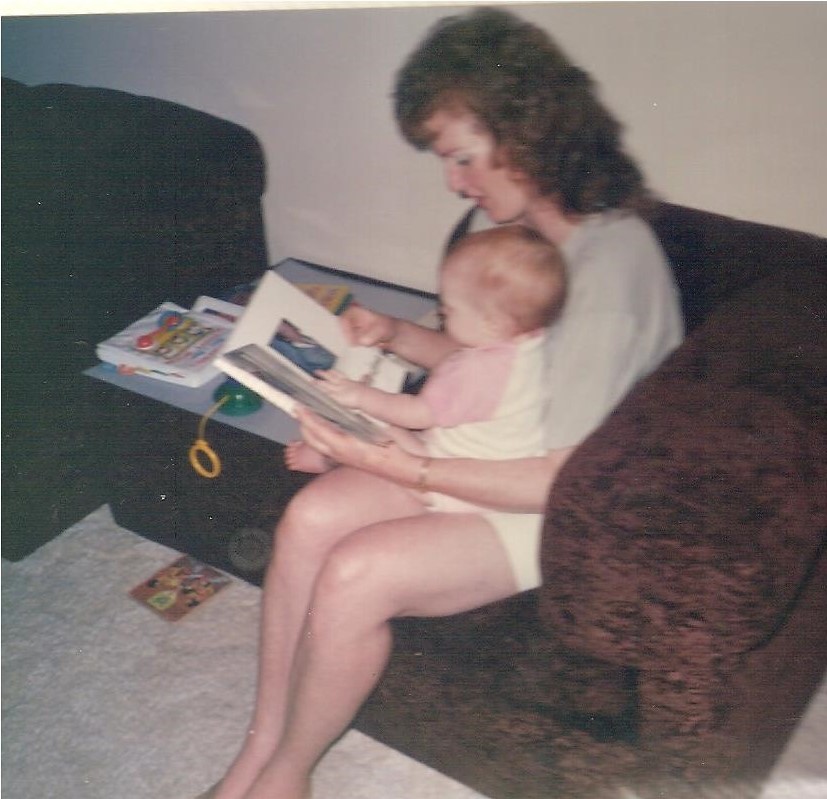
    Nor and Bec reading

    I will provide a brief overview of each post. I would be delighted to have you  follow the links to read the posts in full.

    Searching for meaning in a picture book — Part A

    In this post I explained that sharing picture books with children has many benefits, including:

    At home:

    • It can help strengthen the parent-child bond, becoming a special time of togetherness and of sharing stories and ideas.
    • It has a very positive effect upon their learning, helping them develop language, knowledge of print and books, and exposes them to new ideas and concepts.

    8-12-2013 7-38-33 PM

    In early childhood classrooms, The Very Hungry Caterpillar provides opportunities for work in many subject areas including:

    • Literature appreciation
    • Reading
    • Maths
    • Visual arts, and
    • Philosophical inquiry, but not Science (as I will explain later)


    Searching for purpose in a picture book – Part B

    In this post I discuss some purposes for using picture books and raise some questions about their content.

    A sampling of purposes:

    • encourages a love of reading and books
    • develops vocabulary and knowledge of language
    • provides a link between the language of home and the language used in the wider community and in education
    • supports beginning readers
    • inspires imagination
    • provides opportunities to discuss feelings, emotions, ideas, responses
    • develops feelings of empathy, identification, recognition, hope
    • instils an appreciation of art

    spiderswirl2

    Some questions:

    Do fictional picture books have a role, and do picture book authors have a responsibility, in imparting factual information in their books?

    Does it matter:

    • that, although lions don’t live in jungles, they are often referred to as “King of the jungle” and appears in that setting in many stories?
    • if animals that don’t co-exist, for example penguins and polar bears, appear in stories together?
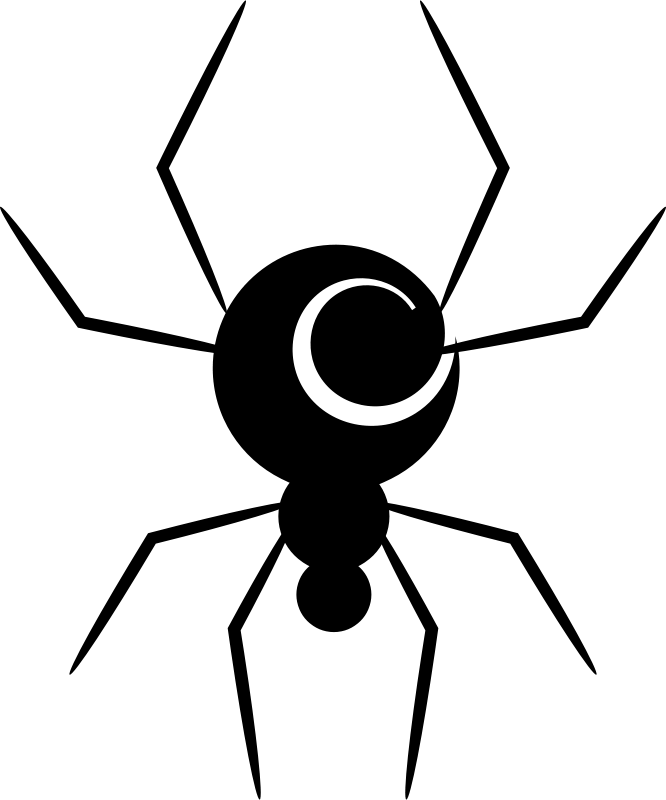
    • if the portrayal of animals in stories is not anatomically correct, for example spiders shown with legs joined to their abdomens rather than cephalothoraxes?

    Do errors such as these influence children’s understanding of the world?

    How should adults handle the misinformation when sharing books with children?


    Searching for truth in a picture book – Part C

    In this post I refer specifically to inaccuracies in The Very Hungry Caterpillar and the pervasiveness of the misconceptions, if not totally attributable to the book, then at least in part. I suggest how acknowledging the inaccuracy can help develop critical literacy.

    In his book Eric Carle writes that

    “He (the caterpillar) built a small house, called a cocoon, around himself. He stayed inside for more than two weeks. Then he nibbled a hole in the cocoon, pushed his way out and . . . he was a beautiful butterfly!”

    Monarch butterfly

    However, as this (hopefully correct) information from the Australian Museum shows, butterflies do not spin cocoons around themselves. Moths do. Some butterflies and skippers do form a silken shelter, but not a cocoon as in Carle’s picture book.

    Unfortunately many articles found in an internet search share the same misinformation. I wonder how many adults grew up believing what Carle shared through his picture books. Even teachers have been surprised to learn that butterfly caterpillars do not spin cocoons.

    In the original post I share some lovely videos related to butterfly and moth metamorphosis. It is worth taking a peek at them.

    Does it matter if children (and adults) think that butterflies hatch out of cocoons? Eric Carle didn’t seem to think so. Do you?

    Finding power in a picture book – the main event

    In this post I argue that The Very Hungry Caterpillar has no place in a science lesson because of the misinformation contained therein: caterpillars do not eat many different foods and butterflies do not come out of cocoons.

    ryanlerch_thinkingboy_outline

    The greatest value of the book is as a tool for teaching critical literacy; for teaching children that just because something is in print, doesn’t make it true. It is also important to realise that misinformation is not restricted to picture books, and that they need to question all sources of information for the author’s credentials and purpose in writing.

    I suggest that teachers and parents:

    • point out inaccuracies and inconsistencies
    • encourage children to evaluate what they are reading and hearing against what they already know
    • support children to verify the source of the information and to check it against other more authoritative/reliable sources
    • help children to recognise that every author has a purpose and to identify that purpose
    • invite children to ask questions about what they are reading and to interrogate the content
    • encourage them to question, question, question.

    Eric Carle says “If we can accept giants tied down by dwarfs, genies in bottles, and knights who attack windmills, why can’t a caterpillar (sic) come out of a cocoon?”


    What do you think? Do picture book authors have a responsibility to be accurate? Is a butterfly coming out of a cocoon in the same realm as giants tied down by dwarfs? Would we accept a child hatching out of an egg? What parts of a story should be based in reality and which parts can be imagined?

     “Why can’t a butterfly come out of a cocoon?” asks Eric.

    Well, Eric, they just don’t.

    Thank you

    Thank you for reading. I appreciate your feedback. Please share your thoughts about any of issues I have raised in these posts.


  • My time, your time, springtime!

    This week at the Carrot Ranch Charli Mills has challenged writers to In 99 words (no more, no less) write a story that is a snapshot of spring.


    At the moment approximately 90% of the world’s population are experiencing the season of spring. The rest of us, the 10% who live in the Southern Hemisphere are entering the cooler months. How those seasons are experienced varies from place to place. I have never experienced an autumn that would fit the description of ‘fall’; nor have I experienced a winter with snow. Those concepts are foreign to me. That is not to say that some living in the southern states of Australia haven’t experienced them. It all depends where one lives.

    The Australian Government describes Australia as having two main seasonal patterns in six different climatic zones. The Indigenous Peoples of Australia describe the changes as holistic changes in nature and life. In Australia, attitudes to and understanding of the seasons are as diverse as the experiences. While the weather doesn’t always know it, spring is marked on the Australian calendar from September to November. It doesn’t matter to which part of the country you travel, there is always something to see and do in spring.

    Springtime in Tasmania 2014
    Springtime in Tasmania 2014

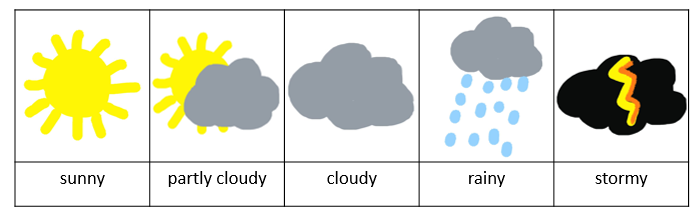
    Part of the daily routine in an early childhood classroom is observing and discussing the daily and seasonal changes in the weather. Each day the children observe the weather and discuss how it may influence their clothing and activities and the impact that changes may have to their local environment and other things including animals.

    Many classrooms have a calendar prominently displayed on which the children’s observations can be recorded and compared. Children are often invited to draw symbols and write words such as those shown here.

    weather symbols

    Discussions about how warm or how cool it is may also occur, though in some parts there is never really what could be called ‘cold’, just ‘cooler’.

    temperature chart


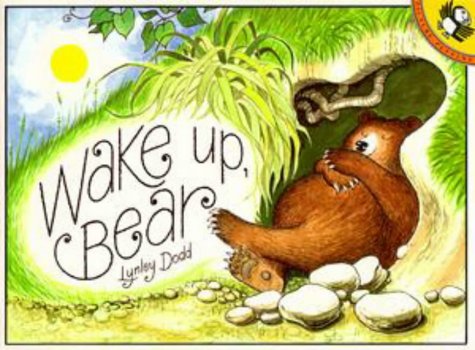
    Reading stories was always an integral part of my classroom practice and I needed little excuse to read another. When the seasons changed I was always looking for suitable books to read and the first I thought of at springtime was Wake Up Bear by Lynley Dodd, a New Zealander.

    Wake up bear

    While we don’t have bears in Australia, just these cute koalas often incorrectly called bears;

    or hibernating animals, except for this cute little mountain pygmy-possum;

    Wake Up Bear is a delightful story to herald spring. In the story, bear has slept all through winter, but when spring arrives he is not quite ready to wake up. The animals each try to wake him up and finally they succeed.

    While it was not Dodd’s intention with the story, it made me think about children learning in their own time, “waking up” when they are ready. Sometimes they need to be shown something just once. Sometimes they need a great deal of exposure and support to “get” it. Sometimes it’s better to leave them alone until the time is right. There have been previous discussions about this here my blog, including In their own time and Not Yet.

    I thought Charli’s spring challenge was perhaps another opportunity for talking about individual differences and the need to respect a learner’s journey. I’ve gone back to my early childhood roots. I hope you enjoy it.


    Springtime in Tasmania 2014
    Springtime in Tasmania 2014

     Spring

    Bees buzz

    Wildflowers bloom

    Cockatoos squawk

    “Gone is the gloom!”


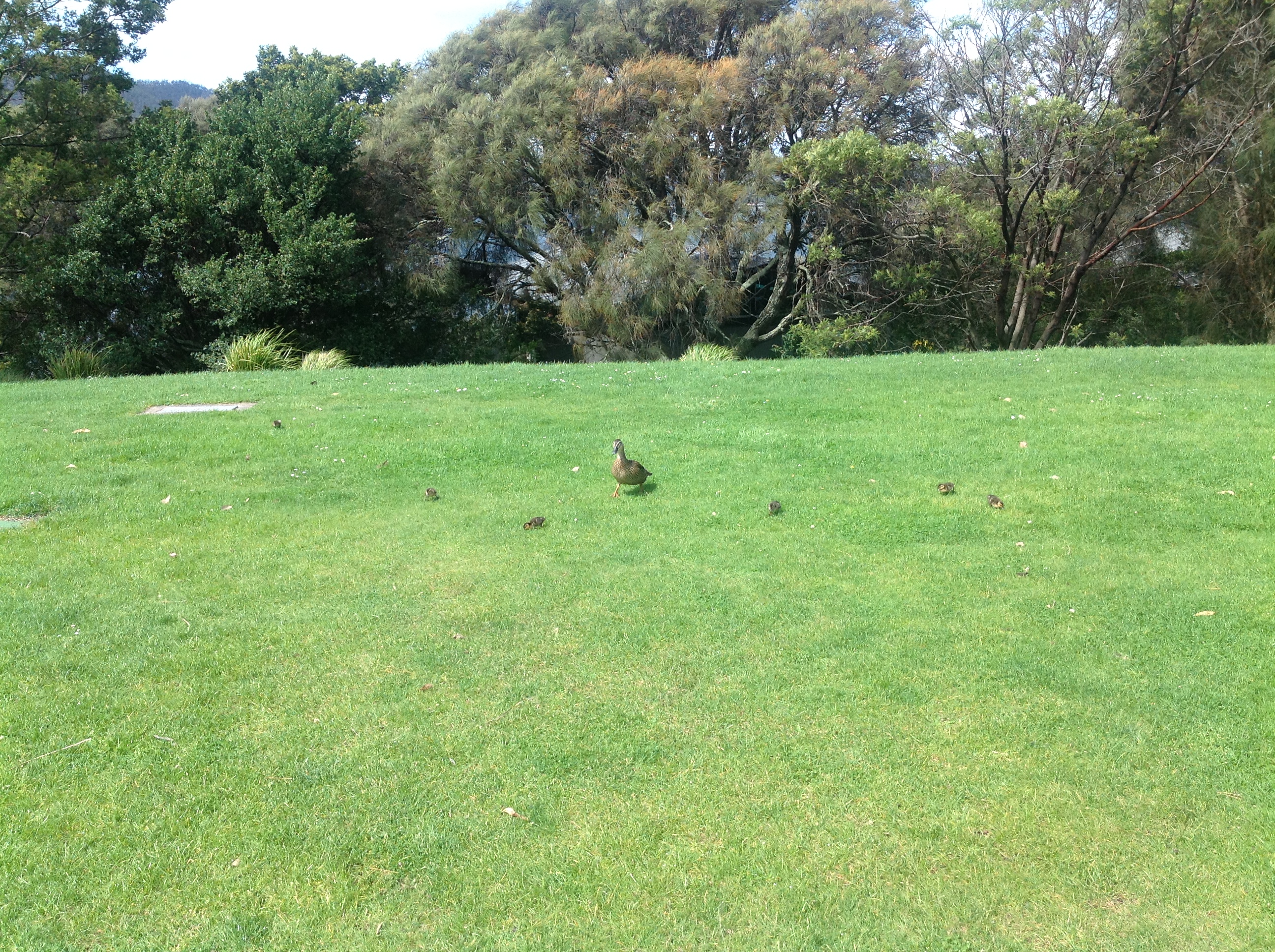
    Mother duck waits

    For her babies to hatch.

    Here they come now

    The first of the batch


    So cute and cuddly

    All covered in fluff

    Eager and ready

    To show off their stuff


    “Patience!“ quacks mother

    “There’s no need to rush.”

    “One more is coming.

    Stand back. Please don’t crush.”


    With one final crack

    Last one’s out of his shell

    “I’m proud of you babies.

    You’ve all done so well.”


    Mother duck smiles

    As they waddle in line

    She knows that each duckling’s

    Own time will be fine.

    Thank you

    Thank you for reading.

    Springtime in Tasmania 2014

    Springtime in Tasmania 2014

    Happy spring to most of you! For the others: enjoy the cooler respite from the relentless heat!


    I appreciate your feedback. Please share your thought about any aspect of this post or flash fiction.

  • “If you want intelligent children, give them a book …”

    If-you-want-intelligent children

    These words piqued* my interest as they wafted to my ears from the TV set in the other room.

    Who is that?” I called out.

    Jackie French,” he replied.

    I jumped up, eager to see and hear more.

    Jackie French is a well-known Australian author and advocate for literacy and the environment. She is currently the Australian Children’s Laureate with the task of promoting “the importance and transformational power of reading, creativity and story in the lives of young Australians”.

    I was delighted to find that Jackie’s speech was in acceptance of an Australian of the Year Award.

    The media announcement released by the Minister for Social Services explains that Jackie was recognised for her “long and distinguished career as a beloved children’s writer, earning more than 60 literary prizes for her books.”

     “Jackie embodies this commitment (to changing lives in our community) and I’d like thank her for the work she continues to do sharing the power of reading and story-telling for young Australians, and her work in conservation.” 

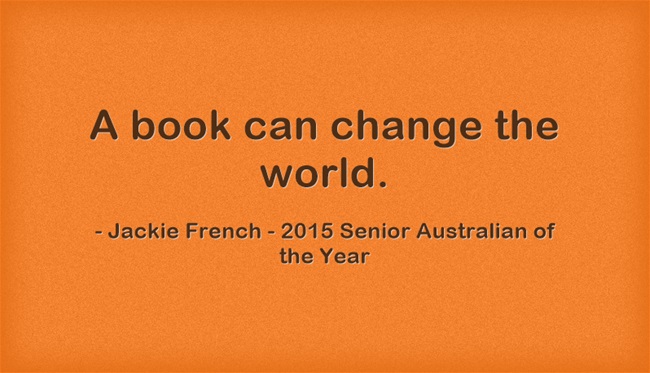
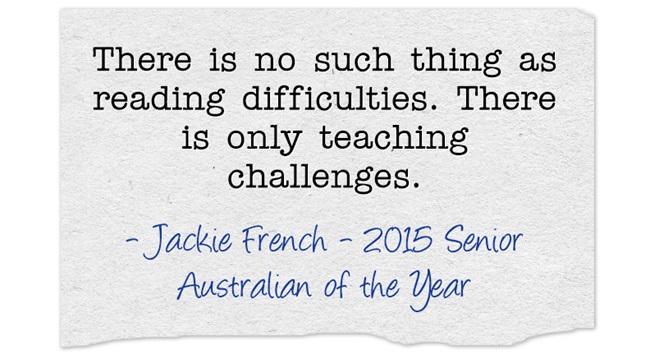
    Here is Jackie, Senior Australian of the Year 2015, accepting her award.

    Failure-is-not-an-optionA-book-can-change-theThere-is-no-such-thing


    In this next video Jackie talks about her book “Hitler’s Daughter”. You don’t have to have read the book to glean much of interest from the interview. In the discussion Jackie shares her thoughts about reading and writing. She questions how the ‘world’ in which one is, influences thoughts about good and evil and decisions that are made. She discusses how the need for evil to be resolved in a work of fiction differs between children and adults. She talks about whether it is necessary for a child to apologise for the sins of the previous generation, and how still controversial issues can be dealt with in an historical situation. It is worth listening to if you simply want something to ponder over.
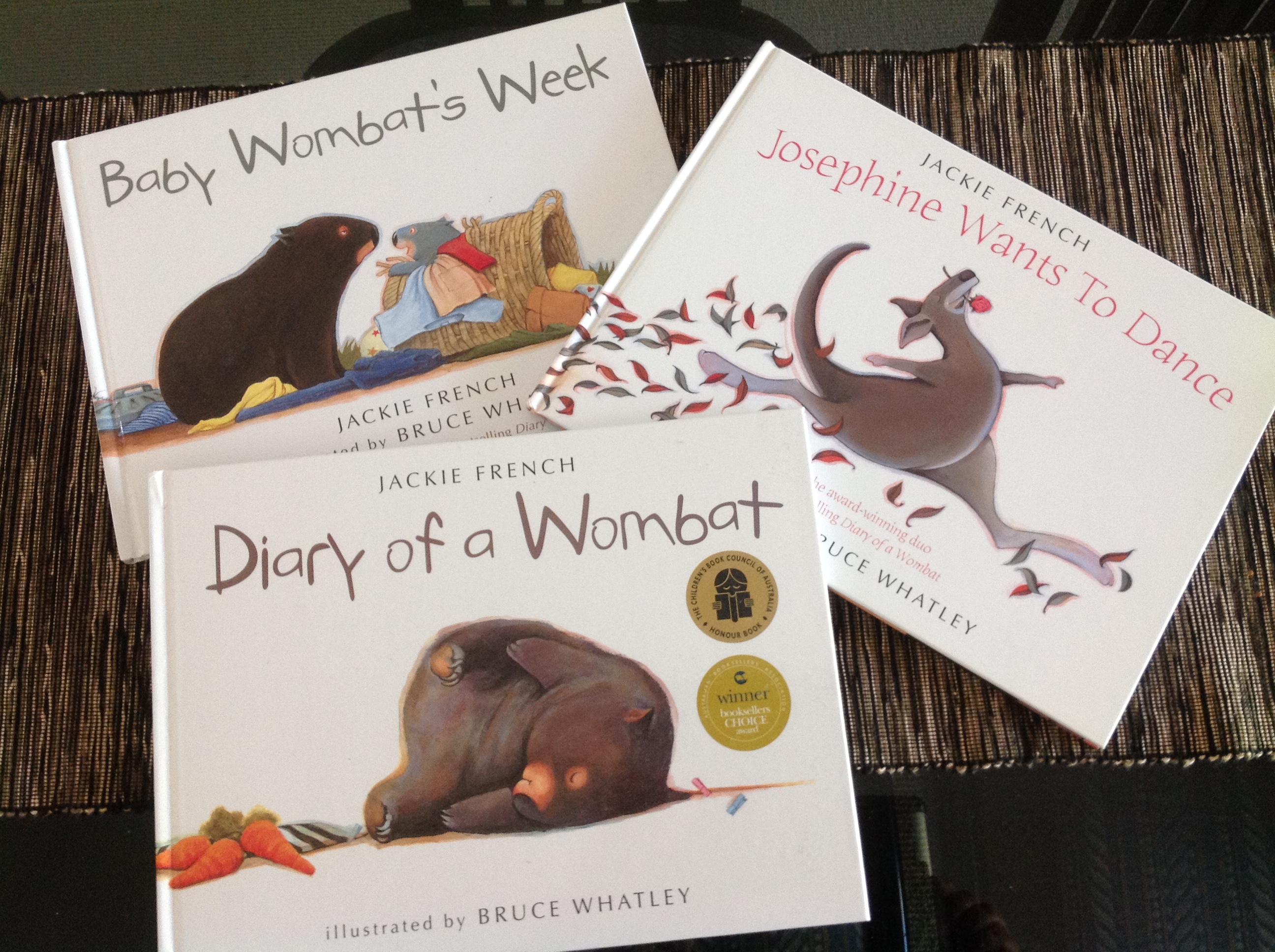
    Being an early childhood teacher I am more familiar with Jackie’s picture books such as

    Diary of a Wombat, Baby Wombat’s Week, and Josephine Wants to Dance, which are delightful.

    IMG_4302

    Here is a video of Jackie reading Diary of a Wombat.

    I have just discovered that Hitler’s Daughter is available as an audiobook, so it is going onto my list!

    https://openclipart.org/image/800px/svg_to_png/148843/1310261210.png
    https://openclipart.org/image/800px/svg_to_png/148843/1310261210.png


    I congratulate Jackie on her award and thank her for the contribution she is making to the lives of so many and the future of our planet.


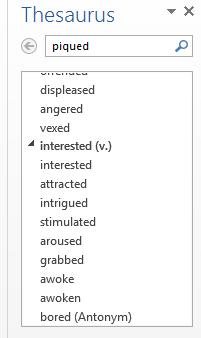
    *piqued

    In this sentence, I am using the word “piqued” to mean “stimulated or aroused my interest”.

    How can one word be used to express opposite meanings? I don’t know how anyone is expected to learn or understand the nuances of this language we call English!

    When I checked with my thesaurus to ensure I had chosen the correct word, this is what I found:

    piqued 1         piqued 2

    How many other words do you know that could almost be listed as its antonym?

    Thank you

    Thank you for reading. I appreciate your feedback. Please share your thoughts about any aspect of this post.

  • Reading is out of this world!

    Space-Sketched

    Reading is a wonderful pastime. Since you are reading this blog I am sure you will agree.

    People read for many different reasons, including:

    • for information e.g. about world events or something of interest, to find out what’s on offer, how to do something, or the time and place to catch a bus,
    • to be challenged e.g. by philosophical or ethical arguments and viewpoints
    • to stay in touch e.g. through letters, emails, blogs, Twitter, Facebook and other social media
    • to be enthralled by a story or delighted by poetic words and imagery
    • to escape the everyday.

    I am certain you could add to the list in breadth and specificity without too much trouble.

    Robert 2

    Developing a lifelong habit, if not love, of reading is important to fully function in society. The “bug” is more easily caught in early childhood but can be developed at any stage throughout life when its rewards become apparent.

    Nor and Bec readingI have previously shared ideas about the importance of talking with and reading to young children, including here and here.

    Another highly influential factor in creating readers is for children to see adults engaged in reading for real purposes, for information and pleasure; and having the opportunity to discuss the purposes of, and ways of reading, different material e.g. the way we read a menu is different from the way we read a story or a newspaper.

    peole_computer

    Additionally, it is useful for children to realise that the importance of reading extends beyond the home. There may be opportunities for them to observe people reading in the workplace or to discuss the need for reading in different roles.

    The Very Hungry Caterpillar

    Another important aspect of reading that I have previously discussed, using ”The Very Hungry Caterpillar” by Eric Carle as an example here, is critical literacy, the ability to interrogate the veracity of the information, its source and author.

    I recently read discussions about difficulty experienced incorporating non-fiction material, especially science information, into classroom reading programs. I was a bit blown away by this because I believe that children will be interested in anything and everything if it is presented in an interesting way.

    An information book doesn’t have to be read all at once, from cover to cover in any particular order. It can be dipped into, pored over, or explored bit by bit.

    Sometimes information can be found in a work of fiction, but it is important, as cautioned with “The Very Hungry Caterpillar”, to check the source and the “facts”.

    So to tie together the elements discussed above, these are important elements for motivating children to read:

    • Talking with them about things of interest to them
    • Reading to them
    • Modelling and discussing positive reading habits
    • Demonstrating the importance of reading
    • Discussing the importance of not believing everything that is read and of evaluating the source of the information and the intent of the author

    In my exploration this week of one of my favourite educational websites, edutopia, I discovered through a post written by Ben Johnson and called When Astronauts Read Aloud Children’s Stories – From Space! a site that met many of the above criteria: Story Time From Space

    Story Time From Space features astronauts on the space station reading story books to children. At the moment there is one story available, but more are planned, as are teaching suggestions and activities, including experiments.

    The story, Max Goes to the International Space Station is the first of a series of five stories written by Dr. Jeffrey Bennett who describes himself as “an astronomer by training and a teacher by trade, but currently spend most of my time as a writer.”

    In his post, Johnson expands on that, describing Bennett as “a research associate at the University of Colorado Center for Astrophysics and Space Astronomy, … (who) has worked at the California Institute of Technology Jet Propulsion Laboratories and NASA Headquarters in Washington, D.C.” He goes on to say that “Dr. Bennett strives to write books that are factually correct, fun, and interesting for students to read.” The experiments that the astronauts do will correspond to those in the books.

    roto-spacesuit-mkiii-clean-new


    While parts of the Story Time From Space site are still “coming”, I think this project has great potential for motivating children to read and for inspiring an interest in the world and beyond. Being read a story by an astronaut isn’t something that happens every day!

    Thank you

    Thank you for reading. I appreciate your feedback. Please share your thoughts about any aspect of this post.

  • I’m (not) dreaming of a white Christmas

    https://openclipart.org/image/800px/svg_to_png/59389/happy_sun_gm.png
    https://openclipart.org/image/800px/svg_to_png/59389/happy_sun_gm.png

    Last week the flash fiction prompt set by Charli Mills of the Carrot Ranch was to write a story using two objects, people or ideas that don’t go together. There was quite an assortment of responses, including mine. You can read them all here.

    This week Charli has continued in the same vein, challenging us to In 99 words (no more, no less) write a story that pairs something seasonal with something odd. 

    In Australia that’s easy. We’ve already got Christmas in summer. Most people around the world would say you can’t get much odder than that!

    www.openclipart.org
    http://www.openclipart.org

    But it is summertime in Australia and Christmas is just around the corner.

    While we enjoy warm days at the beach and in the pool, picnics in the park and barbecues in the back yard, hoping the big storm doesn’t get us this time (like the one that hit Brisbane on 27 November); those from whom we have inherited our Christmas traditions are cooling down in the Northern Hemisphere, many looking forward to a (not too) white Christmas.


    Shops here are playing traditional (northern) carols with snow, sleighbells and mistletoe; decorations are tinged with fake snow and cards show snowy scenes with families huddled around the fireplace.

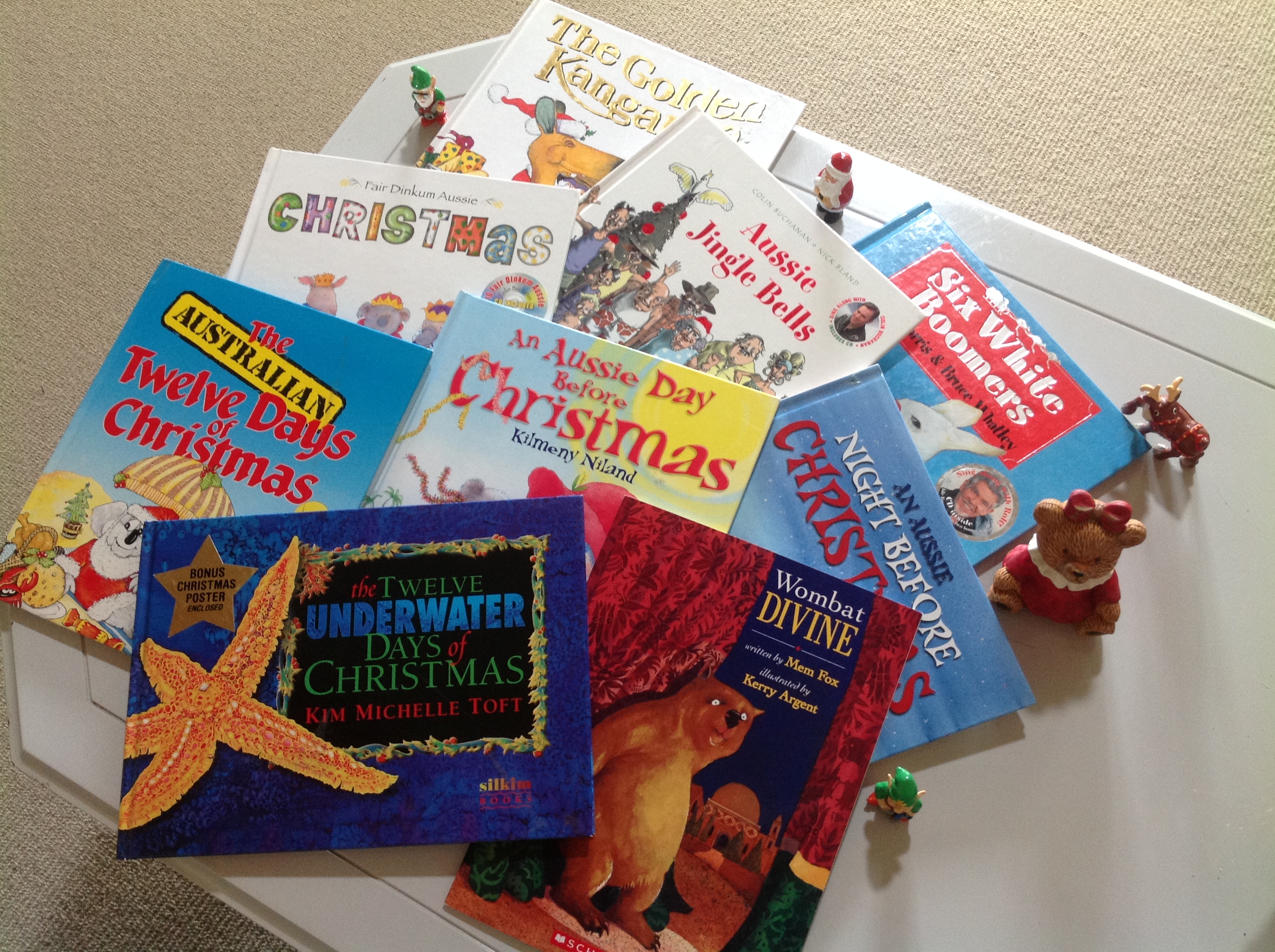
    While there is an increasing number of songs and books with an Australian flavour many are merely innovations on the traditional such, as “The Australian Twelve Days of Christmas”, “Aussie Jingle Bells” or “An Aussie Night before Christmas”.

    Some Australian Christmas picture books
    Some Australian Christmas picture books

    One innovation that I particularly like is The Twelve Underwater Days of Christmas by Kim Michelle Toft. Kim is an Australian who uses her talents as author and illustrator to educate children about the things she feels passionate about: ocean life and coastal habitats. Her illustrations, hand-painted on silk, are absolutely stunning.

    12 Underwater days

    In addition to the visual beauty of the book there is great value in the supporting information through which Kim explains the importance of conserving each of the creatures included in the book. While written by an Australian, the application of the book is not limited to our shores. Creatures from all over the world adorn the pages.  If you ever wished to own a book simply for the beauty of its illustrations, this is a great choice.

    One original song I enjoyed listening to on the radio as a child is “Six White Boomers”. Despite the reasons that make me reluctant to mention it this year, it is a delightful tale of a joey who rides on Santa’s sleigh, pulled by six huge white kangaroos, to be reunited with his mother on Christmas Day.

    Peter CombePeter Combe has written two albums of original, but with a traditional rather than specifically Australian flavour, Christmas songs for children, including this one:

    Some Christmas traditions popular with Australian communities are Nativity plays, carols by candlelight and Christmas parades. Many classes and schools perform their own end-of-year “break-up” concerts to which parents and the wider community are invited.

    Using the traditional Nativity play as the setting, Mem Fox created an original and fresh story in Wombat Divine. It is a delightful tale of Wombat who loved everything Christmas. When finally he was old enough to be in the Nativity Play he rushed along to the auditions. Unfortunately it was difficult to find a part that was just right for Wombat. Can you guess which part he got? You’ll have to read the book to find out! Children all over the world will identify with Wombat and his predicament and enjoy the heart-warming tale.

    Books are wonderful gifts to give or receive at any time. The titles I have mentioned here are perfect for giving, reading and sharing at this time of year. When I was growing up there was always a book for Christmas and birthdays, a tradition that I have continued with my extended family and friends. You can almost, but not always, guarantee that if it is a gift from Norah, it is a book.

    After my siblings and I had grown up and swelled the family numbers with partners and children of our own, my Mum used to say, “There’ll be no presents this year.” It wasn’t that she wasn’t a giving person, for she was. It was just that there were so many of us! When she passed away this year she had about fifteen grandchildren and eight grandchildren, in addition to her remaining nine children and their partners. (I’m saying ‘about’ for grandchildren and great-grandchildren in case I’ve missed some in the count!) You can imagine how daunting a task it would be to go shopping for all these people ranging in age from six months to sixty! However it was always surprising how frequently she did not follow her own rules and had a small something wrapped up to present to many of us.

    This year there will be no presents from Mum, and more sadly, we will be without her presence.

    Although I have borrowed my Mum’s words, “No presents” for both flash fiction pieces included in this post, the stories do not cast aspersions on her generosity. I have simply explored how the oddness of no presents or presence at Christmas time may have impacted Marnie, a character I have been developing in my flash fiction pieces, at different times in her life. At this stage of my writing I am still investigating her character, discovering a little more with each flash piece as her once indistinct figure begins to step out of the shadows and take shape.

    This first piece is written about a difficult time for teenager Marnie and a situation that may be the catalyst for her leaving home.


    No presents

    Marnie jerked backwards avoiding the predictable grope. In so doing she collided with her mother, sending her sprawling onto the tattered sofa.

    “Aargh!” her mother screamed. “Look what you’ve done!”

    Marnie watched the liquid from the upturned glass merge with the patchwork of stains collected in the carpet. If it was her blood it would not have mattered more.

    “I … I’m sorry,” she stammered. But her sorry was for all the years it had been like this.

    He smirked, raising his hand to strike, “No presents for you this year!”

    “That’s right!” She ducked. “No presence!”


    So as to not be too dismal at this time of year, I have written a second piece about a younger Marnie for whom there still seems a glimmer of hope.


    No presence

    With faces as bright as their Christmas wear, the children bubbled into the room, each carrying gifts for the Kindness tree, “for those less fortunate”.

    Parents fussed, removing smudges and replacing wayward hair before blowing kisses and hurrying off for the parade.

    And there was Marnie: no parent, no Christmas dress, no gift, no smoothed-down hair; no smile.

    One last chance.

    “Marnie!” I beckoned, and held out my Christmas cape and crown. “Will you be my special helper?”

    Our eyes locked communicating more than any words. Her smile was my reward.

    “I’m proud of you,” I whispered.

    Thank you

    Thank you for reading. I appreciate your feedback. Please share your thoughts about any aspect of this post or flash fiction pieces.