Live Love Laugh Learn … Create the possibilities

Category: Flash fiction

  • Which is your favourite thinking room?


    Do you have a quiet place at home where you like to think?

    do not disturb door

    Some people I know like to think in the toilet. (I’m not one of them. I prefer to not be in there long enough for that!) They see it as a quiet place where they can sit and think, undisturbed, for as long as they like. If they are “in the can”, “in the dunny”, “at the loo” or “out the back”, or whatever other euphemism you can come up with, their position is unassailable and their sanctuary respected. Mostly, anyway. Parents of young children may vehemently disagree with that!

    A couple of weeks* ago Anne Goodwin reminded us of World Toilet Day and how lucky we are to have access to toilets and sanitation. Most of us take what used to be the smallest room in (or out) of the house for granted, not giving its use a second thought as we flush away our waste.

    But not everyone is so lucky. It seems that more of the world’s population have access to a mobile phone, and or to the internet, than to a toilet. Visit Anne’s blog for many links that explain why a day for toilets is important.

    WaterAidAustralia explains that

    “The day was created to raise global awareness of the struggle faced by the 2.5 billion people living without access to sanitation. It is also used to explore some of the healthy, emotional and psychological consequences people endure as a result of not having a proper, clean toilet.”

    An article written by Nicole Arce and published in the Tech Times cites the U.S. Centers for Disease Control and Prevention for the information that 2,200 children around the world die every day due to diarrhoea. Proper sanitation would prevent most of those deaths.

    Arce writes that the Indian Prime Minister Narendra Modi has set 2019 as its target for “total sanitation”. However, as also suggested in Anne Goodwin’s flash fiction piece “Culture Shock”, the problem can be attributed to cultural as well as monetary issues.

    Charli Mills at the Carrot Ranch followed Anne Goodwin down the toilet path and extended the discussion to include the effect that poor sanitation has on education, particularly of young girls. The link is not as tenuous as it may first appear as explained here and here.

    Charli decided to use her flash fiction challenge to “spread awareness that toilets matter.” She invited readers to “Help spread the call for human dignity and basic sanitary health” by linking to UNICEF when responding to her prompt: In 99 words write a story that includes the toilet.

    I have decided to do just that, as have many others. Check out Charli’s post at the Carrot Ranch to read all responses.

    Toilet sanctuary

    “Miss. Marnie’s locked herself in the toilet and won’t come out.”

    “What now?” I thought, scanning the troubled face pleading for assistance as much as to be absolved of blame.

    “Okay,” I reassured Jasmine. “Let’s go see what’s up.”

    As we hurried to the toilet block Jasmine reiterated her innocence, she hadn’t done anything, she didn’t know what was wrong (it wasn’t her fault).

    “I know,” I smiled. The toilet cubicles had frequently been Marnie’s sanctuary. But not for weeks.  Jasmine’s kind-hearted friendship had seen to that.

    “She’s got her unicorn again,” Jasmine whispered.

    “Oh,” I said.


    *I apologise that this post may appear out of sync with World Toilet Day which was now ten days ago. Unfortunately I have been without internet access for 12 days and unable to publish although I had the post written. Fortunately I still had access to a flushing toilet, and if I had to choose between that and the internet, I’d go for the toilet every time! Though World Toilet Day has passed for this year, the message remains important every day!

    Thank you

    I appreciate your feedback. Please share your thoughts about any aspect of this post or flash fiction.


  • What do you bomb at?

    According to my online sources, including internetslang.com, bomb can mean “something really bad” or “something really good”.

    The urbandictionary.com states that before 1997 it meant “something really bad; a failure”; and that since 1997 it has referred to something excellent, and if preceded by the word ‘the’ it means the best!

    My use of the word “bomb” fits neatly into the pre-1997 definition. Perhaps it’s not surprising since I lived most of my life so far pre-1997! Hopefully, should I live long enough, half of my life will be lived after 1997 as well, but I’ve a while to wait to see if that happens!

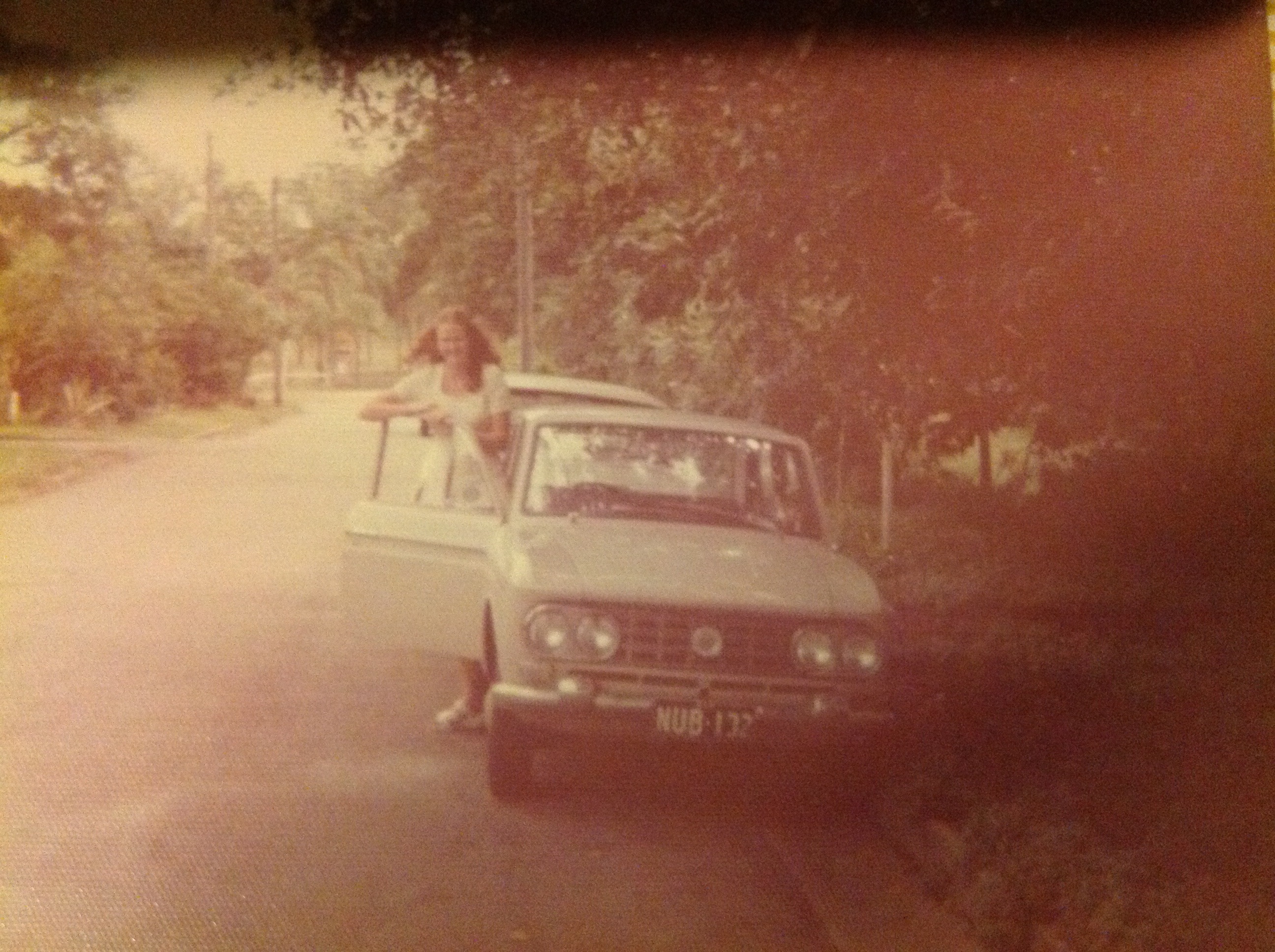
    In my day the word “bomb” was often used to describe an old beat-up car. I bought my first car when it was ten years old. It may have been described by many as a bomb (it burned oil and smoked terribly amongst other things) but I loved it, adorned it with flower stickers and even named it “Ziggy”.

    car Ziggy

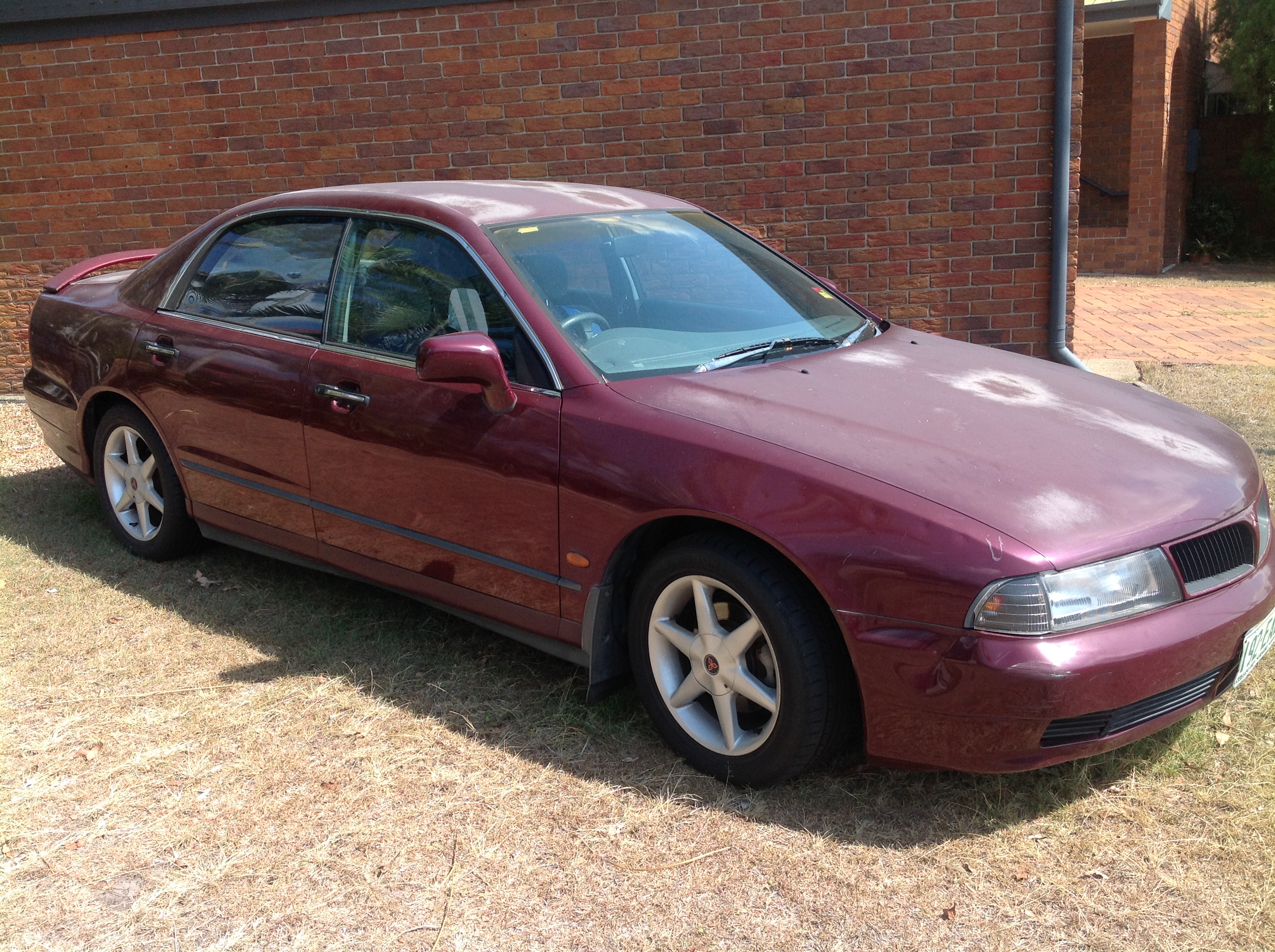
    Nowadays cars seem to last a lot longer before they earn the title of bomb. Dare I say our 1997 car has only in recent years earned that title, and really only after it became unsightly due to hail damage and deterioration of the paintwork. It has been replaced by a car we might call “the bomb” but it still sits in the front yard and gets an occasional outing, too precious for someone (other than me!) to part with.

    magna

    The most common use of the word as a verb was to refer to failure, particularly with regard to exams. After what felt to be a particularly dismal attempt at an exam, various students would bemoan its difficulty saying, “I bombed”. I have talked about failure in previous posts including my “failure” at singing here, and the failure of some aspects of schooling here. The word ‘bomb’ doesn’t appear in either of those posts.

    It was Charli Mills of the Carrot Ranch who got me thinking about bombing with her Nov 12: Flash Fiction Challenge to In 99 words (no more, no less) write a photo bomb (serious scene interrupted by something absurd or unexpected).

    Now Charlie was talking about photo bombs which she described as an “earnest photograph interrupted by the unexpected”, but I thought I would tackle video bombs. I knew I had made quite a few of those!

    In an effort to learn more about making videos, which has been on my to-do list for ages, I also decided to make a compilation of video bombs to accompany my 99 words, while endeavouring to meet both Charli’s criteria and mine:

    Charli:

    99 words

    bombing

    Me:

    99 words that make sense (always a priority)

    find videos to match the 99 words

    make a compilation video

    record the video and words

    My attempt is quite experimental and rather rudimentary at best but I learned a lot in the process. Since my blog is about learning, I decided to share it with you as a checkpoint on my learning journey. I know it’s definitely not “the bomb”, but I hope I haven’t totally bombed.


    In the words of C.S. Lewis,

    “Failures are finger posts on the road to achievement.”


    Video bombing

    Are you a video bomber?

    Ever tried making a video but

    the subject won’t cooperate,

    or turns its back to you,

    or perhaps it even disappears Poof! It’s out of view.

    You shoot upside down or to the side,

    the focus you can’t get right.

    You shoot with the camera supposedly off,

    then close-up your fingers when on.

    You record to capture a photo,

    or snap when it’s action you want.

    If your answer is ‘Yes” to just one of these

    come join the vid-bombers club.

    We’ll commiserate

    And then celebrate

    When your video capture’s “the bomb”!

    Thank you

    I appreciate your feedback. Please share your thoughts about any aspect of this post, flash fiction or video.

  • Whose failure?

    I think about education. A lot. You could say it consumes me. It has been my lifelong passion, and although I am not currently in the classroom I don’t stop thinking and reading about how we learn and how learning can best be encouraged. My discontent with how schooling often is and my optimism for what it could be has been a recurring theme on my blog and a driving force in my life. You would not have to open too many posts to find at least one expressing that view.

    education-is-2

    My poem “Education Is” sums up the differences I see between education and schooling. Some schools do education really well. Some professing to be educational institutions school, very badly. What I consider to be one of the major differences is that education encourages a love of learning that lasts a lifetime; while schooling attempts to force-feed content in such a way that learning is neither enjoyed nor viewed as anything other than what one is forced to do in school.

    In traditional schools assessment often takes the form a test which requires students to regurgitate information that has been thrust upon them, whether they like it, or are interested in it, or not. This occurs across all subject areas. I have written about it before in relation to writing tasks in these three posts: Writing to order – done in a flash!  Writing woes – flash fiction  and Who tests the testers?

    I contrasted my choice of responding to Charli Mills’ flash fiction prompts to the lack of choice students have in state- or nation-wide writing tasks. In Writing woes – flash fiction  I suggested that it would be difficult for me, on a given day, with a restricted amount of time, under the watchful eyes of supervisors, to produce my best work in response to a prompt about which I may have little experience, knowledge or interest.

    www.openclipart.org http://goo.gl/Ep1vK6
    http://www.openclipart.org http://goo.gl/Ep1vK6

    In my flash fiction responses I introduced a unicorn as a symbol of escape from the confines of the classroom or other oppressive situation, into the space where one is free to truly be oneself. It wasn’t a deliberate or premeditated choice, simply a response to Charli’s prompt. However I am happy to adopt it in my flash fiction as a symbol of playfulness and imagination unleashed; the basis for all great inquiry and innovation. Thank you, Charli, for the prompt!

    I introduced the unicorn in the post Of rainbows and unicorns – Part 1 – Fantastic creatures and magical realms and used it again in What do you have in mind? , I’m too busy to be tired! And Reading is all it’s cracked up to be: 10 tips for an early childhood classroom

    I have returned to both these themes again in response to Charli’s most recent prompt to In 99 words (no more, no less) write a story inspired by your muse. I’m not certain who my muse is, but I am certain that it would be very difficult to call upon a muse to assist when writing in a test situation such as that expected of students in school.

    My piece is titled ‘Failure’, but this is the question I have for you: Who really deserves the “F”? Whose failure is it really?

    Failure

    She spluttered out the splinters of pencil: no longer tasty, never helpful. The assessor’s steely eyes pounced. She wiped the last vestiges from her mouth; staring blankly, as blank as the paper in front of her.

    Outside the sunlight danced like fairies on the leaves, beckoning. Below, in the shade, the unicorn pranced and called her name.

    “Why do I have to do this stuff? Who cares anyway!”

    She grasped the broken pencil and scored a large “F” on the page.

    Then she closed her eyes and was away, riding to freedom and joy on the unicorn’s back.

    What do you think?

    Thank you

    I appreciate your feedback. Please share your thoughts about any aspect of this post or my flash fiction writing.

    If you are interested in reading other of my flash fictions pieces, I have collected them all together on one page which you can access here or click on the Flash Fiction tab above.

  • It’s written in the stars

    https://openclipart.org/image/800px/svg_to_png/129913/lkjhgfds.png
    https://openclipart.org/image/800px/svg_to_png/129913/lkjhgfds.png

    An interest in star signs is worldwide. A google search of ‘star signs’ brought up 126 000 000 results in 0.15 seconds. You can find out what your star sign is, famous people who share your sign, get a description of your personality, find out who you are or are not compatible with, and what the future holds for you.

    But how accurate do you think your star sign is, and how accurate are the predictions?

    Are they any more accurate than a teacher’s predictions of a child’s future?

    https://openclipart.org/image/800px/svg_to_png/191354/Good_Grade.png
    https://openclipart.org/image/800px/svg_to_png/191354/Good_Grade.png

    Think back to your school days and the comments written by your teachers on your report cards. Have you lived up, or down, to their expectations?

    Comments sometimes described me as conscientious and said that I worked hard. At other times I needed to work harder, and was told that I could do better, that I needed to concentrate more on … (insert subject name – any will do). Comments in opposition, like the two sides of a coin or the twins of my star sign Gemini.

    https://openclipart.org/image/800px/svg_to_png/178912/tweedles.png
    https://openclipart.org/image/800px/svg_to_png/178912/tweedles.png

    However teachers do not always know, and cannot always predict future life journeys of their students.  Consider how inaccurate were teachers’ predictions for people as diverse as Einstein, Edison, Churchill, Darwin and Pasteur who showed little promise while at school. Disney was accused of lacking imagination, and Salvador Dali of daydreaming. John Lennon’s teachers were not impressed when he answered “happy” in response to the question, “What do you want to be when you grow up?” The list of successful people with unforeseen potential is long. I’m sure you know stories of many others from all walks of life. Maybe yours is one!

    Over at the Carrot Ranch this week, the flash fiction prompt by Charli Mills is to: In 99 words (no more, no less) focus on the personality traits of a character informed by the zodiac.

    Mine is not exactly about the zodiac, but about another form of prediction equally as accurate.

    As expected

    A lawyer, a doctor and a journalist walked into a bar, ‘Class of ’99’ emblazoned on their backs.  

    Talk flowed freely.

    When someone mentioned old ‘four-eyes’ Proffet, laughter erupted.

    “Thought he was a prophet,” they chorused.

    “Mark my stars,” the lawyer mimicked, wagging his finger. “You need to learn to be less argumentative.”

    The doctor peered over her glasses and giggled, “And you miss, will never amount to anything!”

    “Remember Prophet’s favourite, ‘most likely to succeed’?” said the journalist. “Saw Daniel last week, handing out horrorscopes, on corner of Main and Black. Hardly recognised him. Poor sod.”

    Thank you

    Thank you for reading. I appreciate your feedback. Please share your thoughts about any aspect of this post, including my flash fiction

    I’ll leave you with a song about a star someone was born under. Not my star, and not the zodiac either, but a popular song when I was growing up.

    I was born under a wandering star  sung by Lee Marvin in Paint Your Wagon

  • Food for thought

    Food for thought

    Thinking is as much a part of life as is eating. Something to think about is often referred to as ‘food for thought’; and food for thought is just as important to wellbeing as is food for the body. When I’m not thinking about where I’ll partake of my next meal, or what I might eat, I’m often thinking about education.

    www.openclipart.com
    http://www.openclipart.com

    I recently read an article on Selected Reads called Teacher’s Guide to Teaching Students to Ask Their Own Questions which included a review of a book by Rothstein and Santana entitled “Make Just One Change: Teach Students to Ask Their Own Questions“.

    I will be upfront and admit that I have not read the book and am commenting on the review alone which states that the book brings together “several years of research and experience into a methodology for applying their groundbreaking thought and technique.” It goes on to say that “The basic argument … is pretty basic: for our students to achieve excellence and equity, we need to teach them the skill of question formulation.” (my emphasis)


    I really have no argument with the premise of the book. In fact, it sounds like a pretty good read to me. I have even previously blogged about the importance of asking questions in these posts: Child’s play – the science of asking questions  and What you don’t know …


    What I wonder about is: If it is so important for students to learn to ask questions, why do we spend so much time in school teaching them to stop asking questions and to learn just what is presented to them, whether they like it or not?


    Aren’t children born asking questions? Aren’t they pretty good at asking questions (verbal or otherwise) to figure out what they need to know about the world? Why then do we sit them in desks all day and force-feed them content for future on-demand regurgitation?


    I consider it to be a bit like inviting someone to a feast but feeding them pap, which is the essence of my flash fiction piece written in response to the prompt suggested by Charli Mills this week at the Carrot Ranch: In 99 words (no more, no less) include food in your story.


    Food?

    His eyes widened, flitting across the table, scanning the feast, a smorgasbord of sensory delights. His mouth moistened and tummy growled.

    Where to start? A bit of this. A little of that. A whole lot of that! Mmmm!

    He rubbed his belly and licked his lips.

    Suddenly he was marched away and slammed onto a hard wooden bench. A bowl of colourless pap was flung at him.  “Eat this!”

    He recoiled.

    “Eat it!”

    The overfilled spoon was shoved between tightened teeth.

    He gagged.

    “It’s good for you!”

    He spluttered.

    Over time he learned. “Not so bad,” he thought.


    Okay. Maybe I’m exaggerating. Maybe I’m painting the picture darker than reality. Maybe. But sometimes that is necessary for even partial recognition of the situation to occur. You know about the swinging pendulum.


    The picture painted by Scott McLeod of dangerously ! irrelevant is no brighter. In his post The declining economic value of routine cognitive work  he says that while most employees (in the U.S.) are engaged in non-routine cognitive and interpersonal work; routine cognitive work is what students are mostly engaged and assessed in, and what traditionalist parents and politicians advocate. So while work tasks may require “problem-solving, intuition, persuasion, and creativity”, school tasks involve things such as automation and repetition.


    My wish is that all parents, school administrators, education policy makers and teachers do as Rothstein and Santana suggest – let them ask questions!


    Of course I couldn’t write a post about food and questions and not mention the blog of one of my very favourite questioners, Bec, who writes about “wholefoods, vegetarianism, slow living and their existential friends” at There’s no food. There’s much food for thought there!

    And now for something a little bit different: The edible cookbook. It’s a cookbook you can read, cook and eat! I wonder what questions its designer was asking to come up with such an innovative and interesting design.

    Thank you

    Thank you for reading. I appreciate your feedback. Please join in the discussion or share your thoughts about any aspect of this post, including my flash fiction.


  • Sounds like . . .

    Kookaburra in my backyard
    Kookaburra in my backyard

    The flash fiction challenge set by Charli Mills at the Carrot Ranch this week is all about sounds, specifically a sound that heralds change.

    Of course I think immediately of the school sounds: the bells, buzzers or sirens that mark the beginning or end of a school session or day; children’s laughter in the playground interrupted by the cry over a scraped knee or elbow; the hush that overtakes the classroom when the teacher’s footsteps in the corridor announce her arrival; the monotonous chant of sounds parroted repeatedly as cards of letters are flashed in unrelenting sequence, marking the imposition of content-driven curricula where once were child-centred approaches and talk was king.

    I think, too, of the sounds of nature that tell me of the changes in the day: the birds that sing outside my window heralding each new day – the kookaburras, butcherbirds, magpies, little corellas and koels; the rainbow lorikeets that chatter noisily telling me that evening is on its way; the screeching and whooshing of fruit bats as they wing their way across the darkening sky; the thud of a possum landing on the fence and the scratching of its claws as its scrambles from tree to tree under cover of the night.

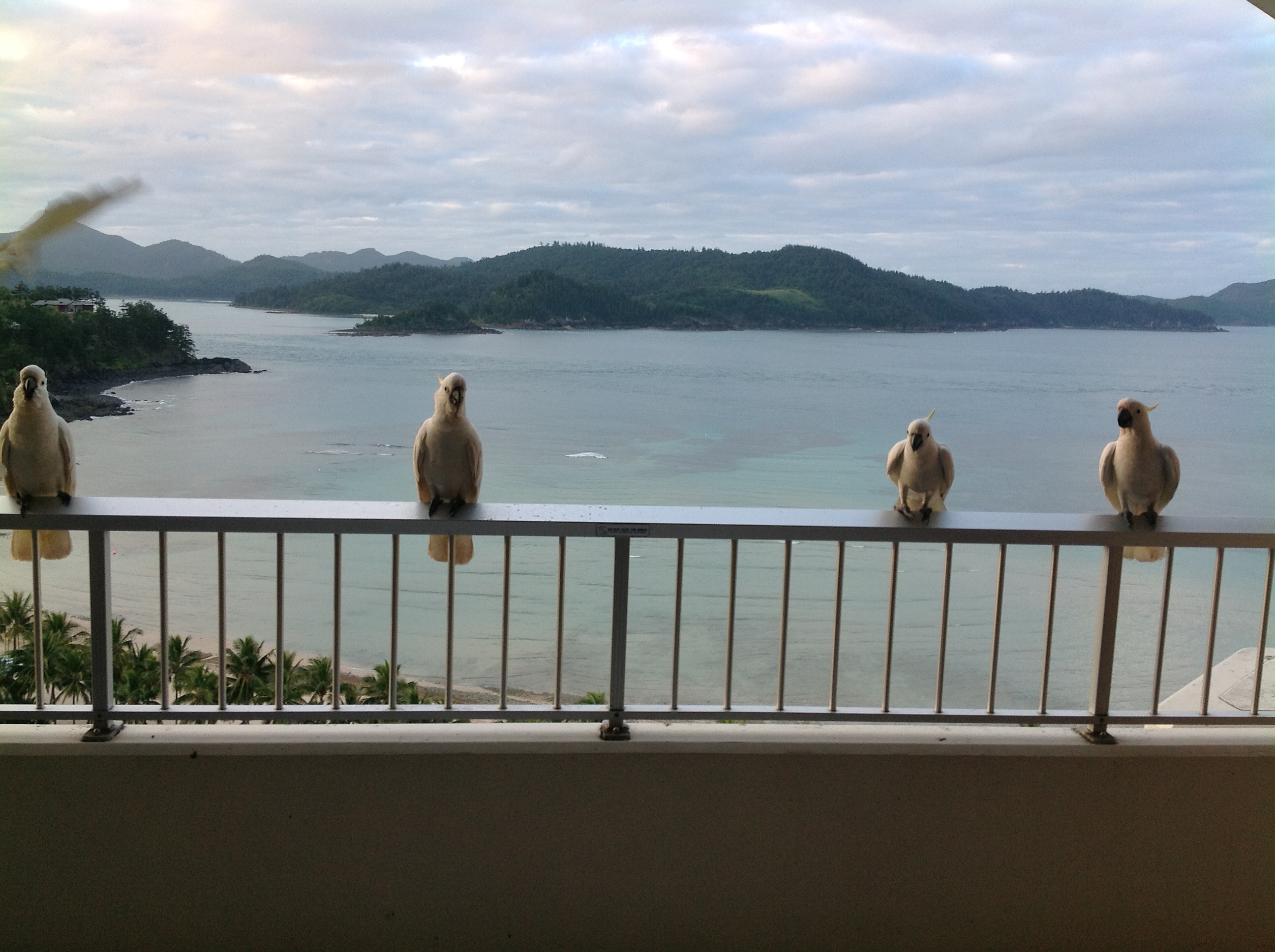
    Cockatoos looking for food, Hamilton Island
    Cockatoos looking for food, Hamilton Island

    We are fortunate in Australia that we don’t have a great number of large menacing animals terrorising our neighbourhoods. Sure dingoes, crocodiles and sharks may be scary but you don’t often come across them, and our most dangerous animals are more likely to be small and quiet and sneak up on you, like our spiders, snakes, jellyfish and ticks. There are no sounds associated with these to give you a warning.

    That’s not to say there are no scary sounding animals. Any sound, if you don’t know what is making it, has the potential to be scary; as in this 99-word flash (memoir):

    Awakened suddenly, I didn’t dare breathe. The sound was unrecognizable: guttural, movie theatre loud in surround sound. I sat up. The sound continued. I wasn’t dreaming.  I nudged Bob. No response. Gripped with fear but needing to know, I tiptoed to the window and peeked through the curtain slit. I expected to see The Creature from the Black Lagoon. There was nothing. Now it came from the front, inside the house? My son! I tore down the hall. He slept peacefully! Back to the bedroom. Bob awoke. “Did you hear that?” he asked, wide eyes staring . . .

    The following day I phoned the Queensland museum and attempted to explain what I heard. The fellow at the other end of the phone mimicked the sound exactly!! He identified it as a male brushtail possum warning others of its territory. These possums are very common in our area and I was amazed that I hadn’t heard this particular sound before. I hear it frequently now as every night they are moving about in the neighbourhood trees and running along our fences and roofs. I have never again heard it at the intensity of that first time, and now that I know what it is, it is no longer scary. In fact, possums are rather cute, as long as they are not living in your roof, eating the produce of your garden or stealing your Christmas puddings!

    This video gives a hint of the brush tail’s sound I heard:

    Another sound that I found quite unnerving at the time of first hearing was that of the mutton birds in the still of the night while we were holidaying on Heron Island, just off the Queensland coast at the southern end of the Great Barrier Reef. I had always thought the cry of the curlew to be quite eerie, but it didn’t match that of the mutton birds whose cry was more like that of the banshees.

    I have written about this frightening experience in the following 99-word flash (memoir):

    The boat tossed mercilessly. I battled to contain my insides while all around were losing theirs into little paper bags offered unceremoniously to obliging staff.

    Finally, just before landfall, I joined in. Then it was over – for me. Bob’s queasiness laid him up for the night; but I went to tea.

    The path back to the cabin was unlit but for a splash of moonlight. Suddenly horrific wailing assaulted my ears. Was Bob being murdered? I hurried back. He was fine, but the eerie sound unsettled us far into the night.

    In the morning we laughed: mutton birds nesting!

    I was fortunate to have not tripped and fallen as the mutton birds nest in burrows and these were dotted all over the island! Of course, once the source of the sound had been identified, we were no longer concerned.

    While my two snippets of memoir don’t fit Charli’s criterion of fiction, they are about sound and I have used them to point to the power of education to change one’s situation. When the source of the sound was unknown, it was frightening. Once we knew what it was, it was no longer scary.

    Knowledge is power. There is a saying, “What you don’t know won’t hurt you” but there is also another that says “What you don’t know won’t do you much good either”. I have written about this previously here.

    Conspiracy theorists believe that those with power withhold knowledge from the masses (e.g. aliens are among us); but I believe that schools that favour test marks over individual development; content over creativity and critical thinking; and conformity over diversity are conspiring to contain the masses. One of the easiest ways to suppress and maintain control over others is to keep them ignorant. I am not suggesting that schools keep students ignorant, but they could do a lot more to maintain children’s natural enthusiasm for learning. I look forward to sounds that will herald positive changes in education.


    I value your feedback. Please share your thoughts about any aspect of this post.


  • The best of days

    school cropped

    It is often said that school days are the best days of our lives.

    Considering that I have had far more days at school than not (as student and teacher) then I should probably agree, else I’d be saying that most of my days haven’t been the best.

    For many adults it is not the in-class time that is most memorable or of which they have the most pleasant memories, it is the playtimes and the before and after walking to and from school times.

    For some children, the in-class time drags while they daydream of long summer holidays and activities with family and friends. Other children thrive with the structured learning, soaking up everything offered to them.

    19178-School-Building-Graphic

    In her post, School: A Suitable Place for Fiction? Anne Goodwin wrote that she is ‘always pleasantly surprised when children these days claim to enjoy school’. On the other hand, in a comment left on previous post here, Lori Schafer said that all her life she had ‘failed to understand why most children don’t like school. Why don’t they enjoy learning, and why don’t they enjoying studying, and why don’t they enjoy writing papers? Because, of course, there are a small percentage of us who do genuinely appreciate the discipline of schooling.’ She was one of them.

    In his post, School’s Out – and Education’s In, Geoff Le Pard said that ‘People confuse school with education, as if they were synonymous’. (I have written a poem to express differences I see between education and schooling. You can read it here.) He goes on to say that ‘education is a constant, not a time limited schooling experience’ and disagrees with the cliché that school days are the best. He says that ‘all those days and bits of days when learning occurs make up the best days of your life’. I agree with Geoff that learning new things, particularly things one has an intrinsic motivation to learn, gives great joy.

    Irene Waters said in her post about school that she loved her primary school days. As the end of her high school years approached, unable to see the point in continuing, Irene wanted to leave and start her nursing career. Her parents convinced her to stay and finish year twelve. While she didn’t at the time, she now appreciates the value in having done so and is grateful that her ‘parents laid down the law’.

    Talking about education and schooling is nothing new for me, that’s what my blog is about after all. However for a lot of people, once finished, school is a thing of the past and not much thought is given to it later. The reason why so many others are talking about it this week is the flash fiction prompt set by Charli Mills at the Carrot Ranch. Each week Charli challenges writers to pen a 99 word story about a particular topic. This week her topic is school.

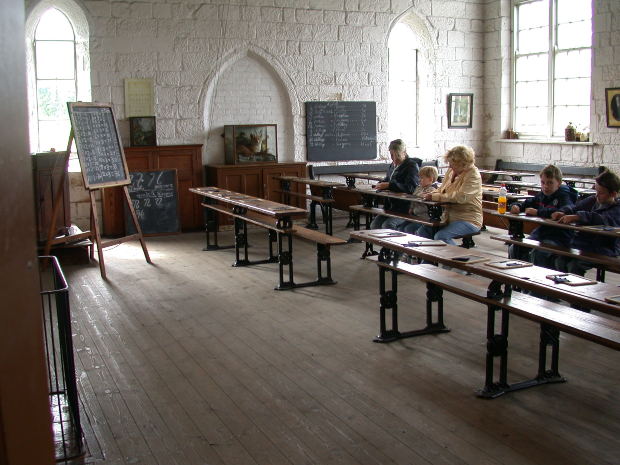
    old school room

    In her post, Charli describes an abandoned one-room schoolhouse that is close to her home. She explains that these schoolhouses ‘were often among the first structures built by pioneers’ and comments on the importance that was placed on education in those pioneering days. Indeed education has been important throughout the history of humankind. It is what sets us apart from other creatures.

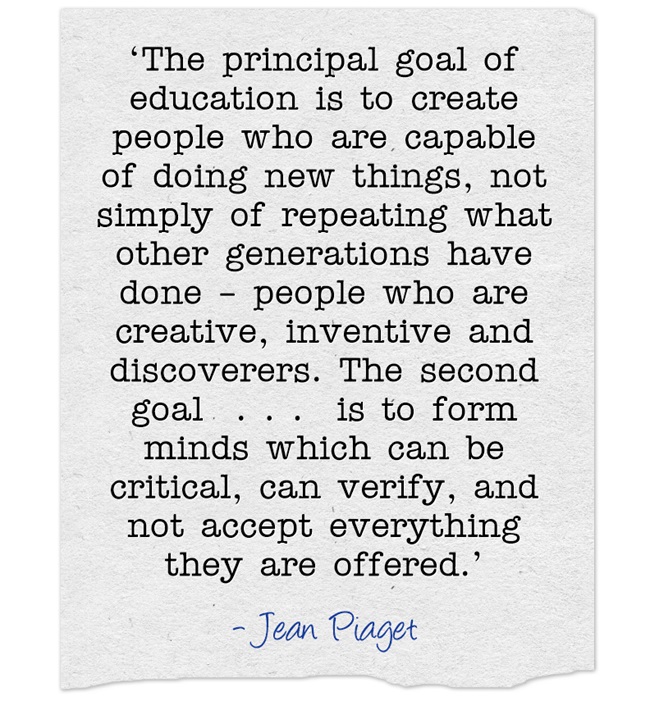
    In the words of Jean Piaget,

    The-principal-goal-of education - Piaget

    I have touched on these aspects of education in previous posts and will definitely do so again in future posts.

    In a tweet Anne Goodwin hinted that she thought I may find this post difficult to write as I have so many options to choose from. Charli Mills thought I might mention how we wrote on slates when I was at school (my children would probably have suggested I write about using dinosaur bones to scratch crude messages in the sand!)

    Instead, I thought about the strategies schools use to create uniformity, and of the many pathways that one may take through life after finishing school.  I hope the analogy makes sense to you.

     teacherbell

    Chocolate balls

    The final school bell tolled and the students erupted from the building like a burst box of chocolate balls, scattering in every direction and at varying speeds. Some stuck together along pathways safe and sure. Others crashed and bumped over roads less traveled seeking excitement, new discoveries and secrets to explore. Others stopped abruptly, their journeys foiled by stubborn obstacles. Still others, rolling upwards, failed to maintain the momentum to carry them over and beyond with those more adventurous others.  

    Who would know?

    Inside the box, they were identical, centers hidden. Outside, their uniqueness was on show.

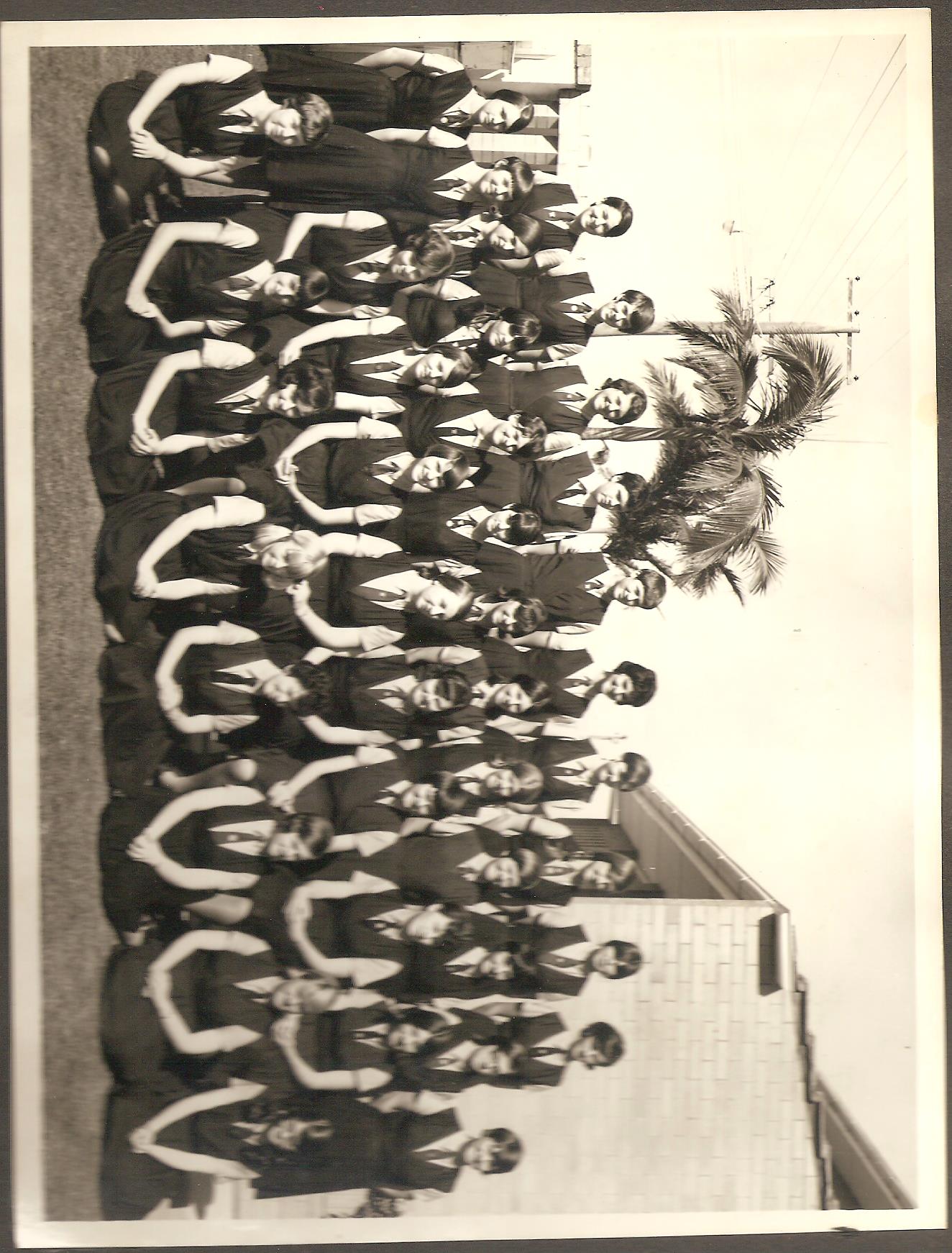
    My year 10 class - only 20 went on to year 12.
    My year 10 class – only 20 went on to year 12.

    I value your feedback. Please share your thoughts about any aspect of this post.

  • Motivation – why we do the things we do

    Over at the Carrot Ranch this week Charli Mills is talking about motivation, specifically the motivation of fictional characters to do the things they do. She explains that ‘motivation can be external–a desire to please, to be found attractive, to be accepted’ or ‘internal–a drive to succeed, a passion to experience adventure, a fear of failure’.

    Motivation is not a new concept to this blog and I have explored it in a number of previous posts.

    stars

    In What did you do that for? Rewards and motivation I discussed the use of extrinsic rewards (such as stickers, awards and cash incentives) for school students; and questioned the authenticity of intrinsic motivation, which ‘is usually related to something of one’s own choice through interest, challenge or purpose’, in an institution at which attendance is compulsory.  I suggested some strategies that teachers may employ to stimulate an intrinsic love of learning.

    why am I doing thiswhat's the point

    Continuing the consideration of the effect of compulsory schooling on a learner’s motivation, the post Why do I have to? explored the use of philosophy as a tool for making the goals of education explicit. All three philosophers: Peter Worley, Michael Hand and Stephen Boulter agreed that if students knew why they were expected to learn certain things, they would be more motivated to do so.

    the examined life

    A discussion of the impact of praise upon a learners’ motivation and achievement was stimulated by reading The Examined Life by Stephen Grosz, a book recommended by Anne Goodwin.  The Post Seeking praise – Stephen Grosz revisited explored Grosz’s suggestion that praise could cause a loss of competence, especially if children were being praised for being clever. Responses to the post, including a guest post by Anne Goodwin, added greater depth to the discussion.

    Other ideas about motivation abound.

    https://openclipart.org/image/800px/svg_to_png/59389/happy_sun_gm.png
    https://openclipart.org/image/800px/svg_to_png/59389/happy_sun_gm.png

    Shelley Wilson’s blog Live every day with intention,  which promises to inspire and motivate you (‘A motivational blog about living life to the full, writing, reading and feeling inspired to follow your dreams’) is the basis of her new book ‘How I changed my life’.

    In this TED talk The puzzle of motivation, Dan Pink explains that the value of intrinsic motivation is a scientific fact. While the focus of his talk is the business world, the findings are equally relevant to education. He says that external rewards may work in limited situations but that they often impede creativity. He says that ‘the secret to high performance isn’t rewards and punishments, but that unseen intrinsic drive – the drive to do things for their own sake. The drive to do things because they matter.

    Which brings me back to my motivation for writing this post and sharing these thoughts: Charli’s post, mentioned at the beginning of this article, was an introduction to her flash fiction prompt to In 99 words (no more, no less) show the underlying motivation of a character.

    My motivations for engaging with the flash fiction challenges set by Charli are both intrinsic and extrinsic:

    I enjoy:

    • the dual challenges of writing to a prompt with a clearly defined word count;
    • the opportunity of writing fiction;
    • exploring the application of Charli’s prompt, however tenuous, to education;
    • the camaraderie of the fellow writers and the opportunity to read and comment on their posts and flash fiction pieces; and

    I appreciate the feedback, support and encouragement I receive in response to my writing.

    In her prompt, Charli suggested that the character ‘may not even understand the motivation fully, but (that I should) let the reader grasp it.’ I have written two pieces in response to this prompt. I hope you enjoy them, and get an inkling of what motivates the characters.


    More than numbers

    The more he stared at the numbers the less sense they made.

    They swirled and blurred. He just didn’t get it.

    “Numbers don’t lie,” they’d admonished.

    “But they don’t tell either,” he’d thought.

    The hollowness left when all he knew had been extracted could not be filled with the smorgasbord of numbers loaded on the page.

    The richness of lives reduced to mere squiggles.

    “This is what’s important,” they’d said, fingers drumming tables of data.

    With heaviness of heart he closed the book and walked away.

    “They are not even numbers,” he thought. “If they were numbers, they’d count!”


    More than words

    “More!” they implored.

    She surveyed their eager faces then glanced at the clock.

    “Just one more?”

    “Okay. Just one more.”

    Before she could choose, a book landed in her lap.

    “This one,” he said.

    “Yes,” they chorused. “It’s a good one!”

    She smiled agreement, then started to read.

    They joined in, remembering, anticipating.

    She turned the page.

    “Wait!” he said. “Go back.”

    “Did you see that?” He pointed to the page.

    “But look what he’s doing,” someone else chimed in.

    They all laughed.

    The shared joy of a beloved book. Each time the same. Each time a little more.

    Thank_you_pinned_note

    Thank you for reading. I do appreciate your feedback. Please share your thoughts about any aspect of this post or my flash fiction pieces.

  • Just imagine . . . the power of imagination

    Have you ever wished you could:

    • be in two places at once?
    • clone yourself to ensure you get everything done?
    • slow time down so that you could achieve all you wanted?
    • make time stand still so you could stay in the present moment forever?
    • pop back in time to undo that embarrassing moment, or peek forward to see the result of a decision that is pending?
    • choose both options and follow each through consecutively, as in parallel universes?

    I have.

    https://openclipart.org/image/800px/svg_to_png/194578/07-Juli-goin-on-a-summer-holiday.png
    https://openclipart.org/image/800px/svg_to_png/194578/07-Juli-goin-on-a-summer-holiday.png

    Multiple invitations or engagements often occur on the same date. Deciding between desired activities is not always easy. Cloning would make choosing unnecessary. Additionally, sending a clone to an unpleasant but unavoidable engagement could also be desirable.

    penguins

    Sometimes the number of must-do tasks can be overwhelming. The ability to engage the assistance of clones, especially to complete less desirable tasks would be great.

    Time travel, wormholes and parallel universes are the stuff of science fiction; and while I am not a fan of the science fiction genre, I wouldn’t mind having access to some of its features. However, whether any, or which, of those features ever move from science fiction to science fact remains to be seen.

    The power of imagination to drive creativity and innovation cannot be overstated. Much of what we now accept as commonplace was once a part of science fiction. Imagination, the stuff of science fiction and scientific exploration and investigation, has brought them to reality.
    You are probably familiar with following quote, initially attributed to George Bernard Shaw but also made famous by Robert F. Kennedy:

     “Some men see things as they are and say why. I dream things that never were and say why not.”

    These words highlight the importance of questioning to stimulate imagination, and when paired with creative thinking, innovation can occur.

    Einstein said that,

     “Imagination is more important than knowledge. For knowledge is limited to all we now know and understand, while imagination embraces the entire world, and all there ever will be to know and understand.”

    He also said that,

     “Education is what remains after one has forgotten everything he learned in school.”

    Although I cannot be certain, from those quotes, what Einstein’s attitude to the current trends in schooling would be (he did attend school and was very advanced in maths and sciences but did not perform so well in the humanities) I think he would not favour a content-driven curriculum which excluded opportunities for imagination and creativity.

    On the other hand, Thomas Edison, the world’s most prolific inventor, was mostly educated at home by his mother who was able to encourage his experimentation and love of learning. He said,

     “To invent, you need a good imagination and a pile of junk.”

    If these significant thinkers of the 20th century, each of whom followed different educational pathways, recognise the importance of imagination, why would anyone argue against it?

    Charli Mills at Carrot Ranch Communications certainly doesn’t. As a fiction writer she embraces imagination. It is the tool of her trade, creating stories where before there were none. This week her challenge is to In 99 words (no more, no less) craft a multiverse situation, setting or character(s)

    Now the term ‘multiverse’ takes me back to the science fiction genre: wormholes, parallel universes and time travel, for example. I’m not sure how well I’ll do with this unfamiliar genre, but I will call upon my imagination and give it a try. See what you think – does my piece fit the criteria?


    Clone Magic

    Clone magic

    All night Leone had huddled in line, sleepless with excitement, waiting for the release.

    Now she had them! Clone pills!

    ‘Take one with water. Cloning occurs in 30 minutes and lasts 24 hours.’

    Leone swallowed one tablet, then another, and another; ignoring the small print: ‘Do not take multiple tablets. Effects are unpredictable.’ 

    When three clones appeared she instructed:

    “1. Clean the house. 2. Exercise. 3. Weed the garden.”

    She flopped on the couch. “Now to read.”

    But — their hands grabbed for her book, pulling her hair and clawing her eyes.

    “Me read! Me read! Me read!”


    Thanks for reading. I appreciate your feedback. Please share your thoughts about any aspect of this article or my multiverse flash.


  • Reading is all it’s cracked up to be: 10 tips for an early childhood classroom!

    This post almost didn’t get published. It almost fell through a crack into the never-never. But just in time the safety net sprang into action and saved it from obscurity.

    That may matter more to me than it does to you, but as an educator I hear too often about children who ‘fall through the cracks’, who fail to thrive in the school system, who miss out on the inspiration and timely support that would empower them on their journey to life-long learning.

    Like those children, this post was an also-ran. It didn’t quite get it, didn’t quite reach the expectations. But then I read something that confirmed for me the importance of sharing my message.

    You see, the love of reading is contagious. It can be caught from anyone, anytime.

    However, it can just as easily be extinguished; and the danger of that happening seems to be lurking in school systems packed too tight with lists of must do, must learn and must achieve expectations.

    I consider it imperative that teachers prioritize time for children to develop a love of literature and reading that will expand their horizons and create a worthwhile companion on the journey of their lifetime.

    https://openclipart.org/image/800px/svg_to_png/174860/bookworm_penguin.png
    https://openclipart.org/image/800px/svg_to_png/174860/bookworm_penguin.png
    Here are 10 easy tips for keeping the love of books alive in an early childhood classroom:
    1. Read aloud to children every day, ensuring that a variety of books and genres are being read and shared.
    2. Have a great supply and variety of children’s books available: picture books, fiction and non-fiction, collections of poetry, beginning chapter books, funny books, sad books, books about animals, space, people . . .
    3. Display books with covers facing out and give them pride of place. Make a display of ‘favourite reads’.
    4. “Sell” books to children (you won’t have time to read them all) by showing the cover and some illustrations; by telling what they are about, what happens, and what the children will enjoy about them.
    5. Make a reading corner with carpet, pillows and bean bags that invites children to get comfy while they read.
    6. Provide time for children to choose and read independently.
      • This can occur during quiet times set aside on a daily basis in which everyone, including the teacher, reads for 10 – 15 minutes. e.g. D.E.A.R. (drop everything and read) or U.S.S.R. (uninterrupted silent sustained reading).
      • It can also be integrated into reading group or literacy centre activities.
    7. Share the enthusiasm for books by providing time for children to excite each other about the books they are reading in a sharing circle.
    8. Display books written by the children and allow access to them for independent choice. Include them in the sharing and ‘selling’ sessions also.
    9. Make a time to visit the school library for reading and borrowing.
    10. Invite other adults to the class to read to the children e.g. teacher-librarian, administrators, support personnel, parents and grandparents.

    Let me know in the comment box a favourite tip of yours.

    This week I have read some fabulous posts by teachers who are making sure there is time for joy and independent choice in their literacy classrooms. I will share these with you below.

    The article that convinced me to share my thoughts was one that was not so joyful.

    Written by Alexander Nazaryan, a first-year teacher, the article appeared in the Opinion Pages of the New York Times on July 6, 2014. He talked about not being able to meet the needs of his students and explained that it was not the fault of the students though, the fault was that they were mostly of poor and immigrant families.

    He felt that asking these students to write about their own experiences did not have ‘the pedagogical value of a deep dive into sentence structure or a plain old vocab quiz.’

    I was immediately struck by the similarity of a statement made to me by my son’s teacher thirty years ago. At the time I was leading an in-service workshop about teaching writing. I would have been talking about ways of engaging students in the writing process by giving them opportunities to write at length about things of interest to them; by encouraging the writing of a first draft to get the ideas down; by providing opportunities for redrafting, rewriting and editing; and opportunities for feedback by sharing their writing with peers; and by making the most of teachable moments through individual conferences with each student.

    This teacher exclaimed that there was no way the children would be able to write anything of length as not one knew what a paragraph was, or indeed what a sentence was. The students were ten years of age and in their fifth year of school. I believe the statement to be more an indictment of the teacher’s inability to appreciate what the children could do, rather than an accurate estimation of their abilities. I knew for a fact that at least one student was more than capable of writing at length with a variety of sentence structures and correct paragraphing. I was certain he wasn’t the only one.

    I am inclined to agree with Nazaryan that ‘Expecting children to independently discover the rules of written language is like expecting them to independently discover the rules of differential calculus.’

    However trying to teach the skills of literacy through a barrage of meaningless drill and practice exercises in a joyless classroom is doomed to failure, and the children, sadly, will fall through the cracks.

    What the children need, in my opinion and unlike that of Nazaryan, is a balanced approach. The skills of literacy need to be taught in a meaningful context.

    That article and others, like this one from HuffPostParents about a year one girl who had to sit on the floor for weeks while her classmates sat at desks make me want to cry.

    However it is not all bad, and there are some wonderful things happening.

    Below are links to posts by or about teachers who are being far more inspirational to their students and other teachers on a daily basis.

    very inspiring blogger

    Tracking back to my post of July 9 The Very Inspiring Blogger Award (nominated by Geoff le Pard) I hereby nominate them for A Very Inspiring Blogger Award:

    Vicki Vinton, blogging at To Make a Prairie

    Matt Renwick at Reading By Example

    This article by Brett Vogelsinger and posted on the Nerdy Book Club

    Steven Peterson at Inside the Dog

    Julianne at To Read To Write To Be

    Carrie Gelson at There’s a Book for That

    Used Books in Class

    Three Teachers Talk


    This brings me back to the reason that got me thinking about cracks, and children falling through the cracks in the first place. This week’s flash fiction prompt set by Charli Mills at Carrot Ranch Communications was to In 99 words (no more, no less) write a story that involves a crack. 

    Here’s my response:

    The Crack

    She willed the earth to open up and swallow her whole. But it didn’t. She just stood there trembling, attempting to hold back the deluge that threatened to engulf her.

    She strained to remember, knocking her head with her fist. Quick. Try. Try. What’s the rule: i? e?  

    She stammered an answer.  Wrong again!  Too many rules! Stupid rules! Broken – just like her.

    She fled, eyes stinging, mouth twitching; and as she passed, with one hand grasped the confiscated unicorn sitting askew the teacher’s desk.

    Away they flew, the assault of mocking laughter fading far below.


    Thanks for reading. I appreciate your feedback. Please share your thoughts about any aspect of this post, including my flash piece.