Live Love Laugh Learn … Create the possibilities

Category: Flash fiction

  • All in the family

    https://openclipart.org/image/800px/svg_to_png/20496/CoD-fsfe-calendar.png
    https://openclipart.org/image/800px/svg_to_png/20496/CoD-fsfe-calendar.png

    The nature/nurture debate wages constantly. Are we who we were born to be, or are we shaped by our environment to be who we are?

    To my untrained mind (I have no qualifications in psychology) it appears that who we become results from a mixture of each in combination with a dose of self-determination. Sometimes it can be difficult to separate the nature from the nurture. Are we that way because of genetics or because of the family environment in which we grew up?

    tweedles

    It is true that no two individuals, even siblings, experience identical environments. Even in the closest of families the differences can be as pronounced as the similarities; in interests, capabilities, personalities and attitudes as well as physical characteristics. Both similarities and differences can be used to argue equally well for nature or nurture.

    A paper published by NATSEM (National Centre for Social and Economic Modelling) in 2013 described a close link between education standards, employment and poverty, leading to social exclusion and disadvantage in Australia. It explained that lower education levels resulted in higher levels of unemployment, and therefore poverty, and that children living in poverty were at risk of not completing high school and of having poor nutrition. And so the cycle would continue.

    That is not to say that children living in poverty are doomed to continue doing so throughout their lives (we all know successful people who through their self-determination have pulled themselves up and out of the situation) but it may be much more difficult for them to achieve the levels of success that seem to come so easily to others in kinder circumstances.

    According to the Institute for Social Science Research at the University of QueenslandResearch shows that when schools, families and community groups work together to support learning, children tend to do better in school, stay in school longer, and like school more.” Commencing this year, the “Parental Engagement in Schools” project aims to discover what type of involvement best supports student learning and outcomes. Encouraging parents to be involved is another issue.

    While my general observations as a teacher, and those of many colleagues, support the notion of a connection between economic status and educational advantage, a paper recently released by the University of Bristol states that “Poorer parents are just as involved in their children’s activities as better-off parents”, and that “The findings support the view that associations made between low levels of education, poverty and poor parenting are ideologically driven rather than based on empirical evidence.

    Perhaps over-generalisations in this area are just as problematic as those that expect all family members to be alike. I think that, regardless of background, it is important for teachers to support all students to make positive choices for their future. This can be done through demonstration and modelling rather than criticism and blame.

    8-12-2013 7-38-33 PM

    I also recommend a certain set of strategies that all parents, regardless of their economic status, can employ to give their children a great start is life, including:

    • Love them
    • Talk with them
    • Read to them
    • Encourage their questions and curiosity
    • Help them seek answers and solve problems
    • Encourage their independence
    • Foster confidence, a willingness to have a go and to try multiple times and ways
    • Be accepting of differences and don’t prejudge their future based on the experiences and futures of others.


    https://openclipart.org/image/800px/svg_to_png/18499/Chrisdesign-Glossy-Smiley-Set-3.png
    https://openclipart.org/image/800px/svg_to_png/18499/Chrisdesign-Glossy-Smiley-Set-3.png

    The old saying goes that “You can choose your friends, but you can’t choose your family”. Although I have read suggestions that we may be genetically close/distantly related to those we choose as friends, I can’t testify to the authenticity of the “science” that makes those claims. However, I think many families have at least one member they would probably prefer to disclaim relationship with! Not my family of course!

    https://openclipart.org/image/800px/svg_to_png/30271/face-kiss.png https://openclipart.org/image/800px/svg_to_png/202307/Pink-Funny-Cartoon-Face.png
    https://openclipart.org/image/800px/svg_to_png/30271/face-kiss.png
    https://openclipart.org/image/800px/svg_to_png/202307/Pink-Funny-Cartoon-Face.png

    Which brings me to the flash fiction challenge set by Charli Mills at the Carrot Ranch this week. She wrote about an Aunt Bronco Billy and challenged other writers to: In 99 words (no more, no less) write a story that includes a nutty aunt.

    I hope I’m not that “nutty aunt” that everyone in the family shies away from, but I am aware of some who are. (Again, not in my family!)

    Here is my response to Charli’s challenge. I hope you enjoy it.


    “Aw, Muuuum!”

    “Don’t ‘Aw Mum’ me. She’s your dad’s only sister . . .”

    “But Mum …” I could already smell her stale cigarette breath and feel the stickiness of her too-red lipstick that wouldn’t rub off.

    “It won’t hurt you. She’s not staying long.”

    “Why can’t Jason?”

    “Because Jason’s going to work,” she said.

    “Yeah, Squirt,” grinned Jason, throwing his backpack over his shoulder.

    “Smoochie Coochie,” he mocked, squeezing my cheeks into a pucker while making loud lip-smacking sounds. His laughter followed him down the street.

    Suddenly she was there with her sharp green pistachio grin.

    “Smoochie Coochie!”

    Smoochie Coochie


    Thank you


    I appreciate your feedback. Please share your thoughts about any aspect of this post or flash fiction.

  • In their own time

    This quote by Albert Einstein is one of my favourites:

    “The only reason for time is so that everything doesn’t happen at once.”

    https://openclipart.org/image/800px/svg_to_png/20496/CoD-fsfe-calendar.png
    https://openclipart.org/image/800px/svg_to_png/20496/CoD-fsfe-calendar.png

    Without the addition of a date to signify, I would find it difficult to separate out the memories and distinguish how far apart events occurred or in which sequence.

    If the “The only reason for time“ was applied to the school situation, it might be quite different, for example,

    “The only reason for time is to ensure that everyone is doing the same thing at the same time.”


    school cropped

    In previous posts I have talked about the importance of having a growth mindset and the power of ‘not yet’ thinking. Most respondents to these posts agreed on a preference for thinking about their own goals as not yet achieved, rather than as failed to achieve. Much like for a twelve month old child who is not yet walking, ‘not yet’ implies no failure, just steps in the right direction, an expectation of success, when the time is right and the child is ready.

    https://openclipart.org/image/800px/svg_to_png/20496/CoD-fsfe-calendar.png
    https://openclipart.org/image/800px/svg_to_png/20496/CoD-fsfe-calendar.png

    For many things we do in life there is no hard and fast rule about when they should be achieved. Most developmental milestones are presented as an average, a range of ages during which time most will achieve. But the edges are blurred and, unless attainment falls way beyond the guide, there is generally no cause for concern.

    When it comes to school learning there is much more anxiety about achievement and reaching particular benchmarks by certain ages. Anne Goodwin hinted at this is her comment on my post Reading is out of this world. Anne said,

    “we need to create the conditions in which children want to learn to read and to continue reading regularly. Sadly, I think some kids are put off by attempts to teach them to read before they are ready, which just gives the message that it’s hard or boring or both.”

    She said that we need ways to “get them in their own time, to where they need to be.”

    Anne is right. Children may be put off reading by attempting to teach them before they are ready; just as often, I would add, by inappropriate methods that present reading as a series of unrelated skills devoid of context, meaning and enjoyment.

    Children may come to reading at various ages and in various ways. Some read early. Mem Fox says that, if she were queen of the world, “children would learn to read easily, long before they came to school”, like my two did.  Others suggest a “better late than early” approach or not hurrying the child.

    I think it is important to recognise that a ‘one size fits all’ approach has no place in education. I would love Mem Fox to be queen of the world and for all children to learn to read easily and with joy before school age, but there is much to do for that ideal situation to exist. David Elkind says that no one believes in hurrying children but parents, educators and legislators can always find a reason to do so.

    Being out of step with peers can be a great cause of anxiety; and anxiety begets anxiety which further impedes learning, as shown in this presentation by Heidi Lyneham.

    To improve the situation for learners we need to recognise that

    • Learners learn in their own time. We need more flexible timeframes that honour each child’s development and learning journey.
    • Learners learn in ways that are as individual as they are. However there are conditions which improve the chances of learning occurring, such as these conditions for literacy learning  as proposed by Brian Cambourne.

    In her comment on my post Reading is out of this world, Nicole Hewes indicated support for this view by describing how she assisted a student’s learning by providing books about whales, a topic the student was greatly interested in.

    Along with the recognition of different timeframes, there must be recognition of and value placed upon the time required by students to develop the skills; and time and opportunity must be provided for that development.

    Just when I was writing this post, Bec, who loves to look after my reading and learning needs, sent me a link to this article by Pernille Ripp who asks,

    “Why do we forget that time to read is the one thing readers need the most to become better readers?”

    And then Charli Mills of the Carrot Ranch posted her flash fiction challenge for this week: In 99 words (no more, no less) write a 2 a.m. story.

    Time: everything was pointing in the same direction.

    Thinking of a learner’s timing being out of sync with that of others made me think about waking up in the middle of the night (say 2am) and not being able to get back to sleep; knowing that one should be asleep; that everyone else is asleep; that one needs to be asleep because there’s a “big” day head. And all the while the anxiety grows as quickly as the ability to sleep fades. Maybe you can identify?

    https://openclipart.org/image/800px/svg_to_png/19413/manio1-Digital-Clock-2.png
    https://openclipart.org/image/800px/svg_to_png/19413/manio1-Digital-Clock-2.png

    Wakefulness

    One moment deep asleep. Next, upright; breath still; ears intent; staining to hear above her pounding heart.

    Nothing. Just the familiar: fan whirring, palm frond swishing against the house.

    Must investigate: bravely, fearfully.

    With limbs trembling, palms sweating and mouth dry, she eases her legs out of the bed, puts her feet on the floor, pushes herself up and pads to the window.

    Peeking out she scans the yard, illuminated by the full moon.

    Nothing. A dream?

    She pads back to bed. 2am.

    “Ooh! Only three hours!” She closes her eyes, wishing hopelessly for sleep until morning’s liberation.

    Thank you

    Thank you for reading. I appreciate your feedback. Please share your thoughts about any aspect of this post or flash fiction.

  • Magnum opus – life in a flash


    Discussions in response to my most recent posts have been in-depth and involved a bit of back and forth and exchange of ideas about optimism, pessimism, meliorism and the meaning of life, including achieving goals and the idea of ‘not yet’. I am grateful to everyone who has joined in the conversation, got me thinking and contributed to my learnacy. Please may it long continue!

    This week at the new-look Carrot Ranch, Charli Mills continues to challenge writers with her 99 word flash prompt to In 99 words (no more, no less) write a life span.

    I decided to lighten up a bit this week, and simply respond to the challenge.

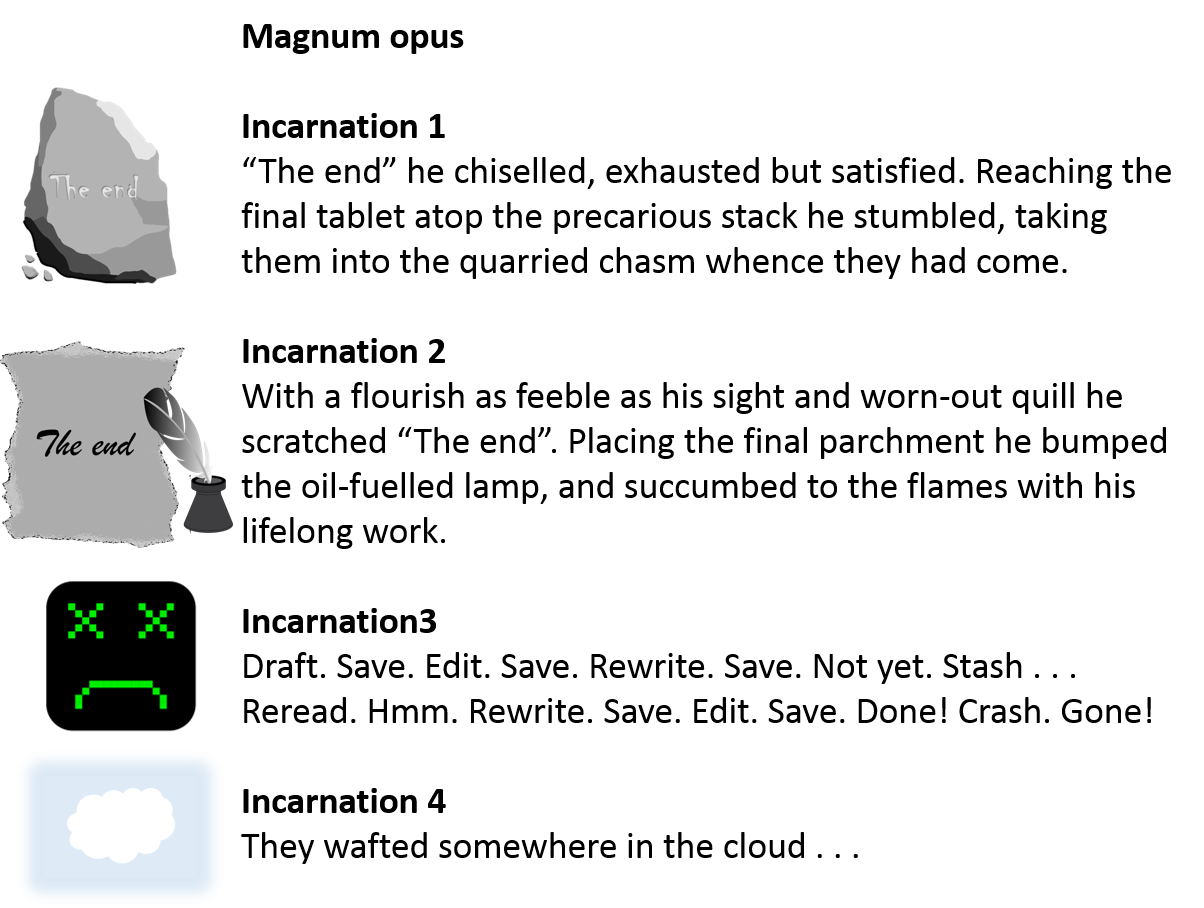
    Magnum opus

    Thank you for reading. I appreciate your feedback. Please share your thoughts.

    Thank you


  • Finding meaning

    Always look on the bright side of life’ is a philosophy to which I aspire. Many think I have achieved it but they don’t know how hard I struggle. I do try to find the good in people and situations, but it’s not always my first and instinctive reaction. When I realise I’ve reacted negatively I try to change or hide my negative thoughts and replace them with positive ones. But it’s not always easy to convince myself, regardless of whether I convince anyone else or not.

    It reminds me of a quote on a laundry bag which has stayed with me in eight different homes in three different states and for well more than thirty years. After all this support I have finally thought to seek out the source of the wisdom and found it to be UK poet and playwright Christopher Fry.

    bag

    I feel the quote represents me quite well; doing what I can to hold it all together and keeping those negative instincts in check by ‘nipping them in the bud’, all the while fearful of one day just losing it and letting it all out in one mighty swoosh. I guess the expectation of fewer years remaining in which I will need to keep myself contained makes me a little optimistic. (Always look on the bright side!)

    I like to think I’m more of a hopeful realist than either a Pollyanna or a negative realistic. A discussion about optimism and pessimism followed a previous post in which I asked How much of a meliorist are you?  But meliorism is more a belief that the world can be improved by the actions of humans than an optimistic or pessimistic expectation of the outcome.

    I believe that humans have an amazing potential for improving our world (i.e. every aspect of it). That makes me a meliorist. Recognising what is happening in the world now makes me a realist. A belief that human actions will make improvements in the future makes me an optimist, but not one without some pessimistic fears. While stories of terrorism, climate change and violence fuel the fears, stories like this TED talk by Tasso Azevedo show that improvements can be, and are being, made.

    I am an education meliorist. I believe that education is a powerful agent for change and has an enormous potential for improving lives. My optimism that education will impact positively upon individual lives as well as the collective human situation outweighs my pessimism about the outcomes I see in current systemic trends and leads me to seek out educators, like Ken Robinson, Chris Lehmann , Michael Rosen, Barbara Arrowsmith-Young and Rita Pierson who share my vision of what could be.

    A quest to improve my own life and the lives of others through education has been a long time passion. Ensuring that my own children experienced the benefits of learnacy, though I hadn’t heard of the term at the time, as well as literacy and numeracy was of great importance to me. I encouraged them to question, to create, to think critically, to read, to learn, to wonder . . .  There is so much we teach our children the list goes on. It is very rewarding for me to see that they have a love of learning and are passing that same love on to the next generation.

    Having, sharing and fostering a lifelong love of learning perhaps in some ways contributes to giving meaning to my life. But it also leads me to question life and its purpose in ways that many others don’t.  This questioning can lead to a sense of unease, of lacking fulfilment, of needing to do and achieve more. I know others who better accept the way things are, accept each day as it comes, and are content in their existence. Sometimes I envy their complacency.  Other times I want to shake them and make them realise that there is more to life than this.

    But am I wrong? Is there actually less to life than this? It is sometimes said that there is no point in accumulating wealth and possessions as you can’t take them with you when you go. But is there any point in accumulating a lot of learning and knowledge? After all, you can’t take it with you when you go either; but like wealth and possessions, you can leave it behind for future generations. If we lived only for what we could take with us, would there be a point?

    I guess what matters is what helps each of us reach that level of contentment, of being here and now in the present moment because, after all, it is all we ever have.

    I often think about life, existence, why we are here and the purpose of it all, constantly wavering between seeing a point and not. A recent discussion with a friend about her feelings of emptiness and needing to find more purpose and meaning in life disturbed my approaching, but elusive, equilibrium again. Will I ever reach that blissful and enviable state of contentment: knowing and accepting who I am, where I am, where I am going and how I am going to get there? Who knows? But I can have fun figuring it out. I am determined to enjoy the journey. I don’t think there will be much joy at the end!

    Which is all very timely with the current flash fiction prompt set by Charli Mills at the Carrot Ranch who talks about actions that we take to reach our goals and challenges writers to In 99 words (no more, no less) write a story that describes a moment of being.

    I hope you enjoy my response.

    Being, positive

    “It’s positive,” he said.

    She smiled. She knew. She only needed official confirmation.

    He wanted dates. She supplied.

    But she knew the very moment an unexpected but welcome spark enlivened her being with its playful announcement, “Surprise! I’m here!”

    She’d carried the secret joy within her for weeks, never letting on, keeping it to herself, waiting. No one would have believed her without proof. But with her whole being she knew.

    Finally, after nine inseparable months, she held the child, distinct and individual. She marvelled at the tiny creation whose existence breathed purpose and meaning into hers.

    Thank you

    Thank you for reading. I appreciate your feedback. Please share your thoughts about any aspect of this post and flash fiction.

  • I can do this – one step at a time!

    Confidence, the willingness to have a go and to get up and try again after an unsuccessful attempt, is crucial to learning.

    Attached to real confidence, as opposed to false bravado, are certain types of knowledge:

    • of the desired outcome
    • of possible steps to achieving the outcome
    • of what is needed to achieve the outcome
    • of where and how to find the knowledge or support necessary to achieve the outcome

    and an openness to possibilities.

    Knowing what one doesn’t know is just as important as knowing what one does!

    www.openclipart.com
    http://www.openclipart.com

    Caroline Lodge expressed a similar view on her blog just this week, confessing that she didn’t know how to go about revising her novel, but that she did know what to do about not knowing: she enrolled in an online editing course. She attributed the view of intelligence as “knowing what to do when you don’t know what to do to the educationalist Guy Claxton.

    I wasn’t aware of Claxton but he sounded like my sort of educationalist so I decided to investigate further.

    https://openclipart.org http://goo.gl/ZvsCFc
    https://openclipart.org
    http://goo.gl/ZvsCFc


    A Google search brought up this result:

    Claxton - Google

    Hmm – seems like, according to Claxton, that definition of intelligence is first attributed to Jean Piaget. I’d better read his article: Learning to learn: a key goal in a 21st century curriculum.

    I didn’t have to read far into the article before I knew that Caroline had sent me in the direction of another great educator (thanks Caroline).

    In the introduction Claxton says,

    “The well-rehearsed economic argument says that knowledge is changing so fast that we cannot give young people what they will need to know, because we do not know what it will be. Instead we should be helping them to develop supple and nimble minds, so that they will be able to learn whatever they need to. If we can achieve that, we will have a world-class workforce comprising people who are innovative and resourceful. The personal argument reaches the same conclusion.”

    I have expressed similar views previously on this blog, including here, here and here.

    A little further into the article Claxton introduces a new (to me) term: illearnerate. He described students not thinking of themselves as effective real-life learners. He says,

    “They think that school has not only failed to give them what they need, it has actually compounded the problem.”

    The term is new, but the thinking is not!

    He goes on to say that,

    “More fundamental even than the concern with literacy and numeracy is the need to protect and develop young people’s learnacy.”

    What great terms, illearnerate and learnacy, I have added to my vocabulary today!

    The steps I am taking are definitely enhancing my learning. I think I am learnerate.

    However, I digress. I was looking for the attribution to Piaget and, a little further into the article, there it was:

    Claxton - Piaget

    I looked further online for confirmation of the quote and found this on goodreads:

    Good Reads - Piaget

    I think there is a subtle difference in the interpretation given by Claxton and would say that intelligence is not so much defined by, but incorporatesknowing what to do when you don’t know what to do”.

    A few weeks ago I used images in my post Bring a plate that prompted Geoff Le Pard to ask,

    “How do you do the images? Adding the captions?”

    I said that I used PowerPoint and would post some instructions if he thought it could be useful. He said that it would be, and Anne Goodwin agreed.

    For some time I had been wanting to create an instructional video using a capture of what I was doing onscreen. However it hadn’t reached the top of my to-do list. This seemed the perfect opportunity to put it there and do the learning required.

    In response to Geoff’s request I made this video demonstrating how to insert pictures and text in PowerPoint, then group and save them as one image.

    For my first attempt I was fairly pleased with the result, though I fear the video may be a bit long at 10 minutes. Maybe I should have started with a simpler image – one picture and one text box may have been enough for the demonstration to be effective. I’d be pleased to know what you think.

    After I had finished the video it occurred to me that I may not have addressed Geoff’s question at all, that the combination of image and caption that Geoff was referring to may have been the image of the whole PowerPoint slide, like this one:

    Rice salad 2

    If so, then my first video would be of no use to Geoff.

    There is a saying attributed to George Bernard Shaw:

    “Those who can do, and those who can’t teach.”

    I both agree and disagree with the statement for different reasons. Teaching is an incredibly important profession and not everyone can do it. Looking beyond the profession to simply teaching someone a skill is also something that not everyone can do. Sometimes I think that the one most capable of teaching a skill is the one who struggled to learn it; not the one who was able to do it effortlessly and almost by intuition.

    The ability to teach requires knowledge of each step or each component and how they work together. This knowledge helps the teacher understand where a learner is confused or what the learner needs to know.

    So just as teachers in classrooms provide resources and strategies to cater for a range of needs and abilities, I have produced a second video demonstrating how to make an image of a PowerPoint slide. This shorter (five minute) video explains how to create images using three different methods: Snagit, Snipping Tool, and printscreen function. I hope I have explained the steps for each clearly.

    Important update: Do not do this at home. Do not follow the procedures in this video.

    Since viewing this post and videos my daughter Bec has told me of a much easier way to create an image of a PowerPoint slide, or of every slide in a presentation. Maybe you know of it too.

    Here’s how to do it:

    1. Click on the slide you wish to make an image of, or any slide if you wish to make images of all slides in the presentation
    2. Go to file, save as
    3. Choose Save as type: PNG
    4. Click Save – you will be asked which slides you wish to export: all or just this one
    5. Selecting all saves every slide as a separate image to a new folder with the file name you choose; selecting just this one saves only the slide selected.

    How easy is that? Thanks Bec. 🙂 And I don’t mind that I found out after making the video. I wanted to learn how to do that anyway, and now I have learned something else as well. Great steps in learning. I’m learnerate!

    The discussion of steps to learning tied in very nicely with the flash fiction prompt set by Charli Mills at the Carrot Ranch this week. Charli challenged writers to In 99 words (no more, no less) write a story about steps, stairs or a staircase.

    This is my response:

    If only

    She collapsed, exhausted. Stairs led up and stairs led down; some steep, some wide, some narrow, most dark. Her head spun and vision blurred. Which way now? Which way had she come? Had she been going up and down these stairs forever?  Going around in circles?  They all now looked the same. She didn’t even know if she’d been in this place before.

    “I’m trapped,” she thought. “Stuck here forever.”

    She closed her eyes, surrendering to despair.

    Outside birds heralded the rising sun. She was lost, oblivious of its promise.

    If only she had recognised the door.


    Thank you


    Thank you for reading. I appreciate your feedback. Please share your thoughts about any aspect of this post, including the videos and flash fiction.

  • Reflect and refine

    The end of a year is often used as a time for reflection, reassessment, and redefining goals. This week at the Carrot Ranch Charli Mills is talking just that: reflecting on the year that was, assessing her achievements and failures and redefining her goals for the next part of her journey. Charli admits that she didn’t achieve all she had hoped but acknowledges that those shortcomings were more opportunities for learning than failure as such. While she learned more about herself and her abilities she was able to recalculate her goals and redefine her vision.

    In education, failure is recognised as integral to learning.

    Willingness to

    • have a go
    • try something new
    • seek alternate solutions and ways of finding solutions
    • persist and not give up
    • recognise that success does not always come with a first attempt;

    these are effective characteristics of learners, innovators and creative people.

    Thomas Edison, after many unsuccessful attempts said,

    “I have not failed. I’ve just found 10,000 ways that won’t work.”

    There is no failure in a failed attempt; there is only failure in giving up.

    Again, to quote from Edison,

    “Many of life’s failures are people who did not realize how close they were to success when they gave up.”

    C.S. Lewis is also quoted as saying,

    “Failures, repeated failures, are finger posts on the road to achievement.”

    He says,

    “One fails forward toward success.”

    The-greatest-glory-in Ralph Waldo Emerson

    What helps that ability to rise again is a sense of where we are going, of what we are aiming for and what we want to achieve. This is often referred to as a vision, and it is a vision that Charli Mills has challenged writers to include in a flash fiction piece this week: In 99 words (no more, no less) write a story that includes a vision.

    Having a vision of the future and working towards that future is essential to effective teaching.

    As explained by Vicki Davis in her post Thank You Teacher for Your Presence on the Cool Cat Teacher blog, teachers are constantly preparing students for more independent and resourceful futures.

    Through learning from a mentor teacher Jackie Catcher was able to refine her vision for effective teaching, which she shared on Three Teachers Talk :

    “I learned that to lead students into our subject, we must make them feel valued within our community. We must work to acknowledge their strengths and show them that we are all equals when it comes to developing as readers and writers. We must praise their hard work and determination far more than their failures, and we must make ourselves available both in and outside of class to have meaningful conversations and connections. In the end, we are never too old to change our outlook and education. After all, one teacher can make the difference.”

    I constantly share my own, and others’, views about and vision for education on this blog.

    I-had-this-dream-Chris Lehmann

    Some of those posts are:

    Visioning a better school, a better way of educating

    Talking interviews

    Whose failure?

    Imagine that!

    Child’s play – the science of asking questions


    I have also referred to an alternative to traditional schooling that I “failed” to establish in the 1990s. The vision for that alternative was:

    “A dynamic centre of learning opportunities

    for children, families and communities

    which focuses upon the development

    of self-esteem and positive attitudes

    in a nurturing environment

    in which individuals are appreciated

    for their uniqueness and diversity

    while fostering the commonality of their human essence.”

    The-best-questions-are

    Which brings me to my flash fiction piece for this week. In it I attempt to draw together many threads from views expressed over the year and finish with an optimism for the future.


    The power of “No”

    It was grey.

    For as long as anyone could remember.

    They moved about, comfortable in the familiar, avoiding the unknown.

    Shadowy shapes beyond incited fear: a threat to all they knew?

    Lives lacked definition, blending to sameness, conforming to rules.

    “But why?” The tiny voice shattered the stillness.

    All eyes turned. Bodies stiffened.

    Whose was this unruly child?

    “Shhh!” the hapless parents failed to hide their offensive produce.

    “Why?”

    Again! No one moved.

    “Because!” was the parents’ definitive reply.

    They breathed. “Because!” they confirmed in unison.

    Defiantly the child pressed the dust-covered switch and flooded the world with light.


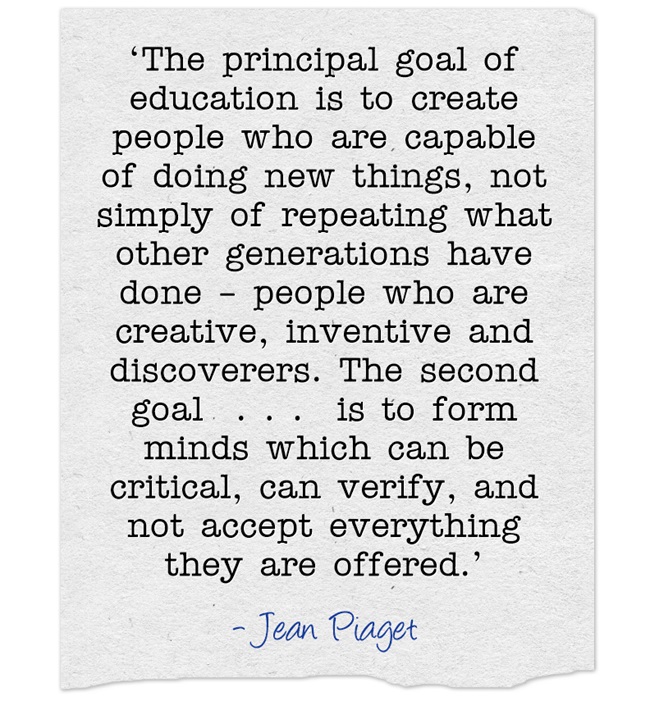
    The-principal-goal-of education - Piaget

    Thank you

    Thank you for reading. I appreciate your feedback. Please share your thoughts about any aspect of this post or flash fiction.

    I wish you success as your vision takes shape in 2015.

    HappyNewYear_by_Rones

  • It’s not fiction

    Most of my current writing is non-fiction with a strong focus on education. The two blog posts I publish each week generally address educational issues or share my thoughts about learning.

    In my ongoing work-for-self I develop educational materials and resources for parents, teachers and children. Some of these are available in my Teachers Pay Teachers store, and are listed on the Teaching and learning resources page of this blog.  My goal is to set up my own website on which all the resources I produce will be available.

    During my work-for-pay hours I am also involved in writing resources for teachers. Most of my published material, listed on the Writing – interest and publications page, is also educational.

    That is not to say that I am not interested in writing fiction. Over the years I have enjoyed writing in a variety of other genres including stories for children, short stories and poetry; and still do. They are just not my main focus at the moment. That may change in the future. Or it may not.

    One opportunity for writing fiction that I am very much enjoying at the moment is the weekly 99 word flash fiction challenge  set by Charli Mills at the Carrot Ranch.

    Initially my responses to Charli’s prompts were unsystematic. However it was not long before I was incorporating them into longer posts which maintained the educational focus of my blog. A recurrent theme is the importance for schooling to target the particular needs of individual children.

    Soon a character emerged: Marnie — a young girl, from a dysfunctional family, for whom school would be a threatening and meaningless experience without the support of a passionate and caring teacher. Sometimes, as with this week’s, the prompt inspires immediately and I write a story in which I hope that the message is strong enough for it to stand alone, without the support of a lengthier post explaining my thinking background.

    Here is this week’s response to Charlie’s prompt: In 99 words (no more, no less) write a story about rare gems. I’d love to know how successful you think I have been.


    glitch, trophy gem http://goo.gl/VEQVxM
    glitch, trophy gem http://goo.gl/VEQVxM

    Uncut gem

    She examined the new arrival, assessing the possible effects of integration into the existing collective. Would the group be enhanced or would this newcomer disrupt the established harmony?

    From every angle the edges were rough and uneven. The years of obvious neglect obscured the potential from any but a trained eye.

    Fortunately her eyes were keen. A bit of encouragement here, a little adjustment there, an opportunity to sparkle and display unique and positive attributes.

    She smiled. Experience had shown what could be achieved with a little polish and care.

    “Welcome to our class, Marnie,” she said.


    Thank you

    Thank you for reading. I value your feedback. Please share your thoughts about this post and flash fiction story.

  • A cute angel

    This week at the Carrot Ranch Charli Mills has set an angel prompt: In 99 words (no more, no less) write a story that features an angel.

    Usually I include my responses to Charli’s prompts in longer posts sharing some thoughts about education.

    This week I’m going to leave it as a stand-alone, without the padding I usually provide. I am hopeful that the educational issues I have alluded to will be as obvious to you as they are to me. I’d love to know what you think.

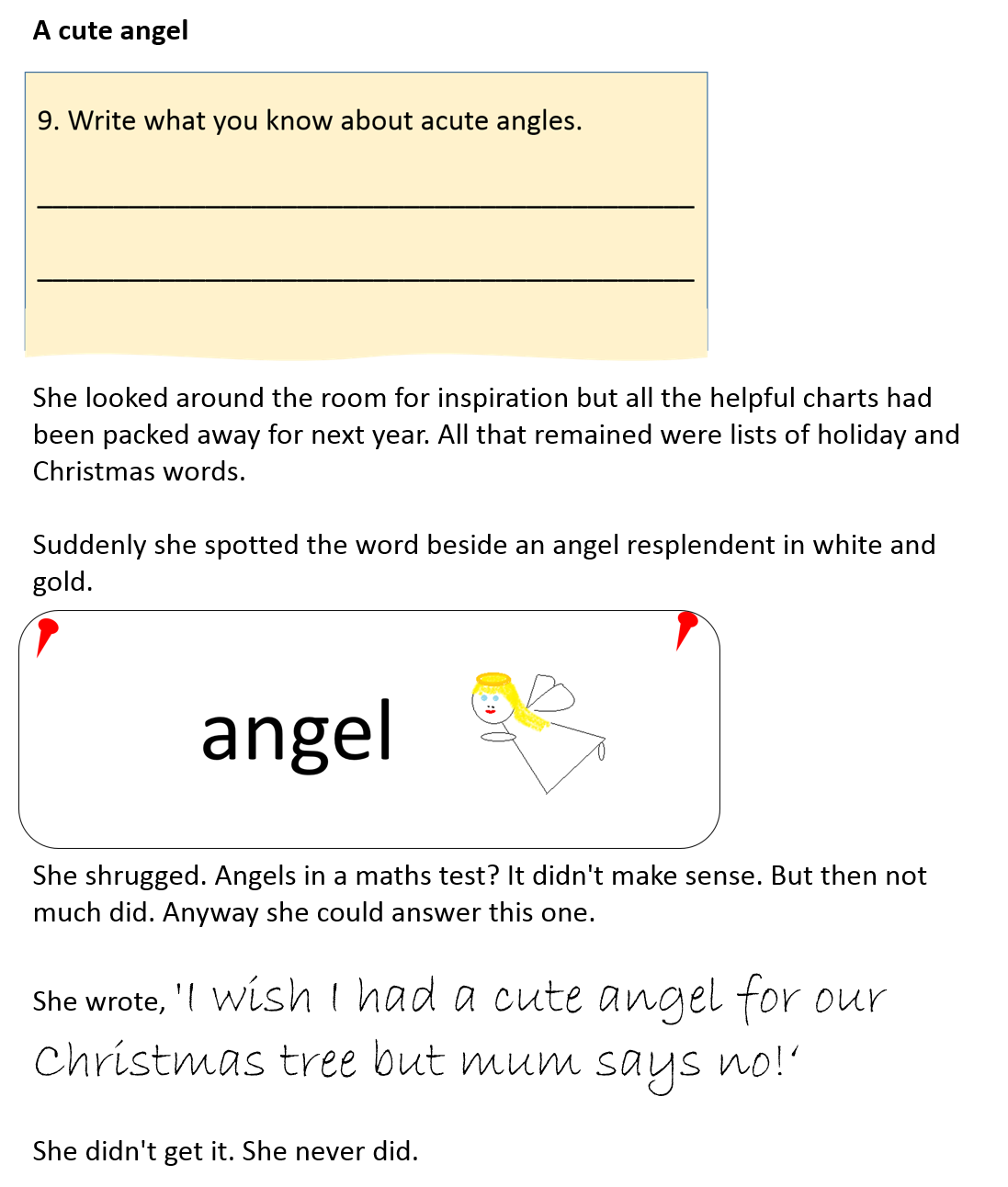
    A cute angel

    Thank you

    Thanks for reading. I appreciate your feedback. Please share your thoughts about this flash and what you consider its message to be.


  • I’m (not) dreaming of a white Christmas

    https://openclipart.org/image/800px/svg_to_png/59389/happy_sun_gm.png
    https://openclipart.org/image/800px/svg_to_png/59389/happy_sun_gm.png

    Last week the flash fiction prompt set by Charli Mills of the Carrot Ranch was to write a story using two objects, people or ideas that don’t go together. There was quite an assortment of responses, including mine. You can read them all here.

    This week Charli has continued in the same vein, challenging us to In 99 words (no more, no less) write a story that pairs something seasonal with something odd. 

    In Australia that’s easy. We’ve already got Christmas in summer. Most people around the world would say you can’t get much odder than that!

    www.openclipart.org
    http://www.openclipart.org

    But it is summertime in Australia and Christmas is just around the corner.

    While we enjoy warm days at the beach and in the pool, picnics in the park and barbecues in the back yard, hoping the big storm doesn’t get us this time (like the one that hit Brisbane on 27 November); those from whom we have inherited our Christmas traditions are cooling down in the Northern Hemisphere, many looking forward to a (not too) white Christmas.


    Shops here are playing traditional (northern) carols with snow, sleighbells and mistletoe; decorations are tinged with fake snow and cards show snowy scenes with families huddled around the fireplace.

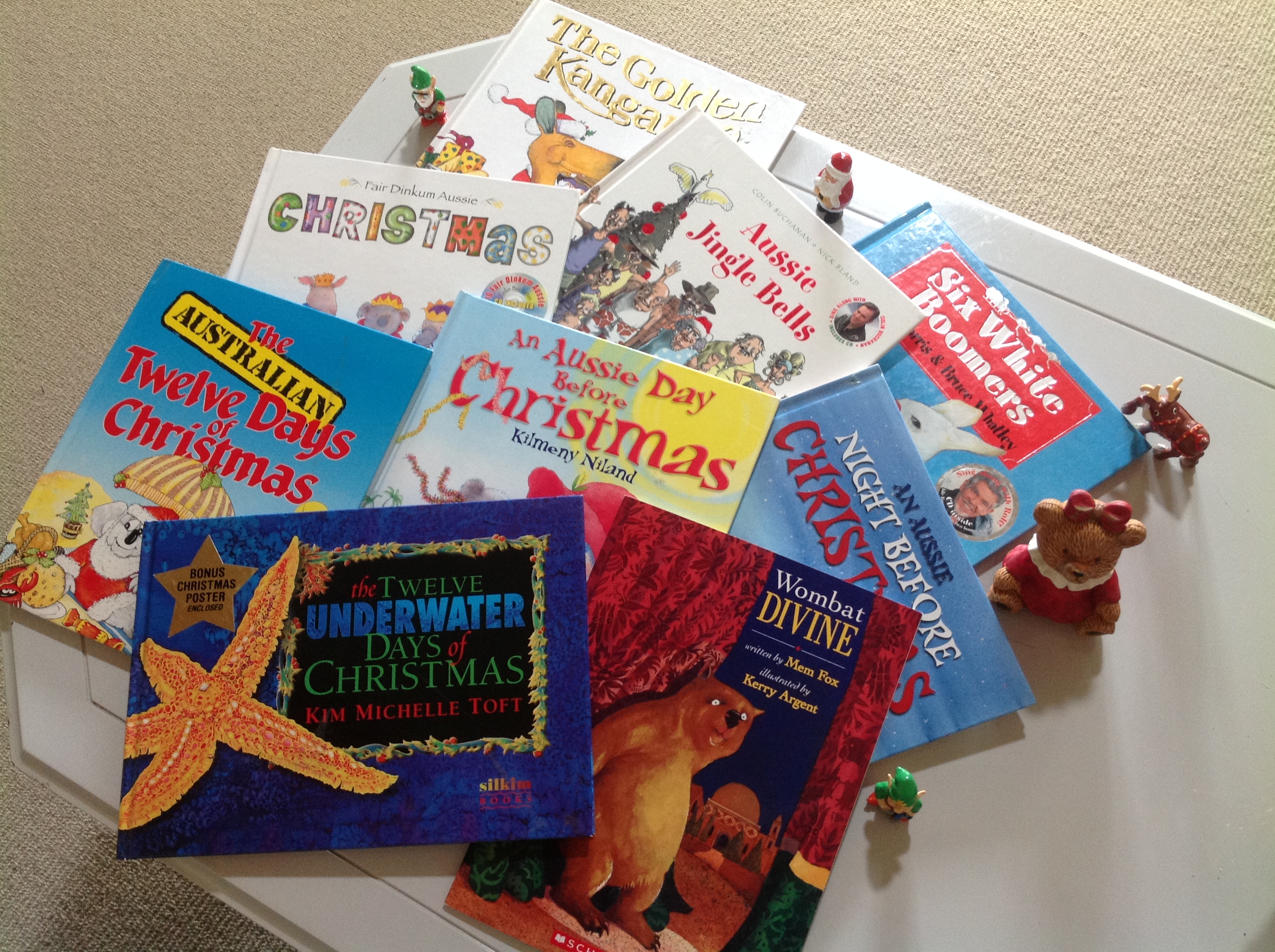
    While there is an increasing number of songs and books with an Australian flavour many are merely innovations on the traditional such, as “The Australian Twelve Days of Christmas”, “Aussie Jingle Bells” or “An Aussie Night before Christmas”.

    Some Australian Christmas picture books
    Some Australian Christmas picture books

    One innovation that I particularly like is The Twelve Underwater Days of Christmas by Kim Michelle Toft. Kim is an Australian who uses her talents as author and illustrator to educate children about the things she feels passionate about: ocean life and coastal habitats. Her illustrations, hand-painted on silk, are absolutely stunning.

    12 Underwater days

    In addition to the visual beauty of the book there is great value in the supporting information through which Kim explains the importance of conserving each of the creatures included in the book. While written by an Australian, the application of the book is not limited to our shores. Creatures from all over the world adorn the pages.  If you ever wished to own a book simply for the beauty of its illustrations, this is a great choice.

    One original song I enjoyed listening to on the radio as a child is “Six White Boomers”. Despite the reasons that make me reluctant to mention it this year, it is a delightful tale of a joey who rides on Santa’s sleigh, pulled by six huge white kangaroos, to be reunited with his mother on Christmas Day.

    Peter CombePeter Combe has written two albums of original, but with a traditional rather than specifically Australian flavour, Christmas songs for children, including this one:

    Some Christmas traditions popular with Australian communities are Nativity plays, carols by candlelight and Christmas parades. Many classes and schools perform their own end-of-year “break-up” concerts to which parents and the wider community are invited.

    Using the traditional Nativity play as the setting, Mem Fox created an original and fresh story in Wombat Divine. It is a delightful tale of Wombat who loved everything Christmas. When finally he was old enough to be in the Nativity Play he rushed along to the auditions. Unfortunately it was difficult to find a part that was just right for Wombat. Can you guess which part he got? You’ll have to read the book to find out! Children all over the world will identify with Wombat and his predicament and enjoy the heart-warming tale.

    Books are wonderful gifts to give or receive at any time. The titles I have mentioned here are perfect for giving, reading and sharing at this time of year. When I was growing up there was always a book for Christmas and birthdays, a tradition that I have continued with my extended family and friends. You can almost, but not always, guarantee that if it is a gift from Norah, it is a book.

    After my siblings and I had grown up and swelled the family numbers with partners and children of our own, my Mum used to say, “There’ll be no presents this year.” It wasn’t that she wasn’t a giving person, for she was. It was just that there were so many of us! When she passed away this year she had about fifteen grandchildren and eight grandchildren, in addition to her remaining nine children and their partners. (I’m saying ‘about’ for grandchildren and great-grandchildren in case I’ve missed some in the count!) You can imagine how daunting a task it would be to go shopping for all these people ranging in age from six months to sixty! However it was always surprising how frequently she did not follow her own rules and had a small something wrapped up to present to many of us.

    This year there will be no presents from Mum, and more sadly, we will be without her presence.

    Although I have borrowed my Mum’s words, “No presents” for both flash fiction pieces included in this post, the stories do not cast aspersions on her generosity. I have simply explored how the oddness of no presents or presence at Christmas time may have impacted Marnie, a character I have been developing in my flash fiction pieces, at different times in her life. At this stage of my writing I am still investigating her character, discovering a little more with each flash piece as her once indistinct figure begins to step out of the shadows and take shape.

    This first piece is written about a difficult time for teenager Marnie and a situation that may be the catalyst for her leaving home.


    No presents

    Marnie jerked backwards avoiding the predictable grope. In so doing she collided with her mother, sending her sprawling onto the tattered sofa.

    “Aargh!” her mother screamed. “Look what you’ve done!”

    Marnie watched the liquid from the upturned glass merge with the patchwork of stains collected in the carpet. If it was her blood it would not have mattered more.

    “I … I’m sorry,” she stammered. But her sorry was for all the years it had been like this.

    He smirked, raising his hand to strike, “No presents for you this year!”

    “That’s right!” She ducked. “No presence!”


    So as to not be too dismal at this time of year, I have written a second piece about a younger Marnie for whom there still seems a glimmer of hope.


    No presence

    With faces as bright as their Christmas wear, the children bubbled into the room, each carrying gifts for the Kindness tree, “for those less fortunate”.

    Parents fussed, removing smudges and replacing wayward hair before blowing kisses and hurrying off for the parade.

    And there was Marnie: no parent, no Christmas dress, no gift, no smoothed-down hair; no smile.

    One last chance.

    “Marnie!” I beckoned, and held out my Christmas cape and crown. “Will you be my special helper?”

    Our eyes locked communicating more than any words. Her smile was my reward.

    “I’m proud of you,” I whispered.

    Thank you

    Thank you for reading. I appreciate your feedback. Please share your thoughts about any aspect of this post or flash fiction pieces.

  • How do you connect?

     Many of you may recognise this song from Sesame Street: One of these things is not like the other.

    Finding the one that doesn’t belong sounds like a simple activity, but which one did you choose? And why? Did you choose the rubber boot? I didn’t. I chose the shoe with laces. Does that make me wrong?

    The items had some obvious similarities: they were designed for wearing on the feet, and they were similar colours. Differences in size and style were also obvious.  Just what made the rubber boot “not belong” any more than any of the others, I’m not sure. Does that mean I am not as smart as a pre-schooler?

    Rather than simply providing children with an answer as happens in this video, I would prefer children were provided opportunities to explore and discuss similarities and differences and would invite children to explain why a particular shoe might be selected.  I think there are valid reasons for each to not belong, and there are also many reasons for them to be grouped together.

    The ability to make connections between new and established information, including by identifying similarities and distinguishing differences, is an important contribution to learning. Adults can aid in the learning process by making explicit the ways in which objects are similar and by discussing ways in which they are dissimilar.

    Young children very quickly learn to notice obvious similarities between e.g. different breeds of dogs, a variety of drinking glasses and cups, or construction items. However adults can assist and challenge children to think creatively and in new and innovative ways by encouraging them to make connections between seemingly disparate objects.

    Many innovations have been developed as a result of creative thinkers making links that didn’t previously exist between apparently dissimilar objects or situations. George de Mestral’s invention of Velcro, involving the application of an observed phenomena to a very different situation, is perhaps one such example.

    Playing games is a good way of encouraging children to think creatively. It is not necessary to purchase pre-packaged games. Many games can be played with items from around the house or in the toy box, or using picture cards from early childhood games like ‘snap’, printed clipart, or cut from magazines. Here are just a few suggestions around which you can construct your own ways of taking turns, playing and having fun:

    https://openclipart.org/image/800px/svg_to_png/178912/tweedles.png
    https://openclipart.org/image/800px/svg_to_png/178912/tweedles.png

     What’s the same?

    Display two pictures e.g. a duck and dog, a bus and a boat. How many ways are they the same?

     How are they different?

    Display two pictures and explain how the items are different. The differences could be obvious e.g. a duck and a dog, or more subtle e.g. two different breeds of dogs, or a male and female bird.

    Which one does not belong?

    Display three or four pictures. Discuss similarities and differences, and then decide which one doesn’t belong, providing reasons.

    Sorting

    Provide children with a larger number of items e.g. construction blocks in different sizes, styles and colours or pictures of a variety of objects or animals. In the beginning it is easiest to sort by one feature e.g. is yellow/is not yellow. Encourage children to look for similarities between particular items e.g. colour or shape and ask them to group all items with that characteristic. They will then have two groups, one with the feature and one without.

    Once children can confidently sort in this way they may be able to sort by two characteristics e.g. size and colour. They may even begin to make decision about how to deal with items that fit into two groups.

    What else?

    Show children a common everyday object and discuss its use. Encourage them to think of alternate uses for the same object e.g. a pencil could be used as a flagstick, a mast on a toy boat or to identify where seeds were planted in a garden.

    Link the story

    Display pictures of any two items e.g. a beach ball and a pencil. Ask children to create a story that involves both items. I immediately think of a family making plans for a holiday at the beach. The child wants a ball to play with at the beach and uses a pencil to add “beach ball” to the list of items to take. Your thoughts are probably very different. I’m sure someone will have the beach ball impaled on the pencil!

    Making up stories like this can be just as much fun for adults as it is for children. Charli Mills at the Carrot Ranch has challenged us to make it so this week with her flash fiction prompt to:  In 99 words (no more, no less) write a story using two objects, people or ideas that don’t go together. Charli allowed us to choose the two items. I decided to explore a little more of my tormented Marnie and her unicorn. I’d be pleased to know what you think.

    Unicorns and coffee

    People crammed in, around and in front of the small sidewalk cafe, reminding her of the fairy-tale pageant that had bypassed her radar. She couldn’t move now. Her coffee fix, too hot to sip, had just been served. So, as always, she retreated within.

    Cocooned in thoughts flittering across years and experiences, she barely noticed the cacophony of the crowd or passing parade.

    The sudden shout of “Unicorn!” penetrated, startling her.

    She was six again, cowering with her unicorn, avoiding mocking stares.

    But this time pitying and unbelieving stares watched the spreading stain of scalding coffee.

    Thank you

    Thank you for reading. I appreciate your feedback. Please share your thoughts about any aspect of this post or flash fiction.