Live Love Laugh Learn … Create the possibilities

Category: Flash fiction

  • Crystalline wonders

    This week, Charli Mills at Carrot Ranch Communications challenged writers to: In 99 words (no more, no less) write a story using the word crystalline.
    In her post, Charli wrote about hunting for agates. She also mentioned many other types of rock, including quartz, chert, silica, gneiss, granite, mica… She used terms like metamorphic and fossilised, and I was transported back to my high school science classes. Sadly, I wasn’t inspired to be a rock-hound like Charli, and needed to check my understanding of these words and terms.

    My research uncovered both science facts and assorted beliefs about the seemingly magical properties of agate, some of which I’ll share with you.

    #12 Science facts about agate (without getting too technical):

    • A type of quartz
    • Most commonly found in volcanic rock, sometimes metamorphic
    • Fine grains and bright colours, often in bands
    • Many are hollow geodes
    • Weather resistant
    • Often found in soil or on the shoreline of waterways
    • Many different types of agate
    • Found in many different countries
    • Many uses including art and jewellery
    • Polishing, often by tumbling, helps to expose their inner beauty of colours and patterns
    • Each agate is unique
    • Can vary in size and value

    Sources: Wikipedia, Minerals.net, International Gem Society
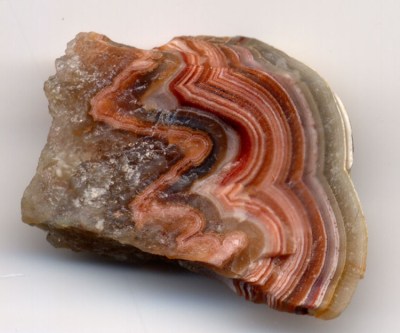
    Due to the bands of colour, agate is also known as Earth’s rainbow.

    A collection of beliefs about the metaphysical properties and healing powers of agate

    Can be used to create balance in emotional, physical and intellectual energy of an individual and of the universe.

    Worn as an amulet, it provides protection.

    Different colours and types of agate are considered to have different metaphysical properties, for example; some are thought to be calming, some uplifting, others bring abundance, some have healing powers, and others bestow strength. In fact, it seems agate can help with almost everything from marketing your writing and managing your overwhelming multitude of tasks to preventing traffic accidents.

    Agate is a zodiac stone for my birth sign Gemini. While I may not dare agree with it (pass me the agate. I’m sure it will help me), I rather like the description. It tells me that Gemini is the sign of the inventor and that,

    Those born under this sign can see both sides of an issue. They’re flexible and can go with the flow, and can be lively and talkative, or restless and nervous depending on their setting. Those born when the Sun is in Gemini are quick thinkers, quick-witted, and quick on their feet.

    Disappointingly for me, I was not born in summer. I’m a Southern Hemisphere winter Gemini baby. Does that make me the opposite?

    Sources: Crystal Vaults, Crystal Healing, Crystals and Jewellery

    It seems that with a small collection of differently coloured agates one could conquer almost everything, be self-aware and self-confident, courageous and strong, peaceful and healthy.  Perhaps a collection in every home, on every corner, and in every classroom, could be the answer to humanity’s problems.

    #12 Agates for a classroom collection?

    • Blue – creativity, problem solving, courage
    • Banded – creates a healthy environment, removes negativity, cuts ties to negative relationships, helps seek solutions and to try new things, offers protection, encourages creativity
    • Blue lace – healing and calming, nurturing and supportive, reduces anger, reduces fear of being judged, assists with verbal expression
    • Botswana – creativity, problem solving, quit smoking, energises the brain
    • Bull’s eye – focus
    • Colorin – helps accept changes associated with aging
    • Crackled fire – energy and protection, prevents burn-out
    • Crazy lace – focus, reduces negativity
    • Dendritic – abundance, peace
    • Green – enhances thinking, improves decision making, resolving disputes
    • Laguna – builds community, improves learning, especially in mathematics
    • Moss – self-esteem, friendship skills, try again

    What do you think? Is it worth a try? I know of at least one teacher who thought so. I was employed to replace her when other teachers and parents became concerned that the children weren’t learning anything useful. She may have found a sense of calm and balance, but the children were disrupted, distracted, and disengaged. Like many things, the power is in the actions we take, and not manifested by the object itself.

    Charli likens rock hunting to writing. She says,

    the more you show up to the beach and the page, the better your chances of finding a crystalline wonder.

    I think polishing the agates to reveal their inner beauty must be a little like writing, and teaching too.

    That’s one reason why I keep showing up. I don’t know that I’ll ever find a crystalline wonder, but I’m prepared to put in some effort to find out.

    This is my response to Charli’s challenge. It didn’t go quite where I intended and maybe not where you’d expect, but I hope you enjoy it anyway.

    Darling Crystalline

    Her mother wanted Chrystal; father, Clementine. Calm registrar decided: Baby Crystalline.

    Parental spats continued as Crystalline grew up. Never in agreement, it made her so messed-up.

    Crystalline retreated, spent days all on her own, searching by the water, for brightly coloured stones.

    She gathered a collection that healed her aching heart, ignited self-compassion and made a brand-new start.

    Believing stones worked magic, curing each and every woe, she took the heart stones with her, wherever she would go.

    She shared their healing powers, with any she could find, she told them “Pay it forward. She became their darling Crystalline.

    Thank you for reading. I appreciate your feedback. Please share your thoughts.

  • A piece of pie

    This week at the Carrot Ranch Charli Mills has challenged writers to In 99 words (no more, no less) write a story that features a pie. You can make it any kind of pie, focus on filling or crust, or tell us about the pie-maker. How does pie set a tone in a story? Does it warm the hearth or bring disappointment?

    But which pie should I choose: meat, vegetable or fruit, with pastry that is short, flaky or puff? Perhaps a piece of pie for a correct answer in Trivial Pursuit?

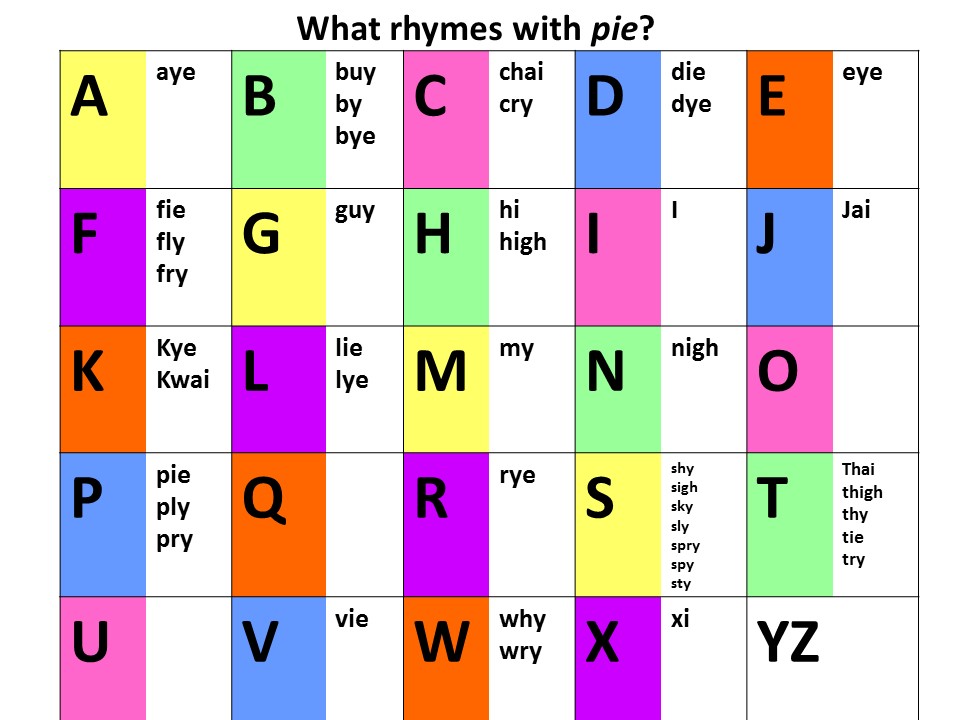
    I considered words that rhyme with pie, and what a list I made:

    what rhymes with pie

    Forty-three words!

    Maybe you can add even more.

    Did you notice the variety of ways we spell the long vowel ī, as in the word pie?

    There are eight:

    aye    uy    y     ye     ai     ie     igh    and     i!

    Isn’t it a wonder that any of us ever learned to read or spell.

    Did you notice there were two ‘pie’s in my title: A piece of pie?

    Did you notice that each time the three letters ‘pie’ were used, they represented different sounds?

    As mature readers and writers we have no difficulty with any of these vagaries of the English language, but for beginners, they can be a challenge.

    The challenge reminds me of “Old Lucy Lindy and the Pies” from Sounds of Laughter in the Sounds of Language Series by Bill Martin Jnr. In the story, Lucy Lindy loves to bake pies. She bakes all kinds of pies, including mince pies. Since all her pies looked the same with their delicious layer of pastry on the top, Lucy Lindy wanted to be sure she knew which pies were which when she took them out of the oven. She came up with a brilliant plan. She put the initials IM on the mince pies, for Is Mince. Then, on the pies that weren’t mince, she put the initials IM, for Isn’t Mince. Children laugh out loud when they realise it wasn’t such a clever plan after all.

    A Necklace of Raindrops

    Another lovely story for young children is “There’s some Sky in this Pie” from the collection A Necklace of Raindrops by Joan Aiken. The story has a cumulative structure similar to that of The Gingerbread Man, but with an additional sprinkle of creativity that could be used to ignite children’s own imaginative stories.

    When the old woman was making a pie for the old man, she looked outside at the snow “coming down so fast out of the white sky.

    “Then she went on rolling the pastry. But what do you think happened? A little corner of the sky that she had been looking at got caught in the pastry.”

    When the pie was cooked and the old woman opened the oven, the pie floated across the room. The woman and man and their cat jumped onto the pie to try to stop it, but they couldn’t, and they floated away on it. From time to time they met others who called out to them,

    “Old woman, old man, little puss, so high,

    Sailing along on your apple pie,

    Why are you floating across the sky?”

    They answered:

    “Because we can’t stop, that’s the reason why.”

    (Notice those different ways of spelling the long ī sound again – three spellings in that short extract.)

    Lucy Lindy and the Sky in the Pie are light-hearted and imaginative stories.

    Recipe for a Perfect Planet Pie

    Another favourite pie story is Recipe for Perfect Planet Pie by Kim Michelle Toft, an Australian author/illustrator and the only illustrator anywhere to illustrate all her stories with silk paintings.

    I have shared some of Kim’s work with you before here and here, and I’m certain to again as I attended the launch of her eleventh picture book Coral Sea Dreaming on the weekend and have scheduled a readilearn interview with her later in the year.

    Kim is passionate about conservation, especially of our marine environment and its inhabitants. In each of her books, she uses her stunning silk paintings to ignite a wonderment in the natural world and inspire a love of and caring for the environment. Recipe for Perfect Planet Pie continues these themes.

    The book reads like a recipe with a list of ingredients, a method, fourteen step-by-step instructions, and “Helpful hints” on each page. The recipe begins:

    1 To prepare the base. Sift the rich chocolate earth and crystallised minerals together. Make a well and pour in one cloud full of rain.”

    and concludes:

    “Serve pie immediately with a side of love and a slice of happiness.”

    At the end of the book, Kim includes information about the pie’s ingredients and the importance of each. She provides suggestions that we can implement to help create a happy, healthy planet and says,

    “Planet Earth is our only home and it is up to us to create change and put our knowledge into action.”

    I’m sure you’ll agree with that.

    For my response to Charli’s challenge I decided to go with a bit of nonsense and see how many of the rhyming words I could use to construct a pie story and still maintain some sort of sense. I wonder how successful you will think I’ve been. I managed to incorporate 28 and at least one from each of the spelling variants.

    A piece of pie

    Kye met Jai at the mall.

    Hi,” said Kye.

    “Nice day,” replied Jai. “Look at that sky. Wish I could fly.”

    “Time for a chai?”

    Aye. And maybe a pie. I’ll buy.”

    “What a great guy!”

    “I try!”

    “I’ll have toasted rye.”

    They sat high by the window and played “I spy.”

    “Oh my,” said Kye, rubbing his eye.

    “What? Why?

    Kye started to cry.

    “Don’t mean to pry.” Sigh.

    “It’s no lie. The end is nigh.”

    “Will we all fry? Will everyone die?”

    “No, just wish I had your piece of pie.”

    Fie! Wish I had Thai!”

    Bye.”

    Thank you for reading. I appreciate your feedback. Please share your thoughts.
  • Ready for landing

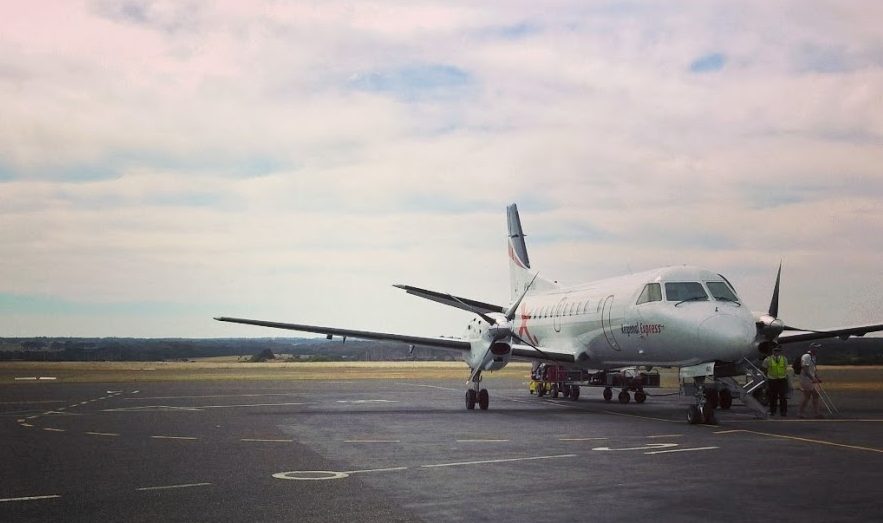
    Air travel wasn’t available when I was a child, or not for me anyway. I am unable to recall anyone in my circles, family or friend, who travelled anywhere by air. Perhaps we weren’t an adventurous lot, but air travel wasn’t as easy, affordable, comfortable, quick, or commonplace as it is now.

    Though I’d often thought I’d love to be a bird soaring above the world, I was a young adult before I experienced my first flight. I was entranced by the land below as I sailed on the wind in a glider, like a bird on the wing.

    It was a couple of years later that I had my first plane fight, and many years later before I travelled internationally. Yes, I’ve lived a sheltered life. Like many of the younger generations, my grandchildren have already experienced air travel, both within Australia and internationally. They would require almost as many fingers as I to count plane trips.

    Whether travelling or not, airports are always a great place to visit with children. There is much to observe, learn, wonder about, and imagine.

    Watching planes take off and land can fascinate children, and encourage all sort of questions, not only about the physics of flight, but the types and features of planes, the airlines, and where they are going to or coming from.

    People watching can also be absorbing and encourage even more questions about the jobs people are doing and the reasons for them, where the people are going to or coming from, and who they are travelling with.

    There is much to see and learn about, like passports, boarding passes, security scanners, customs officers, flight attendants, cleaners, retailers, baggage handlers, check-in operators. Or there were, until recently. Some of these roles have now been automated.

    The boards showing arrivals and departures can spark discussions about places around the world, the people who live there, and who might be travelling to or from each location and for what purpose.

    The currency exchange tellers with their constantly changing figures can lead to even more discussions.

    I’m sure I’ve omitted more than I’ve included and that you can add many other points of interest.

    But knowledge of what goes on in airports is not all that can be developed. Children’s imaginations can also be inspired. Observation tells so much. The gaps can be filled by imaginations creating stories of what might be.

    I was doing my share of people watching recently while waiting for the arrival of daughter Bec on a flight from Canberra. People were coming and going, some hurriedly, others more relaxed. Some were obviously waiting for their own flights, others waited with them. Others, like I was, were waiting for the arrival of family or friend.

    Sadly, we were all to be disappointed. Brisbane experienced an unusual weather event – dense evening fog which prevented planes from landing or taking off. Bec’s plane turned back to Canberra mid-flight. At least she was returned home. It wasn’t so for some of the other passengers, stranded for additional days away from their destination, be it home, holiday or other.

    Evening fog in Brisbane is unusual; morning fog, less so. Last year when returning from LA, my flight was diverted to Coolangatta. Fortunately, disruptions to travel caused by fog are not frequent.

    But why am I thinking about planes and airports?

    This week at the Carrot Ranch, Charli Mills challenged writers to In 99 words (no more, no less) write a story about an unexpected landing. It can be acrobatic, an unplanned move or created into a metaphor. Go where the prompt, or chickens, lead.

    This is where my thoughts landed after a foggy start.

    Ready for landing

    “Are we there yet?”’

    “Not yet, Honey. Look. This is us. This is where we’re going. Another couple of hours. Watch a movie. Then we’ll be almost there.”

    Mum replaced her mask and earplugs. Soon there’d be others to entertain Flossie while she relaxed on the beach or caught up with old friends.

    She hadn’t realised she’d drifted off until Flossie’s insistent, “How much longer?” awakened her.

    “Must be soon,” she flicked on the flight tracker.

    “Please fasten your seatbelts for landing.”

    “Yep. Almost there.”

    “DIVERTED” flashed on and off the screen.

    “What! Where?” She squinted. “Home! Why?”

    Fog!

    Thank you for reading. I appreciate your feedback. Please share your thoughts.
  • Shine a light

    The flash fiction prompt set by Charli Mills at the Carrot Ranch this week challenges writers to In 99 words (no more, no less) write about a beacon. It can be from a lighthouse or other source. Use the word literally or figuratively and go where the prompt leads you.

    Charli writes about our fear of change, fear of the unknown, and of the need for guides “to bring us in to a new harbor, a light to show us the rocky shoals.” She suggests that “Perhaps blogging, writing, are mediums of light that shine a path to bridge cultural differences.” but also acknowledges that, “Instead of looking for a way, some people have backed out of the water and barricaded themselves on the beach.

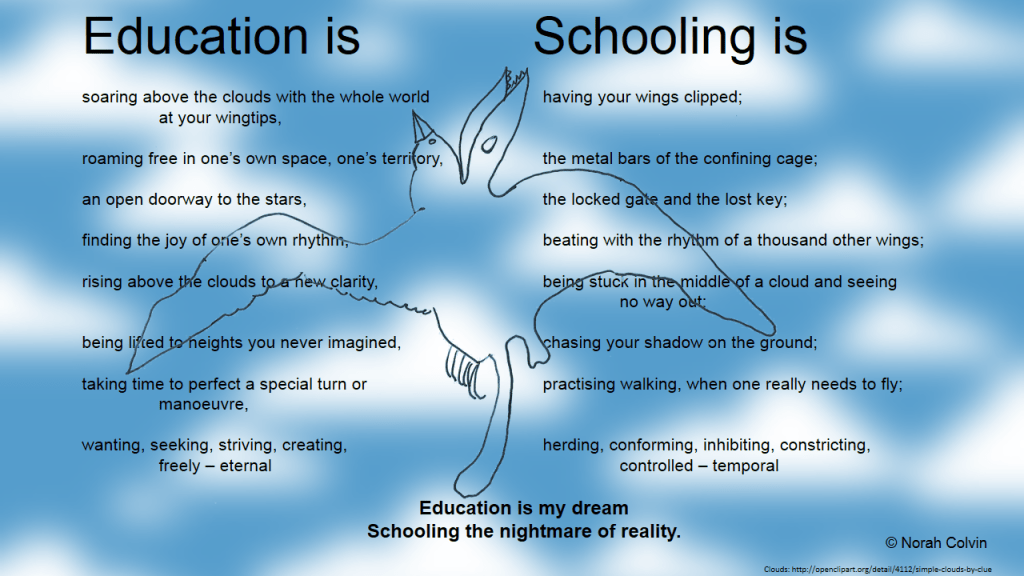
    I see education as the way that will bring us to a “new harbour”, the light that will “shine a path to bridge cultural differences”. Sadly, as I say in my poem about education, there is far too much emphasis on schooling and not enough on education, too much desire to keep the masses down by the insistence on conformity and ignorance rather than the encouragement of creativity.

    © Norah Colvin

    I was well-schooled as a child, but have spent my adulthood exploring what it means to be educated and promoting the benefits of a learner-centred education as opposed to other-directed schooling. I read of a book about “teaching backward”, beginning with what the student needs to know and working backwards. (Needs as determined by others, not the student.) I’d rather teach forwards, beginning with what the student wants to know and going from there.

    When my earliest teaching experiences fell short of my expectations, I searched for the beacons to guide my way out of the murkiness in which I found myself. I devoured books by John Holt, A. S. Neill, Ivan Illich, Paolo Freire, and others, with ideas about education and schooling that were as challenging as they were exciting. I read of innovative educators such as John Dewey, Maria Montessori, and Rudolf Steiner.

    The ideas challenged what I’d been taught but blended comfortably what I had learned through observation of children, including my own young child, and relating it to my own experiences. The pieces began to fit.

    At about the same time, I undertook further studies in literacy learning and was fortunate to work with a team of inspired educators led by Brian Cambourne, whose work and guidance placed the piece that helped the puzzle take shape, and guided my learning journey.

    Beacons, or shining lights, that guide and inspire us, are as essential to our growth as sunlight is for plants. Educators such as those mentioned, and more recently, Ken Robinson, Rita Pierson, and many others, are such beacons. We are constantly told of the success of the Finnish school system and I wonder why it is that those holding the power in other school systems fail to see their light. We need at least one to rise above the fog of number crunching and data collecting to see the bright lights shining on the hill.

    Is it fear, as Charli suggests, that keeps them out of the water? I watched the movie Monsters Inc on the weekend. It seems to deal with the issue of controlling the masses with falsehoods and fear quite well. It is also a great laugh – one of the most entertaining movies I’ve seen for a while. If you haven’t seen it yet, I recommend it.

    I’ve attempted a similar situation with my response to Charli’s challenge. I hope it works.

    Let there be light

    Eyes squinted in the dim light under low ceilings. Immobilised by never-ending paperwork, the menials dared not look up. Flickering numbers on data scoreboards mesmerised supervisors. Inconsistencies meant remonstrations, even punishment, from above. Heads down, keep working, don’t ask questions. The system worked fine, until … Maxwell nodded off. His pencil fell, tapped first, then rolled away. Startled, Maxwell went after it. The room stilled. Sliding too fast, he slammed into the wall, activating a button that illuminated a set of stairs leading up. Everyone gasped. Maxwell hesitated, took one step, then another. Nothing happened. He continued. Everyone followed.

    Thank you for reading. I appreciate your feedback. Please share your thoughts.


  • Security comforters

    Many young children have a favourite soft toy or item which they cart around with them and can’t be without. Linus with his security blanket in the Charlie Brown comics is a good example.

    The strong emotional attachment to an object, most commonly something soft and cuddly, generally occurs during  those years before school age when children are making the transition from total dependence to independence.

    One of my children had a mohair blanket which seemed to be constantly with her. She would twirl and tease the hair until she had a little ball of fluff which she rolled between her fingers and used to caress her nose as she sucked her thumb. I would find little balls of fluff all over the house and, over a couple of years of such treatment, ‘Blankie” became quite threadbare.

    I knew children who had favourite dolls they dragged around everywhere. They would become quite distressed if their dolls could not be found.

    I knew children who could not be without their “Blankie” so mothers bought two identical so that one could replace the other while it was being washed.

    Whatever the focus, it never seemed to matter how old, tatty, and frayed the items became, they were loved no less.

    Newer toys and blankets made of microfibres are very soft and comforting, and perhaps more durable.

    I don’t remember having a special toy or blanket for security. Do you?

    Chances are, if I had one, I would have destroyed it somehow in attempting to discover its properties, as I was known to do with other toys. In my mind it wasn’t destruction, it was discovery. (Is that the excuse of those who invent weapons of mass destruction?)

    Or possibly my lack of memory is more related to the fact that we have very few memories of our earliest years. According to this article by Australian science communicator Dr Karl Kruszelnicki, childhood amnesia may be related to neurogenesis. The rapid increase of new nerve cells in those formative years means that the old nerve cells are over-written and hence memories erased.

    The need for these comforters in young children is generally outgrown by the time children are of school age. The toys and blankets are discarded and forgotten as the children mature and other activities fill their time and minds.

    But for children experiencing higher levels of insecurity and anxiety, the need may continue. For Marnie, a character about whom I wrote many flash fiction stories, a unicorn toy was of comfort when she was feeling particularly vulnerable. Her need for it continued into her early school years and its appearance was an indicator to teachers that things were going badly for her again. When, as a confident adult, she returned to her childhood home, she found she had long outgrown the unicorn that had given her comfort as a child..

    I’m thinking about security objects and flash fiction again this week in response to Charli’s prompt at the Carrot Ranch to In 99 words (no more, no less) write a story about something frayed. It could be fabric, like a flag or garment. It could also be nerves or temper. What is it to be frayed?

    However, I haven’t written about Marnie and her unicorn this time, but something else that’s frayed. I hope you enjoy it.

    Second-hand store

    He’d perched on the stool for longer than anyone knew. Though his coat was threadbare and his bowtie frayed, nothing could erase his smile as he waited daily for a tinkle announcing a potential buyer. The days, though long, were not too long for one as imaginative as he, conjuring stories for items cluttering the shelves.

    One day a woman in a large blue hat and floral coat examined everything in the store, so quietly, he’d forgotten she was there. She startled him saying, “I’ll take him.”

    Lovingly restored, he took his place alongside others in the Toy Museum.

    Thank you for reading. I appreciate your feedback. Please share your thoughts.


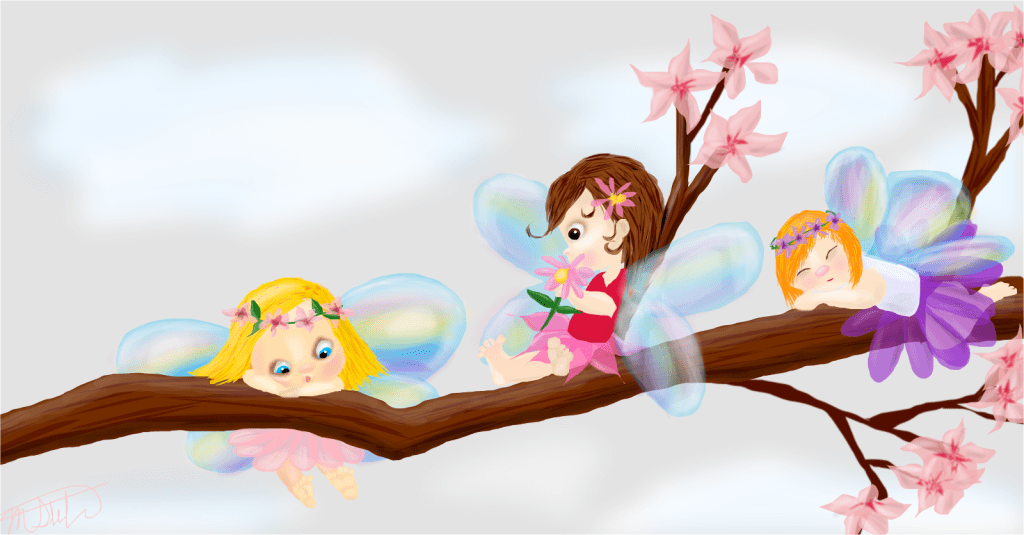
  • Away with the fairies

    © 2014 Shelly ʕ•ᴥ•ʔ https://www.sketchport.com/drawing/6517152420986880/fairies. Licensed under CC-BY.

    Are you a daydreamer? Were you accused of daydreaming at school? Many of us were. With minds that are easily distracted and work that is less than exciting, it is easy for thoughts to drift away into other realms. It can take anything, or nothing, and it is often difficult to back-track from where we find ourselves, along the path of thoughts to what initiated the journey. It can be no more tangible that the dream that escapes upon waking.

    While daydreaming can be pleasant and good for relaxation and creativity, it is often frowned upon in students meant to be concentrating on what they are to learn. Children would probably find it easier to attend if the work was tailored to their needs, initiated by their interests, and involved them as participants rather than recipients. The fifteen minutes of play per hour that Finnish children enjoy would also help, I’m sure, in giving time for minds to be, not corralled into predetermined channels.

    In this Conversation on Daydreaming with Jerome L. Singer in Scientific American by Scott Barry Kaufman on 10 December, 2013, Singer says, I think that teachers need to recognize that often, the daydreaming is because some of the kids are bored”.

    Whether through boredom or not, daydreaming can sometimes lead to breakthroughs in solving problems, creativity and productivity as described in this CNN article by Brigid Schulte For a more productive life, daydream. Brigid lists a number of daydreamers; including:

    • J K Rowling
    • Mark Twain
    • Richard Feynman
    • Archimedes
    • Newton

    Other famous daydreamers include:

    • Einstein
    • Edison
    • J. R. R. Tolkien
    • Boy George
    • Richard Branson

    Here are a few other quotes about the importance of daydreaming:

    Keith Richards is reported as saying that “Satisfaction”, the Rolling Stones’ most famous hit, came to him in a dream, and

    Paul McCartney says the same thing about the Beatles’ hit “Yesterday”.

    Neil Gaiman: “You get ideas from daydreaming. You get ideas from being bored. You get ideas all the time. The only difference between writers and other people is we notice when we’re doing it.”

    George Lucas: “I’m not much of a math and science guy. I spent most of my time in school daydreaming and managed to turn it into a living.”

    Professor Elizabeth Blackburn, the first Australian-born female Nobel Laureate, attributes her success as a molecular biologist, in part, to daydreaming.  She is reported by the Sydney Morning Herald to have said, ‘I think you need time to daydream, to let your imagination take you where it can … because I’ve noticed [that] among the creative, successful scientists who’ve really advanced things, that was a part of their life.’

    While speaking to students at Questacon in Canberra after receiving her prize, she joked, ”Your parents and your teachers are going to kill me if they hear you say, ‘she told us just to daydream.’

    So why is it, if the importance of daydreaming is recognised by successful creatives, thinkers, scientists, and business people, that it is still frowned upon in school? Why do we still insist that children sit at desks, repeating mundane tasks in order to pass tests that have little bearing on their future success or on the future of our species and the planet?

    In a previous post I wrote about John Dewey’s dreamof the teacher as a guide helping children formulate questions and devise solutions. Dewey saw the pupil’s own experience, not information imparted by the teacher, as the critical path to understanding. Dewey also contended that democracy must be the main value in each school just as it is in any free society.” According to Pasi Sahlberg in Finnish Lessons, What can the world learn from educational change in Finland? schools in Finland have dreamed their own dream by building upon Dewey’s.

    Of course, on a much smaller scale, I have my own dream of a better way of educating our children.

    This week at the Carrot Ranch, Charli Mills dreamed a dream and challenged writers to In 99 words (no more, no less) write a story that involves a dream. This action could have happened while awake, such as daydreaming, or make up a dream when asleep. Go where the prompt leads as it could be a nightmare or just fond memories or ambition.

    This is my response. I hope you enjoy it.

    Off with the fairies

    Each year the school reports told the same story:

    He’s off with the fairies.

    Poor concentration.

    Needs to pay more attention.

    Daydreamer.

    Doesn’t listen in class.

    Must try harder.

    Needs a better grasp on reality.

    Will never amount to anything.

    Meanwhile, he filled oodles of notebooks with doodles and stories.

    When school was done he closed the book on their chapter, and created his own reality with a best-selling fantasy series, making more from the movie rights than all his teachers combined.

    Why couldn’t they see beneath the negativity of their comments to read the prediction in their words?


    Of course, not all daydreamers become successful, and not all children have a negative schooling experience. For a much more appreciated and positive set of comments, read this post by Elizabeth on Autism Mom Saying Goodbye to Elementary School.

    Thank you for reading. I appreciate your feedback. Please share your thoughts.

  • Is the ‘right way’ always the best way?

    Giving children opportunities to question, to be creative, and to problem solve are high on my priorities. Children need to be given the time and opportunity to figure out things for themselves. While it is sometimes easier just to tell or show them what to do, or even do it for them, it is generally better for their development, to let them have a go at finding a method or solution. Please note: I am not talking about dangerous things here like playing with fire, testing to see how fierce that dog really is, or driving a car.

    If children are constantly told there is a right way of doing things, they will stop exploring, discovering, and inventing their own or new ways of doing things. This is an issue because, if we always do what we’ve always done, we’ll never progress. There is generally no harm in, but much to learn from, each successive attempt.

    Opportunities to explore, discover, and use intuition are also important to the development of mathematical thinking. When children are developing understanding of number, they often invent their own strategies for working with numbers. Sometimes, as attested in this paper by Heirdsfield, Cooper and Irons, the strategies used display more advanced thinking, and are more efficient, than those taught as ‘the’ correct way of solving a problem using pencil and paper.

    I have noticed a change in the speed and agility with which my seven-year-old grandson works with numbers now that he has learned there are certain ways of; for example, adding two numbers. He tends to second-guess himself as he attempts to mentally calculate using the pencil and paper method he has been taught, rather than other more effective strategies he had previously invented and used. Perhaps you have noticed something similar.

    Provocations, such as these 3 Fun Inquiry Maths Activities for the Last Week of School by Steph Groshell on Education Rickshaw,  are great to get children thinking about different ways of solving real problems.

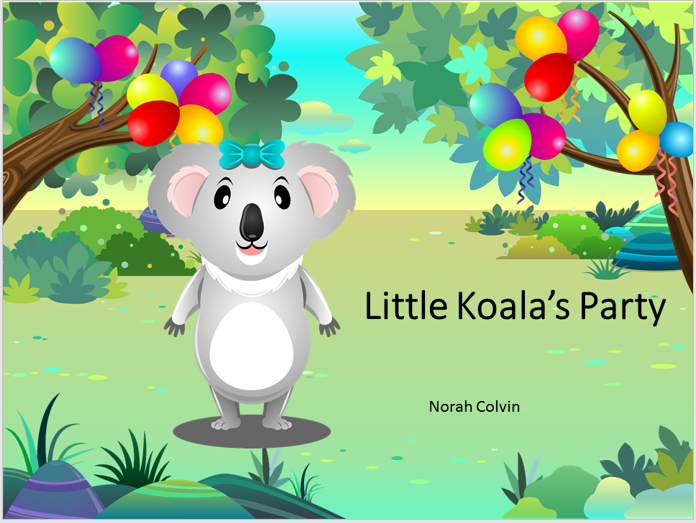
    Little Koala’s Party – a story for problem solving in the readilearn mathematics resources also encourages mathematical thinking and planning. Children help Little Koala organise a party for her family and friends, deciding who will be invited, the number of guests, and what’s on the menu. The suggestion is made that children plan a party of their own and they are asked to consider how they would go about it. The discussion and sharing of ideas, rather than the imposition of one ‘right’ way, is the important thing in developing mathematical thinking.

    Now it might seem a stretch to tie this in with a piece of flash fiction, but I hope you’ll be able to follow my thinking through the mist and into the light.

    This week at the Carrot Ranch, D. Avery took the reins from Charli Mills and challenged writers to in In 99 words (no more, no less) write a story that symbolically, mythically, mystically, or realistically involves dawn, as a noun or verb. Write about the dawn of time or the time of dawn, or the dawning of an idea. As always, go where the prompt leads.

    The right way

    Father and Son sat side by side. Father cracked his knuckles and sighed repeatedly while Son sharpened his pencils, each pencil, and arranged them meticulously according to undisclosed criteria.

    “Come on. Just get it done. Then you can play.”

    “I’m thinking.”

    “Think faster.”

    “I know it’s 96.”

    “Well write it down.”

    “Sir says I have to do the working out.”

    “Then do it.”

    “I don’t know how.”

    “Like this. See.”

    “That’s not how we do it. Sir says…”

    “Then do what Sir says.”

    Slowly it dawned on Dad: Sir’s way may not be the best way for all.

    Thank you for reading. I appreciate your feedback. Please share your thoughts.

     

  • Outdoor games

    Being outdoors, especially in a natural area, is good for the body, mind, and spirit. It is so for children as it is for adults. It is great to incorporate outdoor activity into the daily routine, including the regular school day. With our beautiful Queensland weather, children get to play outdoors most lunchtimes. While one day of indoor play on a wet day is a novelty, more than one and we start to feel cooped up.

    However, other than at lunch breaks, outdoor play is not always scheduled as part of the school routine as it is in Finland, where children have, according to this article in the Sydney Morning Herald, ‘a mandatory 15-minute outdoor free-play break every hour of every day.’

    I support the premise of Finnish education that ‘Fresh air, nature and regular physical activity breaks are considered engines of learning.’

    GDJ, Playful stick figures https://openclipart.org/detail/230070/playful-stick-figure-kids

    They must also have benefits to health and happiness. In Where will the children play? I suggested that ‘While it is great for children to have unstructured play time. It is also important to have equipment to support their play, be it imaginative, social, or physical.’ The reason for this statement is the disagreements I’ve seen occur when children have nothing to play with and no ideas for creating games of their own. It seems that many of the games played in the not-so-long-ago days, before the invention of video games and television, have been lost to subsequent generations.

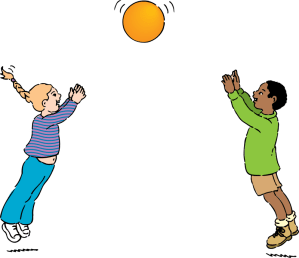
    Johnny Automatic, cartoon of a girl and boy playing with a ball https://openclipart.org/detail/721/playing-ball

    In Are you game?  I wrote about some of the ways playing games can contribute to the development of social skills such as:

    • Sharing
    • Taking turns
    • Cooperation
    • Following rules
    • Dealing with competition
    • Accepting a loss
    • Accepting a win graciously

    When in the classroom, I incorporated some type of game, whether indoor or outdoor, small group or large group, into every day’s schedule. Some of these ideas I have already shared on the readilearn website, including instructions for How to play freeze. I recently added some Maths games and activities for the whole class #1  which include suggestions for playing outdoors, such as Odd and Even. (Both these resources are free!)

    This week at the Carrot Ranch, Charli Mills is also talking about outdoor games. She mentioned childhood favourites; such as, tether tennis, hopscotch, hide-and-see, jump rope, and flashlight tag. As I do, Charli wonders how playing these games compares to playing screen games. I have to admit that I like both, but I think it would be great for children to learn how to play some of my childhood favourites; such as:

    • Drop the hanky
    • Cat and mouse
    • Red rover
    • Fly
    • Skipping
    • Elastics
    • Hula hoops
    • Ball tag (brandy)
    • Hide and seek
    • Tag (tiggy)
    • Spotlight (flashlight)
    • Ball games

    I’m sure you could add others. You know, all games were invented by someone at some time, and it is fun to make up games of your own.  Give children a little equipment, or none, let them use their imaginations and see what games they can come up with.

    I have ‘invented’ a few games over the years. Some of them are already available on readilearn, others are on the list of to-dos. They are not all outdoor games, there are a variety of board games. But Charli has specifically asked for outdoor games. She said,

    In 99 words (no more, no less) write a story that involves playing an outdoor game, like tetherball, hoops, tag. It can be made up, traditional, cultural or any kind of twist. Go where the prompt leads.

    This is my response. I hope you like it.

    Wanna play?

    From the verandah, the park looked enormous and inviting. The men, lugging boxes and furniture upstairs, stopped chatting. Mum bustled them too, ‘Here. Not there.’

    ‘Stay out of the way,’ she’d commanded. He suggested the park. ‘Not by yourself,’ she’d said.

    He went anyway, crossing the wide road alone. He watched a group of kids kicking a ball around. They looked friendly, but… He glanced back at the house. Not missed. Would they let him play?

    ‘Hey, kid,’ one shouted. He turned to run. ‘Wait!’ called the voice. ‘Wanna play?’

    Reassured by smiling faces, he joined in the game.

    Thank you for reading. I appreciate your feedback. Please share your thoughts.
  • Is contentment compatible with a growth mindset?

    I am quite a fan of the growth ‘not yet’ mindset which focuses on a belief in the ability to do and achieve more through persistence and hard work. I have previously written about this mindset in What do you have in mind? and in The power of not yet.

    I wonder how compatible a growth mindset is with a complacency or acceptance of the way things are; a “This is it. I can’t do anything about it.” attitude.

    When I think of contentment, I think of serenity, tranquillity, a feeling of peace and acceptance. I think of it as a positive state of mind. The dictionary defines it as:

    Does this imply that there is no wish for things to be different?

    I often talk about the importance of imagination and creativity to inspiring innovation and invention. But do they also require a certain degree of disequilibrium or discontent with the way things are? Is it necessary to find fault with something in order to improve upon it? How many gadgets do you use regularly, accepting their imperfections without a thought of how they might be improved? It is not necessary to have the ability to improve them in order to imagine how they might be improved.

    A fun thing to do with children is to get them to think of an easier or more enjoyable way of conducting a routine activity. How about an alternative to the traditional, in Australia anyway, emu parade which has children criss-crossing the school grounds, bobbing up and down to pick up rubbish? How about something to carry their heavy back-packs home? Or something to do their homework? (Oh, that’s right, they’ve already invented parents for that!)  I’m sure children, and you, can imagine far more exciting improvements.

    Imagination is the driver of innovation and change. But it also requires action. It is the action that gets us into the growth mindset; perseverance, hard work and repeated attempts. As Edison is oft quoted,

     “I have not failed. I’ve just found 10,000 ways that won’t work.”

    He also said,

    “To invent, you need a good imagination and a pile of junk.”

    I wonder how my friend Pauline King The Contented Crafter would respond to my title question. While I know she has reached a certain stage of contentment in her life, I also know that she strives to better her craft, and does what she can to make the world a better place. How much need for change or improvement can contentment tolerate?

    Charli Mills of the Carrot Ranch and her flash fiction challenge to In 99 words (no more, no less) write a story about feeling content  got me wondering about this. Charli talked about moments of contentment sprinkled among frustrating events and dreams of change.

    It helped me realise that, while they appear to be in contradiction, we need a little of both. We need to be happy with who we are, what we have, and what we have achieved; while at the same time, we need to be aware of what can and should be improved, and some strategies for action. Questioning is important to stimulate imagination, and when paired with creative thinking, innovation can occur. We need the inspiration of just one forward-thinker to lead us into the future.

    The same balance between contentment and growth can be seen in children’s play. I have used it as my response to Charli’s challenge. I hope you enjoy it.

    Purpose in play

    They worked furiously as if with one mind; digging, piling, shaping, smoothing the sand.  As if on cue, two began to tunnel through from opposite sides, meeting in the middle. Others carved into the surface, forming window-like shapes. Sticks, leaves, and other found objects adorned the structure. Then, simultaneously, the work stopped. They glowed with collective admiration. But Than was not yet content. Something was missing. He swooped on a long twig and stuck it into the top, antenna-like. “For communicating with the mother ship,” he declared. Soon they were all feverishly adding other improvements to their alien craft.

    Thank you for reading. I appreciate your feedback. Please share your thoughts.


  • A long shot

    I love the opportunity of finding out something I didn’t know before, and because there is so much  that I don’t know, the opportunities seem to arise quite frequently. Perhaps if I’d taken more advantage of them in earlier years, there’d be less for me to know now, and I’d be more help on a trivia team.

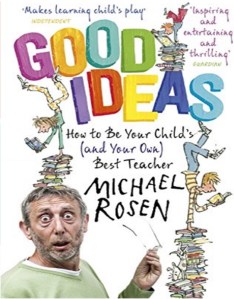
    Curiosity is an essential ingredient to learning and it is important for parents and teachers to encourage it in children, as well as themselves. Providing children with the opportunity of asking questions and helping them find out about what they want to know helps keep curiosity alive. Michael Rosen’s book Good Ideas: How to be Your Child’s (and Your Own) Best Teacher has many wonderful suggestions for doing just that. I wrote about that before here and here.

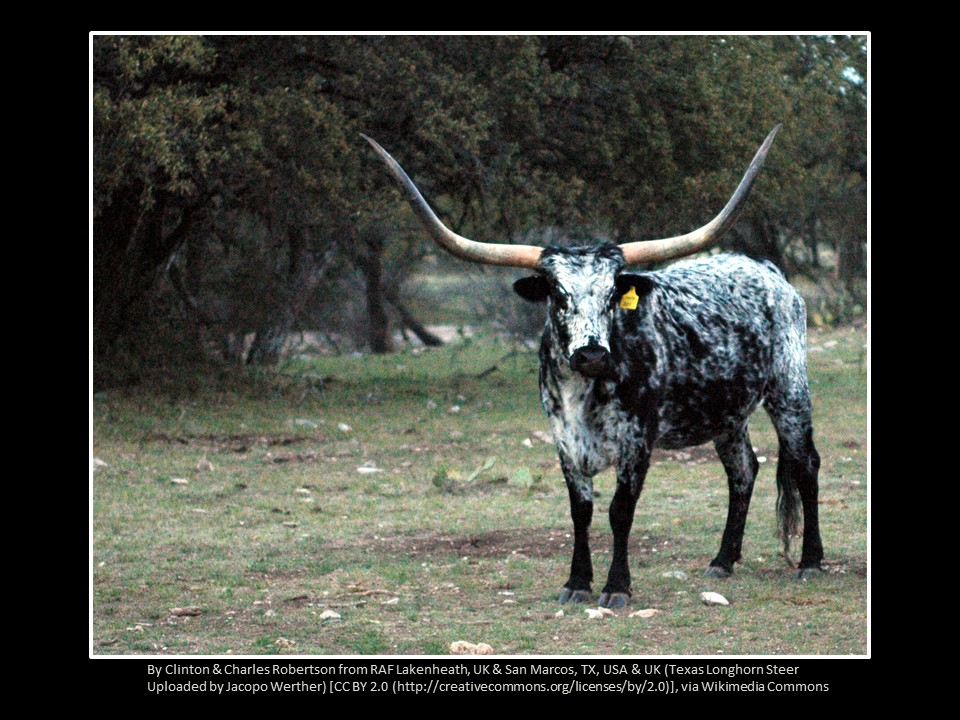
    Over the past few weeks, I have felt increasingly challenged by the flash fiction prompts dished out by Charli Mills at the Carrot Ranch. This week she had me (almost) completely stumped with her challenge to In 99 words (no more, no less) write a (story) that includes the word longhorn. Charli’s in Kansas at the moment, and her reference is to longhorn cattle, a breed not familiar to most Australians. I was aware of a longhorn beetle, but knew little about them too.

    Observing photographs of longhorn cattle, these were my thoughts:

    • Aren’t those horns heavy? How do they hold their heads up?
    • Wouldn’t the horns be dangerous – to the horn owner, as well as to others?
    • What would happen if the animals tried to move through scrub? They could get caught between trees, or knock their horns off.
    • What is the purpose of the long horns?
    • Imagine giving birth to something with horns like that!
    • Are they bred for beef or diary?

    How could I write anything without doing a little research?

    Fortunately, research is no longer as difficult as it was when I was a child. Press a few buttons on the computer, and a world of information awaits. My first stop was Wikipedia, but I investigated other sites too, including The Longhorn Cattle Society and Texas Longhorns. Here’s some of what I discovered in answer to my questions:

    • Longhorns are the descendants of the first cattle to arrive in the Americas with Christopher Columbus and Spanish colonists. Many escaped or were set free on the plains and were mostly feral for about two hundred years.
    • Horns form part of the skull and are difficult to weigh on a live animal. As the horns may continue to grow for several years, there are some differences, and steer horns are usually longer (and presumably heavier) that those of bulls and cows.
    • Horns start to grow at about three weeks. Phew – after birth! In fact, The Longhorn Cattle Society states that the cows are great breeders and have few calving problems.
    • Although the cattle may appear dangerous with their large horns, they are actually quite docile. However, they may experience damage to their horns if they are kept in confined spaces.
    • According to Texas Longhorns, the horns are considered non-functional. I can’t imagine walking around with something that appears so heavy and unwieldy on my head, just for adornment!
    • The cattle have many advantages, just some of which include ease of breeding, longevity and disease resistance. They produce lean meat and cheese has been produced from their milk.
    • There are some Longhorns in Australia, even an association for Texas Longhorns.

    In my explorations, I was surprised to find this article which tells of an Australian Longhorn JR that earned a position in the 2013 Guinness Book of Records for the longest horns.

    JR was pipped at the post in 2014 by Lazy J’s Bluegrass with horns measuring 297.8 cm (117.25 in)

    Watch Bluegrass here.

    The owner says his horns probably weigh about 200 to 300 lbs (90 to 136 kg)!

    I hope you enjoyed finding out about longhorn cattle as much as I did. Or maybe you already knew. When I read that many of the cattle had escaped or been released onto the plains by early settlers, I was reminded of the cow experience on the farm when I was a child.

    Holy Cow! It’s a long shot

    The enclosure was built, the hay delivered, the trough filled. We children watched from the rails, as Dad and Mum manoeuvred Cow #1 into the yard.

    Everyone clambered to be first to milk her.

    “We can all milk her – in the morning,” assured Dad.

    But in the morning, the cow was gone. The gate lay crumpled on the ground.

    A stronger gate contained Cow #2, but she squeezed under the fence.

    More repairs must secure Cow #3? She jumped over to flee.

    Defeated, Mum replenished her powdered supply, and we kids never learned to milk.

    Should’ve got a longhorn?

    For a fun picture book (also based on a true story) about a cow, without any horns, check out A Particular Cow written by Mem Fox and illustrated by Terry Denton. It’s hilarious!

    Thank you for reading. I appreciate your feedback. Please share your thoughts.