

I’m having a delicious time over at Sally’s this week, sharing my post about berries. Won’t you join me?
Category: Flash fiction
-
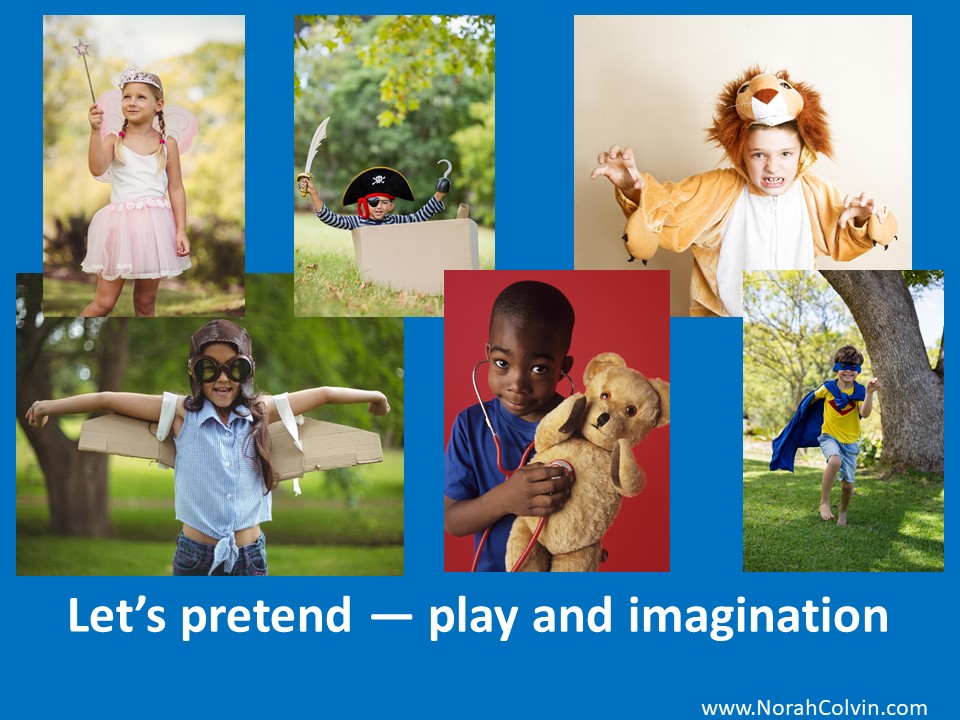
Let’s pretend — play and imagination
If the title conjures up images of children playing dress-ups with forts and castles, saving princesses and defeating dragons, that’s good. Such was my intention.
Pretend play, in which children use their imaginations, allows them to try out different roles, experience different possibilities and enact a variety of solutions to problems they encounter.
But play and imagination isn’t just for children. It is through playing with ideas that new discoveries are made, inventions are created, and innovations implemented. Without imagination, everything would always stay as it always was. Science wouldn’t progress and stories wouldn’t get written.

When Charli Mills at the Carrot Ranch challenged writers to In 99 words (no more, no less) write a story that uses the word eminence. It’s a rich word full of different meanings. Explore how it sounds or how you might play with it. Go where the prompt leads!, I knew that imaginations the world over would be employed to respond.
Every week when Charli sends out a prompt, writers play with ideas to engage readers with unique and imaginative perspectives on the word or phrase. When all have been submitted, Charli searches for threads that bind the diverse stories together and compiles them into a connected whole.
Charli’s use of the word ‘eminence’ in her flash fiction story was unfamiliar to me, so I opted to stay within my comfort zone. With such a serious and imposing word though, what could I do but play? I hope you enjoy it.
Your Eminence
She glided in, regal robes flowing, loyal subjects lining the path.
“Your eminence,” they bowed as she passed.
She occasionally extended her gloved hand to receive their kisses of adoration or stopped to bestow a gift of royal chatter. Though her crown and responsibilities weighed heavily, she held her head high as she proceeded towards the throne. Decorum dictated every move. She dared not breathe out of sync. Her subjects depended upon her.
When seated, she motioned for all to sit. They obeyed, listening respectfully.
“I decree– “
“Lunch is served, Your Majesty.”
“Aw, Mu-um!”
“You’ll reign again later.”
Thank you for reading. I appreciate your feedback. Please share your thoughts.
Share this:
-

School Days, Reminiscences of Geoff Le Pard
Welcome to the School Days, Reminiscences series in which my champion bloggers and authors share reminiscences of their school days. It’s my small way of thanking them for their support and of letting you know about their services and publications.
This week, I am pleased to introduce Geoff Le Pard, author, blogger, humourist and all-round nice guy. I met Geoff through Anne Goodwin, if I remember correctly. We engaged in conversations on Anne’s blog first, then followed each other and engaged in conversations on each other’s blogs too.
Anne and Geoff had already been lucky enough to meet in person on a writing course, but I hadn’t known either for long when I visited family in London for the first time in 2014. I very timidly emailed Geoff and asked if he’d like to meet up. (This was prior to the Bloggers’ Bash of which Geoff is now on the organising committee and I didn’t yet know of any other instances of bloggers meeting up.)
I was both anxious and thrilled when Geoff, Anne and Lisa all agreed we’d meet up at the British Library. I think we were all wondering if these ‘strangers’ were who they said they were or if they might be potential axe murderers. Fortunately, though some of us may have a been a bit stranger than others, none were axe murderers and we had a very pleasant afternoon together.
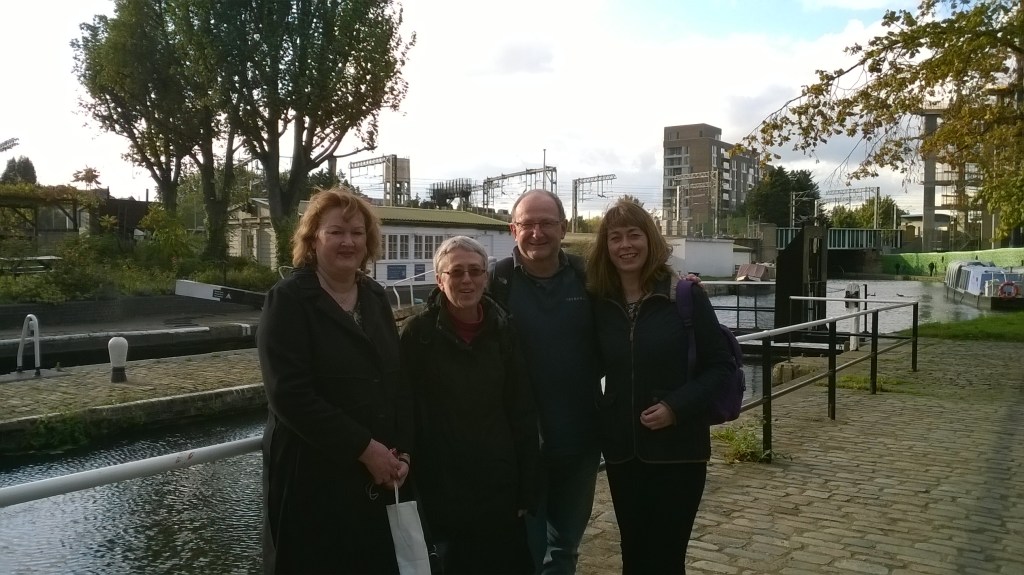
Norah, Anne, Geoff, Lisa beside the lock Since that auspicious occasion, Geoff has entertained thousands, if not millions, of readers with his blog posts that are sometimes hilarious, sometimes serious, often compassionate and always with his own tangent on life, love and anything in between. He has published four novels, three anthologies and one memoir. I have no hesitation in recommending them to you.
But perhaps we should get to the real purpose of this post, which is to provide Geoff with an opportunity of sharing his reminiscences of school.
Before we begin the interview though, I’ll allow Geoff to tell you a little of himself:
Geoff Le Pard started writing to entertain in 2006. He hasn’t left his keyboard since. When he’s not churning out novels he writes some maudlin self-indulgent poetry, short fiction and blogs at geofflepard.com. He walks the dog for mutual inspiration and most of his best ideas come out of these strolls. He also cooks with passion if not precision.
Welcome, Geoff.
Let’s talk school. First, could you tell us where you attended school?
My schooling started at 3 at Miss Stark’s nursery school in a large house about half a mile from home (mum walked me everyday). From there, at 5, I went to Maple Road Primary in Whyteleafe, in leafy Surrey this time about 2 miles away (I caught the bus – until I was 6 with mum, after that with my older brother (he was one year older). At 11 I moved to a local Grammar school, Purley Grammar school for boys, about 4 miles from home (I cycled) until I was 12 when the family moved to south Hampshire and joined Brockenhurst High School, also a Grammar, where I stayed until 16 when I moved into the adjacent sixth form college until 18 (the school was seven miles away and involved a daily train journey after a cycle ride).
Did you attend a government, private or independent school?
The nursery was private but the remaining schooling was Local education authority funded. Grammar schools were an attempt by the post war governments to give the best equivalent of a private education to those who couldn’t afford it. To enter you had to pass your 11 plus. I failed mine, had an interview as I was ‘borderline’ (makes it sound like it was a mental health issue) and was granted a place – I still think Paddington Bear was my saviour – this post explains my reason for thinking that.
What is the highest level of education you achieved?
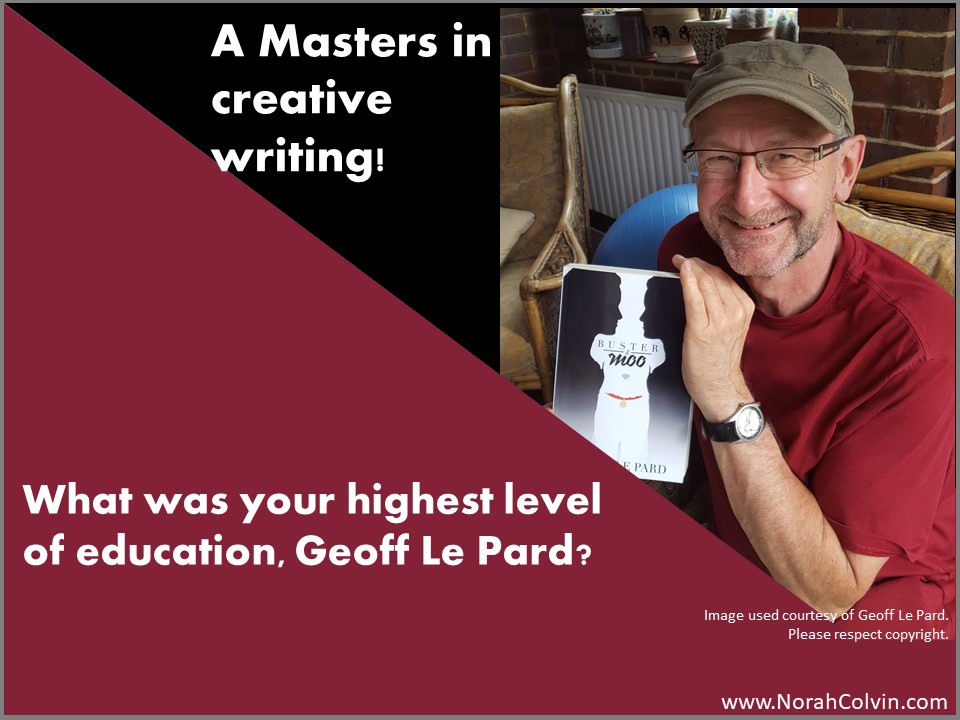
I went through the sixth form, took four A levels (two maths, history and French plus S level maths – not sure what the ‘S’ stood for but it was meant to be equivalent of first or second year at uni – I managed 100% I was told – get me, much good it did me) and then attended University (Law, at Bristol University), and later in life went again for a masters (Creative Writing at Sheffield Hallam)
What work or profession did you choose after school and was there anything in school that influenced this choice?
I chose a law degree at Uni that lead to a career in the Law. I can cite the following influences from school:
- One of my school friends had already chosen law and it sounded cool;
- I went to a careers’ evening organised at school and the two reps from Southampton University were law lecturers and they were the coolest people there
- My maths teacher wanted me to go to Cambridge and do maths and he was anything but cool
What is your earliest memory of school?
The sandpit at nursery and the leather indoor slide and being made to stand in the corner for running when told not to.
I recall the terror of my first day at primary school, the sun in my eyes through the high windows and all the other children; I also remember the old fashioned radio speaker on the wall – a large wooden box with a brass speaker in the middle and listening to a story on it. There was a separate playground for the first and second forms (years 1 and 2 nowadays) with a high wire fence around it, like a tennis court that we stared through, like caged animals, at the older children in their playground
What memories do you have of learning to read?
I’m pretty sure I could read before I went to primary school but unlike my older brother I didn’t really enjoy it. I have to thank him for inadvertently (in the sense that I was an irritating little shadow who he needed to rid himself of) persevering in finding me books to read and converting me to the joys of reading. This post may give you a sense of my journey
What memories do you have of learning to write?
Ah me! Handwriting has never been a strength – a school report, noted in the post above, said I achieved a B in my handwriting exam and the remark from my teacher was ‘I don’t know how he managed it’). We had lined books in which we repeated our own take in cursive writing and mine were not things of beauty – again, perhaps I should indulge another post, here with examples of my work.
What do you remember about math classes?
I was always ‘good’ at maths (if you ignore the geometry report cited above – ‘utterly confused in exam – good term’s work’). I didn’t always grasp a concept immediately like some but it didn’t take long and I generally could work back though to first principles if taught properly. For some time it looked as if maths was my way into university until I was lucky enough to have an inspirational history teacher in the sixth form (years 11 to 13 now) who taught me to widen my horizons. He was cool.
What was your favourite subject?
History and the more modern the better.

What did you like best about school?
Play time, friends, being praised, winning badges, some school dinners and certain teachers. In secondary school I would add in sport and, after the age of 14, learning.
What did you like least about school?
Geography, biology, any sense I was in trouble, shepherd’s pie, girls until I was14 (my terror was different from there on) and certain teachers.
How do you think schools have changed since your school days?
Harder work, more pressure put overtly on children to perform (we had exams that were as difficult, we just weren’t bombarded with how important they were meant to be), a more rigorous structure to what they learn, less scope for great teachers to go off topic, far more Big Brother is watching you – we had scope to break rules, places to subvert – it seems today the rule breaking has to be in public and so is more likely to be chastised. I hear evidence that in certain places behaviour has degenerated but good teachers have always controlled classes. The punishment regime is less physical today and children are believed more than before. Perhaps the biggest changes are children are listened to more and teachers have less time to teach (or should that be to educate?)
What do you think schools (in general) do well?
When they do it well they inspire lifelong learning and in my experience that comes from the spark of an individual teacher capturing a child’s imagination. They give a child tools to learn, to teach, to educate him/herself – reading and writing and, no doubt today IT skills and after that to be inquiring, not to accept what they are told is the answer but to question – the ability to frame the right question is perhaps the greatest gift a teacher can give a pupil.

How do you think schools could be improved?
They can spend more time educating and less teaching. The tyranny of the curriculum is one of teaching’s greatest challenges. The notion that if you learn to a script and regurgitate that script and you will succeed is one of life’s top five fictions; no actor worth their salt merely delivers a script – they have to understand it, live it, get beneath and inside it. That is precisely the same with learning. Get beneath the surface, go round the back, take off the lid and see the workings and that way so much joy will be had and so many avenues will be opened. Good education acknowledges the world is round and that all we can ever do is proceed to the next horizon and see what’s there; bad teachers are education’s flat earthers.
Thank you for sharing your reminiscences of school and thoughts about education in general, Geoff. It’s been wonderful to have you here. I learned so much I didn’t already know about you. I enjoyed hearing your perspective on education and agree with much of what you had to say about it.
Find out more about Geoff Le Pard
on his blog
TanGental: Writing, the Universe and whatever occurs to me
and his author page
Geoff Le Pard’s Amazon Author Page
Geoff’s Books:

My Father and Other Liars is a thriller set in the near future and takes its heroes, Maurice and Lori-Ann on a helter-skelter chase across continents.

Dead Flies and Sherry Trifle is a coming of age story. Set in 1976 the hero Harry Spittle is home from university for the holidays. He has three goals: to keep away from his family, earn money and hopefully have sex. Inevitably his summer turns out to be very different to that anticipated.
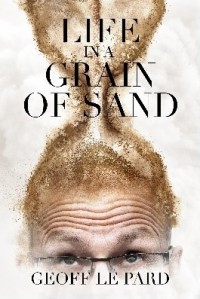
Life in a Grain of Sand is a 30 story anthology covering many genres: fantasy, romance, humour, thriller, espionage, conspiracy theories, MG and indeed something for everyone. All the stories were written during Nano 2015

Salisbury Square is a dark thriller set in present day London where a homeless woman and a Polish man, escaping the police at home, form an unlikely alliance to save themselves.
This is available here

Buster & Moo is about two couples and the dog whose ownership passes from one to the other. When the couples meet, via the dog, the previously hidden cracks in their relationships surface and events begin to spiral out of control. If the relationships are to survive there is room for only one hero but who will that be?

Life in a Flash is a set of super short fiction, flash and micro fiction that should keep you engaged and amused for ages
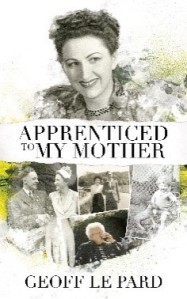
Apprenticed To My Mother describes the period after my father died when I thought I was to play the role of dutiful son, while Mum wanted a new, improved version of her husband – a sort of Desmond 2.0. We both had a lot to learn in those five years, with a lot of laughs and a few tears as we went.

Life in a Conversation is an anthology of short and super short fiction that explores connections through humour, speech and everything besides. If you enjoy the funny, the weird and the heart-rending then you’ll be sure to find something here.
If you missed previous reminiscences, check them out here:
Look for future interviews in this series to be posted on Sunday evenings AEST.
Coming soon:
with more to follow.
Thank you for reading. I appreciate your comments. Please share your thoughts.
Share this:
-

What’s water to you?
Last Friday 22 March was World Water Day.
Sustainable Development Goal 6 is crystal clear water for everybody by the year 2030.
Many of us living in developed countries take access to clean healthy water for granted. We turn on a tap and it is there. Even though it is free and plentiful, the sale of water in plastic bottles is increasing and the bottles are contributing greatly to the destruction of the environment.
If it seems crazy, it must seem especially so to those who live in places without access to regular supplies of clean water.
The figures quoted on the World Water Day website are astounding:
- 2.1 billion people live without safe water at home
- 1 in 4 primary schools have no drinking water service
- about 159 million people collect their water from ponds and streams.
And so, the list continues with one horrifying statistic after another.
Water is essential for life, not only for drinking but also for many of our personal, societal and global everyday activities. According to business reports, it is even more precious than gold. Maybe we could live without gold, but we can’t live without water.
Learning about water — the water cycle, its uses, conservation and pollution — is an important part of everyone’s education. Sometimes we find teachers in the most unexpected places.


Not surprisingly, education is the theme I’ve taken in my response to the flash fiction challenge set by Charli Mills at the Carrot Ranch this week to In 99 words (no more, no less) write a story that features a bucket of water. What is the condition of the water and what is the bucket for? Drop deep into the well and draw from where the prompt leads!

More Precious than Gold
The children observed the bucket.
Teacher explained, “Let’s find out about what’s in the bucket. Ask only ‘yes’ or ‘no’ questions. Do not say what you think it is.”
“Is it wet?” “Yes.”
“Is it a liquid?” “Yes.”
“Is it heavy?” “Try.” “Yes.”
“Do we drink it?” “Does it come from clouds?” “Does it make puddles?”
“Yes. Yes. Yes.”
“Is it more precious than gold?”
“Don’t be stupid,” spluttered Andy. “It’s water!”
Teacher glared. Andy’s smirk dissolved.
Ahmed looked squarely at Andy. “In my country… “
Teacher closed the book. Ahmed’s lesson was more effective than any she’d prepare.

Thank you for reading. I appreciate your feedback. Please share your thoughts.
Share this:
-
It’s a point of view
Have you ever been faced with a task, at work or at home, that seemed so big you didn’t know where to start?
Have you ever been hustled by a supervisor, external or internal, to make a start whether ready or not?
Have you ever jumped in, hoping it would all work out in the end?
Have you ever chipped away without any real sense of direction and eventually found what you were looking for?
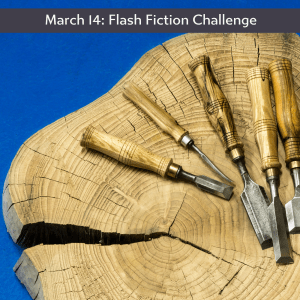
It was of these situations I was thinking as I responded to this week’s flash fiction prompt set by Charli Mills at the Carrot Ranch to In 99 words (no more, no less) write a story that includes a chisel. Use chisel as a noun or a verb. Think about what might be chiseled, who is chiseling. Be the chisel. Go where the prompt leads!
Perspective
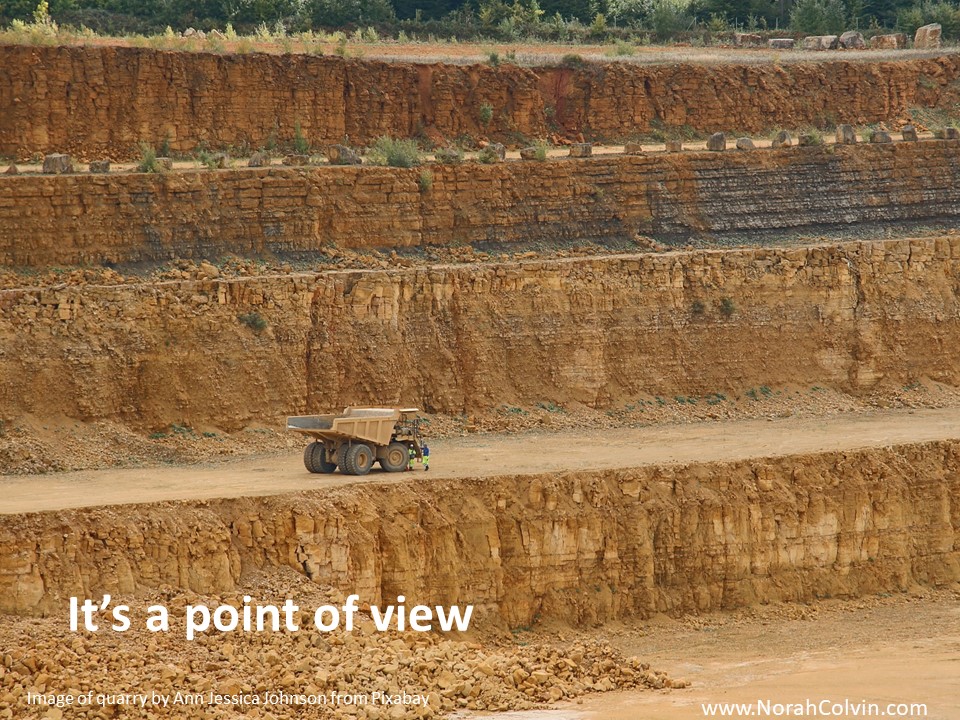
The monumental task cast a shadow deep and long, miniaturising the toolkit at his feet.
He shook his head, muttering complaints and impossibilities.
The supervisor appeared. “Better get started. No time to waste.”
He rummaged through the toolkit, lifting, inspecting and replacing each implement in turn.
“What’s the holdup?” bellowed the supervisor.
He grabbed the mallet and whacked the stone. “Take that!” Chunks smashed around him. He wiped his brow and whacked again.
“Great. You’ve started at last,” encouraged the supervisor.
Later, as the light turned, the shadow faded and diminished. He lifted his chisel and refined his work.
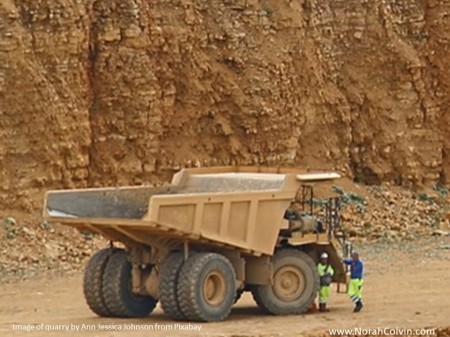
Of course, I’ve had the opposite happen too. I’ve begun a task that I thought was miniscule but turned out to be mammoth. What about you?
Thank you for reading. I appreciate your feedback. Please share your thoughts.
Image of quarry by Ann Jessica Johnson from Pixabay.
Share this:
-

What’s a mouse got to do with it?
A furry mouse or a magic mouse? Which do you prefer?
This week, Charli Mills at the Carrot Ranch got herself a new computer with a new mouse. She thinks it’s a magic mouse. I hope it is.

In her excitement, she put out the challenge to writers to In 99 words (no more, no less) write a story about a mouse. It can be real, imagined, electronic or whiskered. Go where the prompt leads!
Mice feature prominently in stories, poems and songs for children.
Very young children learn the nursery rhymes Hickory Dickory Dock and Three Blind Mice.
Rose Fyleman’s poem about Mice is always popular for children to learn and recite in school.
There is the fable about The Lion and the Mouse, the story of The Town Mouse and the Country Mouse and the more recent The Little Mouse, the Red Ripe Strawberry, and the Big Hungry Bear.
As a child, I enjoyed the song Windmill in Old Amsterdam. Perhaps you remember it too?
But I think my favourite mouse story is that of Possum Magic, the classic picture book by Mem Fox. I’m not referring to the picture book itself, but the story of how it came to be.

Mem shares some of the goss on her site. You see, Hush started life as an invisible mouse in an assignment Mem produced as part of a course in children’s literature. She was awarded a high distinction for the story and, over the next five years, sent it off to nine different publishers. Each time the story came back.
While Mem found the rejections disheartening, she was encouraged by family and friends who believed in her story. So, she sent it off again, and the tenth publisher asked her to “cut the story by two thirds, re-write it more lyrically, make it even more Australian and change the mice to a cuddly Australian animal. “
Mem did as requested, changed the mice to possums, and so Possum Magic was born. The book was published in 1983 and remains one of the most popular and best-selling picture books in Australia. (While not mentioned on the site, I seem to remember reading that the book had almost 30 rewrites!)
When I first heard this story of Possum Magic, I was younger than Mem was when the book was published. The story inspired me and encouraged me to hope. I loved Mem’s yet attitude (though I didn’t yet know it as that), her belief in her story, persistence in pursuing its publication and willingness to learn from others. Without those marvellous qualities, Possum Magic may never have seen the light of day. It may have languished in the bottom of a drawer somewhere with other forgotten manuscripts.
How many manuscripts do you need to take out, dust off, and send on their way?
Here’s my little story in response to Charli’s challenge this week. I hope you like it.
A Mouse Backfires
“Eek!“ shrieked Granny, toppling back on the chair, arms and legs flailing.
“Thwunk!” Her head struck the wall, silencing the children’s sniggers.
Granny slumped motionless, eyes closed, tongue lolling from her slack jaw.
Barney gaped. “D’ya, d’ya think she’s dead?”
“Don’t be silly,” admonished Eliza, older and wiser. “She couldn’t be. Could she?”
The children tiptoed closer.
“What if she wakes up?”
“What if she doesn’t?”
“I’ll check her pulse,” mouthed Eliza.
Suddenly, Granny jolted upright, eyes staring blankly.
The children gasped.
“Gotcha!” laughed Granny. “But that is a clever mouse.”
“How did you —?”
Granny winked. “Granny knows.”
Thank you for reading. I appreciate your feedback. Please share your thoughts.
Share this:
-
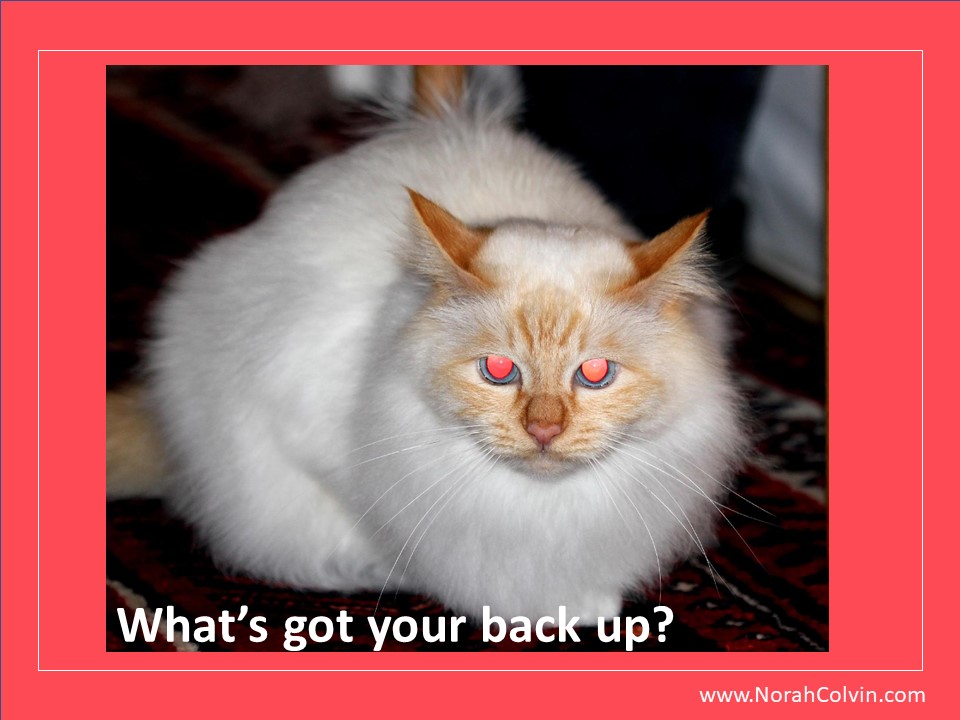
What’s got your back up?
This week at the Carrot Ranch, Charli Mills has urged writers to have a backup plan in place for their work. She suggested a variety of ways including storage on USBs or external hard drives, in the cloud or as hard copies. She also warned that no method is fail-safe.

The cautionary post preceded, as her posts often do, a flash fiction challenge to In 99 words (no more, no less) write a story using the term backup. You can back up or have a backup, just go where the prompt leads! However, there is no suggestion of caution in her final phrase ‘go where the prompt leads’.
When I began to consider how I might use the term ‘backup’, I was soon faced with the complexity of our language and wondering how we ever learn to make any sense of it at all.
Back up may be used as a two-word-phrase or as a compound word. The words, with their regular short vowel sounds and consonants, are easy to read and pronounce, even for the youngest beginning readers. Individually, their meanings are clear. Back refers to a part of the body or a location behind. Up is the opposite of down. But put them together and the complexity of meaning emerges with possible use as nouns, verbs or adjectives.
Below are some examples of meanings that can be applied to the phrase:
Feeling annoyed
Perhaps the most literal translation is in reference to a feeling of annoyance; for example, He got his back up when they insinuated he was always late for work. This use comes from a cat arching its back when annoyed.
Move backwards
The truck driver was told to back up to avoid blocking the driveway.
He had to reconsider and back up when the others told him he was wrong.
Teachers may need to back up on what they had planned when they realise the children are not understanding their lessons.
Blocked
The backup of traffic was caused by an earlier accident on the narrow bridge.
The water would back up in the gutters and overflow every time it rained due to the leaves from the overhanging trees.
Support
It is important to back up any science report with evidence from research.
The situation was escalating, and the police were relieved when backup arrived.
The backup singer was required to take the lead when the performer got laryngitis.
Alternative strategy
You need a backup plan in case this one doesn’t work.
You need to backup your digital work in case your computer crashes.
Posture support
One birthday, thoughtful Hub gifted me a wearable device for supporting my posture during long hours at my desk. Sadly, it was complicated, and he was the only one to don it, semi-successfully. Those of us less brave to even attempt were in stitches as he manoeuvred himself into it. Having failed to convince me or anyone else to try, it has been relegated to the back of an (unknown) cupboard ever since. Mere mention of the BackUp causes fits of laughter and it remained #1 inappropriate gift for many years – until he presented man perfume on another birthday.
This is a true story. No names have been changed to protect the innocent. I tried to find an image of the device online, but it seems the design has probably improved over the years. The one Hub gave me had straps to go around the knees as well as the back.
You’d think with all the different meanings of ‘back up’ that I’d have no trouble finding a story to write. However, since the description of my birthday surprise is 99 words, no more no less, and for the fact that I have no backup plan, that true story will be my contribution this week. I hope you like it. Perhaps truth is stranger than fiction.
Thank you for reading. I appreciate your comments. Please share your thoughts.
Share this:
-
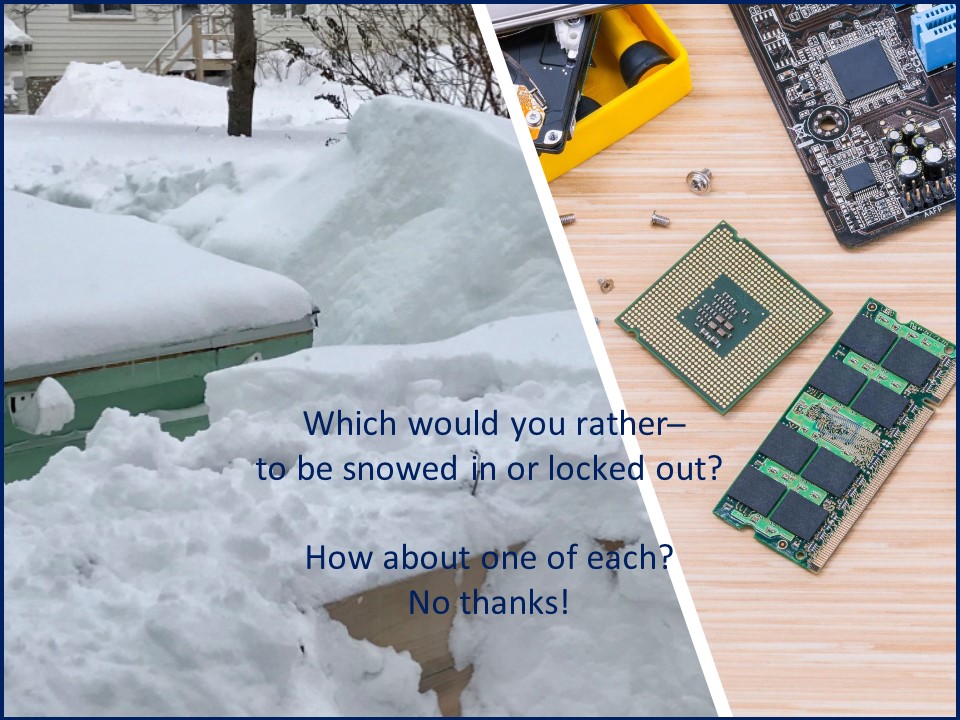
Technology Pushes Back
There’s been a glitch or three at the Carrot Ranch this week, and the usual Flash Fiction schedule has been interrupted. I haven’t yet written a response to Charli’s challenge, but pop over to read about Charli’s challenges and pen a response yourself.
Share this:
-
What do you love?
We use the word ‘love’ to mean care deeply about, as in people, or like a lot, as in food, objects and activities. Questions such as “Who do you love?” and “What do you love?” will elicit very different responses and we generally have little difficulty in distinguishing between the intensity of the feelings. Mostly the whos are more important to us than the whats, and it is easy to distinguish between the likes and the loves, though they can sit along a continuum.

For me, housework sits at the opposite end of the continuum from reading and writing. You won’t find me writing any posts about housework. But you will find lots of posts about reading and writing, especially encouraging a love of reading and writing in children. I find sharing a love of reading and writing to be almost equal in enjoyment as reading and writing for myself. To see children light up with enthusiasm for reading and writing is sheer joy.
I have often said that one of the greatest gifts a parent can give a child is a love of reading. A love of reading and writing, and indeed for all learning, is the best gift a teacher can give.

It is often said that a love of reading is caught, not taught. The same goes for writing. It is important for teachers to ensure that there is time every day to read aloud to children, to inspire them and excite their imaginations with wonderful literature and to provide them with time for expressing their own thoughts and imaginative ideas through writing and any other of the expressive arts.
I have written many blog posts, both here and for readilearn, with suggestions for making time for literature and literacy, but it was the prompt set by Charli Mills at the Carrot Ranch that kept me thinking that way this week.

You see, Charli challenged writers to In 99 words (no more, no less) write a story about valentines. It can be Valentine’s Day, the exchange, love for another, romance, or friendship. Have a heart and go where the prompt leads!
But, as well as being Valentine’s Day, 14 February is also Library Lovers’ Day and International Book Giving Day.
Why wouldn’t I write about one of my loves — reading and writing? I hope you enjoy it.
Just for the love of it
The teacher closed the book, but the children were abuzz.
“Keep going,” they urged.
“Will they be alright?”
“What will happen?”
The teacher looked at the clock. The minutes had passed like seconds. Was there time?
“Pleeeease!”
The teacher opened the book.
“Yay!” cheered the children, then hushed as the words flowed.
As the story unfolded, their eyes lit up and imaginations sparked. They discussed the story’s intricacies and contemplated outcomes as they journeyed with the author through good and fearsome times. Finally, just as the dragon was about to swoop, the teacher stopped. “Now write! What happens next?”
Here are links to just five of the posts I’ve written about reading and writing:
A sprinkle of this, a pinch of that, and Poof! It’s reading — magic!
Wrapping up a year of books — the gift of reading
Reading is all it’s cracked up to be: 10 tips for an early childhood classroom!
And two more about libraries:
Libraries: A wondrous universe to explore — a guest post by Dimity Powell
Libraries, books and reading = infinite worlds to explore
Thank you for reading. I appreciate your feedback. Please share your thoughts.
Share this:
-

Bonus Rodeo: Old Time Radio Winners
The winners of the Bonus Old Time Radio Contest at the Carrot Ranch are announced! Read the winning entries here, and link through to all entries. What a feat!
Thanks to the Continental Fire Company for their generous sponsorship and support.Share this:


 Norah Colvin