Live Love Laugh Learn … Create the possibilities

Category: Flash fiction

  • News Splash

    News Splash

    Carrot Ranch Flash Fiction challenge Splash

    This week at the Carrot Ranch, Charli Mills challenged writers to In 99 words (no more, no less) write a story that makes a big splash. It can be fluid, or you can play with the idiom (to make a big splash is to do or say something that becomes unforgettable). Go where the prompt leads!

    This is where it finally led me. I hope you enjoy it.

    News Splash

    It was splashed all over the front page. There was no hiding it now. Mum and Dad wouldn’t be pleased. They’d cautioned her to be careful. Time. After. Time. And she was. She thought she could handle it. She didn’t need them watching over her every move. She had to be independent sometime. But this front-page catastrophe would be a setback. How could she minimise the damage?

    When they came in, Jess faced them bravely.

    They looked from her to the paper and back. Jess’s lip quivered. “Sorry.”

    “Those headlines look somewhat juicy,” smirked Dad. “More juice?”

    Jess nodded.

    Spilled juice

    Thank you blog post

    Thank you for reading. I appreciate your comments. Please share your thoughts.

  • Would you like strawberries with that?

    Would you like strawberries with that?

    Tomorrow, 5 June is World Environment Day. The theme for this year is Air Pollution. According to the World Environment Day website, nine out of ten people breathe polluted air — a frightening statistic. While the most polluted cities may be far from where we live and the effect of our individual actions may seem negligible, the site recommends ways in which we can help reduce air pollution. I’m sure you already do many of these:

    • Use public transport or car sharing, cycle or walk
    • Switch to a hybrid or electric vehicle and request electric taxis
    • Turn off the car engine when stationary
    • Reduce your consumption of meat and dairy to help cut methane emissions
    • Compost organic food items and recycle non-organic trash
    • Switch to high-efficiency home heating systems and equipment
    • Save energy: turn off lights and electronics when not in use
    • Choose non-toxic paints and furnishings

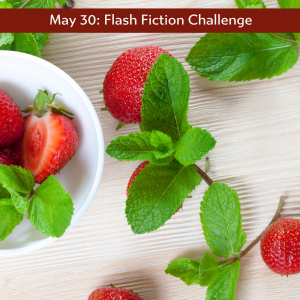
    Carrot Ranch flash fiction challenge strawberries and mint

    While not specific to this year’s theme, I thought the flash fiction prompt set by Charli Mills at the Carrot Ranch this week was a perfect match for World Environment Day. Charli challenged writers to In 99 words (no more, no less) write a story that includes strawberries and mint. The combination evokes color contrast, scents, and taste. Where will the combination take you? Go where the prompt leads!

    Growing plants, particularly those that produce edible delicacies, including strawberries and mint, is a great way of introducing children to the importance of caring for the environment. Both strawberries and mint are easy to grow and require little space.

    The rewards are not only in the eating. Children can learn where their food comes from and understand that it doesn’t just appear in plastic packaging on supermarket shelves or in the fridge at home. In caring for a garden, they learn about what plants need and the importance of caring for the soil. They learn to be patient, waiting for the plants to grow and to be ready to harvest. Understandings learned from small-scale gardening, even in a pot, can be applied to caring for the environment on a larger scale. It is never too soon, or too late, to learn.

    In my response to Charli’s prompt, I have considered gardening as nourishment for the mind and spirit as well as the body. Because strawberries are a favourite with both my grandchildren who would probably eat strawberries anywhere and anytime, I settled on a story featuring a grandmother and grandchild. Any similarity to this grandmother is non-existent. I hope you enjoy it anyway.

    (I included some favourite family strawberry desserts in this post.)

    Grandma’s Garden

    Jess blew kisses to Mum, then raced Grandma into the garden. She pulled on her boots and gloves and readied her digging fork. Emulating Grandma, she soaked up explanations of magic combinations that helped plants grow. At the strawberry patch, they filled baskets with ripe red berries. On the way inside, Grandma clipped sprigs of mint.

    They dipped strawberries in chocolate and garnished them with mint.

    “For Jess?”

    “For Mum.

    “Birfday?”

    “Just —”

    Jess inspected the chocolate bowl. “All gone.”

    “Stawbwee?” said Jess, pointing to the remaining few.

    “For Jess,” smiled Grandma.

    Jess munched strawberries and Grandma chewed mint.

    Thank you blog post

    Thank you for reading. I appreciate your feedback. Please share your thoughts.


  • Ice on the rocks

    Ice on the rocks

    This week at the Carrot Ranch, Charli Mills discusses her daughter’s existence in the treeless landscape in the northernmost town in the world, Longyearbyen on Svalbard, Norway.

    This video provides an introduction to Longyearbyen.

    In her post, Charli warns that “The reality of climate change impacted the polar regions of our world first. Think of the Arctic as our canary in the coal mine … To say the Arctic is the canary means that our planet is changing so rapidly that species are dying.”

    Evidence of those changes is discussed in this recent National Geographic article

    and, while this video shows the changes to the Arctic sea ice from 1979 – 2018,

    (Read information accompanying this video here.)

    this article shows the situation updated to April 2019.

    With the effects so evident, it is hard to fathom that there are still some who deny the climate is changing. To what end?

    The phrase ‘on the rocks’ often refers to a beverage, usually alcoholic, served undiluted on ice. It can also refer to something in difficulty or failing. It was a combination of these meanings, minus the alcohol, I used in the title.

    Charli Mills' flash fiction challenge Ice

    Charli’s discussion introduced her flash fiction challenge to In 99 words (no more, no less) write a story without ice. It can be a world without ice or a summer camp that runs out of cubes for lemonade. What does the lack mean to the story? Go where the prompt leads!

    I took it a little differently.

    Let’s Hear it for Ice

    A world without ice —

    That made me think tw—

    Two times.


    A world without ice

    Would not be so n—

    Pleasant.


    We couldn’t play games

    With a six-sided d—

    Numbered cube.


    We couldn’t have fries

    With a side-serve of r—

    Food grain.


    Our food would be bland

    Without pinches of sp—

    Flavour.


    A world without ice

    Where rule is by v—

    Badness.


    A world without ice

    We’d all pay the pr—

    Cost.


    A world without ice

    I’d say in a tr—

    Moment.


    A world without ice

    I’d even say thr—

    Three times


    Would never

    Could never

    Be anything nice!

    Thank you blog post

    Thank you for reading. I appreciate your feedback. Please share your thoughts.

  • What lives in trees?

    What lives in trees?

    Carrot Ranch flash fiction challenge - trees

    This week at the Carrot Ranch, Charli Mills challenged writers to In 99 words (no more, no less) write a story that goes in search of trees. It can be one particular tree, a grove, woods, or forest. What makes the tree worth seeking? Go where the prompt leads!

    This week, we’re observing a science lesson with a group of 5 – 6-year-olds in search of knowledge about life in trees.

    What lives in trees?

    The teacher displayed photographs of trees.

    “We’ve been learning about where animals live. Today, we’ll list animals that live in trees.”

    Hands shot up, bursting to contribute.

    The teacher wrote:

    possums, koalas, beetles, snakes, birds …

    Amir’s English was developing but his classmates were puzzled when he said what sounded like ‘goat’.

    “Repeat,” encouraged the teacher.

    “Goat.”

    When asked, Amir drew a tree with a recognisable goat standing in it.

    “Not story,” smiled the teacher. “Real.”

    Amir nodded and pointed to the laptop. “Google.”

    A quick search confirmed it.

    Everyone cheered. Amir added to their knowledge tree that day.

    ……….

    Many of you who have travelled may have seen the tree goats of Morocco. However, I wasn’t aware of them until, a couple of weeks ago, a photo popped up on my desktop. Intrigued, I had to find out more. A search for the goated tree began.

    I discovered that the photo wasn’t fake, as I had first thought. The tree is the Argania tree from which we get Argan oil, and the goats like to eat its fruit.

    Although more hygienic methods are now often employed, the oil used to be pressed from the seeds which were passed in the goats’ poop after the fruit had been eaten. I’m certain that 5 and 6-year-old children would love this titbit of information.

    If you are interested, here are some links to help you learn more about the tree goats:

    The Tree Goats of Morocco

    The Story Behind Bizarre Tree-Climbing Goats of Morocco

    Moroccan argan oil: the ‘gold’ that grows on trees

    However, it seems, as with so many things, some people thought they could make extra money from tourists wanting to photograph goats in trees. Sadly, it is not only the goats that suffer from these unkind practices. The trees suffer too and, according to one article I read, “are in danger and the forest is listed by UNESCO as an International Biosphere Reserve.”

    Iconic ‘tree-climbing’ goats of Morocco revealed to be a scam

    Thank you blog post

    Thank you for reading. I appreciate your feedback. Please share your thoughts.


  • School Days, Reminiscences of Christy Birmingham

    School Days, Reminiscences of Christy Birmingham

    Welcome to the School Days, Reminiscences series in which my champion bloggers and authors share reminiscences of their school days. It’s my small way of thanking them for their support and of letting you know about their services and publications.

    This week, I am pleased to introduce Christy Birmingham, prolific blogger, author and poet. I’m not sure how or where I first met Christy but I do know that we have been regular visitors of each other’s blogs since the beginning of 2015, not long before the launch of her book of poetry Versions of the Self.

    I would have thought I read her book not long after that, but Amazon tells me I didn’t purchase it until 2017, so I guess Amazon knows? It also doesn’t display a review from me, though I thought I had added one. However, I do remember enjoying Christy’s insightful poetry and being touched by the exploration and depth of emotion portrayed in many of the pieces which delve into ways in which the self may change over time and in response to circumstances.

    Christy Birmingham 'When Women Inspire'

    On her blog When Women Inspire, Christy shares information on a wide range of helpful topics especially those aimed at helping women live healthier, happier and more fulfilling lives. No topic is too big or too small for Christy. She covers anything which she expects women, however young or old, will find interesting or beneficial. But her blog isn’t just for women. Numerous men regularly read and comment too. If you don’t already follow Christy’s blog, please pop over and say hello.

    Before we begin the interview, I invite Christy to tell you a little of herself:

    Christy Birmingham is a blogger, author, and poet who lives in Victoria, BC, Canada. She uses her writing to show others that they too can get through difficult times as she has, personally with anxiety and depression, as well as professionally with starting her own business. Find her blogging at When Women Inspire, at the gym, reading, or out with her family and friends.

    The interview

    Welcome, Christy.

    Let’s talk school. First, could you tell us where you attended school?

    All of my schooling has been on Canada’s west coast. Specifically, I went to schools in Victoria, British Columbia until after high school graduation, when I then did a mix of college and university in Victoria and Vancouver, BC.

    Did you attend a government, private or independent school?

    I’m a public-school kid!

    What is the highest level of education you achieved?

    I am proud to have a BA in Criminology and Psychology from Simon Fraser University.

    What is your earliest memory of school?

    I recall my elementary school teacher telling us she had published a book. I was wowed by it and never forgot that inspiration!

    What memories do you have of learning to read?

    I was taken out of class regularly to see a speech therapist for problems I was having with pronunciation. It made me self-conscious reading aloud and talking in general.

    What memories do you have of learning to write?

    Learning cursive was so much fun! Learning how to spell out my full name and create different styles of writing for it provided hours of delight for me. I’ve always loved language.

    What do you remember about math classes?

    Not liking them very much, unfortunately. It often took me a while to catch onto concepts, and once math homework was done, I wanted to read books or write short stories.

    What was your favourite subject?

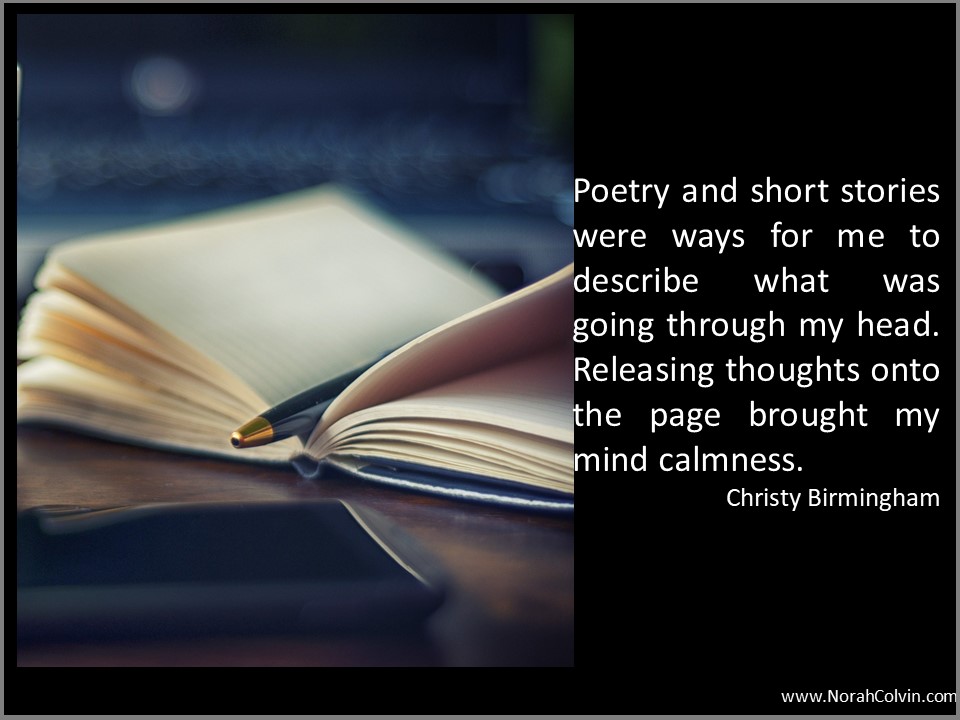
    Christy Birmingham poetry quote

    English, by far. Poetry and short stories were ways for me to describe what was going through my head. Releasing thoughts onto the page brought my mind calmness and then seeing the positive feedback from teachers for what I wrote in English class was amazing to me. I’ve never forgotten the encouragement of certain teachers for my writing in elementary and high school.

    What did you like least about school?

    Trying to find where I fit in. Books brought me happiness, as did the writing. Thankfully I found friends throughout my years of school who supported me in my artistic projects. Once I realized that it was about the quality of friendships rather than the number of friends I had, I was happy.

    How do you think schools could be improved?

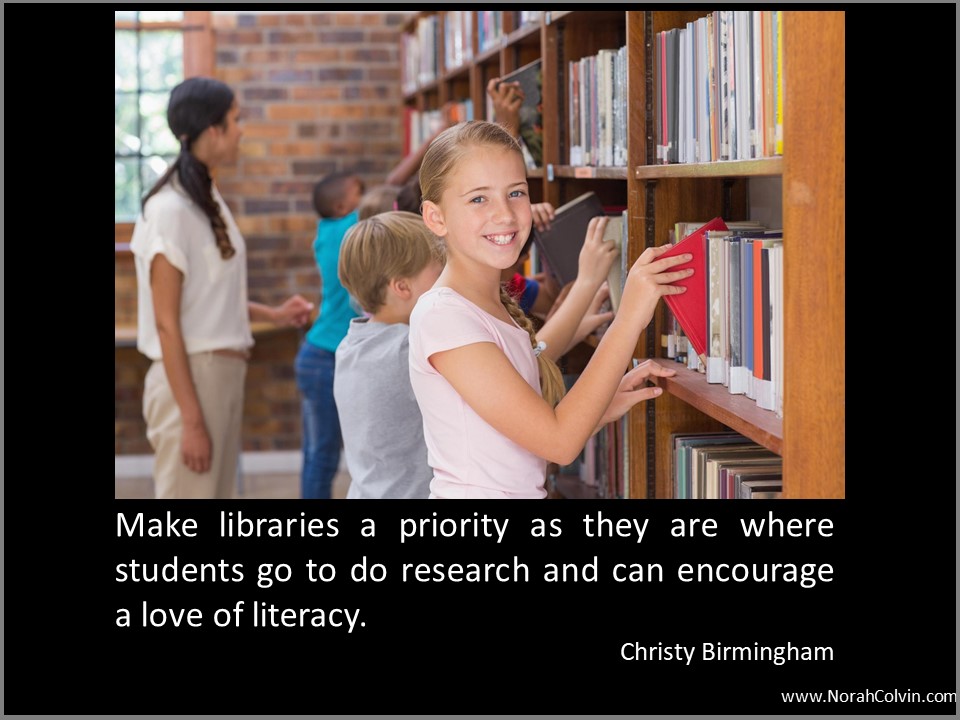
    Christy Birmingham on the importance of libraries

    By listening to students, no matter their age. Hear what students want to see change about your school and determine if it’s feasible. Also, make libraries a priority as they are where students go to do research and can encourage a love of literacy.

    Lastly, engage with the local community rather than being independent of it as a school. By schools partnering with the communities they’re nestled within, students can enjoy a fuller educational experience. Also, schools can get ideas and support from the general community that can take the institutions further than they might otherwise go.

    thank you for your participation

    Thank you for sharing your reminiscences of school and thoughts about schools in general, Christy. It’s been wonderful to have you here. I’m not surprised you enjoyed expressing yourself in writing from a young age.

    Find out more about Christy Birmingham

    on her website When Women Inspire

    Connect with her on social media

    Twitter

    Facebook

    Pinterest

    Purchase your own copy of Christy’s books of poetry:

    Pathways to Illumination

    Versions of the Self

    Previous reminiscences

    If you missed previous reminiscences, check them out here:

    Charli Mills

    Sally Cronin

    Anne Goodwin

    Geoff Le Pard

    Hugh Roberts

    Debby Gies

    Pauline King

    JulesPaige

    D. Avery

    Look for future interviews in this series to be posted on Sunday evenings AEST.

    Coming soon:

    Miriam Hurdle

    Robbie Cheadle

    Susan Scott

    with more to follow.

    Thank you blog post

    Thank you for reading. I appreciate your comments. Please share your thoughts.


  • Can you fool the tooth fairy?

    Can you fool the tooth fairy?

    This week at the Carrot Ranch, Charli Mills discussed important things in life including attitudes to aging. She challenged writers to In 99 words (no more, no less) write a story about growing older. It can be humorous, dark or poignant. It can be true or total fiction. It can be fine wine or an old fossil. Go where the prompt leads!

    Carrot Ranch flash fiction challenge - ageing

    Most of my work as a teacher has been with children who are experiencing one of the earliest physical signs of growing older — losing their baby teeth and growing adult teeth. The loss of these teeth is usually accompanied by great excitement, especially with the expectation that the tooth may be replaced with a coin by the tooth fairy.

    lost tooth - Artie Feb 13 16

    I previously wrote about the world’s diversity of traditions dealing with the loss of children’s baby teeth in A tooth for a tooth. That post also contains a flash story involving some gappy children’s smiles that help to cross barriers.

    When I was growing up, many of my grandparents’ generation had false teeth or dentures that they left in a glass of water by their bedside when they were sleeping. With improved dental hygiene over the years, those numbers are now decreasing. This aspect of growing older — losing teeth whether at six or sixty-six — made me wonder if the tooth fairy might be fooled by false teeth and whether a creative child may have once tried to raise money that way.

    Great-Grandmama’s Teeth

    The sound like freight trains roaring through a tunnel assured Billy Great-Grandmama was asleep. He turned the doorknob ever so slowly, pushed the door gently and slipped into the darkened room. A chink of light bounced off the glass at the bedside. He daren’t breathe as he tiptoed over. Three quick whistles and he froze. The cavern with wibbly wobbly edges stretched wide. Would she wake? No, but better be quick. He lowered his fingers into the glass and withdrew his prize. All that was left was to fool the fairies and he’d buy his Mum that birthday cake.

    Thank you blog post

    Thank you for reading. I appreciate your feedback. Please share your thoughts.

  • Create the possibilities

    Create the possibilities

    Carrot Ranch flash fiction challenge - exhaustion

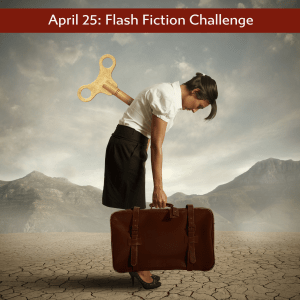
    This week at the Carrot Ranch, Charli Mills challenged writers to In 99 words (no more, no less) write a story that includes exhaustion. Who is exhausted and why? Can you make art of exhaustion? Go where the prompt leads!

    Feeling a little overwhelmed with extra demands on my time over the past few of months, coupled with a recent battle with the flu, I didn’t know if I could muster enough energy to respond this time. But when this blog’s tagline includes the words ‘Create the possibilities’, I thought I should give it a go. I hope you like my response.

    Exhausted possibilities

    Jolted awake when the bus reached the terminal, they grabbed their belongings and stumbled out. The driver shrugged when asked about accommodation.

    ‘NO VACANCY’ signs flashed along narrow streets. ‘NOT WELCOME’ lists accompanied the few with vacancies.

    Trudging back to the terminal, hoping for seclusion, a ‘VACANCY’ appeared where none before. An old man bade them enter, waved away their money and installed them comfortably.

    “Thank you. Thank you,” they bowed, and collapsed into sleep.

    In the morning, they were alone. A note lay on the table:

    When you think you have exhausted all possibilities, there is always more.”

    Thank you blog post

    Thank you for reading. I appreciate your comments. Please share your thoughts.


  • A rainbow of opportunities

    A rainbow of opportunities

    The classrooms of today are filled with children from a diversity of backgrounds and with a multiplicity of perspectives. The futures of those children are filled with opportunities that were unimaginable when I was a child and possibly even now. The world’s landscape — physical, political and social — is changing rapidly. Maybe we are not too far away from finding the pot of gold at the end of the rainbow. Could our ‘wealth’ be bound up in acceptance of our diversity?

    Charli Mill's flash fiction challenge - Gender fluidity

    When Charli Mills of the Carrot Ranch challenged writers this week to In 99 words (no more, no less) write a story about gender. It can be fixed or fluid. Explore the topic on your own terms and open your mind to possibilities and understanding. Go where the prompt leads! I thought I’d have a little play.

    Rainbow futures

    The children went around the circle telling what they’d be when they grew up: police officer, paramedic, teacher, doctor, prosecutor, influencer …

    Laughter erupted when Rudii responded, “Mother.”

    “You can’t be a mother,” taunted one.

    “Can too.”

    “But you don’t have, you know, boobies,” said another, glancing at the teacher.

    “Dad said I can be anything I want,” retorted Rudii.

    “But—”

    The teacher shushed them and the circle continued, punctuated only by an occasional half-giggle or nudge.

    A rainbow of opportunity awaits, Teacher smiled inwardly, contemplating the question he and his partner were processing: who would be Mom?

    Thank you blog post

    Thank you for reading. I appreciate your feedback. Please share your thoughts.

  • Keep the teacher fires burning

    Keep the teacher fires burning

    Teacher burnout is a huge problem. Fading are the days of veteran teachers staying in the job and sharing the wisdom of their experience with the younger generation of teachers. Many articles tell of teachers leaving the profession after five or fewer years.

    Teachers start out with fire in their hearts, with an ambition to change lives and improve outcomes for all the children in their care. Many leave after just a few years when that fire has not only burnt out but has burnt them out too.

    For others, who contemplate no alternative, the fire smoulders for years until they become cynical with a system that is ever-changing but rarely improving, and expectations that increase exponentially with little recognition of their efforts or the value they add to lives or society.

    I recently listened to a book on the topic written by a passionate educator whose fire was extinguished by overwhelming expectations and an inability to reconcile unrealistic demands with a desire to teach children.

    In a job interview, when asked what she taught, it was her response ‘I teach children’ that landed her the position. As the years passed, her employer’s focus turned from teaching children to teaching content and collecting data. As for many, her challenge was to continue educating the whole child while fulfilling the requirements of her employer. It’s a challenge that defeats many.

    Teacher: One woman’s struggle to keep the heart in teaching by Gabrielle J. Stroud is a personal record of one’s teacher’s journey and how she faced the challenge. But it is more than that. It is the story of a journey travelled by many teachers. The names and places may change, but the story stays the same.

    It is a book I wish I’d written. I laughed with Gabbie and cried with Gabbie. I’d walked in her shoes and she in mine. While our times and schools were different, our responses to the changing education landscape were very similar. She wrote from my heart as much as from hers.

    If something doesn’t happen soon to support teachers, there’ll be no heart left in education and it will be a wasteland of useless data, lost potential and unhappy futures. Of course, I’ve written about that before, describing differences between education and schooling in a poem I called Education is.

    If you are interested in reading more about teacher burnout and considering how teachers may be better supported, here are some articles to get you started:

    The Causes of Teacher Burnout: What Everyone Needs to Know on The Chalk Blog. (US)

    Burned out: why are so many teachers quitting or off sick with stress? In The Guardian. (UK)

    Stressed-out teacher? Try these self-care tips on ABC Life. (Australia)

    The hardest, most underestimated part of a teacher’s job on News.com.au. (Australia)

    Heartbreak becomes burnout for teachers when work is turbulent on The Conversation. (Australia)

    The Truth About Teacher Burnout: It’s Work Induced Depression on The American Psychology Association’s Psych Learning Curve. (US)

    Teacher Workload in the Spotlight from my own Queensland College of Teachers. (Australia)

    These are but a few of the many describing conditions that contribute to teacher burnout. However, for a truly entertaining but heartbreaking read that provides an accurate understanding of what happens to the heart of many a passionate teacher, you can’t go past Teacher: One woman’s struggle to keep the heart in teaching by Gabrielle J. Stroud. Gabbie summed it all up sadly by saying that she didn’t leave teaching, teaching left her.

    Carrot Ranch flash fiction challenge - fire

    It’s about the teacher fire that I’ve decided to respond to the flash fiction prompt set by Charli Mills this week at the Carrot Ranch. Charli challenged writers to In 99 words (no more, no less) write a story about fire. It can be a flame that burns or a light that inspires. Follow the flames and go where the prompt leads!

    99 no more no less fire words

    The heart of a teacher

    “It’s storytime, children.”

    They gathered at her feet, bright-eyed, transfixed.

    Jane read, instructed and encouraged. They never tired.

    Later, all snuggled up in bed, Mum asked, “What will you be when you grow up?”

    “A teacher.”


    “Storytime, children.”

    They gathered at her feet, bright-eyed, hearts open, minds buzzing.

    Miss Jane read. They hung on every word, contemplating obstacles and possible resolutions, following the heroes’ journey into the cave and out.


    “Ple-ease!”

    “No time for stories. It’s test time.”

    They slumped at desks, eyes glazed, minds dulled, hearts heavy.

    The cave was cold and dark. Were they ever coming out?

    Thank you blog post

    Thank you for reading. I appreciate your feedback. Please share your thoughts.


  • School Days, Reminiscences of Hugh Roberts

    School Days, Reminiscences of Hugh Roberts

    Welcome to the School Days, Reminiscences series in which my champion bloggers and authors share reminiscences of their school days. It’s my small way of thanking them for their support and of letting you know about their services and publications.

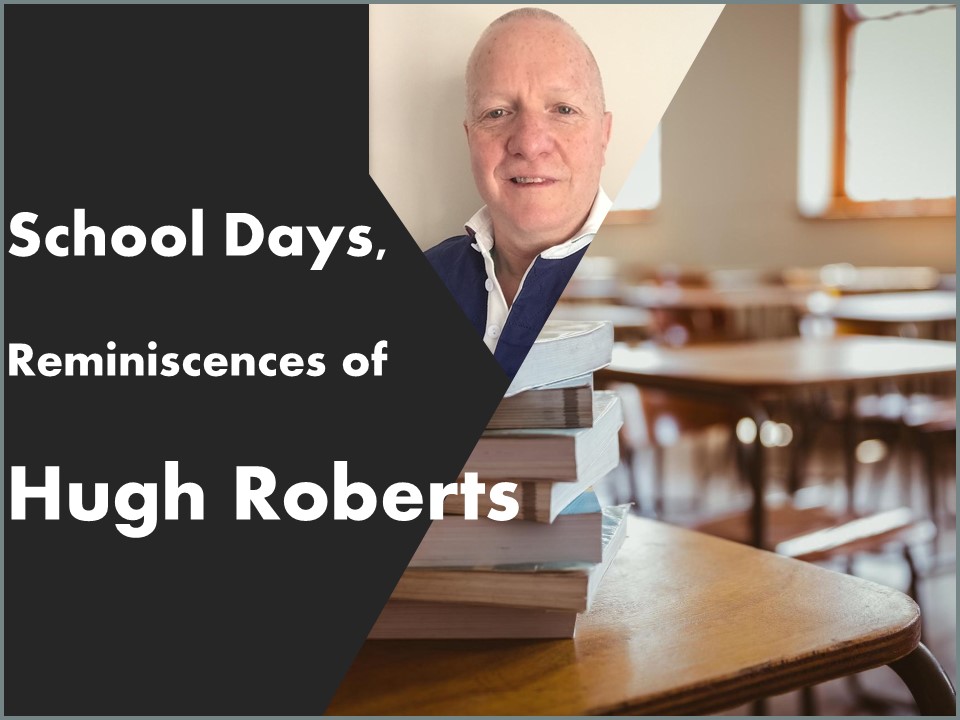
    This week, I am pleased to introduce Hugh Roberts, author, blogger and WordPress Whiz who generously shares his knowledge and advice to assist others along their blogging journey.

    I’m not quite sure when or how Hugh and I met, but it was probably over at Geoff Le Pard’s blog some years ago. They are both now involved in the organisation of the Annual Bloggers’ Bash celebrating its fifth anniversary in London later this year (find out more on Hugh’s blog here).
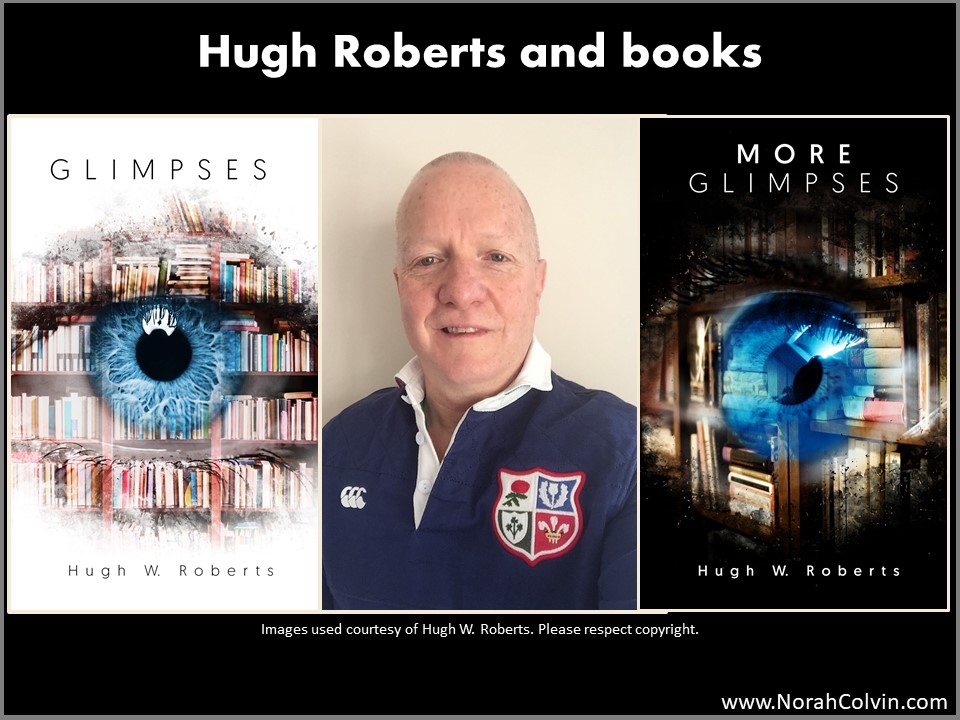
    Hugh Roberts and Books

    Hugh features many interesting series on his blog and always welcomes new readers and often contributors. I read and enjoyed Hugh’s first book of short stories Glimpses. The second volume More Glimpses has recently been released, and I am looking forward to seeing what twists and delights Hugh has in store for me now.

    Hugh also entered both Carrot Ranch Rodeo Contests that I hosted. Although they are judged blind, Hugh won the first competition and came second in the second. That’s a fair indication of what I think of his story telling. 😊

    Before we begin the interview, I’ll allow Hugh to tell you a little of himself:

    Hugh W. Roberts lives in Swansea, South Wales, in the United Kingdom.

    Hugh gets his inspiration for writing from various avenues including writing prompts, photos, eavesdropping and while out walking his dogs, Toby and Austin. Although he was born in Wales, he has lived around various parts of the United Kingdom, including London where he lived and worked for 27 years.

    Hugh suffers from a mild form of dyslexia but, after discovering blogging, decided not to allow the condition to stop his passion for writing. Since creating his blog ‘Hugh’s Views & News’ in February 2014, he has built up a strong following and now writes every day. Always keen to promote other bloggers, authors and writers, Hugh enjoys the interaction blogging brings and has built up a group of on-line friends he considers as an ‘everyday essential’.

    His short stories have become well known for the unexpected twists they contain in taking the reader up a completely different path to one they think they are on. One of the best complements a reader can give Hugh is “I never saw that ending coming.”

    Having published his first book of short stories, Glimpses, in December 2016, his second collection of short stories, More Glimpses, was published in March 2019. Hugh is already working on the next volume.  

    A keen photographer, he also enjoys cycling, walking, reading, watching television, and enjoys relaxing most evenings with a glass of red wine.

    Hugh shares his life with John, his civil-partner, and Toby and Austin, their Cardigan Welsh Corgis.  

    Welcome, Hugh. Now let’s talk school.

    First, could you tell us where you attended school?

    I spent my whole school life in the town of Chepstow; a town on the south-east border of Wales and England in the UK.

    Did you attend a government, private or independent school?

    They were government-run schools.

    What is the highest level of education you achieved?

    I left school at the age of 16 with five ‘O’ Levels and three GSCEs.  I then did a brief stint in college on a hotel and catering management course. A job offer meant I left the class before it finished.

    What work or profession did you choose after school and was there anything in school that influenced this choice?

    My first job was as an office junior before I went into retail.  I enjoyed an office environment, but it wasn’t customer facing (which is what I wanted). I told my careers teacher at school that I wanted to join the police force or fire brigade. Unfortunately, I didn’t qualify to join either because you had to be above a certain height. I was a couple of inches too short!

    What is your earliest memory of school?

    I was the only one standing up in class crying my eyes out while I watched all the mums and dads walking away. It was my first day at school, and I didn’t want my mum to leave me there. I was very emotional and felt she had abandoned me and was not coming back. Of course, she did.

    What memories do you have of learning to read?

    I remember the ‘Peter and Jane’ books which started at 1a, 1b and 1c and went up to 12c (which was the last book in the series). They got harder as you moved up to each one, and you were only allowed to move on to the next book when your teacher was satisfied that you could read the current book satisfactorily.

    What memories do you have of learning to write?

    I remember the first ink pens given to us to practice writing. They were very thin and had to be filled with ink from a bottle, which we had to fill ourselves. It could sometimes get very messy.

    While many of the children around me were doing ‘joined-up’ writing, I was doing all mine in block letters. I can remember being taken aside and told that I had to join the letters together. It took me a long time to gets to grips with joining the letters together, and it wasn’t long before I was left behind.

    What do you remember about math classes?

    I was not too fond of maths. Numbers did not interest me. All I wanted to do was make up stories. All my maths teachers were rigorous, which didn’t help in me gaining any confidence in numbers. I saw them as nasty, uncaring people, who didn’t seem to care about the children around them. I’m sure they did, but I didn’t see it that way.

    What was your favourite subject?

    Geography. I enjoyed learning about other countries and the people who lived in them. I was fascinated by maps and the names of towns and cities and the roads that connected them. Even the positions of countries intrigued me, and when I discovered time zones and realised that it wasn’t ‘lunchtime’ everywhere at the same time, ‘time-travel’ entered my life.  I remember wishing that it would become part of the Geography education module before I left school.

    School Photo - Hugh Roberts

    What did you like best about school?

    Drama class. In primary school, I could run around being who or what I wanted to be. Whether it was a tree, an animal or somebody driving a vehicle, I enjoyed the fun, laughter and enjoyment of the class.

    As I grew up, Drama got more serious, but I enjoyed playing different parts in the school play.

    What did you like least about school?

    Playing sport. I had no liking for playing any physical games, especially on cold, wet days on muddy fields. After Easter, we would do athletics which I enjoyed a lot more. The long jump was my speciality!

    How do you think schools have changed since your school days?

    Unfortunately, I think there are now more children who have no respect for their teachers than there were in my school days. Not only that, but some of the parents also have little regard for the teachers.

    It also saddens me to hear about schools not being able to afford to buy the basics like pens, pencils, books and even toilet rolls, because their budgets have been cut so much. Many now turn to the parents asking them to help fund children’s education when it really should be the government which funds it. I was so lucky to have ‘free’ education but, these days, ‘free education’ is something that is disappearing fast.

    What do you think schools (in general) do well?

    I hear more and more about schools inviting authors, writers and experts to come in and talk to the pupils about a particular subject. Whether it be about self-publishing, how to be safe on social media, or help and advice on careers or money matters, it gives those who want to help a chance to pass on their knowledge to new generations to come. I think it’s fantastic that they also ask people to come in and talk about their memories about specific events. It helps keeps memories and ‘past ways of lives’, alive.

    How do you think schools could be improved?

    More needs to be done in educating children about diversity and the hate crimes we hear so much about nowadays. Nobody should feel afraid to go to school because they are bullied or just because they’re told they are different and don’t fit in. Children should be encouraged to read about different ways of lives and to speak out about bullying. As a child who was bullied at school, my life was made much worse because I was afraid to tell an adult what was happening. These were the days before social media where bullying and hate crimes have now taken up residence. Children, these days, have a lot more to put up with, but I think there are also more bullies these days than there were when I was at school.
    thank you for your participation

    That’s an interesting observation with which to conclude, Hugh. Thank you for sharing your reminiscences of school and thoughts about education in general. It’s been wonderful to have you here. I’m sorry you were bullied in school and wish bullying was something we could eradicate.  


    Find out more about Hugh Roberts

    on his blog: Hugh’s Views and News

    Amazon Author Page

    Goodreads

    Connect with him on Social Media

    Twitter: @HughRoberts05

    Flipboard

    Mix.com

    Purchase Hugh’s books here:

    Glimpses by Hugh Roberts

    Universal Link for buying Glimpses

    More Glimpses by Hugh Roberts

    Universal Link for buying More Glimpses


    If you missed previous reminiscences, check them out here:

    Charli Mills

    Sally Cronin

    Anne Goodwin

    Geoff Le Pard

    Look for future interviews in this series to be posted on Sunday evenings AEST.

    Coming soon:

    Debby Gies

    Pauline King

    Jules Paige

    D. Avery

    with more to follow.

    Thank you blog post

    Thank you for reading. I appreciate your comments. Please share your thoughts.